




Abstract
Lesson
Given the rare nature of Madelung's disease many clinicians will not have seen a patient with it and will not be able to recognise them: subsequently a diagnosis is unlikely to be made.
Madelung’s disease is a rare condition which is characterized with large symmetrical accumulation of noncapsulated fat tissue in the face and neck (buffalo hump), trunk and rarely in the upper and lower limbs (pseudoathletic).
Aetiology is unknown and may lead to great disadvantages emotionally and even socially; further studies are needed to characterize the pathogenesis and histologic findings of this rare adverse event. Stroke in patients with Madelung’s disease has not been previously reported.
A 68-year-old Italian man presented to our department for minor stroke. He was a barman with a history of alcohol abuse and did not smoke or use any illicit drug. Familial history was negative for cardiovascular or metabolic disease. On physical examination, cardiovascular and respiratory systems were unremarkable while neurologic examination revealed mild hyposthenia in the right side of the body with rapid improvement; moreover, our attention soon moved to the strange symmetrical enlargement of the superior part of the trunk and proximal upper and lower limbs making his figure like a bizarre athlete (Figure 1). This condition began five years previously and progressively worsened but the patient did not worry. Complete blood count, liver function tests, lipid profile, glucose and kidney function tests were within normal range. In case of metabolism disease, we tested thyroid function, adrenocorticotropic hormone, cortisol with overnight suppression test, sexual hormones, insulin, and growth hormone – all resulted as normal. Head computed tomography showed an ischemic lesion of internal left capsule confirmed by magnetic resonance imaging; it moreover revealed a massive symmetrical lipomatosis of soft tissue without muscles infiltration (Figure 2). Subcutaneous fat tissue fine-needle aspiration showed non-specific adipose tissue. We were unaware of the final diagnosis when, before referring the patient to a center for rare disease, we tried a Google Image search with key word “lipomatosis, symmetric, limbs”. We found some images similar to our case. A “cybermedical” diagnosis of Madelung’s disease was finally made after excluding HIV infection.
The patient with symmetrical enlargement of the superior part of the trunk and proximal upper and lower limbs. Magnetic resonance imaging showing massive symmetrical lipomatosis of soft tissue without muscles infiltration of proximal upper and lower limbs.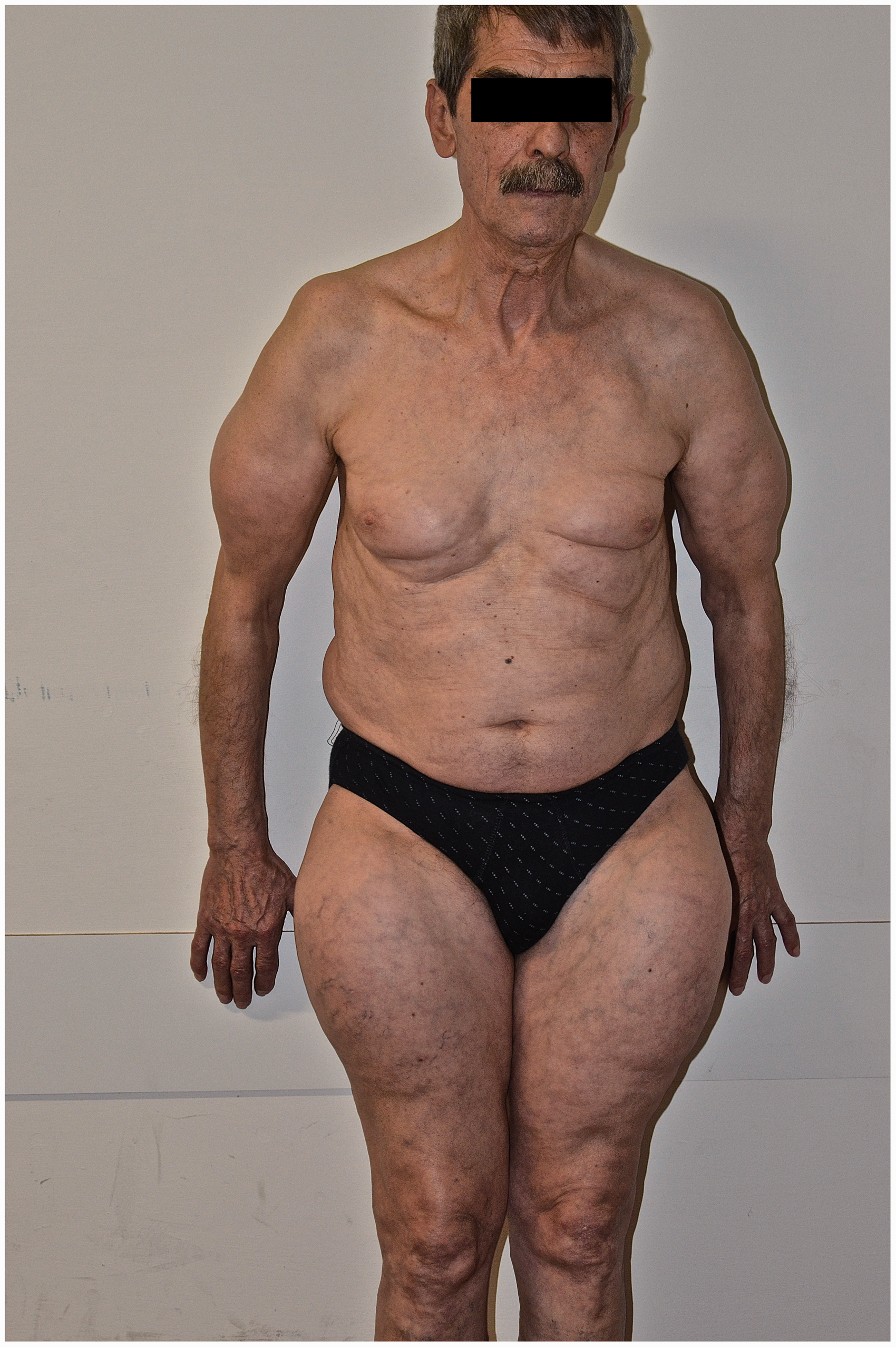

Discussion
Madelung’s disease is a rare disorder characterized by multiple symmetric noncapsulated fatty deposits distributed in the face and neck (buffalo hump), trunk and rarely in the upper and lower limbs (pseudoathletic). The general incidence is unknown but in the literature one case out of 25,000 is reported, with a male-to-female ratio of 20:1; higher prevalence is seen in Mediterranean countries. 1 The cause is unknown. Many hypotheses have been proposed: hypertrophy of brown adipose tissue or mitochondrial dysfunction. 1 Alcohol seems to be a trigger factor; more than 70–90% of the patients have associated alcoholism; another clinical aspect is sensory, motor and autonomic polyneuropathy. The diagnosis is based upon clinical history and physical examination, and there are no histological or standardized criteria. The best treatment is surgery because medical therapy and alcohol abstinence are not effective. 1
The number of rare diseases is estimated to be between 6000 and 7000 entities and tends to grow with improvement of medical science and genetic research. Given the rare nature, many clinicians will never see a patient with these diseases and will never recognise them; subsequently, a diagnosis is unlikely to be made. In fact, a study 2 conducted by the European Organisation for rare disease (EURORDIS) showed that 40% of rare diseases were wrongly diagnosed before the correct diagnosis and that 25% of patients had diagnostic delays of 5 to 30 years. The evolution of the Internet and web searches has transformed our medical ignorance on rare diseases forcing us to update our knowledge about them. Internet searches can support a clinician with information about rare diseases, suggesting the right diagnosis which was not correctly considered before. 3
Conclusion
Finally, the presented case demonstrates that physicians when confronted with unrecognised combinations of signs and symptoms of a rare disease could use Internet searches as part of their diagnostic strategy to prevent unacceptable diagnostic delay and improve medical management of patients.