




Abstract
Online visibility has attracted considerable academic attention, focusing on the role of platform affordances as well as user practices in the constitution and management of visibility online. This article argues that further attention is needed to understand the topological character of this phenomenon – that is, the ways in which technological properties and user practices co-produce distinct social spaces through which online visibility is constituted. Understanding the topological character of online visibility is particularly important in designing methodological interventions that can trace the propagation patterns of these practices and shed light on their actual visibility effects. For this purpose, we: (1) Conceptualize online visibility as a complex and heterogeneous landscape, layered with diverse topologies, co-produced by user practices and medium affordances. We then (2) suggest visual network analysis as an apt methodology for online visibility analysis, (3) illustrate our approach by analyzing the remediation of the 2019 Eurovision song contest on Twitter and, (4) discuss the possibilities for the broader application of our approach across different online platforms.
Introduction
Online visibility is a central element in understanding digital communication, attracting considerable academic and popular attention relating to phenomena from content moderation (Gillespie, 2018) and censorship (Yang, 2016) to ‘filter bubbles’ and ‘echo chambers’ (Bruns, 2021; Pariser, 2011). Online visibility is typically understood as a core media affordance (Flyverbom et al., 2016) involving filtering and display of content (Bucher, 2012), or as practices of ‘visibility management’ (Myles and Trottier, 2017) such as search engine optimization (SEO) (Kingsnorth, 2022) or online censorship (Yang, 2016), through which users attempt to manipulate these affordances and influence what can be seen online. Today, there is growing recognition of the ‘inherent interdependence between the efforts to make something visible, efforts to see something, and the extent to which a context makes those activities easier or more difficult’ (Treem et al., 2020: 45). Visibility is thereby ‘shaped by a complex entanglement of human and non-human actors’ (Madsen, 2016: 8), situated in specific ‘platform politics … and cultures of use’ (Rieder et al., 2018: 52) that are often intertwined with the commercial logics of today's ‘surveillance capitalism’ (Zuboff, 2019). Developing this approach, we argue that a central component in situating online visibility, often missing in academic and popular debates, is a theoretical appreciation of the diversity of online spaces that structure visibility and application of space-sensitive methodologies that account for the multiple ways in which online content becomes visible to users.
Since Foucault's (1991) discussion of the panopticon – frequently used as a theoretical starting point in discussions of media visibility (Bucher, 2012; Doyle, 2011; Mathiesen, 1997) – scholars have argued that the properties of socio-technical spaces play a central role in organizing what can be seen by whom (Brighenti, 2010; Thompson, 1995). Online spatiality is often described through the “network” metaphor, capturing the decentralized and relational character of digital media infrastructures (Brighenti, 2010). The network is a powerful conceptual tool for describing online spaces, but risks essentializing them and overlooking their spatial diversity central to the constitution of visibility in practice. For instance, on Twitter (now X) and the alternative platforms it has inspired, such as Bluesky and Mastodon, some of the basic spaces associated with visibility are follower-networks and hashtag feeds. These spaces possess distinct spatial properties that affect the type of visibility they afford as it relates to potential reach, temporal stability, etc. For example, posts in follow-networks (through the ‘following’ feed) are visible to all ‘followers’ irrespective of their interest in the topic, while hashtags make posts visible to all users interested in the topic regardless of follow relations. This spatial diversity and the distinct visibility effects it generates is not limited to these examples. Newer trends in the digital media environment, such as user-curated feeds on Bluesky, or the diverse content moderation policies on Mastodon's federative architecture, contribute to the further multiplication of spatial diversity online. We argue that the ability to theoretically distinguish and methodologically account for the specificities in spatial diversity is pivotal to understanding online visibility in today's media environment.
To highlight the multi-layered character of online spaces and the visibilities they enable, we draw inspiration from actor-network theory's (ANT) ‘topological thinking’ (Marres, 2012; Mol and Law, 1994). Originating in mathematics, topology refers to the study of spatial formations and their attributes (Law, 1999; Shields, 2012). In social network analysis (SNA), the term is often used as a variable referring to the general properties of networks, for example, centralized, distributed, etc. (Quelle and Bovet, 2025; Zulli et al., 2020). ANT scholars, however, utilize this term more broadly, as an analytical construct that illuminates the ways in which techno-social relations come into being in a ‘topologically heterogeneous manner’ (Mol and Law, 1994: 641) which we find particularly useful for understanding online visibility.
Theoretically, we argue that visibility online is assembled through distinct spatialities and that researching online digital spaces and the visibilities they afford requires ‘topological sensibility’ (Shields, 2012: 56). This enables us to reframe visibility online from a unified and universal techno-social category, as often implied in the literature, into a heterogenous, multi-faceted phenomena, layered with distinct topological landscapes. We coin the term visibility topologies as an analytical construct conceptualizing the techno-social spaces co-produced through the encounter between specific digital objects and user practices that enable local engagements on the interfaces of digital platforms to travel beyond their site of production and become visible to remote viewers.
Our theoretical development of topological sensibility is facilitated by digital methods (Rogers, 2019). Specifically, we introduce visual network analysis (VNA) to the study of online visibility. VNA is an emerging approach in digital methods for quali-quantitative analysis (Munk, 2019), where the ‘objective is to transform the matrix of associations’ within relational datasets into a network ‘image that can be interpreted visually’ (Jacomy, 2021; Venturini and Munk, 2022: 193; Venturini et al., 2021) by observing topological features, such as clusters, structural holes, the position of specific nodes, etc. Affording visualizing and exploring at scale complex online relations while maintaining a space for qualitative interpretive ambiguity, VNA, we believe, is a productive new method for online visibility analysis that can be combined with traditional statistical and ethnographic approaches.
We illustrate our topological approach through an instructive case study of the remediation of the 2019 Eurovision Song Contest (ESC) on Twitter. During this mega-event, Twitter became a backchannel for fan communication (Highfield et al., 2013). The 2019 event sparked political controversy, leading to the platform being repurposed for political interventions in the shape of boycott messages aimed at fans, participating artists and broadcasters (BDS Movement, 2019; Kiel, 2020). Our analysis builds on a dataset of 3,160,851 public posts (tweets) extracted through Twitter's streaming API. Using VNA techniques, we trace the struggle for visibility through the platform's distinct visibility topologies. The analysis shows that while the boycott campaign is one of the most frequent topics associated with the ESC event through the hashtag topology, there is a significant divergence in its propagation patterns, seen through mentions and retweets topologies, suggesting that the campaign was more visible to supporters and central ESC actors than to the general ESC fandom. While our analysis has limitations, it not only illustrates the topological dimension of online visibility but the analytical value of complementing claims about visibility online with topological awareness. Although Twitter has since changed and its API curtailed, this case study still holds didactic value in illustrating our approach, and we conclude by illustrating its broader applicability across different digital platforms.
Literature review: Online visibility
In media studies, online visibility, as a type of social category (Brighenti, 2010), is discussed either as the technological properties of the medium, or the social practices that leverage, moderate, and contest what can be seen and by whom on digital media platforms (Bucher, 2012; Rieder et al., 2018; Treem et al., 2020; Yang, 2016). Illustrating the former, visibility has been considered a ‘root affordance’ of digital media (Flyverbom et al., 2016: 101), where ‘nearly all possibilities for action[…] are connected to efforts to make forms of communication more or less visible’ (Treem et al., 2020: 48). Bucher (2012: 1166) emphasizes the central role of ‘sorting and filtering algorithms’ that automatically curate the items visible in the feed of each user based on social and commercial logics. The filtering of content here relies on the aggregation and storing of transactional user data that becomes assetized (Birch et al., 2021) in ways that enable the platforms to sell visibility to digital advertisers (Coromina et al., 2023). The visibilized content thus blends “organic” user-generated content, calculated as relevant based on previous interactions, and “paid” content, such as promoted posts and ads from digital advertisers. On some platforms, machine-learning of user behaviour is replacing user-interactions as the foundation for online visibility, thus becoming ‘algorithmic media’ altogether (Liang, 2022). Algorithms have also become part of content moderation practices that identify and remove content deemed offensive or inappropriate, turning social media into ‘algorithmically managed visibility machines’ (Gillespie, 2018: 178).
Studies have also examined practices of visibility management through which users attempt to influence how they are seen and by whom (Flyverbom et al., 2016). Researching social media activism, McCosker (2015: 3) notes that visibility ‘cannot be taken for granted as the causal effect of such platforms’, and that without visibility management (e.g., producing specific content or moderating discussions) ‘visibility remains a goal rarely achieved’ (McCosker, 2015: 1). Digital marketing is also a form of visibility management where by using SEO or display ads, commercial actors can optimize or purchase reach and become visible to specific user segments (Coromina et al., 2023; Kingsnorth, 2022). Visibility can also be a ‘double-edged sword’ (Thompson, 1995: 140), constituting a ‘liability when unwarranted’ (Myles and Trottier, 2017: 2), leading to practices that not only enhance but also limit visibility (Tsinovoi, 2020). As noted by Yang (2016) in the context of Internet censorship, user-driven visibility management practices involve both content removal and search results blocking, as well as counter-practices that recode removed information, making it visible again.
Integrating these perspectives, several studies combine platform affordances and user practices in the analysis of visibility. In discussing Google's search algorithms, Madsen (2016: 60) emphasizes that ‘the creation of visibility[…]is inevitably distributed across a range of socio-technical actors such as online platforms, web users, meta-data providers, algorithms and professional analysts’. Similarly, in studying YouTube's relevance algorithm, Rieder et al. (2018: 52) observe that visibility involves a complex ‘socio-algorithmic process’, rather than ‘neat categories of ‘technical vs. social’ or ‘platform vs. users’’. Treem et al. (2020: 46) suggest a multidimensional model that defines communication visibility as ‘the outcomes of activities through which actors strategically or inadvertently: (a) Make their communication more or less available, salient, or noticeable to others, and (b) view, access, or become exposed to the communication of others, as they (c) interact with a particular sociomaterial context’. The study of online visibility thus needs to be situated (Haraway, 1988) within the techno-social circumstances of the medium and the practices of the users. We contribute to the development of this perspective by examining the spatial properties of online visibility.
Theory: Online visibility as a topology
Space and visibility
Following Foucault's discussion of panoptic spaces and the relations between visibility and power (Foucault, 1991), spatiality has long played a key role in theorizations of visibility (Brighenti, 2010). Communications scholars have argued that with the developments in media technologies, social visibility is no longer limited to ‘co-presence’ in ‘the same spatial-temporal locale’, since mediated visibilities stretch visibility relations across time and space (Doyle, 2011; Thompson, 1995: 135). While throughout most of the twentieth century mediated visibility was mainly understood as ‘synoptic’ (Mathiesen, 1997), based on the ‘broadcast diagram of media visibility’ (Brighenti, 2010: 90), online visibility is associated with the spatial properties of networks as ‘means to produce, enhance and manage visibilities’ (Brighenti, 2010: 91).
While network-based understandings of online visibility may seem intuitive based on the technical meaning of the term, as ‘an infrastructure that connects computers’ (Gane and Beer, 2008: 16), as the term migrated from engineering into the social sciences it has also become a trope for new theoretical-methodological applications, such as Castells’ (1996) ‘network’ metaphor for contemporary capitalism or SNA's usage of networks as a quantitative methodological device for representing social relations (Scott, 2017). Of particular analytical interest to situating online visibility, we believe, is ANT. In this approach, the network is not a metaphor for society or a methodological tool. It is an ontology that accounts for how society comes into being through the co-production of social and technological forces, resulting in hybrid actor-networks connected through ‘a series of[…]translations’ from one element (technological or social) to another (Latour, 1999: 15). The identities and meanings of these elements ‘take their form and acquire their attributes as a result of their relations’ (Law, 1999: 3) and ANT researchers use the network term to describe how they empirically trace the relations that bring techno-social phenomena into being. ANT's relationality and heterogeneity are well attuned to the entanglements between technological affordances and user practices observed empirically in the context of online visibility dynamics (Madsen, 2016; Rieder et al., 2018), making it a productive starting point for our theorization.
A central spatiality-related discussion in ANT relevant to the analysis of online visibility stems from the observation that ‘‘the social’ does not exist as a single spatial type, but rather performs itself in a recursive and topologically heterogeneous manner’ (Mol and Law, 1994: 641). As explained by Law (1999: 6), ‘[t]opology concerns itself with spatiality, and in particular with the attributes of the spatial which secure continuity for objects as they are displaced through a space’. In SNA and other network sciences, the term topology typically relates to the shape of a network – that is, the characteristics of the layout through which nodes and edges are connected, including density, distribution of clusters, structural holes etc. (Ahn et al., 2007; Quelle and Bovet, 2025; Waumans et al., 2015; Ye et al., 2018; Zulli et al., 2020). For example, while corporate platforms, like Twitter, have centralized topologies where all information flows through a central server, a federated platform like Mastodon has a decentralized topology where the network operates through multiple interconnected servers, or ‘instances’ (Zulli et al., 2020). While in these approaches topology relates to a measurable property of networks (e.g., centrality measures, degree distribution etc.), in ANT, topology is an analytical construct, invoked as part of a broader theoretical thinking regarding the multiple modes of organizing techno-social spaces (Law and Mol, 2001; Marres, 2012).
Here, the network is a specific type of spatiality where ‘elements retain their spatial integrity by virtue of their position in a set of links or relations’ (Law, 1999: 6). There can, however, also be other spatialities, defined by different topological properties. For instance, in examining medical practices related to anaemia, Mol and Law (1994) show how the same phenomenon can come into being through different social topologies. Network spaces that have been successful in stabilizing certain chains of translation over time can become ‘regions’, whose topological properties are no longer relational but possess stable boundaries between distinct areas, identities and meanings. At the same time, within the same phenomenon, ‘fluid’ social spaces can also emerge where boundaries may dissolve unpredictably, and elements may appear or disappear without jeopardizing the integrity of the space (Mol and Law, 1994).
Topologies of visibility
ANT's understanding of networks and the observation that ‘the social occurs in different topological shapes’ (Blok, 2010: 909), such as regions or networks, are important for the study of online visibility. These insights direct our attention toward the relational effects of techno-social entanglements and open paths for exploring the potential diversity of online spaces and the different forms of visibilities they enable in ways that the network metaphor cannot sufficiently capture. We will articulate our theoretical proposition for the development of topological awareness by examining some of the most common modes of visibility constitution on digital platforms. Since it is not possible here to cover the variety of ways in which online platforms constitute visibility, we focus on one of the most familiar and well-studied social media platforms, Twitter. While the platform has changed, its front-end design and basic functionalities relating to visibility have become a model for other platforms. We therefore believe that examining this platform has didactic value in illustrating our approach more broadly.
The basic parameters of visibility on Twitter, as well as on the multiple platforms modelled on it (Bluesky, Mastodon, Truth Social, etc.), are generated by the establishment of “follow” relations. This generates a digital space with non-reciprocal visibility relations where the visibility of the users is ‘limited by the size of their social network’ of “followers” (Highfield et al., 2013: 316). Twitter's affordances enable “breaking through” this field of visibility by using ‘specific syntax to indicate an intention to extend or narrow the range of adressees’ (Bruns and Moe, 2014: 17). The hashtag enables categorizing content by attaching the “#” sign to any keyword, converting it into hypertext that associates the post with a feed of other posts containing the same keyword. This generates a digital space where a user can ‘address the entire community of users who are tracking the hashtagged discussion’ (Highfield et al., 2013: 316) regardless of follow-relations. Users can also narrow their visibility management efforts by using a mention sign, ‘@’, before a username, which generates a notification visible only to the mentioned user and can be seen as an interpersonal attempt ‘to strike up a conversation’ (Bruns and Moe, 2014: 19). A retweet relocates a post from the network of the sender to the network of the recipient, which can ‘raise the visibility of content’ (Papacharissi, 2015: 35) if ‘the retweeter has a large network and occupies structural holes[…]between different communities’ (boyd et al., 2010: 7).
By mediating between user-interfaces, databases, and, via filtering algorithms, the interfaces of other users, such digital objects (Langlois and Elmer, 2013) are forming distinct techno-social spaces through which content and engagements travel and become visible. In ANT terms, retweeting, hashtagging, and mentioning can be seen as part of an ongoing construction of social topologies, each with distinct properties and visibility effects. Follow-relations are established slowly over time and remain stable, structuring individual users’ basic field of visibility, thus resembling a ‘regions’ topology. Conversely, the spaces produced by hashtags have less stable visibility effects. Hashtags are not regularly pushed into the users’ feeds, and users can engage these spaces without following their ‘full feed’ (Bruns and Moe, 2014: 18). This space resembles a looser ‘network’ topology, as it depends on the alliances between the senders’ hashtags, the recipients’ engagement with the hashtags, and the algorithmic filtering features of the platforms (e.g., trending topics). Establishing ‘follow’ relations requires more time than using hashtags, because they are recipient-dependent and develop slowly while hashtags are instantaneously sender-generated. Similar tensions between reach, stability, user efforts, targeting precision etc. are also evident in other digital spaces. For instance, mentions are more precise visibility catalysts than hashtags, but also more limited in reach. The retweet is a stronger visibility catalyst in terms of potential reach but also recipient-dependent, thus forming a less stable and predictable topology. These types of engagement-based, “organic” topologies are not the only spaces that generate online visibilities. Commercial platforms also include paid promotion options in the form of ads, promoted content, etc., as well as private spaces (i.e., direct messages) through which users can become visible to each other. Search engine platforms, like Google, have different modes of visibility constitution than social media, involving SEO techniques and algorithmic keyword biding (Coromina et al., 2023).
With the fast-changing pace of digital platforms, visibility topologies are always in flux. What is most important in this discussion is not the specific topologies that currently exist on this or other platform, or the way they can be described in specific ANT terms, but rather the ways it enables us to conceptualize online visibility as a topologically heterogeneous phenomenon. We define visibility topologies as the various techno-social spaces generated through the encounter between specific digital objects, filtering algorithms, and user practices, where local engagements on the interfaces of digital platforms “travel” in distinct ways beyond their site of production and become visible to remote viewers. Topological thinking captures not only the ways in which digital objects, such as hashtags or retweets, function as visibility catalysts and play a role in facilitating network-like social spaces where visibility is constituted but also highlights that these spaces have different properties with distinct visibility effects that we must be able to account for methodologically.
Methodology: VNA
Digital methods and VNA
While topological thinking does not have to be based on computational methods, the new ‘traceability’ of everyday life induced by datafication processes (Mayer-Schönberger and Cukier, 2013; Venturini, 2010) and the relational datasets they generate, create new opportunities for developing this approach. Unlike computational social sciences that perceive this as an opportunity to apply quantitative methods on a larger scale (Kitchin, 2014), the digital methods approach, developed in dialogue with ANT, argues for situating data in the conditions of its production and repurposing it for research through the development of new, quali-quantitative methodological sensibilities (Coromina et al., 2023; Munk, 2019; Rogers, 2019). Digital methods take a keen interest in new modes of data visualization attuned to ‘observing patterns, circulation, flows, and boundary maintenance and leakage’ (Ruppert et al., 2013: 36) that may be relevant to topological analysis. Specifically, network charts that use nodes and edges to represent relations between data elements have become a ‘common’ way in digital methods to illustrate a variety of ‘relational phenomena’ (Venturini et al., 2021: 1).
The idea that social relations can be represented in network form was originally developed by SNA scholars, focusing on ‘the mathematical qualifications of these networks’ (Decuypere, 2020: 74). The term network in ANT, however, carries different epistemic commitments revolving around the ‘figurative power of networks’ (Venturini and Munk, 2022: 205). The methodological implications of this have been articulated by VNA: ‘A technique for analyzing networks by reading their visual features’ (Venturini and Munk, 2022: 193). VNA's starting point is that when working with digital methods it is analytically ‘useful to project networks in a two-dimensional space and to use their visual qualities as proxies for their topological features’ (Venturini et al., 2021: 1). The purpose is not ‘hypothesis confirmation’ but ‘exploratory data analysis’ that embraces ‘the richness of relational datasets and exploits their inherent ambiguity’ (Venturini et al., 2021: 2) interpretively. This approach includes some metrics from SNA, but they are applied as part of different – predominantly quali-quantitative – epistemological commitments, characterized by continuity between interpretive and calculative analytical elements (Munk, 2019).
Data and networks
We apply this method in examining the remediation of the 2019 ESC event on Twitter and the formation of distinct visibility topologies at the intersection of fandom culture and digital activism. For the purpose of our analysis we have used the TCAT tool, developed by The Digital Methods Initiative at the University of Amsterdam (Borra and Rieder, 2014), to extract through Twitter's streaming API tweets related to the 2019 ESC event that included different variations of the keyword “eurovision” 1 between 13.05.19 and 21.05.19, creating a dataset of 3,160,851 tweets, of which 1,167,126 are unique tweets. Based on this data we then constructed three networks based on the visibility catalysts (hashtags, mentions, and retweets) that we found most empirically relevant to our case (see Figure 1), including their relations and analytically significant attributes. We then explored these networks using the network visualization and analysis software Gephi, developed at the Science-Po Medialab (Bastian et al., 2009). A key analytical strength of VNA is that ‘a map of social topology’ can reveal relational empirical dynamics (dispositions, connections etc.) otherwise undetected by statistics (Venturini and Munk, 2022: 191). However, this type of analysis can be ambiguous, and we complement our topological analysis with several statistical metrics that further qualify our visual findings and add comparative dimensions.

Hashtags, retweets, replies and mentions during the 2019 Eurovision Song Contest (ESC) event.
Each network reflects the specificity of the digital object at play in its capacity as a visibility catalyst. Hashtags are a trace of the topical interests of users and exploring how they relate to each other can help detect associations between different topics related to the event. For this purpose, we used TCAT's built-in analytical functionalities to produce a co-hashtag network of the event; an undirected network, consisting of a list of hashtags designated as the nodes and a list of co-appearances of these hashtags in the same post as the edges. This basic data structure was enriched with additional attributes for each hashtag, such as frequency and user diversity that help characterizing the topological features of the network. To trace the propagation patterns of these topics, we then used the NetworkX library (Hagberg et al., 2008) for Python to generate two directed network files: A network where the nodes are handles and the edges are mentions, and a network where the nodes are handles and the edges are retweets. We then overlayed these networks with topical-specificity by adding node attributes that indicate topical interest as expressed by usage of topic-related terms in the posts, as well as degree metrics that indicate the reciprocity of these engagements.
We conduct the analysis in Gephi, involving the three generic steps of VNA that are based on the common visual variables ‘position, size, and hue’ (Venturini and Munk, 2022: 193). The positioning of nodes is created by applying layout algorithms that generate the basic space for the analysis. We spatialized our networks using the general-purpose ForceAtlas2 algorithm, that balances performance with exploratory, real-time parameter manipulation—central to VNA— and can generate better visual readability than alternatives (e.g., tighter-appearing clusters) (Jacomy et al., 2014). We applied ForceAtlas2 in LinLog mode, with stronger gravity (to enforce a tighter clustering) after removing nodes and edges that lacked interpretive specificity, which enables the spatialization algorithms to form more legible clusters. 2 We then analyzed the networks by combining visual detection of topological features of the network (e.g., clusters, sub-clusters, bridges and structural holes) together with an ‘algorithmic sensemaking’ (Munk, 2019: 172) process where we: (1) Applied a community detection algorithm (Louvain modularity) to detect statistically distinct clusters, and then (2) explored each cluster qualitatively using partition filters and a tagging protocol (the biggest clusters are tagged by examining the nodes with highest local in and out degrees, the dominant language, and cues from the hashtag attribute). In this process, we also used additional visual variables, such as node size for degree metrics and hue for cluster partitioning, that were instrumental during the exploration but did not end in the final visualizations.
Analysis: Topologies of online visibility during the 2019 ESC
The 2019 ESC
The ESC was established in 1956 by the European Broadcasting Union (EBU) as an annual song competition and has since grown into the most popular musical mega-event worldwide, with participation of over 40 states and millions of viewers (Yair, 2019). Over the years, a dedicated fan culture has developed around the event, including various participatory practices and events in online and offline spaces (Halliwell, 2023). Twitter is a central fandom technology during the event, providing a backchannel of communication for commentary and engagement; a type of ‘communal space[…]where audience members can come together to discuss and debate, in real-time’ the unfolding event using hashtags such as #eurovision (Highfield et al., 2013: 317). Discussions of political issues in these spaces is typically a ‘secondary, tangential theme’ (Highfield, 2016: 33). The 2019 ESC event held in Tel Aviv, however, was considered by experts ‘more political than ever’ (Kiel, 2020: 974). Twitter, in this context, became a technology of political resistance involving visibility management.
While Israel's participation in the ESC has always involved some political tension (Kiel, 2020; O’Connor, 2005), it was not until the emergence of the BDS movement – a network of pro-Palestinian civil society organizations (BDS Movement, n.d.-a) – in 2005 that Israel's participation became globally challenged and reframed as a continuation of its controversial foreign policies. These activities culminated in a global boycott campaign following the 2018 ESC victory of the Israeli performer Netta that granted Israel the right to host the 2019 ESC. The campaign aimed to draw global attention to Israel's controversial policies towards the Palestinians and discredit Tel Aviv as a legitimate site for the event (BDS Movement, n.d.-b). As part of this campaign, Twitter became a medium for the dissemination of boycott calls using various visibility management activities. For instance, Twitter users were encouraged to tweet and retweet specific boycott messages at specific times using the hashtag #boycotteurovision2019 (BDS Movement, 2019). Such techniques, known as ‘Twitter storms’, are common in digital activism (e.g., MSF, n.d.) and rest on the assumption that sudden peaks in activity around a certain topic can be detected by Twitter trends algorithms and made visible to broader audiences. The Israeli authorities even tried to discredit the campaign by claiming that it deployed social bots and fake user accounts to generate these ‘Twitter storms’ and requested social media companies to block it (Ministry of Strategic Affairs and Public Diplomacy, 2019: 5). While the campaigners considered their efforts overall successful (BDS Movement, n.d.-c), broadcasters and participating artists did not respond to the boycott calls, and the 2019 event proceeded without major interruptions. To understand these strategic communication efforts as a type of visibility management, one central question is how effective these efforts were in penetrating the ESC ‘communal space’ and becoming visible to the general ESC fandom. Next, we outline an approach to answering such questions using VNA-based topological thinking.
Topologies of visibility during the 2019 ESC
Hashtags, retweets and mentions are the most prevalent visibility catalysts in our dataset, with 78% of the tweets containing hashtags, 67% of the tweets mentions and 63% of the tweets being retweets (see Figure 1). We therefore decided to focus on these three digital objects as our primary empirical objects. We first wanted to identify the central topics discussed during the 2019 ESC on Twitter using a co-hashtag network. In such networks, proximity indicates co-appearance, so clustering and other topological features can be indicative of discursive formations and how they relate to each other. Using the ‘algorithmic sensemaking’ process, we discovered that the largest cluster in the network (29.4% of the hashtags) is directly connected with ESC fandom, consisting of event vernaculars, such as country abbreviations related to ‘hashflags’ and leading artist's sub-clusters. The second largest cluster (19.62% of the hashtags) mainly consisted of boycott-related hashtags, such as #boycotteurovision2019, as well as more general conflict-related hashtags, such as #BDS, #freepalestine, #apartheid, etc. ESC artists who made references to the conflict were also included in this cluster (i.e., Madonna's performance with dancers wearing the Israeli and Palestinian flags and Iceland's Hatari raising a scarf with the Palestinian flag). Topologically, the location of these hashtags forms a semantic bridge to the general ESC fandom cluster. This node proximity suggests that since these hashtags co-appeared frequently with the boycott hashtags, ESC fans that followed these specific conversational channels would be more likely to be exposed to boycott-related content. The rest of the smaller clusters were less distinct semantically, including a mixture of ESC-related topics and seemingly unrelated, tangential topics such as HBO's Game of Thrones finale.
The visual insight that the boycott topic was central during the 2019 event is supported by selected statistical metrics. With the official ESC hashtags excluded, an analysis of hashtag frequency and user diversity shows that #boycotteurovision2019 was the most popular in the dataset. With more than 18,000 users tweeting it more than 37,000 times it had high user diversity and was twice as popular as its closest competitor #hatari. This is also corroborated by the topological distribution of these hashtags (see Figure 2): The hashtags related to the boycott campaign take up a central position in the network, implying that they are not only frequent but also used in combination with a high number of other hashtags (e.g., #boycotteurovision2019 ranks 7th in terms of how many other hashtags it co-occurs with). If we understand this topology of visibility as the landscape formed when hashtags are used in combination with each other, then the topical distribution, along with frequency and user diversity, indicate that the boycott campaign had a significant visibility impact on the ESC conversations on Twitter. However, a hashtag topology is only one of several forms of visibility topologies on Twitter, and while it indicates that many messages related to the campaign were shared by different users, this analysis does not illuminate the propagation patterns of these topics and to whom they were visible.

Co-hashtag network.
Next, we examined the visibility topologies formed by the other two digital objects frequently used during the event (mentions and retweets), overlayed with topical distribution 3 (see Figure 3). In these networks, visual proximity indicates engagement (i.e., whether handles retweet or mention each other) whereas the overlay indicates topical spread. To complement the visual exploration of the distribution of the topic across the clusters, for each Louvain modularity cluster, degree metrics were calculated that enable comparing the average out-degree and in-degree of handles in that cluster to boycott-related handles elsewhere as indicators of reciprocity. The clusters in mention and retweet networks typically revolve around ‘superusers’, such as participating artists, national broadcasters, and celebrities commenting on the event. We see a division between the clusters according to national lines, where the corresponding national performer and broadcasters are typically in central positions, reflecting fandom dynamics of mentioning and retweeting. However, these networks also have significant differences.

Mention and retweet networks with an overlay of topical distribution.
In the mentions network, the biggest cluster (11.43%) is a mix of international fandom and boycott handles, centred around performing artists, the broadcasters and other central actors, as the top-mentioned handles. Topologically, the centrality of this cluster in the network indicates that it is interconnected with the national clusters more than the national clusters are interconnected amongst themselves. The boycott topic is also highly interlaced with the Irish fandom (2.78%) and the pro-Israel (4.82%) clusters, reflecting mentioning dynamics around more local actors and topics. The rest of the larger clusters are national and international fandoms, apart from a ‘tangential’ UK politics cluster (4.81%) focused on the Brexit negotiations. The top handles in the national and international fandoms are typically artists, celebs, and national broadcasters that support their national artists using hashtags such as the Dutch fandom's #TeamDuncan or the French #TeamBilal.
The division according to national fandom clusters is also apparent in the retweet network. Here the central handles in the national and international fandoms include not only artists and national broadcasters but also ESC bloggers and superfans. The topology of the retweet network is less centralized, implying that most of the retweeting activities take place within national clusters. Most of the clusters are fandom-oriented, the biggest cluster being the Spanish fandom (30.1% of all nodes). Topological exploration of the topical overlay indicates that the boycott-topic is less distributed, concentrated in the more isolated international boycott cluster (Main boycott – 9.78%) and in the Spanish boycott cluster (6.44%). With most of the boycott-related retweets concentrated within boycott-related clusters, this could imply that the topic is mainly visible to already interested users, and not the general ESC fandom.
To further qualify and compare these visual findings, for the 20 biggest clusters visually detected in each network we created: (1) A Pareto chart displaying the distribution of boycott-related nodes as ratios and, (2) a scatter plot that shows correlation between the average out-degree and in-degree from handles posting about the boycott topic indicating cluster by cluster if the engagements between fans and activists are reciprocal; that is, if being mentioned or retweeted prompts a response (Figure 4). These metrics confirm that the mention-network contains a wider propagation of the boycott topic (about 90% spread over 7 distinct clusters). This topology is sender-driven and based predominantly on non-reciprocal engagements, where mentioning is typically unilateral from boycott handles to fandom clusters. There is little correlation (R = 0.362) between being mentioned by boycott handles and mentioning boycott handles, and some of the major fandom clusters, such as the Dutch fandom or French fandom are frequently mentioned without mentioning back. In the recipient-driven retweet-network the boycott topic is concentrated in fewer clusters (about 90% concentrated in two clusters), and there is a high correlation (R = 0.978) between retweeting a boycott handle and getting retweeted by a boycott handle. Taken together, this might indicate that during the event these handles mainly retweet each other and succeed less in interacting with the broader ESC fandoms.
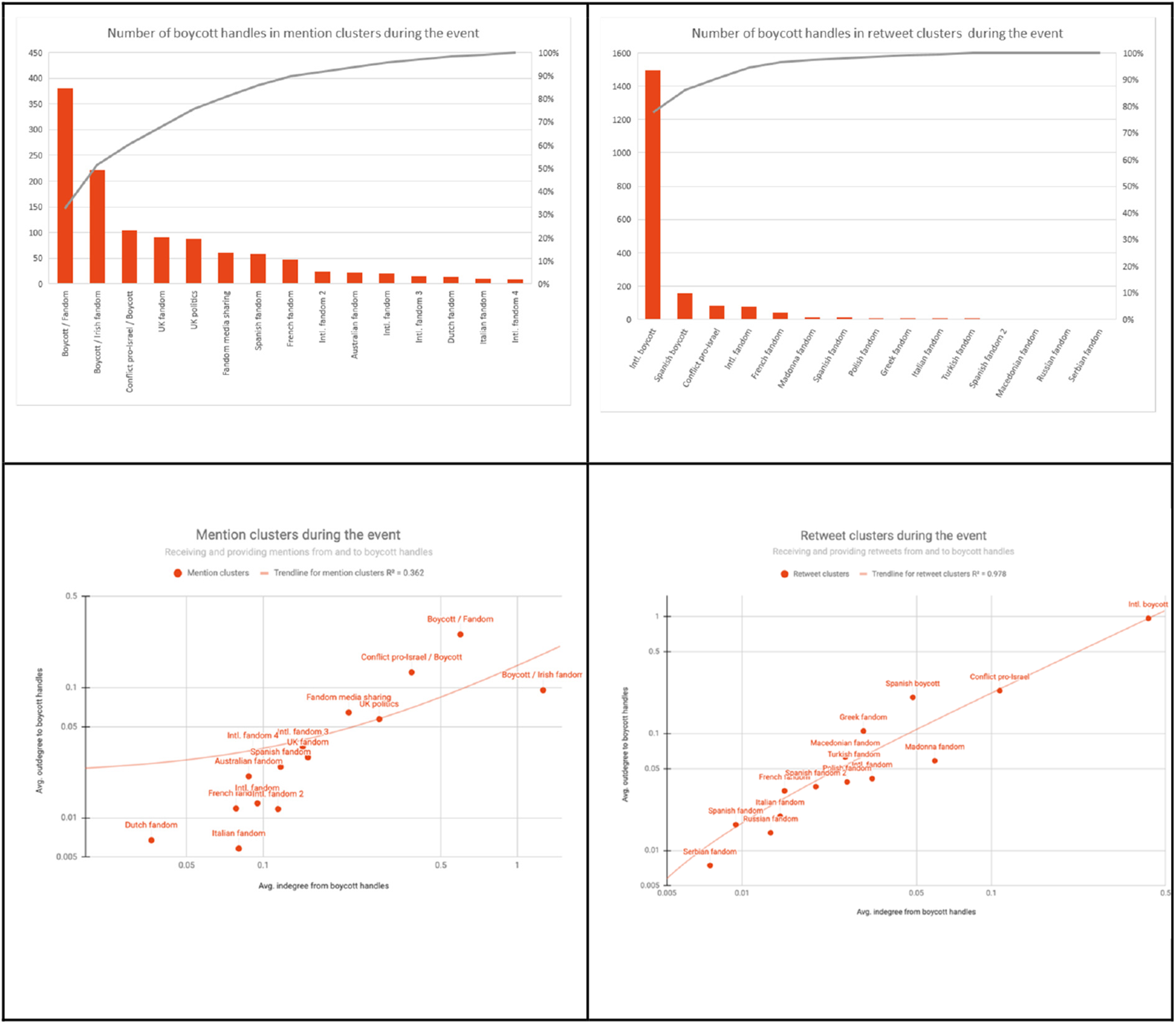
Pareto charts and reciprocity scatterplots of the mentions and retweets networks.
Discussion
Our analysis points to apparent differences between the three visibility topologies. The co-hashtag analysis shows that the campaign was successful in gaining visibility by frequently associating the boycott-topic with the ESC. However, when we examine its propagation through the other topologies the results are mixed. In the mention-topology the boycott-topic reached wider fandom clusters, reflecting strategic attempts to engage with central users. However, this form of engagement was mostly non-reciprocal and did not lead to further traceable interactions that can propel visibility beyond the mentioned users. Retweets are recipient-generated traces of user attention and have the potential to expose the campaign to wider audiences. However, the propagation of the topic in the retweet-network is concentrated in highly reciprocal clusters already interested in the topic. Hence, users already engaged with the topic retweet each other but without being retweeted much by ESC's fandom clusters, which is necessary for reaching new audiences.
These findings support our argument that online visibility is constituted through different topological layers and illustrate that these topologies have to be analyzed in relation to each other. Examining visibility only through hashtags would indicate that the campaign is highly visible without realizing that it is mainly visible to specific communities rather than the general ESC fandom. Conversely, examining the event only through retweets might downplay the volume of these efforts and the intensity with which they may be experienced by the users to whom they were visible. This spatial sensitivity is not inherent in VNA but requires the development of topological thinking. For example, in analyzing the 2012 ESC, Highfield et al. (2013) similarly aggregate networks based on user interactions on Twitter. However, by combining different types of engagements as edges, their networks cannot detect the ways a topic can circulate widely in one topology while remaining narrowly concentrated in another.
Limitations
Beside general limitations involved in API-based research, and specifically streaming APIs (Borra and Rieder, 2014; Lomborg and Bechmann, 2014), our findings must be discussed in the context of limitations related to our analytical choices. The topologies we have examined are based on visibility catalysts that were public, organic, and widespread, omitting private and paid engagements that can catalyze other forms of visibility due to considerations of empirical relevance and data availability. For example, users can also become visible to each other through replies, but this mode of catalyzing visibility was not widespread during the event (see Figure 1). We also did not explore paid engagements through which content can become visible using Twitter Ads or the ‘promote mode’ subscription (Chung, 2017). While we did not encounter any indications that paid engagements were central to the campaign, we could not explore this potentially important mode of visibility due Twitter's API limitations.
With the rapid pace of digital platform development and the reforms that followed Elon Musk's acquisition of Twitter in 2022, our study may appear somewhat historical, raising the question of how this approach can be applied in the current media environment. Twitter/X's role in public life is changing, and researching the platform has become more challenging following the closure of the academic API and the curtailment of other access tiers. While small-scale research projects are still possible, challenges may also arise from evolving operational logics. For example, the introduction of an X Premium subscription enables users to automatically boost visibility in ways that appear organic but may not be traceable (X, n.d.-a). The platform still has an interaction-based “following” feed, where posts are presented in reversed chronological order (X, n.d.-b), but if it will continue evolving into algorithmic media (Liang, 2022), where instead of traceable social interactions visibility will become dependent on opaque algorithmic processes, our approach will have to be supplemented with other methods, such as algorithmic audits or ethnographic encounters that enrol algorithms as part of research (Christin, 2020).
While Twitter's transformation was drastic, all digital platforms are in a state of flux, and it is impossible to discuss stable topologies that are immediately transferable across cases and platforms. Every digital methods research project will involve efforts to understand current platform dynamics (Rogers, 2019) and the emerging visibility topologies at play. We therefore believe that our empirical study is still didactically relevant to understanding contemporary dynamics of visibility. Some of the newer platforms, such as Bluesky and Mastodon, emerged as a direct response to the transformation of Twitter and are modelled after Twitter and its visibility topologies. For instance, Bluesky started as a Twitter experiment with decentralized architectures and evolved into an independent company that managed to attract many former Twitter users. While its backend architecture is different, its interface is heavily modelled after Twitter in appearance and functionalities. Reposting (or ‘reskeeting’) on Bluesky, for instance, creates visibility effects different from mentioning. Like retweets, a ‘reskeet’ on Bluesky is initiated by the receivers, making the post visible to their followers, while a mention is initiated by the sender and visible only to the recipient through a notification. The platform has an open API that enables access to relevant data for the type of visibility research we have conducted (e.g., using the search Posts endpoint) (Bluesky, n.d.). Bluesky also affords new spaces, such as Pin Feed, that in addition to the Following feed enables following algorithmically filtered topical feeds designed and curated by other users. While it is up to future research to explore these dynamics in detail (efforts are already under way (Quelle and Bovet, 2025)), the multiplication of feeds on the platform clearly supports our argument about the multiplicity of online spaces and the heterogeneity of visibility topologies they enable.
Finally, our approach is not limited to Twitter/X-related platforms but can be adjusted to any platform with sufficient datafication of visibility-relevant activities. For instance, Munk and Olesen (2020) explored the HPV vaccine controversy that erupted in Denmark in 2015 following the release of a critical TV documentary by mapping HPV debates across all publicly accessible Danish Facebook pages from 2011 to 2018. While it was commonly believed that the controversy was propelled by Facebook debates, statistical analysis revealed that there were just as many conversations about the vaccine before and after the documentary. However, once they began examining patterns of user interaction around these posts and comments, thereby introducing a topological dimension to the analysis, it became evident that there had been a significant shift. By constructing a network (see Figure 5) where nodes are posts about HPV vaccine side-effects and the edges are shared interacting users (i.e., users who author, comment or react to both posts), their VNA reveal two clearly separated camps prior to the documentary (the nodes highlighted on the left), where content that was critical about the vaccine and its side-effects attracted one particular group of users, while content that was primarily positive attracted another group. This implies that the opinions conveyed by these groups were largely invisible to each other on Facebook. This changed after the documentary (the nodes highlighted on the right), as users were now debating with each other in the same ‘comments’ threads. This can explain the perception among vaccine proponents that the documentary had generated an online avalanche of self-reported side effects; the opposing views were now visible. This not only demonstrates how our approach can be applied beyond Twitter/X-inspired platforms but also the value of complementing claims about visibility with the kind of topological awareness that VNA can facilitate.

Network of Danish Facebook posts mentioning HPV side effects (from Venturini and Munk, 2022, used with the author's permission).
While Facebook's API was also curtailed during the so-called ‘APIcalypse’ (Bruns, 2019), this form of topological analysis can still be performed on a variety of platforms, such as YouTube, where for example it could be analytically meaningful to create networks where the nodes are videos and the edges are user engagement. Any API access, however, can be curtailed, and efforts are underway to outline research avenues for digital methods in the ‘post-API environment’ (Perriam et al., 2019), such as data donations (van Driel et al., 2022) and Web archives (Aasman et al., 2024). For example, Coromina et al. (2023) pave the way for researching the commercial side of online visibility by repurposing digital marketing interfaces, such as Google Ads. Digital platforms, they argue, are embedded in specific epistemologies, consisting of data and metrics, accessible through official and third-party interfaces (e.g., Ahrefs), that can also be repurposed for digital methods research. For example, the market for attention and visibility related to Web3 was examined by constructing a network using search keywords (extracted from Google ads) and the actors that bid for these keywords (extracted from Ahrefs) (Amanatidis et al., 2022). This enables VNA in which commercial actors (nodes) are mapped according to the keywords they bid on (edges), shedding light on dynamics of paid visibility that for most part remain outside API-based analysis.
Conclusions
In this article, we have drawn inspiration from ANT's topological thinking for developing new conceptual and methodological sensibilities for online visibility analysis. Topological thinking helps us understand online visibility as a heterogenous and multi-faceted social category, assembled in distinct ways in diverse techno-social spaces. The term visibility topologies, as developed here, describes these spaces and highlights that they have different properties with distinct visibility effects. These types of topologies can be studied with VNA, and we have illustrated the analytical purchase of our approach by exploring the remediation of the 2019 ESC event on Twitter. The analysis not only revealed the topological diversity of visibility on the platform, but also the ways in which topological sensitivity can assist in discovering analytically significant empirical dynamics.
While this platform has recently been through drastic changes, our approach is relevant to a variety of online platforms, from Bluesky to Google Ads. For each platform it is important to attend to the specific affordances and practices that co-produce visibility topologies. While the specificities of these topologies are in flux, the principles of heterogeneity and multiplicity of online spaces, and the diverse topologies of visibility they enable, still applies. For these reasons, it is impossible to summarize a generic, recipe-like procedure for topological analysis of visibility applicable across different platforms and research questions, but three general principles can be outlined.
A topological analysis should always start by looking for relations; hence the first step should involve ascertaining what kind of visibility relations the platform affords and which of these relations are relevant to specific research questions. In our ESC example we found the relations between hashtags, mentions and retweets most empirically relevant, and these topologies could also be relevant on Bluesky and Mastodon. If we were studying content propagation on, say, YouTube, it might be relevant to consider how videos get recommended together or how users engage with different videos, while mapping visibility on Google would involve the relations between bidding domains and keywords.
The next step is to ascertain how those relationships are datafied and to what practical extent they can be accessed. Engagement-based visibility catalysts can typically be accessed through APIs. However, API access can be limited, and, in cases of algorithmic media, components of visibility relations may be inaccessible altogether. While in some cases alternative sources such as Web archives, data donations, or third-party aggregators may be available, in others new forms of ethnographic encounters with digital spaces might be required as part of topological analysis.
Finally, every visibility topology is only a partial point of observation and knowledge claims should be grounded in relational analysis of the different topological layers relevant to the research question. For example, examining visibility only through hashtags may point to high frequencies but overlook narrow propagation, while examining only retweets may point to propagation but neglect the intensity with which the topic may be experienced within specific communities. Weaving such methodological assemblages (Law, 2004) will present challenges. However, the rapid multiplication of spatial diversity online, accelerated by trends like user-curated feeds or federated architectures, will require developing theories and methods that can deal with spatial fragmentation and multiplicity, and our approach can play a role in initiating this conversation.
Footnotes

Funding
The authors disclosed receipt of the following financial support for the research, authorship, and/or publication of this article: This research was supported by grants from the Carlsberg Foundation and Independent Research Fund Denmark.
Declaration of conflicting interests
The authors declared no potential conflicts of interest with respect to the research, authorship, and/or publication of this article.
Data availability statement
The data underlying this article cannot be shared publicly due to ethical reasons.