



Abstract
As algorithmic systems are part of even the simplest actions in our daily lives, the critical issues of meaningful human agency and autonomy in relation to these systems have been increasing. This article aims to introduce a novel way of conceptualizing meaningful human agency and simultaneously address a gap identified in the current predominant sociotechnical solutions. To do so, it reaches out to A.J. Greimas’ actants theory and theory of modalities and further builds on the author’s own empirical findings. Re-reading Greimas’ theories, it argues that current ‘fixes’ for enabling and facilitating meaningful human agency have overlooked a crucial aspect – the willingness of the individuals to act agentially, even when opportunities and mechanisms to do so may be present. By transposing Greimas’ syntactic trajectory for action (the want- or have-to, know-, able-, do sequence) into algorithmic domains, it proposes and elaborates a prescriptive schema for transforming human agency from an as-if into meaningful human agency. This reconceptualization can be further developed and used as an analytical lens and conceptual tool for investigating existing relationships of power, knowledge, and agency within specific human-algorithm configurations. Further work should entail the translation of this conceptualization and framework into (design) practice.
Introduction
we are unescapably algorithmically processed by calculative devices
(Bucher, 2020:613)
As algorithmic systems are becoming our companion species (Haraway, 2010; Lupton 2016), becoming progressively part of even the simplest actions in our daily lives, the critical issues of meaningful human agency and autonomy in relation to these systems have been increasing. Since our daily lives are predominantly happening on and through algorithmic infrastructures, and due to a multitude of factors (e.g., algorithmic opacity, complexity, corporate gatekeeping practices), individuals are said to be in an asymmetrical power position in relation to the data and algorithmic systems they interact with, which significantly limits their ability to understand, inspect, and challenge the outputs of these systems. Scholars in media and communication studies, along with related fields like science and technology studies, and critical data and algorithmic studies, have been problematizing the nature of algorithmic power in contemporary society and in individuals’ lives and the nature and degree of human agency within these systems (Couldry, 2014; Feenberg, 2011; Hepp and Görland, 2024; Hildebrandt and O’Hara, 2020; Introna, 2011; Kennedy et al., 2015; Neff and Nagy, 2016; Neff et al., 2012; Passoth et al., 2012; Pop Stefanija and Pierson, 2023; Rammert, 2012; Savolainen and Ruckenstein, 2022; Susser et al., 2019). This problematization proves to be a complex one – individuals simultaneously do have agency over algorithmic systems, but at the same time, they are increasingly influenced and impacted by them. The interplay of human and algorithmic agency has been conceptualized as hybrid (Hepp, 2022) or distributed agency (Rammert, 2012), with technical agency attributed to algorithms (Neff et al., 2012). Regardless of the terminology, it is always a matter of relational, inter-agency, exhibiting itself through the assemblages of humans and algorithmic systems.
The aim of this article is to introduce a novel way of conceptualizing meaningful human agency while also addressing a recognized gap. It does this by drawing, first, from a lately forgotten place – the theoretical conceptualizations of the structuralist and semiotician A.J. Greimas. The further development of Greimas’ conceptualizations and their transposition in algorithmic contexts is additionally informed by insights collected from previous empirical studies (Pop Stefanija & Pierson, 2023, 2024, forthcoming). In this article, I argue that Greimas’ theories can be productively transposed within the domain of critical algorithmic studies, and I elaborate further on how they can be employed to conceptualize, investigate, and facilitate meaningful human agency within human-algorithm assemblages. Why is this reconceptualization important and necessary? While researching the preconditions and requirements for achieving meaningful human agency (Pop Stefanija & Pierson, 2023, 2024, forthcoming) and examining the solutions proposed by others (academics, regulators, industry), I identified a substantial gap in current dominant socio-technical solutions. Although the empirical studies I conducted differed, they uncovered one common denominator – I observed that what was often missing for a ‘fix’ in agency to be possible was not only the presence of technical affordances or societal initiatives like regulation and literacy. It was the willingness of individuals to act agentially. This willingness is often overlooked or not recognized as one of the first and crucial prerequisites for an individual to initiate the process of acting agentially. That is why many techno-societal solutions to the issue of agency fail – they do not enable, encourage, or facilitate the willingness to act agentially, even when opportunities to do so may be present (e.g., using data rights under the General Data Protection Regulation). I find particularly productive and significant the emphasis on the importance of the modality of want, and in our further theoretizations and practical approaches, we need to recognize it and account for it.
Following Greimas and supported by my own findings, this modality of wanting is crucial for the transformation of individuals from unknowing to knowing, capable, and finally doing subjects in possession of meaningful human agency. This transformation, I argue, corresponds to the transformation of human agency within human-algorithmic assemblages from an as-if into meaningful human agency. A structuralist and semiotician, Greimas’ narrative syntax, particularly his actantial model and theory of modalities, is strict and structured in its prescriptions. It is exactly this prescriptiveness that is particularly productive. Greimas’ theory captures important aspects and elements that are missing when conceptualizing meaningful human agency, while it also provides essential building blocks for facilitating this type of agency.
Although Greimas’ theories have been widely used in the foundational periods of Actor-Network Theory (ANT) (see Beetz, 2013; Boullier, 2018; Høstaker, 2005; Latour, 1999; Lenoir, 1994; Mattozzi, 2019), they have fallen into a somewhat forgotten and silenced place. Based on Greimas’ actantial model and his theory of modalities, I transpose his theory of actants and actors to investigate and re-problematize the nature of human agency in relation to algorithmic systems. Following his theories, I argue that in their interactions with algorithmic systems, individuals are not fully agential (yet!). Further, translating Greimas’ theory of modalities —considered a theory of agency —allows us to postulate the preconditions and requirements for an individual to act agentially within the human-algorithm assemblage. According to Greimas, this is only possible if a hierarchical organization of four modalities (1. want or have to, 2. know, 3. be able, and 4. do) is established and accomplished as a sequence of programmed actions. This article follows two related lines of argumentation. First, I argue that the agency ascribed to individuals is an as-if agency – individuals are agential but not fully (yet). I relate this agency to how things are at the moment – individuals are steered by what is called algorithmic governmentality (Foucault, 1991; Pop Stefanija and Pierson, 2023; Rouvroy, 2011, 2013; Rouvroy and Berns, 2010; Rouvroy and Stiegler, 2016). Furthermore, following and transposing Greimas’ theory, I argue that we can conceptualize individuals as actants, but not actors. An actant can be considered as possessing an as-if or pseudo-agency. Actor, on the other hand, would entail the practicing of meaningful and productive human agency. The second argument I make is that this dominant type of governmentality has three distinct but interconnected effects on its human subjects and society: algorithmic systems are increasingly endowed with epistemic/algorithmic authority, their workings are impacting virtuality, and with it, subjectivity. Following the prescriptive schema of Greimas’ narrative syntax and exploring ways to translate it into practice, I argue that we can come closer to facilitate the transformation from as-if to meaningful human agency.
The arguments and conceptualizations elaborated in this article can contribute in three significant ways. Transposing and translating Greimas’ theory into a new, human-algorithm context allows for a novel conceptualization of human-algorithm agency and the complex power dynamics involved. This reconceptualization can be further developed and used as an analytical lens and tool for investigating existing relationships of power, knowledge, and agency within specific human-algorithm configurations and systems. The prescriptive schema of the modalities – want, know, able, and do – can also be applied practically in designing future algorithmic systems.
The article begins by emphasizing the need for a novel conceptualization by discussing the nature of human agency in relation to algorithmic systems and the effects of this type of agency on individuals. It then elaborates Greimas’ complex, and potentially unfamiliar, theories in greater detail, developing them further and transposing them to the human-algorithm context. Discussing in detail what this would entail, the article ends with a discussion of a few points of consideration.
On agency, governmentality, virtuality, and subjectivity
To open the discussion on why a novel conceptualization of meaningful human agency is needed, it is crucial to elaborate on the understanding of agency elaborated in this article. The power and agency of algorithms can only be exerted on free subjects, as Foucault (1982) outlines –‘power is exercised only over free subjects, and only insofar as they are free’ (791). Individuals, as entangled in these systems, can still engage in corrective, agential, problematizing practices (Weiskopf and Hansen, 2022). Bonini and Treré (2024; see also Pop Stefanija & Pierson, 2023) provide a comprehensive definition of human agency, accounting for all the intricacies of this asymmetric power position – in our entanglement with algorithmic systems, we are able to exercise our agency, albeit to a degree only. The technical affordances of these systems simultaneously constrain us: we can both act agentially and/or not, we are steered by the boundaries imposed by the algorithmic structures and at the same time we still can, in gradations, exercise some kind of agency – we can resist, repair, reject, manoeuvre, or manipulate, to a degree. The agential manoeuvreing around these technical constraints is further complicated and reinforced by deliberate corporate politics and regimes of visibility, transparency, and explainability (Pop Stefanija, 2023). This is how human agency is understood in this article – while human agency remains present, it is increasingly becoming an as-if agency, mainly consisting of brute acts of clicking buttons, scrolling past, and similar actions (Couldry, 2014: 891), but with almost no reflexivity or self-directedness from the individual (see also Pop Stefanija & Pierson, 2023). This is particularly the case when it comes to interface (Fisher, 2022) or platform algorithms (Cotter, 2020) – algorithms integrated into and used within online decision-making systems such as social media, recommender, and personalization systems, which this article focuses on. Meaningful human agency would entail the ability of individuals to act in response to personalized algorithmic outputs when using or being subjected to the workings of algorithmic systems, in a manner that would enable their autonomy and control over the data inputs, the algorithmic outputs, and the impacts of these processes, based on meaningful information, self-reflection, sense- and knowledge-making. Such agency would enable individuals to act with self-determination and self-directedness.
This as-if agency is an outcome of what Antoinette Rouvroy, borrowing and expanding on Foucault (1991), calls algorithmic governmentality 1 , understood as a ‘government of the social world that is based on the algorithmic processing of big data sets rather than on politics, law, and social norms’ (Rouvroy, 2020, para 3), aiming to shape, guide, or affect the conduct, behaviour, and actions of people (Gordon, 1991; Pop Stefanija & Pierson, 2023). A governance of this kind threatens, affects, and bypasses the elements of knowledge, virtuality (potentiality), and subjectivity (Rouvroy & Stiegler, 2016) – precisely the elements that Greimas’ theories address – by applying algorithmic logic, authority, and automation. When it comes to knowledge, algorithmic governmentality introduces a paradigm shift in how knowledge about the (governed) subjects is produced, what is considered valid and authoritative knowledge, who produces this knowledge, and who has a ‘right to knowledge’. This is knowledge based on ‘reliance on quantified and stripped-of-context data with no input from the individuals themselves’ (ibid.:4). This causes a shift in what or who is considered an epistemic authority – algorithms through their discursive framing as being objective, truthful, and correct become performatively an epistemic authority – ‘unchallenged, accepted unquestionably as true, or as of more value than expertise or knowledge from other sources’ (Beck et al., 2016:1068), perceived as legitimate without coercion (Lustig and Nardi, 2015: 743). Calling it a ‘post-enlightenment epistemic model’, Fisher (2020) defines it as a ‘decisively devoid of subjectivity and all that it entails – reflexivity, hermeneutical and critical capacities, and reason’ (18).
Relying on this type of knowledge and epistemic processes, algorithmic governmentality bypasses both virtuality and subjectivity –‘there is no longer any subject in fact’ (Rouvroy & Stiegler, 2016:12), and subjectivity is avoided. This is precisely because of how algorithmic logic operates – built on vast amounts of individual data, devoid of context and information about intentionality, its goal is to categorize individuals without being interested in them –‘the very notion of subject is itself being completely eliminated thanks to this collection of infraindividual data; these are recomposed at a supra-individual level under the form of a profile. You no longer even appear’ (ibid.,:12). Unlike Foucault's governmentality (1991), algorithmic governmentality does not appeal to individuals’ capacity to understand (Rouvroy & Stiegler, 2016:12), but it functions at the level of signal, of reflex but not reflexivity. As such, it is a process of objectivation rather than subjectivation – a ‘process in which human subjects and their experiences are rendered visible and transformed into an object of knowledge’ (Weiskopf & Hansen, 2022:7), removing human reflexivity from the process of categorizing. This might lead to processes where individuals relate to the algorithmic prescription, internalize it, and ‘self-regulate to comply with what they think and anticipate algorithms or the designers of algorithms are expecting’ (ibid., 12). The creates epistemic imbalances – ‘a situation when some entity holds information, knows, or understand something about an individual, that the individual themselves do not’ (Delacroix & Veale, 2020; Pop Stefanija, 2023) and epistemic hegemony, where knowldege is captured, gatekept, and restricted (Ben-David, 2020; Pop Stefanija, 2023) which results in an elimination of the possibility to author oneself. As Fisher (2020) underlines, algorithmic knowledge and governmentality undermine two key processes in constructing subjectivity: (self)reflexivity and the formation of critical knowledge.
The main goal of algorithmic governmentality is ‘uncertainty management’ (Rouvroy, 2013:10) – by affecting the actualization of the virtual, of the dimension of potential and spontaneity, it seeks to minimize and control the (radical) uncertainty of individuals’ potential actions and their agency, understood as their ability to either do or not do what they are capable of, including questioning, resisting, and disobedience. Targeting the inactual but possible, the algorithmic ordering aims to ‘structure the possible, to eradicate the virtual’ (Rouvroy and Berns, 2010: para X) and to steer the realm of possibility and potentiality in a specific way. Virtuality is definitional of the subject and the subjectivity (Rouvroy, 2013) understood as a process, as an ability to be and become oneself, to author oneself. By targeting uncertainty, virtuality, and potentiality, algorithmic governmentality targets the very elements and processes that allow individuals to author themselves, project themselves, relate to themselves, and ultimately become subjects (Rouvroy, 2013). As will be further discussed, Greimas’ theory postulates precisely the notions of potentiality, virtuality, knowledge, capabilities, and subjectivities as essential prerequisites for acting agentially and becoming an actor or a subject.
Unknowing subjects of algorithmic systems
This was the antidote, she realized, to the feeling of distant people whom she’d never meet who held the power of everything over her. To be able to control the computers around her, rather than being controlled by them.
(Doctorow, 2019:62)
In Unauthorized Bread, Salima, the main character of Doctorow's (2019) novella, faces a situation where her toaster will not toast bread, and her dishwasher will not wash because the company running the software and controlling the appliances went bankrupt. Salima lives in a reality where even the most minor and insignificant daily activities are controlled by software that must be (first) authorized. Left with appliances that do not work, she learns how to jailbreak them using darknet forum manuals and manages to make them functional again, allowing her to use them as she wishes, not in a preprogrammed way.
Salima thus becomes agential in the relation with the systems – for the first time, she ‘had a kitchen full of devices that would obey you’ (Doctorow, 2019:48). One event is crucial for this – she gained knowledge that was previously gatekept, hidden, and inaccessible. By acquiring this knowledge, she transformed from an unknowing to a knowing subject. However, having knowledge is not enough; Salima also needed to become a capable subject. She needed skills and tools to apply that knowledge in practice, to make the appliances work. Once she became skilled and capable, and thus able to, she could exert her wishes, agency, and self-determination over the system. This story matters because it illustrates what it means to be(come) agential, capturing Greimas’ theory of modalities and summarizing the state of as-if agency of the pre-agential Salima and the preconditions Salima met to become fully agential.
Departing from the premise that ‘what may count as a form of agency may be different from who or what counts as an actor’ (Passoth et al., 2012: 5), I start with the question – what counts as an actor according to Greimas’ theory and why individuals, in the current socio-algorithmic arrangements, cannot be considered one, yet?
On subjects and objects
To answer this, I reach out to Greimas’ actant theory and his differentiation between actants and actors. This forms the basis of his narrative theory, where he explains how ‘the transformation of relations’ (Mattozzi, 2019:91), which is a prerequisite for meaningful human agency, can be achieved. Because of its ‘relationality from language to the rest of reality’ (ibid.:90), actant theory is particularly productive and could be easily transposed into the algorithmic domains.
As already briefly elaborated, the difference between actants and actors is significant, for both Greimas and the arguments in this article. The as-if agency that individuals possess in the current constellation of human-algorithm relations resembles Greimas’ definition of actants and the agency they (dis)possess. On the other hand, Greimas’ conceptualization of actors 2 corresponds to the possession of meaningful human agency as understood in this article. The transformation of individuals from having an as if to meaningful human agency parallels the transformation of actants into actors as postulated by Greimas. To develop and substantiate this further, I first elaborate on what this position of actants entails within current data and algorithmic systems. In doing that, I follow the proposal by Passoth et al. (2012) to investigate what becomes an actor by first looking at the different ways how the relevant entity is active (4).
The category of actant is not a simple one, and its definition is complex and scattered in Greimas’ works (e.g., canonical form in 1966 (Greimas, 1984), refined in 1973 (Greimas, 1987a); see also Greimas and Courtés, 1982; Greimas, 1987b). Simply explained, actants are specific elements within a certain constellation (schema, according to Greimas) that follow a predetermined programme – their function is not changeable, their performative boundaries are fixed, and with that, their behaviour is predictable and programmable (Greimas and Courtés, 1982). In this schema, the subject-actant is the origin of the action, and the object-actant is the one that performs the action as requested by the subject-actant. Transposed into human-algorithmic relations, this means that, constrained and steered by the technical affordances of algorithmic systems, individuals follow the programmes of these systems. Thus, algorithmic systems assume the function and position of actants-subjects, while individuals serve as actants-objects. In his well-known example of ‘John wants Peter to leave’ (Greimas, 1987c: 72), where John is the subject and Peter is the object, we can say that the same principle applies to our situation: ‘YouTube wants me to continue watching viral propaganda videos’ or ‘TikTok wants me to keep posting content so I can stay relevant and make my content discoverable’, and similar. When using the verb ‘want’ here, it is used broadly and it refers to the processes of algorithmic workings where individuals’ actions are steered through the technical affordances of the system: algorithms as artifacts can request, demand, allow, encourage, discourage, and refuse certain actions (Davis, 2020). In these examples, Peter and I are considered object-actants who are subjected to the wanting of the subject-actant, to its ‘desire for realization of a program’ (ibid.): to click on this link, to read this news, to keep scrolling, to consume this content. The subject-actants (the individuals) are receiving and executing the desire and the programmes of the algorithm (see also Mattozzi, 2019). Algorithms want something, and they prescribe certain behaviours and actions by requesting, demanding, encouraging, discouraging, or refusing.
Further clarifying the idea of viewing individuals as objects in human-algorithmic relationships rather than as subjects is essential for advancing the arguments. According to Greimas, an actor is considered an individualized manifestation of an actant, while an actant can also be an inanimate object (e.g., an algorithmic system). In the current human-algorithms constellations, the individual processed through algorithmic logic is only an objectified operationalization of the human subject (Seberger and Bowker, 2021). Algorithmic systems categorize, sort, and profile individuals according to often simplistic classifications, disregarding the complexity of individuals and the unpredictability of behaviours, in order to produce algorithmic outputs. The algorithmic logic – and the social order it strives to create – ‘requires no subjects at all, but rather seeks to turn them into objects’ (Fisher, 2022:12), devoid of subjectivity and individuality. The result of this objectivization is a subjectivity made redundant and individuals becoming objectified humans (Fisher, 2022; Seberger and Bowker, 2021), or subjects without subjectivity. Relying on categorization, algorithmic systems attach a certain (algorithmically constructed) identity to an individual, further imposed as a ‘law of truth’ (Foucault, 1982:782) that should be recognized in the individual by others and internalized by the individual themselves. This is an algorithmically imposed subjectivity, and this imposition is a form of power (Foucault, 1982). Or as McQuillan (2022) would say –‘We are not individual subjects of AI but the inferential subjects of AI’ (36). As discussed in more detail above, Rouvroy and Berns (2013) argue that the object of algorithms never manages to become a subject (XX), because algorithmic governmentality prevents and/or complicates the very possibility of subjectification processes of forming subjects. As actants-object, individuals are constrained by the programmability of the algorithm that prescribes behaviour and enables or restricts actions.
In a socio-technical constellation like this, the role and status of the individual in these entangled and complex infrastructures can be understood as one of a ‘subject’ only in the sense of that which is subjected to the determinations of something/someone else. I follow the distinction made by Foucault (1982) about the two meanings of the word ‘subject’ – the first one understood as being a subject to someone else by control and dependence (the case of our human actants-objects). The second one, closer to the understanding of Greimas and Courtés (1982) and to what meaningful human agency should achieve – as a being, an active principle capable of carrying out acts (320), tied to its own identity and subjectivity, by self-knowledge or conscience (Foucault, 1982:782). This second meaning is what Greimas defines as an actor. The question of why, in the human-algorithm schema, individuals are object-actants but not actors yet is not just a conceptual one but also highlights both epistemic and ontological aspects.
On actants and actors
What is the relation between actants and actors, and what is the crucial difference between them? According to Greimas (in Greimas and Courtés, 1982), an actor is not the same as an actant – each actor was an actant first, but not every actant becomes an actor unless certain conditions are met (Høstaker, 2005; Greimas and Courtés, 1982; Mattozzi, 2019). For an actant to become an actor, the actant needs to become a doing subject understood as the source of action (Greimas, 1976:109), the active principle within the particular constellation of actants, the specific entity to which agency is attributed (ibid.).
This is an essential aspect for the remainder of the article, since it argues that this position of having agency, of being (becoming) an actor through the process of obtaining the ability to do, to act, is a crucial ontological position that individuals need to reach. As a subject ‘which is in control of its own […] program’ (Greimas and Courtés, 1982:344), the notion of actor underlines the importance of independence, individuality, and thus, autonomy and self-determination of the acting/doing subject (Akrich and Latour, 1992; Beetz, 2013; Greimas, 1987a; Høstaker, 2005).
While actants follow a prescribed programme and are devoid of specific characteristics (subjectivity) (Greimas and Courtés, 1982:7), actors are related with the notion of transformation, identity, and individuation – the transformative process of becoming a particular individual – characterized by ‘a set of pertinent traits which distinguish its doing and/or being from those of other actors’ (ibid.). The actor's specific ways of doing affect its way of being – it is what allows the process of subjectification, understood as ‘the way a human being turns him- or herself into a subject’ (Foucault, 1984) to take place. Expanding and applying Greimas’ definition further, becoming an actor means becoming a subject that gains subjectivity, as opposed to the position of individuals as objectivized subjects (actants only). This is an understanding of the notion of subject as one where the individual not only possesses qualities but is also capable of carrying out acts (Greimas and Courtés, 1982:320). Greimas and Courtés (1982) equate it with the notion of knowing subject in epistemology.
In that sense, this active principle means (re)gaining subjectivity, understood as the individual's ability to shape their own conduct and personality, and not simply to follow a script, a programmed action. As such, it requires the ability for self-reflection, self-determination, autonomy, and agency. To achieve this, several transformations would need to take place. The element of transformation is a crucial difference between an actant and an actor – to be an actor, it means that one needs to undergo an act of modification, not to be the same as they were before. As Doctorow (2019) describes his protagonist Salima, whom we met earlier – ‘her experience with the dishwasher and the toaster changed her, though she couldn’t quite say how at first’ (22). However, there are a few crucial steps – as Fisher (2022) argues, becoming a subject with subjectivity requires the attainment of critical knowledge, which is crucial for ‘transforming individuals from objects to subjects’ (112).
This is how the term actor is conceptualized in this article – as simultaneously possessing subjectivity, a subject on its own, of its own making, and as something that can act in an autonomous, deliberate manner as a result of obtained knowledge, skills, and reflective processes and practices. As such, the notion of actor contains the essential elements of subjectivity, virtuality, knowledge, and agency, and becoming one would require undergoing a process of transformation through the accomplishment of several preconditions, which will bring a conversion from unknowing to knowing to a capable subject. In the following sections, I discuss what that entails and how it can be actualized.
Preconditions for acting agentially
Greimas’ theory of modalities (Greimas and Courtés, 1982), as a theory of agency (Høstaker, 2005:7), postulates the preconditions and requirements for agential doing. Due to its complexity, I provide a brief and simplified summary. For an action, any action to be performed (what Greimas calls an Act), an acting subject needs to undergo two related, hierarchically and consecutively ordered preconditions – Greimas refers to them as Competence and Performance. In that sense, ‘an act is defined as the passage from competence to performance’ (ibid.:3), while performance is understood as the realized action (Høstaker, 2005). However, for a performance to be initially possible, the acting subject must first be either in possession of or acquire competences. Greimas refers to these competences as modal values or modalities and defines them as ‘the potentiality of doing’ (ibid.:3). There are four 3 such modal values (want or have to, know, able to) (Figure 2), arranged in a strict sequence of programmed actions, and they can be categorized as either virtualizing or actualizing. Competence always precedes and presupposes performance – do (which is a realizing modality) and makes it possible, but not vice versa (Greimas, 1987a:124). Actants emerge as actors only through the process of acquiring competences.

Illustration of the classification of modalities, reworked according to Greimas, (1987a, 1987b, 1987c:132) and Greimas and Courtés (1982:45;195).
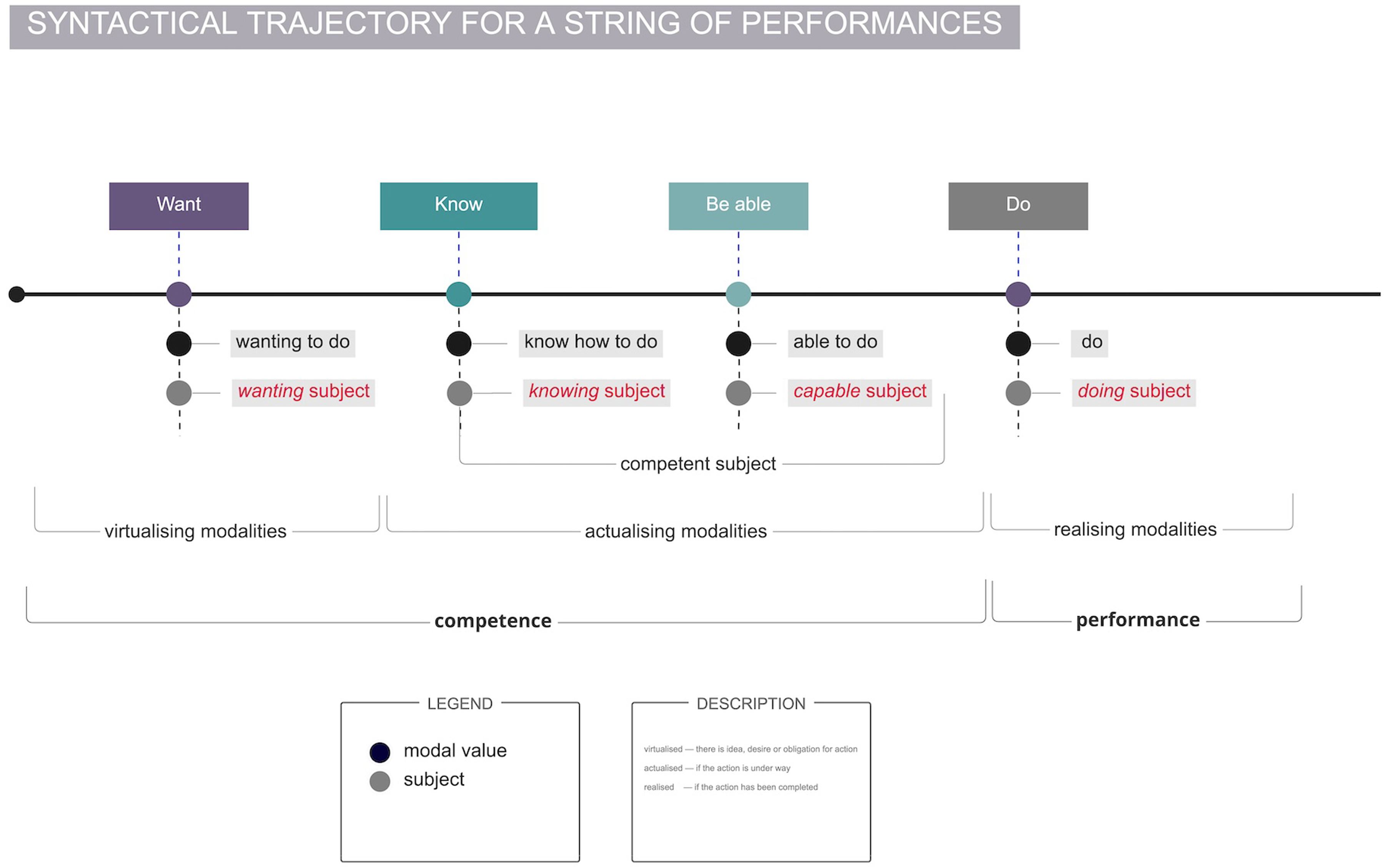
Illustration of the hierarchical schema for a string of performances, according to Greimas (1987a, 1987b, 1987c:129) and Greimas and Porter (1977:37).
For our human-algorithm constellations, that means that for an individual to act agentially in relation to or within an algorithmic system and to be able to impose their own requests on it by overcoming the boundaries of the technical affordances, they first need to have the competences to do so. Since data and algorithmic systems are complex socio-technical assemblages, I argue that all these competences need to be possessed or acquired (both the virtualizing and the actualizing) which would require a ‘redistribution of competencies and performances of actors in a setting’ (Høstaker, 2005:17).
From knowing to capable subjects
To elaborate better on what this process of gaining competences entails, it is necessary that we first define and explain the concept through the theory of modalities. Competence is understood as a hierarchical organization of four modalities (Figure 1): want or have-to, know, and be able. Competence can be obtained or acquired based on either desire (wanting-to-do) or on prescription (having-to-do) (Greimas and Courtés, 1982:45) – the presence of one of these virtualizing modalities is a mandatory first precondition for gaining competence to act agentially, but not enough in itself to realize a performance. As an instrumental programme to make the performance possible, competence requires two more elements – the actualizing modalities of knowing and of being able. The presence and possession of these modalities transform the subject into a competent subject. That means that the ability to act agentially requires cognitive competence, defined as knowing-how-to-do, which transforms the subject into a knowing subject – sujet savant – that has knowledge about the necessity of acting and about how to act. However, this cognitive competence must be complemented with pragmatic competence – an ability to do, making the subject a sujet puissant, a subject who is at the same time capable. Therefore, a competent subject emerges when the knowing subject at the same time possesses the ability, is capable to act (see Rulewicz, 1995); essential knowledge must be acquired or already possessed to enable acting upon that knowledge. This acting upon requires abilities (being-able-to). Thus, the syntactic trajectory of competences and modalities that needs to be fulfilled for an Act (comprising of competence + performance) and transformation to happen can be illustrated as a sequence of want or have to – know – be able – do (Greimas and Porter, 1977:37).
Thus, the acquisition of modal competence (becoming a wanting/obliged, knowing, capable subject) unfolds in three stages, and is a process (Greimas and Courtés, 1982:6). The acquisition of knowledge (know), which Greimas and Porter (1977) refer to as capacity-for-practice is necessary for the actualization of that very practice. On the other hand, only the modal value of ability (able to) ‘makes the operative subject prone to carry out the performance’ (ibid.). One outcome of having acquired knowledge and abilities to act upon it is the newly gained knowing-how-to-be (Greimas and Courtés, 1982), which is an important precondition for the element of subjectivity discussed earlier.
Transposing this into our human-algorithmic conceptualization means that to enable individuals to act with meaningful human agency, we need to ensure that the preconditions are met for the acting subject (the individual) to be simultaneously a wanting, a knowing, and a capable subject, so it can finally become an agential doing subject.
The wanting subject or making agency desirable
According to Greimas, one of the crucial aspects for realizing an action is the desire to act – a subject can possess knowledge and ability, but if there is no desire to act, no action will take place. For that, we need a wanting subject; it is this desire to realize (Greimas and Porter, 1977:30), this wanting and willingness to do something, that sets it up as an ‘operator of the action (faire)’ (Greimas, 1987c:72; Rulewicz, 1995) and establishes it as an actor and a subject. This virtualizing element is crucial in the actualization and subsequent realization of the action, because wanting is related to the element of intentionality and potentiality. It entails that the subject is, first and foremost, aware of the circumstances at hand, and second, wants to act upon them. It presupposes a conscious subject and self- and critical reflection, which require (and are a result of) critical knowledge.
The wanting is the minimal condition for doing, an a priori stage (Greimas and Courtés, 1982:140). This wanting can take even the form of a decision, and to reinforce this wanting/decision for an action, another element can be helpful – the introduction of the modality of having-to-do. As Greimas and Courtés (1982) outline, depending on how one is framing it, wanting-to-do can be seen as a self-oriented having-to-do (141), or the subject's having-to-do can be seen as a prescription made by someone else, an action imposed by another entity. In that sense, wanting-to-do and having-to-do can be remarkably similar, and sometimes they can be reduced to one another (hence they are often represented as a pair, e.g., Figure 1).
The cruciality of the modal competence of wanting-to-do emerges from the fact that if an individual does not want to act, to practice, and actualize agency, none of the consequent steps of competence (knowing-how-to and being able-to-do) and performance can take place. However, in practice, there are few potential obstacles – how to make agency, the desire to act upon algorithmic systems, and to take over control and act with self-reflection and self-determination, first desirable, and then doable? How to overcome the identified obstacles like technical affordances, algorithmic awareness (about being subjected to or interacting with an algorithmic decision-making system) (Eslami et al., 2015; Gran et al., 2021; Rader & Gray, 2015), algorithmic resignation (when awareness exists but the ability to act does not), and learned helplessness (McQuillan, 2022), among others?
Some tried and implemented mechanisms that can serve as mitigating strategies for the challenges of wanting to act agentially and making it desirable are the proposals to make the algorithmic workings visible. Applying seamful design (schraefel et al., 2020) or mandating literacy helps foreground the algorithmic processes, making them recognizable and inspection-ready for the individuals. When individuals are made aware of the workings of algorithms by reducing the effects of intentionally designed obfuscation, it is believed that it facilitates individuals’ abilities to resist, repair, or reject certain algorithmic outputs.
However, while these initiatives have been successful to a certain degree, some of my empirical findings (Pop Stefanija & Pierson, 2023, 2024, forthcoming) have shown that they are not sufficient. What did prove productive for facilitating and encouraging this desire to act agentially is the approach of making the algorithmic matters of fact – matters of concern (Latour, 2004). Since algorithms are becoming an everyday, taken-for-granted object, individuals often do not notice these invisible systems, and they do not recognize their outputs as being results of algorithmic workings; hence, individuals usually do not question the outputs they receive. We can make algorithms a matter of concern only if we simultaneously make them visible and enable people to inquire and see how they are entangled in these human-algorithm assemblages. This aspect emerged as I was working with my study participants as co-researchers – I could witness how this willingness unfolds as the participants were spending time with their algorithmic doubles (the data held about them, the inferences made about them, the logic behind the algorithmic inferences) (Pop Stefanija & Pierson, 2024, forthcoming).
But making algorithmic entanglements and agency a matter of concern is not enough; we need to encourage individuals to care (de la Bellacasa, 2011) about their entanglement with the algorithmic systems. Stimulating care is possible when there is personal investment, a personal stake in what we are concerned about. In my research, I was aiming to build an emotional connection between the participants and the algorithmic systems they were entangled in. People tend to react more and to care when the issue in question concerns them deeply, especially when they are dealing with something that is closely related to them and that affects them, and whose outcomes are tangible, visible, and known. This is, however, only possible if there are opportunities to see and grasp this entanglement, and when the effects and outcomes are made knowable and understandable. If only given time, guidance, and opportunities to understand why this matters and how these human-algorithmic entanglements impact their lives, individuals develop a relationship of care with these systems and, consequently, a willingness to act accordingly.
This process, and this wanting-to-do, can be reinforced and strengthened through the modality of having-to-do. While Greimas prescribes the obligatory presence of only one of the virtualizing elements (wanting-to-do or having-to-do), I argue that both should be present in order to ensure meaningful human agency. Understood as a prescription (Greimas and Courtés, 1982:195), having-to-do overdetermines and governs the consequent doing. This having-to-do can be imposed as an obligation, for example, by mandating platforms to implement technological tools/mechanisms and interface elements that will encourage willingness and nudge agential action from the individual's side. This, in a way, will also bind users to make thoughtful and slow(er) decisions based on reflection and critical understanding.
The doing subject or realizing agency in practice
Knowing (how to do) or making it possible
As discussed earlier, the sequence of modal competences of want or have to – know – be able needs to be acquired first (Figure 2) as a necessary step towards do, or performance. This corresponds to the transformation and syncretism of wanting, knowing, and capable subject into a doing subject. The modalities of want/have to and know are intrinsically connected when it comes to acting agentially, but either one can take precedence. On the one hand, the wanting might lead to the quest for knowledge acquisition, towards a wanting to know (more). On the other hand, the acquisition of knowledge might lead to a consequent desire to act agentially. However, if someone does not know, for example, that they have been algorithmically processed and are subject to algorithmic decision-making, or do not know what this entails, how it affects them, or how to act, they would not want to act upon it.
Before being able to act, as we saw from Greimas, we need the knowing – the cognitive dimension that precedes pragmatic actions. An individual might want to act agentially but not have the knowledge of how to do so. Seen as taking charge (Greimas and Courtés, 1982:32), knowing enables a shift in existing power relations and asymmetries because whoever holds the knowledge also holds the power. For changes in a socio-technical assemblage to occur, a redistribution of actors’ competencies, including knowledge, is required (Høstaker, 2005).
When the knowledge regarding the algorithmic system is hidden, intentionally made opaque and inaccessible, the withholding of knowledge from someone establishes an asymmetrical position of power. This power is generative (Tseng, 2022) as it is hidden in the background and often unnoticed by those it affects. Establishing and accepting algorithmic knowledge as an epistemic authority leads to epistemic hegemony (Ben-David, 2020; Pop Stefanija, 2023) and hermeneutical injustice (McQuillan, 2022), which diminishes or entirely reduces both a person's capacity to know and their ontological position as a knower. Obtaining epistemic insights will shift and reorganize knowledge, both epistemic and critical. Epistemic in the sense of validity, credibility, normativity, and authority of the knowledge about the world and individuals. Critical knowledge in the sense of knowledge about oneself, which is acquired based on information obtained through processes of reflection, learning, and self-determination. As Rouse (2005) says: ‘Both knowing subjects and truths known are the product of relations of power and knowledge’ (107). The ability to know and to have access to knowledge leads to a (re)configuration of that knowledge.
In Greimas’ theory (Greimas and Courtés, 1982), knowledge is regarded as an object in circulation – it can vary in degree, be present or absent, and can be produced or acquired, given or obtained. As such, the epistemic imbalances discussed earlier are not immutable. Knowledge can be provided voluntarily by those who ‘own’ it, or obtained through an informant/helper (someone who possesses this valuable information and knowledge). Or it can be acquired by accident or trickery and through access to secret knowledge (like in Salima's case). In that sense, for example, when we discuss algorithmic knowledge, the knowledge can be provided by the algorithmic system itself (e.g., making the outputs of the algorithmic workings visible, providing transparency and explainability). It can be obtained through various means (e.g., literacy initiatives, transparency tools, and regulation). It can also be forcibly obtained through trickery, when mechanisms and manoeuvres are needed to gain access to it (e.g., hacking, API access, algorithm gaming, data rights, etc.).
This cognitive competence in relation to algorithmic systems can be referred to as algorithmic competence, to borrow the term from Savolainen and Ruckenstein (2022) – an ability to identify algorithms at work, to sufficiently understand, critically assess, and reflect on the logic and the consequences of algorithmic outputs. This competence should enable interrogation, self-reflection, and self-determination – one of the dimensions of autonomy concerning algorithmic systems (ibid.:6). The ability to know, make sense, understand, and make autonomous decisions is one of the crucial steps towards the ability to act, towards the transformation of the individual into a doing subject. However, desire (want), obligation (have to), and knowledge (know) are not enough for acting agentially. Being able and capable of doing is crucial – we need to aim for a syncretism of the cognitive and pragmatic subject, where the knower is at the same time the doer.
Being able (to do) or making it doable
Knowledge precedes agency, but knowledge is only relevant if it facilitates, and is coupled with, the ability to act. To (re)gain agency, individuals must know and be able to understand how the algorithmic systems governing them work. Knowing and understanding, but not being able to disagree, oppose, correct, change, or in any way react and impose some autonomy over the system strips individuals of their agentic power over these systems. This is how Greimas understands knowledge, too. For Greimas, the modality of know is a modality on its own, but knowing has an additional dimension – it is dependent on knowing how to do, and on being able to do in order to act agentially. Knowledge, as understood by Greimas, is both cognitive and practical. It is not only knowledge about, but also knowledge regarding how (to do something, to act agentially). The acquired knowledge must be coupled with the ability to act, so a transformation from a knower to a doer is complete. Here, the modality of being-able-to-do is crucial. It can take the form of being-able-to-do as a freedom and being-able-not-to-do as independence (Greimas and Courtés, 1982:23), which are the two forms related to meaningful human agency. The two opposite forms are not-being-able-not-to-do, understood as submission, and not-being-able-to-do, considered as powerlessness (ibid.), both characteristic of as-if agency and algorithmic governmentality.
The modality of being-able-to-do has everything to do with the possibility and ability to enact the willingness to do (want-to) and the knowledge about how to do it. The cognitive competences are not enough; pragmatic capabilities are necessary. As such, the modality of being able necessitates two different forms of enactment – through material presence, in the form of possessing the tools and mechanisms to do so, and through (cap)abilities or what Davis (2020) refers to as dexterity – the physical and cognitive skills one has with an object, the ‘capacity of a subject to enact the functions of an object’ (144)). It is similar to what Savolainen and Ruckenstein (2022) call situational mastery – ‘the ability to navigate the opportunities and constraints of one's environment in ways that support self-chosen goals and values’ (8).
Being agential, becoming a subject
When an act, a performance is completed by an individual (now considered a competent subject that acts independently), a transformation producing ‘new state of things’ emerges (Greimas and Courtés, 1982: 227), with various outcomes. First, the epistemic imbalances and the epistemic authority positions are shifting. Now individuals can assume a more equal position in relation to the systems that rely on algorithmic knowledge to produce, uphold, and maintain power asymmetries (Foucault's power/knowledge, 1980). This shifts power positions too, and it is not solely the algorithm having power over (Beer, 2009; 2017) individuals, but it is also individuals gaining meaningful power over algorithmic systems and power to influence their outputs. Power here is understood as the ability to intervene in and to structure someone else's possible actions and behaviours and to steer potential outcomes (Lazzarato, 2002; Foucault, 1982).
The acquisition of knowledge and the possession of abilities to act upon and enact that knowledge are the crucial elements that make the actualization of meaningful agency possible. Meaningful human agency, considering everything discussed, can be understood as the ability to act, as an intentional and reflective practice that may or may not be realized, but that relies on the abilities, capacities, and opportunities to conduct and direct one's actions according to one's willingness, and thus to self-govern themselves. This change and shift in the ability to act (more) agentially also affects individuals’ autonomy. Closely related to the notions of agency and control, autonomy implies being able to make ‘reflective and informed choice and the ability to enact one's goals and values amid technological constraints’ (Savolainen and Ruckenstein, 2022:1).
All this inevitably instigates and is supported by the processes of self-reflection and self-determination, which, together with the possession of critical knowledge, are essential building blocks for achieving subjectivity (Fisher, 2022). Returning to Greimas and his definition of performance as causing-to-be, as a transformation, it can be said that the ultimate outcome of this newly acquired knowledge and abilities is the capability to construct one's own subjectivity as a counterbalance to the algorithmically produced one. It is a power to be-able-to-be, understood as a possibility (Greimas and Courtés, 1982:23) to shape oneself, one's subjectivity and behaviour according to one's own wishes, desires, and determinations. It is also a possibility to be able-not-to-be, understood as a contingency (ibid.) – not to accept the decisions, directions, and the imposed algorithmic subjectivity and identity that steer the algorithmic personalization and outputs.
In this sense, we are talking about meaningful human agency as a counterbalance to algorithmic governmentality. To return to the opening story of this article and to Doctorow's Salima – ‘“You see”, she said at last, as a realization came out of the blue to her and left her wonderstruck and thunderstruck, feeling like a revelating prophet. […] A computer you can access without supervision is a computer you can change, because all these computers are the same, deep down. […] Once you can seize control over that computer, all of them are yours’’ (Doctorow, 2019:62/63). What this article aimed to achieve is to conceptualize, from a different theoretical perspective, the agential relation between humans and algorithmic systems. By elaborating on the often blurry and narrow boundaries between subjects and objects, actants and actors, this approach aims to outline a way to understand meaningful human agency that will focus not only on the technological and the societal, but will also pay attention to the crucial elements for achieving agency understood as practice: willingness, knowledge, ability, and action. Conceptualized like this, these modalities can be used as analytical elements for investigating existing algorithmic systems and assessing the scope and extent to which they are programmed, enabled, and facilitated, both at the level of the technical and societal (infra)structures. For example, to investigate if, through technological interfaces or societal initiatives (e.g., literacy), the elements of willingness to act are encouraged and facilitated, if knowledge and sense-making are enabled via meaningful transparency, explainability, or other mechanisms, and if there are technological affordances that provide the opportunities to practice meaningful human agency.
However, there is one important issue we need to account for when devising interventions for ‘more’ agency – How much agency is too much agency?. The aim is not to create a situation of responsiblization of individuals. The facilitation of agency does not mean we should expect or impose on individuals the responsibility for every single decision and the necessity to always ‘critically reflect on their every step’ (Susser et al., 2020: 37). That is why we also need to be careful about the tendency to delegate too much responsibility to individuals for managing their interactions with and within data and algorithmic systems. There is a crucial difference between enabling conditions for autonomy, agency, and self-directedness that are based on meaningful information and knowledge, and forcing autonomy without the necessary preconditions for acting with meaningful agency. As I elaborated above, individuals should be steered and nudged to act agentially but only if they are provided with the conditions and mechanisms necessary for that, and based on awareness, understanding, and knowledge of how they are entangled within these systems, what that entanglement entails, how it impacts them, and what the potential risks are. That is why the risk of responsibilization of individuals is an important aspect that needs to be acknowledged and accounted for when devising strategies and designs for meaningful human agency. Assembled hastily or intentionally harmful, this will put the burden on individuals to be fully and solely responsible for their own decisions and actions, which they may not fully understand and whose consequences they cannot foresee.
At the end, I would like to reflect on what this article did not do – prescribing mechanisms for translating this into practice. To borrow from Bucher (2012), the aim was to ‘form responses rather than definite answers’ (69). As such, the aim was to propose novel approaches and foster and encourage new discussions. By introducing the syntactic trajectory for action (the want- or have-to, know-, able-, do sequence), this conceptualization should facilitate more comprehensive research approaches and design practices. By re-purposing the notions of modal values, especially the one of want to, the attention shifts to an often neglected and forgotten aspect of willingness, which, I argue, can be crucial for encouraging human agency. As never already ready-made, meaningful human agency needs to be assembled, carefully, by programming it through the technological infrastructures and by facilitating it through societal structures.
Footnotes

Ethical approval
No ethical approval was needed since this is a theoretical research paper
Funding
The author disclosed receipt of the following financial support for the research, authorship, and/or publication of this article: This work was supported by the Fonds Wetenschappelijk Onderzoek (FWO), grant number G054919N.
Declaration of conflicting interests
The author declared no potential conflicts of interest with respect to the research, authorship, and/or publication of this article.