




Abstract
Public protests need to communicate their aims to an audience, and the audience must make sense of the message. Initially this article was planned as a visual analysis of protest signs and placards. But to avoid ‘reproduc[ing] the privileged position of sight and vision over other ways of knowing’, we attend to the contested relations between signification, power, and all the senses. The sounds, smells, sights, tastes, and textures found at protests by groups such as Extinction Rebellion, Occupy, and the gilets jaunes, and on issues including women’s rights, nuclear power, immigration detention, Covid-19 lockdowns and vaccination mandates. Through ethnographic documentation of protests and the ‘live’ coverage broadcast in social and news media, our investigation of activities, scenes, signs, and participants reveals, firstly, that public dissent communicates through multiple sensory dimensions, and, secondly, that the senses of street-based protests are inextricably intertwined with sensory control tactics used against protesters in the policing of events.
Introduction: Bodies in place
Walking south on Church Street, I hear the Occupy encampment before I reach it. A rhythmic drumming, echoing in the spaces between the buildings. I turn a corner and I’m there, at the corner where Church Street meets Liberty Street. The park is a compact space, with trees, some flower beds and landscaped concrete. The park is filled with tents, trestle tables, chalkboards, people holding signs, groups sitting or standing in clustered groups. It is both static (the crowd does not move as it would on the street during a rally or march) and continually in motion: the crowd dispersing into huddles and moving as singular participants all around the park. They are cooking, clearing garbage, writing on boards, painting placards, setting up tents.
I cross to the pavement along the northern perimeter on the park. I stop walking, so that I can just look and let the sound wash over me. Suddenly a police officer is standing in front of me: ‘No standing’, he says, ‘You’re obstructing the sidewalk’. I look to my right. Across Church Street, an elongated crowd of people are queueing on the pavement. They stand 2 or 3 deep, stretching more than a block and a half along Church Street. Pedestrians step around them, sometimes into the gutter, in order to pass by. The queue is for the recently opened Word Trade Centre Memorial. I look back at the police officer. It’s as though the thick press of people nearby is invisible to him. He repeats: ‘You’re obstructing the sidewalk’, and commands, ‘Move along now’.
‘OK’, I say, and climb over the low concrete wall bordering the park. For the police, people are either in the protest or out of it, and I’m in it now.
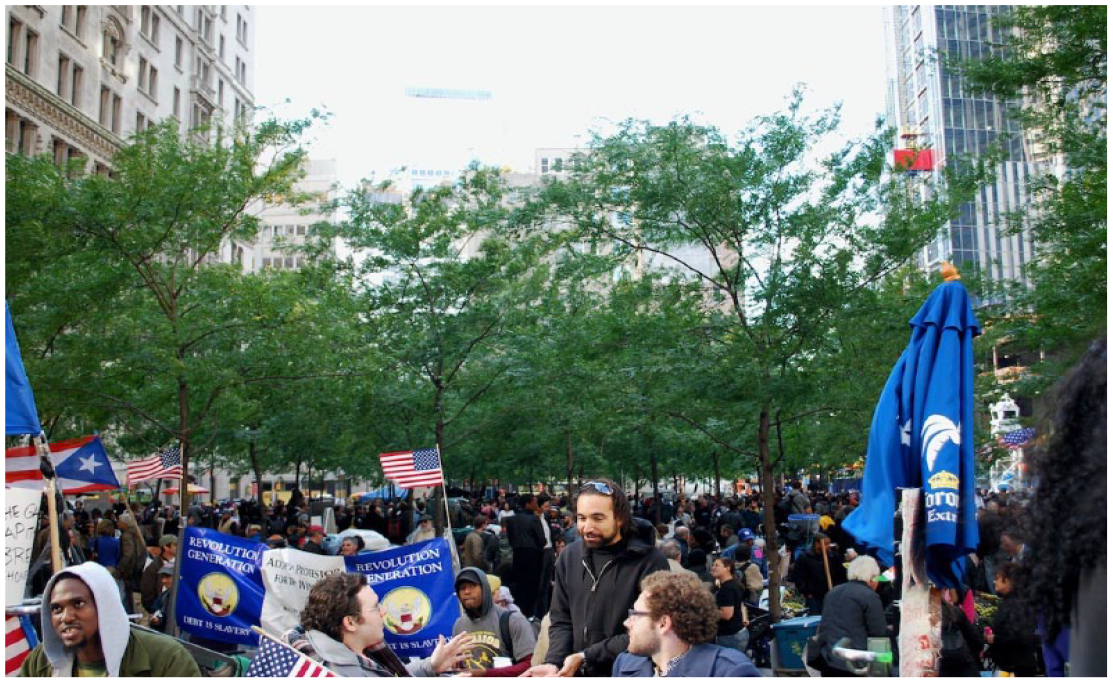
Occupy Wall Street, Zuccotti Park.
In some ways, this article began at that moment in 2011, when the policing of the street facilitated an encounter with the ‘sensorium’ of Occupy Wall Street This article returns to the sensorium to consider the signifying strategies of street-based protests like Occupy. Signification could be conceptualised as a system of codes (Eco, 1979), an archive of meanings (Borysovych et al., 2020), or, as we propose, as a living idiom with a semantic history as well as a contemporary adaptability into new meanings for future actions.
Protest events need to communicate their aims to an audience, and the audience must make sense of the message. Psychoanalysis has emphasised the dominance of the sense of sight, leading to extensive discussion about the gaze and its role in signification (see especially Lacan, 2002 on the signifier/signified relation). Initially we planned a visual analysis of protest signs and placards, ‘attuned to the fraught relations between words, images and power’ (Brown and Carrabine, 2019: 192). But to avoid ‘reproduc[ing] the privileged position of sight and vision over other ways of knowing’ (McClanahan, 2021: 16; see also McClanahan and South, 2020), we have attended to the contested relations between signification, power, and all the senses: sounds, smells, sights, tastes, and textures. Street-based dissent is a sensory assemblage in which the sensory dimensions of street-based protests are inextricably intertwined with sensory control tactics used against protesters in the policing of events.
Dissent is increasingly characterised in governmental, legal and media discourse as ‘nuisance’ (Bhandar, 2012) and police have simultaneously become more militarised in their control responses (Iveson, 2007; Wall, 2021). Police strategies can be considered by reference to use of force, legitimacy or legality of conduct, choice of pre-emptive or reactive intervention, style of communication, and capacity to respond to dynamic situations (Della Porta and Diani, 2006). These dimensions coalesce into modes of policing such as ‘escalated force’ (low tolerance for innovative protest) or ‘negotiated management’ (pre-emptive control through consensus). The protest crowd is a political technology whose ‘vibrance’ (‘excess beliefs and desires [that] shift and turn, sometimes pulling people to confrontation, sometimes drawing people together in new bonds’: Wall, 2021: 3) is targeted by police ‘atmotechnics’ that work through multiple sensory dimensions on bodies in public space (Wall, 2019) with, as we will argue, forceful and intense affective impacts on protesters. At the time of writing, protest is increasingly restricted or prohibited by legislation such as the Police, Crime, Sentencing and Courts Act 2022 in Britain and the Roads Amendment (Major Bridges and Tunnels) Regulation 2022 in Australia, which makes it an offence for a ‘trespasser’ to block traffic during a protest action). When protests do occur, they are subjected to augmented and expanded police powers. In such a context of increasingly repressive control responses, this article aims to offer two things. The first is a critical account of the ways in which policing affects protest bodies – to show how its atmotechnics seek to control the grounds, materials, bodies, and the very molecules of the air in which protest takes place. The second is a celebration of the creative and adaptive ingenuities with which protesters continue to conjoin ‘bodies in alliance’ (Butler, 2011) within a communicative and adaptive sensorium – a determined persistence to maintain dissent in the disappearing spaces for protest in our streets.
Modes of dissent: Bodies moving in space
[W]hen the body ‘speaks’ politically, it is not only in vocal or written language. . .. [I]t is not that bodily action and gesture have to be translated into language, but that both action and gesture signify and speak, as action and claim, and that the one is not finally extricable from the other. (Butler, 2011: 5) (our emphasis)
What ‘actions and claims’ are found in the sounds, smells, sights, taste, and textures of dissent and its policing? To investigate this question, a number of street-based actions are considered, in cities including New York City, London, Tokyo, Paris and Melbourne, on issues such as climate justice, women’s rights, nuclear power, immigration detention, taxation and petrol costs, unequal wealth distribution, vaccination mandates and Covid-19 lockdowns. Protests discussed include Occupy Wall Street, which occupied Zuccotti Park in New York City from 17 September to 15 November 2011, with its wide range of issues circling around financial and social inequalities (Bassett, 2014; Harcourt, 2012; Mitchell, 2012; Taussig, 2012); Extinction Rebellion, originating in Britain in 2018 and taken up in Japan, Australia, Norway, New Zealand, Canada, Germany and elsewhere (Fotaki and Foroughi, 2022; Lee, 2021; Mansfield, 2020; Martiskainen et al., 2020); action against economic and social inequalities carried out since 2018 by the gilets jaunes (‘yellow vests’) in France; protests against immigration detention in Melbourne, Australia (Vogl et al., 2021); anti-lockdown/anti-vaccination protests in Australia (Martin, 2021; Popovski and Young, 2022); and Black Lives Matter events occurring in the aftermath of the murder of George Floyd by police officer Derek Chauvin (Barrie, 2020). Our aim is neither to evaluate the relative merits of protest objectives (although some of those discussed are events and actions in which we actively participated) nor to flatten the distinctive objectives sought by various organisations or events, which no doubt influence the intensity of control responses to any individual protest. Instead, our research investigates what could be considered the sensory grammar or vocabulary of street-based protest.
Two main concerns drove the selection of protest events. First, we focus on urban places: events such as the location outside a weapons’ base for the Greenham Common women’s peace camp (Roseneil, 1999; Young, 1990) or the protests in the Franklin Forest in Tasmania (Clark and Page, 2019) are thus excluded; second, we identified protests deploying diverse communicative techniques in order to highlight how both protests and regulatory responses to them intervene in the sensory landscape of cities. To generate a sensory semiotics of protest, we have undertaken a ‘detailed analysis of. . . different sense dimensions. . . that offers an integrated understanding of urban places’ (Paschalidis, 2017: 9), based in a multimodal ethnographic documentation of protest events and ‘live’ coverage of protests on social media and in news media (Clark, 2011; Kane, 2019; Pink, 2011; Price, 2011) examining activity, scene, signage, and participants.
We followed some protest events on social media and through news coverage (such as the gilets jaunes protests in France). Media coverage of protests is no longer simply a secondary source (if it ever was only that). Butler notes: ‘[t]he media extends the scene visually and audibly and participates in the delimitation and transposability of the scene [of political protest]. Put differently, the media constitutes the scene in a time and place that includes and exceeds its local instantiation’ (Butler, 2011: 8). Other protests were attended by us as participants, and in these we marched, chanted, and lay down in the street along with others in the protest crowd. These include Occupy Wall Street, actions organised by Extinction Rebellion, Justice for Grenfell, the Women’s March 4 Justice, and the Refugee Action Collective (and some of our personal political commitments can be read in these names); we discuss these from a standpoint that conjoins analysis and active participation (Johnson and Haarstad, 2022).
Finally, some protests were attended or followed by us as researchers who did not share the aims of the event, such as the numerous anti-lockdown and anti-vax protests in Melbourne. Observing protests whose aims we did not share, or were actively opposed to, generated challenges for us as researchers, and traces of our struggle to consider their communicative techniques without reflexive pejorative judgement can be found in some of the field notes later in this article. They are included here because anti-lockdown/anti-vax protests were, by far, the most prevalent instances of protest in Melbourne during the period 2020 to 2022. While our discussion of these protests here mainly focuses upon the multiple sensory dimensions of their communicative techniques, but we would note at the outset that control responses for these protests was on the whole far less intensive or aggressive than that brought to bear on other groups such as Extinction Rebellion, Fireproof Australia, Black Lives Matter, and anti-cuts or anti-globalisation protesters in Britain, whose bodies in alliance face extensive, forceful, and sometimes lethal atmotechnics of control.
Signifying dissent, sensing control
Standing on concrete, chanting, holding a sign, wearing a T-shirt with a slogan on it, lying down on the ground – participation in protest incorporates the movements of bodies in place as constitutive elements of dissent. The bodies of human subjects moving to express critique, condemn, or make demands, are ‘social and embodied, vulnerable and passionate’ (Butler, 2011: 11), animated through and by senses, ideas, histories, and possible futures. To signify dissent, these bodies utilise the senses in order to make sense. As Butler (2011) notes, ‘If we consider what it is to appear [in the space of politics], it follows that we appear to someone, and that our appearance has to be registered by the senses, not only our own, but someone else’s, or some larger group’ (p. 6) (our emphasis). In what follows, we consider the ways in which both dissent and its policing register in the senses.
Vision and the politics of appearance
When people assemble in the streets, they enact public space as the ‘space of appearance’ (Butler, 2011: 2). Here, public space is both the place in which debate can take place (an idea with roots in the ancient Athenian agora) and also the place where meaning is made through simulation. Appearance is thus not merely representation as in the communication of ideas but also identifies a deep dependence on visual signification and interpretation. Protest events participate in these dual dimensions. How, then, do protests visually appear in the streets?
Size can be made to matter here. If a protest stretches the length of a street, or fills a square, its volume can evidence public concern for an issue. Size can be seen in situ by participants and bystanders or through media: participants often broadcast live from events, or post videos and images afterwards, while media and police helicopters relay aerial footage of an event’s size and scale. Protests can also communicate through choice of location; the presence of an assembly of protesters next to a government building or well-known landmark signifies through juxtaposition, creating an object of address for the protesters, or a metonymical association as an additional layer of meaning.
Beyond this, protests appear to others through the powerful semiotic affordances of clothing, props, and signage (Liao, 2010). Participants sometimes wear everyday clothing, but often select or adapt bespoke outfits. Some clothing functions like a uniform, enfolding wearers into a community or group. Women attending protests at Donald Trump’s Presidential Inauguration wore pink, hand-knitted ‘pussy hats’; the gilets jaunes are named for the yellow vest motorists must carry in their vehicles. In Australia in 2021, ‘hi-vis’ vests became associated with construction worker protests against COVID-19 vaccination mandates; the ease of obtaining such vests led to concerns that some protesters were ‘fake tradies’ (Von Homrigh, 2021).
With uniforms, ‘there is no separation of person and pose’ but with costumes ‘the wearer always appears in addition to the persona that they present’ (Lavender, 2019: 10). Extinction Rebellion has made theatrically effective use of costumes, linked to specific characters with distinctive performance modes during events. The ‘Sybil Disobedients’ wear blue, red and white costumes and headgear that make them resemble chess pieces or spinning dervishes, each with text condemning government climate (in)action. Their movements are jaunty, engaging. The ‘Red Rebels’, on the other hand, wear costumes of draped red fabric and stark makeup, with movements slowed down, silent, contemplative. The international offshoots of the original British organisation utilise a characteristic colour scheme that brands an event as an Extinction Rebellion one: the Red Rebels are always red, flags are always in the same mid-toned pink, yellow, green and blue shades; the abbreviation ‘XR’ and the hourglass icon are the preferred textual and symbolic representations (Shiels, 2019).
Props also do symbolic work for Extinction Rebellion: blue fabric signifies the rising oceans; a burning papier-mâché globe depicts the warming climate. Outside the Australian Federal Parliament in Canberra, protesters set fire to a pram in 2021 (McKnight, 2021); outside the State Parliament in Melbourne, Red Rebels led a procession in which a giant koala puppet belched clouds of smoke and moaned in pain.
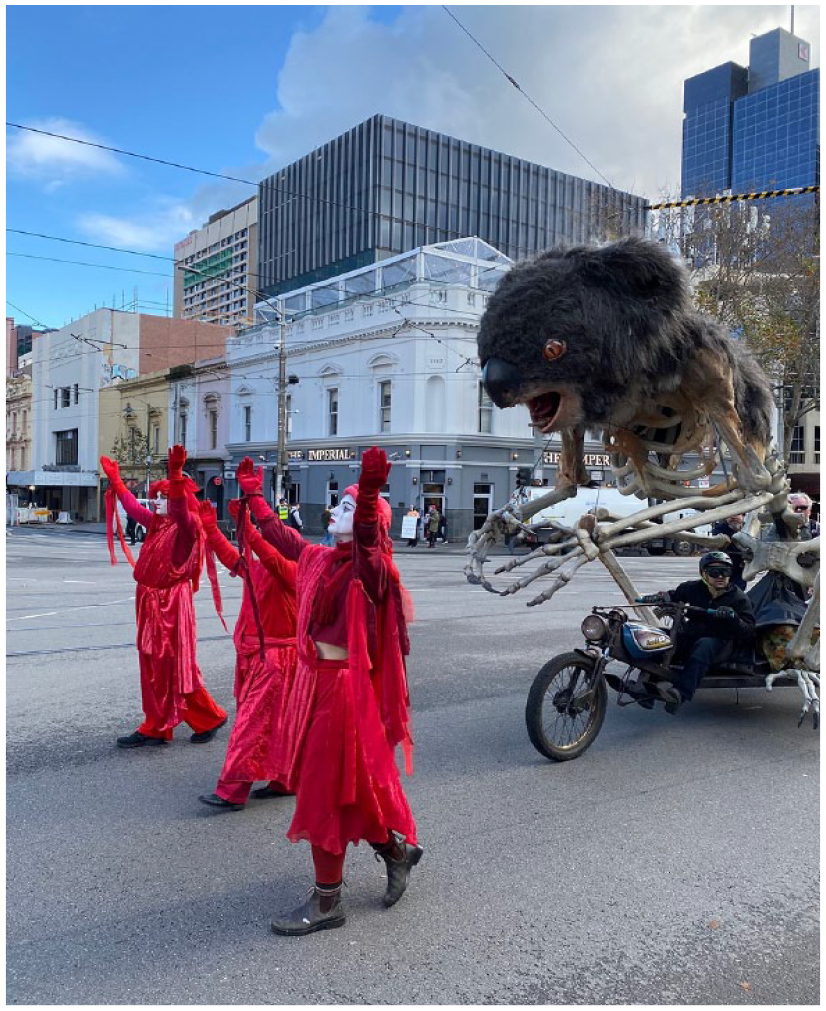
Extinction Rebellion Red Rebels, with koala.
In the same location, anti-lockdown protesters displayed a model gallows and an inflatable effigy of State Premier Daniel Andrews (Zagon, 2021). Their demands and claims were numerous: SACK DAN, NO VAX MANDATES, SACK DAN STAY HOME / STAY SAFE / SLAVE LIVES End Lockdown NOW / Dan-made Disaster!!!! GOD BLESSED US WITH AN IMMUNE SYSTEM / NO TO THE EXPERIMENT / HOPE FOR THE BEST VACCINES ARE CHILD ABUSE MY BODY / MY CHOICE
Visually, the Freedom protests are a riotous jumble of causes and claims manifested at events through the clothing, chants, banners and placards on display. Nowhere was this more obvious than outside the Park Hotel, which was used to detain refugees and, briefly, the unvaccinated Serbian tennis player, Novak Djokovic, who had been refused entry to Australia in January 2022. For several days, the street outside and nearby park were occupied by a crowd whose members wore, variously, Serbian national dress, MAGA baseball caps, Anonymous masks, Free the Refugees T-shirts, and carried Indigenous flags. Once Djokovic was deported from Australia, the Freedom protesters removed their protest to Parliament House, ignoring the remaining immigration detainees. The Refugee Action Collective, however, maintained a visual presence so that the space of the street outside the Park Hotel accommodated a range of dramatically different political aims.
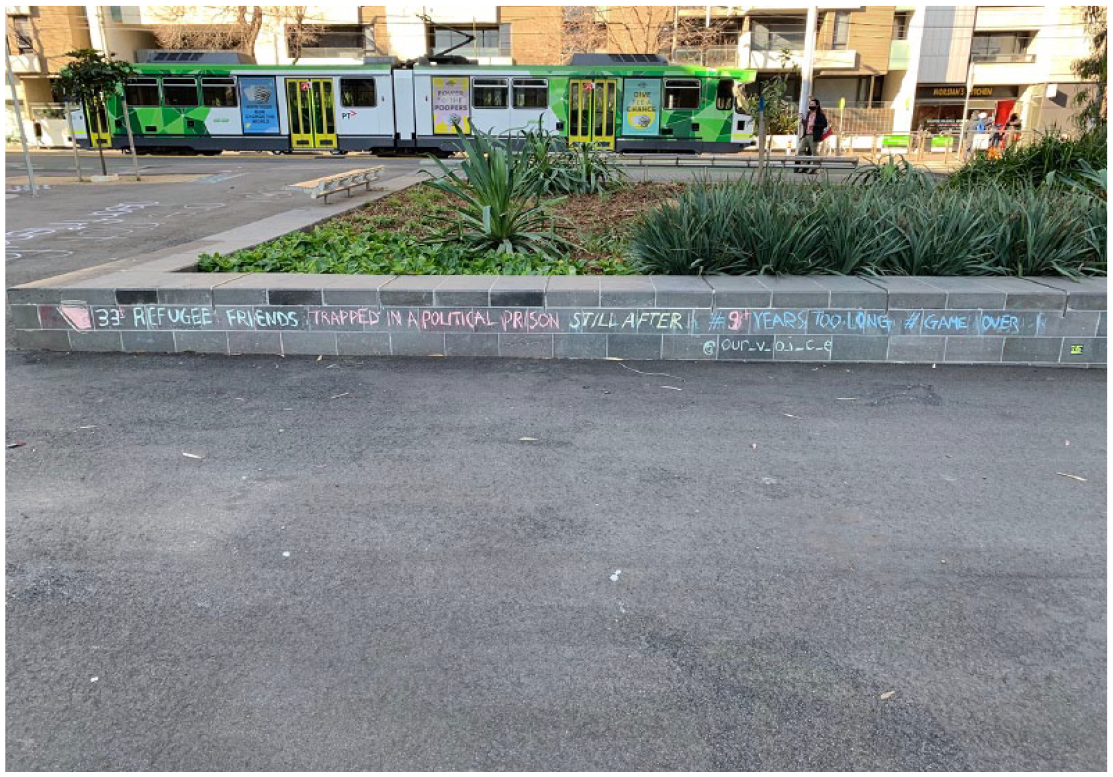
Message to detained refugees, Melbourne.
Demands are written on the footpaths and the building itself: ‘33 refugee friends trapped in a political prison sill after #9+ years too long #gameover’. Messages appear along the footpath opposite the hotel for the refugees: ‘YOU ARE NOT FORGOTTEN DEAR FRIENDS’.
In addition to connoting the wearer’s membership of a community with shared demands, clothing also marks individuals as objects to be policed. Police seek to identify protesters during and after events, with officers dedicated to filming and photographing those present. Prospective protesters are commonly advised to dress with policing tactics in mind, avoiding distinctive clothing and covering tattoos: Wear nondescript clothing in solid colors, preferably in layers, too, in case one layer is exposed to chemicals. . . wear a hat that will provide protection from both the sun and chemical weapons. (Huber, 2020: unpaginated)
Just as protesters seek invisibility in the police gaze, ‘what itinerary must we travel to move from the space of appearance to the contemporary politics of the street?’ (Butler, 2011: 2). Part of that itinerary requires us to move away from the certainties and centrality of vision, and towards the significatory capacities of other senses.
The acoustics of protest
The trope of voice is deeply embedded in political communication: ‘we are not simply visual phenomena for each other – our voices must be registered, and so we must be heard’ (Butler, 2011: 3). Sound is, of course, more than voices. Social movements regularly use music to communicate their ideas: in Britain, the Rock Against Racism movement used music to struggle against fascism and the National Front during the 1970s and 1980s (Renton, 2018); in Japan, musicians drew on a lengthy history of music-making as part of antinuclear protest after the nuclear meltdown in Fukushima (Manabe, 2016). Some protest songs have been specifically written, such as those sung at Extinction Rebellion events; others have been re-purposed by protesters.
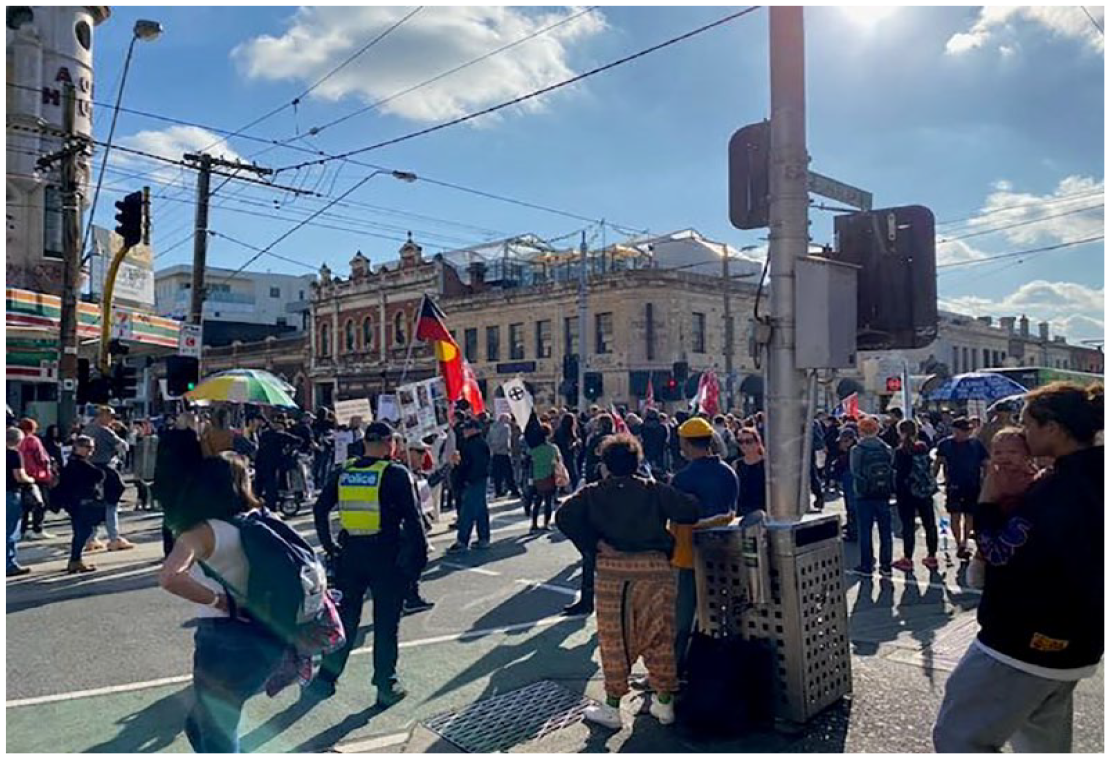
Anti-vaccination protesters singing, ‘I Am Australian’.
From my living room I can hear a loud noise in the streets. A large group of anti-vaxxers are marching. I follow them, taking photographs and filming. The anti-vax movement has become closely intermingled with far-right and alt-right groups such as Reignite Democracy Australia. When they pause at an intersection, they sing ‘I Am Australian’, a well-known song taught in primary schools, with numerous sentimental nationalist references.
Songs are usually chosen because they directly or indirectly communicate something related to the protest. Some connections are opaque or tangential: in September 2021, thousands of protesters blocked the West Gate Bridge (Rose et al., 2021), singing a song called ‘The Horses’ by Daryl Braithwaite, for reasons unclear to many.
In addition to singing, chanting is a common means of communicating the aims of the protest. In Black Lives Matter marches and rallies after a police shooting or death in custody, protesters commonly chant ‘I CAN’T BREATHE’ (repeating the dying words of those murdered by police including Eric Garner and George Floyd). In a call-and response chant, the question, ‘Whose lives matter?’ is met by the response, ‘
Chants have other linguistic and sonic characteristics. Questions are posed and answered: ‘What do we want?’ ‘
‘End the tyranny!’, ‘
Wake up Melbourne!’, ‘
Let me work!’, ‘
Other questions are rhetorical:
One jab, two jab, three jab, four. How many jabs till we say “no more”?’ (‘
Chants do not occur in a decontextualised void. They are situational performances. Clifton and de la Broise (2020) discuss a chant at one of the gilets jaunes protests in Paris (pp. 372–373). A protester shouts: ‘MACRON SI T’ES CHAMPION DEMISSIONNE’ (Macron, if you are a champion, resign!’). Linguistically, the chant is notable in its informality: it uses tu (‘T’ES’), a disrespectful form of address for the French President. But more than this, the words, rhythmic character, repetition, and informal grammar combine with bodily gestures (jumping up and down while chanting, waving a bottle and thus threatening more property damage), yellow vest, and position in front of a burning toll booth (Clifton and de la Broise, 2020) to form a complex sensory assemblage.
In October 2019, an Extinction Rebellion march and temporary blockade in the centre of Melbourne generated another distinctive assemblage:
No trams run while we march through the city centre, their loud rattle removed from the streetscape. A helicopter hovers in the sky overhead. Police. Surveilling the march. When a signal is given, we all sit or lie down in the street, occupying a large intersection. Gradually, the hum of chatter falls away. I can hear birds. A drum is struck somewhere, a regular, melancholic tolling; a gamelan flute chimes. A group of Red Rebels move through us. A single speaker starts to call out ‘The ice caps are melting, the seas are rising’. . . The Rebels step carefully over torsos and legs, moving slowly and silently. The birdsong and helicopter drone seem far away. After a few minutes we stand and move on, and sound rushes around us once again.
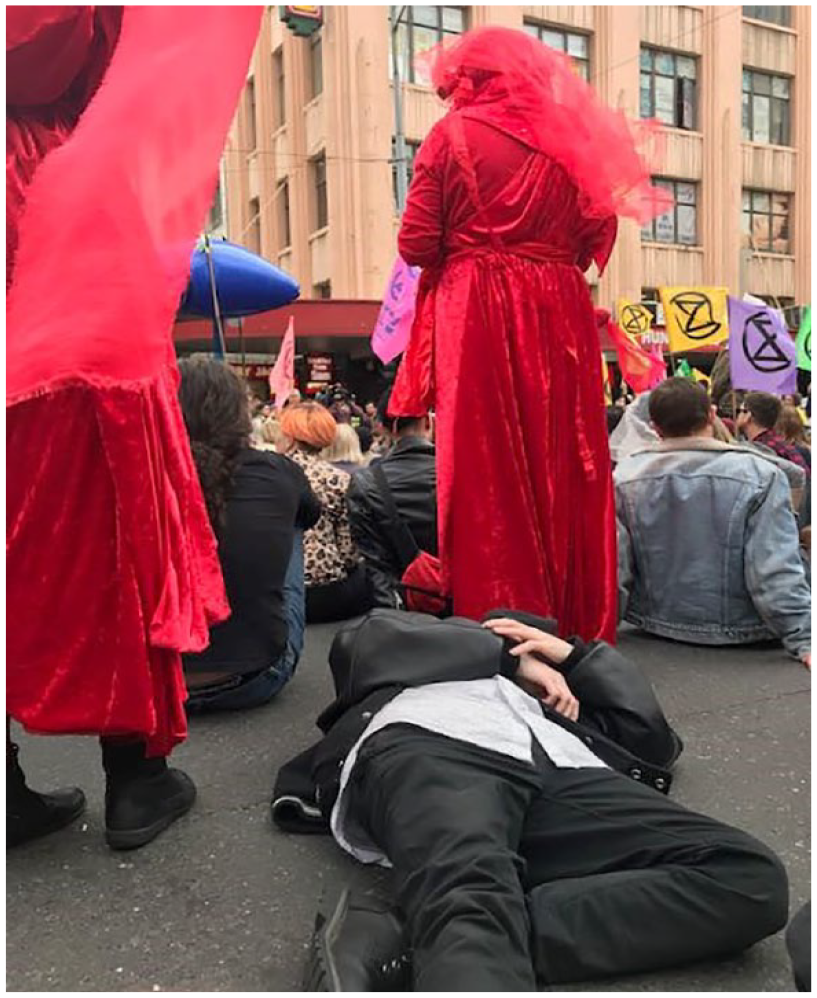
Extinction Rebellion, Melbourne.
If analysed as a sonic event within a situational context, the various constituent elements coalesce into an assemblage typical of an Extinction Rebellion protest: silent individuals dressed in red, moving slowly; the speaker’s voice; the slow sound of drum and flute. Vocal silence here is not a refusal of speech, but an element of a near-silent surrounds (Simone, 2022). Silent rallies such as this create a space of silence within the conventionally hyper-noisy metropolis and paradoxically amplify the impact of protest (Johnson and Haarstad, 2022: 9). The surveilling helicopter acts as a reminder of the presence of police nearby, standing along the pavements surrounding the intersection.
Loud sound has its own distinctive character. The generation of high-volume sound can countermand spatial constraints used to control a large event. In Tokyo, anti-nuclear protests (kōgi) are held on Friday evenings outside the Diet (Parliament) building in Tokyo. (The ‘triple disaster’ of the 2011 Tohoku earthquake, tsunami and nuclear meltdown intensified the deeply rooted activities of Japan’s anti-nuclear movement: Brown, 2018; Liscutin, 2011; Ogawa, 2013.)
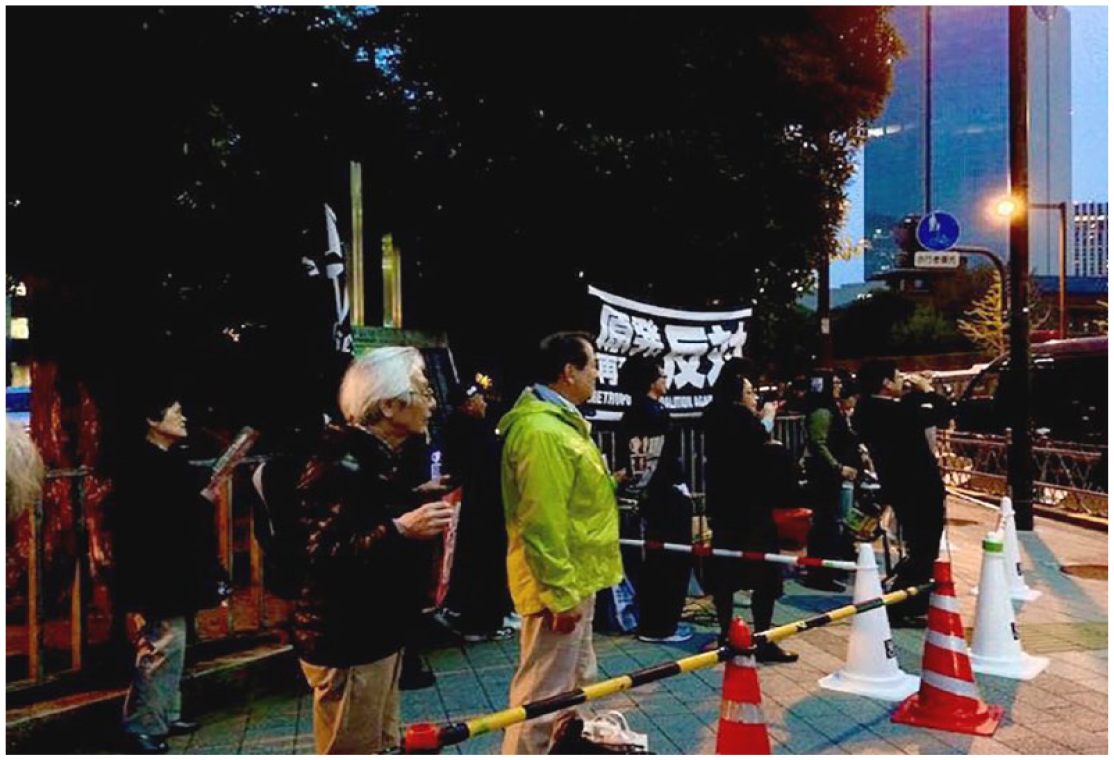
Part of a long, thin, loud line: anti-nuclear protesters, Tokyo 2017.
On a Friday night in April 2017, protesters were corralled behind barricades constructed with traffic cones along the pavements. At every point, the effect is one of scant numbers, since protesters cannot fill the space more than one or two people in depth. But the constricted space means the crowd stretches along several large blocks, threading through the government district. Protesters compensate for their spatial thinning through continuous rhythmic drumming, lasting well over an hour. Complex call-and-response chants are led by individuals with loudspeakers, generating a huge volume of sound that occupies an area that would normally be empty of sound other than traffic noise.
Manabe (2013) writes: ‘Music has long been a part of demonstrations in Japan: percussive instruments and the rhythmic. . . call-and-response pattern were featured in demonstrations since the end of the Edo Period [the 1860s]’ (p. 1; Abe, 2016). Drumming in Tokyo provided the bass beat to protesters’ chants; in other locations, drumming at protests has so dominated the soundscape that it has engendered specific auditory disputes and control responses.
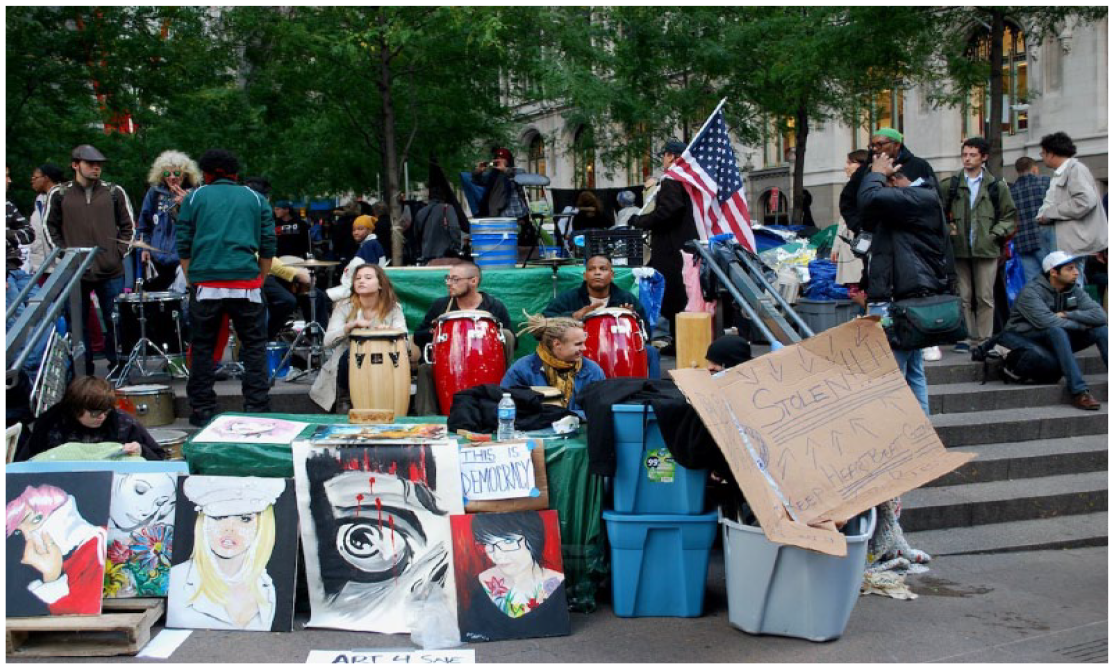
Drummers in Zuccotti Park.
Sound travels, ‘inherently spatial, moving as a wavelength through bodies, ricocheting off hard surfaces, echoing through urban corridors, and propagating loudly or softly in accordance with the technologies that produce it and acoustic conditions that enable it’ (Weitzel, 2019: 209–210). Protest sounds can be ‘small’, such as the chiming sounds accompanying some Extinction Rebellion events, or when protesters at the Black Lives Matter rally in Melbourne in June 2020 thumped their chests in unison to mimic the sound of a heart beating. More often, protest noise is ‘large’, intended to grab attention. The duration of ‘large’ noise-making can determine whether or not a protest is permitted to continue.
Occupy Wall Street generated a great deal of sound within and around Zuccotti Park: one could hear the protest before encountering it visually. At Zuccotti Park, ‘motley assemblages of drummers combining African-based hand drumming with frame drums, full rock kits, buckets, water bottles, and whatever else was at hand’ generated a sound that ‘captures not only the spontaneous culture of Occupy, but a distinctly American folk music influenced by the sonic migrations of African musicians in the Americas’ (Mindel, 2021: unpaginated). At the outset of the protest, drummers in Zuccotti Park were drumming for around 10 hours a day, sometimes more.
Gradually, nearby businesses and residents in adjacent buildings became impatient with the noise. The sonic spatiality of the drums’ ‘relentless polyrhythms’ flowed outside the perimeter of the park and echoed through the neighbouring streets. Attempts were made to agree acceptable drumming times and duration: within certain hours and ending before a fixed time. Non-protesting locals sought a maximum 2-hour duration; drummers wanted a minimum of 4 hours (Memmott, 2011). In late October 2011, the drumming began to increase once more: many drummers did not want to drum only when permitted. McArdle (2011) noted: ‘Last night the drumming was near continuous until 10:30 PM. . . Today it began again at 11 AM. The drummers are fighting among themselves, there is no cohesive group’ (unpaginated). Some of the protesters found it irritating: the drumming disrupted discussion groups and drowned out conversations (Mindel, 2021).
Both tolerated and reviled inside and outside the encampment, the drum circle rapidly became a source of both ‘joy and conflict’ (Mindel, 2021: unpaginated). Although the protesters had to remain within the park, an area of privately owned land required to be open to the public 24 hours a day and from which the police would need the landowner’s permission to evict the protest, the sound of the drums was not in itself containable by the boundaries of property: Nothing made this boundary more tenuous than the drums whose pulse extended the occupation far beyond the police- enforced limits of the park, audible for miles around. (Mindel, 2021: unpaginated)
The contestation of drumming’s acceptability at Zuccotti Park adverts to auditory control as a regulatory response to protest. Some tactics fall into the ‘escalated force’ category of policing in which the use of physical force sits alongside the atmospheric ‘show’ of force, wherein the police disrupt the protest soundscape. Police manuals encourage the drumming of batons on shields to connote the forcefulness of the yet-to-come police action (Wall, 2019: 9). When done by protesters, drumming is a noise to be regulated; when done by police, drumming is a means of control that travels through sound waves into the bodies of protesters: [T]he beat of many officers’ batons on shields is a powerful vibration of material. The vibration reaches the ears of [a] protestor, but it also reaches her stomach, chest and skin. . . Endocrine processes change, glands release hormones, her body produces chemicals that change the bodily processes themselves. . . From her skin and on her breath chemicals are released that are received by the bodies of those around her. . . And. . . of course police bodies are undergoing similar changes. In short, the drumming is not a simple symbolic communication from the police to the protestors. Instead it contributes to the shifting and changing affective atmosphere. . . (Wall, 2019: 9)
The above is an example of low frequency, or ‘infrared’, sounds that affect the whole body rather than simply the ears (Lamb, 2021) and which can affect a mass of protesters. Other techniques are more targeted. Long Range Acoustic Devices (LRADs), or ‘sound cannons’ (Linnemann and Turner, 2022) concentrate loud noise into a beam that can be directed at specific protesters to produce a ‘nauseating, unbearable pain. . . the audio equivalent to looking directly at the sun’ (Lamb, 2021: nonpaginated).
Police commonly surveill protest events from above, using drones or helicopters. The latter are loud. At the Women’s March 4 Justice in March 2021 in Melbourne, thousands gathered in the Treasury Gardens to protest government inaction on sexual assault and sexual harassment in the workplace. Thanks to the incessant hovering of a police helicopter over the Gardens, very little could be heard of the speakers addressing the assembly: thrumming helicopter blades drown out even the amplified voices of speakers. Similarly, at Black Lives Matter protests in the United States, pre-recorded police announcements blasted over loudspeakers obliterated speakers’ voices (Haimson, 2020).
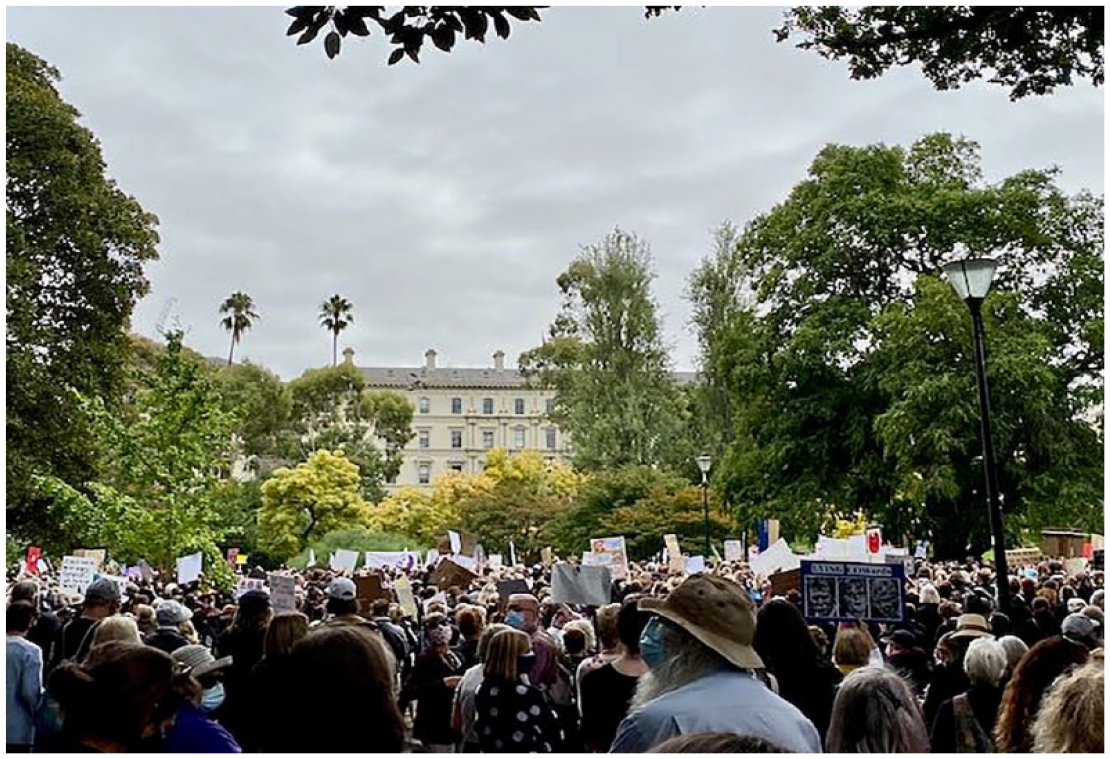
Amplification without audibility: the Women’s March 4 Justice, Melbourne.
Amplification is also contingent on local laws regarding noise. Police can also set limits on the volume or duration of amplified sound and there are restrictions on amplification that councils can invoke to shut down a protest event. In New York City, the use of microphones or loudspeakers requires a permit; the Occupy protesters in Zuccotti Park repeatedly applied for one and were denied (Appel, 2011: unpaginated). Within the park, talks took place frequently. For talks to large crowds, the protesters needed voices to carry through the noisy downtown environment. Thus, the ‘People’s Microphone’ was created. Whatever a speaker said would be repeated, many times louder, by the mass of listeners. As Appel states: The people’s mic [was] available to anyone in the park at any time, and it [became] both a tool of radical equalization and an embodied ritual of spending time in the movement. Cornel West, Slavoj Zizek, Joseph Stiglitz, Naomi Klein, Russell Simmons, Michael Moore, and other public figures who have come to the park to express solidarity all used the people’s mic, speaking in short bursts and pausing as they listened to the amplified chant/echoes of their words spreading through the assembly. (Appel, 2011: unpaginated)
While ‘difficult’, ‘strenuous and cumbersome’ (Appel, 2011), the people’s microphone was ‘an ingenious solution to the problem of mass communication’ (King, 2012: 238) and generated a distinctive intensity of participation. Moments of unexpected humour were created by its use, such as when Judith Butler visited Occupy to speak:
Occupy protester: ‘Mic check’.
Audience: ‘
Butler: ‘Hi!’
Audience: ‘
Butler: ‘I’m Judith Butler’.
Audience:
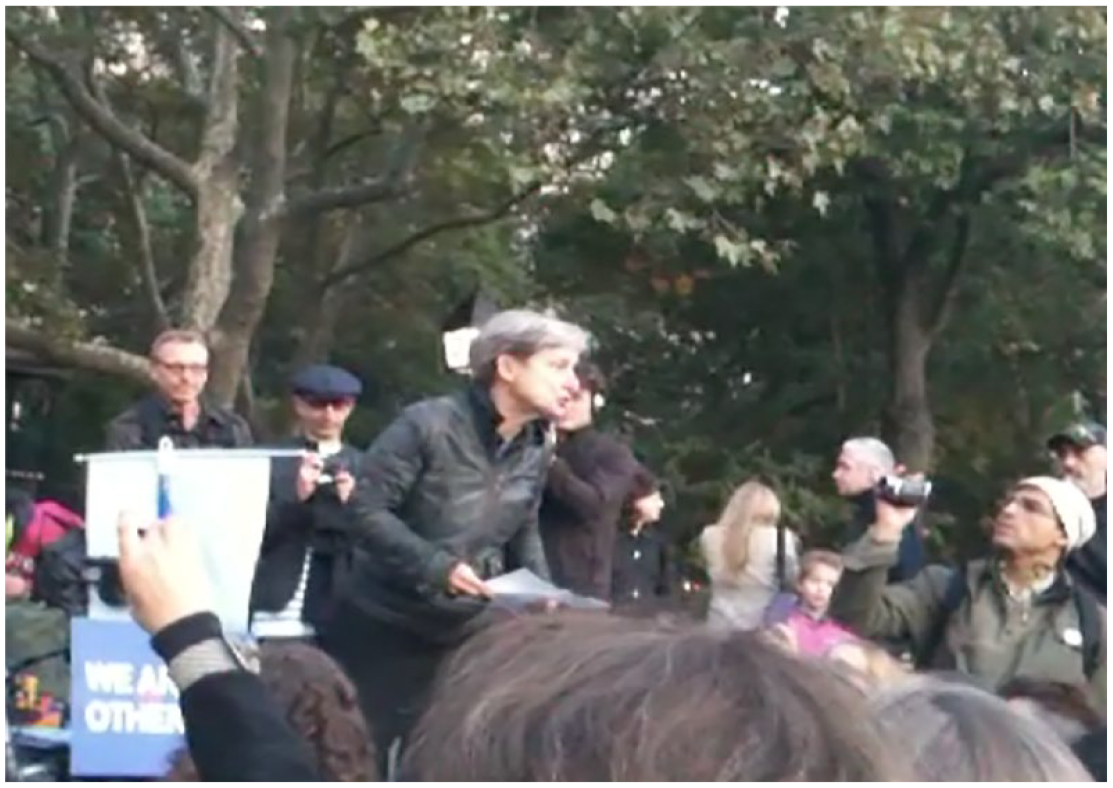
Judith Butler at Occupy Union Square, New York City.
Researcher to another person in the audience: ‘I never thought I’d ever say that sentence. . .’
Out of what was an attempt to silence or at least hinder the vocalisation of Occupy’s ideas was created ‘one of the most definitive experiences of communication at the occupation – the repetition and amplification of one another’s voices’ (Appel, 2011).
Tactile dissent
Anti-vaccination and anti-lockdown protests took place at and around Melbourne’s Parliament House throughout the second half of 2021 and in early 2023 are still occurring. Protesters set up displays of T-shirts, placards, banners and objects, along with tents in which to sleep overnight. We observed the protests on numerous occasions from mid-2021 onwards, noting the ways its communicative tactics morphed through events such as marches, encampment, and, by mid-2022, regularised activities on Saturday afternoons.
Standing on the pavement at the foot of the steps of Parliament House. Protesters have laid posters, T-shirts and other garments, toys and other objects along 5 rows of steps up from the pavement. Behind these steps, barricades create a small orange plastic wall behind which the anti-vax protesters are sheltering from the sun under umbrellas and in small tents. The steps are beige quarried stone, municipally grand, receding up and back away from the pavement. These steps are designed for climbing, ascending from the street into Parliament. I think of Pallasmaa, who writes: ‘legs measure the steps as we ascend a stairway. . . and the entire body moves diagonally and dramatically through space’ (Pallasmaa, 2012: 67). I imagine myself moving this way. But this stairway is one I don’t want to climb. The display of objects and posters on the steps issues an invitation to pedestrians: come and look closer. To look closely, I would have to leave the pavement and walk up a few stairs. I would enter the space of this anti-lockdown, anti-vaccination, anti-mask, pro-Freedom protest. I don’t want to be ‘in’ it. I don’t believe in this stuff. I think their views are dangerous. I want to be distant from this event, from them. I stand on the pavement, on the horizontal level of the street, letting the location of my feet, pressing down on the grey stones of the pavement, mark me as not a protester.
In addition to being the metaphorical locus classicus for protest, the street and adjoining pavements often provide its literal terrain. Streets, and the cities they are built in, are material environments. A streetscape might use concrete, bitumen, wood, various metals, glass, grass, plantings, and more. Protest events are always entangled with the materiality of the street, with protesters sometimes walking or resting on its surfaces; sometimes intervening in its forms. A protest march might involve walking on the surface or the thoroughfare; a sit-in or die-in presses limbs into a new engagement with the materials of the street.
During a blockade, participants glue themselves to the roadway or to pieces of street furniture (‘locking on’). An encampment adds new materials to public spaces: tents, tarpaulins, trestles with pamphlets, storage bins: during Occupy Wall Street, for example, the park was filled not only with protesters but also with tents, storage bins for belongings, and a wide range of furnishings. Similarly, Umbrella Movement protests in Hong Kong added ‘barricades formed of traffic cones and shopping trolleys covered in hand drawn slogans and banners’ and ‘[t]ents and umbrellas of every colour’ to the streetscape (Fraser and Matthews, 2021: 460; Ismangil and Lee, 2021). In each instance, the protester alters the expected (and authorised) ways in which a human subject makes contact with urban materials.
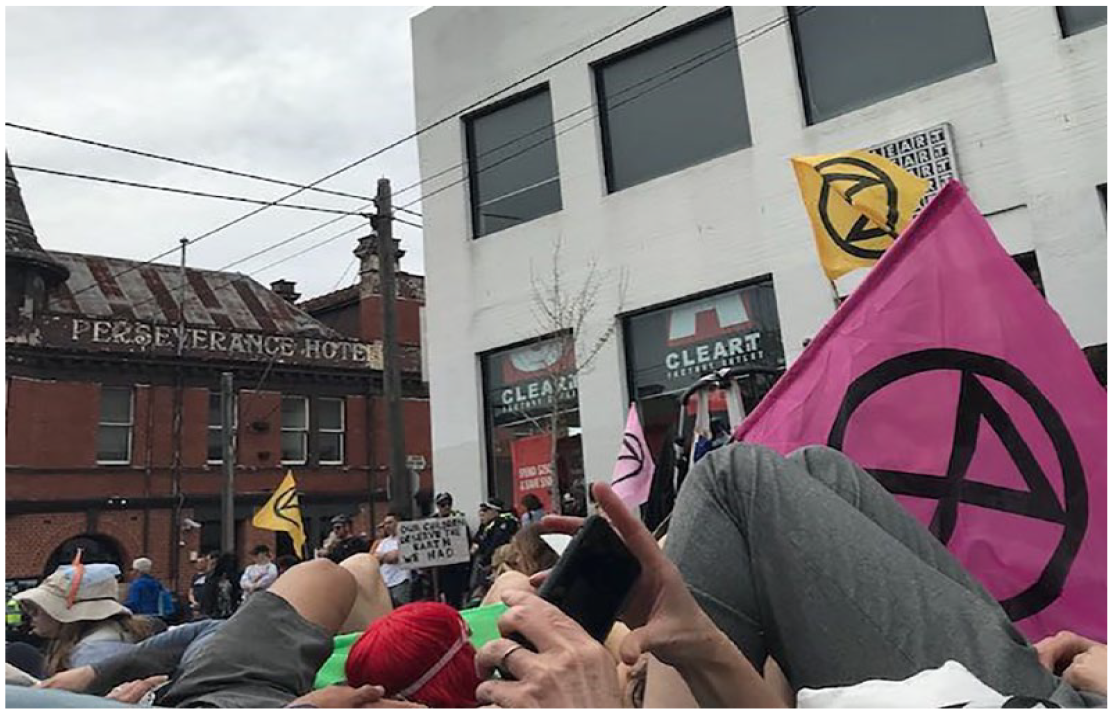
Extinction Rebellion drown-in.
In an Extinction Rebellion ‘drown in’, the choreography of protesters’ movements brought the tactility of surfaces to the fore:
A signal is given, and we all lie down on the ground. We all lie flat, or as flat as possible, layered as we are over each other. My right shoulder rests on the front wheel of someone’s bike. My back presses onto the metal spokes. Under me, the bitumen of the street forms an obdurate mattress. A metal tram track is scored through the bitumen nearby. Slowly, rebels move through the crowd stepping carefully over and between the legs and torsos. These blue ribbons are the waves of rising seas, salty water covering us and the ground we lie on.
Frequently protesters adapt the existing affordances of street locations for uses related to the protest (Popovski and Young, 2022). While a roadway is a surface intended for vehicles to drive on, its bitumen can be adapted as a surface on which to glue large tubes encasing the limbs of protesters from Extinction Rebellion, Blockade Australia, or Insulate Britain. Outside a building holding immigration detainees, a small park is intended as a space of leisure; protesters adapted it as a space to set up tables and unfurl large banners.
At other times, protesters touch street materials in ways that destroy their intended function. In November 2018 in France, the tactile interventions of the gilets jaunes (yellow vests) initially arose from the object of their protests (rising petrol prices through high taxation levels). Protesters blocked roundabouts and toll booths, thus converting infrastructure designed for the circulation of vehicles into obstacles causing vehicles to experience prolonged stasis (Clifton and de la Broise, 2020). Gilets jaunes’ actions rapidly expanded to the smashing of windows, destruction of CCTV cameras and damage to the Arc de Triomphe and numerous establishments associated with prestige products or high-status consumerism (Clifton and de la Broise, 2020; Lavender, 2019; Shultziner and Kornblit, 2020). Damage to or destruction of the materials of the street has also occurred at G20 and other recent anti-globalisation protests but were also used by suffragettes in early 20th century Britain, who smashed windows and set post-boxes on fire.
When police make contact with protesters, their touch can be assaultive: at the G20 protest in London, for example, Nicola Fisher was hit in the face by an officer (Greer and McLaughlin, 2010: 1052). Such forceful contact is often framed by police and media as legitimate (Greer and McLaughlin, 2010, 2012). Occasionally, however, police contact with protesters is acknowledged to have been violent: after an officer at the G20 protest in London struck Ian Tomlinson with a baton and shoved him to the ground, an inquest found Tomlinson’s resulting death to be an unlawful killing by police. 1
Although any part of the body experiences sensations when in contact with an external surface or material, touch as a sense finds its synecdoche in the hand. The finger or hand extended to make contact historically and culturally signifies the act of ‘touching’. Officers’ hands are deployed in a control tactic central to the response to protest events: the shove. As police move through groups of protesters, they push bodies out of their way. Their arms stretch out with flat palms ready to make contact with a protester’s body. Once contact is made the police officer continues to move forward while pushing the protester sideways or backwards, bodily momentum generating force through the arm and into the hand touching the protester.
When protesters’ backs press on the ground to perform death and drowning as a consequence of sea level rise, such a ‘physical synchrony’ or ‘entrainment’ (Weitzel, 2019: 219, 220) builds a collective sensory atmospheric of touch. When dragging protesters out of a blockade, shoving them away or down, or hitting them in the face, the ‘police hand’ ruptures the tactile synchrony of a protest in order to restore subordination through tactile control.
Taste and Politics
In his pioneering article on conceptions of space within cultural criminology, Hayward (2012) proposed ‘container space’ as a key terrain for criminological investigation: ‘the (legally ambiguous) corralling of protestors into a demarcated, confined space for an indeterminate period without access to food, water or toilet facilities. In short, [kettling] is mass detention in public space’ (p. 453). In contrast to the conventional policing tactic of dispersal, a kettle holds protesters in place for lengthy periods. Neal et al. (2019) write: Forming a kettle is an attempt at seizing and exhausting the dynamics of protest by spatial means. It intervenes into the bodily constitution of protest, struggling to destitute the political subjectivity that is potentially emerging in acts of public dissent (emphasis added) (pp. 1047–1048).
A kettle ‘destitutes’ the massed group as a political subject and as human bodies: a kettle is not merely about confinement in an easily policed location but is premised on such confinement lacking ‘access to food, water or toilet facilities’ (Hayward, 2012: 453). Within the protest are innumerable singular subjects whose bodies require these things. Caught in a police kettle, protesters become thirsty, hungry, anxious (Neocleous, 2021). 2 A medical practitioner providing assistance in a police kettle on Westminster Bridge commented: ‘Police had us so closely packed, I couldn’t move my feet or hands an inch. We were in that situation like that for hours. People in the middle were having real difficulty breathing’ (quoted in Neal et al., 2019: 1060). During protest events, breathing, and air, are highly contested.
Smell and the control of the air
Protests have their smells. Sweat from stress, or the press of bodies on a hot day. Urine, if kettled for hours by police with no access to toilets. Encampments, such as Occupy Wall Street or Occupy Melbourne can generate complaints that the bodies present emanate unpleasant odours. McArdle (2011) wrote of Occupy Wall Street, ‘I do sympathize with the people who have to live right next to the smell’ (unpaginated). Assertion of a noxious smell has long been a tool of class differentiation (Miller, 1998: 235); it also invites control responses, since smell both ‘encod[ed] revulsion’ and was ‘difficult to regulate’ (Stallybrass and White, 1986: 139). Although many neighbouring businesses and supportive residents gave protesters access to their showers and toilets (Kadet, 2011), when protesters were finally evicted from Zuccotti Park, the police notice stated the park needed to be cleaned (Deprez and Stonington, 2011), generating a near-isomorphism of ‘clearing’ and ‘cleaning’.
Some protest odours signify care and compassion by organisers and participants rather than opportunities for authorities’ control responses. This was noticeable in a climate change protest on a warm day in Melbourne:
Marching with Extinction Rebellion from the assembly point in the Exhibition Gardens through the park and then along the streets leading into Fitzroy, where a ‘drown-in’ will take place. It’s a sunny October afternoon, and the southern sun is hot on our arms and necks. XR volunteers patrol the line of marching protesters, pulling small trollies with huge bottles of sunscreen and caddies for refilling water bottles. The smell of sunscreen fills the air as we walk.
Smoke rising through the air. A cliché of protest would have it that smoke emanates from petrol bombs or ‘the burning rubber of that car’ (Wall, 2019: 149) when dissent slides into what the media and criminal law designate as ‘riot’ (Ives and Lewis, 2020). 3 But on 6th June 2020, in cities all over Australia, smoke rose from burning eucalyptus branches and leaves, part of a ‘smoking ceremony’ to mark a Black Lives Matter protest taking place on unceded Aboriginal land. The association of smoke with property damage is thus situational and contextual, erasing potential connotations such as welcoming protesters to country for the duration of the event or feeding individuals who comprise the mass-body of the protest. Walking through Zuccotti Park, during Occupy Wall Street, the smells of cooking food filled the air.
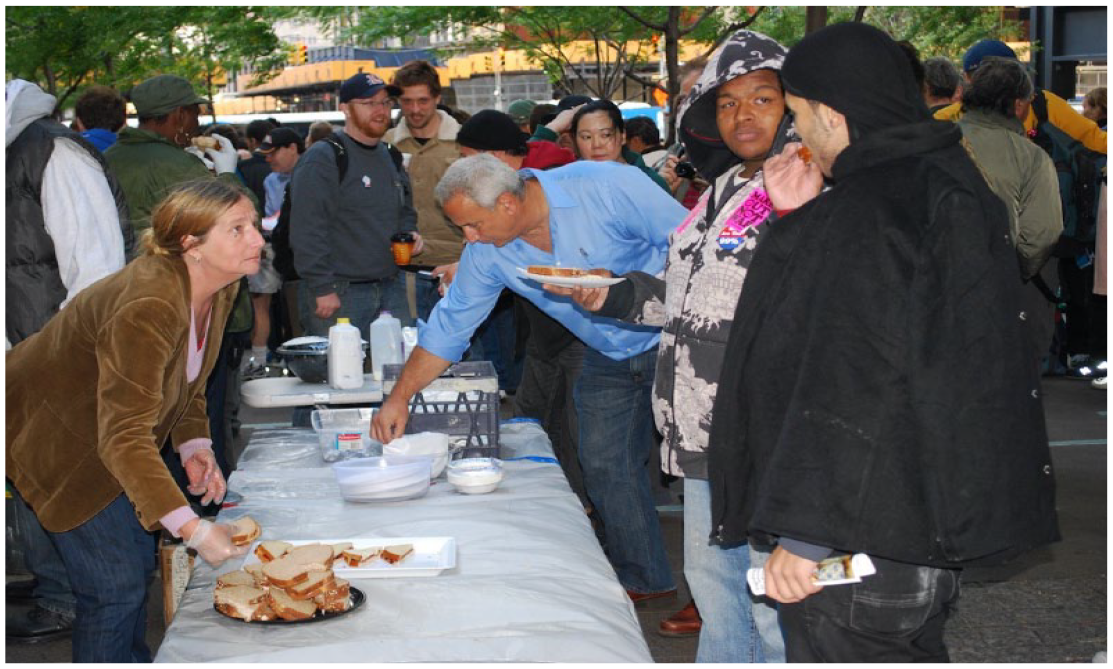
Feeding protesters, Occupy Wall Street.
During a protest event, smells signify repression more frequently than care. The ability of bodies to inhale chemicals has long been an element of what Sloterdijk (2009) calls ‘gas warfare’ (p. 9): thanks to ‘the fact of the living organism’s immersion in a breathable milieu. . . the operational manipulation of gas milieus in open terrain requires making certain “atmotechnic” innovations’ (Sloterdijk, 2009: 23; see also Wall, 2019). Some of these innovations are used as control responses to protest events. Gaseous policing includes the use of capsicum spray, also used in conventional policing, and tear gas sprayed over a group and at individuals or released from cannisters lobbed into a mass of people. Capsicum sounds like a benign ingredient in a recipe, but its key constituent (oleoresin capsicum, from the dried ripe fruit of chilli peppers) causes tearing, conjunctivitis, burning and irritation, sneezing, coughing, shallow breathing and respiratory spasm when used, and has an ‘acrid’ odour (Smith, 2020: unpaginated). During anti-lockdown, anti-mask and anti-vaccination protests in Melbourne, which occurred frequently during the period July 2021 to February 2022, protesters held in kettles were sprayed with these chemicals: ‘protesters were filmed throwing objects – including water bottles and a traffic cone – at police, who had formed a human barricade, blocking the march. In response, police deployed pepper spray’ (Landis-Hanley and Henriques-Gomes, 2021). We watched this on a livestream filmed by journalists from overhead helicopters and drones, broadcast on Twitter and on the websites of local newspapers:
Anti-vaxxers protested all over Melbourne on 17 September 2021, using the ‘swarm’ technique of mass but dispersed assembly to challenge the abilities of police to contain the protests. In one narrow street the police formed a corporeal barricade to contain the protesters in a stand-off. When protesters rushed forward, police officers sprayed capsicum spray into protesters’ faces. The oleosin capsicum leaves the cannister in a long, yellowish stream; when it hits people’s faces, they crumple away from the jet to protect themselves.
Capsicum spray is not the only inhalant used to control protests. Tear gas, so called because of its irritant properties and also known as CS gas, usually contains 2-chlorobenzalmalononitrile, and causes tearing of the eyes, itching, burning of eyes, skin and lungs, choking, coughing, salivating, difficulty breathing, involuntary closing of eyes and blurred vision or temporary blindness. A journalist, tear-gassed while covering the Black Lives Matter protest in Ferguson in 2014, described the smell as ‘acidic’ and ‘like vinegar’: ‘I clearly recall the pain after it hit me’, he wrote: ‘I was suddenly gripped by a pain so intense I nearly fell to my knees’ (Walker, 2014: unpaginated). Police thus no longer need to touch their hands to the bodies of protesters; chemical aggression can do the work traditionally performed by batons and fists.
Conclusion: Sensing dissent
Just as police seek to gain control over bodies and space through atmotechnic interventions, protestors need to develop techniques that immunise crowds or disrupt the affective forces that are brought to bear upon them. (Wall, 2019: 158)
In recounting this sensory ethnography of the ways in which public dissent takes place in urban streets, we have emphasised that the multiple sensory dimensions of protest signification are mirrored in control tactics brought to bear on protesters. Touch, taste, smell, sound and vision can communicate the aims of protest, often combining to form a complex sensory assemblage with multiple semiotic levels. Similarly, the policing of protest operates as a multidimensional assemblage in which a ‘three-dimensional policeman’ enacts ‘volumetric police power’ (Linnemann and Turner, 2022) through mobilisation of the sensory landscape against protesters.
Despite the oftentimes overweening nature of such volumetric police power, something in dissent always escapes it. Protesters again and again implement fleeting yet innovative tactics in response: in Frankfurt, ‘a group of protesters encircle a police kettle, chanting: “Hey! Hey! Our kettle is much nicer!”’ (Neal et al., 2019: 1058). Protesters have also adapted their use of space in ways that defuse the police kettle’s drive to destitute the mass-body of a protest. Tactics such as ‘swarming’ (Neal et al., 2019) disperse protesters to different locations in a city at the same time: multiple kettles are rarer than singular mass containments. Encampments, in addition to providing support and information hubs for protesters, ensure that protesters can retreat to the camp if food and water are needed. Protest sounds can breach seemingly obdurate boundaries of carceral spaces such as prisons through chanting that is heard through carceral architectures (Russell and Carlton, 2020). And as carceral sites of confinement expand throughout cities, protesters still use sound to permeate a confining wall or pierce the ‘psychic scaffolding of the prison’ (Russell and Carlton, 2020: 307).
Dissent thus dissents from the force of sensory governance, and travels further along an itinerary of the senses to retain a place for dissent in the contemporary politics of the street. As governments, councils and police take action again and again in opposition to those who would express dissent, it is important to remember the multisensorial ways in which protest can take place, and through which protesters can maintain an alliance in and with the streets.
Footnotes
Funding
The author(s) disclosed receipt of the following financial support for the research, authorship and/or publication of this article: This article was supported by funding for a Discovery Project entitled ‘Justice in the Streets: Responses to Public Homelessness and Public Dissent’ by the Australian Research Council, DP210101812
