




Abstract
Technology companies are often worth billions, but they still must make their money through advertising. The research literature on the value creation of data-driven platform companies often refers to the expropriation of data or the exploitation of users. This article proposes a relational approach to the understanding of value creation on digital platforms such as social media channels or free internet services. To this end, it combines Marxian and anthropological value theory. Accordingly, the interactions of platform users are understood as asymmetrical practices of gift exchange. This exchange of digital gifts forms the condition of production for the value creation of internet platforms, and is reproduced continuously by their asymmetrical field of interaction. Here it is not the individual who is exploited, but rather the community of those who interact in a particular field. This condition is anchored in these platforms’ terms and conditions, which stipulate that users share their data not only with each other, but also with the company, thereby enabling a three-step process of data commodification by the platform. First, the data are appropriated as use values by the platforms in order to optimize their own services. Subsequently, a secondary commodification takes place, which, unlike other value creation processes, is decoupled from the use value of the data. Third, there is a process of cybernetization, in which the ability to influence users is sold to third parties as a commodity.
Introduction
The digital economy has delivered a raft of free services: search engines, social media, email, games, office tools, collaboration programs, among many others. Corporations mostly earn money by selling advertising on freely available platforms or applications, and their success is based on the initial partial offer to customers of these free services. The rise of platform companies, and in particular the tech giants of Silicon Valley, has stimulated a running political-economic debate on the nature of the digital economy. To date, research on the development of digital capitalism is divided into two basic perspectives, which are sometimes treated as complementary. One focuses on the characteristics of platform companies and their business models from an economic and organizational sociological perspective. The other analyses the questions of economic order (“Is it still capitalism?”), labor, and value creation in the tradition of critical political economy.
The numerous studies taking the first perspective systematize and classify practices and business models of tech companies that still originate in Silicon Valley specifically (e.g., Dolata, 2019; Maffie, 2020; Srnicek, 2016; Vallas and Schor, 2020; Woodcock and Graham, 2020). A significant portion of these platforms consists of variants of two-sided markets. Zalando and Amazon are for instance trading or intermediation platforms that enable a match between demand and supply (Rochet and Tirole, 2006). Research on platforms, in which services and data are exchanged in a nonmonetary way as a win–win configuration, remains undertheorized despite numerous publications on the topic (including Fourcade and Kluttz, 2020; Kirchner and Schüßler, 2020; Schor, 2016; Sundararajan, 2016; Sutherland and Jarrahi, 2018). Specifically, the question of how these platforms create value is still unresolved with some approaches arguing that no value is created at all, and that the digital economy is in fact a new form of a rentier economy (Christophers, 2020; Staab, 2024).
Critical political economy, the second approach, discusses exchange relations and data-service exchange on the internet from the perspective of appropriation and exploitation. 1 Typically, this perspective views the power of internet corporations as a lever for “data extractivism” (Sadowski, 2019; Zuboff, 2019). 2 Most common in this approach is the conceptualization of users’ practices as “labor” which generates data and is exploited by platform companies (Fuchs, 2014, 2017; Andrejevic, 2015). This perspective draws on Marxian critical political economy, which views commodity production as objectified labor, and commodity exchange as the exchange of equivalent abstract labor. Another strand makes the opposite claim: there is no exploitation of labor involved in these platforms, hence they no longer qualify as a capitalist mode of accumulation (most prominently Wark, 2019). Some adherents to this current of analysis even argue that capitalism has been replaced by techno-feudalism (for a critical overview see Morozov, 2022).
In this article, we aim to contribute to this debate and develop an alternative approach that synthesizes competing perspectives. Our focus is on data-driven platforms that offer digital services free of charge. These include communication platforms such as Instagram, X, or TicToc, but also services like navigation or “couchsurfing.” What is the precise nature of the economic or noneconomic logic driving the generation and processing of so-called Big Data through internet-based transactions between platforms and their users? In the present article, we show that the extant approaches focus one-sidedly on forms of appropriation, and thus overlook the specific forms of value creation in the digital economy. 3
It is to be emphasized that the approach presented here relates primarily to peer-to-peer platforms (e.g. X, Instagram, and TikTok), used predominantly for communication purposes, and whose models of value creation remain opaque. Our approach does not refer to crowd-work or service platforms that act as intermediaries between customers and (formally independent) service providers for activities such as content creation, transport or housework. The extensive literature on these platforms agrees that the activities they organize should be understood as work. This is however not the case in the limited area we discuss below; the nature of the actions and value creation is disputed. It is our intent to clarify this point.
First, we recapitulate existing critical approaches to value creation on internet platforms. In doing so, we scrutinize hastily made declarations that users’ practices are value-creating labor. Such claims raise value-theoretical, but above all praxeological problems, because (at least for the actors involved) the activity in question is not conscious or intentionally utility-producing, with a purpose lying outside of the work itself (cf. Spittler, 2002). 4 As an alternative, we propose an approach which understands users’ practices as gift exchange and focuses on this from the perspective of structural inequality between users and platform companies. We recapitulate anthropological theories of gift exchange found in Mauss, Strathern, and Bourdieu and apply these to peer-to-peer relationships on internet platforms. 5
We then turn to an analysis of the commodification of gifts (cf. LiPuma and Postone, 2020). Commodified gifts are not structured according to the logic of reciprocity of gift exchange, but rather to that of accumulation (Fourcade and Kluttz, 2020). Thus, the economic practice of tech corporations may be understood essentially as a form of give-to-get. Obligatory gift exchange is followed by a secondary commodification of data produced by users. Data are collected and transformed into commodities to be sold to other companies. Additionally, optimization of the advertising ecosystem or network takes place: data can be used to improve algorithms and AI, increasing the functionality, attractiveness, and effectiveness of both the digital gift and the advertising space sold by the platforms. Here, data are reified, but in this relationship (between user and company) they remain, at their core, use values, as they bear no exchange value. As cybernetic feedback, data are also reified, and remain use values, but for the benefit the company in the form of “behavioral surplus” (Zuboff, 2019). We bring together the two elements of gift exchange and commodification in an approach that conceptualizes value production in the Big Data economy in “field-theoretical” and “relational” rather than substantialist terms. This field of value production consists of an interplay of capital (the platforms), commodified labor of software developers and data analysts, and the interactions of platform users as a condition of production. The conditions of production in mass digital interaction must be reproduced continuously and expanded by the platforms.
Labor and value on the internet
The classical political economy of Adam Smith and David Ricardo, and Marx (1992) in his critique of the two both assume that economic value is essentially created by human labor. Accordingly, the value of a commodity is measured by the societal average labor time required to produce it. The internet economy, especially in the form of social media platforms, has challenged this analytical framework: in appearance, no commodities are produced, nor is work done on such platforms, yet profitable value creation does seem to take place. Early Marxist approaches tried to resolve this apparent contradiction by arguing that the production of content by platform users is indeed value-creating labor (Terranova, 2000). This argument was later developed systematically with reference to the theory of audience as commodity (Smythe, 1981). In essence, it was argued that free internet services produce added value by appropriating the productive labor of their users without payment (especially Fuchs, 2010, 2014; see also Andrejevic, 2015; Sevignani, 2021). Yet this so-called “prosumer thesis” has also been subject to critique. Among other objections, critics have countered that it is not the unpaid labor of the users of social media platforms which generates value, but that of the employees of the respective platform companies (Bolaño and Vieira, 2015), or that of the marketing industry (Kaplan, 2020; Rigi and Prey, 2015). Some reproach the prosumer thesis with the observation that labor time, so central to Marx, is disproportionate to the value generated. The added value, detractors claim, is not realized on the platforms themselves but on financial markets. Social media activities would then primarily weave a web of affective relationships central to a reputation-based financial economy (Arvidsson, 2011; Arvidsson and Colleoni, 2012; Teixeira and Rotta, 2012). 6
From a Marxian perspective, it should be added that the prosumer thesis neglects the specific social preconditions of value-creating labor. For Marx (1992), it is not just any kind of beneficial labor which creates value. Instead, capitalist value is created only by commodified labor, that is, wage labor in its various forms. 7 From a praxeological perspective, it is also questionable whether the communication acts of platform users can be interpreted as labor. It is obviously not wage labor. But even if one distinguishes between work and labor, as is sometimes done in the discussion about work, it is not work in the strict sense of the word. From the users’ point of view, it is not a utility-generating activity whose purpose is simultaneously external to the activity—according to Spittler (2002), these are the necessary criteria for work. Activities on platforms are practices, a bundle of bodily and knowledge-based actions that have their own materiality and are interwoven with artifacts, such as computers (Schmidt, 2012). According to this perspective, work is a practice, but not every practice is work. However, this is what proponents of the prosumer thesis assume of actions on platforms. Beverungen et al. (2015) therefore remark critically that the prosumer thesis is, on the one hand, too strongly oriented toward wage labor and, on the other hand, does not adequately explain the subsumption and control of unpaid labor by capital. Representatives of the so-called information rent theory describe the transaction behind the “audience commodity” not as unpaid labor, but as a basic rent on social media as advertising platforms that flows from advertizers to the platform companies (Caraway, 2011; Frayssé, 2015; Huws, 2014; Pasquinelli, 2009; Rigi and Prey, 2015). Surplus value would then be created only through labor that produces goods sold through advertising (Azhar, 2017; Robinson, 2015). Adherents of the technofeudalism thesis push this argument one step further: for them, platforms represent a feudal mode of accumulation, which does not rest on the capital-labor relationship but rather on the extraction of rents from pre-existing activities (prominently Dean, 2020).
All the approaches reconstructed here have in common the more or less central reference to the concept of labor in Marx's early writings. Labor is understood not only as the metabolism of human beings with their environment, but also as the “relinquishment” of creativity and thus individuality. In a key passage, Marx states: The more the worker spends himself, the more powerful becomes the alien world of objects which he creates over and against himself, the poorer he himself—his inner world—becomes, the less belongs to him as his own. […] The worker puts his life into the object; but now his life no longer belongs to him but to the object. […] The alienation of the worker in his product means not only that his labor becomes an object, an external existence, but that it exists outside him, independently, as something alien to him, and that it becomes a power on its own confronting him. It means that the life which he has conferred on the object confronts him as something hostile and alien. (
Marx, 1959
:22)
This conception of exploitation and alienation has been applied to digital labor by arguing that internet corporations appropriate the “relinquishment” of their users’ personalities (Andrejevic, 2011; Schaupp, 2017). In doing so, they appropriate not only unpaid labor, but also a “behavioral surplus” (Zuboff, 2019), that is, the potential for data-based and feedback-based manipulation of users. Therefore, their divestment confronts them in an even more alien and hostile way than in analog commodity production. Normatively, in the Marxist debate, an implicit right to the product of one's own labor is derived from this observation, or formulated differently: a right to the protection of individuals’ ownership of themselves.
In order to gain a fresh perspective on the rather entrenched positions of the debate, it is worth examining it from outside the field. The anthropological debate around the concepts of labor and gift exchange is particularly useful here. Although this debate stems from research on segmented premodern societies, gift exchange has not disappeared in modern differentiated society, but persists, and is especially important in large-scale institutions (Adloff and Mau, 2006). As we discuss in the following sections, the theory of (gift) exchange can make a significant contribution to sociological analysis of the digital economy.
Theories of gift exchange and the digital economy
The concept of the gift economy was a central feature of cyberculture in the early days of the internet. Content was not only made available for free, but was also nonproprietary in form; its code was open source and thus generally reproducible. These gifts of the early phase of the internet did not become the private property of individuals, but were rather made available to “communities” for their further development. This community-orientation formed the basis of much of the mythology of the early internet (Barbrook and Cameron, 1996; Turner, 2008). Here we will focus on inequality relations in digital gift exchange.
The community-oriented form of the gift was marginalized in the wake of the commercialization of the internet. The business models of the internet economy's largest corporations commercialized the mode of gift exchange within their sociotechnical ecosystems (Staab and Nachtwey, 2016; Pfeiffer, 2013): Give-to-Get represents one such particular form of gift exchange. Here, the user receives a free product initially, bringing some benefit—an email address, a social media profile, free storage space. This free benefit builds trust, retention, and loyalty, but in the long run it is discounted by users’ own counter-gifts, namely their unremunerated metadata and content. The extensive social science debate on the economic role of users in free digital services, critically reconstructed above, takes this as its starting point. Yet the classical theory of gift exchange represents—in our view—a more useful guide to this process. The limits to the transferability of the approach are nevertheless also apparent. Unlike the gift exchange of traditional societies, digital acts of exchange are sociotechnically mediated, anonymous, and delocalized.
Forging social relationships through unpaid labor and gifts is hardly a novel phenomenon of the digital age. Marcel Mauss (2002) describes gift-giving as a central element of social interaction and integration in “archaic societies.” In Mauss's view, gift exchange was an entirely social fact that regulated cultural and social reproduction and created reciprocity. In gift exchange, a reciprocal relationship is established through the gift, but the counter-gift and its timing are not specified. In contrast to economic market models, which abstract from concrete social relations and assume equivalence and synchrony in the act of exchange, Mauss emphasizes the social embeddedness of gift exchange, based as it is precisely on an asymmetrical relationship and nonequivalence (cf. Adloff, 2016: chap. 4). Yet, as Mauss argues, gifts are by no means elective, but rather based on an obligatory reciprocity of giving, or what amounts to institutionalized exchange. For Mauss, the obligation to give in return derives from the fact that every gift also contains an aspect of the giver. As we will see later, this is also central to interactions on digital platforms, although the obligatory reciprocity of gift exchange is applied quite one-sidedly.
The Marxian concept of labor, so central to the debate on internet-based value, has often been criticized in the anthropological discourse. Marilyn Strathern (1988) accused it of naturalizing a specifically capitalist concept of private property: the Marxian perspective, Strathern argued, overlooks the fact that artifacts are never the sole product of an individual, but that a larger number of people are always directly involved in their production, or at least indirectly provide for their preconditions. “A vocabulary which turns on the deprivation of ‘rights’ must entail premises about a specific form of property. To assert rights against others implies a type of legal ownership. Does the right to determine the value of one's product belong naturally to the producer?” (Strathern cited in Graeber, 2002: 38). Only under capitalist conditions do people produce objects as objectifications of themselves, seemingly independent of any social relations. By contrast, among the Melanesians in Papua New Guinea studied by Strathern, people produce objects as aspects of themselves in relation to other actors in a manner explicitly aimed at transforming one kind of social relation into another (see also LiPuma and Postone, 2020). In short, value and value creation are the result of social relations and interactions. 8
Although they are based on the study of “archaic” noncapitalist societies, these considerations also prove helpful for the analysis of the internet economy (for a separate internet-related application, see Harris et al. 2013). The content created by social media users, for example, is firstly a product of social relations: as with Melanesian artifacts, they acquire meaning and value only by having been “shared” in a community of other users. Such objects are only conceivable as gifts to this community.
Yet at the same time, gift exchange is not an extra-economic phenomenon. Pierre Bourdieu (1977) argues in his ethnological research on the Kabyles that gift exchange is an institutional disguise of what is actually an economic relationship, obscured only by the lag between the exchange of gift and counter-gift (as distinct from barter): “A rational contract would telescope into an instant a transaction which gift exchange disguises by stretching it out in time” (Bourdieu, 1977: 171). Peter Blau (1968) takes up this economic perspective and emphasizes the self-interest of exchange relationships. Like Mauss, he acknowledges the sociality of acts of exchange and the cooperative preconditions for achieving goals, but differentiates between social and economic exchange. In social gift exchange, for Blau, the counter-gifts cannot be exactly specified, whereas in economic market exchange, “the exact obligations of both parties are simultaneously agreed upon” (Blau, 1968: 454). Taken together, these perspectives on the gift offer a promising analytical framework for examining the social actions underlying the internet economy. We will present this initially at the level of peer-to-peer and then at the level of peer-to-platform relations.
Peer-to-peer gift exchange
Social media relationships on the internet economy's platforms may be understood as institutions of gift exchange. In addition to material “monetary gifts” in crowdsourcing, interaction among platform users likewise bases itself on symbolic gifts. Users “give” each other the products of their creative endeavors: painstakingly staged images on Instagram, polished aphorisms on X (formerly Twitter), detailed product reviews enabling others to gain an overview of the flood of commodities in the internet marketplace. This is, as it were, an important explanatory factor for the great appeal of the platforms. Similar to the Kula studied by Mauss, every gift on the social media platforms contains something of the giver. This increases the value of the digital gift and gives the giver a chance for self-presentation. Like the Kula, social media users describe such ensouled gifts as appearing to have a life of their own. In this sense, then, no relinquishment of a preexistent self through labor takes place on social media platforms. Rather, the digital self emerges at the outset through “sharing.” In this, too, the users of the platforms resemble the Melanesians studied by Strathern (1988). In contrast to the prevailing belief in modern capitalist societies, Melanesian society does not conceive of an individual core to human beings. Instead, the subject is constituted primarily by what others think of it. Since these perceptions necessarily differ, Strathern speaks of a “dividual” or “multiple” person. Such a concept also applies to the subjectification techniques of digital networking. Thus, the digital gifts of tweets, likes, and selfies can be seen as “performances of the self” (Papacharissi, 2012). Unlike the exchange of gifts in “archaic” societies, which was a temporally delayed and purposeful act, the connection that digital gift exchange creates is recreated with each use of the app (cf. Fourcade and Kluttz, 2020: 4). Through this mechanism, the element of partial transmission of personal properties through the gift, as analyzed by Mauss and Strathern, becomes permanent and reflexive. However, and this follows the argument that acts of exchange abstract from the individual, platforms remain indifferent to the individual data of users (Zuboff, 2019).
As with the gift exchange in “archaic societies,” reciprocity on social media platforms is anything but optional. It is rather both socially institutionalized and technically mandated. Examples here include various mechanisms for ensuring reciprocal reviews, but also the institution of “follow-for-follow” that is common on all social media platforms. The latter represents a particularly interesting borderline case, as here, a counter-subscription is promised in advance for every subscription to a particular social media channel—regardless of the respective content. While this practice is common, it is just as often regarded as somewhat indecent, as it turns the always implicit reciprocity of gift exchange into an open quasi-contract. The practice is socially sanctioned because it calls into question the concealment of the nature of exchange, what in Bourdieu's sense lies at the core of gift exchange as a social institution.
The anthropological theory of gift exchange illuminates peer-to-peer relationships among platform users. This relation is the true core of the idea of a “sharing economy” (Sundararajan, 2016). The relationship between users and platform companies is however not characterized by symmetrical “sharing,” but by structural inequality. In particular, Elder-Vass (2016) has shown that while interactions on internet platforms can certainly be understood as a form of gift exchange, the gifts themselves are appropriated by digital corporations. In contrast to the principle of reciprocity in gift exchange, the internet economy as a capitalist process of exploitation is built on the principle of accumulation (Fourcade and Kluttz, 2020). In the following, we elaborate upon a proposal for how this should be seriously considered, but without at the same time rejecting the perspective of gift exchange.
Peer-to-platform gift exchange
Digital gift exchange exhibits a specific materiality, and initially in relation to the material character of digital data. Classical goods are characterized by rivalry in consumption. Their use excludes others from their consumption. Shoes cannot be worn by two people simultaneously. Data, however, are nonrivalrous goods (Jones and Tonetti, 2020). The consumption of data by one party generally does not affect its consumption by another. The data the user provides may be used by those who have access to it. In this sense, users are not expropriated by tech companies—their personal data continues to belong to them, but they grant the company nonexclusive rights of use. Through the use of the platform and the user's activity, data are created on the platform itself. For these data, the user cedes ownership rights over data to the platform, which the latter may resell or—more precisely—from which it may derive rents (Birch and Munesia 2020).
Digital gift exchange takes place in two stages. During the first stage, the relationship is contractually regulated by the acceptance of the terms of service (an element that indicates the hybrid character of the digital exchange, which already contains elements of the market and prepares its subsequent commodification). The user creates an account and thereby gains access to the platform. Over the course of the use of the platform, however, gift exchange does not take place sequentially, that is, delayed in time, but synchronously and in actu. Through this synchronization process, gift exchange already approximates the form of market exchange.
The user is able to access the platform for free, 9 but with every use, a gift exchange (service—user data) takes place. Digital gift exchange thus not only establishes a relationship, but this relationship is renewed each time with new data. In this sense, users of internet platforms actively exchange information with “friends” and with the platform simultaneously. Two types of exchange relationships thus prevail on social media platforms: those among users (peer-to-peer), and those between users and platforms (peer-to-platform). The platform serves as the infrastructure for the exchange relationships, and the platform company thereby receives data from two sources: the individual user data (service-for-user data), and the data drawn from the interactions among those users performing exchange acts, or reacting to each other on the platform (see Figure 1).
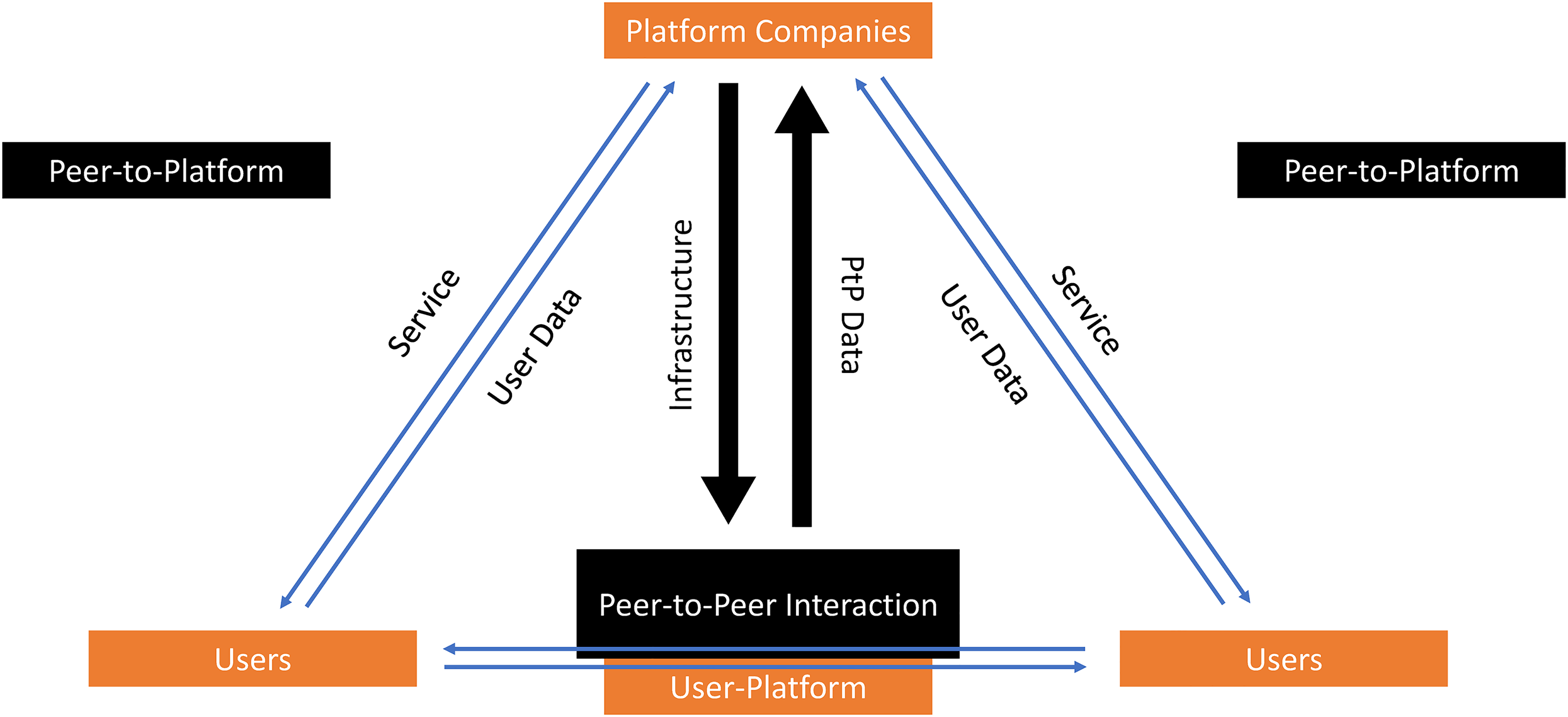
Gift exchange processes of platform companies (source: own representation).
While the terms of service present users and platforms as equal contractual partners, quantitative studies have shown that users feel increasingly uncertain and powerless regarding online services’ data handling, rendering privacy protection subjectively futile. This “privacy cynicism” results largely from the feeling that one must use the communication channels provided by the platforms in order to avoid social exclusion (Lutz et al. 2020). Hence user dependence on digital services and infrastructure in daily life increases, and becomes an important source of power for platform companies as utilities. It is not only the “FoMO”-mechanism (Fear of Missing Out) that keeps people on social media channels; without messenger services or collaboration platforms, cooperation and sociality are hardly imaginable and practicable for many. Draper and Turow (2019) even argue that such “digital resignation” is strategically manufactured by digital corporations in order to safeguard the extraction of data, which lies at the heart of their business model. In sum, the relationship between users and platforms is highly asymmetric.
Much of the exchange among users on platforms initially is not commodified. The gift has a use value for the users, but it has no price. The supposed negation of calculation is a strength of this exchange process, as in the gift according to Mauss. And because digital platforms are ceaselessly changing, optimizing, and expanding, exchange processes are never quite complete, remaining vague, and provisional. As Bourdieu describes it, the digital exchange process makes the process of hiding the economic interests behind gifts immensely easier. Gift exchange is designed by the platforms in such a manner as to never be fully complete. New gifts are added, the rules are constantly changed, and it is hardly possible for users to consider a gift relationship settled.
Following Blau's (1968) perspective outlined above, the users’ relationship with the platform presents itself as a hybrid of gift and market exchange. As a rule, a nonmonetized exchange of concrete and useful—in Marx's terminology—use values takes place. From the user's perspective, what is exchanged is something relatively nonspecific (e.g. data or content) in order to get something specific (e.g. an email inbox). To an extent, this process is consonant with market exchange or contract as described by Blau. Although Mauss's approach had already addressed competitive and powerful forms of gift exchange, Blau analyzed the dynamic of exchange between asymmetrical actors, specifically as it intensifies and reproduces itself: “A benefactor is not a peer, but a superior on whom others depend” (Blau, 1968: 455). The asymmetrical constellation between providers and dependents is a “source of power” (Blau, 1968). Although providers are also dependent on gift exchange, their power increases when those who are dependent on them have no alternatives, and neither the capacity to generate their own resources nor the infrastructure to create a needed good or service.
Obligatory gift exchange 10 is followed by a general “assetization” (Birch and Muniesa 202) and then repeated commodification of those data produced by users and interaction relations. Interactions acquire a new character through digital mediation; every interaction is objectified by datafication (Schwarz, 2021: chap. 2). 11 This takes place in three processes, with the second and third based on the first. In the first, valorization occurs. The primary “user data as use values” remain in the sociotechnical ecosystem of the platform and are used to improve platform algorithms. This increases the functionality, attractiveness, and effectiveness of both the digital gift and the company's actual product. The processed user data are subordinated to the value generation process. They are not monetized and not commodified, but merely reified as assets. Human activities and relations are transformed into data objects, but in the user-enterprise relation they remain essentially use values bearing no exchange value.
In the second process, the data are processed and repeatedly transformed into commodities to be sold on to other companies. 12 We call this process “secondary commodification” 13 because the data from the primary user interactions are reoriented for other purposes. The term indexes the subsequent commodification that serves a commercial capitalist end, and we understand commodification as a subcategory within the broader process of assetization (Birch and Muniesa 2020) Here, the processed data are sold to third parties as commodities. Since the primary product or service of the companies under discussion is a nonmonetized use value, that is, the exchange of gifts is prior to becoming commodities, there is paradoxically no primary but only a “secondary commodification” of the data. The notion of secondary commodification thus means, first, that the data do not become a commodity in the primary value creation of the enterprise; and second, that the process is sequential.
In the commodity production analyzed by Marx, the commodity has a use value and an exchange value simultaneously. But the purpose of all commodity production is the production of exchange value, its utilization, and finally the accumulation of capital. In the primary process of exchange on internet platforms, on the other hand, use values are exchanged from the viewpoint of the users. These only acquire exchange value through the process of sequential secondary commodification on the part of the platforms.
The third process can be described as “cybernetization”: the collected data/assets enable the precise profiling of users, which, in addition to determining their consumer preferences, also consists of determining future behavior. As is well known, these profiles are used for targeted advertisement, based not on individual profiles but on patterns in aggregated profiles. Unlike traditional advertising, however, this is no “one-way communication,” as with an advertising billboard. Instead, platforms react adaptively to the behavior of the users by influencing it by means of continuous feedback (Schaupp, 2017). Here, cybernetization does not mean the self-referential closure and self-control of a system, but rather the attempt to link (human) self-control to specific control goals by means of feedback. This process creates a “behavioral surplus” (Zuboff, 2019) which surpasses mere individually tailored advertising and evaluates users’ reactions, influencing their behavior in real time. 14 Sale of this behavioral surplus is still the main source of income for social media platforms.
A relational approach to digital value creation
Based on the above considerations, how may we better understand the process of value creation within the internet economy? We propose a synthesis of Marxian and anthropological value theories. 15 Such an approach helps to explain the often enormous scale of value creation exhibited by tech corporations. For this purpose, it is necessary briefly to reconstruct Marx's theory of value, which is usually presented in an overly simplified version in the present debate. Such distortions are not only due to the deliberately incorrect reading by antagonists, but are equally the fault of the “substantialist” (Pitts, 2021: chap. 1) reading of Marx's theory of value as found in Soviet Marxism. 16 This substantialist approach proposes that labor is the only substance of value and only workers can produce value. The prosumer approach extends this approach to the group of users but remains stuck in the substantialist paradigm.
Such a reception eventually has led many scholars to reject Marxian theory outright in their analysis of the digital economy. Elder-Vass (2016), for example, repeats the substantialist reading of Marx and counters it by arguing that commodities are produced not only with labor, but also through a combination of resources: the application of technology, social knowledge and natural resources. Yet Marx himself had already answered this objection directly. “Labor is not the source of all wealth” (Marx, 1962: 15, emphasis added) he wrote; capitalist value creation is always based on the appropriation of at least three kinds of conditions of production. These include the “natural conditions of production” such as land, the physical and mental capacities of the labor force as personal conditions of production and the general infrastructural conditions of social production, for example, “means of communication” (O'Connor, 1991: 108). These conditions of production are the preconditions of commodity production. However, they are not themselves produced as commodities, but are appropriated. The observation that these conditions of production are not accounted for in capitalist value occupies an important position in Marx's critique of political economy. His labor theory of value should therefore be understood as a critique of capitalist value rather than as a substantivist attempt to measure the true value of things (Postone, 1993), as Elder-Vass, for example, suggests. Marx's relational conception of value creation as subsuming heterogeneous social and material elements under the general equivalent of abstract labor thus certainly allows for an understanding of the internet economy appropriate to the interplay of gift and commodification.
The extensive debate on value creation on internet platforms demonstrates that this process cannot be explained by the two factors of capital and labor alone. As shown above, such approaches remain dependent on redefining communicative practices of platform users as labor, contrary to the understanding of the actors, and is neither convincing from the perspective of value-form analysis nor from a praxeological perspective. But such a reductionist understanding would not be appropriate for any other value-creation process either, because all commodity production is ineluctably embedded in a set of material and social conditions.
Regarding internet corporations and the technologies they promote—algorithms and artificial intelligence, above all—Marx's Grundrisse is particularly useful. A preliminary notebook used in the composition of Das Kapital, there he dealt with the consequences of automation, or what he called the “automatic system of machinery.” In this, he argued that “the workers themselves are cast merely as its conscious linkages” (Marx, 1973: 692). Marx anticipates a technological constellation extending beyond the first machine age, in which the machine functions much like artificial intelligence. The machine “is itself the virtuoso, with a soul of its own” (Marx, 1973: 693). For this reason, Marx continues, labor changes its character in the creation of value: in its ongoing development, capital calls into being “all the powers of science and of nature, as of social combination and of social intercourse, in order to make the creation of wealth independent (relatively) of the labor time employed on it” (Marx, 1973: 706). In the highly technical and knowledge-based economies of today, the “general intellect” (Marx, 1973: 706), that is, the factors of communication, culture, and knowledge, is steadily gaining in relevance as a condition of production. In this development, value-creating social productive power reveals itself to be “organs of social practice, of the real life process” (Marx, 1973: 706).
This prognosis became the foundation for the thesis that in the digital age, labor was no longer the central value-creating factor, but that society as a whole had become a “factory,” performing “immaterial labor” with its creativity and communication (see especially Hardt and Negri, 2000; Lazzarato, 1996). In our view, this perspective commits the opposite error of that of the proponents of the prosumer thesis: it fails to recognize the specific institution of labor as a commodity which is necessary for capitalist value creation. We argue, by contrast, that the gift exchange relation of platform users is a condition of production for value creation in the Big Data economy. Herein lies the synthesis of gift exchange and Marxian theory. Recent anthropological (Graeber, 2002, 2013) and sociological theory (Adloff, 2016) assumes that human actions, not things or goods, convey value. However, we do not see the actions or interactions on the platforms as creating value themselves, but as a condition of production of value.
Debates on capitalism's relation to nature (O'Connor, 1988) often refer to the “conditions of production.” But this concept cannot be equated simply with the notion of a static stock of resources that is utilized in the production process, as is implied, for example, when data are spoken of as the “new oil” (cf. van ‘t Spijker, 2014). 17 Instead, the conditions of production are themselves essentially social relations that must be continuously produced anew. A founding postulate of materialist feminism is the recognition that the capacity of labor-power must be actively and continuously reproduced as a personal condition of production—mostly through unpaid female labor (Federici, 1975). Even natural conditions of production are not simply available as such, but must be made available continuously and themselves “produced” (Smith, 2007). This is all the more true for social conditions of production, such as the countless interactions transpiring on those internet platforms which comprise the internet economy. Just as with various other conditions of production, these interactions do not themselves take the form of a commodity, and so cannot be conceptualized as capitalist labor. They do however function as gift exchange. Nevertheless, such interactions do not exist in society, ready to be digitally extracted so as to be transformed into commodities, as suggested, for example, by the notion of “surveillance capitalism” (Zuboff, 2019). Instead, they are brought forth by the platforms themselves, and are then enlarged and encouraged by them to the greatest possible extent.
We are thus dealing with a field of value creation defined by a specific interplay of the elements of capital, labor, and conditions of production. In the case of internet platforms, the element of capital consists, on the one hand, of a large volume of monetary investment, mostly of venture capital (Staab, 2024), which is made in the platforms in the form of infrastructure—the firms’ constant capital. This constant capital is in turn produced and maintained by labor. It takes the form of the highly rationalized—and above all commodified—labor of software developers and data analysts. The platforms are based on the infrastructures of the internet and the associated digital “information space” (Boes and Kämpf, 2018). By means of servers and clouds, a permanent digital sphere of communication and exchange is created. As a whole, they constitute the basis of the digital gift exchange undertaken by users, and this represents the social condition of production of the value creation process. In short, the interaction practices of accelerated digital gift exchange have now added a fourth condition of production, which is commodified by the platforms.
In this sense, digital gift exchange and platforms are mutually dependent: digital gift exchange would be impossible without platforms, and yet platforms depend on users’ interactions taking the form of a gift and not a commodity, that is, paid labor. However, this also means that they cannot exercise any formal control over the users. Therefore, while platforms do rely on offering expensive services without charge, they also must develop cybernetic techniques of manipulation in order to extend their indirect control over users. As shown above, both the data of the users themselves and the cybernetic “behavioral surplus” are commodified by the platforms. However, commodification is only made possible by the digital gift exchange that is precisely not labor in the sense of externally determined goal-directed behavior (Spittler, 2002). Such goal-directedness and third-party determination potentially endangers the authenticity of the data and thus also the use value of the commodities produced from them, because it threatens to interfere in the precise measurement of the interactions and preferences of users. All major platforms therefore take precautions to detect and prevent users from manipulating the data created by the platforms. In contrast to the commodified work of developers and analysts, the actions of platform users are therefore worth less to companies the more they adopt the social form of labor.
Conclusion
In this article, we have developed a new conceptualization of value creation as it takes place on digital platforms such as social media channels or other free internet services. In so doing, we first recapitulated existing critical approaches, split as they are between presenting digital value creation as exploitation of user labor, or as a process transcending capitalism altogether, and even approaching feudalism. These conceptions, as we have indicated, are beset by two major problems. From a value-theoretical perspective, they neglect the commoditized nature of labor as a precondition of capitalist value creation. From a praxeological perspective, they neglect the perspective of the users themselves, for whom their interactions do not constitute labor, since they are not purposeful, learned, regular, and permanent activities. In contrast, we proposed a synthesis of Marxian and anthropological value theory. To this end, we reviewed classical anthropological theories of gift exchange. In this view, the activities of users on free commercial internet platforms involve accelerated gift exchange; both social institutionalization and the code of the respective internet services codify a reciprocity of gift giving. Although users exchange their digital gifts at a more rapid pace than in the “archaic societies” of anthropological theory, a constraint of reciprocity remains implicit. At the user level, then, it is not an economic barter. Gift theory offers a more complete account of the production of internet content, and, unlike a theory reliant on the concept of unpaid labor, it incorporates the perspective of the actors themselves, since it focuses on social integration and subjectification.
Yet ethnological theories of gift exchange assume relationships among equals. While the peer-to-peer digital relationship would qualify in this regard, the same cannot be said of peer-to-platform. The former is characterized by the principle of reciprocity, the latter by the principle of accumulation. This difference is anchored in the platforms’ terms and conditions, which stipulate that users not only pass on their data to each other but must always do so for the platform as well. At this point, a three-step process of valorization and commodification of data takes place. First, it is appropriated as use values by the platforms so as to optimize their own services. Second, a secondary commodification occurs, which, unlike other value creation processes, is decoupled from the use value of the data. Here, the processed “interaction data” are sold to third parties. Third, cybernetization occurs: the ability to influence users is sold to third parties as a commodity. More specifically, internal access to users is sold to third parties.
Ori Schwarz argues that digital interactions create value by exploiting “human activities that are not perceived as work” (Schwarz, 2021: 171). But he sees them more as a “pollination” (Schwarz, 2021: 165–172) of other goods and services. Our approach to exploitation of digital activities takes an alternative view. We integrate the two principles of reciprocity and accumulation into a relational approach to value creation. We assume that internet corporations span a field of value creation that is defined by the elements of capital, labor, and conditions of production. The platforms as infrastructures constitute the capital of the companies, which is re/produced by the commodified labor of the programmers and data analysts. The interactions of the users represent the social condition of production for the value creation process. In order to establish this condition, platforms create an asymmetrical field of interaction in which sharing and exchange are central principles of interaction. Therefore, it is not the individual who is exploited but the community of those who interact in this field. 18 This is an abstract type of social exploitation, because the platforms are less interested in the individuals than in the relations among them. Drawing on Peter Blau's approach, our perspective also offers a different approach to explaining the monopoly power of tech corporations. While previous approaches focus either on the technological aspects of network effects and near-zero marginal costs (Varian, Mason, Rifkin) or the empowerment of markets, ours shows how value creation and social power are intertwined.
It is important to emphasize that the approach presented here cannot account for all types of activities on platforms. It does not address crowd-work or service platforms, which mediate between customers and (formally independent) providers of services such as content creation, transportation, or household work. The plethora of studies on these platforms agrees that the activities they organize must be understood as labor. Our approach instead refers to peer-to-peer platforms that are used above all for communication (such as X, Instagram, TikTok, etc.), whose mechanism of value creation is still hotly debated even though it is hardly a new phenomenon. Yet, even on peer-to-peer platforms, work and communication sometimes overlap. Platforms such as YouTube or Instagram pay uniquely popular users to produce content. Although these constitute only a tiny fraction of platform users, 19 for many the sociality of social media confers advantages for a job search. Users engage in often unpleasant, exasperating platform-based self-branding to promote themselves in a strategy to this end. Thus, digital gift exchange cannot be completely separated from activities of work. Still, it is the nonwork aspects of it addressed above which challenge certain theories of value creation. The concept of commodified gift-exchange offers a novel framework for understanding how the commodity form and the gift form are made to overlap so as to render peer-to-peer platforms profitable.
Footnotes
Declaration of conflicting interests
The authors declared no potential conflicts of interest with respect to the research, authorship, and/or publication of this article.
Funding
The authors received no financial support for the research, authorship, and/or publication of this article.
