



Abstract
The Latin roots of the word reparations are “re” (again) plus “parere” which means “to give birth to, bring into being, produce”. Together they mean “to make generative once again”. In this sense, the extraction processes that cause labor injustice, ecological devastation, and social degradation cannot be repaired by simply transferring money. Reparations need to take on the full sense of “restorative”: the transition to a decolonial system that can support value generators in the control of their own systems of production, protect the value they create from extraction, and circulate value in unalienated forms that benefit the human and non-human communities that produced that value. With funding from the National Science Foundation, we have developed a research framework for this process that starts with “artisanal labor”: employee-owned business and worker collectives that have people doing what they love, despite low incomes. Focusing primarily on Detroit's Black-owned urban farms, artisanal textile businesses, Black hair salons, worker collectives, and other community-based production, with additional connections to Indigenous and other communities, we have introduced digital fabrication technologies, sensors, artificial intelligence, server-side apps and other computational support for a transition to unalienated circular value flow. We will report on our investigations with the challenges at multiple scales. At each level, we show how computational supports can act as restorative mechanisms for lost circular value flows, and thus address both past and ongoing disenfranchisement.
Keywords
This article is a part of special theme on Algorithmic Reparation. To see a full list of all articles in this special theme, please click here: https://journals.sagepub.com/page/bds/collections/Algorithmic%20Reparation?pbEditor=true
Introduction
The evidence for algorithmic harms spans a broad number of domains: racialized bias in bank loans, housing, court sentencing, hiring decisions, policing, medical decisions, and many others (Kordzadeh and Ghasemaghaei, 2022). In response to that evidence, frameworks such as Fair Machine Learning (FML) seek to reduce or eliminate such bias. Davis et al. (2021) note that since FML defines “fair” as “absence of bias,” it does nothing to address the fact that even in their unbiased state, technosocial systems such as platform capitalism, labor precarity, and extractive economies reinforce what they refer to as “existing social orders, expressing and materializing hierarchical relations.” In place of FML, they propose a reparative framework, which would address the lack of transformative power in FML. That still leaves room for a wide variety of interpretations as to what constitutes the most promising reparative approach. In this paper we will contrast what we believe to be a less promising framework, Top-Down Allocation (TDA), with our preferred orientation, a bottom-up process we refer to as “generative justice” (Eglash et al., 2020, 2021a). We will present some initial experiments in alternative computational innovation which, although highly limited in scope, offer a model for how large-scale funding and national implementation could be used to deliver generative justice as a transformative and sustainable reparative process.
One temptation of algorithms that allocate resources from the top-down is that this TDA approach only requires small changes, but could affect large scales. However, that also makes it vulnerable to appropriation. As political winds shift, would a newly elected right-wing government decide that it is White working-class men who experienced the greatest relative income decline, and require that all TDA be reprogramed accordingly? If reparation algorithms are making continual allocative adjustments over long time spans, doesn’t that imply that they are treating a symptom and not the causal source? Such challenges hint at the broader range of possibilities suggested by Davis et al. (2021). If the context of social injustice creates constant algorithmic harms, could reparative computing be applied to transforming the context?
In the generative justice approach, the role of computation is not adjudicating fairness from above, but rather facilitating transformation from below: Computation as prosthetics for restoring function in a wounded body politic, still under assault by legacies of colonialism, racism, sexism, and commercial exploitation. The goal of these restorative technologies is to enable circular flows of unalienated value to ensure that politically democratic, economically egalitarian, and environmentally sustainable ways of life can self-generate. If successful, this will constitute computational reparations: not only offering recompense for past violations of human and environmental rights, but also securing a future in which they are less likely to reoccur.
In this paper, we report on experiments in developing these technosocial systems for generative justice. With funding from the National Science Foundation (NSF), we have begun work with “artisanal labor”: employee-owned business and worker collectives that have people doing what they love, despite low incomes. Focusing primarily on Detroit's Black-owned urban farms, artisanal textile businesses, and other worker-owned small enterprises, with additional connections to Indigenous and other communities, we hope to show how computational supports might end the large-scale commodification and exploitation of our social, economic and environmental networks, and replace them with unalienated value networks, such that it is stabilizing local, democratic and egalitarian relations across all civic, economic and social institutions. Although our modest funding only enabled small-scale experiments, we hope to provide a model that large-scale funding could expand to the national level, and thus address both past and ongoing oppression, depredation, and disenfranchisement.
Generative justice as reparations: Theoretical background
In mainstream or “neoclassical” economics, the term “value” simply means the price (Neck, 2022). Item X or service Y is only worth what people are willing to pay for it. Marx (2007) saw pricing as a smoke screen that obscured more fundamental forms of value, the “socially necessary labor” required to create the product or service. “Socially necessary” because it is not simply a matter of the workers supplying strength, skill, knowledge, and other labor. If, for example, workers come home each night tired, hungry, wracked with stress, caked with dirt, or otherwise in need of recovery, and return each day refreshed and presentable, they are not only contributing value at the work site but also through the care labor they receive from others at home and in the community; what feminist scholars now conceptualize as a domain of care relations beyond that of production (Lynch, 2021). In other words, human labor, in its full social context, is a self-generating source of value.
In Marx's view, exploitative working conditions means that the value that properly belongs to those who generated it—whether at the workplace or at home—has been extracted from them. It is now alienated value, existing only as monetary abstractions. The value alienation is due to the product itself, as well as the context and style of work. An assembly line worker may not even know what they are making: The object is alien to them. They are punished for chatting with co-workers; alienated from comradery. They are even alienated from their own bodies through food and rest scheduling, postures, health risk, etc. Marx contrasted this with unalienated production in pre-capitalist artisanal labor, in which the crafter takes pride in their styles and skills, sees themselves in their creative productions, finds joy in labor collaborations, and works at the pace and in postures that they find fulfilling.
The solution Marx proposed was essentially TDA. Admiring the “efficiency” of capitalist technology, the only change was that extracted value would be turned over to a centralized communist state authority, which would determine needs-based allocations. In many cases, this was a cure as bad as the disease: pollution, wealth inequality, and depredation of civil rights exceeding that under capitalism have been documented in the USSR, China, and other communist states (Eberstadt, 2017; Mazurski, 1991). But decolonial scholars have documented the ways that Indigenous traditions contradicted both capitalist and communist models. The Indigenous solution is simply not to extract value at all. Rather, value is circulated in unalienated forms, back to the source which generated it (Grosfoguel, 2011; Obeng-Odoom, 2020).
In governance, state communism has a disastrous history of authoritarian oppression, and even capitalism's democratic institutions can support voting restrictions (Jim Crow, gerrymandering, voting during working hours, etc.). In contrast, many Indigenous societies included radically democratic, decentralized, egalitarian governance forms. In a recent survey of 1409 surviving Indigenous governance communities (primarily in sub-saharan Africa), Baldwin and Holzinger (2019) found that there were thriving mechanisms for democratizing the central authority (elections, rotation, recall). More importantly, 40% did not have any centralized authority at all. They were instead organized as quasi-autonomous “band” structures (somewhat like the democratic potential of online decentralized autonomous organizations described in Nabben et al., 2021). In contrast to communism's history of homophobia and civil rights violations, many Indigenous traditions included support for diverse sexual orientations (Murray and Roscoe, 1998; Robinson, 2020), and they famously developed restorative justice traditions far more beneficial than capitalism's carceral state (Gabagambi, 2018). In contrast to industry's global environmental destruction, ecologists have detailed the ways in which many systems of Indigenous production fostered greater biodiversity rather than its decline (Altieri, 2004; Smith, 2011).
To summarize: both capitalism and authoritarian communism optimize for value extraction, seeking ever-increasing efficiencies in production and labor exploitation. In contrast, economies based on generative justice strive for unalienated value circulation,
1
and thus their infrastructure is focused on the means of returning value to the human and non-human entities who generated it. These circulations are carried out in three interrelated domains: ecology, labor, and society. In an unalienated ecological value system such as agroecology, techniques for returning that value–composting, inter-cropping, and related practices—bring nutrients, maintain soil structures, etc., completing a value return cycle that enriches biodiversity. In unalienated labor systems, artisanal crafters or worker-owned cooperatives allow profits, skills, and other resources and responsibilities to circulate back to those generating the original value. And in unalienated social value, communities circulate forms of solidarity, conviviality, democratic decision making and other material and immaterial public goods that sustain both individual freedoms and collective action. Hence the definition of generative justice (Eglash, 2016): The universal right to generate unalienated value and directly participate in its benefits; the rights of value generators to create their own conditions of production; and the rights of communities of value generation to nurture self-sustaining paths for its circulation.
Above we described a few of the Indigenous techniques for preventing value alienation, and maintaining its egalitarian circulation, specific to the three domains (ecological, labor, and social). Intertwining (braiding 2 ) between domains is equally crucial, which is why we see Indigenous spiritual frameworks that stress reciprocal relations between non-humans in nature, humans performing labor, and collective social action (Eglash et al., 2020c; Lansing and Miller, 2005; Virtanen et al., 2020). Related frameworks have also been developed in some contemporary social justice movements, such as Black food justice organizing around regenerative agriculture (Nunoo, 2023; Penniman, 2018).
The difficulty in “translating” such mechanisms into technological contexts is in part the barriers created by our own colonized thinking. We are so deeply entrenched in thinking about technological progress as the optimization of extraction that we have difficulty conceiving of other modalities. But it is also partly a challenge of very different contexts: Contemporary societies have far more heterogeneity and often conflict in belief and other systems; they have long histories of exploitation and domination; and deeply entrenched technical, material, and social infrastructures that block or actively destroy the ability to maintain or circulate unalienated value forms.
The Latin roots of the word reparations are “re” (again) plus “parere” which means “to give birth to, bring into being, produce.” Together they mean “to make generative once again.” In this sense, the extraction processes that cause labor injustice, ecological devastation, and social degradation cannot be repaired by simply transferring money. Restitution needs to take on the full sense of “restorative”: the transition to a system of generative justice that can keep value generators in control of their own systems of production, protect the value they create from extraction, and circulate value in unalienated forms that benefit the human and non-human communities that produced that value. While Indigenous traditions offer a kind of “proof of concept” model, as mapped out in the “commons-based economy” research by Ostrom and others (see Forsyth and Johnson, 2014 for a review), we propose that establishing such systems in contemporary urban contexts will require a sophisticated technological infrastructure if the restorative process is to develop these economic and ecological exchanges in contemporary contexts (Kostakis et al., 2021; Ntouros et al., 2021; Papadimitropoulos, 2021).
The “commons-based” part of that work has already begun through computational means: The open-source software movement, open-source hardware, open maker movement, creative commons, wikipedia, and others (Aryan et al., 2021; Benkler and Nissenbaum, 2006). But transitioning through the lens of reparations requires a deliberative transformation process, one that can be structured specifically for recompense for past injustice, and—in a bottom-up, democratic fashion—“evolve” extractive economies into their opposite, an economy that embodies generative justice (Eglash et al., 2021b). “Deliberative” is meant in contrast to the 1990s era declarations that merely by making things open access or open source, liberation would spontaneously emerge: We now know that platform domination can simultaneously allow the appearance of freedom while masking enhanced extraction, exploitation, and surveillance (Burrell and Fourcade, 2021). Even the commons-based economy literature, while drawing from Indigenous models, has often failed to attend to issues such as racial injustice (Obeng-Odoom, 2016). This is where insights from Davis et al. (2021) regarding attention to marginalized demographics can be applied. But in the generative justice approach, the reason for focusing on the margins is not only because they are due to reparations. It is also because that is where some of the most powerful forms of existing unalienated value generation are still surviving: sometimes as legacies of resistance and courage; sometimes as creative innovation, but in both cases, they offer insights as to how computation can help craft the most just and livable futures.
Thus the design of the research project we report on in this paper, which explores the computational supports for an economy based on unalienated value circulation (Eglash et al., 2020). At the micro-level, we examine how one can utilize automation (enhanced artisanal productivity, diversification of products, etc.) while still protecting the characteristics that make artisanal work enjoyable. At the meso-level, we examine computational support for connections between local business supply chains, ecological domains, and civic organizations to enable unalienated value flow as a horizontal, localized economy. And at the macro-economic level, we examine how computation might replace large-scale online marketing and commodification of our social networks with unalienated value networks. Because we are only in the first two years, our outcomes at this point are mainly limited to the first two levels.
Prefigurative methodologies: Ends-means alignment for computational innovation
As noted above, the role of computation in this generative justice approach is not the adjudicator of fairness from above (TDA), but rather facilitating these generative mechanisms and value circulations from below. The phrase “from below” can be understood through the technical lens of emergence, self-organization, complexity theory and other fields describing “bottom-up” processes (Sarriot et al., 2016; Schweitzer, 2020). But it is critical to also understand it through the social lens of “prefigurative politics” (Monticelli, 2022). Authoritarian movements, whether left-wing or right-wing, take a Machavelian approach: Violence today for future peace; blind obedience for future freedom. The approach of activists like Gandhi and Martin Luther King, in contrast, was the consistent alignment of end goals with the means of transformation; to maintain a process that would “prefigure” the future they wish to bring into being 3 Here we apply the prefigurative approach to computational innovation.
Donald Norman (Norman and Verganti, 2014) claimed that lay people are generally unable to contribute true innovation: they see only modifications of things they are accustomed to. But he failed to note how the elite also have restricted perceptions; they are blind to many forms of historical and contemporary injustice that lay people know too well. Norman made his name as a designer for Apple, but had little to say about the brutal working conditions and suicides at the Chinese factory where his designs were assembled (Ngai and Chan, 2012). In other words, both designers and lay publics have limitations; thus the challenge becomes how to develop more synergistic forms of innovation. Costanza-Chock (2020) describes how some participatory design approaches can still mask domination, and recommends to “ask instead how design can best be used as a tool to amplify, support, and extend existing community-based processes.” To that one must add the processes by which the community envisions things that don’t yet exist (Dillahunt et al., 2023); the research methods for surfacing dimensions of community assets that are invisible even to locals, and critiques that can start by “unasking questions” (Hofstader, 1979). Below are two methods we use to develop more synergistic collaborations.
Participatory synergy. A common problem in technology for development is to see communities as consisting only of problems to be solved. That sets up the lay side only as knowledgeable about their deficits, and it sets up the experts for “technosolutionism.” Asset-based design (e.g., Kretzmann and McKnight, 1996) was introduced as an alternative to deficit-based approaches, but that still leaves the problem of how assets become part of a transformative process (Wong-Villacres et al., 2021). Hence “unasking” how to solve a deficit: often the “deficit” was created by technological forces in the first place. For example, a community asks for cheaper gas, but it is sold by companies that worked to eliminate public transportation. Teachers ask for an artificial intelligence (AI) text detector, but it is sold by the company making the AI. To better integrate such critiques, we developed a “roots and water” metaphor (Eglash, 2018). The lay side is facilitated in conducting their own research, like roots moving through soil, opening multiple paths of inquiry. Simultaneously the experts can do the same, drawing on lay knowledge for branching paths of investigation. Eventually, the two meet up, but the potential intersection points are now an emergent property of that mutual exploration; a co-evolutionary process. Rather than the static image of “participatory design,” we refer to this as participatory synergy (Bennett et al., 2021). Asset translation tools. Above we describe “roots and water” as a means of allowing richer forms of inquiry that co-develop. That requires tools for translating bi-directionally between domains. For example, we developed an ethnocomputing framework by which the algorithmic aspects of local artifacts and practices can be explored. In the case of fractal geometry in Black heritage designs (cornrows, textiles, sculpture, architecture, and so on), the simulations have been developed by Black communities of practice in education, architecture, arts, literature, sociology, and other domains, according to their own priorities (Agozino and Head, 2007; Bembir, 2019; Matsipa, 2017). A growing collection of these asset translation applications, including tools like e-waste recovery, Indigenous dye chemistry, etc. are available at csdt.org.
Participant locations and demographics
The location we selected is partly convenience–we are located about 30 min from Detroit–but no matter what the location, there were two characteristics required: unalienated value in production practices, and a marginalized population that is owed reparations. The community of Detroit's worker-owned artisanal enterprises offer both prefigurative domains.
Artisanal labor. We define artisans broadly as anyone doing unalienated labor, and “worker-owned” in our case was typically one or two people without other employees, along with a smaller number of worker-owned cooperatives we describe below. In all cases their work is (of course) constrained by the surrounding economy, which requires some compromises. But for all our participants their work is “unalienated” in the sense that they are doing what they love, with their own creative flair, styles of work, and other control over their own means of production. Circulation of value in the form of knowledge sharing, collaborations, and so on is embedded as well. Historically, artisans have held a unique position in maintaining unalienated labor despite attempts at control from governments, competition from corporations, theft of creative capital in both communist and capitalist economies (Garvin et al., 2023). But this resistance usually comes at a cost. They often sacrifice more lucrative careers to gain what they see as more important: independence, room for creativity, connecting to heritage and community, and sustainability (Krugh, 2014; Solomon and Mathias, 2020). Thus it is prefigurative in that we are starting with a group that is already committed to the enjoyment of at least some aspects of unalienated labor. It is with them that we collaboratively explore the possibilities that their more just and sustainable approach could scale unalienated value generation and circulation to entire economic sectors: That the future could have an artisanal economy (Eglash et al., 2020). Race, class, and gender demographics. If we want deep reparations—a future technological ecosystem that facilitates democratic and egalitarian economic relationships—it has to be co-designed with groups that were historically oppressed and currently underserved. Detroit has 30% of its citizens living below the poverty line, and is about 80% African American. Our participant selection included gender equity as well. Contrary to Norman's dismissal of lay participants in the context of high-tech design, we hypothesize that communities of African-American, low-income artisans are a group well suited to designing computational reparations: As visionaries that can bring in understandings that may evade elite designers (Boggs, 1966), as reservoirs of Black heritage practices (Bales, 2012), and innovators in techno-vernacular creativity (Dillahunt et al., 2023; Eglash et al., 2004; Gaskins, 2019). Using a “snowball” recruitment model in which we asked a starting set for recommendations, we currently have 18 active participants (12 identify as female, 6 as male, all as African American). Their occupational areas include arts, clothing, adornment, household furnishings, hair salons, urban farming, landscaping, solar installations, food, appliance repair, and arts education.
Baseline interviews and surveys
Our onboarding process utilized an open-ended asset mapping interview (Kramer et al., 2012) to gain an understanding of their production process–their goals, techniques, and challenges as artisans–as well as their broader landscape of assets (knowledge sources, collaborators, associated networks, etc.). As a preliminary analysis, we took the interviews from 10 of the year 1 participants and coded the transcripts (about 80,000 words total) by extracting keywords using Keybert (Giarelis et al., 2021). The keywords were then grouped into clusters of semantic similarity using KMeans. Incremental tests for semantic coherence showed that as the number of clusters grew smaller the coherence of the clusters became worse. We indexed our analysis to a cluster size of 20 because it represented our first point of semantic coherence. This gave us clusters such as:
cluster 0—teachers, class, multi-generation teaching. cluster 1—flexibility, relief, ideal working conditions. cluster 2—temperature, weather patterns, seasonality.
There are significant associations between the clusters of statements and which artisans they are associated with. Specifically, contingency table analysis through a Chi-square independence test over keyword cluster sizes, indexed to participant interview statements, shows χ2(45) = 67, p = 0.02.
To help visualize this, we eliminated 3 clusters that were extraneous (for example “asset mapping” only appeared because we introduced the phrase), and then grouped the remaining clusters according to 6 categories, which we arranged along a vertical axis from those associated more with qualitative, humanistic themes, to those with more quantitative, technical themes (Figure 1). At the humanistic end, we see the categories of culture and learning; at the technical end we see business and technology. By far the most common clusters were those at the center under “making.” This focus on fabrication techniques reflects our central goal in engaging artisans with priorities around the hallmarks of unalienated labor. There were few differences in frequency between the categories at opposite ends of the scale, but semantically the humanistic end (culture and learning) tended to be about resources and opportunities; in particular drawing on Black heritage and community needs in relation to products and services. The other end (technology and business) included more about potential obstacles, such as the decline of in-person shopping with online marketing.

Plotting frequency of topics raised during asset mapping interviews. Image by permission of author.
Preliminary results at the micro-level
Each participant was paid a $1000 honorarium, and the grant also paid for the technology they selected, as well as installation and training. Given that we are only 18 months into the project, most of the results so far are at the micro-level. We can roughly categorize them along the “use-adaptation-innovation” spectrum developed in varying ways in the literature on technology adoption (Bolosha et al., 2022; Eglash et al., 2004). Figure 2 shows some examples of these categories.
Technology as intended: In the left-most column are cookie cutters, three-dimensional (3D) printed in the shape of African adinkra symbols. Adinkra are one of the best-known, and most utilized, African symbol systems. Each shape is based on natural or cultural objects: For example the paired spirals of “Dwennimmen” above show two rams butting heads. Its meaning, “it is the heart and not the horns,” is a critique of blaming misdeeds on circumstances. More on adinkra as produced and understood in Africa can be found on our site at https://csdt.org/culture/adinkra/index.html. Unfortunately, a quick web search will reveal adinkra jewelry mass produced by large non-Black corporations. This represents a loss of both cultural capital and financial potential. The 3D-printed cookie cutters were just one of many products in which we worked with participants to utilize digital fabrication to relocate the adinkra cultural capital back to Black-owned production (this was also carried out in Ghana, see Eglash et al., 2021b). Others (Figure 3) include laser-etched wood buttons, laser-cut cloth sewn onto ready-made garments, plasma-cut steel for windchimes, and adinkra simulations in arts + STEM (one participant runs an arts education service).

Products along the use-adaptation-innovation spectrum, from left to right: Three-dimensional (3D) printed adinkra cookie cutters; projector system for paperless textile cutting; BatikBot made by combining laser cutter parts and electric wax pen. Images by permission of the author.

Digital fabrication of adinkra designs by participants: laser etching wood, laser cutting cloth, plasma cutting steel, simulations in STEAM education. Images by permission of the author.
Of course, some introductions of digital technology were not heritage based, and used more conventional techniques: Direct to garment (DTG) printing, digitally-controlled food dehydration, and a robotic lawn mower for greenspace between farms among others. But even these sometimes required modifiers. Hence the next category of adaptations.
Technology adaptation: The distinction between use-as-intended and innovative adaptations is contextual. One adaptation involved recycling discarded wood, followed by manual preparation. This lowers costs and enhances environmental sustainability. It also goes against all advice in laser device manuals and guides: they encourage the opposite, very high-end materials of exacting specification. One of the most popular high-end laser brands warns that using anything other than their proprietary “proofgrade” materials will automatically void the warranty, and requires that all images be processed via subscription to their web server before etching or cutting. Thus the investigation of adaptive use offers “participatory synergy” with a broader set of resistance to the ways that proprietary encroachments of the commons, planned obsolescence, and other legislation and corporate design strategies create invisible barriers against transformations to a democratized generative economy (Benkler and Nissenbaum, 2006). These diminish the capacity for user adaptations, repair, commons-based peer production, and improved sustainability. Addressing them by changing technology policy and law is one way in which these small-scale experiments can inform larger-scale structuring (Cangiano et al., 2017).
Another example of adaptation (Figure 2, center) involved a projector for replacing paper patterns with laptop-based designs. The commercial version requires a monthly “pattern library” subscription. Again, such leaks of value extraction appear throughout the business flow. We first mounted a projector on the ceiling, but the illumination was insufficient. A heavier “short throw” projector was introduced: The weight required mounting on an aluminum frame (Figure 2, center). That turned out to interfere with lengthy garments, so our textile artisan developed her own solution by mounting it on the wall: A helpful reminder of the creative power of our participants.
The patterning of fabrics was also an opportunity for innovation. On the hardware side, an on-going experiment has been termed the BatikBot (Figure 2, right), which combined some parts from old laser cutters with an electric wax melting applicator. Better tested has been work with DTG printers. This turned out to be successful for one participant who was taking larger-scale orders from corporate clients, but wanted the flexibility to experiment with new design techniques. We introduced her to a blocks-based coding interface that was already generating African textile simulations on csdt.org (a case of the ethnocomputing approach described above). She investigated scripting, parametric controls, and AI to modify traditional patterns for new designs, which she has used for shirts with stylized portraits of Chadwick Boseman. A similar case of technology innovation as simulation was investigated by one of our non-Detroit participants, using the barbershop CSDT (Kuyenga et al., 2023) to develop new hair styles. These were used not only on customers but also for incorporating STEM education into barber vocational training he did at a local high school. 4
Overall, the micro-level experiments indicate that grassroots innovation can be a robust area for enhancing production activities, without loss of the enjoyable aspects of the work, for low-income artisanal production. There are however unnecessary barriers that could be addressed through technology policy and civic support. One is simply infrastructure: since Detroit's declining built environment offers lower rental costs, many artisans are located in buildings with challenges in electrical supply, roof leaks, heating, plumbing and other aspects that should be (but are usually not) part of civic or government enhancements for entrepreneurial growth. Another is technology policy, where legal structures such as right-of-repair and various supports for commons-based production could strengthen user adaptations and resource sharing. That is to say, there is a vast difference between interventions that are merely helping purchase or train on new technologies, and a reparations approach that can analyze the ways in which past forms of colonization and domination configure an economic ecosystem, and the significant transformations in material, social, economic and legal infrastructures that would reconfigure it for generative justice. With that in mind, we turn to the meso-level.
Preliminary results at the meso-level
While the micro-level operates within a business or institution, the meso-level describes the relation between them. A generative economy would require horizontal integration, sourcing from localized supply chains, collaborative production between democratized institutions, and delivering through localized means, such that value remains as unalienated as possible, and circulates within communities rather than extracted from them.
Our first workshop brought all the participants together for this purpose. We combined speculative design (Dillahunt et al., 2023) with their practical expertise: their mission was to map out development paths to imagined futures. One participant started with a thoughtful speech on about the role of technology as a weapon of colonialism and white supremacy. But she was active in conversations where participants were reframing technology as language innovations, embodied knowledge, and so on. By the end of the second day she was actively contributing ideas about server-side applications and collective funding mechanisms. In response to a solicitation for follow-up ideas, we received her description a few days afterward: So, as I shared in the workshop I’ve been having a hard time openly inviting ‘tech’ into my artisanal process. I’ve been doing a lot of reflecting over the past 48 h and while, as I said in session, some of that resistance is trauma based, I’ve also realized that some of it may also be due to me just becoming so accustomed to my current processes, making do.
What followed was an impressive list of her ideas for innovation in entrepreneurial and community development aspirations. We have highlighted this case not as a claim about our practices, but rather to clarify what is meant by deep reparations with respect to its requirements for addressing the trauma at multiple levels, and thus the need for algorithmic reparations that go about building generative justice from the bottom-up.
Meso-level networks: The material dimension
Bringing artisans together to share outcomes and ideas set the stage for exploring the possibilities for meso-level collaborations. The African Futurist Greenhouse illustrates how computational and material flows were combined. The design began during an ethnocomputing workshop at Kumasi Hive makerspace in Ghana, where African students modeled indigenous architecture using parabolic “ribs’’ with nonlinear scaling (Figure 4). The challenge was now to bring this “asset translation” back into unalienated Black production 5 Back in Detroit, we showed the design to one of our participants, Olayami Dabls, the director of Detroit's African bead museum. From those conversations came what he dubbed “The African Futurist Greenhouse”. The plan was to produce biofabrication materials–plants that grow seeds traditionally used for African beadwork, indigo for dyes, sweetgrass for weaving, and food plants for local consumption–facilitated by digital sensors and automation for temperature and water regulation. Solar photovoltaic panels were installed so that the bead museum could decrease its electric bills and carbon emissions while also powering the greenhouse.
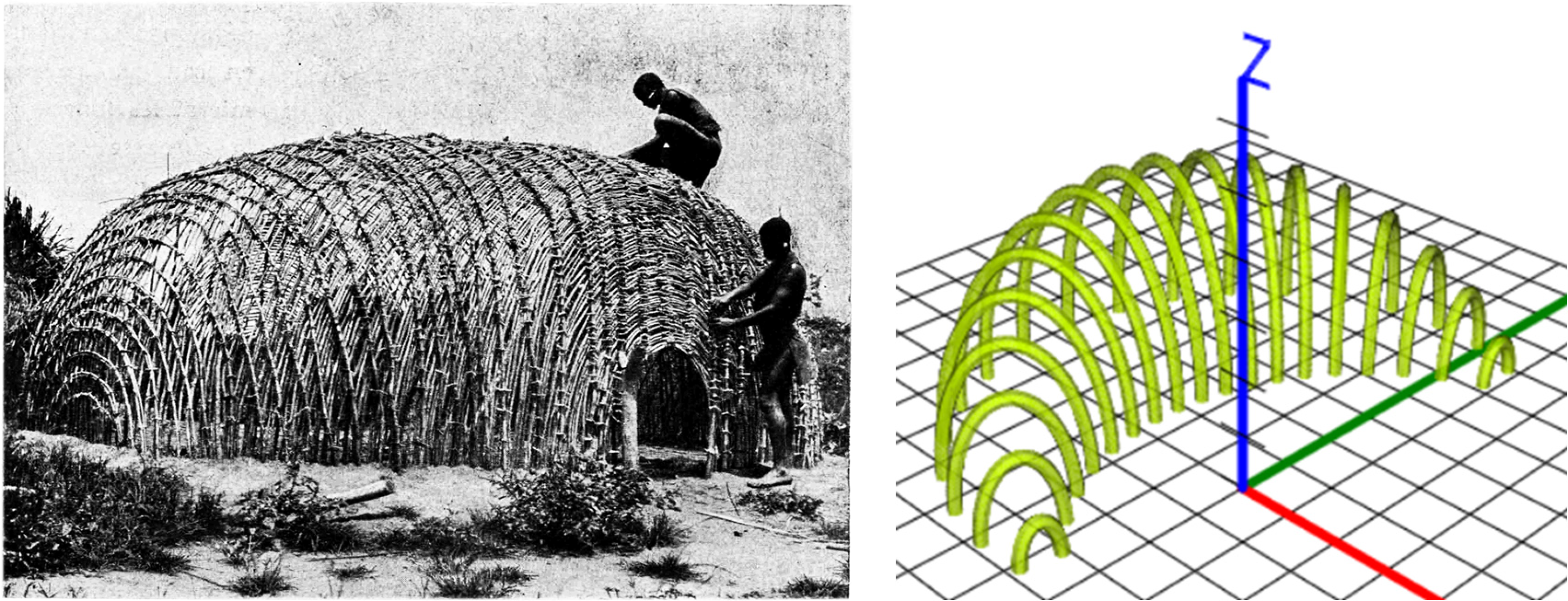
Zulu home construction, from Reclus (1905: 163). Simulation of traditional architecture from Kumasi Hive, by permission of the author.
Before building, we showed Dabls the potential structure variations, visualized as a space of possibilities (Figure 5). Dabls said his preferred design was the one that resembled African wire-based “elbow beads” that were in his shop. This inspired a new product line in which copper from e-waste was recovered to make African-based jewelry (Hogan, 2022). This is one of several examples in which the iterative design cycles of participatory synergy benefitted new product development, technology innovation, and cultural reparations.

Exploring shape space to enhance participatory design. Curvature increases on the horizontal axis; scaling effects increase on the vertical axis. Images by permission of author.
With additional funding from UM's Poverty Solutions program, and the Stamps school of art and design, we were able to hire and train local community members to complete the construction (Figure 6, top). Computing also played a role here: 3D printing the model became a crucial tool for guiding lay participants. The task of automating shutters to respond to temperature was utilized for a culture-based STEM internship program for Detroit high school students (Figure 6, bottom). Such approaches substitute hegemonic STEM orientations with explorations in decolonial development and have shown statistically significant improvement in student interest and performance (Eglash et al., 2021a; Lachney et al., 2021). In that sense, it offers a strategy for reparative contributions in the education domain.

Clockwise from top left: Construction with community members and university students; finished structure; high school STEM interns; harvesting indigo; “grow your own African necklace” display inside the bead gallery. Images by permission of author.
As a node in meso-level exchanges, other participants utilized the indigo harvest, used seedlings from the greenhouse for their own farming projects, and participated in food preparation and consumption from the plants (Figure 6). The cost savings from free electricity, free lunches for museum staff, and increased foot traffic from visitors was a significant financial benefit. The most profitable physical product: Not the craft materials themselves, but rather “grow your own African necklace” kits that contained the seeds.
Another material nexus has formed around Family first Solar, a Black-owned worker collective that installs photovoltaic and battery storage systems. We funded a system for one of Detroit's many Black-owned urban farms, the JOYproject, which reported that their small structure became a refuge for neighbors to recharge phones and share food and entertainment during an extensive power outage shortly after the installation. Their successful linkage between solar photovoltaics and their rainwater harvesting system enabled both electric pumps and the possibility of introducing digital sensing and regulation. We developed the model they provided (again, sourcing ideas from participants) into a local grant proposal. That has now been funded; as a result, solar powered rain catchment and irrigation will be installed on an additional 6 urban farms, furthering ties between a worker-owned solar collective and food justice.
Many of the Detroit urban farms also sustain “rewilding” of pollinator and biodiverse habitats in areas surrounding them, linking these to features such as honey production, youth education and “forest therapy”. A recent study showed that there is far better flooding control, and thus climate change resilience, through Detroit's highly distributed small urban farms than could be obtained by a centralized greenspace (Newell et al., 2022). So the solar irrigation systems have wider imports for what might be called environmental reparations: Generative justice for ecological value.
Meso-level networks: Web-based platforms
Moving from specific horizontal linkages to broader networks, another effort has focused on e-delivery. Food justice group Deeply Rooted was running a delivery service that allowed urban farms in Detroit to advertise their produce and have it delivered in DoorDash fashion, addressing “food desert” impacts on health (Testa et al., 2021). But the monthly charges for the web hosting, the delivery routing, banking fees etc. were yet another case of “leaks of value extraction” that created a significant financial burden. Thus we have been developing a worker-owned e-delivery system, such that it prevents these extractions and can best benefit both workers and consumers. The participatory synergy investigations have brought up features like taking a break, options for selecting routes, flexible schedules around child care, and other forms of driver's life-facilitation. Diversifying its functions, one farm suggested its application to their “food rescue” (corporate store overstock used to distribute free groceries). In the long run, this is where other social institutions—labor unions, civil society organizations, government structures, and so on—will need to be involved.
The above are illustrative examples of what we hope to develop as a wider-spread ecosystem of horizontal integration facilitated by server-side applications on our platform. We currently investigate these “manually”, but developing a platform that facilitates such connections computationally—perhaps as an AI assistive agent, human crowdsourcing, or some combination–is likely the only way to achieve a city-wide, comprehensive community-based economy. But that vision still leaves many questions unanswered. First, we will need to compete with the domination of platforms like Amazon, Uber, DoorDash and the like. Second, more complex products like cars would require either worker-owned factories (e.g., Mondragon in Spain (Morlà-Folch et al., 2021), or networked production (Aryan et al., 2021), but doing so inclusively can be challenging. And finally, even if these issues can be addressed economically, generative justice would need to be addressed in all domains as an ecosystem of mutually supporting value flows: housing, education, policing, courts, and so on. With that in mind, we turn to the macro level.
Macro-level networks: Towards a community-based economy
Figure 7 is a simplified flow chart for a community-based economy that could facilitate reparations through generative justice. As noted in the introduction, it is critical to sustain unalienated value flow in all three domains: ecological value, labor value, and social value. The rectangle at the bottom summarizes some of the micro-level processes by which computation can facilitate those flows and protect them from extraction: digital facilitation of solar, rain, and growing for biomaterials (ecological); AI and digital fabrication to make artisanal methods more financially sustainable (labor); and server-side apps to facilitate incorporation of heritage, decolonial and feminist content (social). The rectangle at right is the meso-level, in which horizontal flows in those same three domains circulate between institutions.
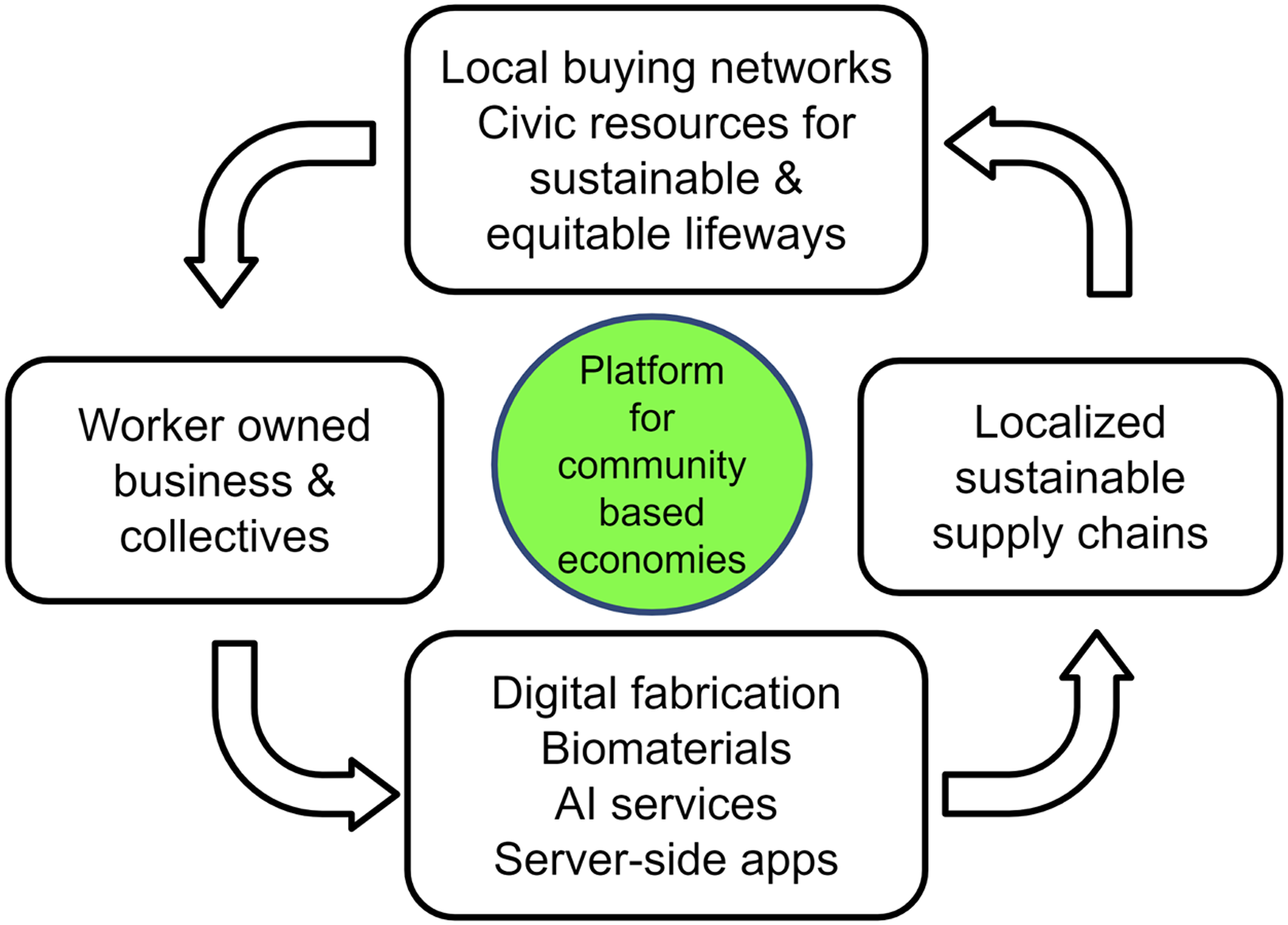
A flow chart for four sectors in which computational assistance could be applied to a community-based economy.
These horizontal links, as we have noted above, include business-to-business economic relations: Linking local biomaterials production as a source for local makers for example. But they also include horizontal linkages to domains such as education. Elsewhere we have shown how decolonial asset translation tools, which integrate local and Indigenous ways of knowing into STEM, and model STEM for local empowerment, can result in statistically significant improvements for students at the margins (Eglash et al., 2020c, 2021a). We can similarly consider how localized empowerment in domains such as housing, health, transportation, policing and so on might be facilitated through other kinds of horizontal linkages. One example is the “urban commons” of Kip and Scholl (2022). But in its application to housing (e.g., community land trusts), they note “professional expertise, time resources for volunteer engagement and idealistic motivations, are necessary preconditions for the use of these tools, yet they also show a selective bias towards the involvement of middle-class activists” (Kip and Oevermann, 2022: 242). How might computational tools reverse that, such that those most in need of housing or other services can be prioritized, without losing the mechanisms of grass-roots governance and unalienated value flow?
Hence the need for the rectangle at the top, the macro-level, in which server-side platform functions offer deliberative consumption and civic resources for more equitable and sustainable lifeways. We have symbolized the integration of all three levels in the center, as we envision the platform as the means by which that occurs. In prior work (Johnson and Eglash, 2021) we used data from Detroit growers and consumers to sketch out some features of an online platform that could address these needs: preventing value extraction by offering free e-commerce services for vendors, knowledge sharing and collaborative labor support for product and services, as well as decolonizing consumption with relational economies. We call for computer science innovation dedicated to enhancing these forms of community-based economies, rather than restricting information activism to “preventing bias,” which may have a limited impact on the economic forces that drive wealth inequality, labor exploitation, and unsustainable practices.
One possible prototype for such functionalities comes from a project in which we developed an AI system for detecting the difference between hand-made textiles and factory fakes (Robinson et al., 2021). This has been extended to examine how that level of identification could make more meaningful connections between specific makers and buyers: The potential of AI to develop a relational economy (Birhane, 2021; Mhlambi, 2020; Nayebare et al., 2023). Another active area for our research is redesigning search engines such that they can deliver more authentic results for consumers interested in local economies. The potential roles that AI might play in helping to fend off competition from duplicitous and extractive enterprises, develop consumer-to-consumer collaboration, and more generally better enable decolonization of consumption practices will continue to be areas of exploration.
Conclusion: “baking in” generative justice as reparations
We began with the contrast between algorithmic reparations that allocate resources from the top-down (TDA), and our quest to develop computational tools that carry out reparations by developing unalienated value flows from the bottom up. The two have in common a deliberative approach to demographics. But the “deliberative approach” from the bottom-up requires a different set of computational tools. We can best explain this through an analogy with contrasting methods of farming.
Industrial agriculture for products such as wheat benefits from economies of scale, but they also require enormous space, water, carbon footprints, monocropping, pesticides, and other causes of environmental degradation. In contrast, agroecology focuses on products like honey, which requires artisanal methods and ecological integration with biodiversity. The same contrast can be applied to computation. By operating from the top-down, TDA aims for the largest scale possible, and so its computational methods tend to be industrial-scale data science. In contrast, computation for generative justice takes an artisanal approach: We work on computational mathematics for resizing clothing; physical computing for farms, AI for authentication, GIS for e-delivery, simulations for fabric color patterns, and so on. It approaches computational diversity in ways analogous to how agroecology approaches biodiversity: Supporting generative, circular flows across every scale and domain. That computational approach might be dismissed as “less efficient,” just as agroecology tends to be dismissed by corporate agriculture. But surely there are more even-handed approaches that could attempt to preserve the advantages, and eliminate the harms, on both sides.
Our focus on a prefigurative approach to algorithmic reparations may seem more cautious, slower, and evolutionary, but that is because it attempts to bake-in circulations of unalienated value flow in multiple domains and scales. There is, to be sure, a top-down role for civic and state institutions. But political decisions can be overturned in the next election. If reparations are to be enacted not just by virtue of voting outcomes at one historical moment, but rather deeply woven into the economic and institutional fabric, we will need national-level funding scales, empowering programs dedicated to developing reparative forms of generative justice across the entire techno-social ecosystem.
Footnotes
Acknowledgements
This material is based upon work supported by the National Science Foundation (NSF) Future of Work at the Human-Technology Frontier under Grant No. 2128756. All opinions stated or implied in this document are those of the authors and not their respective institutions or the National Science Foundation.
Declaration of conflicting interests
The authors declared no potential conflicts of interest with respect to the research, authorship, and/or publication of this article.
Funding
The authors disclosed receipt of the following financial support for the research, authorship, and/or publication of this article: This work was supported by the National Science Foundation (grant number 2128756).
