




Abstract
Data centers are material structures that take up space, use resources like water and energy, and possess a large carbon footprint. This paper examines the broader long-term discussion around data centers during the period 2020–2022 in the Dutch Twittersphere. Through an analysis of tweets and images, it identifies and reflects on the communities active in the discussion and the range of visions and imaginaries of data centers they produce. Unpacking these tweets and images over time traces not only the emergence of a ‘reactive imaginary’, critical of the promises of information technology (IT) industry and (local) governments, but also the blind spots of the discussion. It furthermore reveals an important role for journalism in the discussion by questioning the claims of the industry and contributing to a ‘visibility expansion’ of data center’s impact on Earth's resources. The paper shows the multifaceted and situated nature of imaginaries and their role in shaping decision-making and policy.
Introduction
The increasingly data-heavy applications of social media and data analysis platforms require large data centers. While the metaphor of ‘the cloud’ perpetuates the impression that the internet is floating, natural, and part of a green industry (Crawford, 2021, p. 41), the servers that are the internet reside in data centers. Data centers are ‘where “the cloud” touches the ground’ (Holt and Vonderau, 2015, p. 75). These material structures take up space, using resources like water and energy, and thus have a carbon footprint (Hu, 2015, p. 4). In short, they are complex phenomena whose impact on the economic, social, and environmental structures of their surroundings is considerable.
As the self-described digital ‘gateway to Europe’ (Digital Gateway to Europe, 2022), the Netherlands claims to be a leading internet hub on the continent, housing hundreds of data centers and three so-called hyperscale data centers owned by Google or Microsoft: one in Eemshaven (Groningen) and two in Wieringermeer (North Holland). Local municipalities have attempted to lure Big Tech companies to build additional hyperscale data centers in the country, as in Zeewolde, where in 2021 such plans were met with increased media attention highlighting the harmful impact of these facilities. In the ensuing public debate, citizens and politicians became more critical of the data centers, and there were calls for the national government to intervene.
The aim of this paper is to explore the Twitter discussion on data centers in the Netherlands. We ask the following questions: How have data centers been imagined on Dutch Twitter over time? What shifts are apparent? And how might they be explained? Unpacking these imaginaries over time reveals not only the emergence of a ‘reactive imaginary’, critical of the promises of the information technology (IT) industry and (local) governments, but also the blind spots in the overall discussion. As is clarified in the paper, these data centers are imagined in culturally specific and temporally situated ways. This insight builds on the work of Brodie (2020, p. 3), who highlighted the value in discussing the ‘localization of struggles’ around infrastructure by revealing how the specific claims and needs of Irish residents in Athenry, East Galway, ignited popular support for Apple's data center project there.
This paper unravels the discourse connected to Big Data's physical infrastructure and explores the multifaceted, situated nature of an imaginary and its institutional stabilization achieved through an interplay of the press, the public, and politicians. It contributes to the broader understanding of imaginaries and scholarship that has analyzed the discourse around data centers (Gilmore and Troutman, 2020; Jakobsson and Stiernstedt, 2012; Mayer, 2019; Masson et al., 2022; Velkova, 2019) as well as research that has examined the images of data centers circulated by the IT industry—and has called them out for gesturing toward transparency (Holt and Vonderau, 2015) and the erasure of humans (Taylor, 2019) or alternately has stressed their impermanence and instability (Brodie and Velkova, 2021; Velkova, 2019). However, rather than zooming in on a particular data center and its impact on specific local conditions, this paper examines the broader discussion around data centers during the period 2020–2022 in the Dutch Twittersphere. It traces the increased politicization of the data center discussion and its transformation from a local to a national issue. Twitter is a productive platform for the study of data center imaginaries because it connects voices from policymakers, journalists, and experts with media coverage in newspapers and on television (Chadwick et al., 2017). We show how the interaction of these actors coincides with shifting imaginaries and with new realities of political decision-making.
The paper is structured as follows. First, it provides theoretical background on imaginaries and data centers, revealing tropes in their legitimization and the criticism directed at them in media and communication scholarship. The research design, including a discussion of the study's methodology, is then outlined. We provide additional context for the analysis by touching upon the political climate in the Netherlands regarding data centers. We go on to trace the Twitter discussion over time, identifying the online communities involved in the data center discussion and relating them to types of accounts, topics, and images. Together, these inquiries and reflections flesh out two coexisting imaginaries: the positive assessment of data centers one finds in the IT industry's community accounts versus a more critical evaluation in the other communities that points to the (environmental) costs of data centers. We show how the proliferation of this second, ‘reactive’ imaginary has resulted from hyperscale data centers becoming a common concern across different communities, each with distinct interests and visions. Here we locate an important role of the media in expanding the visibility around data centers and pushing back against popular legitimization strategies. In our conclusion, we reflect on the critical imaginary, its multifaceted and situated nature, and the blind spots of the current data center discussion.
Studying imaginaries
Over the last decades, media and internet research has witnessed an ‘infrastructural turn’, as the media's infrastructure and distribution now receive greater attention than had earlier been the case (Hesmondhalgh, 2022). The work of science and technology studies scholars Susan Leigh Star (Star, 1999; Star and Ruhleder, 1996) and Bowker (1994) has been foundational in this regard. Infrastructure is approached here as a relational concept, ‘sunk into and inside of other structures and social arrangements, and technologies’ (Star, 1999, p. 381). The concept, as clarified by these authors, refers not just to hardware, networks, and cables but also to social practices, standards, and the protocols applied to systems. More recently, a tradition has emerged within media studies that focuses on how ‘media infrastructures interact with media cultures’ (Plantin et al., 2018, p. 298). The work of Larkin (2008), specifically his account of the emergence of Nigerian media infrastructure, has been influential in this line of inquiry. In a complementary fashion, Parks (2015) has also asked questions regarding representations and discourse around media infrastructures (Hesmondhalgh, 2022).
Such questions of representations and discourse are crucial to imaginaries. Taylor's (2002) concept of imaginaries, inspired by the work of Benedict Anderson, is significant. He defines the social imaginary as ‘the ways in which people imagine their social existence, how they fit together with others, how things go on between them and their fellows, the expectations that are normally met, and the deeper normative notions and images that underlie these expectations’ (Taylor, 2002, p. 106). In critical data studies (e.g. Bucher, 2017; Beer, 2019; van Es and Poell, 2020), this notion has been widely adopted, with a frequent emphasis on two main components: the notion's value for unpacking the act of imagining—how people make sense and meaning—and the underlying contention that imaginaries shape, and are shaped by, practice. Although imaginaries share similarities with discourse, they are more directly linked to practices or materialization through technologies (Jasanoff, 2015, p. 20).
The adoption within science and technology studies of Taylor's notion of imaginaries is particularly relevant to this paper. Jasanoff, noting that classical accounts of social imaginaries overlook science and technology, proposes that we consider sociotechnical imaginaries. As she explains, ‘through the imaginative work of varied social actors, science and technology become enmeshed in performing and producing diverse visions of the collective good, at expanding scales of governance from communities to nation-states to the planet’ (Jasanoff, 2015, p. 11). Imaginaries here concern materialization through technology and thus require the examination of actions and performance. Jasanoff points out that although imaginaries tend to be seen as group achievements, individual visions or those of small communities can become collectively held objectives, and it can therefore be useful to study them (Jasanoff, 2015, p. 25). In addition to being collective, durable, and performative, imaginaries are, Jasanoff stresses, ‘temporally situated and culturally particular’ (Jasanoff, 2015, p. 19). As such, it is useful to explore the Dutch context, with its specific social and political relations. Here, we encounter unlikely alliances between groups in society that have different ideas about data centers and their value.
Data center discourses: Corporate and critical
The building of new data centers requires public support or, in its absence, indifference. The fulfillment of either of these conditions depends on the public understanding of the need for the internet and its functioning. The IT industry, but also governments and other industrial actors, can contribute powerfully to such understandings. In the Netherlands, Mayer (2019) conducted fieldwork around Google's hyperscale data center in Eemshaven (Groningen) in the period 2016–2018. She examined the ‘immaterial aura’ that Google cultivated around its infrastructure, a mystique that was ultimately co-created with the local community. The data center became ‘ubiquitous’ in Groningen, garnering a cult status that enabled material and labor exploitation (Mayer, 2019, p. 2). Hogan (2015, p. 5), also looking at the corporate discourse of the IT industry, explains how corporations’ emphasis on economies of scale makes their depletion of natural resources more acceptable. Velkova (2021, p. 664), addressing the Nordic countries, notes how local energy companies and municipal authorities further contribute to the palatability of data centers by redefining them ‘as thermal infrastructures capable of bringing about carbon-free energy futures’. According to these officials, increases in data traffic and storage can be justified not only by the promise of reuse of their waste heat (Velkova, 2016) but also by the data centers’ own use of green energy from wind and solar farms (Maguire and Winthereik, 2021).
The visual images of data centers produced and shared by the IT industry and media outlets shape the public image of these facilities. Such interventions are crucial to understanding ‘cloud infrastructuring’: the strategies and practices of localizing the cloud (Vonderau, 2017, p. 11). Visual images also contribute to the formation of imaginaries in a negotiation between people. Holt and Vonderau (2015) have observed how the particular sorts of data center imagery circulated by Google, Apple, and Facebook gesture toward transparency even as such imagery in fact conceals the presence and workings of a larger digital infrastructure. Generally, components such as rows of server racks, Ethernet switches, and so forth are rendered hypervisible: the aim here is to stimulate desire and awe in the viewer, whose attention is directed away from what is involved in their actual use. Visibility, then, is a trick, performed to distract attention from what matters (Furlong, 2021, p. 196). Taylor (2019) further notes that the erasure of humans in these images is a tendency linked to fantasies of automation, data objectivity, and security. Important here is what Parks (2009) calls the ‘politics of infrastructural invisibility’, which concerns how citizens are kept uninformed of the harms done by infrastructures such as data centers. Journalism has a potentially important role to play here. They can help to create communities of informed citizens by making underlying infrastructural processes visible to the public (Gilmore and Troutman, 2020, p. 922).
The rhetoric promoting data centers as positive economic forces that stimulate green energy futures, promulgated by industry and (local)governments alike, has been met with fierce criticism. In the critical scholarship on data centers within the field of media and communication studies, data centers have been linked to several key issues: sustainability (energy, water, and space) in particular, along with financial-economic and security concerns. These studies, however, tend to focus on either a single data center (Gilmore and Troutman, 2020; Mayer, 2019; Velkova, 2019; Vonderau, 2017), specific perspectives in the discussion (Jakobsson and Stiernstedt, 2012), or images of data centers (Holt and Vonderau, 2015; Taylor, 2019).
The work by Gilmore and Troutman (2020) is particularly relevant to our project. They have provided a critical discourse analysis of 3 years of local news coverage of a debate over Google's access to an aquifer in South Carolina for cooling its data center. Their analysis takes what they call an agri-cultural perspective: they examine the debate over the consumption and allocation of natural resources between actors and institutions. It reveals how local politicians champion economic development over the stewardship of natural resources while concerns from local citizens and journalists are ignored (Gilmore and Troutman, 2020, p. 918). We take inspiration from Gilmore and Troutman's agri-cultural approach, but our paper also connects the debate to data center imaginaries and discusses how, at one point, a reactive imaginary stepped over the ‘policy threshold’—meaning that it required a response from the government. This was achieved through a process of visibility expansion of the impact of these infrastructures aided by the media in interaction with policy. In other words, by expanding the range of issues around data centers and challenging empty promises, a multitude of voices enter the discussion.
Combining quantitative and qualitative methods
For Gilmore and Troutman (2020, p. 919), local newspaper coverage of Google's extraction of water from a local aquifer ‘provides opportunities to evaluate how different sets of humans negotiate how media infrastructures enter into and transform existing ways of life’. Analyzing tweets offers a similar opportunity to engage with an array of voices. Through a variety of computational methods (including topic modeling, image extraction, and network analysis) and close readings of a dataset of Dutch tweets, we gain insight into the data center imaginaries that make up the Twitter discussion. Which ideas about data centers are circulated through tweets and images? But also: Which actors are involved? And how do the communities involved relate to one another? Our analysis considers the textures and dynamics of the contestation around data centers in relation to its situated context in the Netherlands.
Used by politicians, citizens, and journalists to debate political issues, Twitter is an important part of the networked public sphere (Ausserhofer and Maireder, 2013); the platform connects and interacts with traditional media (Schäfer, 2019). In January 2022, Newcom Research and Consultancy published its annual report on the use of social media in the Netherlands. Its findings showed Twitter's high level of penetration in the country: there are roughly 3.5 million registered accounts—in a population of about 14.8 million over 15 years old—with 1.5 million using the site daily (Hoekstra et al., 2022). The users of the platform are, however, not demographically representative: studies in various countries suggest that its users tend dominantly to be male, more educated, younger, and politically engaged (Mellon and Prosser, 2017).
Data collection
We collected data through Twitter's API for Academic Research, which offers access to data from all public tweets on the platform (excluding deleted tweets and accounts). The API provides a wide variety of metadata, such as the number of interactions, text language, and image or video attachments. Our search query consisted of neutral Dutch descriptors of data centers (‘datacenter’, ‘hyperscaler’, ‘rekencenter’) to avoid a bias for tweets in favor of or opposed to data centers. The corpus contains 68,613 Dutch tweets (24,778 excluding retweets, RTs) related to data centers posted between 1 January 2020 and 1 March 2022. In our analyses, we make explicit reference only to accounts and tweets of public figures (e.g. politicians and prominent academics) or entities (e.g. political parties and associations).
The affordances of Twitter shape how conversations take shape on the platform. Accounts can post and interact with tweets in a variety of ways. Tweets are (at present) always limited to 280 characters, or 140 if video or audio is included. The prescribed length encourages concision, which can be a hindrance to nuanced discussion (Jaidka et al., 2019). Twitter allows accounts to follow other accounts but, unlike on platforms such as Facebook, following does not have to be mutual. The platform is therefore well suited to host influential accounts that communicate to many followers (Araujo et al., 2016). Adding to this dynamic is the ability to RT, whereby a tweet is essentially copied to the user's own timeline, amplifying the original tweet's message.
Network analysis
To gain insight into the broader dynamics of the data center discussion, we created a network analysis in Gephi (Bastian et al., 2009). Earlier research reveals that RTs are often used in affirmative modes, approving either the message or the account holder, or both (Paßmann, 2018, p. 164). To detect like-minded publics, we created a RT network of the data set. We extracted RTs and created an edges table containing posters’ names and the accounts they retweeted. Results were loaded into Gephi. We then spatialized the network via the ForceAtlas2 layout algorithm (Jacomy et al., 2014) and used the Dissuade Hubs option to push hubs with weak links to the network's edges. The node's size is tied to their weighted in-degree, i.e. the number of times that accounts have been retweeted. In other words, bigger nodes were retweeted more often than small ones.
Subsequently, by calculating the network modularity in Gephi, groups of accounts with a relatively high level of interconnectedness were identified and randomly assigned colors. By analyzing these accounts and their tweets, we manually provided these ‘communities’ with descriptive labels. 1 This approach allows for the intuitive exploration of relations between accounts and communities (Venturini and Munk, 2022, p. 205). Our claim is not that these constitute communities in a sociological sense but rather that the approach maps like-minded accounts around the subject of data centers. This is an imperfect yet useful way to operationalize the notion of ‘shared understandings’, using RTs as a proxy, that is important to Jasanoff's understanding of visions and sociotechnical imaginaries.
Topic modeling
To grasp what is being discussed in the tweets, we used an unsupervised topic modeling algorithm that detects clusters of words often in close vicinity. First, the quanteda (Benoit et al., 2018) package for R was used to tokenize the tweets in our dataset, filtering out stop words, numbers, social media tags, and other noise, leaving the essential words from each tweet. Then, using Latent Dirichlet Allocation in the seededlda package (Watanabe and Xuan-Hieu, 2022), we went through an iterative process of tweaking the number of topics until we arrived at a coherent output. This resulted in 14 topics in total, made up of groups of related words. We interpreted and labeled these topics. Each tweet has thus been assigned a topic, which allows us to connect these topics to the communities from which they emerge. To examine the evolution of the discussion, we plotted the tweets as topics temporally.
Visual analysis
As noted, visual representations of data centers are important to understanding imaginaries. Data centers, often highly secure facilities, are inaccessible to the public; photographs of data centers are limited. Usually, they are supplied by the industry itself, and as pointed out by Taylor (2019, pp. 5–6), they ‘provide an insight into how the industry narrates itself and attempts to govern the conditions of imaginative possibility through visual media’.
Almost 20% of the tweets in our dataset contained at least one image. Through manual classification, we grouped the 5377 images into 19 categories, ranging from data abstractions to aerial views of data centers and screenshots and newspaper clippings. In reflecting on these images, we considered their meanings and the dominant community in each image cluster.
The data center discussion in the Netherlands
In grasping the visions and imaginaries concerning data centers, it is important to understand the situated political context in which they took hold. The Netherlands is a parliamentary democracy with an elected government and head of state. From October 2017 to January 2022, the third Rutte cabinet made up the government, consisting of the conservative-liberal People's Party for Freedom and Democracy, the social-liberal Democrats 66, and the Christian-democratic Christian Union. Importantly, during this government's term, the Netherlands experienced a series of farmers’ protests following the government's 2019 proposal to drastically cut industrial livestock production to reduce the country's high nitrogen emissions. The Council of State had ruled that the existing approach did not comply with European nature protection regulation. That same year, the agricultural journalist Caroline van der Plas, along with an agricultural marketing agency, founded the Farmer-Citizen Movement (BBB), an agrarian political party associated with a populist tone and right-wing politics. Winning one seat in the 2019 general elections, the party gained traction, and in July 2022, it was polling at 18 seats (I&O Research, 2022). As will become apparent later in this paper, the Farmer-Citizen Movement was a particularly outspoken and prominent voice in the discussion around data centers.
To further contextualize the different participants and visions in the debate, we trace the topics of the online discussion over time (see Figure 1). Doing so reveals spikes in tweet activity that, as our close reading of these tweets revealed, had connections to newspaper articles, an airing of the satirical television program Zondag met Lubach, and a YouTube Live event for the Zeewolde council vote on the building of a new hyperscale data center.

Number of tweets over time, including retweets.
The Dutch government long held the position that the establishment of data centers needed to be organized at a ‘decentralized’ administrative level—at the level of town council and provincial governments rather than the national level (Masson et al., 2022, p. 44). This policy created friction when plans were developed for the siting of new hyperscale data centers. The data center debate in the Netherlands, previously limited to articles in regional newspapers, garnered attention on a national level in part after articles on the topic came out in the national newspaper NRC in the first half of 2020 (Masson et al., 2022, p. 53).
Late 2020 was marked by political upheaval when plans for a new Microsoft hyperscale data center in Hollands Kroon (North Holland) were unveiled. While the mayor and aldermen were in favor of the initiative, the local council was divided, and citizens launched a petition against it. The province of North Holland fought the power of the municipality to grant a license for the building of the data center. This later led to the development of data center policy on the municipal level (Masson et al., 2022). Some attention had already been generated by two articles, one in the NRC (questioning the green image of data centers) and another in the financial newspaper Financieele Dagblad (focusing on data centers and their strain on the electricity grid), but the discussion really heated up in October 2020, when the highly popular television program Zondag met Lubach covered the situation in Hollands Kroon. The episode discussed the opening of the largest wind farm on land close to the new data center and criticized the Dutch government's payment of green energy subsidies to the Swedish company Vattenfall, which delivers the so-called green energy produced by these wind parks. The proximity of wind parks to the hyperscale data centers can fuel the perception that they exclusively produce energy to power data centers owned by American technology giants. Importantly, the episode draws on numerous other media sources, using video clips from news and other current events programs such as NOS Journaal, NH Nieuws, De Hofbar, Omroep Flevoland, RTVNoord, and citing articles published on the websites of national and local newspapers and broadcasters (NRC.nl, nos.nl, noordhollandschdagblad.nl, and dutchitchannel.nl) to draw attention to the issues around data centers.
The following year, in March 2021, the national newspaper De Telegraaf published an alarming front-page article. It referenced internal reports from the province of North Holland that civil servants had kept under wraps: ‘water-gulping’ data centers, so it was surmised in these reports, threatened the delivery of drinking water, and the chemicals added to the water to cool the data centers could end up polluting the environment.
The discussion escalated in 2021 with the announcement of Meta's plans to build, in the municipality of Zeewolde, what would be the largest data center in the Netherlands. The particular concern here centered on the agricultural land owned by the State, property that was leased to farmers but is now to be sold to Meta (Masson et al., 2022, p. 48). Further fueling the discussion was the revelation made by national newspapers NRC and De Telegraaf that then-Minister Wiebes (Economic Affairs and Climate Policy) had helped Meta get priority access to a connection to the transmission grid, thereby ignoring standard procedures. Moreover, it was reported that many concerns and objections from his senior officials over employment opportunities and land ownership had been ignored (Muller, 2021). During a local Zeewolde council meeting in December 2021, members voted on a zoning plan amendment that was necessary for the construction of the Meta hyperscale data center. The meeting was livestreamed on YouTube. On this occasion, the local representatives of the Labor Party (PvdA) and GreenLeft (GL) voted in favor of the data center, thereby deviating from their national party's position. Their votes animated the online discussion further.
These moments of media attention confront certain positive ideas put forth by industry and (local) governments alike: claims that data centers create jobs, that they contribute to green energy futures, and that their massive water consumption can be reused for heating houses. The project in Zeewolde was ultimately paused because of political pressure in parliament, and not long afterwards Meta pulled the plug on the initiative. In the meantime, new national policy has been formulated that designates certain areas in the Netherlands suitable—and others unsuitable—for the building of hyperscale data centers. Data centers can be built ‘at the edges’ of the country, given there is sufficient space and so long as green energy is used (Rijksoverheid, 2022).
The communities
To gain insight into the distribution of visions animating the online discussion, we need a breakdown of the different voices tweeting about data centers. For this purpose, we created a RT network showing RT interactions between accounts (see Figure 2). The network analysis helped identify seven communities, which we manually interpreted and labelled as: (a) left-wing-oriented politics and (b) right-wing-oriented politics, placed in the image below on opposing sides of the network; and, in between, the (c) investigative journalists and citizens and (d) journalists and news outlets. (e) Socialist Party (SP) affiliates reside mostly in the center of this spectrum, although some accounts seem to be associated with left-wing politics as well. On the network's peripheries, almost entirely disconnected from the larger cluster, is the (f) IT industry community, whose lack of interaction with other communities is striking. The (g) energy transition professionals community, however, is concentrated at the bottom left but also scattered in such a way as to bridge the IT industry community and the main cluster.
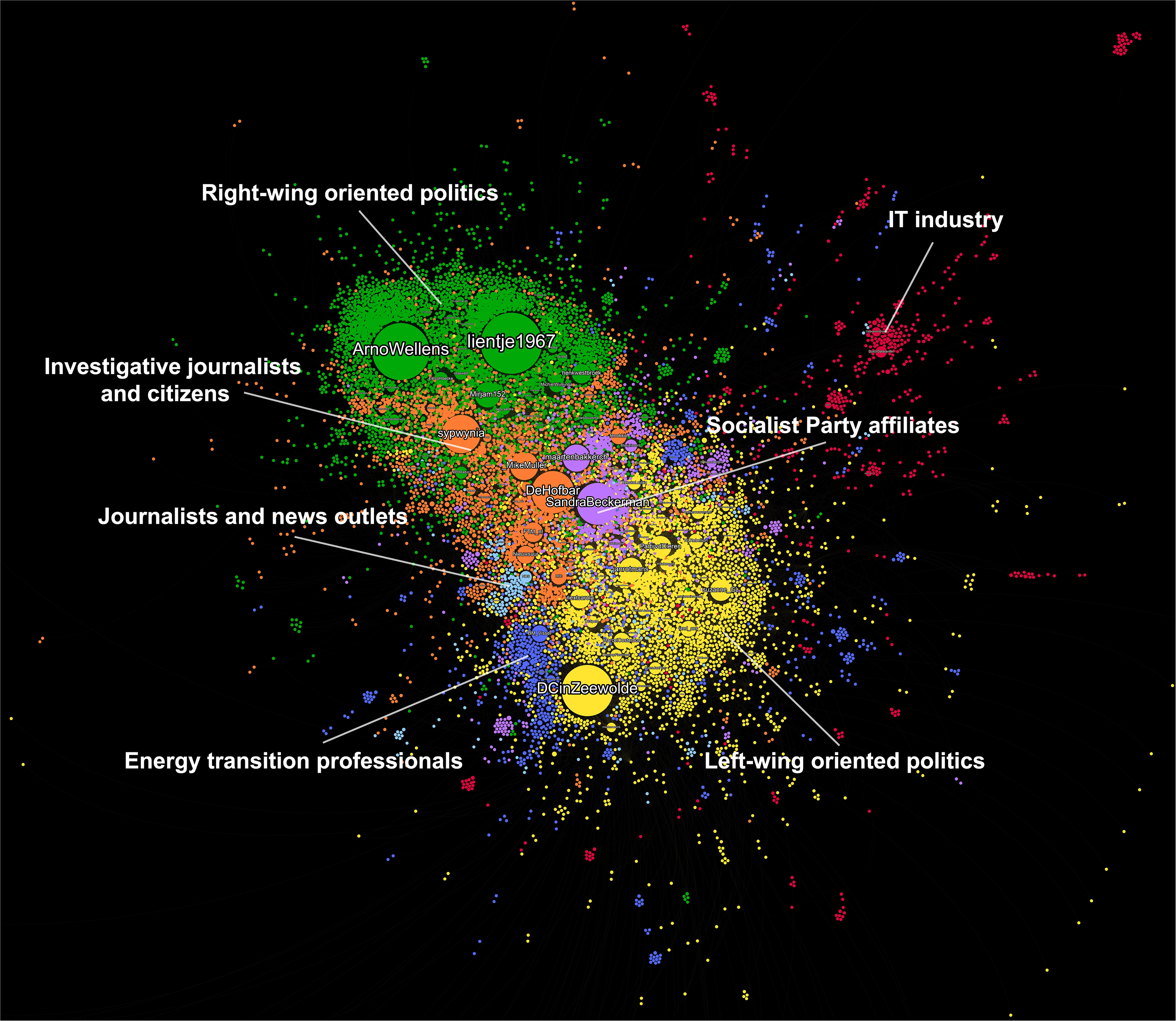
Directed network visualization of retweet behavior between accounts in the Dutch Data Center discussion on Twitter. Nodes represent Twitter accounts and edges represent retweets. Colors indicate communities, calculated through Gephi's modularity algorithm with a resolution of 1.5.
In what follows, we briefly discuss and characterize these communities by analyzing their top ten retweeted accounts, dominant topics (see Figures 3 and 4), and images (see Figure 5). The identified topics can be grouped into four overarching themes: industry, sustainability, economics, and politics. Additionally, the analyzed images yield four different ideas of data centers: as representative of the cloud, as inscrutable boxes with environmental impact, as (a threat to) sublime farmland, and as grand structures accompanied by wind turbines but also beset with controversy.

Topics.

Topics per community.

Chart of the distribution of the image categories (total images = 5377).
IT industry community
The Twitter community presenting the perspective of the IT industry in the discussion around data centers is rather small. It includes accounts such as @datacenterworks and @dutchdatacenters. The former is a trade magazine about the technical infrastructure of data centers, while the latter belongs to the Dutch Data Association (DDA), a branch organization of data centers. Its self-declared mission, posted on the DDA website, is to strengthen economic growth and to represent the data center sector to government, media, and society. In line with this orientation, the accounts found in this community tend to be promotional in nature, and their high-volume tweets generate little interaction.
IT jargon and the Dutch Data Center Association
A dominant topic in tweets from this community is what we term IT jargon (Topic 5). It includes the terms Equinix and NorthC (both data center owners) as well as Amsterdam (where their data centers are located). These companies offer various computing services which, simply put, concern the running of software and provision of services via the internet (‘the cloud’) rather than on local computers. Other terms comprising the topic are infrastructure, networks, clients (as in customers), cloud, and #cloud. The cloud metaphor seems to be pervasive in industry discourse.
Another topic in this community is one identified by the topic model as DDA (Topic 7). It contains the terms article, report, and research but also infrastructure, future, economy, IT, role, and DDA itself. The terms found in the topic echo the mission of the DDA and point to a positive, forward-thinking evaluation of data centers.
The cloud metaphor
The connection of this community to industry and politics is underscored in the images. The community is dominant in the image cluster, which contains logos from tech companies (e.g. Microsoft, Intel, Amazon Web Services, Google Cloud) and data centers (NorthC and BIT) but also those of local political parties (e.g. GroenLinks Hollandskroon) and municipalities (e.g. Zeewolde and Hollands Kroon).
The cloud metaphor hinted at in the topics is supported by the images shared by the community. Accounts associated with the IT industry are responsible for circulating more than half of the images labeled ‘Inside data centers’. Professionally styled, these images predominantly feature the interiors of data centers pictured as seemingly endless rows of servers situated in a void. They exude a futuristic look and feel. They correspond with Taylor's observation that images of data center interiors circulated in the mass media seek to make them ‘look exhilarating and futuristic: sweeping panoramas of server halls’ (Taylor, 2019, p. 9). Servers are glowing, and data are represented by neon light, variously blue, gray, and white. Taylor (2019, p. 8) has commented how, in the context of the data center industry, neon is ‘a key signifier of the future’. Striking, too, is the absence of humans in these images, which supports ideas of stability, security, and safety (cf. Holt and Vonderau, 2015, p. 72).
They are also dominant in the cluster of images we labeled ‘Data abstractions’. These images fuel ideas and representations of data as cloud, which is sometimes even explicitly asserted through the use of icons of clouds. The images found here tend to have a futuristic, Matrix-like feel, pervaded by the colors green and blue. The suggestion is that data are immaterial: pictured as light, data are detached and in motion. Puschmann and Burgess (2014) argue that this sort of metaphor and others like it drawn from nature promote the idea that big data and its technologies are a force too powerful to be controlled.
Additionally, the community is responsible for the majority of ‘technology close-ups’—featuring routers, hard drives, and cables, all decontextualized—often dominated by the color blue. These images again have a futuristic feel and connote ideas of complexity and sophistication. Holt and Vonderau compare these promotional images of on-site technologies as ‘abstract art’ and comment on how the ostensible lack of relations between the components makes the infrastructure less visible (Holt and Vonderau, 2015, p. 75).
Right-wing-oriented politics
The biggest community in our dataset is one we labeled right-wing-oriented politics. A large node here is the Twitter account of the financial journalist Arno Wellens, one of the founders of the right-wing populist party Forum for Democracy—although he and the party parted ways in 2019. His most retweeted tweet reads: This is the company that buys land invisibly to build data centers through secret contracts with municipalities. They get free ‘green’ electricity, with a subsidy. NL will soon be full of boxes and windmills and anyone who wants to know how that works should shut up because progress
2
(authors’ translation).
The largest node here, however, belongs to Caroline van der Plas, the leader of the agrarian political party Farmer-Citizen Movement (BBB). Hers is the most retweeted, liked, and replied-to account within the data center discussion on Twitter. Her most retweeted tweet includes a short video clip from an RTL News television broadcast, revealing that Meta was behind the plans for a data center in Zeewolde. The tweet mentions how the data center in Zeewolde would consume twice as much power as the city of Amsterdam, and it addresses the sacrifice of fertile farmland and the BBB's desire to stop these energy guzzlers that are destroying the landscape. 3
Farmland and geopolitics
As becomes evident from the tweets from Van der Plas’ account, a dominant topic in this community is farmland (Topic 8). It includes the terms land, farmers, farmland, and hectare but also addresses politics, reflected by the terms facebook, meta, cabinet, and government. Another prominent topic is geopolitics (Topic 1), covering terms such as world, africa, twitter, europe, centers, need, how many, internet, people, and use. It points to geopolitical questions about whom data centers host for (the citizens of the country where they are located, or not?) and about how many data centers are necessary. These concerns align with those of Dutch right-wing political programs.
Sublime farmland
The right-wing-oriented politics community is responsible for most of the farmland images in our dataset. All in all, however, this is a very small image cluster. Here, we see farmland from various perspectives, usually, but not always, as a grid landscape. These images perpetuate ideas of vastness and position farmland as sublime. While they don’t feature data centers, they do celebrate the vast green space the centers are supposed to occupy. In this way, they underscore concerns about the displacement of farmers and the destruction of Earth's resources. As mentioned earlier, farmland in Zeewolde would be sold to Meta and rezoned to facilitate the building of a hyperscale data center.
Left-wing-oriented politics
The second largest community, whose tweets often mention both agriculture and the energy transition, is made up of accounts signaling left-wing-oriented politics. The largest node here is @DCinZeewolde, dedicated to questioning the need for a hyperscale data center in Zeewolde. This account has the most tweets about data centers in the entire data set. The community also includes @land_ons, the account of a cooperative that is buying Dutch land with the aim of restoring biodiversity. In December 2021, in what can be regarded as a publicity stunt, the cooperative offered to buy the land in Zeewolde so that it did not have to be sold to Meta. The organization claimed that letting Meta build the hyperscaler would be an assault on the landscape and exert a baleful effect on energy and water consumption. Another prominent account in this cluster belongs to Jan Rotmans, Professor of Transition Studies and Sustainability, which received relatively many RTs and replies. His most interacted-with tweet states: It is incomprehensible that the municipal council of Zeewolde voted in favor of the arrival of a data center. Do they have any idea what that means for the energy transition? Approximately the annual energy consumption of the NS [Dutch passenger railway], or 460,000 households… (authors' translation).
Zeewolde and policymaking
The topic of the Zeewolde local council meeting (Topic 15) is also important to this community, in particular the vote in Zeewolde's local council on 16 December 2021. Terms that make up this topic include decision, party, facebook, meta, municipality, and coming. Importantly, the terms PvdA and groenlinks also feature here, referring to political parties: the Labor Party (PvdA; welfare state) and GL. Their local representatives deviated from their national party's position by voting in favor of the data center, thus causing outrage among sections of the public. Furthermore, the topic policymaking (Topic 3) is also prominent in these tweets. As mentioned earlier, Zeewolde was particularly contentious because of the selling of farmland by the government and the meddling of Minister Wiebes in presumably local or otherwise ‘decentralized’ affairs. It reflects the confusion and tension over where decision-making about the building of new data centers should take place. Calls for a stronger national direction, a specific concern for the Netherlands, were also expressed here.
The environmental impact of inscrutable boxes
The left-wing-oriented politics community is responsible for most of the images containing news articles and political documents, as well as for most of the infographics/graphs and maps, often colorful (using green, blue, and orange, the latter a reference to the national color of the Netherlands). These infographics/graphs and maps communicate about topics such as energy consumption, the amount of hyperscale data centers over time, and their location. The maps mostly offer God's-eye views of the Netherlands that pin the locations of data centers. This perspective, arguably, plays a role in creating a sense of objectivity regarding the claims made (Kennedy et al., 2016, p. 724).
The community often also shares bird's-eye images of data centers as gray ‘boxes’ within a green landscape backed by a blue skyline. Here industrial complexes, outside public scrutiny, inhabit the physical environment; the rich green and blue of nature are juxtaposed with the gray pallor of the technological complex. In contrast to Holt and Vonderau's reading of images showing data centers surrounded by sky and land as resulting in the data centers becoming ‘visible but rendered practically inconsequential’ (Holt and Vonderau, 2015, p. 76), here the environmental burden of the boxes is underscored.
They also circulate images that are part of the small image clusters ‘nature’ and ‘sustainable energy’, where green landscapes and blue skies are dominant. The former communicates integrity and unexploited nature, whereas the latter shows wind turbines and solar panels engaged in the production of clean energy—without, however, featuring the data centers that produce a greater need for them.
Investigative journalists and citizens
The community of investigative journalists and citizens includes the accounts of the investigative platform Follow the Money, the current-events TV program Nieuwsuur, the political TV program De Hofbar, and the national newspaper NRC, as well as the parliamentary reporter for De Telegraaf Mike Muller and the journalist Syp Wynia. These accounts tend to be oriented toward investigative journalism and devote considerable attention to data centers, focusing on the centers’ negative impact on and cost to society.
Green energy subsidies and Hollands Kroon & politics
They tweet about green energy subsidies (Topic 4), using terms such as subsidy, millions, wind park, and wind turbines. This topic was dominant on 12 October 2020, the date when ‘The Netherlands as Hard Drive’, the aforementioned episode of the satirical TV show Zondag met Lubach, was aired. Additionally, the topic Hollands Kroon & politics (Topic 10) features significantly in this community. This, too, connects to what was discussed in the Lubach episode. The dominance of these topics reveals the attention given to the TV broadcast. The presence of these topics indicates that they have an important role in amplifying its reach online.
Grand structures accompanied by wind turbines and controversy
The images that derive primarily from the investigative journalists and citizens' community again echo the ideas found in the Lubach episode. Here we find data centers photographed from the ground to denote their (tall) size as evidence of their massive and impenetrable structures (cf. Velkova, 2019). The colors gray and blue are dominant. They pair with images of white windmill structures, featured centrally as towering above a green landscape backed by blue skies. Here, gray boxes (data centers) and wind energy infrastructures appear side by side.
Within this community, we also encounter images from the TV programs De Hofbar and Zondag met Lubach. In the case of De Hofbar, presenter Rutger Castrium is featured in various locations making his investigations. The screenshots from the data center episode of Lubach capture the presenter next to an overlay featuring either logos of the companies (Big Tech and Vattenfall) and minister Eric Wiebes (Economic Affairs), an NRC article on ‘broken promises’ in the Wieringermeerpolder, or Hollands Kroon alderman Theo Meskers. These images are linked to the critical questioning of wind turbines and to the kind of political decision-making involved in the data center situation. They point to the role of journalism in expanding the visibility of the impact of data centers on Earth's resources and helping to introduce a range of actors into the discussion.
Energy transition professionals
One remarkable community we identified is the ‘energy transition professionals’. The accounts most often retweeted in this community have a relatively high number of @-replies, meaning that they often tweet directly to others, thus engaging in some sort of conversation. While many seem critical of data centers, they often seek in their tweets to correct what they believe are misconceptions about energy consumption. For example, Martien Visser, lecturer on energy transition at the Hanzehogeschool (an institute of higher education in the northern province of Groningen), states that the narrative that data centers massively guzzle energy is a fairy tale: the real high-energy consumers are devices and networks. He raises concerns about the dominant narrative that overlooks the larger digital infrastructure in which data centers are embedded. This is not, however, a topic that resurfaces for this community, suggesting it is a marginalized concern.
Moreover, several tweets point out that offshoring data centers only helps national climate goals—not the climate in general. For instance, one tweet responds to an episode of De Hofbar, addressing as a misconception the claim that green energy is being reserved for data centers. The tweet explains that power from wind turbines goes into the grid and data centers use power from that grid. Electrons, it is stated, are not potatoes—i.e. not something that can be appropriated exclusively.
Climate goals, residual heat, policy making, and DDA
The energy transition describes the shift from fossil-based energy production and consumption to renewable energy sources in the energy sector. There were four topics of almost equal size identified from this community's tweets that reflect that community's identity: climate goals (Topic 14), residual heat (Topic 12), policymaking (Topic 3), and the DDA (Topic 7). As seen earlier, the accounts in the energy transition community actively engage different publics. This includes the IT industry community (which contains the DDA), which in terms of RTs has very limited interaction with other communities.
SP affiliates
Another distinct community is formed around accounts that are mostly associated with the SP. SP is a party that has been in the parliamentary opposition since it was formed in 1971. Its members are concerned with topics such as social health care and employment; they are critical of capitalism and oppose the privatization of public services. Generally, the tweets in the top accounts in this community offer cost-benefit analyses of hyperscale data centers, assessing, for example, how Dutch tax money is used to build energy parks that destroy the landscape and noting that these facilities consume high amounts of energy and water yet fail to produce jobs or tax revenue.
This community includes the SP's official party account and the accounts of its leader, Lilian Marijnissen, and the House of Representatives member Sandra Beckerman. On 13 October 2021, Beckerman submitted an amended motion in parliament that called for an investigation into the energy consumption of data centers. Only days earlier, in a debate in the House of Representatives, Minister Wiebes (Economic Affairs and Climate Policy) had been rather dismissive of her questions on energy consumption and the need for data centers. The motion now passed, and Beckerman explicitly thanked TV personality Arjen Lubach on Twitter for bringing her earlier efforts in parliament to the public's attention. 4 Her tweet points to the media's significance in shaping public opinion and the important role they can play in political decision-making. A reply to her tweet suggests that she should in fact thank the makers of De Hofbar, who had already addressed the topic a week earlier. Beckerman responds by posting a clip of her in the De Hofbar episode with the accompanying text ‘Yes, I know’, followed by a smile emoji. This exchange again points to the important dynamics between politics and media.
Hollands Kroon & politics, and policymaking
Policymaking (Topic 3) includes the terms motion, minister, cabinet, municipality, hyperscalers, control, settle, and national, all of which are associated with policymaking. The topic Hollands Kroon & politics (Topic 10) is similar but more specific, including the terms hollands, kroon, alderman, politics, college, province, and municipality. Both topics reflect the broader national discussion regarding decision-making power for the siting of new hyperscale data centers. They are linked to the motion submitted in parliament. As previously noted, the accounts of some SP politicians are found in the left-oriented politics community. It is likely that the episode of the motion in parliament and the link made to Lubach by Beckerman played an important role in connecting SP politicians and supporters in a distinct community.
Journalists and news outlets
Lastly, the smallest community, comprising less than 2% of all accounts, was labeled ‘journalists and news outlets’. It includes the accounts of the tech journalist Nando Kasteleijn, the financial journalist Arno Wellens, Bright (brand focused on technology, design, and style), RTLZ (business and financial news television channel), and NOS (news from the public broadcaster). These accounts primarily circulate news about data centers. Here we could not identify real outliers in terms of topics, although climate goals and green energy seem to receive slightly more prominence. Their tweets suggest that they engaged with a variety of critical topics.
Two coexisting data center imaginaries
When considering the topics and images in relation to the identified communities, multiple visions emerge that inform two coexisting data center imaginaries. The first imaginary is a positive, industry-oriented evaluation of data centers; the second, circulating in the other communities, offers a more critical evaluation of data centers in relation to their impact on the environment and benefits for society. The concerns of these communities are diverse, yet they converge around a reactive imaginary to the ‘the cloud’ metaphor at the core of the imaginary peddled by the IT industry community.
The imaginary perpetuated by the IT industry portrays data centers as something abstract—data is something stored in ‘the cloud’. This image is circulated both as visual content and in the form of tweets. By leaving the physical buildings housing data centers ‘out of the picture’ (both literally and figuratively), they avoid mentioning any potential impact their infrastructure might have on the environment or the local community. Whenever a data center is shown, the image conveyed is a picture of endless rows of servers devoid of human life, hinting at the sense of timelessness that is also reflected in their tweets.
The building of hyperscale data centers, once encouraged by local governments, has become a highly politicized and controversial issue. Over time, a discussion unfolded in newspapers, television and on social media, in local and regional councils, and in the national parliament. In 2 years’ time, several shifts have taken place: the discussion has migrated from the local to the national news and political arena, and it ultimately has also become a party-political issue. Numerous media reports on the impact of data centers supported a surge of interest in data centers—connecting a series of communities, whose multiple visions fuel a critical imaginary vastly different from that of the IT industry. It understands data centers as being entangled with the material world and resources (wind, water, and land) and connects data centers to debates about human resources (jobs). These communities were brought into the discussion through their specific concerns and interests regarding hyperscale data centers.
Based on our analysis, several implications are noteworthy with regard to how these facilities are currently understood, valued, and experienced. As seen in Figure 6, the IT imaginary initially nourished a public image of data centers that celebrated innovation and economic growth and created representations linked to the metaphor of the cloud. These representations supported ideas of stability, security, and objectivity, free from human interference. But Figure 6 also reveals the emergence of critical questioning toward the IT imaginary, which impacted political decision-making in the Netherlands. Here we find that the media's continued efforts helped to debunk myths surrounding data centers and to connect different publics and their politicians. As a result, now there is also an imaginary, which, rather than providing an abstraction away from data, instead offers a focus on the physical reality of the infrastructure itself. By concentrating on the physical aspect of data centers, their impact is automatically brought forward, and water usage, energy consumption, and use of space (otherwise used for farming, for instance) necessitated by their operation are highlighted. The common concern for data centers pressured the government to develop more explicit policies around their allocation. It institutionalized an imaginary and as such met a policy threshold that required the government to intervene.

Topics over time, including retweets (miscellaneous category has been excluded).
Conclusions
This paper has sought to clarify the dynamics and textures of the data center debate in the Netherlands and to demonstrate the situated context of its imaginaries. The nitrogen emission crisis and the proposed reduction of industrial livestock have played an important role in the development of the discussion of data centers. Of particular interest in this study have been the visibility expansion of issues around data centers and the involvement and interaction of various prominent actors in the debate—leading to growing resistance towards the building of new data centers in particular regions. As Jasanoff explains, ‘It often falls to legislatures, courts, the media, or other institutions of power to elevate some imagined futures above others, according them a dominant position for policy purposes’ (Jasanoff, 2015, p. 4). Journalists and other media personalities have made data centers a matter of national concern (cf. Gilmore and Troutman, 2020). These facilities became a highly politicized topic, leading to different communities voicing concerns derived from their values and ideologies. These participants engaged with the issue from their specific situations and relations to Dutch policy around data centers, the nitrogen emission crisis, and the particularities of regions in the Netherlands. The multiple visions that emerged converged around ideas that data centers inflict harm on Earth's natural resources; these visions resulted in a collective goal of preventing new hyperscale data centers from settling in certain regions of the Netherlands.
Our analysis shows that even though the discussion captures many concerns and expands visibility in this regard, it still contains several blind spots. The debate we discussed was not about data centers in general but specifically centered on the Big Tech–funded hyperscale data centers. Different groups reflected on the impact of hyperscale data centers according to a range of themes: industry, sustainability, economics, and politics. At the same time, the discussion overlooks topics that others have identified as relevant and worthy of attention. For example, Masson et al. (2022) mentioned the importance of considering security issues—which are part of the cultural imaginary of the cloud unpacked by Hu (2015) in his A Prehistory of the Cloud. While this subject is not present in the calculated topics, the images gesture toward it.
Moreover, the discussion does not question the larger digital infrastructure in which data centers are embedded (Holt and Vonderau, 2015; Masson et al., 2022), nor does it critically address the environmental impact of consumer devices (Jancovic and Keilbach, 2022). Problematically, it supposes that massive data consumption is inevitable. With very few exceptions, the problem is framed in terms of the impact of data centers, but the human thirst for data is never seriously questioned. While this concern was raised by accounts in the energy transition professional community, it never took hold as a dominant topic in the debate. Presumably, the current data revolution, rather than leading us to think about ways to minimize our data consumption and hence lessen our environmental impact, presupposes that the need for ever more data centers is not up for discussion.
These data center imaginaries, which exist and circulate beyond Twitter but are echoed on the platform, are important because they impact decision-making and practice. The municipal elections in March 2022 saw the local party Leefbaar Zeewolde double its seats and win a majority. In the weeks before the election, they had specifically campaigned against the building of a hyperscale data center. ChristenUnie, also opposed to the data center, gained much ground too. Shortly thereafter, Meta publicly announced it had halted plans to locate its facility in Zeewolde. A heated debate followed, with calls for more expansive governance of digital infrastructure. As mentioned, not long afterwards, Meta completely withdrew its plans for the hyperscale data center in Zeewolde.
Imaginaries are highly textured and specific. These features ask that we capture the interplay of media, politics, and the public, and to do so requires an in-depth analysis of parliamentary debates, newspaper articles, and television broadcasts in relation to one another. But we are also called to engage in more comparative studies; the comparing and contrasting of failures and successes in locating data centers in certain places and the aftermath, along with the contestations around such projects. Because, although the building of a new hyperscale data center in Zeewolde has been averted, the building of new ones in Hollands Kroon continues—which prompts new questions about the long-term impact of said contestations.
Footnotes
Acknowledgments
Much gratitude to the anonymous reviewers for their encouraging and constructive feedback! And a big thanks to Eef Masson for her helpful comments as we finalized the paper.
Declaration of conflicting interests
The author(s) declared no potential conflicts of interest with respect to the research, authorship, and/or publication of this article.
Funding
The author(s) disclosed receipt of the following financial support for the research, authorship, and/or publication of this article: This work was supported by the CLICKNL, public-private funding EMMA Communicatie & De Groene.
