




Abstract
This article theorizes the relationship between two ways of “seeing” and organizing urban mobility markets: the abstract, algorithmic vision of the mobility platform and the experiential, relational vision of the platform driver. Using the case of mobility platforms in Jakarta, we empirically demonstrate how drivers experience the limitations of the platform's visions and how they deploy their own alternative visions of work and the city. We offer this drivers’ “View from Within” as a counterpoint to the visions of the platform, decentering the platform's visions as the sole arbiter of change and optimization in the city. At the same time, we disrupt the assumed binary between these views, showing how they exist in a complex dance of complementarity and contestation. We conclude with a discussion on the opportunities this entanglement presents for worker agency in the algorithmic market, the hurdles toward more “worker centered design” in platform economies and the tensions between globalizing technological solutions and their localized instantiations. Through this article, we argue for seeing deep, embedded relationships as culturally and historically important modes of urban life which technology has to interact with but cannot fully capture nor do away with.
Keywords
The map of Jakarta is ever-changing. On any given day, streets are being dug up and sidewalks repaired. Political protests block off access to large central areas. Alleys are flooded. New shortcuts are created and old ones closed off as informal settlements are built. Navigating the city requires constant improvisations not captured in technological maps. Yet, in a recent interview, an executive at the Indonesian mobility platform Gojek, dismissed such wayfinding: “We want drivers to use [automated] maps for more advanced data and navigation rather than rely on “tribal” knowledge of directions to get to a place” (Brinson, 2020).
By setting up a binary between “tribal” knowledge and advanced data, he mobilized a particular way of seeing and organizing the mobility market based on belief in the superiority of algorithmic solutions, detachment from existing, on-ground alternative forms of urban solutions and the hope of a compliant workforce. Inspired by Haraway's (1988) “god trick” we call this orientation “the platform's view from above.” In Jakarta, though, the platform confronts an alternative way of seeing and organizing the market: through experiential spatial intelligence, collective relationships, and un-automatable improvisations of the drivers; what we call “the drivers’ view from within.”
Both these visions, the platform's and the drivers’, exist concurrently in the mobility market in Jakarta, as in any other context where technological interventions are made. By juxtaposing both views, we demonstrate the limitations in the platform's view from above and how drivers experience, respond to and repair these limitations. We then disrupt the assumed binary between both views, framing the “drivers” view from within’ not just as a form of resistance to the platform but also a form of acquiescence, subversion, and encroachment that emerges in conversation with the platform. We conclude with a discussion on the opportunities this entanglement presents for worker agency, the hurdles toward more “worker centered design” in platform economies and the tensions between globalizing technological solutions and their localized instantiations.
While we focus on mobility platforms operating in Jakarta, our analysis adds to literature on urban technological interventions by (1) using a multi-method approach of spatial ethnography and visual analysis to break the “algorithmic sublime” (Ames, 2018); (2) by elevating the embodied, relational visions of on-ground workers as a compelling theoretical counterpoint to algorithmic visions of change; and (3) by charting out the complementarity and contestation between top-down and bottom-up visions in the algorithmic city. In the effort of privileging workers’ viewpoints and decentering the platform's vision as the sole arbiter of change, we take inspiration from feminist theory and principles of data feminism: we examine power embedded in the platform's visions, challenge power of the platform's visions, elevate the emotion and embodiment of drivers’ visions, and embrace pluralism in regard to both the drivers’ visions and their responses to the platform (D’Ignazio and Klein, 2020). Our case of Jakarta, a megacity in the Global South, also allows us to show the failures (and adaptations) of globalizing technological solutions in contexts they were not originally imagined for.
Theoretical background
We embed our inquiry within critical data studies, urban studies, and feminist theory to understand how the platform's view from above is constructed, the impulses underlying it and how we can conceptualize counter-views of drivers as part of a broader trend of response and resistance.
Ordering the city
Our article focuses on app-based ride-hail and delivery platforms in Jakarta but we rely on foundational critiques of the smart city and high modernist urban planning to understand the broader incentives and impulses within which the platform operates. Media scholar Shannon Mattern traces the roots of computational ordering of the city to “an urban imaginary that goes back millennia” (Mattern, 2021) from early desires for grids, to the formalism and standardization of high modernism, to cybernetics movements. Mobility platforms are part of the same chain of movements seeking to order allegedly “chaotic” urban systems into legible and frictionless spaces. As Leszczynski (2020) and Sadowski (2020) argue, platform urbanism is not a departure from smart cities. Instead it intensifies the same processes of datafication and networked infrastructures by bringing the “smart city” ideals into the smartphones of every user. While the visual manifestation of optimization by the modern state and urban planner was the static map, the optimizing tool of the mobility platform is the dynamic app that displays maps backed by real-time routing and matching algorithms.
But despite these supposed advances in spatial and temporal sophistication, criticisms of high modernism and smart cities apply as much to mobility platforms. Platform technologies of urban management, like static maps, still create simplified models of reality that do not necessarily capture the complex reality on-ground. The view of urban space platforms advance is also “essentialist, Euclidean, (…) as independent of the objects that inhabit it” (Watson, 2009: 21), like the high modernist planners. As with the smart city, the imagined order emerges from “important presumptions about what constitutes appropriate knowledge and forms of decision making” (Marvin and Luque-Ayala, 2017) dismissing noncomputational types of urban epistemologies. Narratives of computational optimization and the superiority of computational intelligence predominate (Halpern et al., 2017; Powell, 2021). “Smart” is not foregrounded “in the lifeworlds of different marginalized groups in the city” (Mcfarlane and Söderström, 2017).
Glitches in platform visions
Our article follows a broader turn in scholarship on smart and platform urbanism that does not take the instantiation of these datafied “visions” for granted. Technologies often perform “unexpectedly, otherwise than anticipated, or not at all” on the ground (Leszczynski, 2020). Such glitches can emerge from technical failures—“the pixilated hiccup, the frozen screen, or the buffering signal” (Russell, 2020). Likewise, they can also be a result of social forces creating “wrinkles in the veneer of streamlined projections of utopian urban futures (Leszczynski, 2020), for example, organized resistance to technological futures (Datta, 2015; Odendaal, 2022), calls for regulations (Graham, 2020) or even users refusing to change behaviors to adapt to technological expectations. These moments of glitches, errors, and frictions have been theorized as opportunities for people to insert their own imaginations into the technology and to create new worlds (Leszczynski, 2020; Powell, 2021; Russell, 2020). For this reason, scholars like Barns (2018) argue critical scholarship needs to move away from analyzing platforms themselves and study the experiences and interactions of the people using them. The hope is that showing the “decoupling” between the stated and actual effects of algorithms (Christin, 2017) or the “absurdities” (Alkhatib, 2021) generated by algorithmic interventions in the social world, opens up space to imagine possibilities of alternative futures. Yet technological breakdowns still often uphold systemic inequity, as argued by Benjamin (2019), who frames glitches not as technical oversights, but a manifestation of structural racism in a wider society where some populations are unequally harmed. In this case the glitch is a feature, not a bug, that “illuminates underlying flaws in a corrupted system.” But glitches can be manifestations of indifference or structural hierarchies and yet still provide gateways for grassroots intervention as in the case of Jakarta's mobility platform market.
Our article is indebted to this rich lineage of critical scholarship theorizing the incoherence in the platform's attempts at re-orienting the city and the resultant glitches. We believe that though work still needs to be done on decentering the vision of the platform not just by critiquing it but by presenting alternative views as cogent theoretical and empirical counterpoints to the platforms’ view. Our article sees drivers not just as experiencers of the glitches of the platform but as active agents and actors, shaping the platform–driver–city interaction through their own visions.
Workers resisting the platform
Taking a page out of post-structuralist discussions on labor resistance such as James C. Scott, there is increasing interest in the everyday forms of resistance within the digital labor market. These sets of analyses, following Scott's conceptualization of “weapons of the weak,” focus on the “ordinary weapons of relatively powerless groups: foot dragging, dissimulation, desertion, false compliance, pilfering, feigned ignorance, slander, arson, sabotage, and so on” (Scott, 1985).
Literature on digital labor has shown a gamut of such “everyday” strategies adopted by workers for resisting algorithmic management (Wood et al., 2018). Workers gain expertise over the algorithm through algorithmic imaginaries and folk theories (Bucher, 2017; DeVito et al., 2018). Such actions allow drivers to game the system (Cameron and Rahman, 2021; Christin, 2017) or introduce their own logic into the workings of the platforms (Heiland, 2020; Shapiro, 2018; Siles et al., 2020; Velkova and Kaun, 2021). Heiner Heiland shows how drivers use fake Global Positioning System (GPS) to escape the company's spatial control, making the city itself an object of resistance toward the platform (Heiland, 2020). Shapiro looks at how workers calculate their optimizations using rationalities of work and metrics beyond the platform's knowledge.
We see our work primarily building on and extending this scholarship. While we also empirically narrate drivers’ resistance to the platform, we frame this resistance as part of a larger conceptualization of the drivers’ view of work and the city. This allows us to theorize a broader framework to understand the multivalent interactions between workers and the platforms beyond resistance.
The metaphor of vision
The metaphor of “vision” that we use in this article has been particularly important in critical scholarship to pierce the veneer of objectivity adopted by computational interventions, showing how technologies embody specific cultural, political, and epistemological values (Haraway, 1988; Jasanoff, 2017).
Scott (1998) famously uses the metaphor of sight to show how the state's creation of standardized plans and grids produce legibility that allow it to “colonize” and govern. Haraway uses this metaphor of vision to theorize what she calls “god trick”: the distant, all-knowing view that shows knowledge to be seemingly devoid of subjectivity (Haraway, 1988). A recent article by Denton et al. (2021) also used Haraway's “god trick” as a framework to show the subjective way the computer vision databases “see and name the visual world.” Recent work in critical data studies has shown how these judgments and subjectivities are deeply modulated by culture, geography, and power. For instance, Scheuerman et al. (2021) trace the cultural logics embedded in machine learning's reductionist view of gender. Yet, the hype of the technical “erase[s] from view the observational standpoints and associated political choices” that designers and scientists make (Jasanoff, 2017: 12).
These visions of scientists, of technology designers, and of the state, are often centered not just in the design of modern systems but also often in academic critique as well. Our article builds on this analysis, but instead also privileges the sociotechnical visions offered by workers on the ground. We argue that both sets of visions are equally central to the functioning of technology.
Methods and setting
Methodologically, our approach adopts a key intervention of critical schools of thought from feminist and black technology scholars to postcolonial theory: refusal of a simplified, positivist notion of “objectivity” (Benjamin, 2019; Bowker and Star, 1999; Costanza-Chock, 2020; D'Ignazio, 2017; D’Ignazio and Klein, 2020; Jasanoff, 2004; Noble, 2018). We thus use juxtaposition of both visions as an epistemological tool to counter the objectivity and coherence implied by the platform's approach. By placing together these different visions our project centers and elevates an alternative approach to objectivity: what Donna Haraway calls “feminist objectivity” that is, embracing situated knowledge and multiple perspectives to illuminate one issue. We follow this credence by using multiple data sources to call attention to the different ways of seeing the same urban market.
In an article on viewpoints, our own positionality is also important to speak to. This article emerges from conversations between two researchers. We entered the project through our own commitments to on-ground tech workers and an interest in more inclusive and democratic approaches to technology development. While neither of us are from Jakarta nor Indonesian, the first author did a lot of work to build relationships of trust and care with the workers over multiple years and visits. While both authors are committed to doing research that is respectful to those who entrust us with their stories, we understand the power dynamics at play by being foreigners looking in on a culture that is not our own. Thus, as much as possible, the research design centers communally organized participatory knowledge building through local partnerships and an ethic of care for drivers. We also hope that we can leverage our position as academics in a well-funded university in the United States to create more opportunities for community-based dialogue in academic spaces.
Knowing the view from within
The view from within was understood through a ground-up, worker-centered, ethnographic inquiry conducted by the first author. Between 2019 and 2020, she embedded herself within mobility platform driver communities in Jakarta, intimately following their social relationships, technologies of work, and everyday acts of resistance. In this time period, she knew the platform only as the drivers knew it. Over the many visits with driver communities, she was given her own personalized jackets, community ID cards, stickers, pins, and caps. To build local partnerships, fieldwork was done in collaboration with three local research assistants, who provided help with local context, access, and helped cross boundaries of class, race, language, and gender. One of the research assistants herself was a daughter of a Gojek driver. Being vouched for by a community member helped us develop closer relationships with the driver community. All interviews were carried out in Bahasa Indonesian, with transcripts translated into English after the fact with the help of the research assistants.
A large part of this article relies on an understanding of the driver's spatial approach to the city, developed through spatial ethnography with driver communities which included interviews and participatory maps. In January 2020, this author undertook participatory mapping with six driver communities at their basecamps—places of hangout developed by drivers in Jakarta. During these sessions large paper maps were printed out and presented to the drivers. They were asked to map out: (1) areas of high/low orders, (2) areas they avoided (due to traffic, safety, inconvenience, or any other reasons), (3) areas they visited (due to familiarity, friendships, orders, or any other reasons). Each mapping session lasted a few hours, with drivers marking out these areas on the map while also providing additional contextual commentary about the various areas they were marking. Since the drivers’ spatial knowledge is developed communally, the mapping sessions were also designed to capture this collective knowledge. These maps and the conversations they sparked thus became a way to elicit spatially specific information about the drivers’ relationship to the city and their strategies of work. Figure 1 shows an example of one of these mapping sessions held at a basecamp, with a large map being communally filled out by drivers.

Participatory mapping with driver communities.
Knowing the view from above
Gaining access to the platform's “view” was difficult, as is standard with doing research on proprietary platforms (Fields et al., 2020). Thus, we relied on visual analysis of the app itself, and discourse analysis of secondary material such as company blogs, reporting on interviews of Gojek and Grab officials and news articles. The driver-facing app was examined during fieldwork with drivers. Both companies routinely update a technical blog where engineers and data scientists from the companies talk about new features being developed, problems being resolved, and data analyses they have found useful. These public facing pieces, we believe, are important data points to understand how the company views itself and wants others to view it. While curated for public consumption, they represent the values the company holds in high enough esteem to share as part of their brand. In this analysis, we leverage the methods outlined in media studies (Aiello, 2006; Bowe et al., 2020; Kennedy et al., 2016; Kinross, 1985) that bring scrutiny to how visualizations are a rhetorical device used to transmit particular ideas, politics, and power relations.
In summer 2020, after fieldwork had concluded, one of the researchers also became part of a different US-based mobility platform as a research data scientist. While this platform was not the same as the one she studied in Jakarta, the logistics and technologies deployed by the platforms were similar. While no data was collected in this time, her experiences working at a mobility platform became background knowledge to interrogate the visions of Indonesia's platform companies.
Setting
The digitization of Jakarta's mobility market provides an opportunity to witness the tussle between the platform's assumptions and driver's experiences. A non-western mega city of 10 million people, with rising mobile and digital consumption, Jakarta has become a hub for technology startups. Two such startups, Gojek and Grab, entered the city in 2015 looking to “digitize” the city's decades old motorbike taxi market. Gojek is an Indonesian company and Grab is a Malaysian-Singaporean company. Both started out as ride-hailing startups but both companies saw meteoric rise after their launch. They are now positioned as some of South Asia's largest super apps, valued at more than $10 billion with 100 million downloads. Yet, the companies’ alleged success was only part of the story. Over the past 6 years on-ground workers have slowly understood the system, bringing to their new jobs old practices, relationships, and ways of collectivization. The city has placed its own limitations on the efficiency of technology with a complex street morphology not built for legibility, gridlocked traffic, and complex on-ground social negotiations. These interactions between the drivers, Jakarta's sociopolitical landscape, and the platforms provide a ripe setting to explore the questions of this article.
Juxtaposing the drivers’ view and the platform’s view
Using this combination of methods and theoretical frameworks, the article juxtaposes the platform's view from above and drivers’ view from within. As a starting point we use two assumptions platforms make in their operations that characterize the view from above: (1) urban space is orderable, knowable, and abstract and (2) drivers are interchangeable, optimizable dots on a map. Using drivers’ experience of and response to these assumptions, we then showcase the “view from within” as emerging from drivers’ techniques of repair, resistance, and optimization strategies.
Platform assumption 1: Urban space is orderable, knowable, and abstract
In the operations of the platform, the city is a flattened, idealized geography where frictions do not exist—only supply (drivers) and demand (customers). In this world, the former appears to move easily through mapped streets to the latter. This assumption then organizes the workers’ day—when drivers open their app, they confront the abstractions of the platform.
Figure 2 shows an example of the views of the city presented to the drivers by the platform. Both images show the locations of what the platform predicts to be high-demand and low-demand areas in Jakarta. The city is divided into “zones” and like a switchboard these areas are only lit up when economic transactions through the platform occur. Drivers are encouraged to access the “high” order zones, irrespective of any other social, political, and physical features of the area. Accordingly, on the maps presented to the drivers there is very little contextual information provided. The city of the platform is, like the ideal smart city, “deeply de-contextualised and strangely ‘placeless’” (Datta and Odendaal, 2019).

Square zones representing high-demand areas in the city.
Figure 3 shows the interface drivers see when they accept an order. The platform promotes a decontextualized view of the suggested route, assuming movement in a city only requires presence of a street network, with no other constraints. It assumes well-maintained infrastructure, accurate maps, a functioning GPS. There is no traffic beyond what has been measured, no parking delays, and no blocked roads. The computationally adjudicated fastest route is considered best without regard to political constraints, safety, quality of road, weather, or shade.

Routes presented to drivers in a decontextualized city.
Yet, as drivers navigate the city on the backs of motorbikes, they see the city “from within”—cognizant of the city's frictions and immersed in its relationships. Drivers think about where to find shelter spaces as they spend hours waiting for customers on a stationary bike, in a city where rain is never far away, and roads are congested. They consider class differences which result in motorbike drivers being blocked from entering certain spaces in the city. They know that some areas, particularly busy main thoroughfares or high-end malls often have security or traffic police moving drivers along, not allowing them to stop in particular areas. Drivers also have to spend much of their time navigating different forms of spatial governance arrangements. Figures 4 and 5 show examples of such unanticipated hurdles: a truck blocking the road, a sign put up by pre-existing motorbike taxi drivers, prohibiting Gojek and Grab drivers from accessing this street, and lines of platform drivers waiting to get customers, ironically making waiting more difficult. Most malls in Jakarta do not have convenient parking areas for motorcycles, with space being too far or too expensive. The platform's lack of consideration of these variables means the routes they assign drivers are often inappropriate, inconvenient, or just dangerous for drivers.
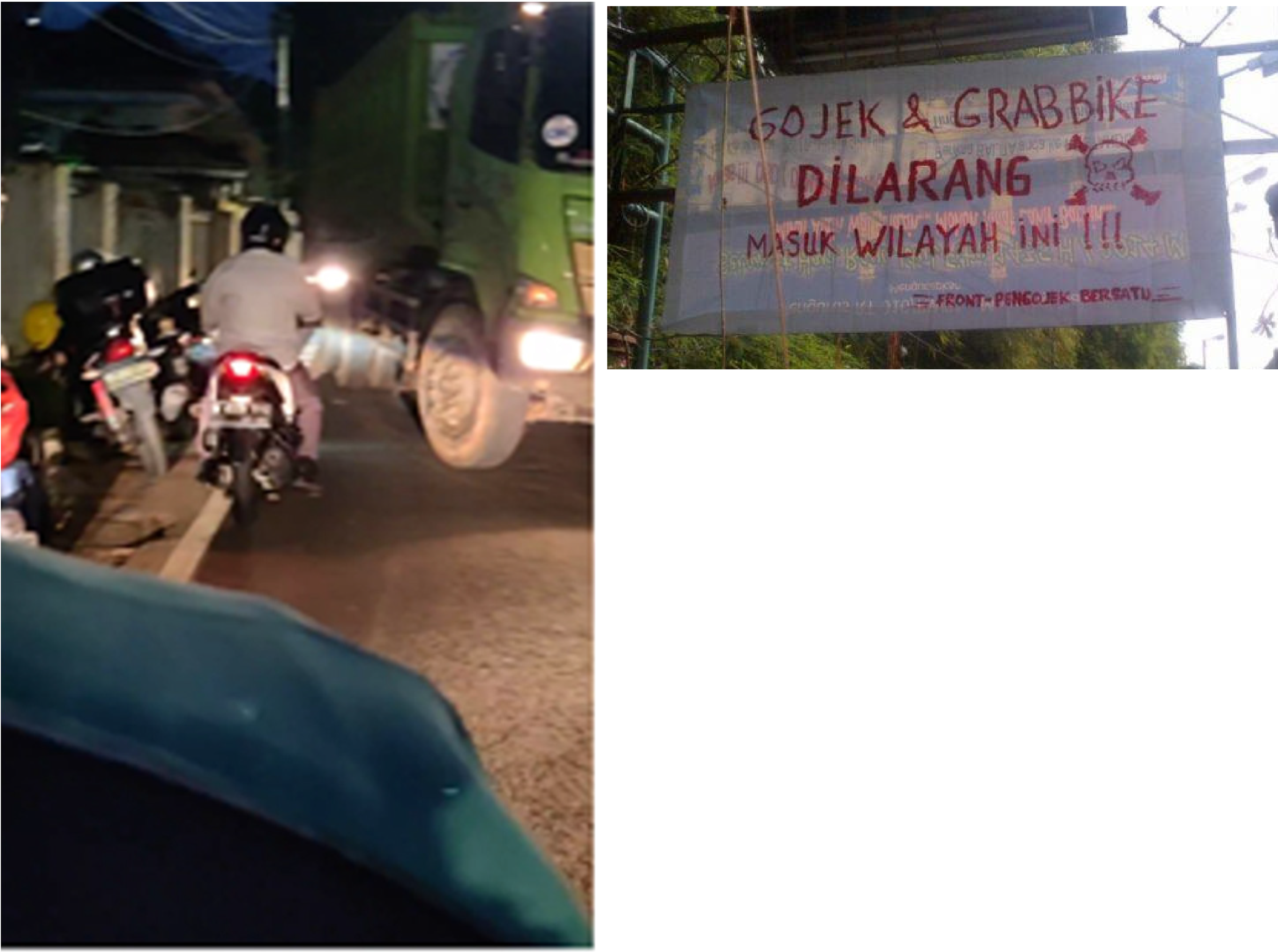
Seeing the city like a driver: areas blocked by traffic (left) and areas they cannot enter because of political reasons (left).

Lines of Grab/Gojek drivers outside a train station in Jakarta (source: Flo, 2019).
Figure 6 is our illustration of the driver's challenge to a decontextualized view of the city perpetuated by the platform. The map both serves as a visualization technique and as a methodological tool to center the “drivers view from within.” The map showcases the multitudes of factors drivers contend with as they navigate and negotiate with the city: the local relationships, frictions, and contingencies. The esthetics of the map deliberately flouts abstracting and professional conventions of the platforms to show the dynamism, informality, and humanness of urban space. The visual space of our illustration is cluttered with photos showing different engagements drivers have with space, areas they see as “friendly” because of other driver groups’ presence or “unfriendly” because of security guards that move them along. Hand drawn lines show how routes can change dynamically and nonstandard illustrations of hurdles show how dynamic and personal these encroachments in a driver's routes can be. Compare this map with Figure 3, an image of what drivers are shown by the platform when an order is received. Figure 6 shows how drivers’ view challenges a basic premise of mapping: that spatial knowledge can be ordered (Pearce and Louis, 2008), “the world made knowable through specific calculations of space” and “space could be conceptualized into points, lines, areas, and surfaces” (Crampton and Krygier, 2005). In other words, Figure 6 shows what drivers know: space is not just Euclidean and the city is “more complicated than writing parameters for rapid spatial optimization” (Mattern, 2021: 65).

A route as seen through the drivers’ view from within.
The platform's view of the city resembles Donna Haraway's theorization of the “god trick” because it places the viewer in the impossible position of a disembodied, all-knowing eye looking down at the city. For Haraway the danger in this visual strategy is that it produces distance—between the map-maker and its object (in this case, the platform and the city). In this case, distance creates a “series of essentialized understandings” about the city which render it as a “neatly defined problem with definite, computable solutions” (Morozov, 2013; Shelton, 2017). These maps thus “mask the people, the methods, the questions, and the messiness that lies behind clean lines and geometric shapes” (D’Ignazio and Klein, 2020).
So, the contextual variables necessary for drivers to navigate Jakarta's streets—finding shortcuts, avoiding areas with more potholes or neighborhoods with bad sewage, deciding your route based on time of day for safety or convenience, preferring areas that bring you closer to your friends—are not imagined as an axis for analysis by the platform. Yet, this context is essential for workers to get their orders completed.
Platform assumption 2: Drivers are interchangeable, optimizable dots on a map
In the introduction of urban technology platforms, a particular data-driven imaginary line is created, which rests on the superiority of algorithmic or computational smartness (Mattern, 2021; Shelton, 2017). This narrative of technosolutionism is prevalent in a lot of discourse produced by GoJek and Grab, making technology the central organizer and optimizer of activity. This way of thinking casts other forms of intelligence, embodied, situational, or Indigenous, as inferior (Mattern, 2021), for example, the derisive and colonial comment from the Gojek executive about drivers’ “tribal” knowledge. If the platform assumes it holds all the optimizing power and all the right knowledge, then drivers can be seen as cogs in the machine; at best nothing more than “sources of data that feed the urban algorithmic machine” (Mattern, 2014) and at worst a hurdle to implementation (Hollands, 2015).
Figure 7 is a composite of headlines from blog posts and public talks given by Grab/Gojek teams explaining their models and decision making for how they match their drivers with customers or manage demand/supply across the entire network. At no point in this narrative are drivers’ own optimizations, desires, or preferences mentioned as factors in the matching/allocation system. In fact, drivers are depicted as having no agency but are viewed as aggregated economic units that are compliant vectors to be moved around a map.
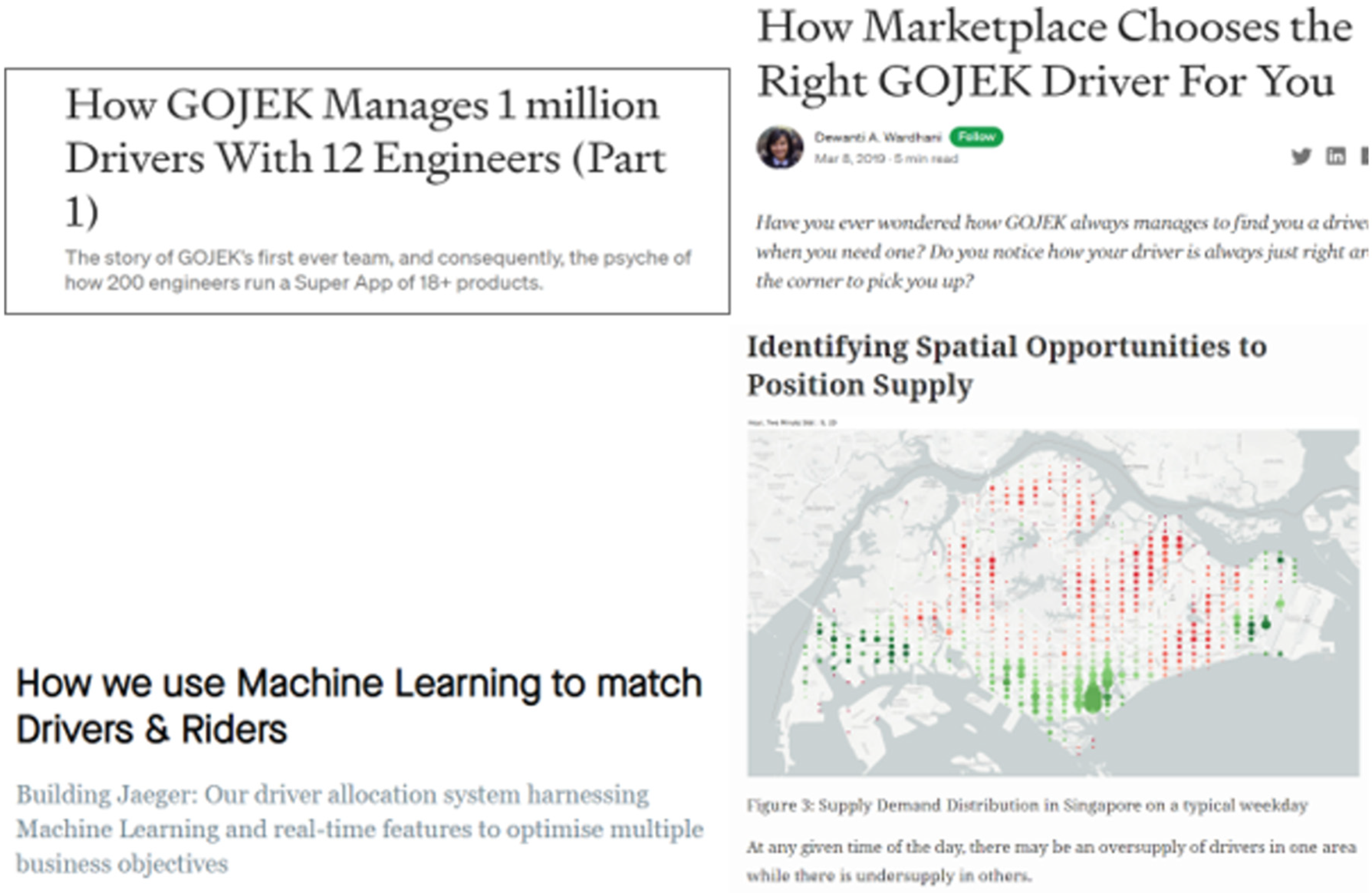
Platform as sole optimizer in company blogposts and presentations (source: Gojek Tech Blog).
The focus in this messaging instead is on how technology and engineers manage drivers, efficiently solving for metrics the platform deems important. The central agential role in this narrative is of the technology and the engineers which are seen to create the optimal match, move around the vectors efficiently, and constantly keep the network in equilibrium. One Gojek blog noted how “smarter allocation decisions generated over 1 million additional completed trips within weeks of our launch” (Richens, 2018) as if the decision of where drivers go and which rides they take is solely the platform's. Another congratulated Gojek engineers for reducing wait time: “It's not magic, it's GOJEK's Marketplace team with a hefty dose of AI & technology” (Wardhani, 2019). In a similar tone, Grab's blog casts drivers as “supply” units, as if they can be moved around like goods or trucks: “We need to balance demand and supply (…) finding ways to move oversupply to areas where there is higher demand” (Garg et al., 2019).
In Jakarta, instead of witnessing the rise of such a technodisciplined, compliant driver force, we see drivers developing their own counter-optimizations, borne out of interactions between urban space, their own preferences and the platform's demands. Through experimentation, consultation, and reverse engineering, drivers land on their own parallel objective functions. This happens even as drivers do “data science” work that is very similar to matching algorithm designers in the platform companies.
For instance, instead of following the platform's directives, drivers routinely predict demand and move their positions accordingly. While their decisions are influenced by messaging from the platform, they also use multiple other sources of information in their calculus. Updates from their peers, weather forecasts, changes in the sociopolitical conditions of the city, personal obligations, their targets for the day, “gut feelings,” all were considered in consultation with what the platform suggested. Drivers also voraciously seek information about their own work patterns. Some keep tabs on their Google Maps Timeline which gives them insight into order hotspots by looking at the places they visit the most on the map (effectively employing a form of cross-platform verification).
In a bid to not be hapless victims of platform optimizations, drivers actively experiment with various strategies to exert agency over the platform. As one driver explained, “the algorithm is a dirty glass of water. If I want to clear the water out I will pour clean water, if I want to clear the algorithm out (of its presuppositions) I will pour in my data.” The aim of this community of drivers was to, in their own words, “not be the slave of the algorithm.” Their proof of beating the algorithm, one driver told us, was them always getting the orders they like “even as the system would like them to take all orders.”
Technological subversions are used to “hoodwink” the platform and further resist what drivers interpret to be platform directives to be order agnostic. There is a thriving underground market of modified apps that allow drivers’ GPS to always be read at hotspots of demand even as they themselves are in nearby resting areas or filter the types of order they want (Qadri, 2021a). Drivers report that these gray-market apps respond to the on-ground realities of working on the streets of Jakarta, as well as to various driver needs while also affording them more agency over their work. These gray-market apps are, then, technological manifestations of the drivers’ view. The interface of one of these apps can be seen in Figure 8. Conversely, when drivers also do not wish to be matched at all in certain areas, they can turn their Grab or Gojek app off when passing through such areas. One wholesale market in central Jakarta is infamous for package delivery orders which drivers tend to avoid as they carry a greater financial risk and are often clunky to carry. These strategies help drivers resist the platform matching systems, even as they comply with its imposition of supply-demand logic.

Gray-market apps available on Google Playstore that allow drivers to spoof Global Positioning System and filter orders.
Drivers also routinely countervail the original logic of ride-hailing: spatially dynamic driver networks that move with demand. In ideal platform design drivers would be spatially indifferent and spatially dispersed, allowing the algorithm to send them to any location. In reality, drivers have sticky spatial preferences. They choose to return to their basecamps (spaces developed by drivers akin to clubhouses), and develop tight work zones around the basecamp. This complicates the supply positioning optimization of ride-hail platforms which assumes an always-circulating, ever-compliant driver, who could be made indifferent to various spatial locations just by monetary incentives alone.
Visions of platforms are instructive of the hubris of technologists as they search for efficiency using rhetoric that only technologies can optimize. Such responses from the drivers challenge the platform's assumptions that it is the sole arbiter of relationships between space, drivers, and their work. In its partial vision, the platform misses these strategies and subversions of the drivers which transform how the platform functions.
Disrupting the binaries of platform versus driver visions
So far, we have presented the driver’s and platform's views as antagonistic. But the relationship between the platform's assumptions and the drivers’ visions is neither one of the complete dominances nor one of the pure resistances. In this section, we further analyze the relationship between platforms’ and driver’s visions, beyond framing of antagonism and dependencies.
Worker subversions that make work more efficient
Drivers often are not trying to overthrow the platform but are optimizing how they navigate its limitations for their own economic gain/livelihood. Their vision for work is not always misaligned with the platforms’ imperatives of maximizing income and working efficiently. Like platforms, drivers are also trying to understand the city as a space for economic extraction and livelihood.
Even the technological subversions used by drivers are a double-edged sword. The idea of “beating the algorithm” espoused by many driver communities is not about doing less work or no work, but about making more money by being matched to better orders. Some underground apps developed by drivers allow them not only to improve their working conditions but also to make more money for the platform. One underground app developed by drivers, for instance, allowed drivers to auto-accept any order that they were matched to. Even the gray-market GPS spoofing apps (which Gojek and Grab have banned) were popular because they allowed drivers to often get high-value orders, which they often would not have been able to because they would be unable to wait in high traffic areas.
From the platform's side, the view from within is actively dismissed in the companies until it is considered to serve the platform's economic interests. Gojek, for instance, has benefited by adopting features originally designed by driver populations for their own gray-market apps. One example of such a feature is the ability for drivers to filter orders. This was originally a feature developed as an underground app for drivers, by drivers, in an attempt to improve their working conditions. Another example is the Grab and Gojek corporate-run shelters which have now started cropping up in Jakarta. Beginning in 2017, both companies began creating their own “offline queues” and shelters mimicking the space, amenities, and functioning of the driver-organized basecamps. These spatially embedded stations in some parts of the city Grab has even contracted with existing driver communities to manage these shelters.
Worker organizing repairing the platform
While there is resistance, there is also infrastructural repair work drivers engage in for the platform. The burden has fallen on drivers for reconciling frictions created by the platform's inappropriate and limited vision of urban space. One main way drivers repair the platform is through the deep networks of collaboration they have developed with each other.
Community relationships allow drivers to continue doing their work by providing them the support, knowhow and space to resolve many tensions and frictions of urban space that the platform is unaware of or indifferent to. Drivers constantly seek help on routes, traffic flows, and parking difficulties from their communities on WhatsApp. Informal relationships help them navigate high parking fees for instance, if they make friends with the parking officer or find drivers to keep an eye on their bike. Through basecamps, drivers have developed a network of physical spaces that are spread out through the city as a web of mutual aid. These spaces allow drivers to rest and find an assured source of help in new neighborhoods (Qadri, 2021a). The basecamps themselves are in turn usually sustained by a patchwork of relationships. Local shopkeepers can set up a running tab, help with security of the basecamp, and local property owners can give them space to set up camp. These relationships then become the infrastructure of platform work.
Another example of repair work done by drivers completely outside the purview of the platform are the agreements set up between platform drivers and pre-existing motorbike taxi drivers (opang). When platforms entered Jakarta, they disrupted the local mobility market, resulting in tensions on the road between the new mobility platform drivers and incumbent “offline” motorbike taxi drivers (opang). In response to rising violence between both communities, drivers negotiated informal territorial agreements with the opang to safely take the road again. One provision in these agreements is the specification of “red zones” where platform drivers cannot pick up customers. If drivers accidentally enter a red zone they run the risk of getting their key snatched by the opang as per community agreements. Maintaining these agreements, educating new drivers about them, and creating work around when the platform ignores them, become the purview of driver collectives. The labor behind this work often goes unacknowledged by the platform, but it is essential to the functioning of the platform as it has been for sustaining new technologies in other contexts (Chandra et al., 2017; Gray and Suri, 2019; Qadri, 2021b; Salehi et al., 2015).
Such repair work has been studied as a common occurrence in the introduction of technological systems where on-ground workers have to do significant compensatory labor to make the technologies function (Elish and Watkins, 2020). In the case of Jakarta though it is the fundamental source of worker power that is repairing the platform: organizing and mutual aid. At some level, this invisible labor also helps confirm to the platform that their vision of urban space is correct, since the platform rarely faces the disruption these could have caused if not for the driver's labor. Thus, drivers indirectly lend credence to the platform's vision.
Platform glitches giving rise to worker power
The frictions emerging from the interaction between the platform's impoverished vision of urban space and the actual realities of Jakarta's sociospatial map, is an example of the platform's glitchiness, where the technology does not function as intended, as advertised or not at all (Leszczynski, 2020). Repairing these glitches, though, is what allowed drivers to develop their own power. Both the worker subversions and worker organizations we discuss in this section only came about because of the communities drivers built around repairing the platform. Facing the vagaries of the new system incentivized drivers to reach out to their peers for help. When red zones and security issues blocked drivers from becoming the freely circulating bodies that platforms had imagined, drivers had little option but to turn to each other to solve the problems of their daily work. Unanticipated political violence on the roads allowed drivers to conceptualize themselves as one cohesive force. Contextually inappropriate routing and matching led drivers to see themselves as superior to the algorithm, or to seek to better it. Drivers were incentivized to communally create their own technological solutions, which we theorize to be subversions. The platform's opacity and ever-changing system pushed a lot of drivers to create their own experiments to understand the routing or matching algorithms, which they then shared with their communities. Drivers now routinely strategize on how best to interpret and mold the algorithm, seeing these subversions as part of their identity and service to the community. With the failures of the platform apparent, drivers created a collective identity and emerged as a powerful force in the city.
This is not to say that these glitches are not signs of the platform dismissing the driver's experiences and not encoding the importance of context in the design of their technology. These glitches are, of course, reminders of the indifference of the platform whereby they can shift burdens on to drivers to manage their own daily work. But they are still what Perera (2009) sees as the gaps and cracks of formal systems that allow the subaltern to recreate and rewrite the spaces of the colonizer. The platform and the drivers exist in a symbiotic relationship: the former's inappropriate reorganization of the market creating conditions for worker solidarities to exist and the worker solidarities in return repairing the platform and creating room for more worker resistances and subversions to emerge. Worker power then in Jakarta, thus cannot be thought of in isolation from the app. The platform created conditions for its own subversion.
Implications for worker power and tech design
The relationship between workers’ and platform's visions bring up questions that are important for both our understanding of platform urbanism as well as for the theory and praxis of worker power. First, what possibilities exist for incorporating workers’ visions within the current platform system? Second, what does this relationship suggest about worker agency in the algorithmic market?
Hurdles to incorporating workers’ visions
A standard question we receive in response to the empirical exposition in this article is whether the platform can integrate the drivers’ view into its current structures? With the rise in participatory, human-centered technology design there may be an argument to be made that there is a win–win situation if platform's open their systems up to engagement with the knowledge system of drivers. Powell (2021) calls this process embracing hybrid knowledge, where gaps of one technological system are filled with other forms of knowledge. In this part of the discussion, we focus on two factors that prevent the platform from seeing a richer view of the urban market: the epistemologies of the platform and the broader economic incentives in which it is embedded.
Methods of seeing
Technological interventions hold subjective judgments on how to see and how to know that are not ideal for understanding the drivers’ view. Platforms’ reliance on quantitative data necessarily produces a limited vision of reality, which means it often misses the ground realities which our ethnographic exercise made apparent. A lot of the hurdles and frictions drivers encounter also do not lend themselves to study through distant, quantitative means. They are often temporary (e.g. political protests or broken traffic lights), ill-defined, fuzzy social relationships which vary based on the individual positionality of the driver (e.g. red zones negotiated between driver communities). There is no central authority or agency the platform can gain the information from in a neat data stream to the platforms.
Big data tools and techniques have rightly been critiqued extensively for what they obfuscate as much as what they reveal. Radical geographers such as Harvey argued social relationships, power inequalities, and class conflict dropped out of view in these analyses (Barnes and Wilson, 2014: 10). When drivers are merely represented as dots on the map, one cannot see the rich repositories of situated intelligence drivers carry nor the hurdles they have to navigate every day to get their work done. Decisions that rely on these large observational datasets, which are granular but low-context and low-resolution on many key elements, then reproduce these absences and omissions. Through this distance drivers are of course seen as mere vehicles for movement.
As Ortner (1995) argues, ethnography is a commitment to “producing understanding through richness, texture, and detail, rather than parsimony, refinement, and elegance.” If platforms are to shift toward a richer understanding of the world they will have to give up the parsimony and elegance of platform models to not just focus on the individual user's behavior but to understand the messy realities and complex systems they engage with in daily life. There would need to be an acknowledgement of the limitations of what the platform can see.
At the same time, though, platforms would also need to consider drivers a community worth understanding, with valuable contributions to make. In the smart city and in the mobility platform, specific visions are deployed around who can optimize and what optimizations are. Currently drivers’ knowledge and their experiments are not seen to be legitimate when compared to the platforms’ methodologies. If drivers are seen to be mere cogs in the machine that only need to be told what to do, then there is no incentive for the platform companies to invest in knowing their needs. As long as the platform company sees itself to be the only legitimate optimizer in the market, it will not recognize the driver's optimizations as worthy of attention.
Tensions of scale in global technologies
Platform's visions also fall prey to what is considered a core value of algorithmic production in tech today: scale thinking (Hanna and Park, 2020; Selbst et al., 2019). Globalizing technologies are accordingly often conceived for a universal, abstract every-city even when they are to be deployed in specific places. Veneration of scalability comes out of computational disciplines that encourage the design of technology that can be ported anywhere and everywhere. Scale thinking encourages algorithmic code that is “interchangeable, abstract, and universal” and can “expand without having to change itself in substantive ways or rethinking its constitutive elements” (Hanna and Park, 2020: 10). Code, then, that is written for scale, needs to assume users to be the same, neighborhoods to be the same, cities to be the same, and does not consider how behavior changes in interaction with technology, or how technologies themselves change in different contexts. Drivers as uniform, interchangeable nodes in a network are also easier to handle computationally and logistically.
Thus, often it's not that platforms do not know that differences in context exist, but they do not need to care about context beyond a few demographic variables because there is belief that such complexity is extraneous to the task and technology can order everything. And indeed, the technology does appear to “work,” but what makes it work is the local knowledge, repair work, and invisible-to-the-platform labor of the drivers. So, platforms fail to recognize that they are not the sole authors of their success and broadly proclaim the successes of scale and abstraction.
This scale thinking is further reinforced by rapid growth and global proliferation of startups like Uber. As constraints to technological implementation have lifted, tech companies believe they could operate the same app in the United States or Pakistan or Indonesia with very low costs. Idle venture capital (VC) money has seen the untapped market of the South as its next frontier. There is thus pressure on startups and platforms around the world to rapidly scale across the world if they are to continue to attract the kind of VC funding they desire.
Heterogeneity is harder to handle if companies are to build systems that scale efficiently across such different spaces. If you are going to become a global tech firm how do you also localize down to the street level? So, any local and contextual nuance has to either be ignored in favor of scale or incorporated minimally when needed but only as long as it is calculable. As Scott admitted in his book on the colonial reach of states, “large-scale capitalism is just as much an agency of homogenization, uniformity, grids, and heroic simplification as the state is” (Scott, 1998: 8). Just as spatial legibility through mapping and grids was concomitant to the state's colonization of space, the platform company's ordering and abstractions are deeply implicated in questions of extraction (Ferguson, 2015). The platform's visions of the mobility market may be far from the experiences of the drivers but allow for the production of a world closer to the platform's ideal. The entanglements of workers’ and platform’s visions in Jakarta though indicate the necessity of paying attention to the “local” and rejects universality as a tenable tenet of technological design.
For platforms to embrace “hybrid knowledge” thus would require a fundamental shift in how our technologies are designed and imagined but also the economic incentives at play in technological development.
Spaces of agency in the algorithmic market
Even if platforms could embrace “hybrid knowledge,” to what ends would this impact the agency of workers? On the one hand, platforms embracing worker strategies could be seen as a win for worker power. After all, in the examples above drivers have forced platforms to give a nod to their organizational strategies and acknowledge their limitations of their assumptions of how matching could work in Jakarta.
Yet if more of the drivers’ perspectives are incorporated into the technology drivers potentially risk losing agency. The power drivers hold right now is their expertise in the form of situated spatial and experiential knowledge which the platform does not have and, in fact, does not even recognize as legitimate knowledge. Somewhat contradictorily to the data feminism principle of making labor visible, then, in this case there may be power in invisible labor. Something similar happened with Gojek when features they had created through their gray-market apps were incorporated into the official app. Drivers lost the ability to use these features at will. Gojek had its own restrictions of use, and would activate and deactivate the features as it wanted. Even in the Grab-run and Gojek-run shelters, drivers cannot produce the same form of sociality as in their own spaces. As companies adopt social practices of the drivers, they grant some power to drivers, but take away other forms of agency. Drivers do not necessarily escape the platform's management nor does the platform accept the failures of their existing model. The platforms imitate driver innovations in social and spatial governance, but make a corporatized, controlled version of it.
We though cannot dismiss the importance of the ways in which drivers in Jakarta have infused their own visions into the platform's systems. Interactions with powerful systems by the urban poor are likely to be framed as marginal or as individual subversive acts that put holes in the system but are ultimately not transformative (Scott, 1985; Simone, 2014). However, urban theorist Bayat (2000) in his analysis of encroachments by the poor, argues that there can be incremental progress and betterment through the pushing back of the poor: actors tend to expand their space by winning new positions. In Jakarta, too, the driver's vision is not marginal to the system, nor defensively framed around survival. Instead they have leveraged their collective power to change the functioning of the algorithm and business models of the companies as noted above in the case of company shelters. After all, if there is a “recursive loop between the calculations of algorithms and the calculations of people” (Gillespie, 2014: 183), then driver behavior becomes a key determinant in the efficiency of the platform's algorithms.
Technology is also not necessarily oppositional to worker agency. Drivers have relied on other forms of corporatized technology outside the platform to organize and repair their daily work. WhatsApp has been central in drivers creating their own support networks as it allows drivers to stay in touch and engage with each other even when they are physically distributed. Woodcock (2021) sees “in the appropriation and weaponizing of communication technology like WhatsApp workers have been able to show an emancipatory potential that can be found in technology.” But corporatized tech remains a precarious source of power. Features are not designed to support worker organizing nor do workers necessarily have control over how and when features are released or retired or their data. Using corporatized tech to resist corporatized technology is working in the short run, but the sustainability of this reliance is unclear.
This article is cognizant of the power digital platforms hold, and acknowledges the difficulty of systemic transformation within platform capitalism. While incremental changes in platform design may help workers, the question of worker knowledge being integrated within corporatized platforms is complex. In the end, the form of worker agency we discuss in this article emerges from glitches that will always emerge when simplified models of reality are imposed on complex worlds. The indeterminacy of this agency parallels the indeterminacy of the glitch itself. It can be both a productive opportunity for workers to resist and the symbol of an oppressive status quo. Workers have both used glitches to gain power, but the existence of the glitch shows the technology's indifference to their context, hurdles, and experiences (Benjamin, 2019).
Conclusion
This article demonstrates empirically how the platform's data-driven, algorithmic approach to urban mobility relates to the situated, local, and relational vision of drivers. In this comparison, the aim of this article was not to romanticize the driver's knowledge, which can also be inaccurate or limited in many ways. Nor was it to argue whether the algorithm is wrong or right. Any algorithmic system makes limited optimization choices, based on particular assumptions, and objective functions. Our aim was instead to showcase how intrinsic the driver's vision is to the platform's function in the city. This complex, contradictory and complementary relationship between these visions then open up limited possibilities of worker agency within the structure of the algorithmic market but also show the possibility of knowledge appropriation that could foreclose worker agency.
The interactions we have recorded in Jakarta also showcase the evident tension between local contextualization and global scale inherent to platforms in the Global South. When the platform treats all cities around the world as an equation to be algorithmically solved, it seeks to flatten out lived experiences and relationships of daily life in cities like Jakarta. Jakarta's case clearly reveals the futility (and irony) of technologies trying to automate out such relational exchanges and abstract away local context. Making the global technology of platforms function at local scale requires these very thick relationships of social embeddedness that are borne out of collective cultures. As researchers we can highlight the importance of the relationships and visions drivers create, not just as romanticized notions of resistance, but as culturally and historically important modes of urban life which technology can interact with but not necessarily fully capture nor do away with.
Footnotes
Declaration of conflicting interests
The authors declared no potential conflicts of interest with respect to the research, authorship, and/or publication of this article.
Funding
The authors received no financial support for the research, authorship, and/or publication of this article.
