




Abstract
Using Big Data to better understand urban questions is an exciting field with challenging methodological and theoretical problems. It is also, however, potentially troubling when Big Data (particularly derived from social media) is applied uncritically to urban governance via the ideas and practices of “smart cities”. This essay reviews both the historical depth of central ideas within smart city governance —particular the idea that enough data/information/knowledge can solve society problems—but also the ways that the most recent version differs. Namely, that the motivations and ideological underpinning behind the goal of urban betterment is largely driven by technology advocates and neoliberalism rather than the strong social justice themes associated with earlier applications of data to cities. Geosocial media data and metrics derived from them can provide useful insight and policy direction. But one must be ever mindful that metrics don’t simply measure; in the process of deciding what is important and possible to measure, these data are simultaneously defining what cities are.
“Our broad research question is using social media data to run a city better.” (Email from an urban informatics professional, March 2015)
The email quoted above arrived in my inbox in 2015 and is representative of an increasingly common refrain as Big Data and related analytics gain purchase within urban planning and geography. Based loosely under the broad and multi-faceted idea of “smart cities” (see Albino et al., 2015) the question voiced in this email represents an exciting field with challenging data, methodological and theoretical problems that has precipitated thoughtful discussions across disciplines.
Nevertheless, this particular email gave me pause, especially the phrase “using social media data to run a city better” with all its technocratic and reductionist overtones. 1 To be clear, I have used social media data extensively in my work in Urban Geography. Still the mindset I saw displayed in this email is one that is often found in smart city policy approaches (Lehrer, 2010; see Townsend, 2013 for similar assessment), and one that I find troubling, given the complex challenges in using social media data (and other “Big Data” sources) to produce meaningful insights, particular in the cause of making cities better.
This essay represents my assessment of how the related issues of Big Data and social media have been (and are being) brought to action in urban governance via the ideas and practices of “smart cities”. Although I contend a key task for work on smart cities is grounding “analysis in the actually existing cities, territories and relationalities where these policies are being constructed and implemented” (Shelton et al., 2014: 10) this commentary takes a more macro perspective, with the goal of unpacking rather than accepting the idealized version both used by some proponents and critics.
Histories of smart(er) cities
While the term smart city is widely evoked, the visions and actual practices of smart cities are quite diverse belying anything as simple as a single model. For example, Batty et al. (2012: 481) characterize smart cities broadly as a new way to understand and address urban problems “in which ICT is merged with traditional infrastructures, coordinated and integrated using new digital technologies”. This scoping of smart city projects across the full range of urban governance tasks and interlocking urban systems is also noted by Albino et al. (2015: 6–8) who outline over 20 examples ranging from the relatively simple metric of information technologies diffusion to deep organizational changes to communities often including new roles for private actors and citizens. In short, the idea of the smart city is unruly and multi-faceted, and beyond an increase reliance upon information technologies can vary widely in actual practice.
Moreover the idea of improving quality of life via information-mediated cities is not without historical precedent. While some have pointed towards work from the late 1980s and 1990s on so-called ‘cybercities’ and other such visions of an ICT-mediated urban experience (Batty, 1997; Castells, 1989), the real precursors to the contemporary vision of the smart city go much, much further back in time. By limiting our historical analysis only to the last two decades since the growth of the internet, we risk missing the more fundamental connection of these contemporary urban policy trends to longstanding ideas within planning practice and urban governance. In short, smart cities are not due to the specific availability of certain new information and communication technologies, but are a continuation of the longstanding use of techno-scientific ideology as a kind of universal justification for planning. The actual priorities for intervention—be it growth machine economic development, mass transit, sustainability or even suburbanization—are generally derived from the localized (or regionalized) understandings of urban planners and municipal politicians that adopt smart city terminology to meet pre-existing goals.
Furthermore, the visions of the smart city typically invoke, albeit often implicitly, are echoes of the classic urban ideas of Ebenezer Howard and his orderly ‘garden cities’, or even Patrick Geddes and his regional observatory in Edinburgh. But it is not only these pioneers of urban theory that the smart city and its proponents draw on, but also the ideas of the RAND Corporation and other Cold War-era institutions who appealed to the supposedly inherent qualities of technoscience to guide urban planning (Light, 2003). And while the resurgence of hyper-rational, technoscientific planning may seem new when cast against the backdrop of the postmodern turn over the last two decades or so, the history of urban planning has many such swings of the pendulum (LeGates et al., 2009).
An especially intriguing, late-midcentury example of this approach is the Project Cybersyn (Proyecto Synco in Spanish) enacted during the socialist Allende regime during the early 1970s in Chile which viewed cybernetics as a technology of liberation (Medina, 2011; see also Crampton, 2015). With a vision and goal set that foreshadows the rhetoric of the 21st century smart cities, Project Cybersyn “was an attempt to build a computer system for real-time economic control” and included the “creation of a futuristic operations room where members of the government could convene, quickly grasp the state of the economy, and make rapid decisions informed by recent data” (Medina, 2011: 3, 6). A key part of this vision was Project Cyberstride, a series of information flows from manufacturing plants (transmitted via Telex to a single centralized mainframe computer) for collation and analysis at the operations center (see Figure 1). The goal was to address problems within the supply chains of interlinking industries and factories in an anticipatory manner rather than simply reacting to a sudden crisis (Medina, 2011: 86).
(a) Operations room and (b) schematic for the Algedonic meter from Medina (2011: p.2 and p.90).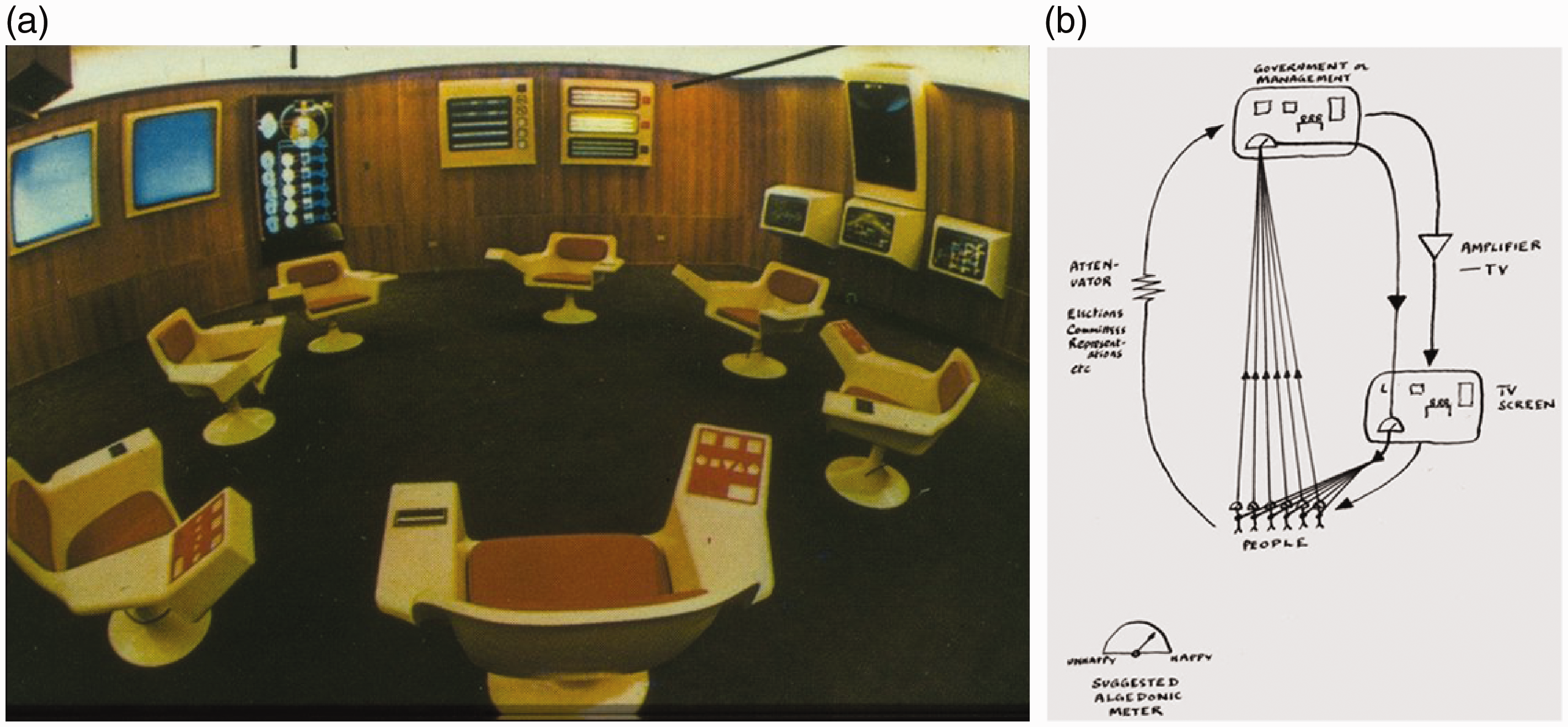
In addition to economic functions, Project Cybersyn also sought to shift the scale at which data could be collected and attempted to devise metrics that measured the mood of the population. Although not implemented, the plan envisioned devices called algedonic meters connected to television sets (see Figure 1) distributed around the country whose aggregated (albeit apparently non-normalized) voltage readings would be channeled to the operations center. These meters were envisioned as “capable of measuring how happy Chileans were with their government at any given time. … Unlike polls these algedonic meters would not limit or prompt answers by asking set questions … the meter did not require users to rationalize their level of happiness or normalize it to fit on a uniform scale.” (Medina, 2011: 89). It is an evocative notion, combining the ideologies of centralized socialist planning and cybernetics focused on creating a more equitable society.
The Project Cybersyn design was not dissimilar to the vision of urban governance promoted more recently in which cities are conceptualized as a “complex network of interconnected systems” (IBM, 2010). Moreover, just as the Cyberstride Telex network was designed as an anticipatory rather than a reactive system, smart cities seek to leverage information flows in decision-making and thus “anticipating and resolving problems proactively” (IBM, 2012). Although the Project Cybersyn was abandoned by Pinochet military dictatorship, it highlights the widespread appeal of harnessing real-time data; metrics and informatics to make economies and cities run better. There are some rather obvious design parallels between Cybersyn’s operations room and the current Rio de Janeiro’s Intelligent Operations Center (see Figure 2) planned to provide a range of data inputs via “live digital maps … the GPS-tracked movements of the city’s garbage truck fleet, current precipitation picked up by the city’s brand-new Doppler radar and … live transmission … beamed from the dash-mounted camera of the city’s eight thousand buses” (Townsend, 2013: 67–68). The overlap in design sensibilities, however, are overshadowed by the differences in practice brought by local priorities, i.e. Project Cybersyn sought to transform basic economic structures while Rio pursues the more prosaic goal of making existing city services more efficient.
Rio de Janeiro’s intelligent operations center (Wilson, 2015).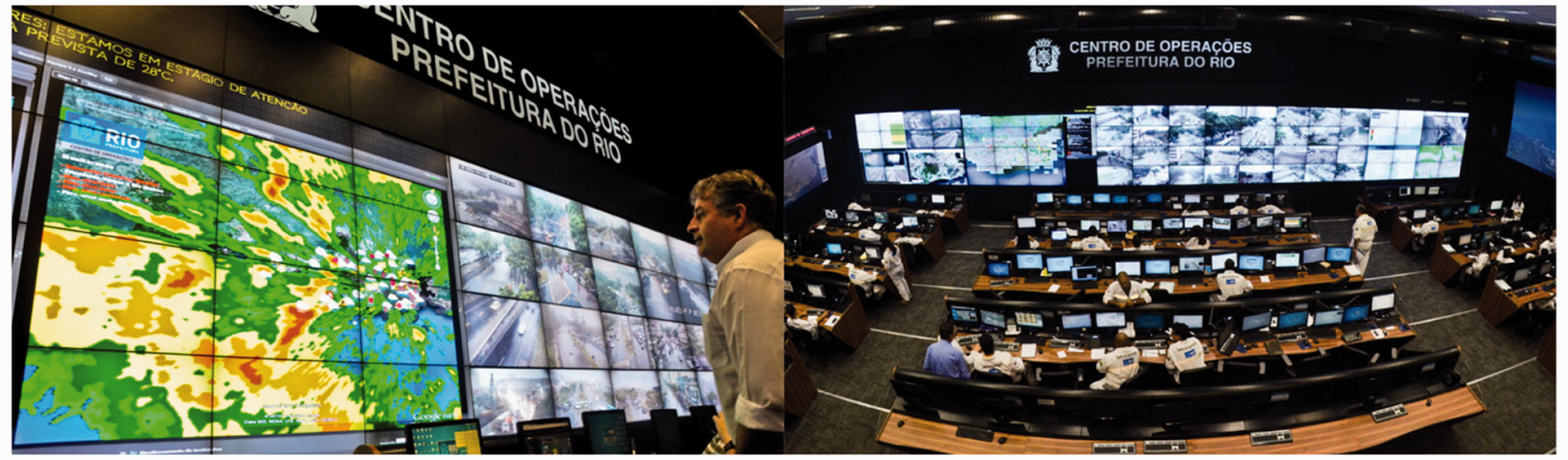
Although the specific technologies in play are new, smart city governance has plenty of antecedents in urban planning history (Hall, 1988), all with the laudable goal of making the cities run better. That said, the ideologies and priorities associated with these strategies have varied widely, from the socialist-based vision of centralized planning in Allende’s Chile to the neoliberal market based approaches promoted by technology providers to the preoccupation with security and service provision of pre-Olympics Rio, resulting in decidedly different interpretations of what “better” means.
Ideologies and smart cities
One of the tropes associated with smart cities is the often-cited statistic that the majority of humanity is currently living in cities, and this trend will only increase in the future (National Intelligence Council, 2012). From this starting point, smart cities are then identified as an essential strategy for dealing with an urbanized future and its associated problem: what White (2016) characterizes as an ideology based on a “shared orientation to the future” and an “imperative for change”. A standard set of examples—Masdar in the United Arab Emirates, Songdo in South Korea, and Living PlanIT Valley in Portugal—are regularly called upon rhetorically even though these “built from scratch” urban concentrations are decidedly the exception rather than the rule. When one looks at the cases of “the actually existing smart city,” a much more complex picture emerges; in a majority of cases, particularly in the developed world, smart city governance is implemented via ad hoc process in older cities. These projects come together via complex negotiations and assemblages of technologies, policy-makers, vendors and motivations (Shelton et al., 2014) and unfold in the context of an ongoing neoliberal project promoting privatization and the rollback of the state.
Branding and metrics
There has been plenty of critique of smart cities as a product of neoliberalism that seeks to shift governmental services and infrastructure to private providers (Greenfield, 2013; Halpern et al., 2013; Hollands, 2008; Kitchin, 2014a; Vanolo, 2013). Indeed one might tie the popularity of smart city governance to a certain hegemony of thought (Gramsci, 1995) built upon ideologies deeply integrated with everyday life, what Mirowski (2013) names a sort of “folk” neoliberalism. This conceptualization is useful as it captures how the vagueness and diversity of smart cities imaginaries—some kind of new technologically mediated system across multiple urban systems—leverages a desire for change to existing urban traditions without the need to specify what will come instead.
Of course, any implementation of smart city policy is shaped by the specific challenges of each city as well as the existing ideologies associated with a particular strand of urbanism, e.g. the welfare state of Europe or the free market alignment of the U.S. Vanolo’s (2013: 12) case of Italian cities highlights a particular urban utopian imaginary tied to the smart city policies in Europe (see also Hollands, 2015). These smart city opportunities are also shaped by public funding opportunities—focused at the city rather than regional scale—that is creating a “new geometry of power relations” in Italy and the larger European context (Vanolo, 2013: 12). This contrasts with the US experience where foundation and corporate funding have been more prominent than state initiatives, at least until the 2016 U.S. Department of Transportation Smart City Challenge.
Given the amount of marketing material from technology companies like IBM, Siemens and Cisco it has become a bit of a cottage industry within the US to critique smart city governance as the cat’s paw of corporate intervention within cities. However, narratives of smart cities as simply artifacts of technology company marketing are overly simplistic as urban policy makers pursue them for a range of reasons (Shelton et al., 2014; Wiig, 2015). For example, smart city policies are often rhetorically connected to competitiveness in a global economy, both to make a city an attractive location for investment but also to branding it as a technologically savvy and progressive place. Again this is not simply a matter of pushing the agenda of the for-profit sector but a mindset among urban officials that smart city policies are an important signal/tool for competitiveness (see McCann, 2011). In fact, the sparse evidence of the effectiveness of smart city policies relative to other strategies (Wiig, 2015) makes it difficult to promote on its own merits. In effect, smart city governance is as much about branding opportunities as it is about thoughtful public policy.
One of the key means by which smart city branding emerges in urban governance is via Big Data and metrics. Data have long been a part of urban management (e.g., the Telex flows in Allende’s Chile) but the practice of neoliberalism has been accompanied by an intensification of metrics (Brenner et al., 2010) and within recent years with the rise of Big Data and smart cities. 2 In particular, metrics have become a key means through which stories can be told (particularly those of the techno-utopian variety aligned with the economic interests of technology companies) and data visualized in the roll out of smart cities. Again, this is not new per se. Story-telling and visualizations have a long history within advocacy and community planning (Davidoff, 1965), radical geography/mapping (Bunge, 1971) and participatory Geographic Information Science (GIS) (Elwood, 2006). These examples, however, had the explicit goal of working with marginalized groups to produce alternative knowledge and narratives to the dominant ones. More recently, one of the possible benefits for crowd-sourced knowledge was the potential to provide locally based information that would otherwise not be collected by larger data aggregators (Goodchild, 2007). Thus, it is somewhat ironic that story-telling and data visualization have emerged as a central element to technology companies’ marketing campaigns on smart cities (Söderström et al., 2014).
Building stories and identifying metrics
Two of the main stories (or tropes) used to promote and justify smart cities policies are the twin crises of (1) growing urban populations in an era of climate change and (2) increased urban competition in an age of austerity. Combined, these stories present a picture of an uncertain future, with crises that need immediate action, that are most effectively addressed via the inclusion of new information technology to existing governance and institutional systems (White, 2016). This urgency in turn leads to a solution—new streams of Big Data, often crowd-sourced—that is cast as a key and necessary means for addressing the crises identified in the first two stories. While my primary interest is in the role of metrics in smart city governance it is useful to review the two stories that identify the specific set of problems that smart city metrics can address.
The story of growing urban populations is based on the observation that the majority of the world’s population lives in urban areas. 3 It is a story that most urbanists find intrinsically appealing; it justifies our own interests and predilections for scale both in terms of research and approaches to governance. It does, however, also contribute to a certain ossification in thinking about the scale at which problems are addressed, valorizing the metropolitan while leaving less room for regional, state, federal or international approaches (White, 2016). This downplaying of other scales of governance is particularly relevant to issues of climate change (Hollands, 2008). Cities might be large sources of carbon, but this story also casts them as the means to concentrate population in more compact and efficient systems. Urbanization (as long as it is smart) thus became a key response to climate change even as industrial and consumption practices (as well as treaties) operated at global and national scales.
The second trope, longstanding ideas associated with neoliberalism’s focus on governmental bloat and the need for privatization (Peck, 2005) have earlier antecedents within entrepreneurial urbanism (see Molotch, 1976) or technology parks (O’Mara, 2005), and more recent arguments around the creative class (Florida, 2002). Within this story urban governance becomes managing a city in a competitive market of other cities to attract a limited supply of investment and showcasing a city’s brand even if it is largely vaporware. 4 Thus, smart city policies become a way for urban managers to continue to provide public goods as before—such as functioning transportation systems to allow movement of goods and people—but with fewer resources brought about by the austerity measures associated with competitive (i.e., lower) taxes. The basic inputs to governance remain the same—data traffic counts—but the sources and methods used to collect them may shift from the public to the private sector or entail a new approach to measuring.
Based on these twin stories, urban governance becomes a matter of managing information technology to efficiently construct data flows (big or otherwise), which by their enactment defines what constitutes an “urban problem”. Traffic counts are easy to capture but metrics on “community” or “social justice” are much more complex and thus less likely to be quantified and incorporated. To be fair, this is not a new issue caused by smart city policies as transportation policy has long been a key (and comparably easily measured) element of urban governance. Smart city approaches that include installing traffic sensors or collecting mobile phone records (IBM, 2010) intensify established practices rather than break completely new ground. My concern is that precisely because these data are easy to collect, smart city policies help reify rather than question established practice, e.g. traffic sensors aimed at vehicular traffic steer solutions in certain modal directions rather than others such as increasing pedestrian access.
To counter this tendency it is important to foreground the processes by which different kinds of data are collected, valorized and come to matter for governance. For example, Taylor’s et al. (2014) project collecting traffic counts is not for a centralized transportation office, but rather at the request of local residents interested in better understanding their neighborhood. While this particular project was not tied to the local transit authority (and thus likely does no contribute to policy) this kind of participatory planning or mapping is well established within urban governance (Sieber et al., 2016). While participatory processes are not straightforward, they represent a means through which smart city metrics are grounded in deep and nuanced understandings of place drawn from citizens, planners and activists with long histories and connections.
This kind of nuanced and engaged involvement in urban governance, however, runs counter to many of the observed practices of Big Data and social media in which individuals become data. This is most obvious within the private sector when our curated social media output is resold and monetized as marketing avenues but is also evident within the public section. Experiments with social media by urban governments enroll citizens either as recipients for official communications (Sobaci, 2016) or as sensors in data collection projects, ranging from smart thermostats and demand conservation to potholes identification. For example the Street Bump (http://www.streetbump.org/) app emerged from Boston’s New Urban Mechanics office (tied to the Mayor) and uses smart phones’ accelerometers to detect possible sites for road repair. The bumps identified by the app “provide the city with real-time information to fix short-term problems and plan long-term investments.” While a clever application of available technology, it also raises concerns about the bias of incoming data as the users of such an app—younger and wealthier individuals—are likely to be clustered in certain neighborhoods. 5 Moreover, this role of citizens as sensors (Goodchild, 2007) stands in contrast to a more deeply engaged citizenry envisioned by Taylor’s et al. (2014) project and participatory planning. After all, the role of sensors is to pass through data rather than to question its significance or contribute to defining its meaning.
Encompassing unconscious contribution (cell phone records, CCTV records) to a continuum of conscious contributions (check-in, activity monitors, social media) together create what Wilson (2015: 39) calls the “quantified self-city-nation, the flickering of screens, the dynamics of real-time data and the prospect for behavioural change intersect in a glossy imaginary where being technologically fashionable and facile supersedes concerns of differential docility.” In short, a reduction of urbanity built on a series of self-referential and self-replicating metrics that capture a specific (and generally the most measurable) slice of the urban experience and in turn shape the trajectory of future possibilities.
The banal, yet performative, role of metrics
The role of smart cities metrics in producing a particular version of urbanity relates to Çalışkan and Callon (2010) work (as well as earlier ANT theorists) on how the expectations, metrics and institutions in markets are established. Çalışkan and Callon (2010: 16, 23) highlight the role of “material technologies” in structuring markets, a point also emphasized by MacKenzie’s (2006) work on the linkages between specific economic models and resulting structure of financial markets. Key to MacKenzie’s work is his argument that a specific material technology—in this case a financial model called the Black–Scholes–Merton algorithm—was adopted as a standard within financial markets largely because it helped solve a variety of political and operational problems, rather than for its fundamental accuracy. He continued this line of argument in later work (Millo and MacKenzie, 2008: 8) highlighting the way in which the Black–Scholes–Merton algorithm provides legitimacy “by providing a stream of methodologically valid information (although not always realistically valid)”. In other words, the model/metric acted in a performative manner, helping to define the reality of these financial markets rather than simply describing them.
The metrics of smart cities are as productive of urban experience as these risk algorithms are for the financial markets, thus making understanding metrics, Big Data and software algorithms a key area for urban scholars. To date, studies of the social construction and political economy of data and metrics have been relatively underdeveloped with notable exceptions such as Hacking’s (1990) argument about statistics “making people up” or Bowker and Star (2000) exploration of the role of standards and classification in ordering the human society and interaction, particularly the largely invisible ways in which this is enacted, normalized and made natural.
While classification and data have long histories and genealogies (see Crampton and Elden, 2006) including applications to centralized governance (Medina, 2011), there has been a recent intensification of metrics across society (Ajana, 2013) and scales from the metropolitan to the individual. Road sensors and CCTV provide streams of information directly into urban governance systems while social media and a range of apps and highly personalized devices such as Google Now 6 or the Apple Watch 7 provide data streams at individualized levels of granularity. This has profound effects on privacy, as Lyon (2014: 4) argues “contemporary surveillance expands exponentially—it renders ordinary everyday lives increasingly transparent”, often behind private corporate firewalls. 8 Thus, in addition to serving as sensors, citizens are also intensively sensed and measured within smart cities; a situation aligned with both the priorities of neoliberalism and the new security apparatus of post-9/11 governance (Lyon, 2014: 9).
Performative smart city metrics
There have been many calls for more research on the production of software and metrics in order to more fully integrate these understandings within studies of society and cities (Kitchin and Dodge, 2011). Ruppert et al. (2013) argue for analyses of “‘the social life of methods’ in order to better understand the ways methods and data have moved outside of research practices and into the social world” including urban governance. Kitchin (2014a) calls for studies of the political economy of data assemblages and related algorithms to better understand how they enact economies, cultures and cities at scales beyond the boldest visions of Project Cybersyn. Far from stale, routine or boring, data and metrics are deeply imbricated within daily practices as events are measured and feed back into the “quantified self-city-nation” (Wilson, 2015). In short, data/metrics and code have emerged as central actants within social, cultural and economic spheres within urban systems. Given the malleable set of justifications for smart city governance it is essential to engage in empirical studies of the assemblages of sensors, data, information networks and management as they are produced in and engage with pre-existing and specific systems of urban governance. Earlier work has focused on the ways in which software continually (re)produce urban space (Kitchin and Dodge, 2011; Thrift and French, 2002) provides differential access to parts of the city (Graham, 2005) as well as creates representation of the urban via hybrid spaces and digital augmentations (Graham et al., 2013; Zook and Graham, 2007a, 2007b).
There are a number of examples of the productive role of data/metrics within urban governance (in particular see Kitchin, 2014a); often via city websites that offer various trackers and/or dashboards. Incidents of crime, movements of city buses and dozens of other metrics are tracked and in so doing redefine what the city is (e.g., Rio de Janeiro’s Intelligent Operations Center). Or at least what is worth measuring with the city. The very banality of metrics and expectations embedded in daily practice is their power; what Wilson (2011) refers to as “formation of geocoding subjects” or the ways in which data, classifications and specific technologies are enlisted to construct particular visions of the urban. This makes the control of metric definition a key locus of power. Whoever gets to define what “running a city better” actually means, whether it be ranking the results of spatial searches (Zook and Graham, 2007a, 2007b) or through the priorities of smart city policy makers and consultants, occupies an authoritative position.
This marks a significant expansion of the role of data in cities. It is no longer simply a question of providing inputs for understanding but evolving into a central function of city and metropolitan governments alongside (and in some cases supplanting) the long established roles of policing, transit and social services. Shelton (2014a) terms this practice as data-driven governance or when “Data of all kinds—big and small, open and proprietary, digital and analog, volunteered or captured—is no longer simply a tool in the urban planner or policymaker’s toolkit, but both a key input and output of urban governance processes. Data is the modus operandi and the raison d’etre of contemporary urban governance.”
Given this power associated with metrics in data-driven governance, there have been regular calls for and projects focused on community based data collection and mapping; the “map or be mapped” argument (Bryan, 2007). While this represents one possible strategy, we must also recognize that public visibility is not appropriate (or sought) in all cases as data (particularly for marginalized communities) has varying levels of sensitivity (Young and Gilmore, 2014). Even community-based projects with minimal privacy concerns are not without problems. For example, Breen (2015) explores a range of practices by which community actors (encompassing a wide spectrum of “community”) define neighborhoods via metrics ranging from arts and creativity to crowd-sourced signage. Successful locally incubated projects, however, can be—either by design or happenstance—transplanted in problematic ways to new locales even when the focus is on something as seemingly unproblematic as the creation of way-finding signs to increase neighborhood walkability.
Anticipatory smart cities metrics
An additional key moment represented by smart cities has been a shift to anticipatory governance, which no longer seeks to make theoretical linkages to explain causation, but works to identify metrics through which urban problems can be managed before they emerge. This kind of anticipatory action has long been implemented in business settings—Wal-Mart’s harnessing its transactional records to stock stores prior to hurricanes and Amazon’s recent patent for what it calls “anticipatory shipping” (Bensinger, 2014)—but increasingly Big Data and smart cities are distinguished by an anticipatory orientation (Lyon, 2014; White, 2016).
Because this orientation is based on the specific data that have been created for and deployed within smart cities, these metrics and their associate logics help shape what kinds of futures are allowed to unfold; or as Kinsley (2012: 1557) argues they help “stabilize how particular futures play out”. In a similar manner Amoore (2013: 9, emphasis in original) argues that anticipatory logic “acts not strictly to prevent the playing out of a particular course of events on the basis of past data tracked forward into probable futures, but to preempt an unfolding and emergent event in relation to an array of possible projected futures. It seeks not to forestall the future via calculation but to incorporate the very knowability and profound uncertainty of the future into imminent decision … To manage risks ahead of time is to enroll modes of calculation that can live with emergence itself, embrace and incorporate the capacity for error, false positive, mistake and anomaly”. Anticipatory logic is particularly useful in justifying smart city governance and metrics as a logical and efficient response to the tropes of growing urbanization during climate change as well competitiveness during austerity. With these stories stabilizing a narrative of crisis, smart city metrics are thus easily and unproblematically put forward as the solution to “run a city better.”
Geosocial media metrics in urban governance
Geosocial media data—geotagged content created by individuals and shared through social media and accessible for collection by others—have become increasingly prevalent as mobile technologies have emerged, contributing to what some have called a ‘data revolution’ (Kitchin, 2014a). Through geosocial media it is possible to measure and analyze a wide range of everyday social, economic and political activities (Poorthuis et al., 2016) of interest to urbanists, particular when combined with other Big Data types—collected by sensors or produced through intentional crowd-sourcing projects. Often, however, “big” is simplistically equated with “better” resulting in metrics and maps that may be easy to digest and pleasing to the eye but which produce realities that mischaracterize and constrain.
What does geosocial media data represent?
One must be mindful of the biases of social media data which—on average—tend to be over-representative of wealthy people and places (Graham and Zook, 2011) as well as being skewed in terms of gender (Stephens, 2013). Digital social data is always a selective representation of social reality and one must be cautious in its use as well as critical of approaches, which presume the neutrality of data. Moreover, building upon Goodchild’s (2007) concept of volunteered geographic information (VGI) it is crucial to engage with the concept of “volunteered” as often geosocial media results from individuals’ actions but not their conscious decision or is largely reflexively created (e.g., tweets or Facebook posts that are a matter of habit but open to repurposing by others). As a result there are important ethical issues associated with the use of big geosocial media data in research, a point that has not escaped the US National Science Foundation and other funding agencies (Holdren, 2013).
Still because social media data is relatively easy to capture and analyze in real time, it is increasingly attractive as a data source for urban analysis. To be sure, social media has great potential for understanding new elements of cities and thus (if used well) could provide new insights for urban governance (Poorthuis et al., 2016). Analyzing the world with geosocial media data rather than census data does not necessarily require new methods but does bring different challenges, such as the unstructured nature of much of the data making it difficult to conduct meaningful research. In short, unless one is careful in using this data—cleaning, interpreting, etc.—one is likely to run afoul of GIGO (garbage in, garbage out) and produce insights that are hyped as insightful but upon further consideration are not as instructive as they might be.
For example, a recent map by Eric Fisher was touted by the public relations department of MapBox as the “Most Detailed Tweet Map Ever” (https://www.mapbox.com/blog/twitter-map-every-tweet/), as it was based on a dataset of 6.3 billion tweets. This was a problematic characterization subject to critique on a number of levels. Firstly, due to standard cartographic practice and limits to the processing power of browsers, the actual map eliminated about 90 percent of all tweets since many points were over-plotted. Not really an issue per se but the marketing tagline of a 6.3 billion-tweet map runs counter to basic cartography. This also provides an apt example of how the interpretation of data and analysis transcends the details of production (known by the analysts and those who read and are able to understand footnotes and appendices) and the urban official and citizen who use the product to understand their city. In short, the contingent and constructed nature of analysis and map are often rendered opaque for the end user.
Also problematic is the reification of “(1) that more data is equivalent to better data, and (2) that the only important aspect of the data is the geographic coordinates attached to it.” (Shelton, 2014b). The latter point is particularly relevant to smart city governance as planners and geographers often concentrate on the locational dimension of this data—the latitude/longitude coordinates. There is, however, an enormous amount of non-geographic information—networks, contexts, user self-description—associated with geosocial media data that can be leveraged for use (Crampton et al., 2013). This represents exciting new opportunities for urban governance to explore relational and temporal questions —What parts of the city are used by different populations? How do the functions of neighborhoods change over the course of the day or week?—that previously were difficult to pursue.
Local government use of geosocial media
The ways in which urban governments deploy existing and adopt novel datasets are evolving. Perhaps the most advanced is the promotion of “open data”—largely government datasets made publically and easily available for reuse in the expectation that new services for citizens could be developed independent of state action. Towards this end, many local governments have promoted hackathons—gatherings of volunteer software developers tasked with making new apps for local use—which have achieved mixed success along with raising concerns about regular government procurement (Johnson and Robinson, 2014). Relatedly citizen groups and non-profits have worked to engage local governments through the creation (or crowd-sourcing) of new datasets that represent concerns historically outside the purview of local government data creation and collection. A meta-analysis of 12 cases of the use of public participation via geosocial networks and other digital tools by citizen groups in Canada shows that the nature and conditions of participation are evolving (Sieber et al., 2016). Some existing inequalities between citizens are seemingly solidified and the reviewers worry whether these digital tools and networks are increasing individualism empowerment at the expense collective engagement to influence decision-making.
Looking specifically at the reliance of social media by local governments reveals that efforts are largely exploratory (see Sobaci, 2016 for recent and wide-ranging review). Kavanaugh et al.’s (2012) relatively early look at the use of social media by local governments and identified issues of how best to monitor social media communications and process the often overwhelming deluge of incoming data. The expectation is that social media can serve as a potential means to allow for more citizen inputs (Janssen and Helbig, 2016) and increase openness and accountability (Stamati et al., 2015). The most prominent use cases for this aspect of social media were in situations where real-time communications were paramount, such as emergency management. This ability to leverage social media during emergency has been shown effective in other cases (Bird et al., 2012), including more general cases of crowd-sourcing maps rather than social media (Zook et al., 2010).
The main example of local governmental use of social media is unfortunately also the most problematic, namely utilizing social media posts as an intelligence source for policing. In October 2016, the American Civil Liberties Union (ACLU) reported that police departments were using the services of a social media development company to monitor the activities of protestors. The company in question, Geofeedia, noted in its promotional activities to police departments that its feeds of Twitter, Facebook and Instagram data “covered Ferguson/Mike Brown nationally with great success” (Cagle, 2016). This type of use of social media clearly raises concerns that local governments might stray towards an Orwellian big brother state in which citizens are tracked and recorded.
Social media and socio-spatial theories
One example of using geosocial media in arguably more constructive ways is Shelton et al.’s (2015) analysis of Twitter data to study mobility and segregation in Louisville. While not numbering in the billions, it did involve some large numbers, starting with a dataset of close to 6 million tweets that were reduced to 600,000 based on series of filters identifying a set of users engaged in a particular type of behavior. In this case, people who were primarily active in one of two areas within the city and sustained this action over time. The goal was to combine concepts of relational socio-spatial theory with the methods of critical GIScience, in order to explore the spatial imaginaries and processes of segregation and mobility in Louisville (see Figure 3). The topic of mobility and segregation—social ills of mid-sized US cities—reflects the situated nature of smart city research and cases studies from other parts of the world focused on different measures of well-being.
Unevenly segregated activity spaces of Louisville, KY (Shelton et al., 2015).
The results highlight the dynamic and porous nature of neighborhoods in Louisville which runs counter to standard narratives of unbridgeable divides. In Figure 3, this is demonstrated by the extent to which people from the West End (a predominantly poor and African-American neighborhood) are mobile and active throughout the city (represented by purple shading) and regularly cross “the 9th Street divide” (marked in red) a locally well-known and racially based boundary. In contrast, those from the East Enders (a predominantly affluent and white area) were more spatially segregated and less likely to cross the divide (see the orange shading). To be sure, documenting mobility for these neighborhoods in Louisville does not invalidate other approaches to mobility and their findings. For example, Pendall and Hedman’s (2015) study of income inequality within commuting zones (similar to metropolitan areas but encompassing the entirety of the US) has increased from 1990 to 2010, including the specific case of Louisville.
The goal of using Twitter to study mobility was not to build an anticipatory logic but nevertheless contribute to making the city “run better” by providing an alternative understanding of how segregation and neighborhoods work in the case of Louisville. “Ultimately, we wish to reiterate that we are not arguing that geotagged social media data is an unequivocal improvement on, or replacement for, other forms of social and spatial data, especially when analyzing questions of inequality. But rather than reinscribing these inequalities through the use of such datasets, we would argue that our analysis has shown that this kind of social media data represents a potentially rich source from which to construct empirically-grounded counter narratives of these inequalities and popular socio-spatial imaginaries thereof, which in turn can allow for alternative conceptualizations of, and interventions into, urban socio-spatial relations and processes.”
And while this work uses “Big Data” of great interest to more positivist approaches to smart cities, it is also an analysis that is very much based on the kind of longstanding and situated knowledge that is increasingly discounted within smart cities in favor of more quantifiable metrics. This is a key point of emphasis since the priorities of smart city governance often devalue the grounded local knowledge that has been part and parcel of the long 20th century of the community or advocacy planner. This often comes in terms of opportunity costs. For example, are resources spent on hiring an urban data scientist to build metrics for an Urban Dashboard (along with associated backend models and Big Data feeds) or for neighborhood facilitators who work with community groups and produce less easily visualized data and insight? These decisions are made across cities and will shape what metrics and data are available for urban governance.
Conclusion—Running cities better
In this essay I show both the historical depth of central ideas within smart city governance—particular the idea that enough data/information/knowledge can solve society problems—but also the ways that the most recent version differs. Two key things stand out: (1) the rise of a certain kind of data metrics and (2) the role of a specific type of ideological bent—neoliberalism—that is closely tied (albeit not reducible) to technology corporations. Although these two points are closely interlinked—particularly the way in which metrics are selected and promoted according to ideology—it is conceptually useful to consider each in turn.
First, I argue that we should not to simply reject the use of Big Data metrics as one means to help to run cities better. In this I echo Kitchin’s contention that “it is possible to think of new epistemologies that do not dismiss or reject Big Data analytics, but rather employ the methodological approach of data-driven science within a different epistemological framing that enables social scientists to draw valuable insights from Big Data that are situated and reflexive.” (2014b: 9–10). Kitchin’s (2014a) ongoing Programmable City project including working directly with the City of Dublin to create an urban dashboard is one such approach as is Miller and Goodchild’s (2015) call for data driven geographies and the example used earlier from Shelton et al. (2015).
The second point about ideology brings me full circle back to the email from the anonymous urban informatics specialist and their desire to use data to “run a city better.” While I have used this offhand comment as a foil in this piece, I am not unsympathetic to the intent it represents; after all, a similar sentiment can be found throughout city planning theory and practice and is ultimately what led me to my present career. What does give me pause, however, is what I fear to be the conflicting motivations and ideological underpinning behind this goal of betterment as represented by this email. Namely, that the drive to “run a city better” is related to ongoing pitches advanced by a particular constellation of actors—technology firms, start-up entrepreneurs and city officials operating under the dual stories of urbanization and neoliberalization (White, 2016). This stands in marked contrast to the strong social justice themes within planning (c.f. Davidoff, 1965) as well as the ideas within the Project Cybersyn of using cybernetics as a technology of liberation on behalf of the people (Medina, 2011). While one could certainly critique the feasibility or desirability of the Chilean project, it was couched in a larger project and ideology dedicated to the betterment of society.
In the current smart city, the connection to societal betterment is much less certain and clouded by layers of marketing and branding. For example, Wiig (2015) examines the example of Philadelphia’s participation in IBM’s smarter city challenge and argues that the effort was more indicative of a branding exercise that falls in line with a long history of municipal economic development. In other words, “The smart city acted as a digitized facsimile of the entrepreneurial city. A techno-utopian policy masked global ambitions, signaling a city as “a smart city full of economic vitality” that was “not a radical break from past efforts at economic policymaking, but as an extension of them.” Thus, one need be cautious in evaluating the potential of smart city governance as well as the associated metrics. There is promise; geosocial media data and metrics derived from them can provide useful insight and policy direction. But one must be ever mindful that metrics don’t simply measure; in the process of deciding what is important and possible to measure, these data are simultaneously defining what cities are.
Footnotes
Declaration of conflicting interests
The author(s) declared no potential conflicts of interest with respect to the research, authorship, and/or publication of this article.
Funding
The author(s) received no financial support for the research, authorship, and/or publication of this article.
Notes
This commentary is a part of special theme on Urban Governance. To see a full list of all articles in this special theme, please click here: http://journals.sagepub.com/page/bds/collections/urban-governance.