




Abstract
With the surge in the number of data and datafied governance initiatives, arrangements, and practices across the globe, understanding various types of such initiatives, arrangements, and their structural causes has become a daunting task for scholars, policy makers, and the public. This complexity additionally generates substantial difficulties in considering different data(fied) governances commensurable with each other. To advance the discussion, this study argues that existing scholarship is inclined to embrace an organization-centric perspective that primarily concerns factors and dynamics regarding data and datafication at the organizational level at the expense of macro-level social, political, and cultural factors of both data and governance. To explicate the macro, societal dimension of data governance, this study then suggests the term “social data governance” to bring forth the consideration that data governance not only reflects the society from which it emerges but also (re)produces the policies and practices of the society in question. Drawing on theories of political science and public management, a model of social data governance is proposed to elucidate the ideological and conceptual groundings of various modes of governance from a comparative perspective. This preliminary model, consisting of a two-dimensional continuum, state intervention and societal autonomy for the one, and national cultures for the other, accounts for variations in social data governance across societies as a complementary way of conceptualizing and categorizing data governance beyond the European standpoint. Finally, we conduct an extreme case study of governing digital contact-tracing techniques during the pandemic to exemplify the explanatory power of the proposed model of social data governance.
Keywords
This article is a part of special theme on Social Data Governance. To see a full list of all articles in this special theme, please click here: https://journals.sagepub.com/page/bds/collections/socialdatagovernance
The ongoing global COVID-19 pandemic has not only created unprecedented health and economic crisis but has also offered significant opportunities and raised concerns regarding datafied governance, as described in Redden (2018: 3; also see Milan, 2020; Robbins et al., 2020). Among many issues, intriguingly, the adoption of a range of digital contact-tracing solutions as epidemiological surveillance, control, and governance strategies has stimulated disparate responses across the globe (for a review, see Akinbi et al., 2021). Concerns that such adoption is “an intrusion on civil liberties” (Bengio et al., 2020: e343) that could trample the right to privacy and data protection have sparked stern criticism and resulted in the slow uptake of contact-tracing apps in countries such as France, the United States (Chan and Saqib, 2021), and Italy (Elkhodr et al., 2021). In contrast, societies such as Taiwan and South Korea have witnessed overwhelming public support for the use—even when it is mandatory—of extensive and fastidious contact-tracing measures to mitigate the public health impact of the pandemic (Akinbi et al., 2021). Why have these seemingly similar pandemic-triggered datafied governance policies and practices met with divergent societal responses in these democratic societies? In a broad sense, how can we understand both similarities and differences regarding datafied governance across the globe from a comparative perspective, including their underlying or structural roots that foster, encourage, or hinder-specific governing initiatives and performances? These are emerging as daunting tasks for policymakers, scholars, and the general public, given that more and more such types of governance are now appearing with somewhat similar names, but with considerably divergent meanings and implications. This study offers a preliminary answer to these questions by proposing and explicating a model of what we call “social data governance,” along with its inherent ideological and conceptual groundings. With this model, we uncover dissimilar conceptualizations and operationalizations of datafied governance across different political and cultural contexts and advance a comparative agenda for future research.
We first present a critical review of the scholarship on data(fied) governance. Although we acknowledge prior contributions, we argue that terms like “(big) data governance,” “datafied governance,” “automation of governance,” “algorithmic governance,” and “data-driven governance” (e.g. Curran and Smart, 2021; Danaher et al., 2017; Gritsenko and Wood, 2020; Micheli et al., 2020; Thompson et al., 2015) could risk signifying an organization-centric perspective that primarily concerns factors and dynamics regarding data and datafication at the organizational level (e.g. data management, data infrastructure, algorithm, and data policy) at the expense of external macro-level social, political, and cultural factors that structure and (re)produce data-related governance policy and practice. In actuality, the terms “data” and “governance” both entail the societal dynamics that underpin various dataism, datafication, and governance issues (e.g. Mejias and Couldry, 2019; Peters and Pierre, 2016; van Dijck, 2014). This study proposes the term “social data governance” to explicate the complexity of the societal dimension of datafied or data-related governance and suggests that datafied governance not only reflects the society from which it emerges but also produces and reproduces the policies and practices within that society. Following this argument, a model for social data governance is then articulated to elucidate the inherent ideological and conceptual groundings of various modes of governance across the globe. This preliminary model could function as an alternative, complementary way of comparatively conceptualizing and categorizing data(fied) governance, particularly beyond the European standpoint (e.g. Micheli et al., 2020). Finally, we will return to cases of digital contact-tracing solutions during the pandemic to illustrate the explanatory power of the proposed social data governance model.
An organization-centric pitfall in data(fied) governance
The increasing availability of huge and unprecedented scales of data, and complex mathematical and computational advancements are coming together in powerful ways to interpret, inform, and influence the governance of individual behaviors, organizational practices, and performances of societies. We follow the normative definition of “governance” as a model or framework for organizing, managing, and steering society (van Asselt and Renn, 2011: 435; also see Treib et al., 2007 for a review). Considerable scholarship has identified various models through which governmental and corporate, state and nonstate actors worldwide are trying to make greater use of large volumes of data to identify, predict, and even modify human behavior (e.g. Birch et al., 2021; Danaher et al., 2017; Gritsenko and Wood, 2020; Micheli et al., 2020).
Among existing studies, some have adopted an organization-focused approach to scrutinize data(fied) governance as part of organizational management (e.g. Khatri and Brown, 2010; Tallon, 2013; for a review, see e.g. Alhassan, Sammon, & Daly, 2016). With an explicit focus on corporate entities, these studies either discuss organizational policies or procedures that guide and assess effective management and use of data (e.g. Abraham et al., 2019; Khatri and Brown, 2010; Tallon, 2013; Weber et al., 2009) or probe into the management of data repositories within the governmental and public sectors (e.g. Thompson et al., 2015; Janssen et al., 2020). In other words, these studies explore the governing arrangement of data within an organizational setting.
Others investigate the mechanism that turns large-scale social phenomena into quantifiable and analyzable formats (Mayer-Schönberger and Cukier, 2013: 78), yet still largely with an organization-centric approach. Among these studies, the focus lays not on data governance as part of organizational management per se. Instead, it addresses (the disclosure of) corporate practices of dataism, datafication, and governance issues that entail a broader implication for managing and steering society beyond organizational borders but are “often hidden behind closed doors” (see Reutter, 2022: 904 on such discussion in critical algorithm studies). Like Micheli and her colleagues (2020) contend, major attention is currently devoted to the model of data governance established by a few corporate big tech platforms, such as social networking platforms (e.g. Schwarz, 2019) and sharing economy platforms (e.g. Basukie, Wang, & Li, 2020). Studies on “data-driven governance”—which refers to specific societal steering equipped with “data-driven practices of categorization, classification, segmentation, selection and scoring” (Hintz et al., 2018: 146; Dencik et al., 2019)—mark organizational and institutional setting as the key framework that both enables and constrains, for instance, specific data assemblage (Kitchin, 2014; Reutter, 2022). Similarly, scholarship on “algorithmic governance” (see Danaher et al., 2017 for an overview) advocates to concentrate on code and organizational processes (Coletta & Kitchin, 2017: 4; Kitchin, 2017: 27), so as to unpack the key properties of datafied systems (Just and Latzer, 2017; Smith, 2020) in the steering of human behaviors and activities.
Although the existing literature embraces a wide variety of different terms to elucidate distinct facets of data or datafied governance, this study does not tackle the governance of data, or data management and regulation. It instead concentrates on governance with data, that is, data(fication) as a means of governance, and its ordering effect as an emerging and distinctive kind of societal steering (König, 2019). In other words, the term “data governance” is used in this study to inspect the governing effects of data, dataism, and datafication ( van Dijck, 2014 ) to achieve desired governance outcomes in societies.
Still, it is of importance to scrutinize existing scholarly engagement with the concept of “data governance,” and similar concepts, adopt in research; for instance, terms such as “data governance” and “datafied governance” are often used for divergent phenomena, while other studies consider them interchangeable (e.g. Bodó et al., 2021; Dencik et al., 2019; Redden, 2018). Without denying their substantial contributions, as illustrated earlier, a plethora of studies have taken what this study would call an organization-centric perspective. To be clear, this perspective is inclined to center around various aspects of datafied logics, techniques, and procedures—including harvesting, selecting, storing, stewarding, policing, analyzing, distributing, and comparing data—as intraorganizational phenomena, or the primary, or even self-contained, assets of governing mechanisms within an organization. In other words, despite some exceptions (e.g. Micheli et al., 2020), studies have been limited to explaining the societal dynamics, such as political, economic, and cultural circumstances beyond the organizational scope, that have given rise to “situated, contingent and relational” (Micheli et al., 2020: 2) governance arrangements regarding data and datafication. As researchers have argued, neither the terms “data” nor “governance” are value-free, but actually “carry the biases of the social and cultural context in which they arise” (Winter and Davidson, 2019: 47; see also Crawford et al., 2014; Dencik et al., 2019; Kitchin, 2014). An exclusive or dominant focus on governance with data as an intraorganizational phenomenon thus could lead to the detachment of either data or governance from its broader societal context, as such a focus encompasses limited sensitivity to, and interest in, the above biases of the social and cultural context.
Recently, as Zygmuntowski and his colleagues (2021: 7) identify, scholarship is expanding its scope from data governance as somehow narrowly defined areas of interorganizational and intraorganizational disposition to governance as “the entirety of transnational and trans-organizational data flows, from the macro-level of nation-states to the micro-level of citizens.” Studies of data and data governance from a Global South perspective (e.g. Arora, 2016; Mahrenbach et al., 2018) further note that “different geographical, political, social, organisational, and jurisdictional contexts also affect roles and power in the (data) governance discourse” (Micheli et al., 2020: 4). In a similar vein, some, like Milan and Treré (2019: 325), have drawn critical attention to “data universalism,” that is, considering datafied governance as “asocial and ahistorical, presenting technology (and datafication-related dynamics, we add) as something operating outside of history and of specific sociopolitical, cultural, and economic contexts.” Similarly, scholars from Critical Data Studies have reminded us that (big) data is not merely a technological issue but is instead a “mythology” (boyd and Crawford, 2012) and an “ideology” (van Dijck, 2014) shaped by “horizons of culture” (Boellstorff, 2013), and which thereby solicit scrutiny (e.g. Crawford et al., 2014; Kitchin and Lauriault, 2014). Subsequently, “[d]ata, along with its sciences and infrastructures, are informed by specific histories, ideologies, and philosophies that tend to remain hidden” (Iliadis and Russo, 2016: 2). Extending beyond organizational-level datafied processes and techniques, “data governance should focus…on the systems through which data is collected, managed and used” (Janssen et al., 2020: 1–2).
Social data governance: a model
To overcome the pitfall of organization-centricism, and especially to bring forth the somehow “marginalized” (Davies, 2013) societal dimension of data governance, we propose to instead use the term “social data governance” to explicitize and explicate the social dynamics—essential and multifaceted—that underpin and contextualize datafied governance arrangements. The term “social” draws our attention to what Tilly (1984; 2015) described as the historically determined structural and contextual accumulations in which the data governance under study occurs. Furthermore, it involves “…the frameworks of understanding within which individuals live; a way to describe what they take or understand various actions, or inactions, or statuses to be; and a way to understand how the understandings change.” (Lessig, 1995: 952, emphasis in original). As Li (2021) notes, “the social” is essential for untangling governance involving datafication beyond the digital infrastructure. The social hereby lends itself—including its fabric and variation—to systematic description, exploration, and elaboration for a proper understanding of contingent data governance in this study.
By designating “social” as a prefix for “data governance,” the proposed term entails threefold meanings when addressing data governance. First, it denotes a model or framework that encompasses the quantified calculation, fully or partially, through which information about human behaviors in social contexts is collected, shared, manipulated, interpreted, and represented through (digital) technologies. Second, such a model or framework guides, monitors, provokes, biases, controls, and constrains social behavior (van Dijck, 2014) for the specific purpose of sociopolitical control. Third, the model or framework is constituted and framed, but not necessarily decided, by multifaceted societal elements, such as the political, social, economic, and technological apparatuses and arrangements (Micheli et al., 2020). By highlighting the social dynamics of both data and governance, we seek to avoid the organization-centric pitfalls as far as possible. Our emphasis on such dynamics prioritizes the external macro-level social, political, and economic factors that shape data and governance arrangements.
Next, then, is the question of unpacking and, more importantly, explicating the richness and subsequently the vagueness of the social dynamics that mold and interact with data governance. Here, we follow Chaffee’s (1991) framework for concept explication with a specific focus on operationalization so as to identify key dimensions and variables for examining and comparing social data governance across the globe. To be clear, to ensure that various types of social data governance are commensurable with each other (Wang and Huang, 2016), we have to go beyond overly general descriptions like “various socio-technical arrangements set in place” (Micheli et al., 2020: 3, emphasis in original) and “specific sociopolitical, cultural, and economic contexts” (Milan and Treré, 2019: 325). Instead, the explication requires a process to develop plausible ways of sensitizing (Blumer, 1954) and operationalizing the social dynamics at play when reviewing, interpreting, and classifying social data governance. In other words, we are not arguing for a list of definitive variables for consideration in relation to the “social,” but an explicit way of addressing “social” as a sensitizing concept (Blumer, 1954) and thereby encouraging research to be sensitive to external macro-level social, political, and cultural factors that structure data-related governance policy and practice across contexts. Equally importantly, we take a theory-informed approach to justify possible dimensions and variables. Although scholarship has suggested a few ways of categorizing data-related governance globally (e.g. Bodó et al., 2021; O’Hara and Hall, 2018), they suffer from a distinct lack of underpinning theoretical framework. Instead, we follow Tilly’s (1984: 29) suggestion to “establish workable taxonomies…for particular analytical purposes; …convert absolute distinctions…into empirically distinguishable continua; [and] locate observable sequences of human behavior within the taxonomies thereby established.”
Although there are diverse ways available to operationalize social dynamics, this study offers a preliminary way, but certainly not the only way, to untangle such dynamics in terms of the literature of governance in political science and public management. It consists of two analytical dimensions. For one thing, this study follows Treib et al.’s work (2007) on modes of governance to consider state intervention and societal autonomy as one dimension in scrutinizing social data governance. State intervention and societal autonomy, generally speaking, consider the degree of determination by states or governments in organizing, steering, and managing society, and a corresponding degree of significance for societal or nonstate actors (Krieger and Crahan, 2001: 57–59). Such consideration is an essential element in the discussion on governance, as it takes account of “the extent and form of public intervention and the use of markets and quasi-markets to deliver ‘public services’” (Rhodes, 1996: 653). As a preliminary proposal here, we do not map out the diversity of modes of state intervention and societal autonomy. Instead, the basic classification in this dimension, as suggested by Alvarez et al. (1996: 4), is dichotomous. Accordingly, the dimension of state intervention and societal autonomy involves authoritarianism and liberal democracy, or libertarianism (Alvarez et al., 1996), at opposite ends of the analytical spectrum. Authoritarianism refers to “a form of government that monopolizes authority over the state” (Vaillant, 2012), in which “non-government actors are expressly excluded from governing processes, and citizens are not guaranteed political pluralism, civil liberties, or government accountability” (Pearce et al., 2014). Conversely, as a governing practice, libertarianism advocates for limited and minimal government (Rhodes, 1996: 653), with the involvement of nonstate actors beyond sanctioned members of the state in the governing of collective affairs. In addition to the above exploration of key actors or stakeholders, the authoritarianism–libertarianism dimension further allows us to scrutinize data assemblages that frame “how data are produced and to what ends they are employed” (Kitchin, 2014: xvi), such as centralized or decentralized models in terms of data access, management, and security (Khatri and Brown, 2010: 151).
For another, this study considers connecting national cultures to governance styles, as delineated by scholarship in political science and public management (e.g. Meuleman, 2010; Zattoni and Cuomo, 2008). Culture indicates “the values, attitudes, beliefs, orientations, and underlying assumptions prevalent among people in a society” (Huntington, 2000: xv). Human behavior and societal arrangements are culturally based and embedded, and people with different values and in different societies may respond to even the same arrangement differently. National culture, as Meuleman (2015: 7, emphasis added) has suggested, thus “may show an underlying ‘default’ governance approach.” In other words, governance practices embody, “reflect” (Zattoni and Cuomo, 2008: 1), reproduce, and fortify differences in culture, as governance has different normative implications across cultures (Licht et al., 2007; Noorderhaven and Tidjani, 2001).
We take “the first and most important component” (Gorodnichenko & Roland, 2011: 492) of Hofstede’s (1983; 2011) cultural indices, individualism versus collectivism—or communitarianism, which will be used interchangeably—as the other dimension so as to spell out national preferences in governance styles. For one thing, while we recognize the criticism directed toward Hofstede’s indices (e.g. Baskerville, 2003), we also acknowledge that the dimensions “reflect mechanisms of social organization, or strengths and opportunism of different nations, which may be epiphenomenal to historical origins” (Baskerville, 2003: 10). As studies have demonstrated, national culture and societal values have a range of significant implications for governance (e.g. Hofstede, 1984, 2001; House et al., 2004). For another, among the six dimensions of national culture (Hofstede, 1984, 2001), individualism-versus-collectivism, “a fundamental dimension of cultural variation” (Brewer & Chen, 2007: 133), captures essential contextual distinctions in governance and therefore is considered as “the most fruitful way of explaining cultural differences across societies” (Kyriacou, 2016: 91). Moreover, this dimension is particularly appropriate for specifying governance as societal steering of human behaviors and activities because it offers insight into culturally conditioned views of self-interest versus group interest seeking, which essentially affect ways of conducting public administration (e.g. Chen et al., 2021; Kyriacou, 2016; Rhodes, 2007). Governance arrangements can thus be recognized as the offshoots of national cultures, whether they involve communitarianism or individualism.
Governance arrangements are legitimized and justified with reference to the common good (e.g. Chhotray and Stoker, 2009), and, along with the same lines, data governance looks at “uses of data at the service of the public good” (Micheli et al., 2020: 12). Communitarianism and individualism appraise the common good in distinct ways, however, thus leading to contrasting performances of governance. Communitarianism is a social philosophy that notes the importance of a community, or the society-based definition of the common good (Etzioni, 1996: 5; 2007). Often considered in contrast to individualism, which advocates the centrality of the individual, communitarianism prioritizes community and societal interests over those of the individual. In other words, individualism indicates that individuals should formulate the common goods “on their own, without membership in, influence from, or regard for a community” (Etzioni, 1996: 4, emphasis in original). By contrast, communitarianism takes a community-oriented perspective to support “a sense of a shared immediate common good” (Taylor, 2003: 200). It is collective-based units, such as the family, schools, and associations—all parts of communities—that articulate shared conceptions of the good. Communitarianism and individualism thus lead to dissimilar characteristic approaches to governance (Tenbensel, 2005).
In summary, to explicate the social dynamics of social data governance, we advance a tentative model with a two-dimensional continuum (see Figure 1) for further exploration and comparison of datafied governance arrangements. We reiterate that both dimensions are included in the model, especially given their extensive consideration in the scholarship on governance (e.g. Chhotray and Stoker, 2009; Dahlberg, 2007; Tenbensel, 2005; Treib et al., 2007). As illustrated, the horizontal dimension identifies state intervention and societal autonomy, with authoritarianism and libertarianism as opposite ends of the spectrum. The vertical dimension involves national cultures, with individualism and communitarianism as its opposite ends. Accordingly, the model produces four quadrants that we can employ to survey and categorize social data governances across contexts. The quadrants are not separate categories, but spaces on a continuum. Although neither dimension is more important than the other, importance rests on where the social data governance in question is located within the two-dimensional space. In other words, the points represent the relative positions of social data governance by specific countries. This tentatively proposed model thus exemplifies the complexity of explicating social data governance, as different governances encompass different levels or degrees of state intervention/societal autonomy and communitarianism/individualism, and that these factors determine the very location of specific social data governances.
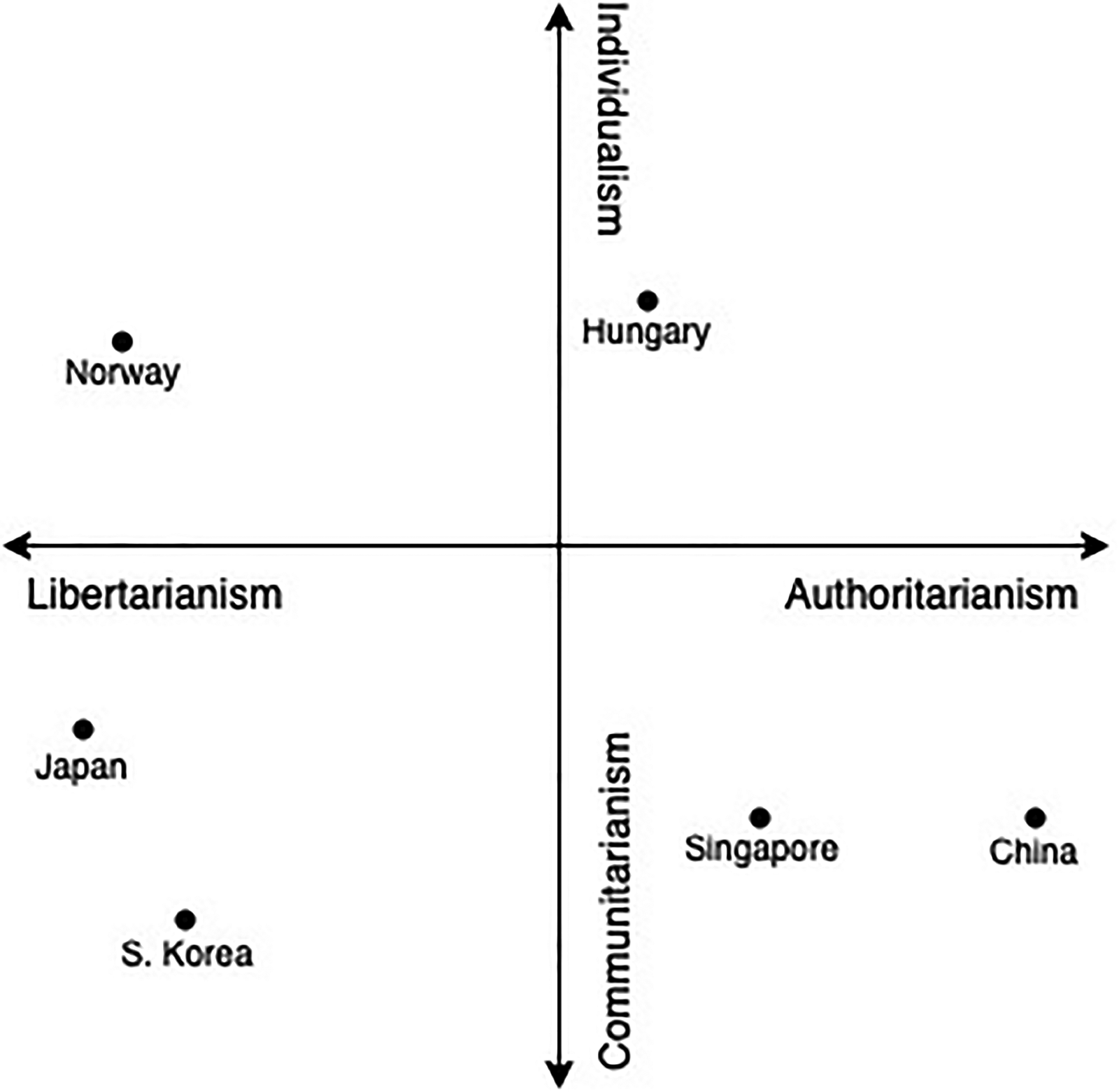
A model of social data governance.
Three issues, then, need to be kept in mind before we move to an illustrative application of this model. First, similar to other studies on the typology or models of data governance (e.g. Micheli et al., 2020), the quadrants in our proposed model are seen as “ideal types” in the Weberian sense rather than empirical or real types. Given “[the task of] attaining knowledge of reality, with its constant and universal character of qualitative differentiation and uniqueness” (Weber, 2012: 5, emphasis in original), Weber believes that [the ideal-type] is obtained by means of a one-sided accentuation of one or a number of viewpoints and through the synthesis of a great many diffuse and discrete individual phenomena, which are in conformity with those one-sided, accentuated viewpoints, into an internally consistent mental image. In its conceptual purity, this mental image cannot be found empirically anywhere in reality. (Weber, 2012: 5, emphasis in original)
Given these, as “conceptual constructs” (Kockelmans, 1978: 12), the ideal quadrants of social data governance in this study “emphasise certain traits in order to synthetise phenomena that differ for the degree of affiliation to those traits” (Micheli et al., 2020: 7). Each of these quadrants represents various cases with a unique combination of different degrees of attributes involving state intervention and national culture that are believed to underpin contingent social data governance policies and practices.
Second, considering sovereign nation-states—one key, traditionally dominant institution of power—as the unit of analysis, as several studies have done so (e.g. Dencik et al., 2019; Gritsenko and Wood, 2022; Hintz et al., 2018; Redden, 2018), the proposed model by no means ignores either the influence of supranational unions or multinational corporations on social data governance decisions (e.g. the General Data Protection Regulation [GDPR] in the European Union and beyond) or the variations of social data governance practices within a country given the heterogeneity in the culture and management of subnational levels. Instead, this model offers one possible prism (DeNardis, 2014: 23) through which to understand governance mechanisms as the efforts and influences of nation-states in steering activities within or through national boundaries.
Third, it is essential to be mindful that the social dynamics unpacked here, in Ancelovici’s words (2021: 128, emphasis added), stand for “a set of conditioning factors that shape the outcome without actually causing it.” Or, the word “conditioning” emphasizes that the social dynamics and context in our model encourage, hinder, but do not cause the social data governance in question. They are instead parts of the systematic exploration and elaboration of somehow daunting or puzzling governance phenomena as illustrated in the case of digital contact-tracing techniques noted at the beginning of this study. The discussion here follows the argument of tackling social dynamics as context, an interactional problem (Dourish, 2004; Seaver, 2015), which, as Dourish (2004, p. 22, emphasis in original) expounds, considers contextuality as a “relational” and “occasional” property. “It is not simply the case that something is or is not context; rather, it may or may not be contextually relevant to…particular settings, particular instances of action and particular parties to that action” (Dourish, 2004: 22, emphasis in original). Along with the same lines, as Tilly and Goodin (2006: 21) explain, “we ‘make sense’ of an otherwise puzzling phenomenon by finding some special feature about it which, when taken into account, allows us to assimilate that case to our standard model of how the world works.” Those social dynamics are special features that shape not only data but also the manner in which governance rules, practices, and processes occur—as we will illustrate through the selected case of the governance of digital contact-tracing techniques across the globe from a comparative perspective.
Governance of digital contact-tracing techniques: an illustrated study
This section offers an illustrated case study of the governance of digital contact-tracing techniques during the ongoing COVID-19 pandemic from a comparative perspective. As a public health intervention, digital contact-tracing techniques involve a range of data collection, selection, manipulation, interpretation, and representation technologies to retrospectively retrace the movements of, and contacts between, a diagnosed infected patient and a user (Colizza et al., 2021). The governance of such digital techniques is thereby an exemplar of social data governance, as it not only involves the frameworks and rules regarding the collection, storage, manipulation, interpretation, and presentation of data about social behaviors but it also generates substantial social consequences and implications (e.g. quarantining contacts, and fear and bias regarding individuals with infection) as well as legal and ethical considerations in a specific social context. The governance of digital contact-tracing techniques would be best regarded as an extreme case given its unusualness (Seawright and Gerring, 2008: 301). The unusualness, or rarity, that makes such a case valuable further speaks to the urgent need for, and the unprecedented fast, worldwide-scale implementation, of governance arrangements related to sophisticated, widespread contact-tracing techniques. In this sense, an extreme case study of the governance of digital contact-tracing techniques offers an exploratory perspective from which to understand the analytical power of the proposed model, with data mainly from news, policy analyses, and scholarly sources in English.
To identify and collect the data, we performed an extensive and integrative search of academic articles, book chapters, books, and news coverage. As an initial step, we used the keyword-screening method in the Web of Science Core Collection database on July 1, 2021, on publications in English and ranging from 2019 to 2021. The keywords like “contact tracing,” “COVID-19,” “technology,” “digital,” “app,” and “surveillance” were used in all fields to locate journal articles and book chapters covering digital contact-tracing techniques during the pandemic. Then we examined this list of academic contents and also extended our methodology by searching (a) the references of the sources and (b) the names of specific digital contact-tracing techniques identified in our initial search. Subsequently, the countries used as examples were selected largely on the availability of data and proper descriptions of the governance of digital contact-tracing techniques. The comparison aims to encapsulate how the proposed model of social data governance would take steps to shed light on the less-addressed, yet crucial, aspect of societal dynamics, even though the comparison may not be generalizable. Equally importantly, deviant cases (Seawright & Gerring, 2008: 302), if any, will only encourage and inspire better identification and justification of “the pre-interpretation of the relevant context, that in turn informs the subsequent interpretation” (Dilley, 1999: 15). The following analysis adopts a two-step approach. In the first step, we focus on national culture, that is, the dimension of communitarianism or individualism. We then examine state intervention and societal autonomy in each dimension.
The communitarianism dimension
An overview of social data governance worldwide regarding digital contact-tracing techniques signifies fundamental differences in the regulation, adoption, and usage of these techniques in organizing and steering society during the pandemic period (e.g. Riemer et al., 2020). One of the most observable differences, well-acknowledged in the literature, is that societies with a communitarian culture and tradition, typically in Asia, such as Singapore, South Korea, and Taiwan, embrace high-tech means of tracking and surveillance measures, which are even mandated in some cases, as part of their pandemic-related governance arrangement. The embracement exemplifies the influence of deep-rooted communitarian values and social control that “sacrifice[s] personal freedoms for the collective good” (Riemer et al., 2020: 740). In other words, as Cha (2020: 6) has observed, the governance of the adoption of digital means of tracking the virus is not necessarily only an issue regarding autocrats—or authoritarianism in this study. Rather, and instead of privacy and individual rights, communitarian virtues, like duty and responsibility, predicate the governance practices and policies during the pandemic across these societies.
Let us take South Korea, a country with some of the strictest data privacy laws in the world, as an example (e.g. the Personal Information Protection Act [the PIPA], Ko et al., 2017: 100). Its communitarian cultural orientation dramatically shapes the country’s virus containment governance efforts. Kasdan and Campbell (2020: 606) coined the term “dataveillant collectivism” to emphasize public cooperation and voluntary compliance due to “a strong norm of undertaking personal sacrifice for the collective good, especially in times of crisis.” Against this backdrop, the Contagious Disease Prevention and Control Act (CDPCA) overrides certain provisions of the PIPA and other privacy laws, and entitles authorities to relevant power in order to collect, profile, and share personal location information for epidemiological investigation through proactive tracing technologies (Park et al., 2020; Cha, 2020: 10). Communitarianism also explains the high degree of support among the public for adopting digital contact-tracing apps for quarantine and mandating rule-breakers to wear wristbands (Park et al., 2021: 54) in South Korea.
Similar governing phenomena are also viable in, for instance, other East Asian societies, such as Taiwan, Hong Kong, Singapore, and Japan, as demonstrated by the population’s overall cohesiveness in understanding the danger, and their resulting compliance, which is compatible with the underlying communitarianism-oriented culture of these societies (An and Tang, 2020: 797). For instance, Garrett and colleagues (2021: 12) assessed the attitudes of the Taiwanese to mobile tracking technologies through four survey waves and disclosed “a strong sense of communal responsibility to the public’s health,” which leads to the weighing of the public health benefits of tracking and tagging technologies against the risks to personal privacy and security. Similarly, prosocial and community-oriented considerations (i.e. protecting family, friends, and colleagues and fulfilling one’s responsibility to their community) remarkably surpassed concerns over individual privacy when adopting the government-sponsored contact tracing app COCOA in Japan (Jamieson et al., 2021), despite the app’s design defect as one of the crucial causes of the users’ dissatisfaction and nonadoption. In short, while concerns abound regarding these “heavy-handed” and even “unacceptable” (Crocker et al., 2020) tracing and surveillance apparatuses in individualism-oriented societies such as the United States and Germany (Cha, 2020: 7), these communitarianism- or collectivism-oriented national cultures elicit public cooperation and voluntary compliance when designing and implementing specific social data governance during the pandemic.
Despite the above similarities in the consideration of national culture and tradition, there are remarkable differences in these communitarianism-oriented societies regarding either the general governance of pandemics or specific governing arrangement toward digital contact-tracing techniques. For instance, studies have employed terms like “state-society synergy,” “collaborative governance,” and “society-centered bottom-up approach,” respectively, to highlight the proactive engagement of society, or nonstate actors, in shaping, implementing, and coordinating the government’s public health measures in Taiwan (Huang, 2020; Yen, 2020), South Korea (Kim and Kim, 2020), and Hong Kong (Wong and Wu, 2021: 9). On the Chinese mainland, however, civil society retains limited involvement during the pandemic and is essentially controlled and maneuvered by the Communist Party or government agencies (Hu and Sidel, 2020), with citizens being “subject to rather than part of local governance” (Mittelstaedt, 2021: 4). Similarly, given its strong, centralized leadership (Ke and Wei, 2004), Singapore adopted an “all-of-government approach” against the pandemic, with “the weak and constrained influence of civil society in influencing policy directions” (Wong and Wu, 2021: 12). Here, in addition to the dimension of national culture, the dimension of state intervention and societal autonomy helps reveal and compare largely unacknowledged governance regarding digital contact-tracing techniques even across societies with similar cultures and traditions.
More specifically, despite aggressive and scalable digital contract-tracing measures and arrangements having been adopted and accepted in society, South Korea and the Chinese mainland carried out substantively incompatible social data governance. South Korea has implemented, as Kim and Kim (2020: 536, emphasis in original) have described, “ambidexterity governance with a whole-of-society approach,” which involves both public control and civic engagement. Contact-tracing apps built by citizens for quick response to the spread, such as the very first mobile application “CoronaNow,” were widely adopted far before government-created official apps came into practice (Kim and Kim, 2020: 537). Following the “Proposal for Public Repository Related to Infectious Disease,” the government made certain elements of epidemiological data freely available to the public, which invited the active participation of private individuals, companies, and organizations in the better development of digital contact-tracing apps and data visualization (Kim and Kim, 2020: 537). Corona 100 m, one of the most commonly downloaded, privately developed digital contact-tracing apps, uses government-released data and runs parallel to the official apps (Watson et al., 2020). In short, the governance of digital contract-tracing techniques in South Korea also attributes its civic involvement and open data governance to libertarian commitments to public participation, which further promotes the principles of transparency and integrity, strengthens public trust and civic cooperation, and reinforces democratic solidarity and inclusiveness (Tworek et al., 2020: 47).
Conversely, the case of the Chinese mainland involves the state, together with different governmental agencies, initiating and monopolizing the operationalization and, particularly, the authority over, contact-tracing platforms and practices. As Boeing and Wang (2021: 348) have explained, the contact-tracing governance, mandated by municipal or provincial-level governments, “largely depend[s] on the goodwill of the government” without the engagement of “spontaneously formed autonomous collectives of residents.” In practice, the government’s endorsement and collaboration with key tech firms Tencent and Alibaba “legitimizes and authorizes” (Boeing and Wang, 2021: 341) the collection and analysis of citizens’ personal information in sensitive areas. The lack of transparency in how the tracing apps work, however—and whether the data will be reused by government bodies for purposes other than those originally envisioned—generates complaints on social media without proper responses from the authorities (Mozur et al., 2020). Meanwhile, media discourse has predominantly highlighted the positive outcomes of the adoption of contact-tracing apps, regardless of the accountability mechanisms involving, for instance, data collection, analysis, storage, and removal (Liu and Zhao, 2021: 10). With the public perception that the state’s surveillance and data collection through contact-tracing techniques function as “a positive change that makes society safer” in turbulent times, the nationwide mandatory adoption of such techniques in turn strengthens both the use of contact-tracing apps and, more importantly, “the regime’s legitimacy” (Liu and Graham, 2021: 9). Digital contact tracing on the Chinese mainland has subsequently evolved into “the state’s algorithmic eye to identify, document, and evaluate risk during the pandemic” (Liu, 2021: 3), which makes such authoritarianism-style governance distinct from the governance with civic engagement in South Korea, notwithstanding their common communitarianism culture and tradition.
The individualism dimension
This section looks at the two quadrants as regard the dimension of individualism, and reviews the libertarianism dimension first. Societies employing libertarianism in state intervention and societal autonomy share quite a few similarities in their social data governance of digital contact-tracing techniques. Norway’s governance of “Smittestopp,” one of “the most invasive COVID-19 contact-tracing apps” according to Amnesty International, functions as another example in this case of the quadrant of libertarianism (for an overview of the app, see Sandvik, 2020b). The launch of the app demonstrates part of the Norwegian government’s immediate and drastic reactions after the first-known infection in Norway. The rush to release this app led to controversial issues, however, such as being over intrusive, experimentation, and a lack of transparency regarding its purpose (Sandvik, 2020b). Self-organized societal forces, particularly from the Norwegian tech and data protection communities (Sandvik, 2020a), and public agencies, such as the Norwegian data oversight agency Data Protection Authorities, but also beyond these local communities globally (Gjerde, 2021: 13; Skille and Gundersen, 2020), are together playing fundamental roles in voicing criticism, both nationally and internationally, against the implementation of the app. Various efforts have also included requests for open data governance, making the source code open, which failed in the first Smittestopp app (Sandvik, 2020b: 4) but succeeded in the second version (Elmokashfi et al., 2021). After being reviewed by an independent group of experts (Bergstrøm, 2020), and only two months after its launch, the app was withdrawn due to privacy and security concerns ( Datatilsynet, 2020 ). In the case of Smittestopp, as Sandvik (2020a) commented, public engagement on the legality and legitimacy of digital contact-tracing techniques is more crucial than ever.
The case for governing Smittestopp is also an intriguing example from which to discern the imprint of individualism. On one hand, generally speaking, the Norwegian government and public agencies have placed their (meta-)narratives as specifically revolving around the deeply ingrained, collectivism-oriented cultural concept of “dugnad” (Moss and Sandbakken, 2021). Derived from the old Norse dugnaðr, dugnad fuels prosocial and cooperative behaviors “‘that benefit individuals and those around them’…and ‘…that have to do with helping others, contributing to the community … , [are] associated with greater personal well-being, … [and are] beneficial to the group’” (cited in Simon and Mobekk, 2019: 818). In doing so, the Norwegian government and public agencies were struggling to “constitute a common subjectivity based on communitarian ethics” (Gjerde, 2021: 8). The developer of Smittestopp, the Norwegian Institute for Public Health, tweeted requests “to download #smittestopp right now” and “contribut[e] to the dugnaðr” side by side (Sandvik, 2020b: 2). On the other hand, more importantly, as Gjerde (2021: 9) discovered, the dugnad discourse comes in a more individualism-oriented way to persuade people to turn themselves, independently and individually, into “partners” in the dugnad and the war against the virus. For instance, the Norwegian Minister of Health, Bent Inge Høie, advocated that “the entire society must participate in the dugnad against Covid19. Each and every one of us has an important task” (cited from Gjerde, 2021: 9, emphasis added). Later, Høie stressed its voluntary nature, to encourage the adoption of Smittestopp, while foregrounding his hope that “as many as possible will participate in stopping the spread of Covid-19 through installing the app” (cited from Gjerde, 2021: 13). Such an individualistic discourse is consistent with other government initiatives, such as asking that “the individual him or herself must make such decisions” when considering foreign travel (Gjerde, 2021: 9, emphasis added). In short, Norway has incorporated cultural awareness in their formulation of both the general governance of the pandemic and the specific governance dedicated to contact-tracing techniques while implementing contact-tracing interventions in a culturally adaptive way by epitomizing an individualism-oriented approach.
The last case concerns the authoritarianism–individualism quadrant of the model of social data governance. We take the governance arrangement in Hungary as an example of this last category. Despite the limited information in English, we are still able to shed light on some governance arrangements in terms of our proposed model.
Hungary’s pandemic response has been widely criticized as authoritarian governance in the name of a public health intervention (Diamond, 2020). Enacted by the Hungarian National Assembly, the emergency law, Act XII of 2020 on the Containment of Coronavirus, allowed Prime Minister Viktor Orbán to extensively “rule by decree” (Guasti, 2020: 53). The law also criminalizes behaviors such as disseminating misleading information and breaking the rules of quarantine (Guasti, 2020: 53), both of which could be seen as a continuity of the country’s “deeply entrenched convictions about social order” (Simon, 2020: 108). The effects of these arrangements are described as “chilling” (Guasti, 2020: 53) and could partially explain Hungary’s successful containment of the virus but also its exception given that Hungary is a highly individualistic society (Hofstede, 2011: 95). In other words, some scholarship shows that individualistic societies are less likely to endure, for instance, (self-)quarantine and other mandatory measures as a sort of sacrifice, given their preference for personal freedom (Gokmen et al., 2021), which weakens the capacity of society to work together for common goals. Hungarians, however, behaved with great self-discipline during the pandemic (Cao et al., 2020), largely against the backdrop of such an authoritarian emergency state.
Hungary launched VirusRadar, its official contact-tracing app, on a voluntary basis and the Házi Karantén Rendszer app (The Home Quarantine System) to enforce quarantine measures (Kaszás, 2020). Although the general recommendation regarding storing data from digital contact-tracing apps is to avoid using one central place that would increase the risk of mass government surveillance, Hungary implemented a centralized model (Blasimme et al., 2021: 2) in terms of data access, management, and security (Khatri and Brown, 2010: 151). The centralized model of data storage, and thus data assemblage, has long-term implications beyond the pandemic situation, particularly because the storage is not controlled by public health authorities but instead by the Minister for Innovation and Technology and the Operational Corps (Operatív Törzs), the operational body in charge of coordinating the measures related to the coronavirus outbreak in Hungary (Council of Europe, 2020: 12). Government decrees regarding the collection, processing, sharing, and storage of user data, further entitle the authorities—including the Operational Corps but also the police and other enforcement authorities—to obtain and retain any kind of personal data from private or public organizations, legal entities, and private and public associations, without limitation, in the fight against the coronavirus (Milieu Consulting SPRL, 2020: 17). The purposes for which data can be used and how the data are processed remain vague. Although there is little available information about how the decrees have been implemented in practice, some decrees “overwrite the general rules on data protection, which require public bodies to indicate the purpose of the data request and to justify the cause” (Milieu Consulting SPRL, 2020: 17).
In summary, we have illustrated in this section how the proposed model would take steps to account for and uncover some of the underlying issues regarding the social dynamics of social data governance. In this vein, the idea of the analysis, somehow comparative, is not “a rigorous scientific test” of the proposed model. Rather, it serves as “an assessment of the general fit” (McAdam, 1982: 63) of the model in order to tease out the effect of underlying or structural roots that foster, encourage, or hinder-specific datafied governance initiatives, arrangements, and performances in these selected cases. We also make no claim to deny the relevance of existing models and frameworks in interpreting data governance, despite their somehow organization-centric perspective.
Conclusions, limitations, and future research
This study started with a critical, reflective review of the existing discussion on data(fied) governance, an emerging phenomenon in the data-intensive world. Although the organization-centric perspective largely concentrates on internal factors and dynamics regarding data and datafication at the organizational level, it is not the whole story of datafied governance without consideration of external social factors that structure and (re)produce data and governance arrangements. To advance the discussion on datafied governance, this study proposes the term “social data governance” to tackle the societal dynamics, underexplored yet underpinning and contextualizing—instead of deciding—datafied governance. A preliminary model of social data governance was explicated, which consists of two dimensions, state intervention and societal autonomy, and national cultures, each at opposite ends of the spectrum. Four categories of social data governance serve as a preliminary framework to account for variations in such datafied governance across societies from a comparative perspective. Following the proposed model, we conducted an extreme case study of governing digital contact-tracing techniques across the globe to exemplify the explanatory power of the model. For illustrative purposes, Figure 1 shows the relative positions of selected cases in the comparative analysis in the proposed model, given the consideration of authoritarianism/libertarianism (in terms of Democracy Index [DI] 2020 in the Economist Intelligence Unit, 2020: 10–15) and individualism/communitarianism (in terms of Hofstede’s Individualism Index Values [IIV], see Hofstede, 2011: 95–97). Both indexes serve as examples and thus can be replaced by other ranking systems.
Our study makes the following contributions, both theoretical and empirical. It advances the theoretical discussion on data governance, or, more precisely, governance with data, by highlighting the social dynamics of both data and governance, using the slightly revised term “social data governance.” In line with existing scholarship (boyd and Crawford, 2012; Crawford et al., 2014; Kitchin, 2014; van Dijck, 2014), the proposed term highlights the importance of considering data governance as a socio-technical product and setting beyond what this study simply calls “the organization-centric perspective,” or intra- or interorganizational aspects. Such an understanding is necessary to untangle the puzzling and daunting phenomenon that the same phase “data governance” can be associated with different rationalities of governance arrangements across contexts and societies. In other words, the emphasis on the social reminds us to move beyond the existing organization-centric perspective and instead to focus on the relationship between data assemblage/governance arrangement and the context in question.
Second, as a theoretical advancement, this study promotes a theory-informed model with societies or nation-states as units of analysis that allows us to unravel social data governance beyond ethnocentrism from “the European standpoint” (Micheli et al., 2020: 4). As Riemer et al. (2020: 732) pointed out, scholarship on IT or digital-related governance is less to do with societal-level governance. Meanwhile, a lack of underpinning theoretical frameworks could mean that existing models, frameworks, or categories of data-related governance are arbitrary (e.g. Bodó et al., 2021). Instead, by integrating two specific dimensions—the long-term interest in state intervention and societal autonomy in governance (Treib et al., 2007) and culture as the operating systems of humans (Hofstede et al., 2005)—the proposed model overcomes such deficits and is capable of placing a wide variety of social data governance phenomena across the globe under scrutiny, as illustrated in the case study. It further enables the reflective deliberation that some seemingly emerging, data-related governing arrangements and practices may turn out to be continuous, long-established practices in the society in question.
Third, the illustrated study not only instantiates the explanatory power of the model regarding social dynamics but also pinpoints both the similarities and differences between social data governance across societies in the case of digital contact-tracing technologies. To be clear, while studies have largely looked for commonalities regarding the governance of the pandemic (e.g. population-wide support, see Cha, 2020; Kim et al., 2021), they fundamentally leave the following question unanswered: whether the governance of the pandemic, be it related to digital contact-tracing or not, in South Korea, Taiwan, and Japan, the same as the governance of the Chinese mainland and Singapore, which are rooted in substantively different political institutions and arrangements? Our empirical study sheds light on such differences and their underlying mechanisms. As a preliminary step to categorizing social data governance, our theoretical and empirical advances encourage further comparative studies in a fruitful way.
As a preliminary explanation, exploration, and comparison of social data governance across the world, this study has a number of limitations. First, the proposed bi-dimensional model consists of dichotomous, or the simplest possible values (authoritarianism vs. libertarianism and individualism vs. communitarianism), which could be improved by including complex scenarios of either political spectrums or cultural patterns. The former helps recognize the diversity of modes of state intervention and societal autonomy, while the latter delineates the heterogeneous nature of the culture (e.g. Todd, 1985). Second, and as already acknowledged, the model essentially follows the strand of scholarship on governance that takes nation-states as the unit of analysis and omits the consideration of supranational, multinational, or subnational entities and their efforts and influence on social data governance (e.g. Zygmuntowski et al., 2021). Further studies should expand the model by integrating different scales of, or multilevel, governance (e.g. Allain-Dupré, 2020) that would further examine and identify additional dimensions or variables in the model across different contexts. Third, our comparative analysis is fundamentally based on, and thereby limited by, selected cases with data in English. We recommend that the methodology be extended either by involving more cases with data in original languages or by triangulating datasets of different languages. To involve more cases would also help recognize other dimension(s) crucial for establishing the social “as a necessarily political project…bound up with questions of method” (Seaver, 2015: 1106, emphasis in original).
Footnotes
Acknowledgments
The authors would like to thank the anonymous reviewers, the colleagues at the Center for Tracking and Society, University of Copenhagen, and Matt Zook for their constructive and reflective suggestions.
Declaration of conflicting interests
The author(s) declared no potential conflicts of interest with respect to the research, authorship, and/or publication of this article.
Funding
The author(s) disclosed receipt of the following financial support for the research, authorship, and/or publication of this article: This work was supported by The Independent Research Fund Denmark - Sapere Aude Starting Grant (grant number 1055–00011B) and The Carlsberg Foundation Grant (grant number CF20-0705).
