




Abstract
This article examines the social acceptability and governance of emotional artificial intelligence (emotional AI) in children’s toys and other child-oriented devices. To explore this, it conducts interviews with stakeholders with a professional interest in emotional AI, toys, children and policy to consider implications of the usage of emotional AI in children’s toys and services. It also conducts a demographically representative UK national survey to ascertain parental perspectives on networked toys that utilise data about emotions. The article highlights disquiet about the evolution of generational unfairness, that encompasses injustices regarding the datafication of childhood, manipulation, parental vulnerability, synthetic personalities, child and parental media literacy, and need for improved governance. It concludes with practical recommendations for regulators and the toy industry.
Introduction
Against the context of increasing datafication of children (Lupton and Williamson, 2017) and surveillance capitalism (Zuboff, 2019), this article investigates children’s toys and services that make use of emotional AI. Although smart and connected toys are growing in popularity (Mascheroni and Holloway, 2019), availability and use of emotoys are few and limited in scope. Yet, on the basis of rising interest in the use of emotional AI and biosensing across diverse life domains (McStay, 2018), growth in networked objects, and the long history of toys and care (Turkle, 2011), it is likely that emotion and affect-based entanglement between children, networked objects and AI-based playthings is picking up speed. While we are sensitive to debates around the psychology of childhood development, this is not our expertise. Rather, we are interested in arising ethical and governance concerns, the terms by which child emotional AI may be acceptable (if any) and what parents think of these technologies.
To explore these issues we conducted interviews with data protection regulators, leading academics, privacy-oriented non-governmental organisations (NGOs), and diverse industrial and service sectors that use emotional AI. Against a context of literature on dataveillance and children, connected and smart toys, emotional AI and criticism of affective computing, the leading theme to emerge from interviewee concerns is generational unfairness. In digitally mediated life the term has roots in ‘sharenting’ and exploitation of children’s digital footprints (Blum-Ross and Livingstone, 2017). Yet, injustices against children are evolving to encompasses biometric privacy, novel modes of datafied commercialisation of childhood, and the social installing of questionable relationships between children and synthetic personalities. We followed our interviews with a UK-wide national survey of parental attitudes towards emotoys. This explored the acceptability of emotoys and use of emotional AI in child-focused technologies, and by what terms use of these intimate technologies in toys should be governed. It revealed ambivalent attitudes and, when interpreted in context of literature on technology, ethics and parenting, highlights a need to protect parents as well as children.
Emotional AI in children’s toys and services
Emotional AI refers to technologies that use affective computing and artificial intelligence techniques to try to sense, learn about, and interact with human emotional life (Emotional AI Lab, 2020). The practice of using computer sensing to interact with emotional life has origins in the 1990s, with the field of affective computing (Picard, 1997).What McStay (2018) terms ‘emotional AI’ and ‘empathic media’ are made possible through weak, narrow and task-based AI efforts to see, read, listen, feel, classify and learn about emotional life. This involves data about words, images, facial expressions, gaze direction, gestures, voices and the body, which itself encompasses heart rate, body temperature, respiration and electrical properties of skin.
Applied to children, emotional AI raises concern about the conversion of child behaviour and subjectivity into biocapital (Lupton and Williamson, 2017). Questions about child bodies and profiling sit within a context of longstanding concern about media effects on children, online screen-based media, and the increased tendency for children to be ‘always on’ in all contexts of childhood (such as play, communication, education and promotion of wellbeing; Livingstone et al., 2018). Leaver’s (2017) work on parents is also relevant to this article, questioning the positioning of datafied surveillance as a normalised part of childcare where not using intimate surveillance may be seen as a failure of parenting (see also Stark and Levy, 2018). Here the emotional and affective context that parenting takes place in increasingly overlaps with the datafication of parenting (in Leaver’s case, pregnancy apps and sensors in cots and cribs). Emotion focused wearables are increasing in popularity with Amazon’s Halo and Garmin systems already tracking emotion. Child-specific wearables are emerging too, such as Moxo, by the start-up mPath, who have worked with brands including LEGO, Google, Best Buy and Hasbro.
On toys, despite the seeming novelty of emotional AI in toys, there is a historical context. Toys with robo-qualities of automata reach back to the 1800s and beyond. For example, in the 1920s, Dolly Rekord, designed by Madame Hendren, was a phonograph doll that spoke nursery rhymes. In 1959, Mattel’s Chatty Cathy was able to utter 11 phrases, including “I love you” (Vlahos, 2019). Dolls such as Talky Crissy from the 1970s contained transistors and circuit boards that played pre-recorded electronic messages (McStay and Rosner, 2020). By the 1980s microprocessors gave rise to interactive toys such as Teddy Ruxpin that read children stories.
The 1990s saw a new development. Whereas toys in the past were typically Rorschach objects, upon which a child projects feelings and situations, ‘smart toys’ involved new forms of mutual engagement that involved awareness of the toy’s emotional state (Turkle, 2011). Raising questions about human–technical connection and care for semi-autonomous systems, ‘toys’ such as Tiger Electronics’ Furby (1998) and Bandai’s Tamagotchi (1996) created novel forms of entanglement with machines. Despite the relative simplicity of these social technologies, they introduced tricky questions about the desirability of care for objects, hybridity, biomimetic toys, anthropomorphism and the need to keep synthetic entities ‘happy’. The 2010s saw the emergence of ‘connected toys’ that rely on the internet, Wi-Fi and Bluetooth and ‘smart toys’ defined by sensors, voice and/or image recognition software, self-learning algorithms, scope for interaction with children and the creation of relatively easy-to-use control software (Holloway and Green, 2016; Winfield, 2012). These smart and connected toys raised security concerns (Chaudron et al., 2019), but also apprehension of deception in child relationships with AI systems (Jones and Meurer, 2016). Other smart and connected toys scholars have examined the lack of creativity afforded by smart toys and how their designs may be transgressed by children (Grimes, 2015, Marsh, 2017), adult conceptions of what a child is (Ruckenstein, 2010), comparisons between real and robo-pets (Ribi et al., 2008), domestication of toys (Brito et al., 2019), and the blurring of shifting online and offline domains (Mascheroni and Holloway, 2019).
Emotoys themselves are still relatively rare although home social robots, such as Anki’s Cozmo (2016) make use of existing optical and voice-based sensors (Druga et al., 2017). With a chirpy voice, Cozmo has social qualities in that ‘he’ (gendered male by its creators) learns, adapts, responds to users and has ‘moods’ of his own. Mood degrades if he gets ‘hungry,’ he shows ‘elation’ and ‘confidence’ at having won a game, lows if it strays close to an edge from which he can fall, and even ‘anger’, such as Cozmo smashing his forklift into the ground if he fails at a task. Able to recognise users, he reads facial expressions and (in a limited fashion) interprets his environment. Through cameras, Cozmo's facial recognition software allows him to recognise faces and learn people's names, but he also uses emotional AI to recognise and respond to basic emotions: anger, disgust, fear, happiness, sadness, and surprise. In time emotoys are likely to possess additional sensors, including players’ heart rate, skin conductivity and blood flow sensors (McStay and Rosner, 2020). We suggest however that developments in both emotoys and wider child emo-objects will not be driven solely by technology, but the extent to which technology engenders care, entanglement with objects, experience, learning and novel ways of mediating human relationships.
Research design
To understand ethical questions around emotoys and parental perspectives we conducted 13 in-depth interviews (Miller and Crabtree, 1992) and a demographically representative UK national survey of parental attitudes to emotional AI in child-focused technologies (n = 1000). The interviews were designed to uncover legal, child development, privacy and consumer-related issues for further consideration. Their aim was to solicit opinion and insight from individuals across industry, academic, policy, health and civil society groups in the UK and USA with expertise on emotional AI, data ethics regarding children’s emotions, relevant legal issues and the toy industry. With informed consent, the interviews were conducted between August 2019 and May 2020, with an average interview length of an hour. Questions were tailored towards interviewees’ expertise, and each (with varying degrees of follow-up questioning) were asked about the future of emotoys, technology, rules and ethics, potential harms and benefits. Interviewees were happy to be identified and speak of their own views, but noted that these views should not be taken as representative of their organisations (See Table 1 for interviews).
Thematic analysis of interviews
Due to familiarity with the topic of emotional AI (McStay, 2018) and Internet of Things (IoT) data protection policy (Rosner and Kenneally, 2018), analysis of the 13 interview transcripts followed an adaptive approach (Layder, 1998). This balances deductive theory with inductive insights from data. To analyse the interview data, a hand-coded approach was employed (Cresswell, 1994; Miles et al., 2014). This was preferred to a software-led approach due to low interviewee numbers, sensitivity to the context of the interviews, voice and behaviour cues, and other contextual factors that might have been missed by an automated approach. The practicalities of coding were done by annotating sentences and paragraphs of deductive interest (from the literature review and author understanding of the field) and inductive interest (other insights relevant to the research aims of this project that were not foreseen). After developing codes, these were abstracted into categories and then into broader themes. Both authors undertook this process, reached similar conclusions, and then debated and agreed four key themes. These are generational unfairness; parental susceptibility; guarded interest in potential benefits of these technologies; and need for good governance.
Survey design
To explore issues arising from analysis of the interview data, we sought insights from parents regarding: (1) acceptability of emotoys and use of emotional AI in child-focused technologies; and (2) by what terms use of these intimate technologies in toys should be governed. Conducted in the UK in February 2020 and executed online via commercial survey organisation, ICM Unlimited, the survey (n = 1000) was segmented by UK region, work status, parental age and gender (binary). Parents were also segmented by the age of their children. The survey asked about parents’ comfort with monitoring child emotion through toys; acceptability of wearables that report affective/emotional states to parents; usefulness of these insights; whether data should be shared with authorities in cases of abuse/self-harm; when consent should be given for emotoys services; and comfort with data collection of emotions for child marketing. Online surveys are imperfect, involving difficulty of presenting complex topics, inter-subjectivity and minimal control over whether respondents are engaged or distracted (Rog and Bickman, 2009). Yet, positively, the research generated a respectable weighted sample of hard-to-reach participants. Further, absence of inter-subjective sensitivities also avoided interviewer bias, a common problem with ethical and privacy-related research (Zureik and Stalker, 2010).
Key findings
The interviews generated four key themes: (1) generational unfairness, with sub-themes on manipulation, memory, and living with ontologically uncertain objects; (2) susceptibility of parents, with a sub-theme on immature signals; (3) guarded interest; and (4) need for good governance, with sub-themes on special protections for emotion data, timing and consent. Each of these are discussed below.
Generational unfairness
The principle of generational unfairness is not new, given unconsented to sharing of photos of children by parents on social media (Leaver, 2017), attribution of digital skills to children, consequent burden of responsibility (Livingstone and Third, 2017), and longstanding introduction of smart objects into the home (Chaudron et al., 2019). The unfairness is that children have little control over the datafication of their childhood years. Yet, we suggest that data about emotion represents an increase in this logic, introducing new concerns and questions. Thus, generational unfairness was an expected, but important, insight from our interviews and thematic analysis. Josh Golin of Campaign for Commercial Free Childhood crystallises this view, saying: When your own play in your own bedroom is no longer private, when your own home is no longer private, when your own feelings and emotions are no longer yours to share when you choose to share them, but are being analysed and shared with others even when you're not ready to share them – I think we've done those kids a tremendous disservice […]. (Interview, 2019) I have concerns there will be emotional tracking of children throughout their adulthood, and that it starts to become available to the university that they're applying to, or the healthcare that they would like to obtain, or the job that they're after. (Interview, 2019)
Emotional AI amplifies informational asymmetry due to child inability to challenge embedded framings of emotion in technology. For example Jag Minhas, of emotional AI company Sensing-Feeling, contrasts this with adults who have scope to negotiate with emotional AI technologies: such as deciding not to use a given device, to switch off emotion-sensing functionality, or to conceptually challenge the limited palette of emotions offered by emotional AI. If data literacy for children refers to ‘the knowledge, skills and attitudes that allow children to flourish and thrive in an increasingly global digital world’ (Nascimbeni and Vosloo, 2019: 3), the challenge of understanding and disputing how emotions are categorised sets what we see as an impossible literacy benchmark, certainly for young children. This leads to a potentially insidious outcome, as Minhas concludes by suggesting that we might ‘breed a generation of people who have a very confined set of personalities that were influenced heavily by algorithms.’
Manipulation
Key among unfairness concerns was manipulation by companies that do not have child wellbeing foremost in mind, economic value of data about emotion, and power differentials. Industry expert Ben Bland (Sensum) remarked that ‘if anyone [in the emotion analytics industry] is focusing their research on children as a data set, they're going to have a huge advantage in the market if they're going to start creating toys and things off the back of it’. On manipulation and third parties, Bland notes this data would be a premium product and that negative emotion would be most valuable because ‘people spend more when depressed’. Indeed, studies of social media companies show that they have long profiled the full gamut of child emotions and profited as a result (Barassi, 2020). For Jenny Radesky (Developmental Behavioural Paediatrician with a focus on digital media) emotional AI used with children creates generational unfairness through power imbalances between companies and children, largely due to children’s ‘limited awareness about their own emotions … about data collection and about machine learning and all of the other technical aspects that go into their interactions with technology …’ (Interview, 2019). Interviewees recognised the ease with which these technologies might be woven into a dystopian narrative, but were broadly keen to avoid this. Amelia Vance (Director of Youth and Education Privacy at the Future of Privacy Forum) for example saw scope for positive uses of child nudging, but also stated that technologies that influence emotions ‘are pushing past nudging to outright manipulation’, which in turn creates a ‘discrepancy of power between the companies offering a convenience, and people adopting it without understanding the implications’ (Interview, 2019).
Memory: Data longevity and the right to a past
Another aspect of generational unfairness is concern about the right to have parts of childhood forgotten. With pre-existing concern in ‘sharenting’ (Blum-Ross and Livingstone, 2017) and right to data erasure debates (Lambert, 2019), emotoys expand concerns about data longevity. For example, Golin observes that increasing toys’ capacity for conversational ability means that children would ‘tend to see them as confidants and confide in them’ (Interview, 2019). This is a reasonable assertion given human–computer interface research on Amazon’s Alexa that finds ‘young children are highly influenced by the spoken nature of conversational agents, respond to the agents at a very young age, and imbue the agent with human-like qualities’ (Sciuto et al., 2018: 866). For Golin confidence is problematic because, in the case of Hello Barbie, ‘Mattel employees were going to be listening to these conversations; that they were going to be shared with third parties, but it wasn't exactly clear who these third parties were going to be […]’ (Interview, 2019). Problems with data longevity in emotion-sensing toys and related objects were exacerbated through potential for discrimination. Golin notes for example that suggestions coming from emotion-enabled devices on how to a calm a child may, in the short term, be useful information, but adds that ‘the idea that that information would live on as a profile … that that child might be labelled as being “prone to tantrums,” there's just so many ways that that's troubling’ (Interview, 2019).
Amplifying Leaver’s (2017) concerns about intimate surveillance in social media, apps and smart objects, it is instructive to recollect that toys such as Barbie and counterpart Ken are a way for children to safely explore, enjoy and try-for-size adult concepts like sexuality (McDonough, 2011). Asked about the need to retain personal data to enhance toy development and user experience, Golin insists that retention is generationally unfair, asserting that ‘It doesn't benefit the child or the parent at all that they're keeping a recording of this.’ Radesky also raises generational and temporal concerns, and privacy arguments based on the need for reserve to create positive growth, pointing out that ‘longevity of collected emotion data can be detrimental to a child’s growth and self-definition.’ This goes to the fundamentals of privacy (freedom to explore assuming no harm to others), but also more focused child rights to physical, mental, spiritual, moral and social development. ‘These aspects of growing up really deserve to only be remembered by the child and family and those who can make real meaning out of it,’ Radesky argues, ‘Not in some database that has pigeonholed the child as having some sort of emotional characteristics for the purposes of marketing …’ (Interview, 2019).
Living with ontologically uncertain objects
Already introduced in relation to unfairness and data longevity is the issue of synthetic personalities that may simulate empathy without meaningful testing or oversight. Pasquale (2020) has taken issue with simulated empathy due to potential for deceptive mimicry and the imbalance of care between the child (who cares) and the synthetic (that mimics). On this point, Minhas remarks, ‘there's a risk that emotional and AI-powered toys could encourage a shift away from the human touch’ (Interview, 2019). A key problem for interviewees with a professional interest in children is that the term ‘child’ represents a massive span of intellectual and emotional abilities. Aligning with Pasquale on mimicry, Radesky pointed out that young children are ‘more likely to take things at face value and are magical thinkers’ (Interview, 2019), thus confusing appearance with reality. A consequence for Radesky is that ‘they think it [the synthetic] should be treated morally,’ which as Pasquale (2020) notes, risks manipulation by manufacturers (and potentially third-party companies).
Susceptibility of parents
The second main theme emerging from our study is susceptibility of parents to having their own data illiteracy and emotions exploited. Certainly there are new ‘digital generations’ of parents (Colombo and Fortunati, 2011), but does this translate to an ability to manage children’s data protection and interaction with novel biometric and AI-based technologies? Interviewed, Sonia Livingstone (LSE and director of multiple global projects on child digital rights) pointed to low parental literacy regarding personal data. She observes, ‘As soon as [parents] start to think about it, they get quite anxious about how the data is going to be used, who has their child's data, and whether it might be used against them’ (Interview, 2020). Parental susceptibility and their comprehension of personal data issues directly impacts children in multiple ways. Discussing the example of a wearable that could track child stress, Livingstone sees scope for vulnerability through low data literacy: ‘The problem is the parent might misunderstand and get it wrong’ (Interview, 2020).
Aligned with concern about data literacy is parental emotional susceptibility. Radesky remarks that having an infant child is a ‘huge growth period for parents’ and that [emotionally] ’you don't stop developing just when you reach the age of 18’ (Interview, 2019). With adults still developing, learning to cope with being parents, and children who may refuse to be calm or sleep, this is not an ideal situation for making rational decisions about privacy and data protection. Parental susceptibility is that a technology may solve an immediate short-term problem (such as calming a crying child), but there is a long-term trade-off. This issue is understood in privacy scholarship where, even with sufficient information, people in general (never mind frazzled parents) are likely to trade off long-term privacy for short-term benefits (Acquisti and Grossklags, 2005). Radesky worries that emotion-sensing may come to be relied upon by stressed and worn-out parents to understand why a child is behaving in a given way. As a consequence, child-oriented emotional AI will, for Radesky, be first marketed to parents to tell them what their child is thinking and feeling when their child is distressed, not sleeping, behaving in unusual ways, or refuses to calm down.
Susceptibility also comes in the form of fear of failure (Leaver, 2017; Stark and Levy, 2018). For Radesky this create an unethical business opportunity: I worry that some simplistic technology is going to jump in and say, “Hey, we'll be able to predict your child's tantrums and stop them before they start” [and] “We'll be able to tell you what sort of things make your child happy.
Immature signals
Interviewees both with and without technical expertise in emotion-sensing see it as methodologically problematic. Radesky remarks, ‘With an algorithm like deep learning, which is just trial-and-error, emotions are not trial-and-error. They are so much more complex than that and they represent a deep network of different regulatory, physiological and mental states within the brain’ (Interview, 2019). A key problem is industrial overreliance on Ekman and Friesen’s (1971) six basic emotions (Stark and Hoey, 2020). Fifty years later, even psychologists who support face-based emotion research recognise complexity, this taking the form of an expanded repertoire of emotions, context specificity, multimodal sensing, situation appraisals, expressive tendencies, temperament, signal intent, subjective feeling states and multiple meanings of expressions (Cowen et al., 2019).
On children specifically, Barrett et al. (2019) problematise face-based basic emotion systems due to their lack of contextual awareness (e.g. who, why and where a facial expression was made). They observed that facial coding is especially poor with children, due to their immaturity and lack of development in emoting. There are also more subtle problems. Comparing supervised and unsupervised machine learning about emotion, Azari et al. (2020) find ‘above-chance classification accuracy in the supervised analyses … suggesting that there is some information related to some of the emotion category labels’ (p. 9). However, the unsupervised learning stage did not replicate the emotion data clusters that supervised leaning began with. The significance is that machine learning in emotional AI may discover a signal in data that is stipulated by a system that seeks to stimulate an emotion (such as a toy). Yet, when the stipulated signal is removed, ‘that signal may not be sufficiently strong to be detected with unsupervised analyses alongside other real world variability in other features’ (2020: 10). In other words, the creation of emotion labels imposes an unnatural (or at least contingent) vantage point on the world, where one may find what one wishes to see. These emotion labels are problematic because of their contextual, cultural and ethnocentric nature. This is a well-rehearsed argument in social constructionist accounts of emotions (McStay, 2018), but through empirical work testing supervised and unsupervised machine learning, Azari et al. (2020: 10) conclude that ‘emotion categories are better thought of as populations of highly variable, context-specific instances.’ This leads them to challenge predetermined labels in building supervised classifiers in emotional AI systems.
The lack of high quality training data for analysing emotion expressions and affect was raised by multiple interviewees. Minhas observed ‘a lot of the training data that's out there is still at a very early stage, it’s kind of academic research’ (Interview, 2019). As to achieving high confidence in automated emotion detection, Minhas adds, ‘I think it will be multimodal’ – necessitating extra signals and data sources to triangulate and identify a child’s state. Although this may improve accuracy, it perforce increases surveillance breadth (McStay and Urquhart, 2019). As a consequence, Minhas adds, ‘And certainly as a business, our ethos would probably steer us away from … building our technology into objects where the main recipients of which would be children’. This takes us beyond the scope of this article, but it worth noting that emotional AI companies operating in public spaces (such as retail, in the case of Sensing-Feeling) will inevitably collect data about children, even if they are not the main target.
Guarded interest
No interviewee expressed unreserved support for toys that pertain to sense emotion, but some did express guarded interest, our study’s third main theme. Interest clustered around child health, wellbeing, safety and creativity. In academic writing, Livingstone (2009, 2018) tries to re-balance alarmism with the opportunities of internet use. It was notable then that, in interview, when asked about emotoys and emotional AI in child-focused devices she says: So, partly, I'm with that large proportion of the general public that just wants to say, “Stop!” But I can see many incredibly well-meaning claims from decent organizations about how this can be used to do good. So the health industry or the health sector is probably the best case of that. And I think this is … the debate to be had. We have to decide what is going to benefit children. (Interview, 2020)
Eva Lievens, a European child law expert and smart toy researcher is less negative about smart and emotoys: ‘Some of these toys are really, really entertaining and really interesting for children; sometimes educational’ (Interview, 2019). Lievens adds that the value of emotoys depends on their purpose: ‘I could imagine that, for instance, very sick children who are in hospital and who are lonely, that maybe such kind of toys can enhance their wellbeing.’ Also seeing potential for positive uses, Amelia Vance (Future of Privacy Forum) described tests with CogniToys’s conversational toy Dino (2015) that uses IBM Watson technology to interact with children. She sees potential benefits, including ‘helping kids self-regulate their emotions, helping them figure out how to calm down and really visualise.’ Although recognising scope for privacy abuse and the need for parental consent, Vance suggests that toys such as Dino might help ‘to deal with a student who has a problem with self-regulation in elementary school’ (Interview, 2019). This purpose-based justification connects with Art. 3 of the United Nations Convention on the Rights of the Child (UNCRC) that states ‘the best interests of the child shall be a primary consideration’. Although privacy plays a role in the UNCRC (Art. 16), the Convention is broader in scope. Toy researcher and child rights specialist, Ingrida Milkaite, echoes this: ‘I think it depends very much on whether an actor is trying to create things in the best interest of the child for the wellbeing of the child’ (Interview, 2019). Similarly, for Verdoodt, best interest is about scope and purpose restrictions, urging emotoys designers to: ‘[…] not go and sell or commercialise the data that you are collecting for this purpose’ and ‘to try to keep it as limited as possible’ (Interview, 2019).
Need for good governance
European legal experts were cautious and critical, but did not reject the premise of emotoys. They did however insist on the need for good governance, our study’s fourth main theme. Cautious interest for Valerie Verdoordt (a child rights and data protection law researcher from LSE) took the form of a child’s right to participate in the digital environment, ‘perhaps with these toys’ (Interview, 2019). Verdoordt’s point aligns with the Council of Europe (2016) that recognises scope for harm in the digital environment, yet simultaneously promotes healthy access to it. The law, then, has enabling as well as restricting dimensions; although Verdoordt (in line with Art 12. of the UNCRC that promotes expression of views that affect the child) states if a toy company [were to] develop such an IoT [Internet of Things] toy … what they should really do is also listen to children during the development phase […] Children also have “a right to be heard” because it is in ‘the best interest principle of the child. (Council of Europe, 2016)
Governance of emotional AI (and emotoys) is further complicated by GDPR being only one part of a wider governance system, especially as it overlaps with consumer protection. Damian Clifford (legal specialist in emotional AI) raised the issue of consent, which the GDPR requires to be freely given (Art. 7). Clifford is sceptical that consent to data processing is ‘freely given’ and has reservations about whether access to emotoys should be conditional upon consent. In addition to well-known problems of complex language and the length of time it takes to read privacy notices (Cranor et al., 2014), a more unique problem is that emotional AI may be integrated into a given service. This leads Clifford to suggest that 'the boundaries between processing that is necessary for the provision of the service might come under something like a contract as grounds for processing as opposed to consent.’
In addition to minimal attention to emotion and consent, extra-territoriality was also raised by legal experts. The GDPR applies beyond the territorial boundaries of the EU for data processing activities. It applies for (1) offering of goods or services to data subjects situated in the EU (not just EU citizens); (2) monitoring the behaviour of such data subjects, where data potentially leaves the EU to be processed (Cremona and Scott, 2019). Extra-territoriality emerged as a concern due to the international nature of the emotoys market and different data protection standards around the world. European law and governance specialists noted that early connected and smart toys were (and still are) often produced in the US or in China, with child rights specialist Eva Lievens expressing concern about entrance into the EU market of toys that ‘do not have the same data protection requirements as in the EU’ (Interview, 2019).
Special protections for emotion data?
In addition to unique provision for children, we were also interested in whether there should be special protections for data about emotion. McStay (2016, 2018) has argued for a class of privacy protection based on intimacy, but there is a good case to be made that existing provisions for biometrics and personal data are sufficient. Interviewees from a legal background agreed that emotion is of innate interest. However, they did not agree that special legal provisions are needed, although certain practices might need further restrictions. Asked whether more legislation is required, Clifford responded, ‘the more [laws] we adopt the more it seems to contradict what we've got…’ Rather: ‘I think what we need at the moment is some enforcement’ (Interview, 2019). Clifford also sees need for greater regulatory clarity on whether data about human emotion is personal data or sensitive personal data, where the boundaries lie, and at what point data about emotion fits into one category or the other. Eva Lievens similarly sees the intrinsic value in emotion, noting that emotion is inherent to a person’s identity, personality and to human intimacy. She adds that the goal of data protection regulation is not only to realise the right to data protection, but that it is also closely linked to privacy rights. Yet, on sensitive data, she observes that ‘there is already some kind of specific protection in relation to biometric data,’ meaning no extra law is required (Interview, 2019).
Timing and consent
The GDPR provides for six legal bases that allow personal data to be processed: consent, contractual obligations, legal obligations, vital interests, public interest and legitimate interests (Art. 6). It is thus conceivable that children’s emotional data could be processed without gaining consent. However, Verdoodt argued that ‘consent appears to be the only legal basis,’ adding as a company, if you opt for the ground of legitimate interest, you have to balance your legitimate interests with the data subject rights, with the rights of the data subject and the interests of the data subject. In this balancing test, the interests of children it's a reference to national contract law or law on capacities of children, or it is a reference to the US Children's Online Privacy Protection Act (COPPA), or it is a reference to, “Oh well, our neighbouring country is using that age.” But it's almost never developmentally justified reasoning on why a child is considered competent to give consent from a certain age (Interview, 2019). will be stronger or taken more into account than adult data subjects. So I think it will be difficult to use this as ground for processing. (Interview, 2019)
Interviewees with legal expertise were also asked when the process of obtaining consent should begin. As will be developed in discussion of the parental survey below, this temporal question is important. Should it be in-store before purchase, on the box, inside the box, on a website, or in an app? Eva Lievens says, ‘I think this is really a point of attention for toy manufacturers’, suggesting toy boxes should indicate that data about child emotion will be collected by the toys (Interview, 2019). Stephen Balkam (US-based Family Online Safety Institute) similarly says, ‘I would love to see more in the way of decorations on the front of a box … that says “Hey, parents! This is what we do with the data” blah blah blah. Not a 14-page privacy policy…’ (Interview, 2019). Josh Golin, speaking of COPPA and the US context, is also clear on this: I do think efforts in really stark and clear language that talk about what [devices] collect and what's happening with the information at point-of-sale is really important because I don't believe that it’s really informed consent once you get to point of downloading the app and you've already got this product that your child is excited about (Interview, 2019)
Survey findings: Parental perspectives
Having established four primary themes from the interviews (generational unfairness, susceptibility of parents, guarded interest and the need for good governance), we next sought survey-based insights from parents regarding the acceptability of emotoys and use of emotional AI in child-focused technologies, and by what terms use of these intimate technologies in toys should be governed. (See Table 2 for questions and findings.)
Interviewees asked about emotoys.

Parental perceptions of child-focused emotional AI.
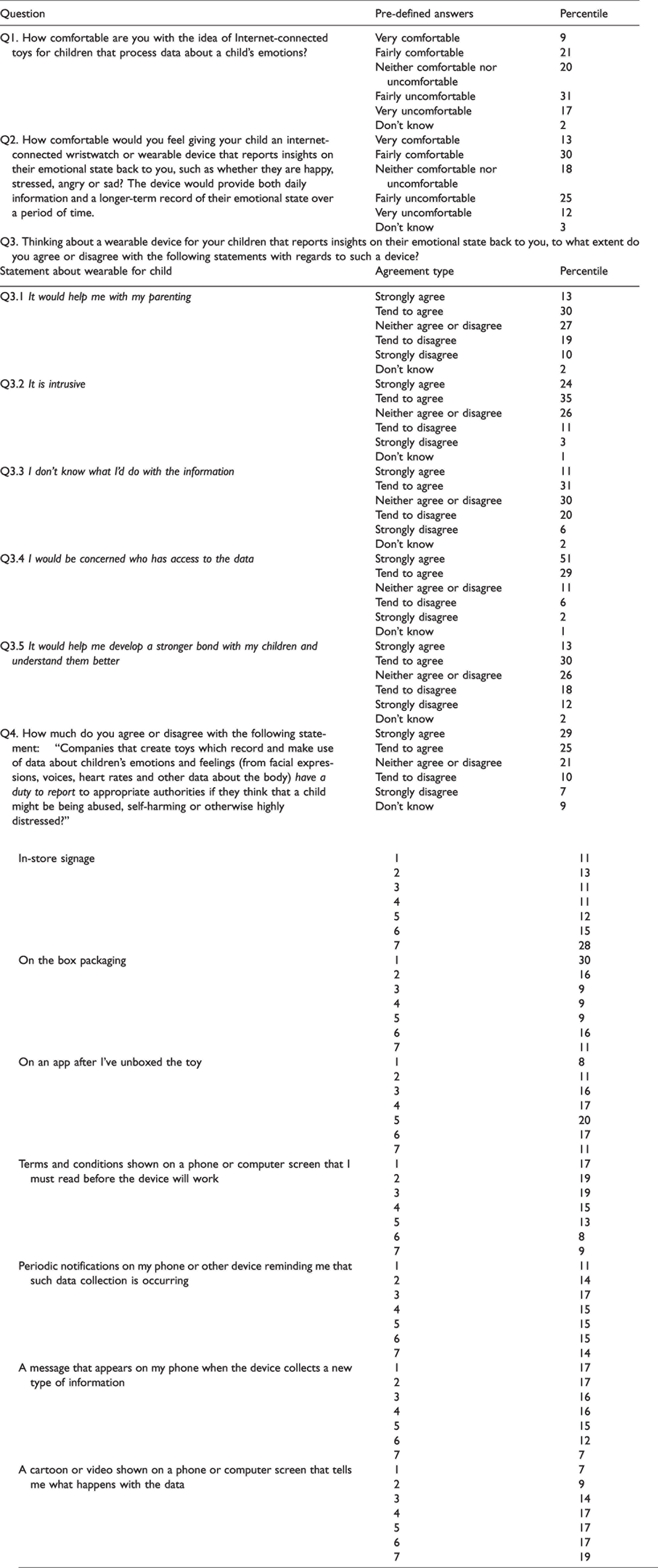
Q1 asks: ‘How comfortable are you with the idea of Internet-connected toys for children that process data about a child’s emotions?’ Parents were not given extended descriptions of the technology, but were in effect asked to consider the principle of emotoys. We were especially interested in creepiness (McStay, 2018; Tene and Polonetsky, 2014), parental alarm and comfort with new technology (Livingstone, 2009). Parents display neither high comfort nor very low comfort, with 48% overall registering as ‘Uncomfortable’ (versus 30% overall as ‘Comfortable’). This suggests that while parents are clearly not comfortable with the idea of these technologies for a variety of reasons (some unpacked below in answers to other questions), parental alarm was not a leading sentiment.
Q2 asked parents: How comfortable would you feel giving your child an internet-connected wristwatch or wearable device that reports insights on their emotional state back to you, such as whether they are happy, stressed, angry or sad? The device would provide both daily information and a longer-term record of their emotional state over a period of time.
Q3 asked parents to consider wearable devices for children that reports insights on a child’s emotional state back to parents. A key finding in Q3.1 is that 43% agree that an emotion sensing wearable would help respondents with their parenting, while 29% disagreed. These findings should be treated cautiously since the technologies were not explained, nor was the questionable effectiveness of using biometrics to infer emotion (Azari et al., 2020; Barrett et al., 2019; McStay, 2018). Nevertheless, the idea that these technologies could be a benefit to parenting was not dismissed. Follow-up work is required to explore this, but our initial reactions connect with Lupton and Pederson’s (2016a) aforementioned interest in tracking technologies, reassurance through quantification, and Leaver’s (2017) observation that not using intimate surveillance has scope to be seen as a failure of parenting. From the survey we cannot conclude parental motives for interest in emotion-sensing wearables, but desire for reassurance seem sensible. We do conclude however that, in relation to governance and policy, relevant regulators should consider failure and guilt-based sales tactics in surveillance technologies (emotion-based or otherwise) as problematic.
Q3.2 finds that 59% of parents agreed that a child-oriented wearable that tracks emotion is intrusive, although this too should be seen in light of the finding that parents broadly think it would help them with their parenting. Again, this gives support for Leaver’s (2017) point about intimate surveillance and that parents are aware of being potentially invasive, yet this is justified on grounds of what is understood as ‘good parenting’. We agree with parents, that it is intrusive, but add that if emotion trackers are used to assist with mental and emotional wellbeing (such as combatting child anxiety), it is questionable whether wrist-based surveillance devices will help given privacy concerns.
Q3.3 raises an apparent paradox: it finds that despite the perceived potential to help with parenting established in Q3.1, 42% in Q3.3 ‘strongly’ or ‘tended’ to agree that they did not know what they would do with information about their children’s emotions. Further qualitative work will help resolve this, but we think it is partially explained by: (1) longstanding acculturation of digital media into parenting and (2) lack of familiarity with devices that collect data about emotions. The question becomes one of what would social adoption look like as parents become more familiar with them and what conventions would be formed around the data from emotion-based devices? As Lupton and Pederson (2016b) have explored, it is useful to take lessons from acculturation processes in digital media, such as asynchronous messaging (like texting and emoji), real-time more intimate communication (phone) and video calls (to see visual images of their children as they chat). Indeed, this care for wellbeing from a distance helps explain parental interest in emotion trackers even if parents are not yet clear on what they would do with the data. Longhurst (2016) grants a glimpse of the nature of acculturalisation as she discusses the mediation of emotion in hybrid terms as the organic and inorganic comingle through communication technologies. McLuhanite in its vision of an extended sensorium (McLuhan and Fiore, 1967), the appeal is that emotion-based devices may promise ambient awareness of wellbeing, even if it is not clear to parents what they would do with that information. It will be interesting to see how social adoption and the technologies develop, especially in light of: (1) Longhurst’s argument that mothers perform the majority of emotional labour; (2) that emotion in relationships has long been mediated; and (3) that mediation enriches inter-connections. For example, wearable manufacturers continue research into languages of haptic communication (McStay, 2018), which provides not only for communication, but touch-based intimacy from afar. We look forward to close-up study of these technologies in lived contexts, just as social media and messaging are prevalent today. This will be to understand the child-focused emotional AI not only in terms of unfairness and the concerns posed in this article, but acculturalisation among parents and children.
Q3.4 is about levels of concern over who would access data about the child. Eighty per cent of parents agreed that they would be concerned about who has access to the data, with only 8% disagreeing. Despite relatively extensive literature pointing to low level of parental concern about data privacy and children (Lupton and Pederson, 2016b), we see parallel with Livingstone et al.’s (2018) finding that while parents do adopt new technologies they are simultaneously concerned about privacy. This seeming contradiction is apparent in Q3.5 as, again, it shows that despite strong privacy concerns, parents think there is in principle potential for these technologies to help develop stronger bonds with their children and understand them better (43% agree, with 30% disagreeing with this premise). Collectively, the answers to Q3 indicate ambivalence in that parents might be interested in such devices for a variety of reasons, but they have clear privacy and security concerns about who might be able to access data about children.
Q4 was interested in reactions to the proposition that toy companies might have a duty to report to appropriate authorities if systems flag that a child might be being abused, self-harming or otherwise highly distressed. The question was motivated by: (1) an extension of research focus from parental to institutional surveillance; (2) the thorny ethics of child protection and intervention (Hall et al., 2016); and (3) concern from the technology ethics field on the need to defend human expertise from technophilic AI claims (Pasquale, 2020). Overall, 54% agree with the premise versus 16% who did not. The point about human expertise is vital, especially given that emotion-sensing is a deeply problematic method (Barrett et al., 2019; McStay, 2018). As discussed above in the interview section on immature signals, Azari et al.'s (2020) findings about over-reliance on basic, folk and ethnocentrically specific categories of emotion are central because they confirm that emotion labels are social and contingent. Applied to our question of sensing whether a child might be being abused, self-harming or otherwise highly distressed, the scope for misunderstanding in emotional AI is profoundly problematic due to scope for false positives (and negatives) in the most sensitive of circumstances (child abuse).
Given longstanding concern about privacy and consent notification (Cranor et al., 2014), Q5 was interested in the means by which parents should be informed of the types and methods of data collection for these toys. Options given were: in-store signage; on the box packaging; on an app after unboxing; on a range of networked devices that must be shown before the toy will work; through periodic notifications reminding parents that data about their child is being collected; notification when a new type of data is being collected; and cartoons or a video that tell parents what data is being collected and how. Parents did not express strong preference for any option and it is possible that respondent fatigue may have occurred. There are however some clear insights: Q5.1 finds that parents are not keen on in-store signage as a means informing them about what data is collected, but on-the-box packaging received a much better response in Q5.2 with 30% voting for this as the most important means. Q5.4 shows that parents were also positive about an approach whereby a device will not function until terms and conditions have been read. Again, given longstanding observations about the lack of attention paid to terms and conditions of service, this is worthy of follow-up assessment to further scrutinise the finding.
The finding of parental preference for on-the-box packaging may not be a scintillating insight, but it is very practical. It also resonates with the statement from the UK Information Commissioner’s Office that customers should be able to view privacy information, terms and conditions of use and other relevant information online without having to purchase and set up the device first, meaning customers can make informed decisions about whether to buy the device in the first place (ICO, 2020). The time-based dimension is important because it answers a problem in data protection provision and, with appropriate easy-to-digest information on the box, begins the informed consent process before the item has been bought. In relation to toys, it also helps address problematic consent stipulations in GDPR: that consent should be given when a person provides data to a controller and at the time when personal data are obtained (Art. 13).
Conclusions
Emotional AI is the use of affective computing and artificial intelligence techniques to try to sense, learn about, and interact with human emotional life. This article has explored usage in toys (emotoys) and related child-focused objects (such as wearables that pertain to track wellbeing). To explore the significance of these in relation to ethics, governance and data protection, the article made use of expert interviews and a UK national survey of parents. The interview stage raised diverse concerns about generational unfairness. Having digital origins in ‘sharenting’ and exploitation of children’s digital footprints, generational unfairness itself is not a new idea. Yet, unfairness and injustices through the datafication of emotional life introduce new concerns and questions. Interviewees opined that adults are doing a disservice to children, that they are not envisaging consequences and that they are creating gross power imbalances between children and corporations. Unfairness through imbalances took a range of forms, including manipulation of child vulnerability, that parts of childhood should remain in the past, unwanted labelling of behaviour, the need to try-for-size adult concepts like sexuality without a corporate data gaze, and socially unhealthy corporate strategic interest in the construction of synthetic behaviours.
Interviewees also saw parents as vulnerable, especially in relation to data literacy, inexperience of raising children, fatigue, fear of failure, concern about the loss of human skill in parenting and the outsourcing of these skills to questionable technologies. Interviewees flagged problems with methods behind these technologies, a point this article bolstered with discussion of contextual, cultural, ethnocentric and labelling techniques in machine supervised learning. Methods aside, interviewees saw scope for good in child-focused emotional AI but insisted that it must be used in the best interests of the child. Governance was shown to be problematic, with all recognising that laws remain limited for children and questions of datafied emotion. However, expert interviewees did not recommend new law, but better enforcement of existing law. Regarding toys and other emo-objects themselves, consent was the preferred legal basis for personal data to be processed.
The survey stage generated ambivalent responses. Parents were concerned about privacy, yet also saw merit in emotion-enabled devices. Leaver’s (2017) work on parents and intimate surveillance provides a useful prism in that it recognises the affective context of parenting, fear of failure, inherent surveillance in parenting and longstanding datafication in parenting (such as pregnancy apps and sensors in infant cots). What might be seen as contradictory findings – such as broad agreement that emotion sensing wearables could help with parenting, but that parents did not know what they would do with this information about their children’s emotions – are to an extent resolved by seeing that parents want to do the right thing. With very high concern for privacy added, parents are pulled in multiple directions. We suggest that the survey results reflect the technology, parenting and governance landscape well. Given that parenting is inherently about care, communication, wellbeing, emotion, oversight, modulation of control, interest in new tools to help with parenting, and that parents are exploring the mediation of these in a highly imperfect governance context, the results make sense. We recommend close regulatory attention to these technologies due to questionable effectiveness, potential trading of long-term privacy for short-term benefits, and the conceivable severity of outcomes resulting from the processing and sharing of child data (we have the finding on potential child abuse in mind).
As a practical final point, if these technologies are to be deployed at scale, we draw on findings from the expert interviews and the parental survey to urge on-box notification for emotoys. Further, on how to advance child and parental data literacy (flagged at the interview stage), the popularity of unboxing videos with children (Ofcom, 2019) should not be missed: an age-appropriate communications strategy featuring prominent YouTubers to enhance data literacy regarding emotoys and related toys might also be considered.
Footnotes
Declaration of conflicting interests
The author(s) declared no potential conflicts of interest with respect to the research, authorship, and/or publication of this article.
Funding
The author(s) disclosed receipt of the following financial support for the research, authorship, and/or publication of this article: This work is supported by Economic and Social Research Council [grant number ES/T00696X/1] and Engineering and Physical Sciences Research Council [grant number EP/R045178/1].
