



Abstract
This article draws on research undertaken by the authors as part of the Administrative Data Research Centre in England (ADRC-E). Between 2014 and 2017, we conducted four case studies on government administrative data for education, transport, energy and health. The purpose of the research was to examine stakeholder perspectives about the sharing, linking and re-use (secondary use) of government administrative data. In relation to the role and nature of consent given by data subjects for re-use, our study revealed significant variations in data provider and researcher attitudes. Although our study setting was England, we believe that the findings have wider resonance. Our analysis identified six factors which might account for the variations around consent: the specificities of the legislative framework governing the collection and processing of particular data; the type of data being collected and the relational context in which it is created; the broader information governance framework in which the data resides; the creating organization's approach to data release; the relative levels of risk aversity within the creating organization; and public perceptions and social attitudes. In conclusion, we consider whether consent is still the best mechanism available for data re-use, or whether a social contract model of data sharing should be developed.
Introduction
Obtaining the consent of the data subject is the primary mechanism which underpins the fair and lawful processing of personal data in a European setting. It acts as a governance mechanism ‘to protect individual interests, to promote personal autonomy, and to act as a foundation for trust’ (Laurie and Postan, 2013: 372–373). However, consent is not a simple concept and is not easily defined, obtained, or observed. In the age of Big Data, there are questions over whether it is a sufficient mechanism to protect privacy, and the extent to which it can address a wider set of concerns around the ‘fairness, justice, and due process’ of data use and re-use (Barocas and Nissenbaum, 2014a). In an exploration of the limits of consent, O'Neill (2003) suggests that the inherently propositional nature of consent creates degrees of opacity around what is being consented to. Does consent represent informed choice, particularly when possible outcomes are complex or when the freedoms of the individual may be compromised? O'Neill (2003) also argues that the consent of individuals is not sufficient when the resulting action has implications at a collective as well as an individual level.
Research ‘in the public interest’ (which uses pseudonymised or identifiable person-level data) may reduce the obligation to obtain consent. In place of explicit consent, researchers and data providers rely on legal gateways, on privacy notices, and on offering opt-outs to data subjects. Our research uncovered distinct differences in the role and nature of consent for the research use of government administrative data in England across education, energy, transport, and health. Our analysis identified six factors which might help to explain the variations: (1) the specificities of the legislative framework governing the collection and processing of particular data; (2) the type of data being collected and the relational context in which it is created; (3) the broader information governance framework in which the data resides; (4) the creating organization's approach to data release; (5) the relative levels of risk aversity within the creating organization; and (6) public perceptions and social attitudes. Although our study setting was England, we believe that the findings have wider resonance.
In this article, following a discussion of the qualitative, inductive research methods used, we present a discussion about the data relating to consent from the four case studies in turn (education, transport, energy, and health), followed by a summary of the six factors which influence the understanding of consent identified from the research data. We explore whether a single approach across government to consent for the secondary research use of personal data exists or can be developed or, perhaps preferably, whether a multi-faceted model can be envisaged which would allow for both individual and collective goods and would promote public understanding and trust in government data use. In conclusion, we consider whether consent is still the best mechanism available for data re-use, or whether an alternative social contract model of data sharing should be considered. This research contributes to public policy debates and suggests an approach to the reconfiguration of the social understandings around consent for secondary data use.
In European law governing the processing of personal data, obtaining the consent of the data subject is the primary procedural mechanism which underpins the fair and lawful processing of personal data (General Data Protection Regulation (GDPR), 2016). The UK Information Commissioner's Office suggests that explicit consent ‘requires a very clear and specific statement of consent’ that is ‘expressly confirmed in words’ (ICO, 2017). However, according to McDermott (2017), data protection as a fundamental human right is linked to upholding the principle of autonomy alongside privacy, transparency and non-discrimination. This points to an information ecology in which consent may be the primary, but is by no means the only mechanism through which processing of personal data can be lawful.
Secondary data processing in a health context is subject to the common law duty of confidence, as Grace and Taylor (2013) suggest, which prevents data being disclosed for purposes outside the ‘reasonable expectations’ of the data subject. In a complex data environment, such as in the NHS, defining public expectations for control of patient-identifiable data and information governance systems is also complex (Caldicott, 1997). While obtaining consent from the data subject for secondary use of personal data is the default position (Grace and Taylor, 2013), the use of de-identified data and of identifiable data in the public interest reduces the obligation to obtain consent. As Barocas and Nissenbaum (2014a, 2014b) note, informed consent has ‘longstanding operational challenges’ which are exacerbated in an era of Big Data and complex data flows. Anonymised data also has significant limits in an inter-connected data world.
One approach to managing the mutable nature of consent is through ‘opt-outs’ through which data subjects can object to the use of data for secondary purposes. Precisely defining the opt-out in an understandable way in a form which can be operationalised is not easy, and if done badly, can result in a loss of public trust and the fracturing of the social licence to collect and process data, as exemplified in the failed care.data scheme (Carter et al., 2015; Ostherr et al., 2017; Vezyridis and Timmons, 2017). Sexton et al. (2017), MacNeil (2011), Flinn and Shepherd (2011), and others have explored the trust nexus surrounding records and data, suggesting that public trust is a fluid construct, dependent on an ever-changing dynamic between data, the space-time in which it exists, and those that interact with it.
Taylor (2015) argues that the way forward through the dichotomy of opposing tensions is to ensure that data protection is framed not just in terms of individual rights and freedoms but as a collective public good. A number of authors have examined issues around the focus of consent on the autonomous individual, the binary choices presented by consent to privacy notices as a condition of accepting a service (Cate and Mayer-Schönberger, 2013), and the increasingly social context of consent, transformed by digital data (Ruppert et al., 2013). Social contract theory from the work of moral and political philosophers, including, in the 20th century, John Rawls (1958), might help us to rethink consent in a social context. A social contract theory seeks to show that citizens ‘comply with the fundamental social rules, laws, institutions, and/or principles of that society’, ‘by rational agreement’ even though individual reasons for complying differ (Stanford Encyclopedia of Philosophy, 2017). Traditionally, the social contract relied on consent, but contemporary social contract theory has moved towards agreement and the question of justification (Rawls, 1958). This aims to model the reasons and conditions under which citizens would agree, if they were properly informed about an issue and acted in a reasonable manner.
These ideas change the frame of the discussion on privacy, rights, and data protection away from a focus on individual data subject rights towards achieving collectively beneficial outcomes. It may be possible to re-model the role that consent should play in balancing individual privacy and wider societal benefits through a social contract model for data sharing.
Research methods: Four instrumental case studies
Summary of interviewees in ADRC-E study.

HEI: Higher Education Institution.
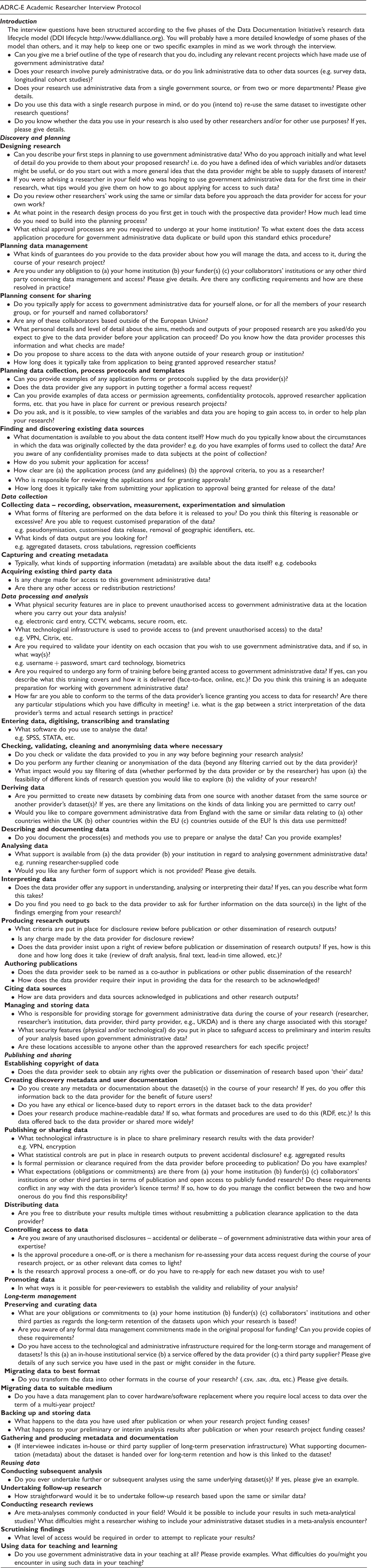
Example interview protocol.
In the education case study, the main dataset used by researchers was the National Pupil Database (NPD); a person-level database which matches pupil and school characteristic data to pupil attainment. Access requests are scrutinised by the Department for Education (DfE)'s Data and Education Standards Analysis Group and the Data Management Advisory Panel (DMAP) (UK DfE, 2016). Researchers can apply for data linked to Higher Education Statistics, and to Further Education students' Individual Learning Record.
In the transport case study, many researchers relied on open data. The STATS19 database of road traffic accidents resulting in personal injury, available from the Department for Transport (DfT), is collected by the police, validated by local authorities, and collated at the DfT. The dataset, published annually, is available through the UK Data Service, as open data through data.gov.uk, and directly from the DfT.
The key dataset in the energy case study was the anonymised dataset of the National Energy Efficiency Data (NEED) Framework, collated by the Department of Energy and Climate Change (DECC). It brings together data on gas and electricity consumption provided by UK utility companies, Home Energy Efficiency Database, property values and household characteristics from other government agencies, utility regulators and external data providers (including commercial credit brokers). The data in NEED is ‘publically available data and data provided through commercial licences, voluntary agreements and service level agreements with dataset owners’ (UK Department for BEIS, 2013).
The main dataset that researchers in the health case study used was Hospital Episodes Statistics (HES); a patient-level database containing over a billion records of patients attending Accident and Emergency units, admitted for treatment or attending outpatients clinics at National Health Service (NHS) hospitals in England. NHS Digital publishes annual HES data from 2009 at provider-level as open data. Researchers can access anonymised in context (or more fully identifiable), patient-level data. Access requests go to the Data Access Request Service of NHS Digital, and through IGARD (the Independent Group Advising (NHS Digital) on the Release of Data), replacing the Data Access Advisory Group since 2017.
Results: Four case studies
This section examines the data from each of the four case studies in turn, drawing out the findings around the role and nature of consent in government administrative data.
The role of consent in enabling research use of routinely collected administrative data for education
In recent years, the DfE has been at the forefront of government data sharing initiatives, leading in an ‘exemplary way’ (A12) on ensuring that routinely collected government education data can be used ‘extensively by researchers’ (A12). This open attitude to sharing data for secondary research use has been part of a cultural shift where a more risk averse attitude of ‘not giving the data to anyone unless they had to’ (A16) has been superseded by a deeper dedication to ‘widening access’ (A13). As one respondent commented: You know, some people think we should just put the National Pupil Database on the web so anyone who wants to use it… and obviously in a world of open policy-making and open data, there's much to be said for that. (A16)
The DfE's open attitude to secondary use can be set against the relatively peripheral role that consent plays in enabling data collection. In the NPD, school data collection is mainly mandatory under specific legislation and regulation (Education Act 2005 section 114, Education Act 1996 section 537A, Children Act 1989 section 83, UK Government, 2013), and relies upon the display of privacy notices in schools and on local authority websites. A limited opt-out arrangement is offered (to parents of children aged 13 upwards to their 16th birthday, and thereafter to the students themselves) which restricts the exchange of data with local youth support services, but there is no equivalent opt-out mechanism in respect of the same data passed by schools to local authorities and to the DfE. As described by A13: Privacy notice[s] tell parents, teachers and children why we need to collect the information, what we're allowed to use it for, and that covers any request that we will get that we will then approve, so we don't have to go through actual permissions from the schools [or individual pupils] themselves…so we have the legal side covered to allow us to release this data.
Governance of requests to re-use education data held by DfE for research is provided by the DMAP which includes external representation (UK DfE, 2016). Data in NPD is broken down into four tiers. Tier One data are directly identifying (includes names, addresses, date of birth, exam candidate number, unique learner number) and/or highly sensitive (includes looked-after status, ethnicity, Special Educational Needs assessments, reasons for exclusion, and absence). Requests to use this data always go through DMAP, as do all requests for linkages with other datasets. Tiers Two to Four relate to less identifiable and sensitive classes of data, which are usually handled by the NPD and Data Sharing Team. Governance oversight seeks to ensure that data requests are in line with legislation and regulations, whether the data requested is proportionate to need (data minimisation) and security standards are proportionate. For highly sensitive and identifiable data releases, a finite period of time for which access is permitted for research is agreed under specific licensing agreements. The consent of data subjects, or their legal guardians, for such secondary re-use is not required.
However, where researchers seek to link independently collected cohort data to routinely collected administrative education data (such as the NPD), the consent of data subjects is required as the independently collected data is not covered by the legal gateways. Here, in keeping with a proactive approach to data sharing, DfE governance is light touch: If a researcher has collected some data outside that area and wants to link it to the NPD…they have to show us that they've got the relevant consent arrangements in place. We don't need to see evidence of that consent anymore, but the onus is on them. (A13)
A12 argued that asking for individual consent for research purposes is problematic not only because of its likely impact upon research re-use of the data but also because it is likely to cause problems for existing government uses of data for monitoring educational progress. A12 set out the difficulties: If you ever made it optional, the government would stop functioning because, obviously the administrative data is not there for research, the administrative data is there first and foremost for them to run the system, so if you started to have to ask every individual whether or not they can put their data in this database, um, well, you couldn't do that [laughs]! I think my biggest issue is that I don't know what I have and haven't agreed to. …I don't mind sharing it because I think there's a use to sharing this, and pooling it together for research and analysis, but it just worries me that I can't turn round and say I know exactly what sort of information is being held about me, how, and for what reasons. (A20)
In summary, in relation to research use of routinely collected education data such as NPD, for the most part, the collection, sharing and linking of individual-level personal education data for research use are unconsented. Research use of government administrative data for education is subject to a legislative and regulatory framework which enables secondary use largely without consent, relying instead on a system of privacy notices. Where consent is deemed necessary for specific uses, the DfE takes a ‘light touch’ approach with researchers responsible for obtaining consent. Although some of the data collected is considered sensitive (Tier One), most is not, and the data is collected in a mandatory context, with a limited system of opt-outs for data sharing. DfE operates a clear governance framework which generally facilitates data release for research use, suggesting a relatively low level of risk aversity with respect to data release. Public perception seems surprisingly tolerant of the lack of explicit consent mechanisms for NPD, when compared, say, with health data, although students expressed some concerns about their lack of control over their educational data.
Transport data and open data
In relation to government administrative transport data, the role of data subject consent in determining research re-use of the data is also peripheral, but for entirely different reasons. The Department for Transport (DfT) has been at the vanguard of efforts to facilitate better use of, and access to, data for more efficient government and the public benefit. DfT commissioned research into a UK National Transport Data Framework (NTDF) (Landshoff and Polak, 2008), in advance of the government-wide push towards open government data and, in the wake of the Shakespeare Review (2013) which considered the growing value of public sector information and how it could be better exploited including recommending the publication of a National Data Strategy, published an open data strategy (DfT, 2013). The strategy states that ‘transport is a ‘data-rich’ area, where there is huge public appetite for information that can be used to inform travel choices, to improve performance and to hold operators and Government to account’, including ‘datasets owned and published by the wider industry such as timetables and real-time running’ information. Movement towards open data by DfT and its agency family (including the Driver and Vehicle Licencing Agency (DVLA)) resulted in public availability of large numbers of official statistical datasets relating to road and public transport. DVLA has been a leader in developing digital government services, enabling sharing of data with the motor trade and insurance industries, local government and the police, as well as launching online access for individuals to their own driving licence records (https://www.gov.uk/view-driving-licence). The sale of DVLA vehicle register data, although specifically permitted under statute (UK Government, 2002), has not been without controversy. DfT's open data strategy focused on making data available that is of use to service providers, application developers, and to individual citizens as data users (DfT, 2013).
Academic researchers interested in transport issues therefore mainly have to rely on anonymised aggregated open datasets (such as STATS19), rather than having access to the more granular person-level administrative data from which these open datasets are derived. As an aggregated and anonymised dataset, individual consent from data subjects in STATS19 is not required for governance. Our interviewees acknowledged that injured individuals' consent was unlikely to have been obtained by police attending the scene of an accident, but this was contrasted by A24 with health data (potentially relating to the same incident) where the expectation around obtaining consent was the opposite.
Given that much data in the transport arena has long been open and publicly accessible, it was a common view that no explicit consent or ethical review was required for secondary research use, of STATS19 for example: Generally speaking when it's secondary analysis of data that's publicly available you do not [gain] ethics approval, and you know, as long as I think no one is identifiable which they're not because, you know, it's based on collision location, that's sort of the only variable that could give away anything. (A22) I suppose my slightly hardline view, … if people are … giving data to say the government, then I think it's a reasonable expectation that that data will be used for, research or whatever it is for the betterment of the way things are run. (A28) I think that if someone was doing some research that was going to be for the public good that required linking several datasets, I think it's crazy to say that can't go ahead unless you've got the approval of all the people who are in the dataset. I think the consent side will stifle some good research ideas and will hold back some research. (A24)
Energy data and multiple data sources
A shifting landscape around consent emerges in our third case study on government administrative data for energy. DECC collates the NEED framework which derives from multiple data sources and does not solely comprise government administrative data. Instead, multiple data flows of varying provenance are linked together in-house by DECC, for the purposes of generating government statistics and for internal research purposes. The statutory basis for DECC's acquisition of the data at the heart of the NEED framework – energy consumption data derived from utility meter readings – lies in the Statistics of Trade Act 1947, as amended by subsequent legislation, such as the Electricity Act 1989 and the Utilities Act 2000. Unsurprisingly, given that the underpinning legislation is 70 years old, it does not anticipate contemporary data uses. This legislative framework, coupled with data licensing restrictions and reinforced by the effects of privatisation in the utilities sector, severely limits the extent to which DECC is able to share NEED data beyond government: … the Statistics of Trade Act, and that allows the government to use, for statistical and research purposes, information from businesses which is considered to be useful to the government. … we cannot disclose that information in such a way that any individual business or any individual entity within the data can be identified. So we can only publish aggregated figures and we can't pass the data on without the express permission from the people that have supplied the information. (A26) So earlier in the year, we wrote to all of the electricity companies and all of the gas companies, and asked their permission for us to share their data with academic research partners that we thought put forward proposals which were worthwhile. We put lots of caveats around everything to say that we'd ensure that all the appropriate safeguards were put in place and all the appropriate protocols were followed to ensure the data is held securely. But unfortunately, a number of the suppliers declined, and said they weren't happy for that to happen. (A26)
In place of consent by individual householders, NEED relies on a privacy impact assessment (PIA) in conjunction with the energy suppliers and the regulator to address transparency concerns. It requires that ‘all suppliers have a privacy policy which provides information on how customers’ data is handled’, including a fair processing notice on how data may be shared with government. The PIA allows government to link data ‘in circumstances where permission has been granted by the individual (e.g. through a survey response) or an appropriate privacy notice has been published’, but does not enable access by external academics or other third parties: ‘…if we wanted to link the data in-house, that's fine …. But in order for an academic to link to this data, we’d have to give them that data, and that's the bit we can't do’ (A26).
However, the centrality of the utility companies in consenting and approving data access and re-use is set to change. The presumption that the utility companies own the data and therefore are in a position to dictate its flow is being challenged by government policy around the introduction of ‘smart meters’. While the utility company owns the meter: Ownership over the data that you use in your business and your home is becoming more personalised and it has been decided under government processes that you, the homeowners or the person who controls the meter will own that data, and that the suppliers will not own that data at all. And you will be the one that grants access to it. (A27)
In the energy data case study, the legislative and regulatory framework surrounding NEED has subsumed the role of consent to a minor position. The complexity of the relational context in which utility data is collected and of the information governance frameworks is increased by the mix of public, private, and third parties who deliver energy services. If consent is required for secondary research, it has to be given by the data owners, currently often a commercial utility company: however, in future, the use of smart meters to collect household data will transfer data ownership to individuals and that will have significant implications for the need to gain consent for secondary research use of energy data. No doubt, a programme of public information about consent and any opt-outs around energy data and the public interest in research will have to be developed.
Personal sensitive health data and the role of consent
Across our four case studies, the role of consent as a mechanism for enabling secondary uses of data is arguably most complex in the context of government administrative health data. In addition to the broad legal framework, disclosures that have a ‘robust public interest’ and therefore permissible without explicit consent led to the introduction of Health Service (Control of Patient Information) Regulations in 2002 (commonly referred to as ‘Section 251’). An independent group, the Confidentiality Advisory Group (CAG), advises the Health Research Authority (HRA) and the Secretary of State for Health on whether to permit processing for both research and non-research purposes without consent under the Section 251 regulations. Two significant safeguards are whether the research is in the ‘public interest’ and the lack of a ‘practicable alternative’.
Analysis of our interview data indicates that the existence of the Section 251 provision is broadly welcomed by the range of stakeholders we interviewed (including health researchers, policy makers and data providers) as a means of providing a mechanism to judge when secondary use of identifiable and sensitive health data without consent is legally permissible. The complexity of the interface between different aspects of the legislative framework can lead to confusion amongst the research community over when an application to CAG may be necessary. However, there was a strongly articulated perspective from a small minority of interviewees that questioned the legitimacy of having a legal override to consent: The 251 process colloquially is bust, it's indefensible, it's a sham, because in theory you should only have a 251 exemption if you cannot contact the patient to get their permission. So in what case in the modern world is it not possible to contact the patient to get their permission? (A36)
Most research uses of HES data are not affected by the opt-out because person-level data is supplied to researchers pseudonymised (anonymised in context). However, where researchers want to link data, for example, between HES and Office of National Statistics mortality data, the data given to the researcher becomes re-identifiable. The question of whether such research requests are subject to the opt-out has been cause for concern. A39 reported research into child mortality which was affected by Type 2 opt-out, but queried the lack of transparency about the permission pathways, and who is making the decisions on the application of opt-outs, and whether those decisions can be challenged.
A39 goes on to describe the impact that applying the opt-out is likely to have on the validity of the research: If applied it will mean that 2% of the population will be opted out, if it is in Manchester it will be up to about 6% and at some GP practices it will be 100% so that is a very important loss of a non-random section of the population that you really need to know about…the opt-out has the potential to undermine the use of an important piece of health information, and ultimately damage research in the public interest.
Dame Fiona Caldicott conducted a review (2016) of the basis upon which information is shared in health and social care. The review proposed ‘a new consent/opt-out model to allow people to opt-out of their personal confidential data being used for purposes beyond their direct care’, although ‘where there is a mandatory legal requirement for data in place, opt-outs would not apply’. Even if patients elected to opt-out of data sharing for research and service improvements, they could reverse that decision later and could give specific consent to be included in a research project. At the time of writing, these recommendations have not been implemented.
In summary, in relation to health data, consent (and related opt-outs) plays a far more centralised role in governing research access to data than is the case for use of other types of government administrative data. NHS is generally reluctant to release data for secondary purposes except through highly scrutinised and regulated information governance processes, in spite of open data priorities at a national level. The specificities of the legislative gateways for health and social care data are complex, and the consent and opt-out arrangements are difficult to understand or explain clearly to data subjects. The types of data created are typically highly sensitive personal data collected in a confidential setting, often face-to-face with a health professional, which brings high expectations of trusted data systems and which GDPR recognises as requiring stricter processing. Poor public perception of data management within the NHS, following high-profile data breaches, ransomware attacks, and, in particular, the failed data sharing project, care.data, contributes to a risk averse stance towards releasing data for secondary research.
Results: Six factors
Our analysis of the four case studies suggested that the role that consent plays in both enabling and restricting research use of routinely collected government administrative data varies between case study sectors and creating organisations. The factors governing the role of consent in research use of administrative data which emerged from the inductive analysis of our interview data cluster around six issues. The six factors observed in our data are not evenly distributed across the case studies.
The first factor relates to the specificities of the legislative framework governing the collection and processing of the data. The UK Data Protection Act 1998 (succeeded by GDPR in 2018) and the Human Rights Act 1998 uphold the rights of data subjects in the processing of personal data. Within each case study, these overlap with specific legislation, for example, relating to statutory powers of government to mandate data collection, producing a unique context in which consent is framed. For example, the Statistics of Trade Act 1947 governs data collection by DECC and requires consent for further dissemination, but the focus of that consent is on the utility company as the supplier of the data rather than the individual data subject.
Within the legislative framework, the type of data being collected and the relational context in which it is created has an impact on the role that consent plays in governing research access. Health data is created as part of a confidential relationship between data subject and health professional which brings the common law duty of confidence into the framework and reinforces consent as a mechanism for secondary data use. Health data was also classed as sensitive under the Data Protection Act 1998 and as a special category in the GDPR and Data Protection Act 2018, including a requirement for ‘explicit consent’ to be gained before its secondary use. Consents gained by researchers working with health data are scrutinised more closely by NHS Digital, than those obtained for educational data held by DfE.
Thirdly, the broader information governance framework in which the data resides also has an impact on consent. A ‘consent by default’ approach has emerged as the accepted path to data sharing in the NHS. This is reinforced through the NHS Constitution for England (2015) which, in relation to ‘consent, respect and confidentiality’ states, ‘you have the right to be informed about how your information is used’ and ‘to request that your confidential data is not used beyond your own care and treatment…, and where your wishes cannot be followed to be told the reasons including the legal basis’. Health care data subjects are offered the right to object to further dissemination through ‘opt-outs’. Information and data governance frameworks are more fully developed in the NHS than in other parts of the public sector in our study.
The creating organization's approach to data release is the fourth factor influencing consent as a governance mechanism for research access. The DfT, for example, has focused its efforts on publishing open data and deflected attention away from the provision of research access to more granular, person-level, data. Consent as a governance mechanism is not needed, but at the cost of having less useful data available for research.
The relative levels of risk aversity within the creating organization is the fifth factor. In the context of health, NHS Digital takes considerable measures to scrutinise the ‘informed consent’ gained by researchers to enable secondary use of identifiable and sensitive data. The risk aversity seems to be related to the public scrutiny applied to NHS Digital to account for its data dissemination practices and improve its levels of oversight and audit. For example, the Partridge Review (2014) considered data releases made by one of its predecessor organisations and recommended that NHS Digital should tighten mechanisms for compliance and accountability in an attempt to entirely eliminate personal data breaches.
Finally, public perception plays a part in determining organizational levels of risk aversity, which in turn has an effect on approaches to consent. In the case of health, prominent criticism of data sharing programmes from the media and lobby groups (such as the failed attempt to share health data across hospitals and doctor's practices, care.data, see Carter et al., 2015) led to the introduction of opt-outs for mandated data collections. However, studies by Ipsos MORI (2014, 2016) on the relationship between public understanding and public trust in the uses of data, and by Health e-Research Centre (2016) asking to what extent patients should control access to data, indicated more positive attitudes emerged, as ‘greater knowledge about the subject and exposure to the ideas tends to be related to acceptance’ (Ipsos MORI, 2016). This suggests the possibility of shifting public perceptions and consequently of data provider attitudes to risk.
Conclusion
This study evidences the variations in practice across government in relation to consent for the secondary research use of administrative data, articulated around six factors. In unpacking these variations, there is a fundamental and unanswered question, which is whether consent is in fact the best mechanism for enabling individual privacy and public protection against harm. Manson and O’Neill (2007) argue in the context of biomedical ethics that consent has become an accepted orthodoxy. Consent mechanisms are the primary means of ensuring the individual's right to choose (Laurie and Postan, 2013). When individualistic self-determination is the goal of data governance frameworks, the individual gains highly specified degrees of choice over how ‘their’ data is used. This is echoed in our study: …risk is highly contextual, and actually individuals are reasonably good at understanding the benefits and rewards of different things. We make trade off decisions all the time, and we do so really remarkably well on the whole, but the professional attitude is that you aren't in a position to calculate those risks …I am much more trusting of the public in their abilities to make decisions. (A36)
The majority of researchers we interviewed placed individual consent as one among many governance mechanisms within a social contract model of data sharing. In this framing, the end goal is protection of data subjects from deception and harm. Interviewees who championed a social contract model of data sharing framed personal data, not through the language of individual ownership, but of co-production: People have an image of medical data and confidentiality that is often captured by the language of ownership. I have it, I give it to the GP to use, and if they don't use it in the way I expect then that is an abuse. But actually I don't have it, the data is part of the relationship, all this data is co-produced… We need to understand what the ground rules are of that co-production process, and we need to work out what is a betrayal of those ground rules and what isn't, and that requires a lot more transparency and openness but it doesn't necessarily require a high degree of individual privacy choices. (A42)
As phrased by A42, rather than focusing on consent, ‘it would be much better to think about permissions and licences and people's agreement to trust certain gateway organisations’. In this model: We need to build up an account of what makes it acceptable to use this information through a combination of things, which is not just about ‘we want to do this, do you agree?’ but it is more about ‘we are not sure what we might like to do with it, we would like you to be part of the enterprise, this is what we are building in as safeguards and protections’. …We should be thinking about a ‘no surprises’ rule, in that, even if people haven't set out expecting this, if we have reason to believe that they would be surprised and upset then we need to put some effort into being open and transparent about it. But I don't think it is helpful to think about that as a question of consent, it is more a question of governance and acceptance. …We need … a social contract that allows us to say that we feel we have permission to do these things… we have to put in place an open and transparent explanation of what we think we are doing, some processes to reassure that we are doing what we thought and said we are doing, and some mechanisms for accountability. (A42)
In practical terms, what might a model based on a shared articulation of this kind look like? The Nuffield Council on Bioethics (2015) proposed a social contract model of data sharing. A social contract model would need to be underpinned by an agreed set of reasonable expectations about how data will be shared; clarity and transparency about the process by which individual freedoms are respected; agreement on the governance that will give acceptable assurances, and on who is accountable for what.
The ethical issues concern the privacy of individuals and the risk of disclosure, but also the larger moral consequences and social impact. The balance of risks must ensure that data is used responsibly to promote the public interest, in a way that best reconciles the interests of individuals and groups, in keeping with their fundamental rights (Nuffield Council on Bioethics, 2015). Consent is designed to convince data subjects and public stakeholders of a pre-determined public good in research. In contrast, co-constructed participation in a deliberative and dynamic process balances the relationship between public and private interests: this might move the debate towards Rawls's (1958) question of justification. A social contract model ‘recognises the necessarily provisional nature of decisions about data management and governance, since the horizon of possibilities – and the values and interests invested in them – are constantly changing as the social, political, technological and information environments evolve’ (Nuffield Council on Bioethics, 2015).
In conclusion, then, our study suggests that there is no single agreed formula for the use of consent as a sufficient mechanism to ensure privacy in the secondary use of government administrative data. In seeking to identify applicable norms, mere compliance with the law and adoption of one-time consent processes is inadequate to ensure that data use is ethical and morally reasonable. Information governance frameworks must go beyond the law, based on an identification of reasonable expectations of privacy and data use held by all interested parties, to determine the social thresholds for what is acceptable in a given use context. Consideration of the six factors identified in this research could lead to the development of a more reflexive and dynamic process of articulating the justification for data sharing and re-use, moving towards a social contract model of agreement which would provide a more trusted and transparent approach to sharing of government administrative data. This would go some way towards addressing the limitations which our research, and the work of others, has highlighted of the use of consent as the primary governance mechanism. Our research suggests that consent is no longer the best or only mechanism for data re-use and suggests that a dynamic social contract model might provide a better approach.
Footnotes
Acknowledgements
The authors are grateful to members of the sub-project Management Group (ADRCE-project 003.01) for their advice and guidance: Professor Ruth Gilbert (UCL Institute of Child Health), Professor Lorraine Dearden (UCL and Institute for Fiscal Studies) and Professor Paul Wilkinson (The London School of Hygiene & Tropical Medicine).