



Abstract
Chinese cities are increasingly using digital technologies to address urban problems and govern society. However, little is known about how this digital transition has been implemented. This study explores the introduction of digital governance in Shenzhen, one of China's most advanced smart cities. We show that, at the local level, the successful implementation of digital systems faces numerous hurdles in long-standing data management and bureaucratic practices that are at least as challenging as the technical problems. Furthermore, the study finds that the digital systems in Shenzhen entail a creeping centralisation of data that potentially turns lower administrative government units into mere users of the city-level smart platforms rather than being in control of their own data resources. Smart city development and big data ambitions thereby imply shifting stakeholder relations at the local level and also pull non-governmental stakeholders, such as information technology companies and research institutions, closer to new data flows and smart governance systems. The findings add to the discussion of big data-driven smart systems and their implications for governance processes in an authoritarian context.
Introduction
Since the 1990s, the use of digital information technologies to optimise and transform government services has been discussed as part of the concept of e-government, which began with the trend of state institutions creating Internet websites in order to share information and move some public service delivery online (Jiang et al., 2019; Liou, 2007). More recently, the advent of big data – often characterised by numerous dimensions such as volume, velocity, variety and veracity (Kitchin and McArdle, 2016) – and artificial intelligence (AI) presents governments with unprecedented possibilities for data collection and analysis. New means of gathering and analysing big data are seen by public authorities as helpful tools for decision-making about how to address governance problems. So-called ‘smart’ initiatives based on these technologies include sustainable urban development (smart cities), agricultural production (smart farming), environmental management (smart environmental protection) and the incorporation of information technology (IT) innovations in industrialisation processes (smart manufacturing) (e.g. Eiza et al., 2020). Governments’ embrace of these new digital applications has given rise to a ‘digital governance’ literature (Barns, 2018; Löfgren and Webster, 2020; Pereira et al., 2018).
China is currently at the forefront of experimenting with the large-scale application of data-driven digital systems in various governance domains. As part of an ambitious digitalisation agenda pushed by the central government (NDRC, 2016; Xinhua, 2021), sophisticated digital technologies, big data and AI are making inroads into China's central and local governance systems. At both national and local levels, state institutions have started to ‘smarten up’ and experiment with a wide range of digital tools for governance purposes, such as sensors for pollution control (Tarantino, 2020), national big data platforms for environmental protection (Kostka and Zhang, 2018), facial recognition cameras for integrated security and surveillance networks like ‘Skynet’ (Kostka et al., 2021) and blockchain technology for financial governance (Zhou and Goh, 2019). Already as of 2018, 500 smart cities with increasingly sophisticated digital technologies were located in China (Atha et al., 2020; Deloitte, 2018; Shen et al., 2018). This exemplifies the country's state-led digital governance approach, and the central government's strong commitment to both promoting the development of digital technologies within China and incorporating them into state governance.
A growing number of studies have explored the implications of this digital transformation for governance in China (Caprotti and Liu, 2020; Gao, 2020). However, there have been fewer empirical studies examining digital governance innovations at a close range (Chen and Greitens, 2021; Gao and Tan, 2020; Ma et al., 2021; Zhang et al., 2017). As such, there is still little known about the local realities of this new state-led digital governance approach in China: How are digital technologies integrated with local governance processes in China? What are the challenges emerging from this process? Do relationships between various stakeholders change as a result of digital data playing a more central role in governance, and if so, how? In the context of China's response to the COVID-19 pandemic and the incorporation of digital surveillance technologies in the ongoing repression of the Uyghur minority in Xinjiang province (Leibold, 2020), the term ‘digital authoritarianism’ is now a commonly used phrase in reference to China (Polyakova and Meserole, 2019). China's adoption of digital technologies in urban governance is unmatched in terms of its scope, sophistication and international influence. As of 2018, 18 countries had already adopted China's digital surveillance and monitoring technologies (Polyakova and Meserole, 2019) and China's IT companies have exported smart city applications to over 100 countries (Atha et al., 2020). Therefore, gaining a deeper insight into digital governance implementation is critical for understanding the transformations underway in China and beyond.
Our study centres on a close examination of digital governance innovations in Shenzhen, one of China's most advanced smart cities (Shen et al., 2018). We show that one of the important dimensions of smart city reforms is a state-led push for data centralisation and the establishment of a unified digital platform infrastructure. However, numerous implementation hurdles have slowed the roll-out of these initiatives. Our paper makes two core arguments: First, in Shenzhen, the process of digital technology adoption is far from straightforward as issues with data quality and quantity, as well as data standardisation and integration, hinder speedy technology adoption. Poor coordination of governance processes among actors – both within and across government departments, administrative hierarchies and IT businesses – further puts sand in the wheels of technology adoption. As a result, implementation was mired in an initial phase of making data operational for digital systems. Second, Shenzhen's newly implemented digital governance system runs on a ‘platform infrastructure’ that aggregates different digital data resources within one system to facilitate integrated analysis. These digital platforms entail a creeping centralisation of data and suggest a push to move data resources away from sub-municipal and departmental administration agencies up the hierarchy to the municipal level. An implication of the specific configuration of this digital governance system is that lower administrative government units have become mere users of the city-level smart platforms rather than being in control of their own data resources or platforms.
The paper is based on 13 semi-structured interviews conducted in Shenzhen in 2019. Our interviewees had experience with local digitalisation efforts under the Shenzhen smart city framework and were identified by snowball sampling. They included government officials, business representatives, academics and IT experts working in Shenzhen's big data/AI industry. These individuals participated in digitalisation efforts through research, technically operationalising systems as IT contractors, or working in roles related to the adoption of digital governance systems. Guiding questions pertained to which big data or ‘smart’ projects in Shenzhen interviewees had experience with, how they judged these projects’ implementation and challenges and their opinions on the potential of such projects to address relevant governance issues. Questions were specified and amended depending on the specific role and experiences of interviewees within their respective fields. Interviews were later inductively coded to identify and analyse pertinent themes in regard to our questions. In addition, the study draws on document analysis of state documents and provincial government reports, including Shenzhen's Outline Plan for Smart Shenzhen (2011–2020) and its 2018 New-Type Smart City Construction Comprehensive Plan.
Emerging concepts of digital governance in authoritarian contexts
Academic work on digital governance is growing rapidly. Notions of ‘smart governance’ have become a key feature in research on smart city developments (Barns, 2018; Pereira et al., 2018). While ‘smart city’ can be an umbrella term for many different urban development projects (Jong et al., 2015), the focus has moved to the adoption of digital technologies in many aspects of urban life (Kitchin, 2014; Lim et al., 2018). Smart city literature has focussed primarily on democratic contexts and has problematised the use of digital technologies for governance purposes (Hollands, 2015; Zook, 2017). A wider critique of the smart city policies includes documenting failures of ‘smart’ development attempts and their adverse effects on urban livelihoods. Examples include failure to curb urban crime while enhancing digital surveillance (Wiig, 2018), facilitating exploitative labour conditions by businesses that are embraced as part of digitally upgrading cities (Attoh et al., 2019) and potential blind spots around unequal benefits of open data for citizens and commercial actors (Barns, 2016). Similar questions of surveillance, privacy, data ownership and social disempowerment have also been raised in scholarship on China's digitalisation (Kostka, 2019; Kostka et al., 2021; Lv and Luo, 2018; Ruan, 2018; Xu, 2021; Yang and Xu, 2018).
While this literature has identified the risks and opportunities of public authorities’ digital transition, much less is known about ‘actually existing smart cities’ and implementation experiences in particular localities (Shelton et al., 2015; see also Kitchin, 2015; Löfgren and Webster, 2020). Accordingly, we study smart city policy implementation and examine how local data is operationalised to enhance governance with digital technologies. In this paper, we define digital governance as governments’ incorporation of digital technologies (data-driven and aimed at big data analytics, including AI, cloud computing, or the internet of things) into governance processes and interactions between state agencies and other stakeholders. We draw on prominent e-government and smart governance concepts but diverge from the literature in not focussing on citizen engagement with digital governance (Pereira et al., 2018).
The growing literature examining digital governance in China highlights problems relating to data quality as well as poor coordination among actors within digital systems. Well before the advent of smart technologies, governments were already struggling with ‘data islands’ to establishing more efficient and integrated governance (Ghosh, 2020; Halpern, 1992; Holz and Lin, 2001). The collection and integration of (digital or other) information within the massive Chinese state is a long-standing challenge impeding effective governance (Holz, 2008; Liu et al., 2016). Recently, a number of studies have examined the challenges faced by local governments in implementing digital systems. Caprotti and Liu (2020) outline various types of platform-centred infrastructure systems in different cities and stress the central role of data as the key resource in this development. Chen et al. (2017) show how the Guangzhou government struggled to move towards sharing information on a unified digital platform due to implementers’ insufficient digital skills and the absence of procedures to guide implementation, leading to delays in implementation. Leibold's (2020) study of mass surveillance of Uyghurs in Xinjiang shows the patchy integration of digital tools with conventional human surveillance methods. These studies demonstrate the uneven and evolving local realities of governments smartening up.
Employing the concept of ‘fragmented authoritarianism’ (Lieberthal and Oksenberg, 1988), research in China has illuminated the challenges of coordination across government departments and administrative hierarchies, as well as between state officials and market actors. These familiar barriers to coordination across government departments are evident in the push for digital governance systems. Zhang et al. (2017), for instance, look at local data integration initiatives with a study of ‘one-stop service centres’ for government services in Beijing and Chengdu. While these initiatives achieved the necessary collaboration between different government agencies, it was far more challenging to adjust the existing governance structures in order to integrate information than to carry out the technical upgrades. Chen et al. (2017: 333) in their study on the creation of digital governance platforms in Guangzhou, find that the implementation process was delayed due to ‘government staff resistance to changes that threaten their habits and authority’ and the ‘lack of mechanisms for horizontal collaboration and information sharing across different organizations’. In their work on another ‘one-go at most’ platform in Zhejiang Province, Gao and Tan (2020: 72) describe the new system as a ‘digitalized iron cage’ for the local administration and their range of discretion vis-à-vis citizens and upper-level state actors. Other recent research (Chen and Greitens, 2021: 16; Gao, 2020) similarly shows that increased information integration in the course of such digital transition at the local level in China decreases the ability of local governments to evade top-down scrutiny of their performance and that ‘bureaucratic “losers”’ of this development might be resistant to this change. This research shows that increased information transparency via data sharing can be a sensitive topic, even if only vis-à-vis other state actors. Accordingly, the push to pool data as part of the establishment of digital systems may encounter resistance from government actors reluctant to let others peer into their affairs.
The emerging literature on smart cities in China has not yet closely examined the role of private companies. In the 2010s, Chinese Internet companies started driving big data as a concept, and it quickly became a state-backed research field and industry (Lv and Luo, 2018). Subsequently, the proliferation of smartphones gave rise the concept of ‘Internet Plus’ services, which further promoted the deeper integration of apps, social media applications (e.g. WeChat) and other online services in public service provision, thus becoming a staple of the state's administrative reform ambitions. More recently, cloud services and blockchain have also been discussed for e-government applications (Liang et al., 2017). Caprotti and Liu (2020: 3) capture this development by pointing out that the ‘increasing volumes of data necessitate handling and processing capabilities that are typically held by corporate actors [which] potentially recasts the state (at certain points of the smart urban project development life cycle at least) in a client role’. While these ever more sophisticated digital technologies have expanded the range of potential applications for governance, the highly technical nature of these smart systems has made state-firm cooperation a requirement in the design and implementation of digital governance systems.
The national digital China strategy
A closer look at recent national-level policies reveals the political support and investment efforts behind China's ‘digital agenda’. The 13th Five-Year Plan (2016–2020) opened its chapter on the National Big Data Strategy with a statement that the government ‘will make big data a fundamental strategic resource […] to help transform and upgrade industries and bring about innovation in social governance’ (NDRC, 2016). Such goals will be aided by ‘accelerate[d] efforts to facilitate inter-departmental sharing and use of data resources through unified platforms for sharing and exchanging government data’. In terms of digitalising government, the 13th Five-Year Plan defines the goal as ‘a more IT-based government’ with platform-based data exchange. 1 Several other key policy documents published in 2015 and 2016 summarise China's comprehensive digital strategy. 2 These plans outline China's overall goal of government informatisation and the intended use and supervision of data relevant to central and local governance. Data relating to population demographics, corporations, natural environments and geographic information should be collected in databases based on unified platforms, and data sharing is encouraged across regions, departments and levels of administration. Discussions of the overarching Digital China Strategy at the 2017 19th National Congress of the Chinese Communist Party reinforced these goals, culminating in key slogans such as ‘Great Cyber Country’, ‘Digital China’ and ‘Smart Society’. China's recent 14th Five-Year Plan and statements by Premier Li Keqiang show that digitalisation and technological innovation will remain a core priority for the central government, including a strong focus on IT, the proliferation of fifth-generation applications, and digital governance (Xinhua, 2021).
Statements from top party-state leaders provide further evidence of the strong political will of the central government for developing and encouraging the use of big data and AI applications in order to upgrade city-, regional- and national-level governance. During a Politburo study session, President Xi Jinping stressed the integrative, unifying direction in which digital governance should develop and emphasised that data resources should take full advantage of new technologies: We must have a profound understanding of the role of the Internet in national management and social governance, take the implementation of e-government and the construction of new-type smart cities as the starting point, and use data concentration and sharing as the means to build a nationally integrated national big data centre and promote technological integration, business integration, and data integration to achieve cross-tier, cross-regional, cross-system, cross-departmental, and cross-business collaborative management and services (People’s Daily, 2016).
Government officials reiterated these intentions at a 2017 State Council executive meeting, deciding that the government would ‘work to consolidate and integrate the national data sharing and exchange platform to enable connectivity across networks, data and administrative services’ (Xu, 2017). President Xi Jinping and Premier Li Keqiang expressed further support for eliminating information silos through integrated information systems and advocated for accelerating the integration process in order to ameliorate administrative service delivery (Xu, 2017). Big data is a key resource for integrative digital platforms and thus plays a large role in this national digital agenda to upgrade governance capacity.
Overall, the strong push for data centralisation is part of a broader trend in the state's digitalisation agenda under Xi Jinping. In accordance with this digital push from China's top leaders, data-driven governance projects are currently being rolled out by the central government. For example, the integration and centralisation of data is a key aim of interdepartmental agreements on data sharing that are part of China's ongoing efforts to build a social credit system. The development of centralised pollution data platforms in the context of environmental governance is another example of this trend (Kostka and Zhang, 2018).
The case of Shenzhen
Shenzhen Municipality is a fast-growing city of >12 million people (as of 2017) located in China's southern Guangdong province, just north of Hong Kong. Owing to its status as the first Special Economic Zone established by the central government in 1980, Shenzhen has quickly developed into an economic powerhouse with a strong high-tech industry. The headquarters of domestic digital technology giants such as Tencent, ZTE and Huawei are all located in Shenzhen, which also has a vibrant high-tech start-up scene. Shenzhen's GDP surpassed that of Hong Kong in 2018 (Chen, 2020), reaching 2.6 trillion yuan (US$374 billion) in 2019.
Among the different emerging ‘smart’ cities in China, Shenzhen is especially closely-watched. First, Shenzhen's smart city development has outpaced that of other cities such as Beijing, Shanghai, or Hangzhou (Shen et al., 2018). Second, digital city plans in Shenzhen are very advanced and have moved from promoting small pilot-based experiments in 2010 to having a comprehensive city-wide plan in 2018. In 2011, Shenzhen's Pingshan New District was one of 90 jurisdictions to join the first round of China's smart city pilot program organised by the Chinese Ministry of Housing and Urban-Rural Development. In 2012, the first Outline Plan for Smart Shenzhen (2011–2020) was released and in 2018 the city issued its latest overarching policy for smart city development: The New-Type Smart City Construction Comprehensive Plan (hereafter ‘Smart City Plan’). Third, Shenzhen is home to several major tech companies, including Tencent, Huawei and DJI. Fourth, the relevance of digital developments in Shenzhen was recently elevated to take a leading role in advancing China's pan-Pearl River Delta regional development plan. In February 2019, the Central Committee of the Communist Party of China and the State Council named Shenzhen the leading city in building a regionally integrated smart city cluster to span the Pearl River Delta region. The region is intended to pilot a new type of smart city and function as a regional big data testing ground for the development of common data standards and data sharing practices at the regional level (State Council, 2019). The national government's endorsement of Shenzhen to take the lead suggests that the ‘Shenzhen digital mode’ is seen by China's leaders as a role model for other regions.
The key guiding principles underpinning Shenzhen's 2018 Smart City Plan are data unification and integration. The Smart City Plan's objective is the overall improvement of public service provision and city governance capacity across different fields through the establishment of a comprehensive data management system. The city's plan is closely linked to central initiatives such as ‘Great Cyber Country’, ‘Digital China’ and ‘Smart Society’. The city's smart governance is envisioned as an integrated big data aggregation grid that feeds a wide array of information into city governance in order to benefit government, industry and the broader public. This system is operationalised via centralised city-level institutions for data collection, management and application. With two centres and two platforms at its core, Shenzhen's Smart City Plan mirrors the emphasis on streamlining and integrating platforms that is a central aim of China's national policy. This is reflected in the visual representation of the new-type smart city (Figure 1) that was included in the official Smart City Plan.
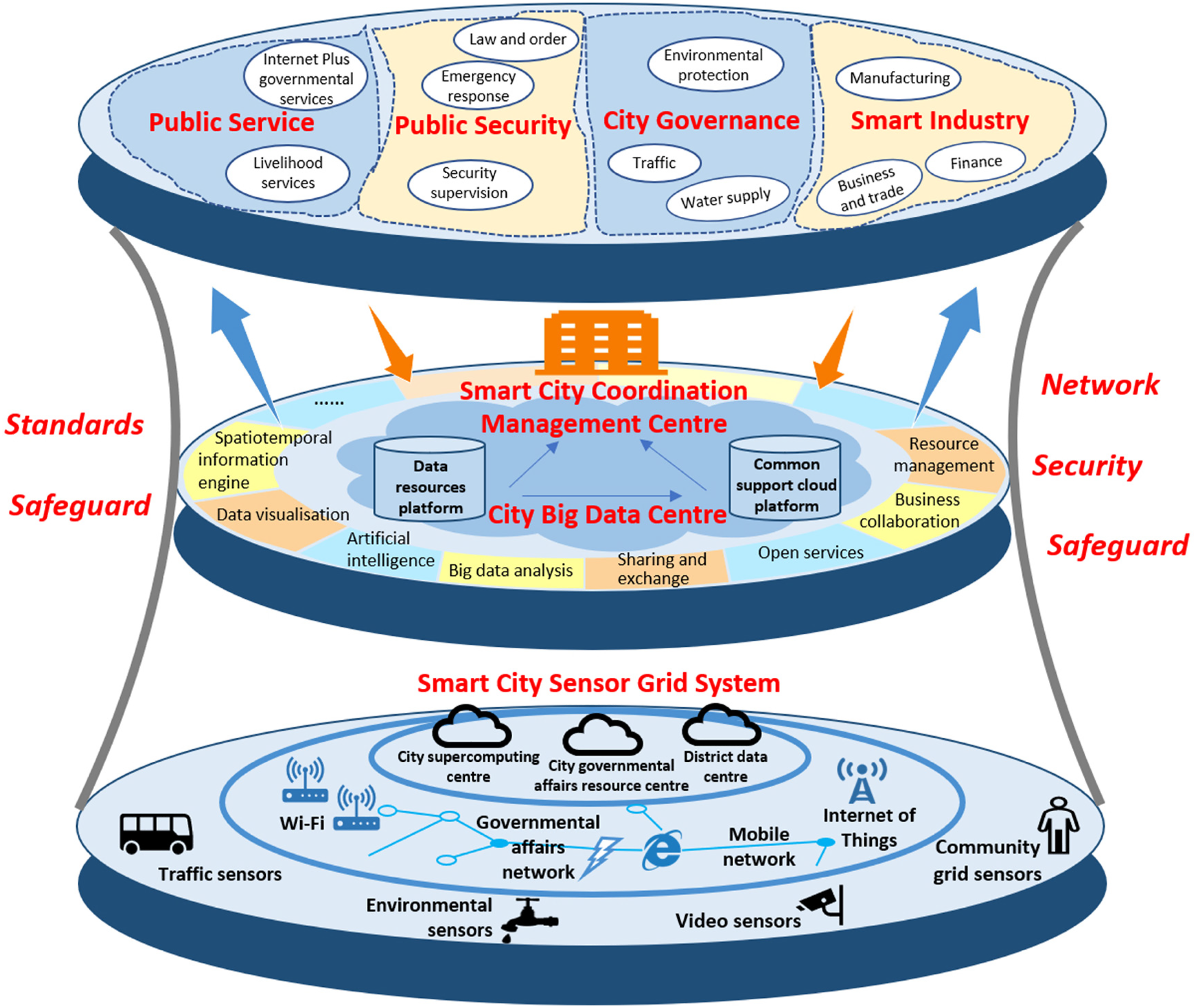
Shenzhen's 2018 new-type smart city construction comprehensive plan. Graphics adapted and translated from the original plan.
The structure of the city-level system is conceptualised in three layers, flanked by safeguards for standards and network security. The bottom layer is dedicated to data generation via the Smart City Sensor Grid System, which consists of a web of data sources and collection infrastructure. This layer's outer circle shows sensors collecting data on traffic, environmental quality, surveillance video footage and community grid management. 3 The next circle represents a networked infrastructure made up of Wi-Fi, government networks, mobile networks and the Internet of Things. This infrastructure connects to the inner circle of three cloud centres for supercomputing, governmental resources and district-level data, respectively. Above the Smart City Sensor Grid System is the structure's central layer, which is organised around two centres (City Big Data Centre and the Smart City Coordination Management Centre) and two platforms (one for data resources and the other for cloud support). The core centres and platforms are surrounded by a range of big data usages, including AI, big data analysis, data visualisation and data sharing. On the very top layer of the structure, there are different areas of city governance that are envisioned for big data applications including public service provision, public security, city management and smart industry.
This latest Smart City Plan seeks to harness new methods of data generation, data integration and data-driven analysis. The advantages of integrating different sources of urban data have long been apparent to the local government. In the early 2000s, the urban grid management system started to integrate some data and communicate with relevant administrative departments as needed (Lin, 2013). Also, new technologies were successively employed to collect data and increase government efficiency, e.g., GIS technology (Lin, 2013). However, the initiatives remained experimental and partial in their integration due to the challenges of collecting and analysing data drawn from disparate sources. In reference to these growing pains, Shenzhen's Outline Plan for Smart Shenzhen (2011–2020) called for ‘breaking through the barriers between districts, departments, industries and systems to fully integrate the information infrastructure and urban public information resources’ (Outline Plan for Smart Shenzhen (2011–2020)). The 2018 Smart City Plan's layered structure builds and expands upon previous initiatives by implementing the envisioned comprehensive information infrastructure. The municipal-level core centres and platforms streamline, integrate and expand data collection and analysis via an overarching, city-wide digital system.
Data practices inside the local state: sharing, standards and integration
As of March 2019, the Smart City Plan was at an early stage of implementation and its core institutions, such as the City Big Data Centre, were still in the process of being established. The plan was the leading policy document on smart city development in the municipality and a common frame of reference for a variety of initiatives within the government and the business landscape. Our Shenzhen interviewees relayed that the implementation was advancing in three phases (a) collection of data, (b) analysis of big data and (c) application of the analysis to specific governance issues.
Interviewees suggested that the implementation challenges were different in each phase of the plan. The initial phase, data collection, poses challenges relating to data selection and collection. Reported issues range from insufficient quantities of data and data gaps in specific fields to poor-quality data. In the second phase, the major objectives are data aggregation and incorporating big data into analyses. Even in cases where there was a sufficient volume of data to start exploring the big data resources’ analytical value, challenges such as the poor standardisation of data and the resulting barriers to integration frustrated analysts. In the final phase, which remained a far-off ideal according to interviewees in 2019, it is hoped that big data resources will be deployed for targeted analysis to improve urban governance.
Interviewees were largely in agreement regarding the current state of smart city development, as well as remaining challenges and the role of businesses. In the context of the Smart City Plan, interviewees mostly described various aspects of the plan as being in phase 1 (data collection). Some projects were heading towards phase 2 while seeking to overcome problems with data standardisation and integration to allow for the initial exploration of data resources for analysis.
A number of challenges slowed progress in moving from traditional information (e.g. non-digital and often qualitative information) to genuine big data applications. Interviewees agreed that the success of the platform meant to integrate data flows hinged on overcoming hurdles relating to data standardisation and integration in smart city platforms. Interviewees also highlighted problems introduced by the government's reliance on private firms’ major role in the development of smart systems. Government projects are routinely contracted to companies via the public tender system. To further distribute the work of government projects, larger companies (e.g. Tencent and Huawei) often choose to subcontract to smaller companies and start-ups. The involvement of private companies reportedly created hurdles that additionally complicated reliable system maintenance. The involvement of different companies and teams in a project via complex and ad hoc subcontracting practices made the design, operation and technical support of digital solutions for actual governmental tasks challenging.
Beyond data silos: Standards and integration
Interviewees frequently emphasised that local data are highly heterogeneous because of the multiplicity of actors generating, collecting and administering data. A senior researcher in close contact with the local government described the current situation as an ‘ocean of data’. This interviewee noted that despite the vast quantity of data, ‘real big data’ remained elusive since incompatible data could not be readily integrated into a single pool for analysis: ‘We are not there yet at all; it needs a process’ (INT_SZ_11). Even within a single government body, different units do not always share data formats or employ the same data standards. Elaborating on the challenges to meaningful standardisation within a government department, one interviewee working with such data explained: ‘While there have been standards within the [department], there were both changes to these internal standards over time and different standards between different localities. These differences still exist, and the process of standardisation has not been achieved’ (INT_SZ_11). This heterogeneity of data handling has been amplified by private companies working on government projects, who also have different data standards across teams and projects even within the same company (INT_SZ_6).
Data quality is a multidimensional issue in big data contexts. One important aspect of data quality is the assessment and use of historical data, which, in the Shenzhen context, are not only non-standardised but also low quality. A senior researcher and government project leader described the implications as follows: ‘The consequence at the moment is that, if we use those data, our results might be wrong. So, it is sometimes even better to not use those data at all because we would draw the wrong conclusions. There are many reasons for doubt’ (INT_SZ_11). The interviewee provided an example where historical records pertaining to water quality issues appeared to provide a sufficiently large quantity of information. However, it was found that the data was almost useless as input for big data analysis due to issues with data quality and inconsistent formatting. Another challenge of tapping into existing information was referred to as ‘data excavation’. This process entails turning information recorded in a wide range of formats (e.g. hand-written or scanned documents circulated within the government or complaints filed by the public to different departments) into digital data compatible with a big data context (INT_SZ_11). Prominent examples of advanced smart systems, e.g., the much-admired Hangzhou City Brain and its smart traffic system, were described as rare instances of local governments’ success in facing typically fragmented data environments. Hangzhou's success was attributed to the unique circumstances of a single tech company, Alibaba, operationalising the system and being able to draw on an already mature field of standardised data collection on traffic (INT_SZ_6).
In addition to the exigencies of data quality, meaningful standardisation involves the comprehensive coordination of data collection systems. One interviewee offered the example of environmental sensors to illustrate the extent of minute coordination and planning necessary for the development of meaningful standards and integration. In order for the data to be reliable and suitable for integration at a larger scale, even maintenance standards and timeframes for check-ups might have to be coordinated. At the same time, climatic conditions could further frustrate the national pooling of data. For instance, there could be differences in data collected by sensors in the north and south of China, as humid conditions in the south could harm a sensor's technical accuracy much faster than in the dry north (INT_SZ_7). More importantly, administrative processes would have to be compatible with different data resource-holding institutions across different localities and levels within the political hierarchy. Overcoming this hurdle seemed very challenging if not altogether impossible from the interviewee's point of view (INT_SZ_7). As such, the complexity of platform-building stems not just from technical challenges but also institutional fragmentation. A comprehensive digital governance system has steep requirements for coordination and cooperation across a wide range of actors if it seeks to establish smart decision making enabled by integrated big data.
Both central and local governments are aware that data standardisation stands in the way of realizing the vision of smart government. Interviewees saw it as a complicated issue that would take a long time to be resolved, requiring much stronger efforts to coordinate different actors working on big data and AI. A senior researcher and government project leader saw the need for a proper, well-planned process. He also elaborated on current practices in big data projects, which, according to him, hinder the systematic development process of new digital systems: Not many teams work on the topics of big data and AI in the long term. Instead, there is a stronger focus on projects. This ‘projectification’ has its advantages and disadvantages. The advantages are that tech is quick to be used and to put out applications. The disadvantage is having no systematic planning and there being a lack of compatibility, a lower level of quality etc. We’ve often tried to do it properly in [our] projects, but there was no time to do that. (INT_SZ_11)
The same interviewee also regarded the leadership's enthusiasm for smart city projects as, paradoxically, part of the problem: ‘The leaders are very eager and in a hurry to have this new technology. But it needs a process and has to include a detailed consideration of the system that is supposed to be put in place’ (INT_SZ_11).
On the whole, interviewees agreed that moving from phase 1 to phase 2 remained a distant goal. Many dimensions of information – that either was already available or still had to be generated – had not yet been standardised and integrated into a digital environment conducive to big data/AI analysis and applications. However, the challenges of phase 2 and 3 were already on the horizon. In data niches where big data development was reportedly more advanced, interviewees already reported new challenges. While these niches had partially overcome data hurdles still faced in many other areas, the process of ‘unearthing’ the value of the available big data through targeted analysis and linking it to practical governance issues turned out to be another challenge (e.g. INT_SZ_11). Asking the right questions to design and operationalise the data analysis that actually ‘smartens up’ governance practice is the next high peak to be scaled after data integration.
Despite all the difficulties in implementation, interviewees shared a vision of the end result. Descriptions centred on a resulting system based on a big data environment suitable for integrated AI analysis on smart city platforms (INT_SZ_6; INT_SZ_11; INT_SZ_13), which was capable of closing information gaps and identifying causal mechanisms behind governance issues (INT_SZ_11; INT_SZ_13). It was also described as holding great potential for informing predictive decision making (INT_SZ_6; INT_SZ_11) and significantly improving law enforcement (INT_SZ_13). In comparison to traffic, most governance issues are not as readily turned into big data projects. For example, issues like freshwater, air and noise pollution are pervasive urban problems and notoriously difficult to govern consistently and effectively. One interviewee with environmental enforcement experience exemplified his current challenges and hopes for big data-based governance: Now we have some data and the companies provide other documents on related information, e.g. where they buy what materials for production or other financial records. But those documents are easy to fake. And the data we collect in most cases only has signalling effect but no legal use. Hence, the enforcement problems remain. A comprehensive data collection throughout a company's process from inputs to outputs, combined with information from other government departments, e.g., on material procurements, input of freshwater resources, and product outputs, that is then subjected to AI analysis could then tell us when unusual patterns occur, where they appear in the process, what reasons might be underlying it and help us enforce regulations. Then it would be clear: What goes in, must come out – that would be hard to fake! […] But it will be a longer process until this becomes reality (INT_SZ_13).
Local hierarchies and data politics
In Shenzhen, issues regarding data resources, access and sharing among local government agencies are bound up with competing political interests. While the national leadership was described as eager to adopt a big data–driven new technology, an interviewee said: ‘the current situation is clearly delineated. There are different systems, and they even fight with each other instead of being combined. [This is due to their] interests’ (INT_SZ_11). One issue is that different government departments hold different data resources. At the local level, the Ecology Environment Bureau of Shenzhen Municipality generates and manages data on industry emissions but has to turn to other government agencies or private companies to obtain additional information for certain investigations (INT_SZ_13) – information that others might not willingly share. In light of long-standing bureaucratic fragmentation and conflicts of information sharing, it is not surprising that a push for a digital system requiring cross-departmental coordination could trigger conflicts.
The development of smart city projects is a large undertaking and involves different governmental and non-governmental actors. Governmental actors routinely rely on outsourcing technical know-how and operations to the private sector or research institutions. The overlay of the political hierarchy on data sources is seen as a factor inhibiting third parties’ effectiveness. An interviewee working on the business side of state-business projects implied that the government's centralised power over data was a hurdle to further progress rather than the solution: The government's authority is the problem at the moment for big data technology to reach the analysis stage, which hardly any tech has done so far. […] Big companies have data in some areas and can be active within these areas because it doesn’t involve the problem of needing to be authorised by the government. (INT_SZ_12)
Another interviewee emphasised that data exchange and sharing among the different public and private actors would be required in order for existing datasets to be mobilised in a big data context. Reflecting on his own experience, he noted that ‘currently, publicly available data are limited, and we need to collect them from different government agencies if we are able to get access at all’ (INT_SZ_11).
The specific state-business relations in the context of big data differed between projects and contracted partners. As one interviewee with many years of work experience in the high-tech industry described it, the implementation of smart city projects involves two parties the government has the general data, which no one else has, while businesses do the technical implementation. The interviewee elaborated that these businesses follow the logic of a division of labour between big and small companies; their tasks are usually ‘separated by levels’. The big technical infrastructure, such as platforms, clouds and big data collection, was done by BAT (referring to the three large IT companies Baidu, Alibaba and Tencent), while the precise technical applications were assigned to smaller companies that were given the necessary data (INT_SZ_12). For smaller companies, an interviewee with many years of work experience in different-sized companies providing data services further laid out the challenges of ‘data-poor’ companies (INT_SZ_12). Smaller and new companies in the field of big data and AI often do not have their own data resources, constraining their ability to develop new approaches.
Data sharing seemed to be an expression of both practical need and trust, the latter of which is related to firms’ size and status. In general, the government trusts big companies (such as BAT) more than smaller companies or other third parties (INT_SZ_10). Yet, interviewees speaking from experience with government projects from the perspective of BAT, as well as small IT companies, emphasised that data-sharing modalities depended on individual projects and case-by-case testing rather than established routines (INT_SZ_10; INT_SZ_12). Various modalities of data sharing were reportedly tested and used as a means of adjusting the degree of data access to different actors during the projects. In many cases, companies or other third parties working on government projects do not get direct access to the data for which they are creating and operationalising a digital system. Also, numerous digital service applications provided by private companies have to cooperate with the government without gaining direct access to data needed to operate the system, e.g., to verify an individual's identity via ID verification, which is needed for many commercial apps (INT_SZ_10), or personal health records for smart health applications (INT_SZ_12). When it came to actual project work, interviewees described how companies worked on government initiatives under varying restricted conditions. Two general approaches were described (a) companies develop an application without insight into the actual data, relying on government users to feed data into the application or (b) companies have strictly regulated access to project-relevant raw data for a government project. Similar to differentiated data-sharing practices between the government and businesses, ‘data-rich’ companies like Tencent have different ways of sharing data resources with smaller companies.
The important role of subcontracts for companies and the significant data resources held by large IT companies might raise the question of whether state-business relations would be altered through new dependencies in favour of business. An interviewee holding a senior position in a think tank close to the government laughed off the question of whether big companies with their own large data resources have any considerable leverage in their dealings with government: ‘No, the government has strong control over the companies; that's not a problem’ (INT_SZ_4). This strong control was partly attributed to the government's advantage in data resources which still include core information not found elsewhere. Governmental data resources were described as the most comprehensive – albeit not necessarily accessible – data, especially for detailed information on the wider population. Although inconsistencies in governmental data are common knowledge, ‘we are not at the stage where non-governmental sources of data would put us in a position to question government data’ or make it obsolete (INT_SZ_6). Businesses might have different kinds of data than the government, but they were seen as complementary rather than competitive.
The matter of who gets access to data resources is of primary importance in the rollout of smart city systems in China. As the implementation hurdles show, such systems demand that standardised and integrated big data environment available for analysis and applications. Apart from technical challenges in overcoming these hurdles, however, locally fragmented and heterogeneous data resources highlight the significance of data politics beyond technical challenges. These data politics are enhanced by the new importance of data but also map onto existing administrative hierarchies and public authorities’ relationships to non-governmental stakeholders.
Data centralisation and smart platforms
In Shenzhen, interviewees suggested that the push to aggregate data resources on a single platform illustrates a broader trend of data centralisation at the city level. One implication of this ‘creeping’ centralisation of data is that local departments and agencies—for whom data is power, as described above—are increasingly losing their control over data resources.
Interviewees concurred that the smart city initiative is both a priority from the top-down and also an inevitability on the basis of tech trends. In general, interviewees in Shenzhen saw potential in increased digital governance capabilities arising from the analysis of pooled information and viewed them as being in line with China's national digital agenda. At the same time, interviewees also regarded the smart cities push as something fixed and non-negotiable rather than as a case of loose, potentially reversible local experimentation. As one city-level government official stated: ‘It is not about liking or not liking big data or AI. That the whole of society is moving in that direction is unavoidable, and AI will have a big influence in the future’. Hence, the question of whether or not to choose to engage with big data was regarded as unproductive. The interviewee articulated this issue in relation to the topic of environmental governance: ‘You can’t opt out of taking big data into consideration and making use of it, so it's not a question of doing or not doing big data; how useful it will be in addressing environmental issues will depend on what happens in the future’ (INT_SZ_13).
Local officials expressed varying degrees of enthusiasm regarding smart city initiatives. First, many local officials expressed a general fear that data transparency and pooling would make their activities and actions more transparent. This new scale of transparency introduced via data sharing across government silos was a source of discomfort for officials, especially in a setting where operating in grey areas is often the norm and where every local official can find themselves the target of corruption or malfeasance charges. One official summarised this discomfort as follows: Different levels of leadership have different attitudes; the higher the level, the more optimistic and positively hopeful the attitude. The grassroots and technical leaders are not the same. They worry it might increase their work, e.g., through time spent on data work and input. Also, a scoring system might track their work hours and rate them, which can affect cadre evaluation and promotion. This is going to happen (INT_SZ_11).
Furthermore, several interviewees lamented losing a powerful bargaining chip since holding control of data resources can be decisive in defining both state and business stakeholders’ influence on the current stage of smart city development. One example of such a loss of data control occurred when the municipal department's former internal data platforms were integrated into a new platform located at the central municipal level, a move ‘upward’ in the city government hierarchy. A city official described the upward centralisation process on the city-level platform as follows: We used to have our own data platform that signalled to us when a company exceeded [pollution] standards or displayed unusual performance. We would then send out a team to check on them. But that data collection and platform is no longer with that office and has been handed over to the larger unified project. We still have a monitoring system and run monitoring tours but not with big data or AI. That's a direction that we can’t push on our own and is handled at the city level now (INT_SZ_13).
4
Previously, the data were located – and the data analysis was carried out – within the municipal department, which acted of its own accord. With the establishment of the central municipal smart city platform, data from this department were centrally pooled with other data sources to have an integrated analysis in line with the overall Smart City Plan. As data become more valuable and increasingly subject to top-down pressures to be shared and integrated, the implementation of smart governance systems reshuffles data control and access, upsetting power relations in the process. While some departments might stand to benefit from pooled local data resources that are aggregated at the city level, including comparatively data-poor departments that previously faced challenges when asking other departments to share, other departments will lose privileges over data access and management. Overall, the smart city platform pools the data and control at the central municipal level, which suggests the power over access, as well as the use of data, will be allocated to city-level administration rather than individual departments or sub-municipal actors.
Despite the evident top-down push for centralising platform infrastructures to concentrate data resources across the city, it is unclear how local relations would be reconfigured under big data-driven smart systems in Shenzhen. As an interviewee from a local government department notes, digital efforts are in an early phase and the outcomes are still unclear: The government doesn’t work like a company. It's slower, and ultimately the degree to which a new system is used will strongly depend on who is in charge at the time. […] For it to be useful, you need a team to focus on it and push it day to day. […] There are many examples of previous projects by former leaders [within the department] that haven’t made an impact because they were left to the side and didn’t become a useful part of our practice (INT_SZ_13).
As an interviewee from academia noted in a similar context: ‘In general, only bottom-up works in the long run. Leaders cannot visit all localities to emphasise a policy's importance all the time; thus, they can’t make up for a lack of bottom-up movement and implement [the policy] on their own’ (INT_SZ_1). Engaging and maintaining a grassroots commitment to these integrated digital systems is crucial to move beyond singular, short-lived projects. From this bottom-up perspective, the centralisation of data and control over their use will hinge on a continued top-down push for the implementation and maintenance of this digital system.
Discussion
Our findings show how central–local dynamics shape digital governance developments in China in numerous ways. As seen in Shenzhen, local smart city developments are firmly situated within the central government's wider policy framework, which aims to integrate data for the purposes of smart governance. The platform design of smart governance systems favoured in national strategic documents is replicated in Shenzhen's plan to integrate data via centralising platforms. This, in turn, has implications for the local government and stakeholders in the long term. The top-down, mandated nature of this smart city push has given implementation a different quality than previous, bottom-up experimentation in Shenzhen. Previous bottom-up digital initiatives were much smaller and more insular in scale (Atha et al., 2020), while Shenzhen's new 2018 Smart City Plan is far more ambitious and aims at large-scale data unification and integration via a comprehensive data management system.
Our analysis of the unfolding local realities of China's digital governance ambitions provides two main findings. First, our findings join recent empirical studies examining how the ‘rubber meets the road’ in the rollout of smart city development. We identified technical and political hurdles to implementation intrinsic to the digital governance system which imply potential tensions around data resources and trade-offs in decision-making power for stakeholders within the local state. In Shenzhen, significant hurdles embedded in local data practices included inconsistent data quality, quantity and integration issues. While stakeholders in Shenzhen were optimistic about how integrated big data analysis could improve their fields in the future, they also had reservations about the practical relevance of the latest developments in the smart city framework to their daily governance practices. Overall, the vision of more scientific and data-driven governance based on digital solutions seemed more of a distant possibility rather than a current reality in Shenzhen.
Second, the digital platform infrastructure that underlies the smart city in Shenzhen entails a creeping centralisation of data suggesting a push of data resources away from sub-municipal administration and departmental agencies up the hierarchy to the city level. From the perspective of administrative reform, this development could be viewed as a promising step towards overcoming administrative fragmentation, inefficient resource use and suboptimal governance outcomes at the local level. At the same time, data centralisation opens spaces for intra-governmental tensions relating to access and control over information. The potential gatekeeping of data resources at the city-level – that is, who collects what and allows access to whom – present sources of potential influence between data-rich and data-poor state institutions and companies. The study points to a conceivable development in which the city-level government centralises and consolidates its position as the broker for data and analysis access, thereby strengthening its position in its relationship with other key stakeholders within and outside government. Assuming the current smart system framework progresses to full implementation, currently privileged data-holding government agencies might be demoted to mere system users.
Our findings contribute to the smart city literature which has focussed primarily on democratic contexts and studied the opportunities and risks of digital technologies for governance purposes (Hollands, 2015; Zook, 2017). Similar to previous findings, we show that Shenzhen's Smart City Plan had significant implications for different stakeholders. With this increased emphasis on the quality and quantity of data for local decision making, the strategic value of data has been strengthened and appears to be disrupting power relations in the process. Integrating data islands and centralising data on smart platforms serves to empower new players in data politics and disempower others. We thereby concur with Löfgren and Webster’s (2020: 11) assessment that it will not be technical challenges that are key to shaping digital governance trends because ‘the real issues are how to deal with organizational differences, governance, and legal issues’. Furthermore, our findings show how the technological demands involved in the development of smart governance involve IT companies and research institutes as new key players in the design and implementation of the digitalising state. Yet, while the state relies on business for technical know-how, it appears to retain significant leverage through the tendering of lucrative projects and managing access to valuable data resources. Although private companies play an increasingly crucial role in digital governance processes, the government nevertheless retains strong control and operates from a position of power.
The development of these governmental platform-based digital systems continues to pose many empirical questions that are beyond the scope of this paper. Looking ahead, the careful consideration of potential negative impacts on citizens and marginalised groups in society is urgently warranted. As the existing literature demonstrates, the proliferation of big data technologies poses significant risks to citizens’ privacy through exploitative data collection and repressive surveillance by state and non-state actors alike (Barns, 2016; Leibold, 2020; Xu et al., forthcoming). In addition to privacy concerns, data and decision-making can be influenced by biases and errors generated in the course of automation and integration of algorithms into digital systems (Kitchin et al., 2015). The discriminatory and harmful effects that arise from such systems are often unintended and manifest in opaque ways, further complicating clear accountability and opportunities for rectification vis-a-vis state and other actors (Barocas and Selbst, 2016; Coletta and Kitchin, 2017; Crawford and Schultz, 2014). The more comprehensive and sophisticated the system, the more urgent the need for a critical assessment of how people are ‘in-, on-, or off-the-loop’ of automated processes towards understanding and acting upon complex issues (Coletta and Kitchin, 2017; Höchtl et al., 2016). This extends necessary inquiry into who specifically is ‘looped into’ digitally enhanced decision-making processes as well as which means they support to what ends (Ananny and Crawford, 2018; Williamson, 2014), drawing attention to alternative approaches to digital system design and governance that differ to that of Shenzhen. Overall, the accelerating technical capabilities together with the centralisation trend that we analyse in this paper raise urgent questions for future research into how the problematic potentials of emerging digital governance systems in an authoritarian state can and continue to be negotiated between different actors (Caprotti and Liu, 2020; Cowley et al., 2018; Jiang et al., 2019; Kostka, 2019).
Conclusion
Sorting through the complex development of local digital governance initiatives reveals much about which factors will decisively shape big data trends, both within China and beyond. As local governments design, test and integrate large-scale data flows and smart infrastructures, digital governance is starting to take shape around the globe. Many countries and cities aspiring to ‘smartening up’ and benefit from the digital transition increasingly turn to China and its tech companies to provide technical solutions (Atha et al., 2020; Polyakova and Meserole, 2019). This paper offers empirical insights into one such digital governance system's implementation at the local level in China, the hurdles faced therein, and its broader implications. Based on Shenzhen, one of the leading smart cities in China, the analysis provides a snapshot of China's ongoing and highly dynamic uptake of big data-driven applications for governance purposes via top-down, centralising digital systems.
We find a significant gap between big data ambitions and actual local realities in Shenzhen due to major technical and political hurdles embedded in local data practices. The primary takeaway of the study is that ‘smartening’ China's cities is an arduous process, largely related to technical challenges and hurdles within the state that emerge during the implementation process. Contributing to the literature highlighting the political hurdles to digital system implementation (Chen et al., 2017; Zhang et al., 2017), we show that most vexing data standardisation and integration problems stem from the enduring fragmentation of political authority in China's governance system. Policy makers need to account for political hurdles specific to a local political economy, which often only emerge at the stage of implementation but crucially shape smart system outcomes. Similarly, city-level data and analysis platforms for governance purposes imply a form of resource and decision-making centralisation that is at odds with the current fractured system (Chen and Greitens, 2021; Gao and Tan et al., 2020); the success or failure of smart city initiatives thus turns largely on whether such divides can be bridged. Smart city development and big data ambitions also pull non-governmental stakeholders closer to new data flow and smart governance systems. Tech companies, research institutions and other third parties are increasingly involved in technically operationalising the envisioned smart systems and handling their data for local governments. These newly intertwined state-business relations pose potential future sources for coordination and tensions in sensitive areas of data use, ownership and privacy issues.
Footnotes
Acknowledgments
Genia Kostka gratefully acknowledges funding from the European Research Council (Grant No 852169). Both authors acknowledge a travel grant received from the Center for International Cooperation at the Freie Universität Berlin. For helpful comments, we are very grateful to three anonymous reviewers, Sarah Eaton, Xinhui Jiang, Yuchen Liu, Wiebke Rabe, Liz Pis and participants of the ‘Scraping the Demos’ Political Epistemologies of Big Data’ workshop at the Weizenbaum Institute in 2019.
Declaration of conflicting interests
The authors declared no potential conflicts of interest with respect to the research, authorship and/or publication of this article.
Funding
The authors disclosed receipt of the following financial support for the research, authorship and/or publication of this article: This work was supported by the H2020 European Research Council (grant number 852169).
