




Abstract
Geoengineering is typically defined as a techno-scientific response to climate change that differs from mitigation and adaptation, and that includes diverse individual technologies, which can be classified as either solar radiation management or carbon dioxide removal. We analyse the representation of geoengineering on Wikipedia as a way of opening up this dominating, if contested, model for further debate. We achieve this by contrasting the dominating model as presented in the encyclopaedic article texts with the patterns of hyper-link associations between the articles. Two datasets were created tracing the geoengineering construct on Wikipedia, shedding light on its boundary with its context, as well as on its internal structure. The analysis shows that the geoengineering category tends to be associated on Wikipedia primarily with atmospheric solar radiation management rather than land-based carbon dioxide removal type technologies. The results support the notion that the dominant model of defining and classifying geoengineering technology has been beneficial for solar radiation management type technologies more than for land-based carbon dioxide removal ones. The article also demonstrates that controversy mapping with Wikipedia data affords analysis that can open up dominating definitions and classifications of technologies, and offer resistance to their frequent naturalising and decontextualising tendencies. This work is in line with recent work on digital sociology, but the article contributes a new methodology and reports on the first empirical application of controversy mapping using Wikipedia data to a technology.
Introduction
Geoengineering is typically defined as ‘deliberate large-scale manipulation of the planetary environment to counteract anthropogenic climate change’ (Royal Society, 2009). Technically, it could aim to either remove CO2 or other greenhouse gases (GHGs) from the atmosphere, or attempt to reflect more sunlight away from the planet. Geoengineering is often presented as a complement, and sometimes alternative, to climate mitigation and adaptation.
Geoengineering is a controversial proposition. Explicit challenges come from environmental non-governmental organisations, notably the ETC Group (2010), and there are also many outspoken critics and ambivalent researchers in academia (e.g., Hulme, 2014; Robock, 2008). The concerns are numerous, including (though varying across specific technology varieties) potentially disastrous side-effects on Earth systems, the difficulties of finding out about effects and impacts before large-scale deployment, the risk of undermining mitigation efforts, militarisation of weather and climate and threats to democracy through the need for centralised decision making (e.g., ETC, 2010; Macnaghten and Szerszynski, 2013).
To date, the concept of geoengineering has been absent from climate policy, and marginal to the wider debate about what to do about climate change. Recently, there have been some signs of growing acceptance of the need for some, but not all, kinds of CO2 removal, and not for any attempts at managing sunlight reflectivity (IPCC, 2014). The imagined potential of geoengineering technology is primarily manifested in a growing number of academic publications, policy reports and wider media discourse. Funding for this type of research has been limited, and what is at stake now is not only acceptance in climate policy but also in science policy. And, as will be the focus of this article, the way the technology is conceptualised has its own politics.
Whilst the ways in which geoengineering is defined and framed are diverse (Bellamy et al., 2012; Cairns and Stirling, 2014; Nerlich and Jaspal, 2012) and dynamic (Scholte et al., 2013), there is a typical definition, as set out above with reference to the highly influential Royal Society report from 2009, which presents it as being a kind of science and technology (S&T), which can be used to manipulate the climate system so as to counter climate change. It is typically presented as having two sub-classes: either carbon dioxide removal (CDR, removing CO2 from the atmosphere and sequestering it) or solar radiation management (SRM, redesigning part of the Earth system so as to reflect more sunlight back out into space). These two classes encompass further technically diverse individual technologies, e.g., placing mirrors in space or putting iron filings in the oceans. This model of definition and three-level classification of geoengineering technology, see Figure 1, is controversial but remains dominant (cf. NAS, 2015a, 2015b).
Three-level definition and classification of geoengineering.
The establishment of a dominant model for defining a new technology is in itself not innocent (Bowker and Star, 2000; Latour, 1993) and deserves to be opened up for debate (Stirling, 2008). Geoengineering technologies are diverse, not just in terms technical properties but also their legitimacy in the eyes of climate policy makers, ranging from afforestation already included in the Clean Development Mechanism under the Kyoto Protocol to severe scepticism in the case of, for example, stratospheric particle injection. How individual technologies are classified and defined in or out matters profoundly for perceptions of geoengineering and for how it is received and used by policy makers, and therefore the contested, but dominant, conceptual model of geoengineering deserves further opening up.
In actual representational practice, the complexity of geoengineering exceeds and overflows (Callon, 1998) the narrow confines of the simple dominant model, and comparison of such practice with dominant explicit conceptualisations can help open up debate on definitions and classifications of geoengineering. In this article, we aim to develop a novel methodology for this based on studying how geoengineering is structured on Wikipedia, and use it to open up the dominating definition of geoengineering.
Wikipedia is an influential knowledge infrastructure with a potentially large impact on how the general public (Mercer et al., 2011) as well as professionals (Heilman et al., 2011) understand new areas of science and technology like geoengineering. It is produced by a number of editors, although not necessarily a crowd as often assumed (Kittur et al., 2007) and rather than democratising the production of knowledge may tend to reproduce hierarchies of expertise (König, 2013) and their closing down of concepts and debate. However, Wikipedia consists of both encyclopaedic entries with neat, explicit definitions of their topics and an inter-linked network structure, where the relative strength of association between concepts also constitutes a means of grouping things together or keeping them apart. By contrasting this associative network structure with the neat definitions of the entries, we can show how the representational practice overflows the boundaries set up in the dominant model and so help open it up for debate.
With this in mind, we ask the following empirical questions:
What is the context of geoengineering on Wikipedia? What is the category of geoengineering composed of on Wikipedia? How do the internal and external boundaries observed in representational practice differ from the dominant model of definitions and classifications?
And in relation to the methodological novelty, we ask:
How can analysis of Wikipedia data be used to open up dominant definitions and classifications?
Literature review
There are a few normative contributions to the literature proposing how geoengineering ought to be defined and classified (Boucher et al., 2013; Pereira, 2016; Heyward, 2013), but little substantive analysis of how boundaries are drawn in actual practice. Bellamy et al. (2012) studied what specific technologies feature in published appraisals of geoengineering (as de facto extensional definitions), finding a strong tendency towards SRM-type technologies, with stratospheric aerosols the most often included technology, but with the CDR-type technologies of air capture and ocean fertilisation also among the most often included.
Belter and Seidel’s (2013) bibliometric study shows a highly diverse and weakly integrated field of research. The literature studied is dominated in terms of volume of articles by CDR-type technologies, especially ocean fertilisation and land-based sequestration, with biochar as a separate category, followed by SRM (here including other methods and general geoengineering) and air capture. They find relatively little co-authorship, apart from within the ocean fertilisation category. Oldham et al. (2014) show a similar fragmented pattern for patenting. Arguably though, geoengineering is not just about the production of knowledge but also potentially a commercial, political, military etc. matter or at least this is part of what is at stake in contestation of its definition. A more heterogeneous (Law, 1987) analysis, then, may yield a different result.
There are no studies that analyse how the boundary between geoengineering and other technologies is drawn in practice. Although Bellamy et al. (2012) suggest that the very fact that geoengineering options are typically presented apart from mitigation and adaptation options contributes to foregrounding choice amongst geoengineering technologies, and suppress choices between geoengineering and other ways of responding to climate change. In the main, framings that relate geoengineering to mitigation tend to assume that they are distinct entities, and argue over the relationship between them. However, Cairns and Stirling (2014) also identified one frame ‘Let’s focus on carbon’, where the very definition of geoengineering is claimed to be slippery and a pragmatic matter of what helps us respond to climate change most effectively and safely (referring primarily to CDR type technologies).
In sum, there is a dearth of studies of how geoengineering technology is defined and classified in representational practice. Such analysis could usefully be heterogeneous, i.e., not limit itself to S&T categories, and contextual, i.e., not assume that geoengineering is a given entity − with a ready-drawn boundary between itself and its context − but rather analyse the contingent production of that boundary.
Conceptual framework and practical, political relevance
Definitions and classifications of S&T categories are political acts that seek to shape the discourse, and stabilise and structure such categories as discursive entities (Bowker and Star, 2000; Latour and Woolgar, 1979), and we expect this to be true also in the case of geoengineering. The definitions and classifications do so by establishing boundaries – external boundaries between what is to count as geoengineering and what isn’t, and internal boundaries between types of geoengineering (on the importance of boundary work, see Gieryn, 1983). These boundaries are established through ongoing, repeatedly performed representational practice, although they are also contradicted by contesting voices.
The dominating explicit definition of geoengineering draws a boundary between it (as a type of S&T that can be used against climate change) and its heterogeneous and more apparently political aspects (funding patterns, military potential, etc.). Geoengineering is in this way naturalised and reified (dissociated from human, social, and political categories), as is common practice for S&T categories (Latour, 1993). Although this naturalisation is contested, for example, by the NGO ETC that campaigns against geoengineering and has questioned whether geoengineering is best seen as a technology or as a political move to defend the status quo of a carbon dependent society (ETC, 2010), and only partial.
This naturalisation is closely related to decontextualisation (presentation of an idea as universal) that is again typical of S&T categories (Latour and Woolgar, 1979). Strictly speaking, the dominating definition does not do away with context entirely; rather, it reduces the complexity of the context to the single, scientific, global fact of looming climate change, stripping away all other aspects in a partial but severe decontextualisation. This decontextualisation is achieved by drawing a boundary between this application domain and other potential ones, obscuring other potential uses of the same knowledge base. This decontextualisation is also partial and contested, as authors have pointed to the possibility of using the technology for, e.g., military combat (e.g., Robock, 2008), and continuities with technological trajectories like macro-engineering and terraforming (Fleming, 2006).
The dominating model also uses classification, i.e., a hierarchical taxonomy, which in itself does political work (Bowker and Star, 2000), by determining the relationship between geoengineering and other S&T categories, as well as between different kinds of geoengineering. The model creates symmetry between categories in several ways. First, it sets geoengineering up as another option for how to respond to climate change, alongside mitigation and adaptation (thus reinforcing the effect of the definition discussed above). The advisability of adding geoengineering to the climate policy repertoire has been fiercely contested (Gardiner, 2010; Hegerl and Solomon, 2009; Macnaghten and Szerszynski, 2013; Robock, 2008). Second, it makes a set of disparate technologies into equal instances of geoengineering, creating unity and coherence out of diversity. Third, and relatedly, it makes CDR and SRM equal types of geoengineering. This classification utilises a scientific fact (the difference between climate cooling through carbon sequestration vs albedo modification) as the primary criterion of classification and so foregrounds a scientific difference and downplays a range of differences in other dimensions, for example dissimilar justice implications (Royal Society, 2009). In contrast, Heyward (2013) argues that geoengineering technologies are so technically and politically diverse that we should abandon the term.
Importantly, some of the technologies included in this dominating classificatory model are already relatively well established fields of scientific research and even technological development, with existing funding sources and support bases, including in climate policy. This is true for some of the CDR technologies, for example afforestation, whereas other CDR technologies like ocean iron fertilisation and most SRM technologies are less well established (IPCC, 2014). There may thus be a stronger incentive for the less well resourced technology communities to adopt the geoengineering label and support its use. They may also benefit from being associated with the more well-established technologies and hope that some of their (relatively) stronger climate policy legitimacy will rub off.
The dominating model of definition and classification shoehorns a complex reality into a simple discursive structure. Such reductionism is necessary to produce terms used as short-hand to facilitate communication, but their use involves choices about where to draw boundaries and what to foreground and background, and so serves particular political purposes, in relation to, e.g., policy making as discussed above, and deserves to be further opened up for debate (Stirling, 2008).
We would also expect the complexity and contested multiplicity of geoengineering to overflow (Callon, 1998) the narrow confines of the dominating model when people invoke the term in actual representational practice. Therefore, how geoengineering is bounded and defined in representational practice and how its diverse content is classified there, and if and how this differs from the dominant model of definitions and classification become interesting questions.
Methodology
With regard to methodology and methods, this article is inspired by the controversy mapping approach. Controversies have long been a privileged object of research in the field of Science and Technology Studies (Hackett et al., 2008; Jasanoff et al., 2011) because of the possibility they offer to open up the ‘black-boxes’ of S&T (Pinch, 2015). Because they disagree on the assemblage of socio-technical networks, the actors of controversies are forced to discuss them explicitly, thereby making their discourses (and to some extent their practices) accessible for social analysis (Callon, 1981; Martin and Richards, 1995; Venturini, 2010).
In the last few years, the study of socio-technical disputes has been renewed by the so-called ‘controversy mapping’ approach. This approach is characterised by two innovations: the exploitation of digital methods (Marres and Rogers, 2005; Venturini, 2012) and the emphasis on visualisation (Ricci, 2010; Venturini et al., 2015; Yaneva, 2011). This article not only shares these two features but also innovates on the methodology of social cartography by focusing on a peculiar type of digital traces – the networks of labels and hyperlinks woven in a set of Wikipedia articles. While controversy mapping has extensively drawn on corpuses of scientometric references (Callon et al., 1986; Shwed and Bearman, 2010), news articles (Chateauraynaud, 2009), websites (Rogers, 2004) and social media pages (Niederer, 2013), the potential of Wikipedia as a source of data to study socio-technical controversies has not been fully exploited. Currie (2012) has studied debates over feminism on Wikipedia, but S&T boundary controversies have not been studied there.
To open up the dominant model of definition and classification of geoengineering, this article also develops a new methodology that builds on a tension identified between two formal properties of Wikipedia. Being the largest and most important collaborative online encyclopaedia, Wikipedia is at the same time a community, a medium and a genre. In this article, we will concentrate on the second and third aspect.
Wikipedia is in terms of genre an encyclopaedia. Despite all the technical and procedural innovations it introduced, Wikipedia remains (at least in its front interface) relatively close to the format of traditional encyclopaedias. In particular, it respects the key feature of this literary genre: the fact that the text is not continuous but chunked into articles. Before entering the actual text of the topics, the first and most important operation of encyclopaedias is the articulation of knowledge into discrete atoms or quanta of information identified by specific labels. We will observe this discursive organisation in this article, to study how geoengineering is bounded and parcelled up on Wikipedia.
Besides being a genre, Wikipedia is also a website. As a medium, Wikipedia is structured as a large hypertext of html pages. On Wikipedia, links are intended to indicate meaningful associations; the Wikipedia guidelines suggest that a link should help the reader towards better understanding (Borra et al., 2015). 1 We therefore see not just article text but also links as the outcome of a negotiated meaning production process amongst editors. As noted by many authors (starting from the inventors of Google, Brin and Page, 1998), a crucial aspect of hypertexts are their connections (Barabási, 2002; Cardon, 2013; Helmond, 2013). Connectivity defines key features of online phenomena – clustering, borders, centrality, authority – thereby making hyperlink cartography a powerful tool for the study of the discursive structure of controversies (Adamic and Glance, 2005; Marres and Rogers, 2005; Rogers and Marres, 2000). In this article, we will analyse the network of citations among the Wikipedia pages related to geoengineering and discuss how they are clustered into different topics and sub-topics, each one with its specific visibility and articulation.
There are thus two organising principles that define the structure of Wikipedia content: the discreteness of the articles and the clustering of the citations among articles. Taken together, these two features of Wikipedia offer a remarkable opportunity to study the contested definition and classification of geoengineering, and socio-technical controversies in general. Wikipedia allows (and requires) contributors to define delimited topics, but there is also a lot of flexibility to merge and split the topics, and to indicate relationships between them through hyperlinks. It is this pre-formatted nature of the data that makes Wikipedia suitable for analysis of the structure of boundaries between issues (Marres and Weltevrede, 2013). Whilst the encyclopaedic articles as such can be expected to support the dominant model of definition and classification of geoengineering in drawing neat boundaries around geoengineering and its component classes, the pattern of hyperlinks between articles might show where the controversial complexity overflows 2 the confines of the dominant model and different boundaries may become visible. We can use the tension between genre and medium to open up the dominating model.
Geoengineering related articles on Wikipedia also link to other articles, which can be analysed as the context of geoengineering. Wikipedia data is therefore suitable for analysis of both internal and external boundaries. Moreover, by studying Wikipedia as a network of links and labels, we can also analyse how the representation of geoengineering mobilises and is framed by notions belonging to a wide range of discursive fields (natural sciences, political debate, technical literature as well as legal and economic discourse). Analysis of such Wikipedia data is thus both contextual and heterogeneous.
The tension between the genre and the medium allows us to analyse the contrast between the dominating, reductive model of definition and classification of geoengineering and a representational form that both reproduces and challenges this reduction, as well as offers scope for contextual and heterogeneous analysis. Therefore, we will in this article contrast the dominant model of definition and classification in the literature with the presentation of geoengineering on Wikipedia to determine whether the tension between genre and medium helps us open up the dominating model. We will also compare the results of our analysis with the literature on geoengineering definitions and classifications reviewed above to assess the contribution of our methodology vis-à-vis those already applied to map the internal and external boundaries of geoengineering.
There are of course alternative methodologies for this task. Bibliometrics has been used before (Belter and Seidel, 2013), but is likely not sensitive enough to the heterogeneity we seek to analyse. Discourse analysis and ethnography are plausible options for rich heterogeneous and contextual analysis, but lack the convenience of pre-formatted chunks of meaning found on Wikipedia.
Methods
The aim that guided the development of the approach to data collection and analysis was to be able to compare the dominant model of definition and classification of geoengineering with the representations of it on Wikipedia. Importantly, this included comparing both internal boundaries within the geoengineering construct (the main geoengineering article plus other articles with geoengineering content) and external boundaries between geoengineering and its context.
We collated two datasets containing Wikipedia articles and the hyperlinks between them. We only considered links that were intentionally included by editors in the text of an article, and discarded links automatically generated by templates. The datasets were constructed to include articles focussing on geoengineering so as to analyse its internal structure, but also other related articles so as to explore the context of geoengineering on Wikipedia.
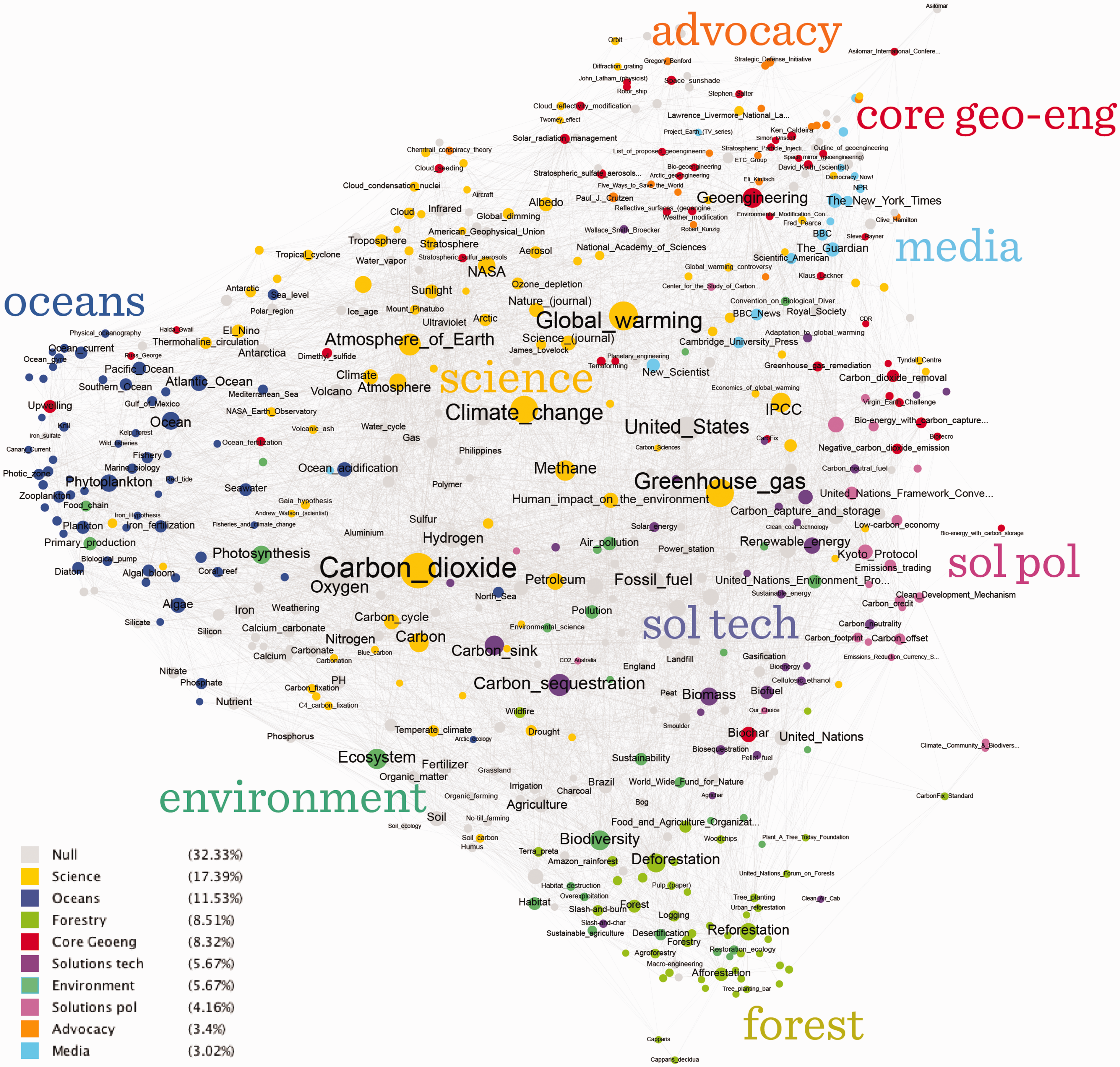
The first dataset 3 was generated to explore the boundary between geoengineering, mitigation and adaptation within the specific context of climate change. The dataset was therefore constructed to contain as many climate change related articles as possible. This was done through a combination of manual expert choice and by drawing on the category structure of Wikipedia (where editors indicate the relationship between articles in a hierarchical topic structure) through including articles in categories under the category of climate change. 4 This generated a climate change related network dataset of 1063 nodes (articles) and 6208 edges (hyperlinks).
The second dataset 5 was generated to explore whether there was any other relevant contexts to geoengineering than climate change. We therefore started by manually selecting (drawing on our expertise and acquaintance with geoengineering literature) an initial set of articles that best reflects the dominating definition of geoengineering and enumerations of geoengineering technologies in the literature. The hierarchical category structure is not suitable for this more open-ended search for contextual articles, and instead the dataset was then extended to include further articles that were closely associated (inter-linked) with the initial set. We chose articles that linked to or were linked from at least two articles in the initial set. This generated a geoengineering based network of 529 nodes (articles) and 8887 edges (hyperlinks).
Geoengineering articles in the geoengineering based network.

Note: Articles in the geoengineering based network that were deemed to be directly related to geoengineering.
Note that the networks and groups identified contain not just areas of S&T but also other categories of articles. These categories included events, companies, advocates (pro and con), etc., as discussed in the ‘Results’ section. The analysis is in this sense heterogeneous.
The analysis of the clustered topology of the networks was done mainly visually. The datasets were rendered suitable for this using the GEPHI 6 network visualisation software (Bastian and Heymann, 2009). The software draws closer the nodes representing articles that link to each other, using a so-called force-vector algorithm. In particular, we used the algorithm ForceAtlas 2, checking the option of LinLogMode option and setting gravity to zero. 7 Unlike scatter-plots or geographical representation, such techniques do not rely on a pre-existing space. The nodes are not positioned according to pre-defined coordinates, or to a category to which they are deemed to belong. Rather, the graphs define a relational space. The algorithm produces this by simulating a system of physical forces: nodes are charged with a repulsive force driving them apart, while edges introduce an attractive force bounding nodes together (Jacomy et al., 2014). Once the algorithm is launched, the nodes are displaced until the opposing forces reach a stable equilibrium. At the state of balance, therefore, the distance among the nodes is significant: the system of forces draws closer those nodes that are more directly connected and draws apart those nodes that are disconnected or more indirectly connected. The geometric distance between nodes becomes an indicator of their mutual connectivity. The different density in the node distribution is also significant: denser clusters represent groups of nodes more frequently inter-related than related to the rest of the network. 8
We can thus analyse our networks visually by interpreting the positions of the nodes and their clustering. To be sure, we could instead have based our analysis on a series of corresponding network metrics (one can observe the visual clusters or calculate ‘modularity’, observe the centrality of certain nodes or calculate their ‘closeness centrality’). We primarily used visual analysis because, given the objectives of this article, the mathematical proof of our findings is less important than the insights that the visual examination of the networks offered to us. The continuous and debatable nature of the visual analysis of our networks has great value (in line with the tradition of ‘exploratory data analysis’, Healy and Moody, 2014; Tukey, 1977). Precisely because it is questionable, it sparks questions and encourages us (and our readers) to reflect on the blurred and permeable boundaries of geoengineering.
In addition to the visual analysis, metrics describing the structure of article inter-linkage were calculated. The two metrics of ‘in-degree’ and ‘out-degree’ represent the number of incoming and outgoing links for each article. In addition, articles are assigned a high ‘page rank’ when receiving many links from other articles, especially those that also receive many links (Brin and Page, 1998). Appropriately for a study of contested categories, we also used a metric of the controversiality of individual articles to help analyse the network structure. The h-index measures the depth and breadth of editors’ discussions on the talk pages; an article has h-index N if at least N subthreads in its discussion tree reach depth N (i.e., N levels of nested replies). For a more detailed description of the metric, see Laniado et al. (2011).
In the representation of the first, climate change dataset (Figures 2 and 3), node size is proportional to the h-index of the node. While the rankings produced by h-index and in-degree tend to overlap, as the most central concepts tend to also be the more controversial, they don’t coincide fully.
9
For this article, we chose h-index instead of degree, which is usually used to represent node relevance in a network to highlight the controversiality of the articles. The geoengineering related articles have significantly smaller discussions associated, and therefore lower h-index range (as shown in Table 2), and thus this metric is less indicative in this setting. For this reason, in the second dataset (Figures 5 and 6), we chose to represent nodes with size depending on their indegree to highlight the most central articles, as is commonly done in network visualisation.
The climate change network, mapped out by meta-category, and with the geoengineering cluster circled in. Note: See a zoomable version at: www.medialab.sciences-po.fr/publications/geoengineering/figure-1 Zooming in on geoengineering in the climate change network. Articles in the separate core geoengineering group in the climate change network. Note: Articles in the climate change network that were found in the separate cluster. The articles are listed with metrics of controversiality (h-index) and connectivity (page rank). Spatialisation of the geoengineering centred network. Note: (1) ‘Science’ is here short for climate science. ‘Advocacy’ refers to individuals and organisations active in the discussion around geoengineering, and not necessarily in favour of its development or deployment. ‘Carbon capture’ refers air capture and biomass CCS. The non-categorised articles are mainly about natural phenomena, like hydrogen and erosion, but also a few fossil energy related articles. (2) See a zoomable version at: www.medialab.sciences-po.fr/publications/geoengineering/figure-2 The 69 geoengineering related articles in the geoengineering network (in Figure 6 the geoengineering articles are spatialised separately from the other articles in the geoengineering based network to visualise the separation into two sub-groups more clearly. The pattern is however found in the overall geoengineering based network as well, cf. Figure 5).



Results
Geoengineering in the climate change network
To map out the overall landscape of the first, climate change network, all the most controversial articles of the network were manually attributed to three main meta-categories (clusters): Existence/attribution (of anthropogenic climate change), Mitigation and Adaptation/consequences. A final category, General, includes articles concerning two or three of these controversies. See the network in Figures 2 and 3, and a stylised representation in Figure 4.
Stylised representation of meta-categories in the climate change network.
The geoengineering construct is found in two separate parts of the network. Some of the geoengineering articles are observable as a separate cluster (here called the ‘core group’), but the others are intermingled with other climate change topics. The core group articles have higher h-indexes, but generally much lower page ranks, supporting the interpretation of the two groups as distinct, with the core group more separated from the rest of the network and more controversial. See data in Tables 2 and 3.
The core group includes SRM, space mirrors, ocean iron fertilisation, weather modification and other specific technologies, but also the topic of ‘geoengineering’ itself. This suggests that geoengineering is constructed by the editors of Wikipedia as a cohesive and distinct thematic entity in relation to climate change, although in a way that does not simply map onto the normal definitions. The core group is closer to the existence/attribution and adaptation meta-categories than the mitigation one, and, notably, close to several articles relating to climate emergency (Hulme, 2008; Markusson et al., 2013), which helps explain its controversiality.
The second group (here called the ‘land-based sequestration group’) includes technologies like bioenergy with carbon dioxide capture and storage (BECCS), biochar, reforestation, and ‘CDR’ itself. This land-based sequestration group is neatly lined up along the boundary of the core group. On Wikipedia, the technologies of the land-based sequestration group are not independent of core geoengineering, but still more strongly associated with mitigation.
The content of the two groups is clearly heterogeneous. We can observe that there are mainly ‘fields of S&T’ in the groups. But, in addition to fields of S&T, there are Wikipedia articles on scientists and engineers working on geoengineering like Ken Caldeira, David Keith and Stephen Salter (see e.g., Nathan Myhrvold in Figure 3). The two groups also include a few organisations and companies, e.g., the environmental organisation ETC and the company Biorecro.
The geoengineering based network
The geoengineering based network tends towards a triangular shape, with geoengineering related articles forming one corner, and with oceans and forestry in the others, cf. Figure 5. We can – in a somewhat cheesy but useful manner – understand this in terms of the elements of earth, water, air and fire. The geoengineering construct is centred at the air corner, dominated by SRM type technologies. Upwelling and ocean fertilisation provide the link to and the reason for the presence of water: oceans, as a corner. Biochar and afforestation/reforestation provide the link to earth: forestry and agriculture. At the centre is the climate science category, with an atmospheric flavour towards the air corner of the triangle, and a planetary, global flavour towards the centre of the triangle. The centre includes both greenhouse gases and their constitutive elements with their biogeochemical cycles, and related policies and human actions. Here we also find the element fire, with the burning of fossil fuels and its impacts on these cycles.
The main context for geoengineering on Wikipedia is thus climate, and especially climate science, rather than, say, industry or security. There are some industrial articles though, including ones related to fossil fuelled power production, forestry and agriculture, and one article on fishery. There are also a small number of military articles, including Artillery and the Strategic Defence Initiative.
Unlike in the climate change network, there is here no separate geoengineering cluster. The centre and glue of the network is climate rather than geoengineering, even though the latter is the departure for how we collected the articles. This constitutes a de-centring of geoengineering, which reproduces the marginal position of the core geoengineering group in the climate network (cf. Figures 5 and 6).
The geoengineering construct here again has two sub-groups. It resembles the division between the core and the land-based sequestration groups observed in the climate change network, but now some outer layers of these groups have been peeled off and become relatively distant and isolated outliers. The core group still includes a broad range of techniques, relating not only to the atmosphere, space and land, but has lost its ocean-related techniques: upwelling and ocean fertilisation. The land-based sequestration group has retained techniques relating to enhanced weathering, and capture-based technologies, whereas the forestry-based sequestration technologies, including biochar, have become outliers.
Comparing the networks
We can think of the geoengineering based network as a zooming in on geoengineering – the geoengineering network has only about half as many articles as the climate network. In so doing, we have in a sense increased the topological resolution, and discovered a more fine-grained structure. What seemed like two groups earlier has now been resolved into two groups plus outliers, and in the process the profiles of the groups have changed. What is visible through this comparison is a topological layering. If we were to produce a third network, zooming in on for example capture technologies, we could perhaps discover further layering in the topology of geoengineering. This finding is coherent with the ‘nested clustering’ often observed on the Web whereby zooming in on a cluster of Web pages always reveals smaller sub-clusters. The clustering observed is not just an artefact of such increased resolution. Rather, we see a strong continuity between the two networks, which confirms the integrity of the clustering. We are also not suggesting the existence of discrete layers, but rather that with a gradual increase, or decrease, in the resolution of how we represent a networked topology, we can learn new things about the structure of the object of study. 10
Both the core geoengineering and land-based sequestration groups are heterogeneous, as in the climate change network. However, we can here see that the land-based sequestration group is more ‘material’, in the sense of being close to climate policy, mitigation technology and fossil fuelled energy industry. In contrast, the core geoengineering group is relatively ‘ideational’, in being relatively far from policy, technology and industry, but strongly linked in with climate science (and especially the atmospheric science part of this central group) as well as media and geoengineering advocacy (pro and con; here analysed as a category separate from the rest of geoengineering). Furthermore, the geoengineering advocacy articles mainly relate to the core geoengineering group, compatible with a less established, more marginal status for the core geoengineering technology than for capture-based technologies in the realm of climate change.
Discussion
The heterogeneous analysis that is possible with Wikipedia data allows us to see geoengineering as not just a scientific category. This heterogeneity also allows us to analyse the way geoengineering is situated among a range of societal institutions, including media, industry and, marginally, the military. This result thus goes some way to bringing contingency and multiple contexts back into the analysis.
The geoengineering structure found does also not respect the dominant model of classifying geoengineering technologies. The boundaries drawn on Wikipedia do not match the neat three-level hierarchy of geoengineering classification, and are instead replaced by a more complex nested topology. The zooming possible with Wikipedia data allows us to see a subtle structural layering, rather than a stark CDR-SRM dichotomy. And instead of that naturalising science-based distinction, the structure on Wikipedia seems to reflect also the political fact that land-based sequestration technologies are more established in climate policy than core (atmospheric or ocean-based) geoengineering technologies.
Articles in the land-based sequestration group intertwined with mitigation and adaptation in the climate change network.

Note: Articles in the climate change network that were found intermingled with mitigation and adaptation articles. The articles are listed with metrics of controversiality (h-index) and connectivity (page rank).
Frequency of inclusion in geoengineering appraisals compared with our core and land-based sequestration groups (in the climate change network).

The table shows a comparison of what specific geoengineering technologies Bellamy et al. (2012) found were most commonly included in appraisals with what technologies we found in the climate change network, divided in core and land-based sequestration groups.
It seems likely that this is because some of the technology communities that could be defined as geoengineering have more to gain from the association with the term than others. The relative prominence of individual geoengineering technologies on Wikipedia compared with the bibliometric study by Belter and Seidel (2013) is revealing in this respect. In the latter, ocean iron fertilisation and land-based sequestration are the most prominent categories, but in our analysis, the most prominent group is core geoengineering, which features SRM categories strongly. This supports the notion that the geoengineering category has been constructed to promote some geoengineering technologies over others. By grouping together the core technologies, which had hitherto not been seen as climate policy options (nor received much research funding), with land-based sequestration ones that had (more often), the boundary between mitigation and geoengineering was blurred in an attempt to build legitimacy for the core technologies by association with already established mitigation options. Conversely, the relatively more accepted land-based sequestration technologies are potentially undermined by the association with the core group.
Conclusions
The first of two main contributions of this article is the identification of an ambiguity between the dominating model for defining and classifying geoengineering and the tendency in representational practice to actually refer to core technologies more than land-based sequestration technologies. This analysis fills a gap in the literature with regard to how geoengineering is bounded and defined in representational practice. The identified ambiguity also matters politically, e.g., for decisions on research funding and formulation of climate policy, and for facilitating debate about geoengineering.
The second main contribution is that the article presents the first application of controversy mapping using Wikipedia data to an empirical case of S&T. This article contributes a demonstration of a new tool for the box of methods suitable for the study of controversial public representations of S&T, especially with regard to analysing boundary drawing and opening up related definitions and classifications. There is a sense in which the genre of the encyclopaedia is betrayed by the medium of hyperlinked webpages. The genre of the encyclopaedia serves well those who want to reify and naturalise geoengineering and promote a particular, decontextualised and apolitical definition and classification of its component technologies. However, the topology of the medium of interlinked webpages resists such semantic reductionism and reveals the overflow of less explicit tendencies and more fluid classifications present in representational practice. Through working analytically with this balance between genre and digital medium, we have thus been able to open up dominant definitions and classifications and make them easier to challenge in the ongoing contested construction of the notion of geoengineering.
Highlights
The geoengineering notion tends to be associated with atmospheric SRM technologies Heterogeneous and contextual analysis makes commercial and military interests visible More controversial geoengineering technologies gain most from dominant definition Wikipedia data can be used to open up dominating definitions and classifications
Footnotes
Acknowledgements
We would like to recognise the input from colleagues and the Work-In-Progress seminar at Lancaster Environment Centre, Lancaster University.
Declaration of conflicting interests
The author(s) declared no potential conflicts of interest with respect to the research, authorship, and/or publication of this article.
Funding
The author(s) disclosed receipt of the following financial support for the research, authorship, and/or publication of this article: This work has in part benefitted from funding from the European Commission: EMAPS (Electronic Maps to Assist Public Science) project, FP/SIS 288964, as well as the UK Economic and Social Research Council and the Arts and Humanities Research Council: CGG (Geoengineering Governance Research) project, ES/J007730/1.