




Abstract
Do female public servants receive a stronger negative public reaction from being involved in corruption than their male counterparts? While there are good theoretical reasons to suggest they do, the empirical evidence on this question to date, which primarily focuses on elected officials, remains inconclusive. To shed new light on this matter, we investigate a larger but hitherto understudied group: street-level bureaucrats. Using a conjoint experiment conducted in Paraguay, one of the most corrupt countries in Latin America, we evaluate public preferences for corrupt versus non-corrupt bureaucrats. Contrary to existing theories of gender and corruption, our results suggest there is no significant difference in how citizens react to male and female corrupt bureaucrats.
Introduction
Bribe requests are very common when citizens in the Global South need to conduct a government transaction. Globally, one in four people pay a bribe each year to access a public service (Pring, 2017). Other forms of petty corruption in the bureaucracy are also endemic. This paper builds on a growing literature on the interplay between gender and corruption in government (for a review, see Alexander, 2021) to assess whether gender stereotypes play a role in public perceptions of corrupt street-level public servants. Are female bureaucrats in the developing world subject to harsher evaluations than their male counterparts when they engage in similar forms of petty corruption?
The conventional expectation of the gender and politics literature is that women should suffer a stronger backlash from being involved in corruption because corrupt behavior contradicts prevailing stereotypes of women (Alexander and Andersen, 1993; Barnes and Beaulieu, 2014). Given that women in politics and public service tend to be perceived as more honest than men, any behavior that deviates from this stereotypical preconception should trigger a strong negative public reaction (Batista Pereira, 2021). However, prior research on this question has yielded mixed results. While some observational studies suggest that women are punished more harshly for corruption than men (Carlin et al., 2020; Dulani et al., 2021; Reyes-Housholder, 2020), experimental studies have produced weak and inconsistent evidence of a gender gap in evaluations of corrupt politicians (Batista Pereira, 2021; Eggers et al., 2018; Klašnja et al., 2021; Schwindt-Bayer et al., 2018).
We revisit this question by focusing on petty corruption among street-level bureaucrats. We focus on bureaucrats in service delivery positions for two reasons. First, exploring how citizens evaluate women in frontline public service positions can advance our understanding of citizen attitudes toward gender roles. A better grasp of gender stereotypes and the extent to which women and men are evaluated equally can inform strategies to promote gender equality in public service and beyond. Second, studying public perceptions of women in the bureaucracy can provide insights into gender dynamics that occur during interactions between the state and society. If women in public service are subjected to a different standard than their male counterparts, this could explain why women choose career paths that keep them away from politics and the public sector. Documenting the double standards faced by women in the bureaucracy is important because public administration often serves as a steppingstone to political positions.
To study public perceptions of women bureaucrats, we designed a conjoint experiment and embedded it in an online survey of 3,107 Paraguayan respondents. Survey participants evaluated five pairs of bureaucrats that differ on key attributes such as their gender and their record of engaging in different forms of corruption. We asked which one they would prefer to encounter when visiting the Civil Registry, which allows us to estimate the interacted effect of gender and corruption when assessing public servants. Our findings reveal a similar-sized decline in preferences for corrupt women and men bureaucrats when compared with non-corrupt officials. These results are important because they illustrate that existing theories of gender and corruption might not apply well to cases of systemic corruption, where citizens do not evaluate corrupt public officials (or politicians, as previous evidence has shown) based on their gender. Given that corruption and bribery are widespread in the Global South, it is relevant to better understand how people evaluate public officials in such contexts.
Gender, bureaucracy, and corruption
Women are stereotypically perceived as more ethical, honest, and trustworthy than men. Previous studies have found that women are used as anti-corruption symbols in public office (Armstrong et al., 2022). This seemingly benevolent stereotype of women as honest or incorruptible explains why they are seen as a cleaning force in government (Barnes and Beaulieu, 2014; Batista Pereira, 2021). Prior research has established a correlation between women’s representation in government and reduced perceptions of corruption (Bauhr and Charron, 2021; Dollar et al., 2001; Esarey and Schwindt-Bayer, 2017).
When citizens are given no additional information to update their priors, they might perceive female bureaucrats as more honest (and therefore less likely to accept bribes) than male bureaucrats. Since women are expected to be less corrupt and more ethical, they may face greater public scrutiny. The conventional expectation in the gender and politics literature is, therefore, that female public servants should suffer a stronger backlash when they engage in corruption because corrupt behavior is counter-stereotypical (Alexander and Andersen, 1993; Barnes and Beaulieu, 2014). In other words, because women in politics and public service tend to be perceived as more honest than men, any behavior that violates those stereotypical preconceptions should result in a strong negative public reaction (Batista Pereira, 2021).
Conversely, male stereotypes may not prioritize similar virtues or may associate masculinity with assertiveness or competitiveness rather than honesty. For example, men are characterized as more agentic and competent than women (Eagly and Steffen, 1984) and are often observed from a young age in high-responsibility roles that are agentically demanding (Sczesny et al., 2018). Therefore, male bureaucrats should not be held to the same high standards of integrity as female bureaucrats. They are not expected to be particularly honest, and citizens may assume male bureaucrats will be more corrupt than their female counterparts. We might, therefore, observe a sharper decline in citizens’ preference for a female (vs. a male) bureaucrat who engages in petty corruption because corruption is counter-stereotypical and violates public expectations of how women should behave in the civil service. This leads us to our first hypothesis.
There is a sharper decline in preferences for a corrupt public servant when the bureaucrat is a woman.
However, it is also possible that the public evaluates the corrupt behavior of all bureaucrats in the same way, regardless of gender, for two reasons. First, people associate women with integrity, but these gender stereotypes may not apply to individuals in the public service. Research shows that gender stereotypes are only activated under very specific circumstances, which can explain why women’s and men’s suitability for public office are not always evaluated differently (Bauer, 2015). Previous studies in the public administration literature suggest that the female stereotype of honesty is not particularly salient in the bureaucratic arena. Goetz (2007: 87) describes the belief that women bureaucrats are less corrupt than men as a myth “grounded in essentialist notions of women’s higher moral nature.” In their review of six laboratory corruption experiments, Frank et al. (2011: 68) indeed conclude that “women are not necessarily more intrinsically honest or averse to corruption than men.” When bureaucratic corruption is generalized, and the risk of detection is low, female public servants are not averse to extorting bribes for access to public services (Alhassan-Alolo, 2007; Jewkes et al., 1998).
Stensöta et al. (2015) similarly demonstrate that the share of women in state administration is not significantly related to the extent of corruption in 30 European countries. They argue that the link between female representation and corruption is weaker in the administrative than in the legislative arena because “the bureaucratic administrative logic absorbs actors’ personal characteristics” (Stensöta et al., 2015: 475). The standard procedures and values of the bureaucracy constrain public servants’ behavior and lead to a “de-gendering” of the experiences acquired prior to joining the state administration. In contexts where corruption among street-level bureaucrats is endemic (as is the case in most countries in the Global South), conforming to bureaucratic norms might lead men and women to participate equally in corrupt transactions. As a result, citizens might not perceive female public servants as cleaner and more law-abiding. Brierley and Pereira (2023) present experimental evidence that citizens in Ghana do not expect women bureaucrats to be less likely to solicit bribes than men. 1 If women bureaucrats are perceived as equally corrupt, gender stereotypes will be less prevalent and female bureaucrats might not be held to higher ethical standards than men.
Second, even in the context of electoral politics, where gender stereotypes should be more prevalent, prior findings are decidedly mixed. While some observational studies suggest that women are punished more harshly for corruption (Carlin et al., 2020; Dulani et al., 2021), experimental studies present much more mixed findings and overall weaker evidence of a gender gap in evaluations of corrupt politicians. Two studies find no differences in the way female and male politicians are punished for corruption (Klašnja et al., 2021; Schwindt-Bayer et al., 2018). Eggers et al. (2018) similarly show that citizens on average sanction corruption similarly among female and male politicians, although they find that female voters punish corrupt female politicians slightly more than corrupt male politicians. While interesting, that finding has not yet been replicated in other studies and remains undertheorized. Other works find that voters punish corrupt female candidates less, but only in some countries. For example, Batista Pereira (2021) detected a difference in backlash against corruption between male and female politicians in Mexico, but not in Brazil. He concludes that country-level factors such as exposure to corrupt female leadership could have attenuated benevolent female stereotypes in Brazil. Le Foulon and Reyes-Householder (2021) conclude that voters evaluate female and male candidates differently in Uruguay but not in Chile or Argentina. They similarly argue that country-level conditions, especially the “particular history of corruption scandals involving women in political office” in Chile and Argentina could explain the null results in those countries. Prior studies, therefore, hint at the possibility that widespread corruption, and women’s well-known involvement in such practices, could undermine positive views about them, attenuating the effect of gender stereotypes that could lead to a differential treatment.
It might therefore be the case that in contexts where corruption is generalized, citizens react in a similar way against all corrupt officials, regardless of gender. In light of this accumulated evidence, we are interested in evaluating whether this null finding is replicated in a different echelon of the state administration—street-level bureaucrats.
(null)There is NOT a sharper decline in preferences for a corrupt public servant when the bureaucrat is a woman: the decline is the same for men and women.
The case of Paraguay
To test these two competing hypotheses, we conducted a conjoint experiment in corruption-prone Paraguay, a country that can offer insights into citizen attitudes toward petty corruption in the Global South. 2 While Stroessner’s dictatorship, which institutionalized corruption in Paraguay, ended 40 years ago, informal patron–client relations continue to shape public administration (Schuster, 2021). The case of Paraguay also illustrates the challenges of eradicating bureaucratic corruption that endures despite civil service reforms (Schuster, 2014). We expect our results to generalize to other Global South cases with similar problems of endemic bureaucratic corruption.
Additionally, Paraguay presents a compelling case for examining gender attitudes toward public officials. As many Latin American countries, Paraguay has seen significant progress in women’s representation within the civil service. However, women in Paraguay are still underrepresented in the highest ranks of public administration, as they are in other Global South countries (UN Women, 2023, UNDP, 2021). Women’s working conditions deteriorated during the pandemic, widening the wage and unemployment gaps (Bordon et al., 2022). Paraguayan women are also unrepresented in the political arena, especially in high-level positions like the national legislature (Echauri and Gimenez, 2022). The prevailing sentiment suggests that Paraguayan society questions women’s competence for public service roles (Zub Centeno, 2021). The country thus represents a paradigmatic example of the challenges that women encounter in public life. Studying women bureaucrats in Paraguay can therefore help us understand these barriers and inform strategies to encourage women to pursue careers in public administration and improve women’s working conditions in the public sector.
Design
In July–August 2021, we fielded an online survey with a conjoint experiment in Paraguay administered by Offerwise, a market research firm with extensive experience in the region. Survey participants were invited by email, and we relied on age, gender, and education quotas to construct a sample that is as representative as possible of the country’s population. Our sample contained 3,107 respondents over 18 years old from diverse backgrounds. The survey did not rely on any type of deception; respondents’ identities were confidential, and the study received Institutional Review Board approval. 3
At the end of the questionnaire, we included a conjoint experiment in which we asked respondents to evaluate hypothetical bureaucrats working in the civil registry. In a conjoint experiment, respondents evaluate different profiles, each containing different attributes. These profiles are randomly generated, which allows us to learn the effect of the attributes on how respondents evaluate the profiles. Conjoint experiments mimic real-world decisions when people simultaneously observe and evaluate multiple attributes. Conjoint analyses have been used extensively to evaluate people’s multidimensional preferences while limiting social desirability bias (Hainmueller et al., 2014). Prior research comparing the results of conjoint and behavioral benchmarks has shown that these types of survey experiments have high external validity even when respondents are evaluating hypothetical scenarios (Hainmueller et al., 2015).
Hypothetical comparison of two randomly generated public officials.
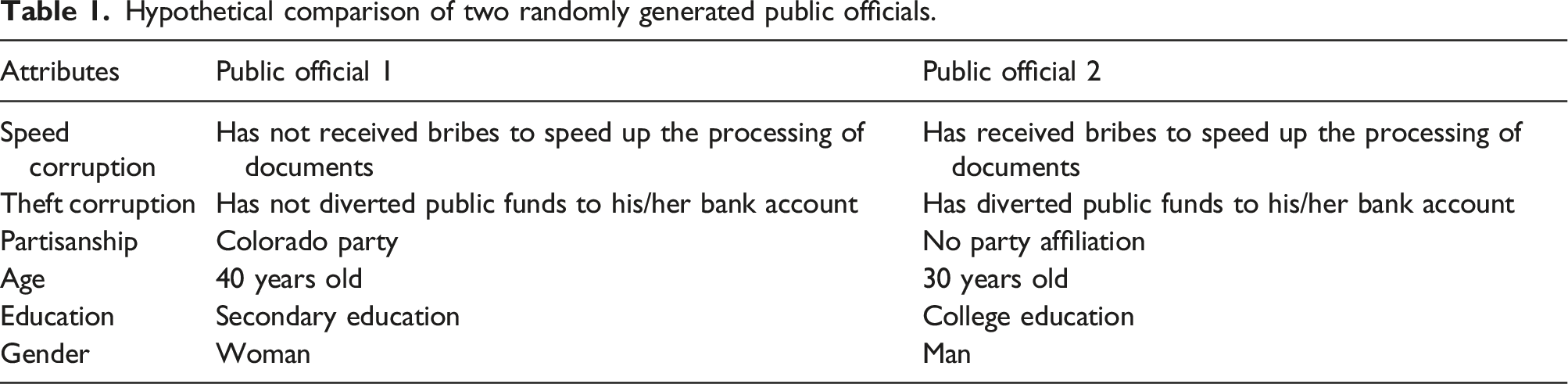
We asked respondents, “Which of these public officials would you prefer to see you when you visit the Civil Registry?” 4 The Paraguayan Civil Registry issues birth, marriage, and death certificates, and it is a typical example of a bureaucratic institution in which corruption is common. We compute the AMCE (average marginal component effect), which is the average difference in the probability of being preferred between two attribute values (Hainmueller et al., 2014), for the attributes of interest.
Results
Figure 1 depicts the effect of both types of corruption on the evaluation of men and women public officials. The third panel reports the difference between genders. The dots indicate point estimates and the lines 95% confidence intervals. The reference categories (dots without a confidence interval) are non-corrupt public officials. Citizens’ evaluation of speed and theft corruption by bureaucrat gender. 31,070 profiles evaluated by 3,107 respondents. Full results in table format are available in Appendix C.
The first panel indicates that citizens are 19 percentage points less likely to prefer a male public official who has accepted bribes compared to a clean official (95% CI: [−0.206, −0.176]). Respondents were 31 percentage points less likely to prefer officials involved in theft corruption relative to clean bureaucrats (95% CI: [−0.326, −0.295]). The results for female officials in the second panel are nearly identical: 19 and 31 percentage points, respectively; the 95% CIs are marginally different [−0.204, −0.173] and [−0.326, −0.295], respectively.
The third panel confirms that there is no significant distinction between female and male bureaucrats. For bribes, the point estimate for the difference is 0.003 (95% CI: [−0.018, 0.023]), and for diverting funds it is 0.000 (95% CI: [−0.021, 0.21]). For both types of corruption, the decline in preferences is similar for women and men bureaucrats. This evidence provides support for hypothesis 2, showing that there is no distinction between women and men bureaucrats.
We implement three robustness checks in the supplemental appendix. First, we use representative matching (Visconti and Zubizarreta, 2018; Kuffuor et al., 2022) to construct a matched sample that looks similar to the Paraguayan population using the 2018 Paraguayan Household Survey as a benchmark. Second, we use two alternative outcomes that assess how people evaluate public officials: “Which of these public officials should be promoted to a higher position in the Civil Registry?” and “Which of these public officials should represent Paraguay in an international conference of public officials?” The study’s conclusions do not change when using these alternative outcomes to measure people’s preferences for bureaucrats. In a third robustness check, we evaluate whether there are differences by respondents’ gender. These results indicate almost identical preferences between women and men respondents. Thus, we have no evidence that women and men respondents evaluate women and men public officials differently.
Discussion and conclusion
Prior work suggests there is a strong norm against corruption in the Global South (Boas et al., 2019; Carreras et al., Forthcoming). In survey experiments, citizens strongly reject politicians who engage in corruption (Klašnja and Tucker, 2013; Vera, 2020; Weitz-Shapiro and Winters, 2017). This anti-corruption norm appears to be so strong that it diminishes the impact of gender stereotypes on evaluations of bureaucrats. Previous research has established that Latin Americans widely reject corrupt politicians, regardless of their gender (Batista Pereira, 2021; Klašnja et al., 2021; Schwindt-Bayer et al., 2018). Our experimental results suggest this is also the case for street-level bureaucrats. Citizens are less likely to prefer a corrupt bureaucrat, and the magnitude of this effect is very similar for female and male bureaucrats.
Our findings track closely with those of other experimental studies that have reported weak and inconsistent evidence of a gender gap in evaluations of corrupt politicians (Batista Pereira, 2021; Eggers et al., 2018; Klašnja et al., 2021; Schwindt-Bayer et al., 2018). Yet the results remain puzzling because they are inconsistent with conventional expectations of the gender and politics literature, as well as a number of observational findings that report more negative reactions against corrupt female officials (Carlin et al., 2020; Dulani et al., 2021; Reyes-Housholder, 2020).
We can only speculate as to why this is the case. One possibility is that in contexts where corruption is very widespread, the (benevolent) gender stereotype that women are more honest is eroded. If corruption is generalized, citizens might not believe women are less likely to accept bribes or steal from public coffers. Similarly, they might not believe that honest female bureaucrats will remain uncorrupted. Lacking that prior expectation, citizens will not necessarily react more negatively to corrupt women. A recent study conducted in Ghana shows that people do not expect women in the bureaucracy to be less corrupt (Brierley and Pereira, 2023), which lends credence to this possibility. Other studies conducted in Latin American countries have also speculated that salient cases of corruption by female politicians and the perception of generalized corruption in the political arena might deactivate gender stereotypes and lead to a similar backlash against corruption (Batista Pereira, 2021; Le Foulon and Reyes-Householder, 2021). This body of evidence suggests that in Global South countries where corruption is widespread, citizens react in a similar (negative) way to all instances of corruption regardless of the perpetrator’s gender.
Another plausible explanation for the disconnect between the theory and empirical findings is that the survey experiments that report null interactions between gender and corruption (including ours) might fail to capture important social or political dynamics that activate gender stereotypes in the “real” world. In a survey experiment, the corruption treatment might “drown” the effect of gender stereotypes and lead to equal backlash against male and female public servants in this controlled environment. Outside of the experimental setting, interpersonal discussions might increase the salience of gender stereotypes and lead to a stronger negative reaction to corrupt women in the bureaucracy or the political arena. In other words, people might speak differently about their encounters with corrupt public servants depending on the gender of the street-level bureaucrat. These social interactions can lead to biased evaluations of bureaucrats and more negative perceptions of corrupt female officials. In cases of high-level corruption, media framing might also make gender stereotypes salient and lead to stronger sanctions against female politicians (Eggers et al., 2018). Hypothetical survey experiments might not detect these subtle, more systemic forms of discrimination. Future research should continue to investigate the factors that contribute to (or deter) gender bias in evaluations of public servants and affect how citizens react to corrupt female public servants.
Supplemental Material
Supplemental Material - Gender stereotypes and petty corruption among street-level bureaucrats: Evidence from a conjoint experiment
Supplemental Material for Gender stereotypes and petty corruption among street-level bureaucrats: Evidence from a conjoint experiment in Miguel Carreras, Sofia Vera, and Giancarlo Visconti in Research & Politics
Supplemental Material
Supplemental Material - Gender stereotypes and petty corruption among street-level bureaucrats: Evidence from a conjoint experiment
Supplemental Material for Gender stereotypes and petty corruption among street-level bureaucrats: Evidence from a conjoint experiment in Miguel Carreras, Sofia Vera, and Giancarlo Visconti in Research & Politics
Footnotes
Acknowledgments
We thank Nara Pavão and seminar participants at APSA for valuable comments and suggestions.
Declaration of conflicting interests
The author(s) declared no potential conflicts of interest with respect to the research, authorship, and/or publication of this article.
Funding
The author(s) disclosed receipt of the following financial support for the research, authorship, and/or publication of this article: This project was funded by a grant provided by the National Council of Science and Technology of Paraguay (CONACYT).
Carnegie Corporation of New York Grant
This publication was made possible (in part) by a grant from the Carnegie Corporation of New York. The statements made and views expressed are solely the responsibility of the author.

Supplemental Material
Supplemental material for this article is available online.
The replication files are available at: https://dataverse.harvard.edu/dataset.xhtml?persistentId=doi:10.7910/DVN/MGAQDT&version
Notes
References
Supplementary Material
Please find the following supplemental material available below.
For Open Access articles published under a Creative Commons License, all supplemental material carries the same license as the article it is associated with.
For non-Open Access articles published, all supplemental material carries a non-exclusive license, and permission requests for re-use of supplemental material or any part of supplemental material shall be sent directly to the copyright owner as specified in the copyright notice associated with the article.
