




Abstract
More women in public institutions are correlated with lower levels of corruption. However, this relationship is thought to be context specific, and the mechanisms that underlie it remain unclear. We conduct two survey experiments to investigate whether and why end-users expect women bureaucrats to be less corrupt in Ghana. Our results show that citizens do not expect women bureaucrats to be less likely to solicit bribes than men. This result holds across bureaucrats with different levels of experience in the public sector and respondents who have and have not paid a bribe. Our second experiment shows that citizens expect men and women bureaucrats to distribute equal shares of their salaries with their extended families. We argue that equality in financial pressures explains why bribe-taking rates may be similar across genders. Our results cast doubt on the idea that women bureaucrats will reduce petty corruption in countries where corruption is pervasive.
Introduction
One in four service users pays a bribe each year globally, with higher rates among the poor (Fried et al., 2010) and urbanites (Pring, 2017; Seligson, 2006). Some policymakers believe that increasing women’s representation in bureaucracies is key to reducing petty corruption. Prior studies suggest that women have inherent or socially induced traits that make them more law-abiding than men and thus less likely to condone or engage in corruption (Dollar et al., 2001; Esarey and Schwindt-Bayer, 2018). Women’s lower rates of involvement in corruption may also result from relatively fewer opportunities to join existing networks (Bjarnegård, 2013; Goetz, 2007), or be an artifact of gender stereotypes that characterize women as more honest and trustworthy (Barnes and Beaulieu, 2014).
However, it remains unclear whether increased women’s representation—beneficial for other reasons—will lower rates of petty corruption in the contexts where such a reduction would be most beneficial. Indeed, observational evidence suggests that the protective role of women officials, whether as politicians (Bauhr et al., 2019; Dollar et al., 2001; Esarey and Schwindt-Bayer, 2018) or bureaucrats (Alhassan-Alolo, 2007; Swamy et al., 2001) is confined to high-income democracies (Pereira and Fernandez-Vazquez, 2022; Sung, 2003). Despite the importance of understanding the relationship between gender and corruption, we have little experimental evidence on this topic in developing countries, especially outside of a laboratory setting. Furthermore, the mechanism that drives the relationship between gender and corruption within bureaucracies continues to be unclear.
Our study has two main goals. First, we assess the claim that citizens expect women bureaucrats to be less likely to extract bribes than their male counterparts. We do so in the context of Ghana, where corruption is understudied despite being a central obstacle to development (Gyimah-Boadi, 2015). Second, we investigate potential mechanisms that may explain a relationship (positive or negative) between gender and corruption. We focus on three mechanisms: (1) women are expected to have inherent or socially induced traits that make them less corrupt, (2) women are expected to be less corrupt because they have fewer opportunities to engage in corruption, and (3) women are expected to be less corrupt because they face less external financial pressure to support their extended families or kinship groups. Social pressure to donate to group members is a well-established source of bureaucratic corruption in developing countries (Ekeh, 1975; Price, 1975).
To measure corruption, we rely on end-users’ expectations of bureaucrats’ behavior. As our data shows, these perceptions are often based on respondents’ personal experience with bribes: one-third of the citizens we sampled had paid a bribe in the last 12 months. Alternative ways to measure petty corruption include using bureaucrats’ self-reports or secretly recording bureaucrats while they work. Our concern with using surveys with bureaucrats (rather than end-users) was the potential for gendered survey response bias. Such bias would make any potential differences between men and women bureaucrats difficult to interpret. The ethical implications of recording bureaucrats without their permission prohibited us from using this strategy. Importantly, in our analysis, we show that the results are robust to only including respondents with experiences of bribe-taking.
We embedded two original studies—an audio experiment and a vignette experiment—into a survey of citizens in Ghana. Ghana has high rates of petty corruption. In the audio experiment, respondents heard an exchange between a service user renewing their driving license and a bureaucrat. We randomized the gender of the bureaucrat and the length of time they have worked in the public sector. Varying the gender of the bureaucrat allows us to assess the hypothesis that women bureaucrats are perceived as less corrupt than men bureaucrats. Varying the length of time the bureaucrat has worked at the driving license office allows us to assess the role of opportunities on corruption. We use time in office to proxy for potential opportunities to join corrupt internal networks. Finally, we use a vignette experiment to assess the role of gendered financial expectations. Randomizing the gender of bureaucrats, we ask respondents what share of the public official’s monthly salary they would expect them to donate to their extended family.
In the full sample, a majority of respondents expect that the bureaucrat will ask for a bribe. We find no overall differences in respondents’ expectations of bribe-solicitation across men and women bureaucrats. We also find no evidence that respondents expect men or women bureaucrats who have worked longer in the public sector to be more likely to solicit a bribe. These results hold for the full sample and for the subset of respondents who have direct experience paying bribes.
The results from our second experiment reveal no gender differences in financial expectations. We use these results to explain the null findings in the audio experiment. We argue that a key explanation for why women bureaucrats might be likely to solicit bribes at the same rates as men is because they face the same level of external pressure to contribute to their extended families.
Our results make two significant contributions to the study of corruption. First, we join a handful of studies that employ experimental methods to study petty corruption. This literature has assessed which citizen attributes or behaviors make them more likely to become victims of bribery (Fried et al., 2010; Robinson and Brigitte Seim, 2018), as well as characteristics of the bribe (Klašnja et al., 2020) and bribe environment (Armantier and Boly, 2011). To our knowledge, our study is the first to randomly manipulate bureaucrats’ individual characteristics to assess bribe-solicitation expectations. Second, our focus on mechanisms contributes to the study of gender and corruption. We explain the symmetry in bribe-solicitation rates between men and women in this context with reference to the equality in the social pressures faced by bureaucrats.
Theory: Gender and corruption
The presence of more women in public office has been associated with lower levels of corruption (Bauhr et al., 2019; Dollar et al., 2001; Swamy et al., 2001), particularly in high-accountability contexts (Esarey and Schwindt-Bayer, 2018). This relationship is not explained by social and economic development, civic freedom, ethnic fractionalization, or education levels. Two dominant explanations for this relationship are gender differences in risk aversion and access to corruption networks.
Behavioral research shows that women tend to be more risk averse than men (Croson and Gneezy, 2009; Eckel and Grossman, 2008; Seguino et al., 1996). Accordingly, women officials may be less likely to engage in corruption due to the risks of being caught or punished (Esarey and Schwindt-Bayer, 2018). Consistent with this argument, Rivas (2013) shows that women laboratory subjects who play the role of a public official are less likely to accept bribes than men counterparts. Considering perceptions, Barnes and Beaulieu (2019) find that voters perceive women politicians as more risk averse. Further, Barnes et al. (2018) show that respondents who are told that women are more risk averse believe that hiring more women in the public sector will reduce corruption. However, differences in risk aversion across genders are less relevant in contexts where detection and punishment levels are rare.
Differential risk aversion implies a causal effect between gender and misconduct in public office. To assess the extent to which gender alone determines public officials’ behavior and related perceptions of citizens, our first hypothesis is that citizens will expect women bureaucrats to be less corrupt than men bureaucrats (H1).
The negative relationship between women participation and corruption has also been explained by opportunities: differential access to corrupt networks (Alhassan-Alolo, 2007; Bauhr and Charron, 2021; Bjarnegård, 2013; Goetz, 2007). Joining or developing a network of accomplices takes time, and there is evidence that public officials become more corrupt the longer they spend in office (Klašnja, 2015, but see Pereira and Fernandez-Vazquez (2022)). Because women often constitute a minority in public institutions, they may find it challenging to penetrate established corrupt systems. If gender mediates opportunities for corruption, then women, on average, will engage in fewer corrupt practices than men (Goetz, 2007). This argument implies that citizens perceive more experienced public officials—those with greater exposure to corrupt networks—as more likely to engage in corruption, relative to newcomers. However, it could be the case that to engage in petty corruption bureaucrats do not need to be part of a network, especially in contexts of endemic corruption (Esarey and Schwindt-Bayer, 2018). In this case, we may not see a relationship between experience and corruption. To assess the role of opportunities, we hypothesize that citizens will expect experienced bureaucrats to be more corrupt than their less experienced counterparts (H2).
A less explored mechanism that may also explain a negative relationship between women bureaucratic presence and corruption is differential pressures that men and women face to provide for their kinship groups. Well-educated members of kinship groups often experience positive and negative social pressures to supply benefits—often financial—to group members (Ekeh, 1975; Price, 1975). Bureaucrats who provide financial assistance often enjoy increased prestige within the group (Bates, 1974), while those who do not may be socially ostracized. Social expectations exert significant pressures on bureaucrats (Alhassan-Alolo, 2007).
If group pressures incentivize corruption, then any difference between genders in the extent of social pressure may also affect individual bureaucrats’ propensity to engage in corrupt practices. For example, in male-dominant societies, men bureaucrats may face more pressure to distribute more or higher-value benefits than women bureaucrats. If this is the case, citizens may expect men to be more corrupt than women in the same position. To test this mechanism, our third hypothesis is that citizens expect men bureaucrats to face greater financial pressure to provide for kinship groups than women bureaucrats (H3).
Gender, corruption, and bureaucracy in Ghana
To examine the impact of bureaucrats’ gender on perceptions of petty corruption, we conduct two survey experiments in Ghana. Like in many developing countries, both grand and petty corruption remains endemic. Ghanaians’ main experiences with corruption occur through their everyday interactions with street-level bureaucrats. Ghana ranks above the continental average in terms of the share of citizens who pay bribes: one-third of citizens paid a bribe to access public services in 2019 (Pring and Vrushi, 2019). Petty corruption remains high in Ghana partly because of the unreliable administration of public services (Gyimah-Boadi, 2008). Solicitation of bribes is common when accessing a range of public services, including during encounters with police (53% of users), to obtain IDs (38%), or public utilities (35%) (Pring and Vrushi, 2019). In this study, we focus on citizens being asked for bribes when renewing a driving license (one form of ID). We selected the driving license authority as a representative agency, similar to other ID or public utility offices, where end-users interact with bureaucrats, and where petty corruption is common. We expect the results to generalize to similar public agencies.
In terms of end-user experiences with women bureaucrats, the majority of women in Ghana (68%) participate in the labor market, and over half of service sector workers are women. 1 While more men than women work in the country’s driving license body, women constitute a significant minority. The same is true in other public sector organizations; for example, 27% of police traffic officers are women (Harris et al., 2022).
Sample, measurement, and experimental design
To test our hypotheses, we constructed a random sample of 1268 citizens and conducted a face-to-face survey in three southern regions of Ghana: Greater Accra, Central, and Eastern. We stratified districts to ensure a mix of respondents living in urban and rural communities. Within districts, we randomly sampled polling stations (N = 139), from which we began a random-walk strategy to identify households before randomly selecting respondents. Our sample is representative of the sampled regions and broadly representative of the country. 2 Randomization was performed by the survey software. The balance tests in Appendix Section 2 demonstrate that the randomization process was successful.
Audio experiment: Officials’ gender, experience, and bribery
In the audio experiment, we manipulated two variables. First, we varied the gender of the public official. Second, we randomized the bureaucrat’s years of experience. The result is a 2 × 2 full factorial design. We cued the bureaucrat’s gender through their name and voice. 3 To signal experience, we indicated how long they had worked at the institution. High-experience bureaucrats said they had worked in the agency for 12 years. 4 This information was included in a 40-second conversation between a bureaucrat working at the country’s driving license authority and a citizen renewing their driving license. Respondents heard the conversation in their preferred language: English or Akan. 5 Respondents wore headphones to reduce potential response bias.
The audio design has three advantages relative to text-based survey experiments. First, it allowed us to more accurately recreate the type of interactions that usually take place in public agencies, using separate voices for the citizen and the bureaucrat providing the service. Second, the audio intervention facilitates comprehension, relative to text (Vadas et al., 2006). This is particularly relevant in settings where literacy rates are low. Third, the audio recording provides a subtle way to cue the bureaucrat’s gender, reducing the risks of social desirability bias or demand effects.
Measuring corruption
We measure bureaucratic engagement in petty corruption using responses from citizens—end-users of public services. Specifically, after listening to the audio, enumerators asked respondents how likely they thought it was that the civil servant would solicit a bribe. Responses were recorded on a 7-point Likert scale. Our measurement approach relies on citizens being reliable sources of information on bureaucratic bribe-taking. Citizen surveys are widely used to measure corruption and can provide a more objective measure of corruption compared to expert-based perceptions (Treisman, 2007). 6 Citizens are particularly well suited to measuring petty corruption because of their direct experiences paying bribes. Our survey shows that one-third of our respondents had paid a bribe in the last year. 7
Alternative ways to measure corruption include using bureaucrats’ self-reports or secretly recording bureaucrats while they work. These two methods present methodological and ethical challenges. Considering the former, corruption has been shown to be a sensitive topic and subject to under-reporting (Agerberg, 2020). Bureaucrats have strong incentives to deny individual engagement with corruption. Our concern was that response bias might be gendered, which would invalidate the measure. In turn, secret recordings may risk bureaucrats losing their jobs. To avoid these issues, we used direct questions of end-users, and took steps to reduce response bias.
Vignette experiment: Gender and financial pressures on bureaucrats
In the vignette experiment, we randomly varied the bureaucrat’s gender and asked respondents how much of the public servant’s monthly salary they should give to their extended family each month. The vignettes included identical information across the two treatment conditions regarding experience in office, salary, and a description of current tasks. To mirror the audio experiment, in all cases, the bureaucrat worked at the driving license office. After reading the vignette, we asked respondents what contribution they thought was reasonable. We convert this amount into the share of the bureaucrat’s monthly salary.
Results
The first hypothesis predicts that women bureaucrats are perceived as less corrupt than men. The top estimate in Figure 1 shows the average treatment effect of the bureaucrat’s gender in the audio experiment.
8
The results do not provide evidence that citizens expect women bureaucrats to behave differently from their men counterparts. Although the results show that women bureaucrats are expected to be slightly less likely than men to solicit a bribe, the difference is substantively small and indistinguishable from zero (−0.12 on a seven point scale; SE = 0.09).
9
The causal effects of (a) gender and (b) years of experience on petty corruption. Note: Points indicate the average treatment effect of official’s gender (top) and experience (bottom) on the perceived likelihood that the bureaucrat will ask for a bribe according. Wider/thinner bars are 90/95% confidence intervals from linear regressions, with each treatment as the predictor. Table OA.5 presents the full model results.
In short, our data shows that citizens expect similar behavior from men and women bureaucrats. We re-estimate this effect among respondents with direct experience of paying bribes. Respondents who recently paid a bribe may be more likely to base responses on actual experiences and to rely less on any gender stereotypes. Our results are robust to this analysis. 10
To assess our second hypothesis, we first pool the treatment conditions by level of experience in office, irrespective of gender. The causal effect of experience is shown in the bottom estimate in Figure 1. According to the opportunities hypothesis, officials who have been in office longer should be perceived to be more likely to engage in corruption. On average, respondents perceive bureaucrats with high-experience levels (12 years) to be slightly more likely to solicit a bribe than less experienced bureaucrats. However, this difference is substantively small and indistinguishable from zero (0.14; SE = 0.91).
We also assess the second hypothesis by comparing perceived rates of corruption between women and men with average levels of experience and high levels of experience. Figure 2 displays these results. We do not find evidence that women with less experience in the public sector are less likely to take bribes than similarly placed men (difference in means = −0.07; SE = 0.14). Likewise, we find no evidence that experienced male bureaucrats are more likely to take bribes than experienced female bureaucrats (difference in means = −0.16; SE = 0.12). Overall, this result suggests that women are just as able as men to navigate corrupt networks, and suggest that it does not take bureaucrats of either gender too long to do so.
11
Again, our results are robust to subsetting to respondents with direct experience with petty corruption.
12
The causal effects of gender among bureaucrats with different levels of experience. Note: Points indicate the average treatment effect of gender when officials have average experience (top) and 12 years of experience (bottom) on the perceived likelihood that the bureaucrat will ask for a bribe according. Wider/thinner bars are 90/95% confidence intervals from linear regressions, with each treatment as the predictor. Table OA.6 presents the full model results.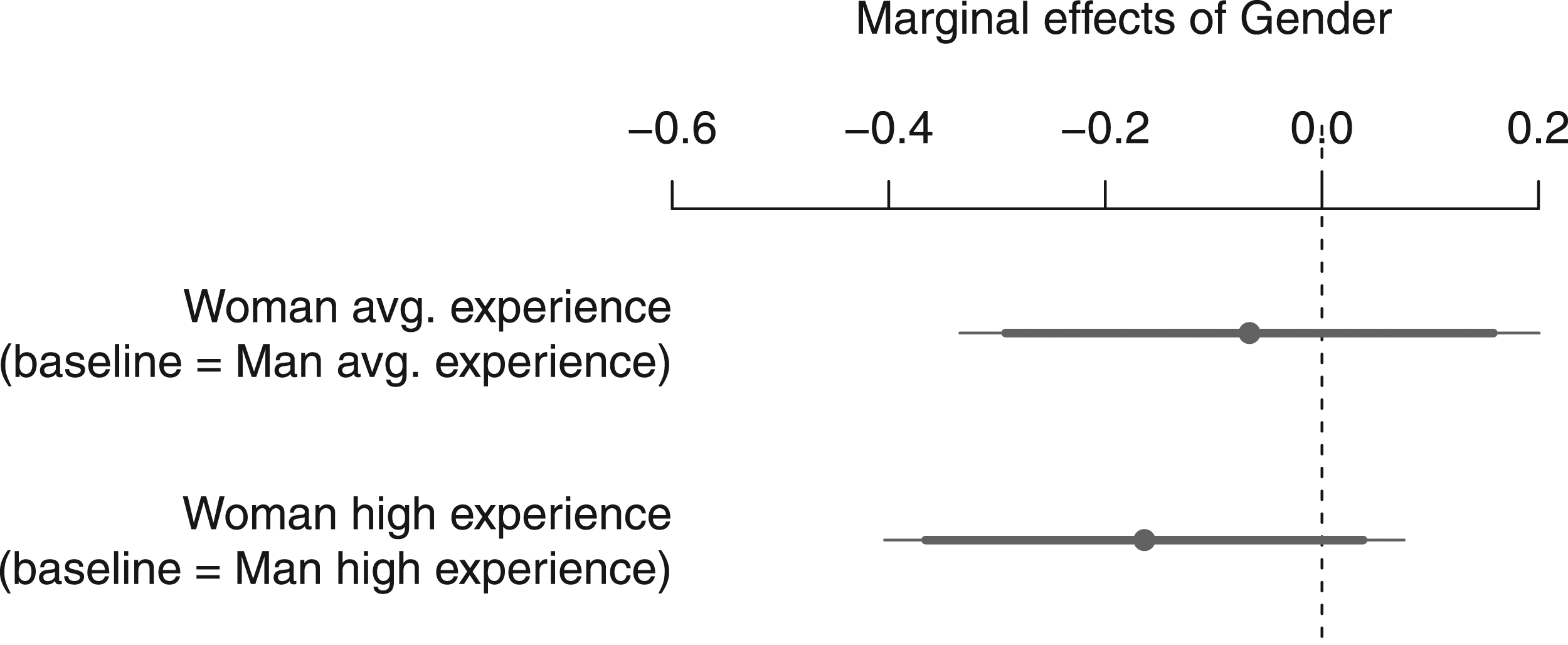
Results from the vignette experiment
The final mechanism we assess is whether men bureaucrats face higher financial pressure to provide for kinship groups than women bureaucrats. The results show that our respondents expect street-level bureaucrats to pay a significant share (22.4%) of their monthly salary to family members. Furthermore, our results reveal that the financial expectations are similar for men and women bureaucrats (23.1% and 21.7%, respectively).This difference (1.4 percentage points; SE = 1.1) is not statistically significant at conventional levels. This result holds for respondents from matrilineal and patrilineal ethnic groups (see Table OA.10).
The findings from the vignette experiment have two important implications. First, they suggest that bureaucrats face pressure to redistribute a significant share of their salaries to their kinship networks. Given that many bureaucrats in Ghana do not feel their salary is adequate and take out loans to cover their living costs (Luna, 2019), these financial pressures can provide a significant incentive to solicit bribes. Second, the findings reveal an important mechanism to explain why women and men bureaucrats behave similarly: they face equal pressures to provide for their kin.
Conclusion
Prior studies reveal a negative correlation between the presence of women in public agencies and corruption (Dollar et al., 2001; Swamy et al., 2001). These findings inspired policy initiatives to recruit more women into the public sector with the aim of reducing corruption. We investigate whether end-users expect women bureaucrats to be less corrupt than their men counterparts. We do not find evidence that citizens expect women bureaucrats to be less likely than men bureaucrats to solicit bribes. While we cannot conclude directly from this that women bureaucrats do in fact take bribes at the same rates as men, our findings provide suggestive evidence that this is the case.
We expect our first set of results to generalize to other countries where, like Ghana, it is common for street-level bureaucrats to solicit bribes and where detection and corruption rates are low. In such contexts, corruption bears minimal risks to the perpetrator, which makes gender differences in risk aversion less relevant. Our findings are consistent with evidence from Latin America where citizens expect men and women politicians to be equally corrupt (Le Foulon and Reyes-Housholder, 2021; Schwindt-Bayer et al., 2018). They are also consistent with the broader literature, which focuses on politicians rather than bureaucrats, and suggests that the corruption-reducing role of women is only effective in high-accountability environments (Esarey and Schwindt-Bayer, 2018; Armstrong et al., 2022; Barnes and Beaulieu, 2014, 2019).
We expect the results from our second (vignette) experiment to generalize to contexts where, as in Ghana, women are significant portion of the workforce. The mechanism we propose may be absent in countries where fewer women work, and, thus, may not be expected to share their salaries with their extended kin.
Our experimental designs assess the role of bureaucrats’ gender on citizens expectations of corruption, while minimizing social desirability bias. Similar experimental methods can be adapted to other contexts. Future studies can use this approach to assess whether our results travel to different settings or across types of public officials.
Supplemental Material
Supplemental Material - Women bureaucrats and petty corruption. Experimental evidence from Ghana
Supplemental Material for Women bureaucrats and petty corruption. Experimental evidence from Ghana by Sarah Brierley and Miguel M Pereira in Research & Politics
Footnotes
Acknowledgments
We thank Elif Ozdemir and Samuel Kweku Yamoah for their assistance in fielding the survey. Funding for the survey was provided by the Adam Smith Institute.
Declaration of conflicting interests
The author(s) declared no potential conflicts of interest with respect to the research, authorship, and/or publication of this article.
Funding
The author(s) received no financial support for the research, authorship, and/or publication of this article.
IRB approval

Supplemental Material
Supplemental material for this article is available online.
Notes
References
Supplementary Material
Please find the following supplemental material available below.
For Open Access articles published under a Creative Commons License, all supplemental material carries the same license as the article it is associated with.
For non-Open Access articles published, all supplemental material carries a non-exclusive license, and permission requests for re-use of supplemental material or any part of supplemental material shall be sent directly to the copyright owner as specified in the copyright notice associated with the article.
