




Abstract
In June 2021, Eric Adams — a former captain of the New York City Police Department — won the Democratic mayoral primary for the city of New York with 30.7% of the vote. Adams’ candidate profile struck many as unique — a Black man, he paradoxically represented a liberal yet tough-on-crime approach. In this paper, we analyze how tough-on-crime candidates’ identities impact their favorability among progressive voters. We focus on both race (e.g., Black vs white candidates) and gender (e.g., female vs male candidates). Building on literature regarding stereotypes, perceived policy competency, and expectations among progressive voters, we hypothesize that tough-on-crime candidates will be less favorable to Democratic voters, but this will depend on candidate identity. We expect both Black and/or female tough-on-crime candidates to experience less pushback for tough-on-crime stances compared to their white and/or male counterparts. We test these expectations via a conjoint experiment included in an original, nationally representative survey of U.S. adults. Our results support the idea that Democrats punish tough-on-crime candidates, but this effect is conditional on candidate identity. Namely, Democratic Black candidates are not strongly punished for being tough-on-crime. Unexpectedly, we find that female Democratic candidates experience more electoral penalty than their male counterparts when taking tough-on-crime positions.
Introduction
In June 2021, Eric Adams, a former police captain, won the Democratic mayoral primary for New York City, beating 12 other candidates and going on to win the mayoral election. Adams’ candidate profile struck many as unique — despite being a Black Democrat, he took a strong tough-on-crime approach. His candidacy received widespread attention, largely for the presumed paradox between tough-on-crime policies in a heavily left-leaning city. Importantly, Adams is not a standalone phenomenon. In recent years, US politics has seen a variety of popular, liberal candidates representing tough-on-crime approaches. Some of the most notable candidates in this camp represent identity groups that are not stereotypically associated with such a stance — particularly members of minoritized ethnoracial groups and women.
We hypothesize that on average, Democrats are less willing to vote for candidates with tough-on-crime policies. However, we also expect that candidate identity (e.g., race and gender) will condition this link, as voters use these traits as heuristics to infer the candidates’ political behavior and policy stances (Sanbonmatsu, 2002). As race and gender are both associated with stereotypes and/or social movements related to policing in particular ways, we expect that the identity of candidates and their public security policy stances will produce an interactive effect on respondent preferences. We argue that Black candidates and female candidates will experience less of an electoral penalty when they take tough-on-crime stances compared to white male candidates, due to the counter-stereotypical nature of this association (Jones, 2014; Koch, 2000).
Using a preregistered conjoint experiment on a nationally representative sample, we find that Democrats do punish candidates for tough-on-crime stances and that such punishment is conditional on the identity of the candidate. Black candidates experience no penalty for taking tough-on-crime stances, but their white counterparts do. Contrary to our expectations about gender, we find that female candidates experience more punishment than their male counterparts for taking tough-on-crime stances. We also find suggestive evidence that Democratic voters penalize white female candidates the most for taking tough-on-crime positions.
On the whole, we conclude that Democrats punish tough-on-crime candidates — but that Black male candidates who take tough-on-crime positions can resist some of this punishment, shedding light on how candidates like Eric Adams are able to succeed among left-leaning constituencies. These findings contribute to our understanding of how race and gender interact with policy preferences to shape candidate evaluations in US politics.
Democrats & tough-on-crime candidate stances
In the United States, tough-on-crime stances — political positions that advocate for punitive approaches to policing and public security (e.g., increased use of force against criminals, the death penalty, and increased spending for “fighting crime” (Enns, 2014)) — are typically associated more with the Republican Party than with the Democratic Party (Arora, 2018; Holian, 2004; Petrocik, 1996). Jacobs and Carmichael (2001) show that in states with greater Republican strength, punitive policies dominate the policy space. This is not to say that Democrats do not compete with Republicans on this issue — candidates like Bill Clinton worked hard to be seen as similarly tough-on-crime (Holian, 2004). However, largely following episodes of police violence, such as the murders of George Floyd and Breonna Taylor by police officers, Democratic voters have moved away from tough-on-crime preferences, with more support for police reform and policies like defunding the police (Boudreau et al., 2022; Jackson et al., 2023). One 2020 Pew poll found that 76% of Democrats viewed the treatment of racial and ethnic minorities by the criminal justice system as a very big problem in the country today, up from 67% in 2018 (Dunn, 2020). Thus, we expect that Democrats, on average, will penalize tough-on-crime candidates, as this often does not align with their policy preferences.
However, we expect that candidate identity will condition this link. This is because identities confer information to voters (Sanbonmatsu, 2002). Here, we focus on two of the most prominent and immediately recognized identity categories: race (Black vs white) and gender (female vs male).
We expect that Black candidates may experience a smaller electoral penalty for taking tough-on-crime candidates from Democratic voters, compared to white candidates, for a handful of reasons. First, Black candidates are stereotyped as more progressive than their white counterparts (McDermott, 1998; Sigelman et al., 1995). Thus, voters, when making candidate choices, may assume that Black candidates are more progressive on issues like crime even when the platform takes a more tough-on-crime approach. While respondents will be given information about policy stances in this experiment, previous work has shown that some stereotypes, particularly racial stereotypes, are hard to overcome, even in the face of counter-stereotypical information (Karl and Ryan, 2016). Similarly, Black candidates are seen as more concerned with the rights of marginalized groups (McDermott, 1998) and more willing to help the disadvantaged (Weaver, 2012). Thus, their tough-on-crime stances may be perceived as more humanitarian, even when the policy language is identical.
Next, because there is a growing awareness in the Democratic Party about the extent to which the criminal justice system unfairly targets Black communities (Alexander, 2010; Baumgartner et al., 2021; Newell, 2013), Black candidates may be the preferred policy leaders in this area, similar to the ways in which Democratic voters will defer to Black candidates on issues and language about race (Stephens-Dougan, 2020). Finally, as Democratic voters’ racial attitudes liberalize (Engelhardt, 2023), they are preferring candidates of color as they place increased value on diversity in representation. Indeed, Weissman (Forthcoming) finds that Democratic voters punish candidates of color less for ideological incongruence (with their own positions) than white candidates. Thus, candidates of color who take on tough-on-crime stances may not experience the same penalty as their white counterparts.
We also expect that the gender identity of the candidate will condition the way that Democratic voters react to tough-on-crime candidates. Female candidates tend to be stereotyped as more compassionate (Alexander and Andersen, 1993; Anzia and Bernhard, 2022) and competent in dealing with vulnerable populations (Huddy and Terkildsen, 1993), which is the antithesis of tough-on-crime policies. Thus, even when they take a tough-on-crime stance, they may be seen as more humanitarian. Similarly, because female candidates are seen as weaker on issues like policing and the military (Anzia and Bernhard, 2022; Huddy and Terkildsen, 1993; Swers, 2007), even their tough-on-crime stances may be perceived as more rehabilitative, despite the lack of any information that they will be. Finally, Democratic voters may prefer female candidates because they value demographic diversity in politics (Stauffer, 2021), thus allowing female candidates to weather non-preferred policy positions. Similar to the findings regarding racial diversity, Weissman (Forthcoming) finds that Democratic voters are less willing to punish female candidates for taking positions that are out-of-step with the voters’ preferences.
Uniting the expectations we set for race and gender, we anticipate that Black women will be the least likely to endure a penalty for taking a tough-on-crime stance than other race-gender identity groups. Given that Black women have been at the forefront of pushing back against police targeting and the carceral state (Davis, 2003; Jackson, 2024), we expect that Democrats will see Black women as the least tough-on-crime candidates, even when their platform is tough-on-crime. Further, in keeping with Weissman (Forthcoming)’s recent findings, we expect that Democrats’ increasing valuation of demographic diversity will allow Black female candidates to have more latitude in their position taking.
Taken together, we expect that the race and gender of the candidate will condition the extent to which they are penalized for tough-on-crime stances among Democratic voters. This leads to the following preregistered
1
expectations in the context of a primary election: • H1: Democrats penalize tough-on-crime candidates. • H2: But this penalty is affected by the identity of the candidates: – H2A: Candidates who are Black are penalized less than candidates who are white. – H2B: Candidates who are female are penalized less than candidates who are male. – H2C: Candidates who are female and Black are penalized the least.
We also analyze Republican respondents. However, based on existing literature we do not have clear theoretical expectations for their candidate support, and thus do not preregister hypotheses regarding their behavior. 2 However, the analysis of Republicans serves as an important point of comparison for the Democratic analysis, as it allows us to understand whether these findings are specific to Democrats, as we anticipate, or apply to all voters more broadly.
Data and methods
To assess our expectations, we fielded a randomized conjoint experiment (Hainmueller et al., 2014) on a nationally representative population of U.S. citizens via Qualtrics (N = 1499). The experiment evaluates the degree to which a candidate’s (1) tough-on-crime stance, (2) gender identity (female vs male), and (3) racial identity (Black vs white) influence respondents’ likelihood of supporting the candidate in question. As our preregistered hypotheses apply to Democratic voters, we focus on the subset of our sample that identifies as Democratic (N = 682). However, we also compare results within this subset to our full sample and Republican subsample (N = 552). 3 We ran this identical experiment on a non-representative student sample (as preregistered, see Appendix 3).
Conjoint Setup: Prompt, Attributes, and Levels. Respondents were presented with the following prompt and randomized attributes for each pair of candidates. They completed this choice task five times. The partisanship of candidate was set to match to partisanship of respondent. Following the prompt, they were then asked “what candidate would you vote for?”
Below, we are going to present you with two alternative political candidates and a series of their characteristics and policy positions. Imagine they are competing in a primary to run as a [Democratic/Republican/Independent] candidate for mayor of your city or town. For which of the two candidates would you vote in this primary? Even if you are not completely sure, please indicate a preference.

Although our primary interest is Democratic voters, it is important to compare quantities of interest with the full sample and Republican subset. For this reason, we report marginal means (Leeper et al., 2020). 4 In a choice experiment with two alternatives, the marginal mean of an attribute is the probability of choosing a candidate given the specified level of the attribute. A marginal mean of 1 signifies that the respondent would definitely choose a candidate given the specified level of that attribute, while a value of 0 indicates that they would not.
Findings
First, we evaluate whether Democrats favor candidates with tough-on-crime policies in the aggregate. Figure 1 presents the marginal means for candidate support based on the crime stance of the candidate at the 90% confidence level.
5
In the pooled sample, we see there is a preference for candidates who take a prevention stance and a penalty for tough-on-crime candidates. When we break this out by partisanship, it is clear that Democratic voters drive this effect. Democrats express about 1.5% points less favorability for tough-on-crime candidates, lending support for Hypothesis 1. They also express about 1.5% points more favorability for candidates with prevention stances. There are no effects among Republican respondents based on crime policy. Preferences for crime platforms by partisanship. Note: Marginal means with confidence intervals presented are at the 90% level. N = 1499 for pooled sample, 682 for Democratic sample, and 552 for Republican sample.
Figure 2 illustrates how candidate identity conditions this relationship. Marginal means are presented based on both the crime policy and the race of the candidate. In the pooled model, white tough-on-crime candidates are significantly less likely to be chosen compared to tough-on-crime Black candidates. Again, this effect is driven by Democrats. Democrats are a little more than 2% points less likely to choose the tough-on-crime candidate when they are white, but there is no corresponding penalty for Black tough-on-crime candidates. The difference between respondent preferences for Black versus white tough-on-crime candidates is statistically significant. This provides support for Hypothesis 2A. Note that we originally hypothesized that Democrats would penalize Black candidates less than white candidates for taking tough-on-crime stances. However, we find that Black Democratic candidates do not experience any penalty for their tough-on-crime stance, while their white counterparts do. In other words, the hypothesized relationship is even more stark than we initially expected. Preferences for crime platforms by respondent partisanship and candidate race. Note: Marginal means with confidence intervals presented are at the 90% level. N = 1499 for pooled sample, 682 for Democratic sample, and 552 for Republican sample.
In Figure 2, we also provide results for Republican respondents. While Republican respondents tend to prefer Black tough-on-crime candidates compared to their white counterparts, neither marginal mean is statistically different from 0.5, and the difference between the two quantities is not statistically significant. This suggests that on average a Republican candidate’s race does not impact a co-partisan citizen’s opinion on their crime stance.
In Appendixes 2.7, we provide suggestive evidence that the preference for Black, tough-on-crime candidates is driven by respondents’ deference to Black candidates’ positions on crime policy, due to their perception that Black communities are disproportionately targeted by unfair policing practices. Respondents who believe that tough-on-crime policies more directly affect Black individuals (pre-treatment) are less likely to penalize Black candidates for being tough-on-crime, but do penalize white candidates.
Next, we evaluate the effect of candidate gender on Democrats’ preferences for tough-on-crime candidates. Results presented in Figure 3 illustrate that within the pooled sample, there is no significant difference between respondents’ favorability towards male versus female tough-on-crime candidates. Among Democratic respondents, contrary to our expectations, we find female, but not male, tough-on-crime candidates are punished. However, the difference in marginal means is not statistically significant. Similarly, Democrats appear to give female, but not male, prevention candidates a boost — though again, the difference in marginal means is not statistically significant. Thus, we find no support for Hypothesis 2B, that female candidates would be punished less than male candidates for tough-on-crime positions. We find suggestive evidence that the opposite may be true — that female candidates are punished more than male candidates for taking tough-on-crime positions. We find that Republicans slightly favor male, but not female, candidates who take prevention stances. The difference in marginal means is statistically significant, indicating that male candidates get a stronger boost than female candidates when taking prevention stances. Preferences for crime platforms by respondent partisanship and candidate gender. Note: Marginal means with confidence intervals presented are at the 90% level. N = 1499 for pooled sample, 682 for Democratic sample, and 552 for Republican sample.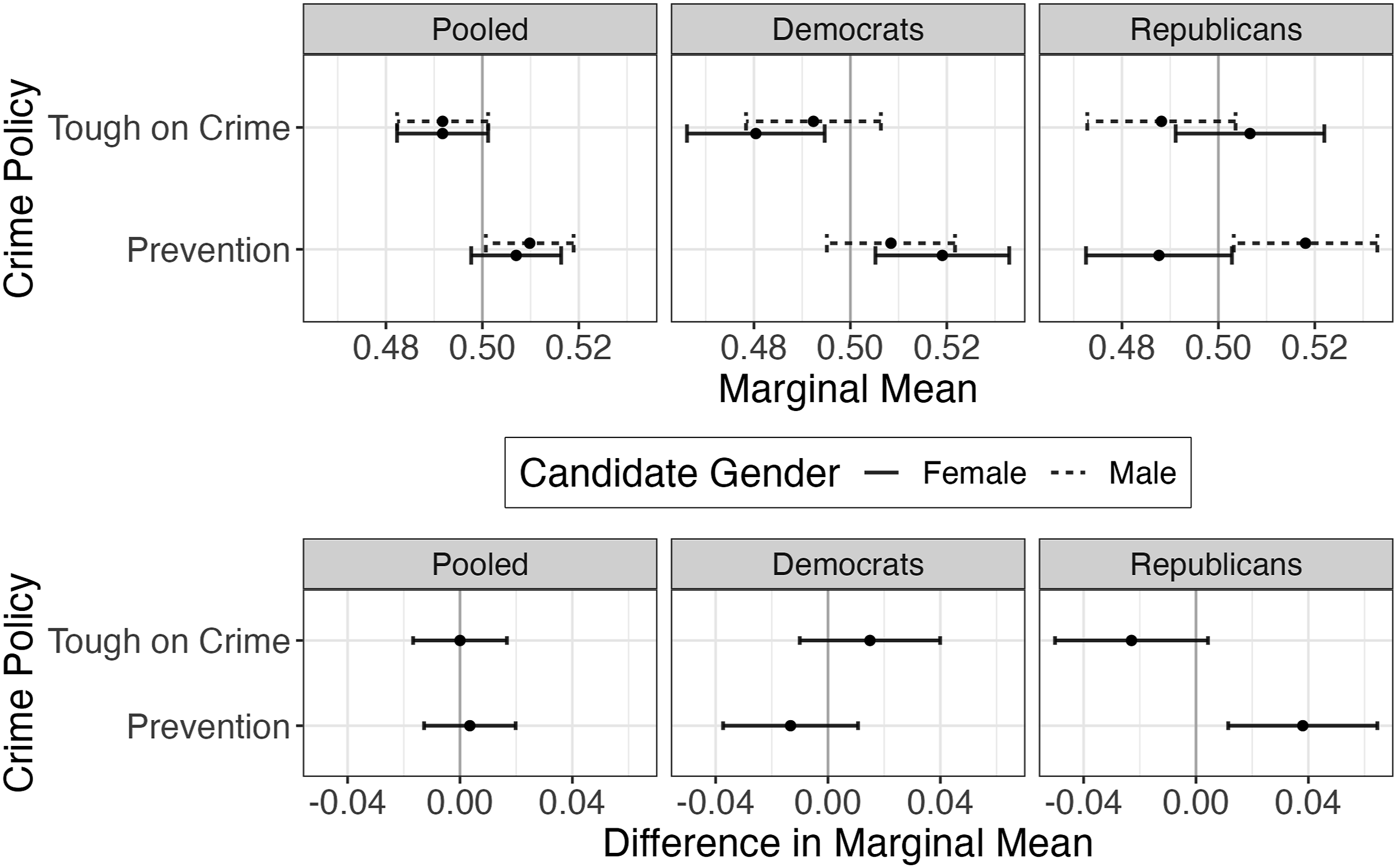
Finally, we turn toward evaluating the final hypothesis, that Black female candidates experience the least pushback for tough-on-crime stances. Figure 4 presents marginal means for this test. Here, we present results for the Democratic sample due to the complexity of multiple interactions. Results for Republicans and the pooled sample are presented in Appendix 2. Democrats’ preferences for crime platforms by respondent partisanship and candidate gender. Note: Marginal means with confidence intervals presented are at the 90% level. N = 682 for Democratic sample.
Figure 4 shows that Black women experience a boost in favorability among Democrats when they take prevention stances (the bottom solid line). However, this difference is not statistically significant. Democrats penalize both male and female white candidates for taking a tough-on-crime stance, though again this within-race difference is not statistically significant. Thus, there is little evidence for Hypothesis 2C that Black female candidates are punished the least by Democratic voters. These results are slightly underpowered, as we have a sample size of 682 Democrats. See Appendix 4 for further details.
On the whole, the experiment provides evidence that while Democrats punish tough-on-crime candidates, they are less likely to punish Black tough-on-crime candidates, compared to their white counterparts. The gender dynamics are less clear, though there is some suggestive evidence that female tough-on-crime candidates are punished more than their male counterparts, in line with recent work indicating that women are punished for taking counter-stereotypical stances (Holman et al., 2022; Ono and Yamada, 2020). It is less clear how gender plays a role in this relationship. There is some evidence that female tough-on-crime candidates are punished more than their male counterparts by Democratic voters.
It should be noted that all results are fairly small in magnitude. This is common in survey experiments, as interventions are minor. Here, we attempt to mimic voter behavior in a campaign context — which would include much more media coverage and information — with a brief experiment. While the effects are small, we contend this relationship likely exists outside the experimental context to a larger degree. All results are robust to removing respondents who presented evidence of poor attention (see Appendixes 1.4). 6
Conclusion
This experiment sheds light on the way that candidate identity interacts with policy preferences to shape support among voters. While Democrats prefer tough-on-crime candidates, they only penalize white, not Black, candidates for taking these stances.
While this experiment has demonstrated that white, but not Black, candidates experience a decline in support when taking tough-on-crime candidates, the causal mechanism for this connection is still unclear. We posited several mechanisms and provided suggestive evidence that respondents are more deferential to Black candidates on crime policy because they see their racial group as more directly affected by unfair policing practices. Future work could test this more directly. For example, researchers could prime respondents about how tough-on-crime policies target Black communities, and assess how this information affects attitudes. Similarly, researchers may manipulate other candidate characteristics, like occupation, to test the cognitive link between candidate race and leadership ability in the realm of criminal justice.
Further, while we found that female candidates were punished more than male candidates for being tough-on-crime, they were also rewarded more for taking prevention positions; neither of these differences in marginal means was significant. Thus, the results presented here are mixed. This could be due to the nature of the policies analyzed in this experiment. While women are often seen as advocates for victims, the feminist movement has been most directly linked with confronting violence against women (Brubaker, 2019; Wegrzyn et al., 2023). The policies analyzed in this experiment were focused on street-level crime rather than gender-based violence. As a result, the particular policies may have more directly led to increased deference to Black candidates as leaders on the issue.
Our exploratory analysis of Republican voters reveals that conservatives prefer male candidates who endorse prevention-oriented approaches compared to their female counterparts. This indicates that there may be partisan differences in how gender and crime policy positions affect candidate support. Future work with larger samples may allow researchers to explore heterogeneous effects based on respondent characteristics like race, age, or gender.
Together, our findings help explain how someone like Eric Adams could be elected in left-leaning New York City. Adams is a former police officer and outspoken about his tough-on-crime policies — and he is also a Black man. This experiment indicates that Democratic voters may have been more amenable to his candidacy given his racial identity. Our results may also shed light on why a politician like Lori Lightfoot, 7 who is a Black female Democrat, experienced more criticism for her tough-on-crime positions. Broadly, these findings contribute to our understanding of how candidate identity and policy stances interact to produce support among voters.
Supplemental Material
Supplemental Material - The “tough-on-crime” left: Race, gender, and elections of law-and-order democrats
Supplemental Material for The “tough-on-crime” left: Race, gender, and elections of law-and-order democrats by Isabel Laterzo-Tingley and Leah Christiani in Research and Politics
Footnotes
Acknowledgments
The authors thank Marc Hetherington and the Politics in the Field at UNC (P-FUNC) team for graciously providing survey space for this research. We are also grateful for feedback from Christopher Clark and from the three anonymous reviewers.
Declaration of conflicting interests
The author(s) declared no potential conflicts of interest with respect to the research, authorship, and/or publication of this article.
Funding
The author(s) received no financial support for the research, authorship, and/or publication of this article.

Supplemental Material
Supplemental material for this article is available online.
Notes
References
Supplementary Material
Please find the following supplemental material available below.
For Open Access articles published under a Creative Commons License, all supplemental material carries the same license as the article it is associated with.
For non-Open Access articles published, all supplemental material carries a non-exclusive license, and permission requests for re-use of supplemental material or any part of supplemental material shall be sent directly to the copyright owner as specified in the copyright notice associated with the article.
