




Abstract
This study investigates the short- and long-term consequences of armed conflict and displacement on social cohesion among citizens within attacked nations, using Ukraine and Bosnia and Herzegovina as case studies. Through a pre-registered vignette study in Ukraine (December 2022; N = 1,623), we reveal a significant difference in social cohesion between those who stayed in the country during the war and those who left. This difference intensified when those who left did not want to return. A similar difference persists in Bosnia and Herzegovina 30 years after the Bosnian War (May 2023, N = 338), despite extensive reconciliation efforts. Our findings point towards an understudied consequence of armed conflict and displacement on social cohesion within the attacked nation and shed light on the challenges to post-war reconciliation.
Introduction
Research on armed conflict has repeatedly emphasised the long-term negative consequences for the relations between the attacker and attacked (Conzo and Salustri, 2019; Fiedler and Rohles, 2021). Previous studies put their focus either on the conflicting parties’ relationships (Gilligan et al., 2014) or on loyalty shifts due to newly emerging power structures within the attacked state (Weidmann and Zürcher, 2013). How armed conflict and connected phenomena such as large-scale displacement affect relations within the attacked nation is still an unanswered question. Conflicts in the past have anecdotally illuminated the potential for a distinction based on the decision of individuals to leave the country or to fight in the war or on the home front (Chevtayeva, 2022). Hence, the answer to this question could help us to better understand the societal consequences of armed conflict.
In this research note we provide empirical evidence of the short- and long-term relationships between armed conflict, large-scale displacement and social cohesion within the attacked nation. We analyse how the decision to leave the country during the course of armed conflict affects attitudes towards other members of the nation, and whether intentions to return, or to actually return, can change these perceptions. As those who left the country are still citizens, and because they hold voting rights as well as have ties to relatives and friends who stayed, attitudes towards this group remain of significant importance for the nation state and its leaders.
We identify two possible avenues for how fleeing a country under attack can affect social cohesion. First, fleeing could lower social cohesion because those who leave the country might be perceived as being disloyal. Second, fleeing could strengthen social cohesion because those who leave might be seen as victims of the war – for instance, those who were suffering in Ukraine – and are perceived therefore as being more deserving for repatriation and empathy. However, recent research on Ukrainian refugees shows that seeking refuge out of the country is, among other things, correlated with individual resources such as income and education (Van Tubergen et al., 2024) and is therefore not available to everyone who might want to leave. We thus deem it more likely that seeking refuge is considered a betrayal rather than an indication of vulnerability. In this research note we will elaborate on this argument in greater detail, relying on the concept of ‘social cohesion’ and on the socio-psychological theories of ‘in-group deviance’.
Social cohesion became a prominent concept in various social science disciplines during the last decades (Chan et al., 2006; Friedkin, 2004; Janmaat, 2011). This was due to its importance for explaining societal well-being (Schiefer and Van der Noll, 2017). We first draw on the conceptualisation by Chan et al. (2006) which focuses on horizontal social cohesion between individuals. Second, we incorporate the conceptualisation of social cohesion by Schiefer and Van der Noll (2017) as the existence of social relations, a sense of belonging, and an orientation towards the common good that together denote the quality of the collective’s closeness.
To argue how social cohesion might deteriorate during armed conflict as a possible explanation we draw on previous studies on in-group perceptions and relations which showed that individuals prefer loyal in-group members, and they devalue those who deviate from the perceived group norms (Castelli et al., 2007; Otten and Gordijn, 2014). We propose that in times of war, loyalty is closely associated with national protection and with messages from the political elites – for instance, in Ukraine during the attack of Russia in 2022 and 2023, and in Syria during its civil war since 2011 – and that this can lead to the belief that loyal citizens or community members would defend the country or the community at the war front or on the home front. Consequently, those who leave the country might be perceived as not orientating themselves towards the common good and as having a weaker sense of belonging as well as feeling less relatable. We thus hypothesise that people who leave their country during a war are evaluated more negatively than those who stay (Hypothesis 1). However, those who return, or at least intend to return, are assumed to be evaluated less negatively than those who never return (Hypothesis 2).
We tested our hypotheses in two pre-registered survey experiments in different contexts: in Ukraine during Russia’s war which started in 2022, and in Bosnia and Herzegovina focussing on the Bosnian War in the early 1990s. 1 Russia’s invasion of Ukraine in 2022 has led to more than six million Ukrainians fleeing the country: almost 15% of the total population. In addition, many more millions have been displaced internally (Centre for Research & Analysis of Migration, 2023). To evaluate whether the hypothesised correlations also persist in the long term, we re-ran our study in Bosnia and Herzegovina (BiH), which, 30 years ago already, similarly suffered from an armed conflict and large-scale displacement. In the context of the Bosnian War, from 1992–1995 more than two million inhabitants were internally displaced or left the country, although most of them returned after the war ended (Black, 2001). 2
Data and methods
Data collection
For the Ukrainian survey, we drew on data from a panel study that was set up via social-media sampling in June 2022 as an international cooperative effort, by teams of scientists from Germany (Jörg Dollmann, University of Mannheim & DeZIM-Institute, Anna Hebel, GESIS – Leibniz Institute for the Social Sciences, Sabrina Mayer, University of Bamberg & DeZIM-Institute, Steffen Pötzschke & Bernd Weiß, both GESIS), Qatar (Ingmar Weber, Qatar Computing Research Institute), and the UK (Ridhi Kashyap, Douglas Leasure & Francesco Rampazzo, all University of Oxford). The aim was to test the feasibility of using social-media recruitment for sampling participants for a panel structure in highly dynamic times of crisis.
Due to the ongoing war and massive relocation in Ukraine, random sampling was not feasible. Additionally, applying geo-referenced sampling techniques could not be carried out because such methods rely on later face-to-face interviewing. In summary, we saw no possibility of applying a random-sampling approach. Therefore, we relied on sample selection using geo-referenced advertisement campaigns on two widely used social network sites in Ukraine – Facebook and Instagram – which are supposedly used by more than 60% of the population (statcounter, 2023). We stratified the campaigns into five regions, as well as by gender and age (up to 50 and above 50). Luhansk, Donetsk and Crimea could not be targeted directly. People who selected the campaign were asked whether they would be willing to take part in an online survey of the Ukrainian view of the role of the European Union. We did not offer incentives because we feared that others who were not from Ukraine might take part, thus affecting the results. We made this clear in the survey introduction. Participation could be stopped at any time and all answers deleted. The first wave of data collection was conducted between June 3 and June 28, 2021, with more than 18,500 respondents taking part. For those participating in this recruitment survey, we asked for their consent to be contacted again. More than 14,000 provided their panel consent, of which about 7,240 provided us with valid email addresses. The field time of the second wave of data collection – which we use for this article – took place between November 24, 2022 and January 31, 2023 (response rate: 32.5 %). One invitation and three reminders were sent out. Apart from some socio-demographic questions, the questionnaire dealt mainly with the respondents’ attachment to the EU and to NATO countries, whether joining the EU was preferred, as well as questions on national identity, attitudes towards sanctions against Russia, and political attitudes. No incentives were provided to respondents. The average length of survey participation in wave 2 was 33.8 min (SD = 36.6; median = 26.2). The survey was offered in Ukrainian and in Russian – both versions provided by a translation company – and checked by three native speakers. However, only 1 % of participants in wave 1 and less than 1 % of participants in wave 2 took part in Russian. In total, 2,260 persons took part in the second wave, of which 1,694 were still living in Ukraine: 1,623 had no missing values for the vignettes. We excluded from the analysis all respondents living abroad, as we were interested in the attitudes of those who had stayed.
For the survey in Bosnia and Herzegovina (BiH), we relied on Talk Online, a major commercial online access panel with more than one million participants in most European countries. Our survey population in the BiH survey were all adults. However, we knew about the biases in online access panels and treated this data as non-probability sampled.
We asked for quotes regarding age groups, gender, and entity (Republic Srpska, Federation of Bosnia and Herzegovina, Brčko District of BiH) that could be fulfilled for all groups except for the age groups 50–59 and 60+ and entity from Republic Srpska which are underrepresented by up to 10 %. The survey was translated into both Bosnian and Serbian and was fielded between May 23 and June 6, 2023. The average length of survey participation was 11.4 min (SD = 13.1; median = 8.8). In total, 395 persons took part, of which 338 never fled the country, and 392 had no missing values for the vignettes. For descriptions of both analytical samples see the Online Appendix, Table SI1.
Experimental design
Our design is a vignette study that belongs to the family of factorial survey experiments (Hainmueller et al., 2015). We employed a single profile vignette which presented different characteristics in the form of a short paragraph instead of a table. The different vignette characteristics were derived from the literature (e.g. Bansak et al., 2016). Respondents then evaluated the profile on several rating scales. See the Appendix for the exact wording. We tried to keep our experimental design for the two countries as similar as possible, with each respondent receiving four vignettes.
In Ukraine, we systematically varied the characteristics described in the vignettes: migration status (‘stayed in Ukraine’ or ‘fled to Poland’); return migration intention; city/region of origin (varying how affected those were by the war); native language (Ukrainian or Russian); gender; age (25 or 40), number of underage children, and occupational status.
The vignette used in BiH was changed slightly to acknowledge the country’s particularities such as the religious divide between Muslims and Christians. We varied migration status (‘stayed during the war’ or ‘fled to Austria’); return behaviour; religion, to indicate ethnic group belonging (Catholic, Muslim, Orthodox); gender; age (45, 60 or 80), and occupational status.
After each vignette, respondents had to indicate whether (A) ‘The person belongs to (Ukraine|Bosnia) for me’; (B) ‘I think the person’s actions are right’; (C) ‘I like the person’; and (D) ‘In the course of reconstruction, this person (should be/should have been) financially supported’. These four items capture the three dimensions of social cohesion from Schiefer and Van der Noll (2017): a sense of belonging (A), orientation towards the common good (B, D), and social relations (C). The corresponding scales range from 1 ‘Fully agree’ to 7 ‘Fully disagree’. Taking the mean of the reversed four items, we calculated a social cohesion index, ranging from 1 to 7, with the higher values indicating higher social cohesion.
We estimated average marginal component-specific effects (AMCE) by using linear regression models, including cluster-robust standard errors at the individual level and period effects in Ukraine (week of the survey), similar to Bansak et al. (2016).
Results
Descriptively, members of the respondents’ own nation are on average evaluated favourably. The mean for the social cohesion index in both countries is above the mid-point of 3.5: 4.1 in Ukraine (Cronbach’s α = 0.87; SD = 1.5), and 4.9 in BiH (Cronbach’s α = 0.82; SD = 1.6). How are these attitudes now affected by war-related displacement and return, or the intention to return? Figure 1 summarises our main results for both studies. We start with Ukraine in the left panel. Compared with those who stayed in Ukraine, individuals who left the country are evaluated less positively. However, there is substantial variation depending on the return intention: those who returned after the end of the war, or at least intended to return, are evaluated much less negatively (about −0.4 to −0.5 scale points) compared to those with no intention to return (−1.7). However, when we look at the absolute numbers, those with no intention to return are still evaluated with a mean slightly above the mid-point (3.7, see Online Appendix Table SI2). The interpretation is that on average respondents do not have very strong feelings of rejection, and they evaluate those who have no intention to return neutrally. Full Regression Models on Positive Attitudes, Ukraine, OLS, Unstandardised Coefficients. Note. Cluster-robust standard errors applied, ***p < .001; **p < .01; *p < .05. Full Regression Models on Positive Attitudes, BiH, OLS, Unstandardised Coefficients. Note. Cluster-robust standard errors applied, ***p < .001; **p < .01; *p < .05.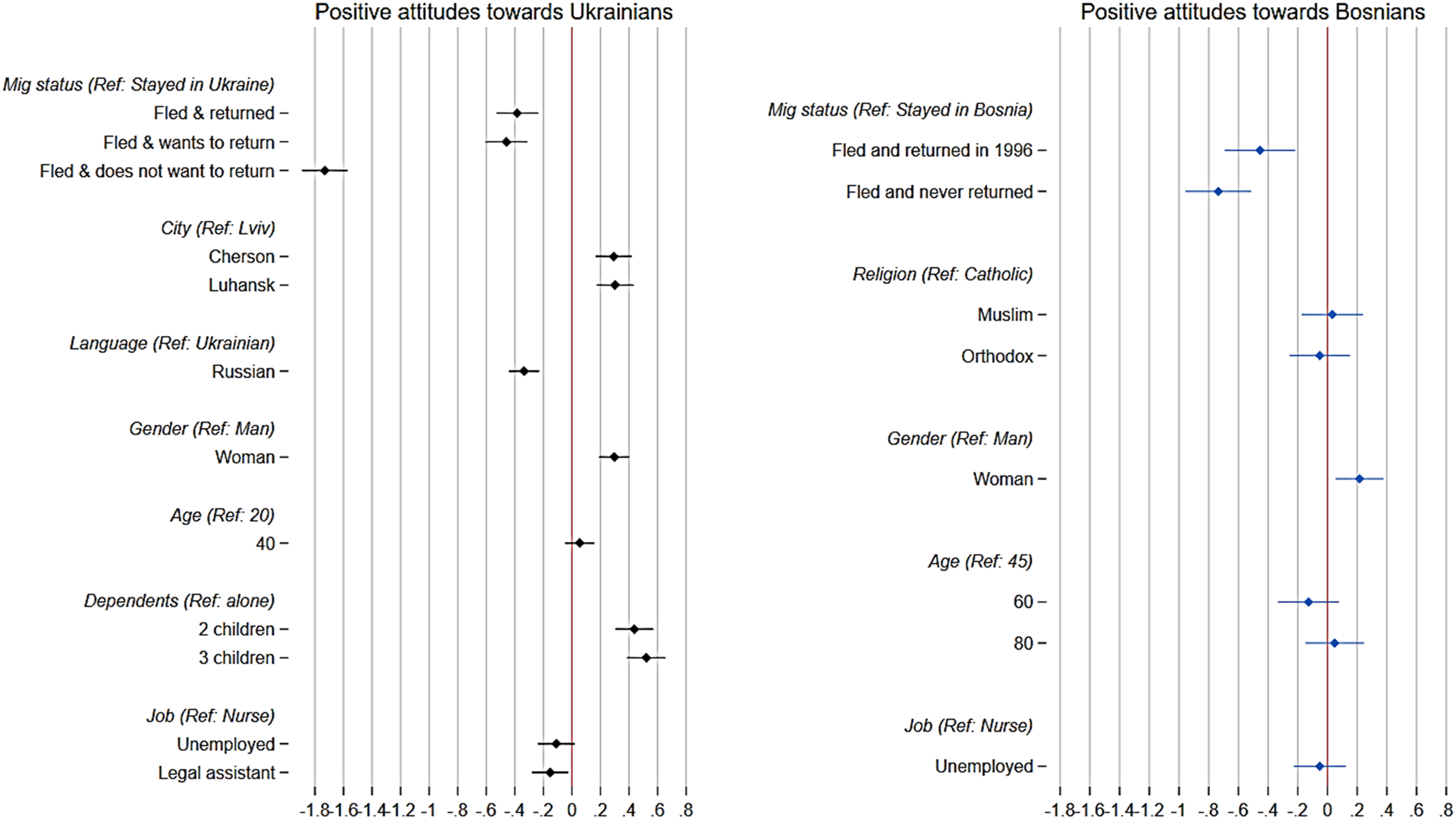
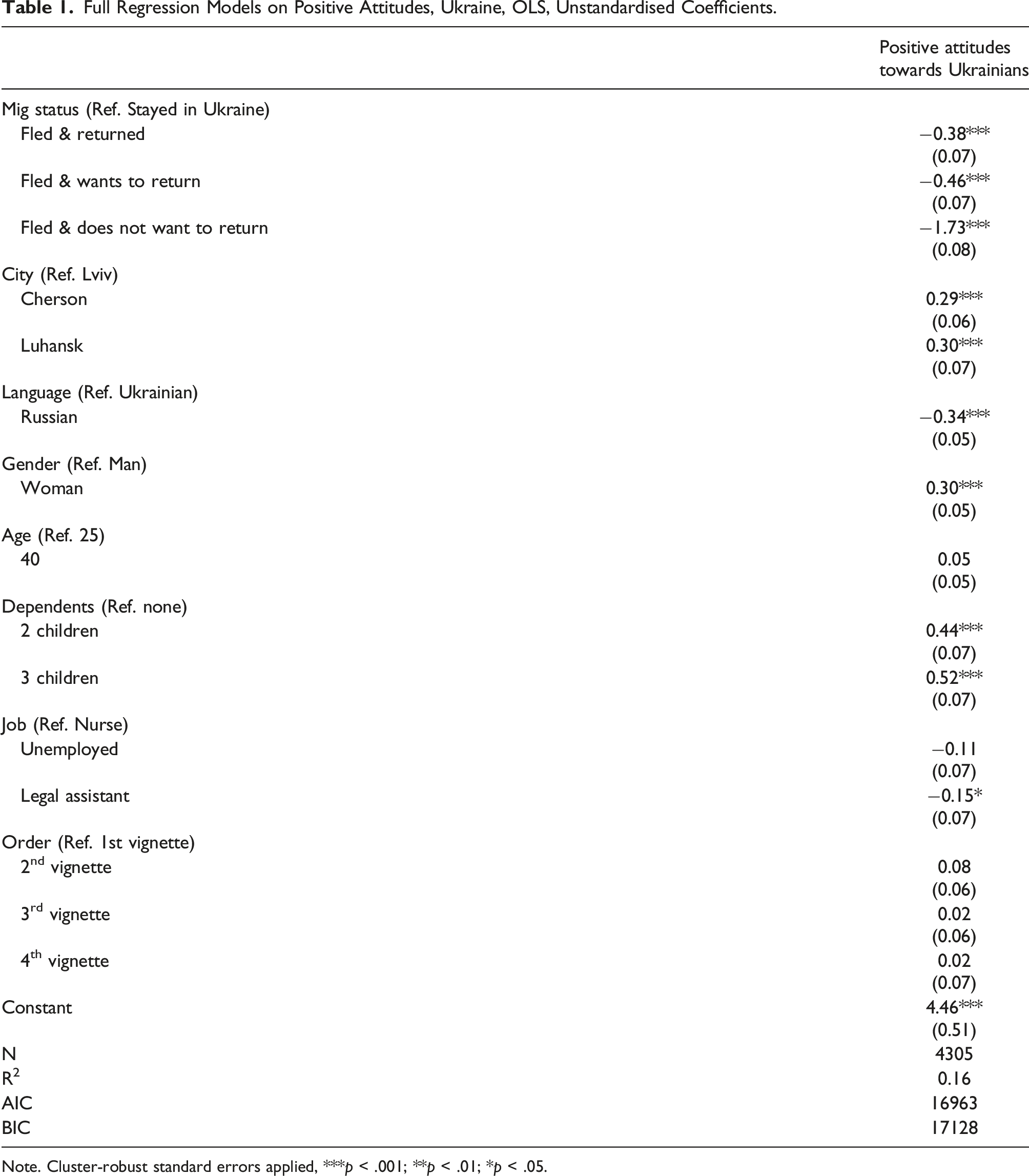

Compared with the other six characteristics of the vignette, migration status and return intention – besides having children – have the strongest impact on the social cohesion index.
One could argue that this strong emphasis on displacement and return intentions might be caused by the current very high salience of the ongoing war. We thus turn to BiH, where the war has been over for almost 30 years (right panel in Figure 1). However, similar results are obtained for BiH: individuals who left for Austria are also evaluated less positively. However, the difference between those who returned (−0.5) and those who never returned (−0.7) is less pronounced and is not significant. Also, in absolute numbers, those who fled and never returned are still evaluated with a mean of 4.4 scale points, which is above the mid-point. Hence, those who fled are not disliked or rejected, but they are substantially less liked.
Also, migration status and return behaviour in the BiH study are the strongest predictors of the social cohesion index. We therefore accept Hypothesis 1, because those who fled the country are evaluated much more negatively than those who stayed. Regarding the mitigating effect of returning, we can only partly accept Hypothesis 2. Only in Ukraine do we find a substantial and significant difference in evaluations between those who returned/wanted to return, and those who wanted to stay abroad. Our results thus point to short-term effects rather than to long-term effects in that regard.
For both countries, we re-estimated the models using not the mean index for social cohesion but the single variables separately as dependent variables. However, the results remained similar (see the Online Appendix, Tables SI3 and SI4).
Discussion and conclusion
The end of any war marks a crossroad for state rebuilding of the attacked state. Besides economic resources and political allies, social cohesion – that is, generalised trust, connectedness, and belonging – becomes a crucial social element for success. Our analyses are based on two vignette studies: one conducted in Ukraine during an ongoing war, and the other in Bosnia and Herzegovina nearly 30 years after the war there ended. Our results provide strong evidence for short- and long-term negative consequences of armed conflict on the social cohesion of the attacked nation. This shows a division based on attitudinal evaluations between those who decided to stay – or who could not leave for some reason – and those who left intentionally. This effect is even more pronounced in Ukraine for those who left but did not want to return after the war. Our study provides useful insights for the post-war period. This is because lower social cohesion within specific parts of the population could have negative effects for solidarity and for establishing public goods and may lead to a long-term post-war social divide that could be politicised and polarised by political actors. This did not happen in BiH, although the topic of those who stayed and those who fled is still very salient. Due to the high number of refugees, most inhabitants have close relations who lived abroad at least some of the time. However, the re-integration of returning refugees was facilitated through the massive efforts of returnees and civil associations and is thus not a relevant dimension of political competition (Porobič, 2016).
Besides the important insights our study delivers, we also face some shortcomings. Importantly, our study in Ukraine was conducted by using a convenience sample, initially distributed through social-media ads. Although the generalisability of our results to the whole of Ukraine can be questioned, other studies have shown the external validity of experimental data using convenience samples (Coppock et al., 2018). In addition, we argue that this shortcoming is clearly outweighed by the replication study in BiH. Together, the two vignette studies provide strong indications that the reported effects during an ongoing war can still be observed, even in a case where the war ended almost 30 years ago. How such a division affects the political system in the long run depends on local opportunity structures, party system set up, and whether political elites politicise this difference. This might remain as a characteristic of a non-politicised population that simply persists in society, or it can have the potential to be used by political actors, often in conjunction with other characteristics that relate to the war such as ethnicity or religion. One could even argue that war, as a massive emotional event associated with death and displacement, might have the potential of being politicised to a much greater extent than other divisions. However, we cannot say for sure that the differences in cohesion towards those who left the country during a war are specific to war-related migration. We find differences in social cohesion in two countries that faced war, and we provide an explanation based on loyalty. However, we can neither provide evidence for the supposed mechanism nor show that this is specific to war-related migration. Hence, future research has to determine whether our findings describe a possible general pattern that can be observed for all types of migration. In addition, we cannot take into account past victimisation and internal displacement (in the Ukraine context) nor individual differences such as nationalism or collective narcissism and their effect on evaluations. These aspects would also be important avenues for future studies.
Supplemental Material
Supplemental Material - Armed conflict as a threat to social cohesion: Large-scale displacement and its short- and long-term effects on in-group perceptions
Supplemental Material for Armed conflict as a threat to social cohesion: Large-scale displacement and its short- and long-term effects on in-group perceptions by Sabrina J Mayer, Jörg Dollmann, Jannes Jacobsen, and Lisa Walter in Research & Politics.
Footnotes
Acknowledgements
We are grateful to Jonas Köhler and Artem Meth for providing feedback at the data collection stage, as well as to Martin Kroh and Christoph G. Nguyen for helpful comments and suggestions. We thank Artem Meth and Lara Holzmann for general research assistance. Both studies were approved by the social sciences ethics committee of the University of Bamberg.
Author contributions
SJM, JD and JJ are PI of the project; SJM, JD, JJ and LW designed the data collection and the vignette; SJM analysed the data and did the data visualisation; SJM wrote the first draft, JD, JJ, and LW revised the manuscript, SJM, JD, JJ and LW agreed on the final draft.
Declaration of conflicting interests
The author(s) declared no potential conflicts of interest with respect to the research, authorship, and/or publication of this article.
Funding
The author(s) disclosed receipt of the following financial support for the research, authorship, and/or publication of this article: Our research was funded by the German Federal Ministry for Family Affairs, Senior Citizens, Women and Youth.

Data availability statement
Supplemental Material
Supplemental material for this article is available online.
Notes
Appendix
The vignette presented to Ukrainian participants (see an example in Figure 2) reads as follows: Now we show you profiles of four people and would like to know your opinion. Person 1 is Example of vignette (English translation). Note. Vignette dimensions underlined.
References
Supplementary Material
Please find the following supplemental material available below.
For Open Access articles published under a Creative Commons License, all supplemental material carries the same license as the article it is associated with.
For non-Open Access articles published, all supplemental material carries a non-exclusive license, and permission requests for re-use of supplemental material or any part of supplemental material shall be sent directly to the copyright owner as specified in the copyright notice associated with the article.
