




Abstract
All over the world, a very large number of elections take place concurrently with other elections for representatives in different government tiers. A crucial question for understanding electoral outcomes in those elections is the existence of electoral spillovers or coattail effects. Causal identification of coattail effects is challenging because popularity shocks typically affect parties in both concurrent elections. This paper exploits a quasi-experiment—the ban of a party in only one of the concurrent elections—to estimate coattail effects. The results show that a 1 pp decline in electoral support for a party in a given election reduces its support in the concurrent election by 0.25 pp. This comes along with a decline in turnout of the same size in both elections.
A very large number of elections take place concurrently with other elections for representatives in different government tiers, all over the world. In November 2020, US citizens elected their President, one-third of the Senate, all members of the House of Representatives, eleven governors, and most state legislatures. In October 2019, Colombian citizens elected, on the same day, departmental governors, departmental legislative chambers, municipal mayors, counselors, and local administrative boards. In the EU, elections to the European Parliament are held concurrently with national elections in many countries; in the United Kingdom, general elections concurred with local elections for the most part in the last decades. In Pakistan, national and provincial assemblies are elected concurrently; and in India, there is an ongoing debate to hold all the country’s elections on the same day (“One Nation, One Election”). 1
How do concurrent elections influence each other? The literature has emphasized the role of voters’ mobilization and turnout. If a party becomes more popular in a given election, it will attract more sympathizers (peripheral voters) to the polls in the concurrent election, resulting in electoral gains in that election as well. This is typically known as a coattail effect (Campbell, 1960; Meredith, 2013; Rogers, 2019).
Nevertheless, causal identification of spillovers across concurrent elections is challenging. Empirically, there is a strong correlation in the popularity of any given political party across concurrent elections. Many factors affect concurrent elections simultaneously: voters’ preferences, information, or the state of the economy. Hence, interpreting such correlations as electoral spillovers, even after controlling for observables, requires restrictive assumptions.
To causally identify cross-election spillovers, one must isolate shocks affecting the party in only one of the concurrent elections. For instance, Meredith (2013) exploits the disproportionate support for candidates from geographically proximate voters (i.e., friends-and-neighbors votes). The findings indicate that a one-percentage-point increase in the personal vote received by a party’s gubernatorial candidate in a county increases the vote share of the party’s secretary of state or attorney general by 0.1 to 0.2 pp, which is smaller than suggested by raw correlations and earlier studies.
In this paper, to circumvent these causal identification problems, we draw on a quasi-experiment with exogenous variation in party support in only one of the concurrent elections. This quasi-experiment is the ban on Batasuna, a large party in the Spanish region of the Basque Country, banned for its links with the terrorist organization ETA. Batasuna was fuzzily outlawed in local and provincial elections, which take place concurrently every 4 years. In some municipalities, Batasuna was outlawed in both elections; in some others, in only one; and in some others, in none. Our empirical strategy exploits cases where, on the same election day, voters could vote for Batasuna in one of the local or provincial elections, but not in the concurrent one. This allows us to estimate the causal spillover effect of losing support in one election (i.e., due to the ban) on support in the concurrent election.
Exploiting this exogenous source of variation, differences-in-differences estimates show that a 1 pp vote loss translates into a vote loss in the concurrent election of 0.25 pp. Moreover, bans have a negative effect on turnout of the same size in both concurrent elections, of around a half of the coattail effect. This highlights the role of voters’ mobilization in driving spillover effects of party popularity across elections, consistent with Campbell’s (1960) conjecture, and with (Rogers, 2019), which shows that as the costs of voting increases—due to rainfall on Election Day—the strength of the relationship between presidential and congressional voting weakens (i.e., certain types of voters “surge” to the polls when there are greater net benefits to voting but “decline” to turn out otherwise).
The results of this paper are important both methodologically and substantively. Methodologically, we estimate a causal effect from a quasi-experiment affecting a party in only one of the concurrent elections. Substantively, we provide evidence of coattail effects in a comparative context, with a different electoral system (i.e., proportional), and with results within a similar range. Moreover, the quasi-experiment in this paper allows us to relate and quantify the explanatory power of turnout for coattail effects.
This paper adds to a number of contributions which study coattail effects in the United States, besides the aforementioned studies by (Meredith, 2013; Rogers, 2019), such as Calvert and Ferejohn (1983), which isolates personal votes using responses to an open-ended survey question on the reasons for voting for presidential candidates; and Garmendia Madariaga and Ozen (2015), which uses campaign spending and incumbency as excluded instruments to examine two-sided coattail effects between concurrent presidential and gubernatorial races. 2
Institutional context
The Basque Country is a rich region with a high degree of autonomy within Spain. Basques elect one regional government, 3 provincial governments, and 251 local governments. Local and provincial elections take place on the same day every 4 years, and feature a very similar electoral rule. 3 Municipalities above 250 inhabitants elect their city council with a closed-list proportional system (d’Hondt, with a 5% threshold), and the city council appoints the mayor. In provincial elections, there are 3 or 4 electoral districts per province, and MPs are elected with the same system (d’Hondt), with a 3% threshold. Provincial parliaments then appoint their President. Spanish citizens residing in the Basque Country are eligible to vote in both elections, but foreigners may only vote in local elections. 4 Although both elections are held concurrently and at the same polling stations, there is variation in turnout: voters may choose to vote in only one of the elections. Polling stations typically feature separate tables with ballots of candidatures for either election. Voters pick a ballot, put it in an envelope, and cast their vote in a ballot box (there are two different ballot boxes, one for each election). Voters may pick the ballots in private cabins as well, to ensure secrecy.
Local governments collect real estate and business activity taxes; provincial governments partially collect value-added, income and corporate taxes, and help fund local governments. Both governments are in charge of 36% of public spending (18% each) in the Basque Country, which is largely devoted to social policy. Basque politics are multi-dimensional: parties take stances in the left-right and the independence-centralization dimensions. The same parties contest local and provincial elections (i.e., these are integrated parties, which facilitates the existence of coattail effects (Garmendia Madariaga and Ozen, 2015)). While in the United States, there is a clear hierarchy in the causal direction of the coattail from the Presidential onto the Congressional race; in this case, it is less clear. For instance, turnout is very similar across provincial and local elections, partly because they take place on the same day.
Basque politics have been shaped by ETA, a leftist-independentist terrorist organization that claimed over 800 lives between its creation in 1959 and its dissolution in 2018. The political wing of the leftist-independentist movement, Batasuna, has been an important party since the first elections after Franco’s dictatorship. Over the period of analysis, the party adopted different electoral brands, including “Herri Batasuna,” “Euskal Herritarrok,” and “Acción Nacionalista Vasca.” For simplicity, we refer to all of them as Batasuna.
In 2003, the Spanish Supreme Court banned Batasuna after the Spanish Parliament passed a Law of Parties to restrict the political participation of organizations allegedly supporting terrorism. In response, Batasuna created a new electoral brand, which was banned as well. As a result, Batasuna could not contest any of the 2003 local and provincial elections.
In 2007, Batasuna created yet another party to escape the ban, but again this was detected and banned by the judiciary. However, a few weeks before the 2007 elections, Batasuna revived a decades-old electoral brand (EAE-ANV). The police and the judiciary failed to find enough evidence that this was yet another relabeling of Batasuna and could only ban the party in some cases when the connection of the new brand with previously banned organizations was deemed evident enough (i.e., based on the number of former Batasuna candidates or top officials in the lists of EAE-ANV, three or more former candidates and one or more former city councilors.).
As a result, Batasuna contested the 2007 elections in around 40% of the 251 Basque municipalities, and in 3 out of the 11 electoral districts in provincial elections (two districts in the province of Araba, one in Bizkaia, and none in Gipuzkoa). Within those municipalities where Batasuna would typically contest local elections, in 4.4%, it was legal in both provincial and local elections; in 52.75% in only one of them; and in 42.85%, in none. And wherever Batasuna was legal in only one election, in 30% of the cases, the ban was on local elections; in 70%, on provincial elections. A few months after the 2007 election, the new party brand (EAE-ANV) was deemed a continuation of Batasuna in its integrity and fully outlawed.
The aim of the paper is to obtain an exogenous shift in party support, to understand how it translates to party support in the concurrent election. This is important because if we study how much better a party performs in a specific location when there is a candidate of the same party in the concurrent election, we may obtain that it does much better, but not necessarily because the popularity of one candidate spills over to the concurrent election, but perhaps instead because the very choice of contesting an election was in anticipation of positive electoral prospects.
The exogenous shift that we propose is the ban on Batasuna, which often applies to only one of the two concurrent elections. The coattail effect is the ratio of the effect of a ban in a concurrent election on support for Batasuna over the direct effect of the ban on support for Batasuna in the election where it takes place. Hence, to estimate the coattail effect, we need a measure of support for Batasuna under the ban. This measure is the share of null votes, which is what Batasuna campaigns for under the ban.
In Spain, on Election Day in the polling station, there is a ballot paper for each party. Voters place the ballot paper in an envelope, and then place it in the ballot box. When votes are counted, they can be valid or invalid (null). Valid votes are either envelopes with a ballot paper corresponding to a legal party or empty envelopes (blank votes). Invalid (or null) votes are envelopes containing anything other than ballot papers corresponding to a legal party. Turnout is the sum of valid and invalid votes over the voter eligible population. There is no need for voter registration: voters are automatically registered from the census.
Under the ban, Batasuna distributed, through informal channels, ballot papers with their name and proposed electoral list. Their aim was to coordinate their supporters, to reclaim the share of invalid votes as votes for them. In practice, any vote that would be counted as invalid (a piece of hand-written paper, for instance) would serve that purpose. After the election, Batasuna would make a counterfactual seat allocation to claim that they would have obtained a certain number of seats, had those votes been counted as votes for them.
Hence, when Batasuna is banned, its votes drop to zero, and null votes sharply increase. Null votes are otherwise typically a very small percentage of votes. To take this into account and avoid inflating the measure of support for Batasuna under the ban, we measure support for Batasuna as the sum of Batasuna and null votes: whenever Batasuna is banned, these are the share of null votes, whenever Batasuna is legal, the share of Batasuna and null votes.
Figure 1 displays the evolution of Batasuna and null votes as a fraction of eligible voters, pooling local, and provincial election results.
5
Before 2003, Batasuna obtained around 12.5% of the votes, while null votes were very close to zero. In 2003, when Batasuna is fully banned, its votes drop to zero, and null votes jump to 7.5%. Null votes as a measure of Batasuna support under a ban.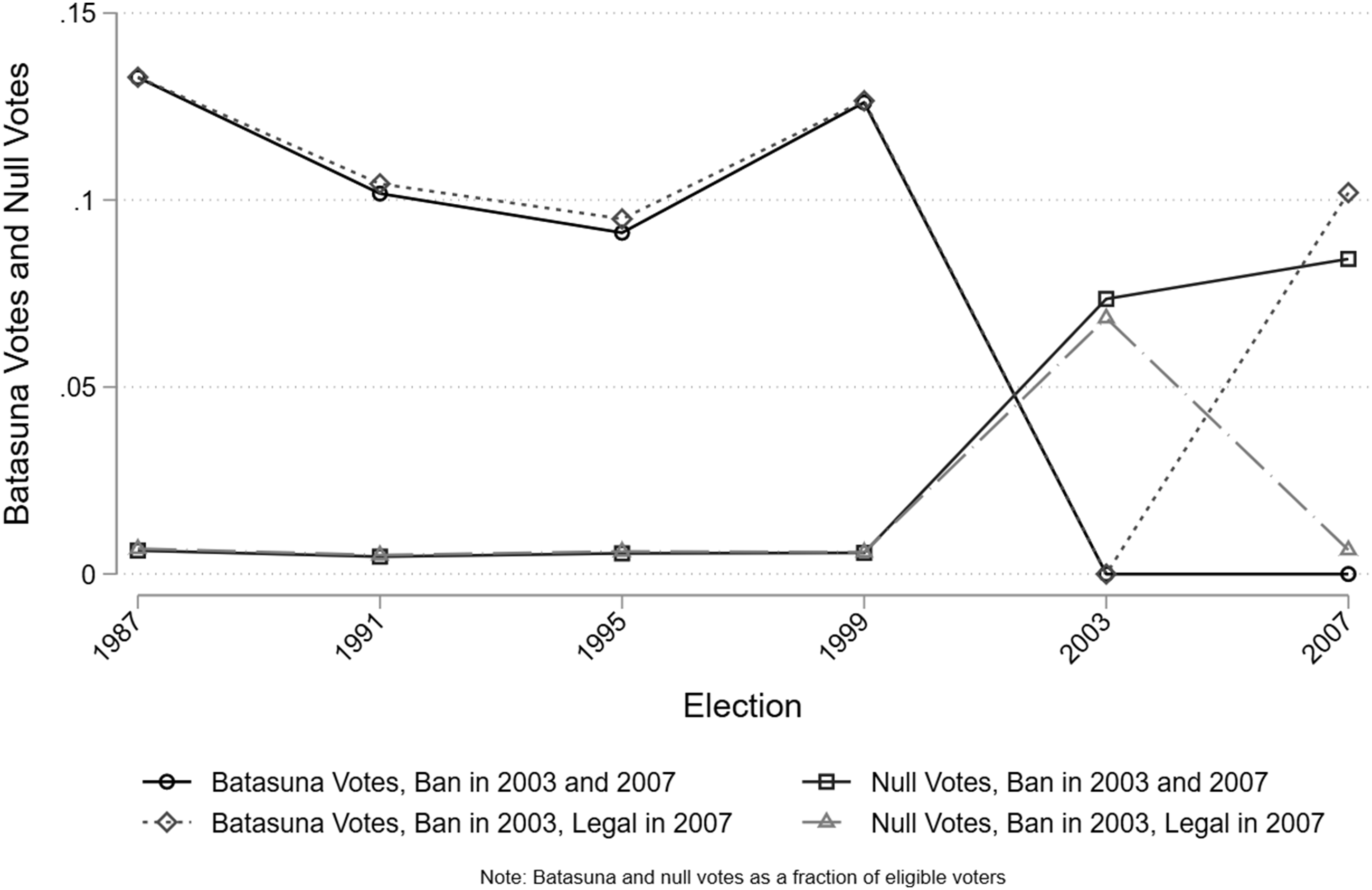
The sharp increase in null votes, which were almost zero before any ban, shows that they capture support for Batasuna under the ban. This is especially visible in 2007, when Batasuna is banned only in certain municipalities and elections. Where Batasuna is still banned, its votes stay at zero and null votes stay at around 8%. Instead, wherever it is legal, null votes go back to zero and Batasuna votes rise again to pre-ban levels. This shows that null votes can be used as a measure of Batasuna’s support under the ban: null votes only increase where and when Batasuna is banned, and in direct proportion to its support in regular conditions.
Hence, we can compare support for the party under the ban across electoral precincts by comparing their share of null votes, taking into account that there is always a small share of null votes in any election. The main outcome of interest will be defined as Batasuna Support (pop.) = Batasuna votes + null votes/Eligible voters. Another outcome of interest will be Batasuna Support (turnout) = Batasuna votes + null votes/Total votes, and Turnout(pop.) = Total Votes/Eligible Voters.
Related papers have studied other electoral effects of the bans on Batasuna. Arenas (2016) studies the effect on support for Batasuna in the very same local election under the ban. It finds, as in Figure 1, that bans reduce Batasuna support by 33%, compared to elections where the party is legal. On the other hand, Arenas (2021) studies the long-lasting effect of bans on support for Batasuna after the end of the bans in 2011, documenting a long-lasting negative effect on Batasuna’s support in local elections, with a small negative spillover on subsequent (not concurrent) regional elections. In this paper, instead, we study the spillover effect of bans on support for Batasuna across concurrent elections.
Empirical analysis
We estimate the direct and spillover effects of Batasuna bans on turnout and electoral support for Batasuna. We estimate these effects by differences-in-differences, comparing the outcomes of elections with and without a ban, before and after the treatment. The left panel of Figure 2 displays electoral support for Batasuna, splitting the sample according to its legal status in 2007. It suggests that the ban had a substantial direct negative effect on support for the party. Recall that wherever Batasuna is banned, support is measured with null votes, as explained in the institutional context section. Direct effects and spillover effects of a ban.
To estimate the spillover (i.e., the coattail effect), we compare the outcomes of elections with and without a ban in a concurrent election, before and after the treatment. This is shown in the right panel in Figure 2, which splits the sample according to Batasuna’s legal status in the concurrent election in 2007. It suggests that bans have a slightly negative effect on support for Batasuna in the concurrent election.Hence, the figure shows that a negative shock in a given election has a negative effect in the concurrent election as well. To obtain the coattail effect, we divide the effect on the right panel by the effect on the left panel.
We next study these effects in a regression framework, including the effects on turnout. We estimate the following regression, pooling electoral data at the electoral precinct level p (where each municipality is divided into between 1 and 9 electoral precincts), for each election type j (local/provincial), for each election t from 1987 to 2007, for all municipalities where Batasuna used to exist before the 2003 ban.
6
Ban
j
refers to the ban of the party in election type j; while Ban−j, in the concurrent election to j. The outcomes of interest are Support for Batasuna and Turnout.

This is a panel data model with electoral precinct by election type fixed effects (FEs) α pj , which allow electoral outcomes to differ in every electoral precinct and for every election type; election type by year FE δ jt , which allows electoral outcomes to differ by year for every election type; and province-year FE μc(p)t, which allows electoral outcomes to differ by year for every province. Observations are weighted by the number of eligible voters in each election. 7 We cluster our standard errors at the electoral precinct level, since that is the unit for which we expect outcomes to be most serially correlated over time.
β1 captures the direct effect of the ban (i.e., the effect of Ban pjt on y pjt , as in the left panel in Figure 2). Instead, β2 captures the spillover effect of a concurrent ban (the effect of Banp−jt on y pjt , as in the right panel in Figure 2, holding constant the party’s legal status (Ban pjt ) in a given election. A number of recent contributions, such as Goodman-Bacon (2021), have highlighted that a two-way fixed effect estimator may be biased for the causal effect of interest whenever units receive treatment at different times. However, this is not a staggered design: all the variation is due to the 2007 ban status (in 2003, the ban is in place everywhere, and hence, it is collinear with the year fixed effects). Table A1 in the Supplemental Appendix reports descriptive statistics by treatment status.
The identification assumption for a causal effect is that treated and control units would have followed parallel trends in electoral outcomes in both concurrent elections in absence of the 2007 ban. If this is satisfied, both β1 and β2 have a causal interpretation. In this context, this means that the 2007 ban should be orthogonal to differential trends in support for the party across concurrent elections (because we are conditioning on levels of support by including fixed effects). Arenas (2021) shows that in local elections, bans happen more often in municipalities with lower levels of pre-ban support for Batasuna—in part because they tend to present the same candidates over time, which was used as evidence to ban the party, as explained in the previous section. The paper exploits the rule used by the public prosecutor to create an instrument for the 2007 ban which shows similar (albeit noisy) results, suggesting that this is not related to unobservable changes in trends for support at the time at the ban. In the variation exploited in this paper’s design for coattail effects (combining bans in local and provincial elections and weighted by population), there are no visible differences in levels nor in trends in support for Batasuna, as shown in Figure 2, and balance Table A2 in the Supplemental Appendix. Moreover, for estimating coattail effects, the identification assumption is that the ban is orthogonal not to trends in support across electoral precincts, but to differential trends in support across the concurrent elections within the precinct.
Figure 2 suggests that pre-treatment trends are parallel and the identification assumption plausible. In Figure A3 in the Supplemental Appendix, we report estimates of Rambachan and Roth (2023) bounds on relative magnitudes of deviations in parallel trends for the effects of a ban in the concurrent election (coefficient of Banp−jt). The reported statistics show the 95% confidence interval of the point estimates if trends would deviate relative to the maximum trend deviation in the pre-treatment period. The results show that in general, point estimates would become less precise as deviations of parallel trends would loom larger. The effect on support for Batasuna (population share) would still be statistically significant after a deviation of a half of the maximum pre-treatment deviation; the effect on turnout after a deviation of 1.1 times the maximum pre-treatment deviation. On the other hand, the effect on Batasuna support as a fraction of turnout becomes noisier immediately. To further test the robustness of our results to pre-treatment differential trends, we provide additional estimates from specifications controlling for pre-treatment differences in trends in both concurrent elections. We do that by computing the within-precinct election-to-election changes in the outcome for every pre-treatment period and for both elections, and controlling for them by interacting all those changes with the election year dummies. Hence, these specifications pick up variation in treatment status which is orthogonal to any pre-treatment differences in trends in both concurrent elections.
Figure 3 displays the yearly differences between treated and control units under either specification, where the baseline year is 2003.
8
In the top-left panel, the light-gray squares show yearly differences in support for Batasuna, normalized to be zero in 2003, between municipalities with and without a ban in that same election (i.e., the direct effect of the ban). It shows that these differences were stable over time until the treatment year (2007), and a large direct effect of a ban in 2007, reducing electoral support for Batasuna. Instead, the dark-gray circles show yearly differences in support for Batasuna, normalized to be zero in 2003, between municipalities with and without a ban in the concurrent election (i.e., the spillover effect of the ban). It shows that these differences were stable over time until the treatment year (2007) and a small but significant spillover effect of a ban in 2007, reducing electoral support for Batasuna. The top-right panel of 3 reports the same results, but controlling for pre-2007 trends, as in the specification above. The magnitudes slightly correct for some pre-treatment differences, but the message is very similar and consistent with Figure 2 as well. Year by 2007 concurrent ban coefficients. Base year: 2003. 95% confidence intervals, standard errors clustered by electoral precinct. Left panels: baseline. Right panels: adjusting for pre-trends.
In the bottom-left panel of Figure 3, light-gray squares show yearly differences in turnout, normalized to be zero in 2003, between municipalities with and without a ban in that same election (i.e., the direct effect of the ban). The figure suggests a direct negative effect of a ban on turnout. Indeed, a ban modifies the incentives to show up the day of the elections at the polling booth: the benefits of voting for people close to Batasuna are lower.
The dark-gray circles show yearly differences in turnout, normalized to be zero in 2003, between municipalities with and without a ban in the concurrent election (i.e., the spillover effect of the ban). This figure shows that the ban had the same effect on turnout in the election where the ban was in place and in the concurrent election. In the bottom-right panel, we present results adjusting for pre-2007 trends, which confirm the negative effect of a ban on turnout, of equal size in both concurrent elections.
Hence, the results in Figure 3 outline voters’ mobilization and turnout as possible drivers of spillovers across concurrent elections. When Batasuna became less popular in a given election, it attracted fewer sympathizers to the polls in the concurrent election as well, which led to electoral losses in the concurrent election (a coattail effect).
Coattail effects.

Standard errors clustered by electoral precinct. * p < .10, ** p < .05, and *** p < .01. Observations weighted by the number of eligible voters. † year-by-election type FE and year-by-province FE. Pre-trends specifications include year FE interacted with pre-treatment trends (yearly changes in the outcome) in both concurrent elections. β Coattail estimated with 2SLS, instrumenting Batasuna support p−jt with Ban p−jt as an excluded instrument.
Columns 2–3, 5–6, and 8–9 report estimates of the direct effect of the ban (coefficient of Ban pjt ) and of the spillover effect of the ban (coefficient of Banp−jt). Columns 2, 5, and 8 report equation (1) estimates; columns, 3, 6, and 9, correct for any pre-treatment trend differences. Results are in line with Figure 3. The ban had a direct negative effect on Batasuna support, of around 2.6 pp, which led to a spillover effect on the concurrent election of 0.8 pp. Hence, for every vote lost in one election, Batasuna lost 0.25 votes in the concurrent election. This is computed in the bottom row of the table, with β Coattail , given by the ratio of the spillover effect over the direct effect. Finally, columns 8–9 show a negative effect on turnout, of the same size (1.5 pp) in both concurrent elections, again, as suggested by Figure 3.
Coattails and turnout
If the ban were leading to a decline in turnout across the board, we would expect two patterns. First, a decline in turnout Total Votes/Population, and a much smaller decline in Batasuna Support/Population (since the decline in total votes would come from all parties, and Batasuna’s vote share is around 14% before the ban, as shown in Table A1 in the Supplemental Appendix). Second, no effect on Batasuna Support/Total Votes in the concurrent election.
If instead, the ban has a coattail effect (i.e., a negative effect of the ban on the turnout of Batasuna voters, which spills over to the concurrent election where they are still competitive), we would expect two patterns. First, a decline in turnout Total Votes/Population, and a decline of Batasuna Votes/Population of a similar size. Second, a negative effect on Batasuna Voters/Turnout.
The results show that the decline in turnout (column 8) is 0.9 pp. On the other hand, the decline in support for Batasuna as a fraction of the eligible voters (column 2, 0.67 pp), around two-thirds of the decline in turnout. This is in-between both mechanisms, but closer to the coattails mechanism (which would suggest the same decrease) than to the overall turnout decrease mechanism (which would suggest a decline in Batasuna support of 14% of the decline in turnout).
Regarding the second pattern, we find a significant effect of 0.98 pp (column 5) on support for Batasuna as a fraction of turnout. This is consistent with the coattail mechanism, and inconsistent with the overall turnout decline mechanism.
Hence, these patterns suggest that the ban is not just leading to a decline in turnout in the concurrent election, but mainly to a decline in the turnout of Batasuna voters, which reduces the support for the party (relative to all other parties) in the concurrent election.
External validity
Would we expect these effects to be the same in other contexts? Batasuna is not a typical party, and these are estimates in the context of a ban, where people may be less inclined to stay home even if the benefits of turning out to the polls are smaller. Hence, we may expect coattail effects for mainstream parties to be smaller. Indeed, Meredith (2013) finds that one-percentage-point increase in the personal vote received by a gubernatorial candidate increases the vote share of their party’s secretary of state and attorney general candidates by 0.1 to 0.2 percentage points, which is slightly smaller than our estimates, which imply a coattail effect of around 0.25.
Another relevant question for external validity concerns the type of elections where coattails may take place. For instance, Meredith (2013) finds that the personal vote received by a gubernatorial candidate increases the vote share of their party’s secretary of state and attorney general, but no effect of personal votes for a secretary of state or attorney general candidate on the performance of their party’s gubernatorial candidate or other down-ballot candidates. We report effects distinguishing between local and provincial elections in Table A5 in the Supplemental Appendix. 9 We find that coattail effects are mainly driven by spillovers from local to provincial elections, but not the other way around. This suggests that the ban on local elections may have been more salient, because of the proximity of city councils to citizens, and the proximity of banned candidates to the municipality, since they may be friends-and-neighbors (i.e., a personal vote). While we cannot identify the reasons behind this heterogeneity, theorizing and understanding these differences across elections is a natural next step for future research.
Conclusions
Concurrent elections are a definitive feature of federal countries. How do they influence each other? If a party becomes more popular in a given election, this may attract peripheral party sympathizers to the polls, resulting in electoral gains in concurrent elections (coattail effects). This argument is theoretically clear, but empirically challenging to demonstrate and quantify. In this paper, we estimate coattail effects using a quasi-experiment in the Spanish region of the Basque Country, featuring exogenous variation in the popularity of the candidates of a party in only one of the concurrent elections. The results indicate that a one-percentage-point decline in a party’s electoral support decreases its support in the concurrent election by 0.2 to 0.3 pp. Moreover, this comes along with a decline in turnout of similar size in both concurrent elections, consistent with Campbell’s (1960) conjecture that peripheral voters’ mobilization drives coattail effects.
Supplemental Material
Supplemental Material - Coattail effects and turnout: Evidence from a quasi-experiment
Supplemental Material for Coattail effects and turnout: Evidence from a quasi-experiment by Andreu Arenas in Research & Politics
Footnotes
Declaration of conflicting interests
The author(s) declared no potential conflicts of interest with respect to the research, authorship, and/or publication of this article.
Funding
The author(s) disclosed receipt of the following financial support for the research, authorship, and/or publication of this article: Funding from the Ministry of Science and Innovation (PID2020-120359RA-I00) is gratefully acknowledged.

Supplemental Material
Supplemental material for this article is available online.
Notes
References
Supplementary Material
Please find the following supplemental material available below.
For Open Access articles published under a Creative Commons License, all supplemental material carries the same license as the article it is associated with.
For non-Open Access articles published, all supplemental material carries a non-exclusive license, and permission requests for re-use of supplemental material or any part of supplemental material shall be sent directly to the copyright owner as specified in the copyright notice associated with the article.
