




Abstract
Research shows that off-cycle local elections witness much lower turnout than elections held concurrently with state or national elections. However, not all concurrent elections are created equal. Local elections can be held concurrently with presidential general elections, congressional midterms, or state and national primaries. We leverage the passage of a California law that forced cities to change their election calendar to understand the ways in which the electorate differs across different types of concurrent elections. Using election returns from the California Data Archive and data from an original survey of 3,000 residents from Los Angeles County, we find that when cities switch to holding elections concurrently with presidential general elections turnout increases, the share of underrepresented groups increases, and the electorate is more likely to prioritize issues important to marginalized groups, but the same is not true for elections held concurrently with midterm elections or primaries.
In 2015, the state of California ended more than 150 years of off-cycle local elections with the passage of SB 415, the California Voter Participation Rights Act (Anzia 2012; SB415 1 ). Aiming to increase turnout in local elections, the bill forced most local California jurisdictions like cities and school districts to begin holding elections concurrently with statewide elections. SB 415 allows local governments to align their elections with either general or primary elections in even numbered years, resulting in a variation across cities in the kind of concurrent election that they hold. This state-level change in election law offers a unique opportunity to measure the effect of forced changes to election timing on voter turnout and voter priorities.
The literature on timing and turnout agrees that cities that hold on-cycle elections have a much higher turnout than cities that hold off-cycle elections. However, we have limited evidence of the effect of switching election timing as a result of an exogenous injunction. Because cities that hold on-cycle elections may differ in important ways from cities that hold off-cycle elections, studying outcomes when cities are forced to alter their timing helps to isolate the role of concurrency in turnout. Additionally, city election concurrency can vary as some cities align their elections with statewide primaries, midterms, or presidential elections. We argue that not all local election concurrency dates significantly increase levels of voter turnout or diversify the composition of the electorate in the same way. While concurrency with primary and midterm elections may weaken the barriers that voters face in off-cycle local elections, these local elections are still likely to feature low-information environments, weak social pressure to participate in the election, and overall higher costs in casting a ballot relative to general presidential elections. Thus, we expect the greatest increases in voter turnout and diversification of the electorate to occur among local elections that are concurrent with general presidential elections. Finally, we know little about what issues voters prioritize in local elections. If election timing changes who votes, we suggest it may also change the electorate's issue priorities.
To test these claims, we first use election returns gathered from the California Election Data Archive to document the effect of changes to election timing. We find that aligning local elections with presidential general elections has the largest effect on turnout, followed by local elections that are held concurrently with midterm general elections. Elections that are moved to be held concurrently with primary elections witness a smaller increase in turnout. Then, we draw on data from an original survey of more than 3,000 residents in the eighty-eight cities of Los Angeles County conducted immediately following the 2020 general election to explore the demographic composition and policy priorities of the electorate when election timing changes. By asking respondents about their policy preferences and their turnout in two local elections, we show that significant fault lines exist on local issues, and that residents’ varied priorities correlate with their likelihood of participating in local elections.
Compared to off-cycle elections, when local elections are held concurrently with presidential general elections, we find that renters, young people, people of color, less educated people, and weak partisans are more likely to turn out to vote. We link this increase in turnout to our finding that the electorate is more likely to prioritize housing affordability, the provision of immigrant services, and the availability of multilingual government documents when elections are held concurrently with presidential general elections compared to off-cycle elections.
When cities change their election timing from off-cycle to concurrent elections, they frequently choose to align with primaries instead of general elections, a choice that is acceptable under SB 415. Our research suggests that these concurrent elections will not dramatically reshape the electorate or local representation. However, when cities align their local elections with presidential general elections, they are likely to witness a diversification of their electorate, as well as increased prioritization of local issues that are of particular importance to young voters, renters, and voters of color.
Existing Research on Local Turnout
Timing and Turnout
Studies have shown that turnout in local elections is significantly lower than national turnout, averaging around 20% by some estimates (Alford and Lee 1968; Caren 2007; Hajnal 2010; Hajnal and Lewis 2003; Hajnal and Trounstine 2005; Wood 2002). The single most important factor in predicting variation in local turnout is the timing of the election (Alford and Lee 1968; Anzia 2013; Caren 2007). Some city elections coincide with presidential, congressional, or state elections, while others are held on non-concurrent or off-cycle dates. Hajnal and Lewis find that city elections that coincide with presidential elections are associated with a turnout of registered voters 36 percentage points higher than cities that do not hold elections that coincide with the presidential election (2003, 656). Caren finds that cities holding elections concurrent with presidential elections increase voter turnout by 27% compared to cities that do not do so (2007, 41). Almost every study published on election timing and turnout concludes that implementing concurrent elections is the way for cities to increase participation in their elections (Anzia 2013; Berry and Gersen 2011; Hajnal 2010; Holbrook and Weinschenk 2014; Kogan, Lavertu and Peskowitz 2018; Marschall and Lappie 2018).
However, questions remain. First, it is possible that cities that choose to hold concurrent elections differ in important ways from cities that choose off-cycle elections. These differences may account for some share of the variation in turnout across cities. By investigating how turnout changes when cities are forced by the state government to alter their election timing, we can focus on the effect of concurrency within cities. Second, it is unclear whether all concurrent elections have the same effect when it comes to increasing voter turnout. Cities that switch their elections from off-cycle to on-cycle may choose whether their elections coincide with national primary, midterm, or presidential general elections. If the goal is to increase turnout, the optimal alignment for local elections is the presidential general election, given turnout rates (∼60%) that far supersede the typical turnout in an off-year local election. A midterm general election buoyed by gubernatorial and congressional races offers the next highest turnout rate, but still consistently lower turnout than in general presidential elections (Leighley and Nagler 2013). National primaries, which take place in the spring of even years, offer the lowest potential effect on turnout. According to a report from the Pew Research Center (Desilver 2016), between 1980 and 2016, turnout in presidential primary elections has not exceeded more than a third of eligible voters nationwide.
Literature on turnout in primary elections has found that many of the factors that drive low voter turnout in primary elections are similar to those that drive low voter turnout in local elections including a lack of competitiveness, limited campaign spending, and attention (Kenney 1983; Kenney and Rice 1985; Moran and Fenster 1982). Gerber et al. (2017) found that voters who vote in general elections but not primaries attribute their lack of participation to the perceived lower stakes of primary election outcomes, weaker social norms about the importance of voting in primary elections, and the information hurdles they must overcome to make an informed vote in primary elections (also see Nownes 1992). It is reasonable to suspect then that switching local off-cycle elections to coincide with primary elections might not have the effect of ensuring a more representative electorate. Local elections that coincide with primary elections are still likely to feature low-information environments, weak social pressure to participate in the election, and overall higher costs in casting a ballot.
Only a handful of studies have estimated turnout effects across different types of concurrent local elections relative to off-cycle elections. Using a survey of city clerks in California, Hajnal, Lewis, and Louch (2002) compared turnout in cities with off-cycle elections compared to cities concurrent with presidential, presidential, primary, and gubernatorial elections. Anzia (2013) compared turnout for city council elections that are concurrent with presidential, presidential primary, gubernatorial general, gubernatorial primary, other state primary, and state special elections compared to off-cycle elections. However, neither of these studies leveraged a change in state law forcing cities to adopt on-cycle elections. Thus, our first task in this paper is to provide estimates of the expected increase in turnout when cities change their elections from off-cycle elections to primaries, midterms, or presidential elections.
Timing and the Composition of Local Electorates
Political efforts to increase turnout have been driven, in part, by concerns that low voter participation, particularly in off-cycle local elections, might lead to an electorate that is unrepresentative of the population (Bartels 2016, Hueso, SB 415 Senate Third Reading 2 ). Local elections are often low-information affairs due to the absence of party labels in most elections and the perceived low importance of the offices being elected (Holbrook and Weinschenk 2014; Schaffner, Streb and Wright 2001; Wood 2002). Local elections that are not held concurrently with national elections may generate additional informational and logistical hurdles for voters as media coverage and campaign activity can be scarce (Collins, Lucero and Trounstine 2020). Certain segments of the electorate may be better able to cope with these hurdles and thus may be likely to participate, regardless of the timing. Using survey data from the 1990 American Citizen Participation Study, Hajnal (2010) found that African Americans, Latinos, and Asian Americans are less likely to report participating in local elections compared to whites. Research also indicates that lower-income, less educated, and younger voters are less likely to participate in local elections (Anzia 2019; Hajnal 2010). Similarly, primary electorates tend to be older, have higher levels of education and income, and have stronger norms regarding participation (Geer 1988; Gerber et al. 2017; Ranney 1968; Sides et al. 2018).
Hajnal, Kogan, and Markarian (2022) use a proprietary version of the voter file to estimate how the demographic composition of the electorate changes when election timing changes. There are two sources of error in the voter file. First, some voters will vote in presidential elections but not in mayoral or city council elections. The voter file still codes this voter as having turned out in the particular election year, so there is overreporting. Second, some cities do not report turnout to the state in off-cycle elections. So, there are some cases when voters participated in off-cycle mayoral or city council elections, but they are not coded as having turned out in the voter file, which leads to underreporting. In short, in using the voter file to calculate turnout, Hajnal, Kogan, and Markarian are unable to determine whether a voter participated in a local race (such as voting for mayor or city council). However, even though they are not focused on turnout in local elections, their results are instructive for our study. For instance, Hajnal et al. show that the white share of voters is about 10 percentage points lower in presidential elections, about 6 percentage points lower in midterm elections, and about 5 percentage points lower in primary elections relative to off-cycle elections. They find a similar pattern with older voters. The share of voters over the age of fifty-five is nearly 22 percentage points lower in presidential elections compared to off-cycle elections. The share of older voters is about thirteen points lower in midterm elections and about four points lower in primary elections. Overall, Hajnal et al. conclude that while primary, midterm, and presidential elections feature more representative electorates than off-cycle elections, presidential elections produce the greatest representative match between the state's registered voter population and the electorate, followed by midterms, and then primaries.
Yet, even if off-cycle elections generate different electorates, they may not produce different political outcomes unless the policy preferences of the electorate also shift. Several studies have found little evidence of different policy preferences between non-voters and voters, or that higher turnout uniformly benefits one party's candidates (Bennet and Resnick 1990; Citrin et al. 2003; Erikson 1995; Hansford and Gomez 2010; Nagel and McNulty 1996 but see Bartels 2016; Fraga 2018). Work by Kogan et al. (2018) examined election timing and the passage of school tax referenda across several states and found that while the composition of the electorate, particularly the share of local interest groups (such as teachers), shifts between on-cycle and off-cycle elections, this shift is not large enough in the aggregate to affect policy outcomes. On the contrary, on-cycle elections may weaken the power of groups who have more stake in local elections and whose policy preferences might significantly differ from low participating groups. For instance, homeowners have personal financial interests that can be tied to local election outcomes. Local policymakers have a direct influence on development projects and other initiatives that can influence property values in a region, which is why homeowners are thought to be one of the demographic groups most likely to pay attention to local politics. As a result, they may participate in larger numbers despite the high costs of voting in local, nonconcurrent elections (Anzia 2013; Fischel 2001). If this is the case, it may be that off-cycle electorates are less likely to prioritize issues that renters care about (such as high housing costs). We also know that generally, Latino turnout rates lag behind white turnout rates. It could be the case that issues that are more important to Latino voters, such as immigration and bilingual education are more likely to be prioritized in concurrent elections. Current research has not provided evidence regarding differences in the policy priorities of off-cycle electorates compared to concurrent electorates. Thus, our second task in this paper is to investigate how the composition of local electorates and their priorities change between local elections that are held concurrently with different kinds of elections (primaries, midterms, and presidential general elections) compared to off-cycle elections.
Election Timing and Local Election Turnout
To better understand how different types of election concurrency affect the electorate, we focus on a single county in California—Los Angeles. As described above, in 2015, the California state legislature enacted SB 415. The law required local governments to begin holding elections concurrent with the state/federal primary or general election in even years by 2020. 3 To study how the law would affect city turnout and electorates, we sought to identify a location where it would be possible to generate a survey sample of residents living in cities that were already holding concurrent elections, as well as residents living in cities that would be forced to change to concurrent elections by SB415. Ideally, we wanted the set of cities in the latter category to display variation in the type of concurrent election that they eventually chose (primary, midterm, or general). Los Angeles County fit these needs. The county comprises more than eighty cities that feature significant diversity in terms of total population, demographic composition, and political orientation. The cities also vary in terms of election timing. Some cities have always held elections concurrent with state and national elections, but many, including Los Angeles itself, were forced to switch by SB 415. The city of LA waited until the 2020 election to comply with SB 415, and many of the smaller cities in the county followed suit to save on election costs.
We began by investigating the effect of SB 415 on turnout in local elections for the cities located in Los Angeles County. To do this, we gathered election data from the California Election Data Archive for local elections held between 2015 and 2020 for all eighty-eight cities in the county. For our analyses, we only included final citywide elections. As a result, our sample was reduced to eighty-four cities (e.g., some cities only held district elections for city council during this period). Appendix Table A1 lists all of the cities included in the analysis, along with information about their election timing.
For each city, in each election year, we recorded voter participation for the race with the highest aggregate vote total (typically the mayor or at-large council seats). Our dependent variable was Turnout of Age Eligible Voters in each election. Our independent variable captured the Timing of elections. It was coded 0 if the election was held Off-Cycle, coded 1 if the election was held during a national Primary, coded 2 if the election coincided with the November Midterm election, and coded 3 if the election was held concurrently with the November Presidential election. 4 In our analyses, Timing was treated as a factor variable, withoff-cycle elections as the base category. We included fixed-effects for city and year. This design leveraged the fact that some cities were forced by SB 415 to shift their election timing, while others maintained the same election schedule, allowing us to determine the effect of changes in election timing on changes in turnout. The fixed-effects for cities allowed us to compare turnout within the same city depending on election timing, while the fixed effects for years allow us to account for time trends in the data (e.g., turnout in 2020 was higher generally).
We estimated the following model:

Table 1 presents the result of this estimation.
Turnout in Different Types of Concurrent Elections.
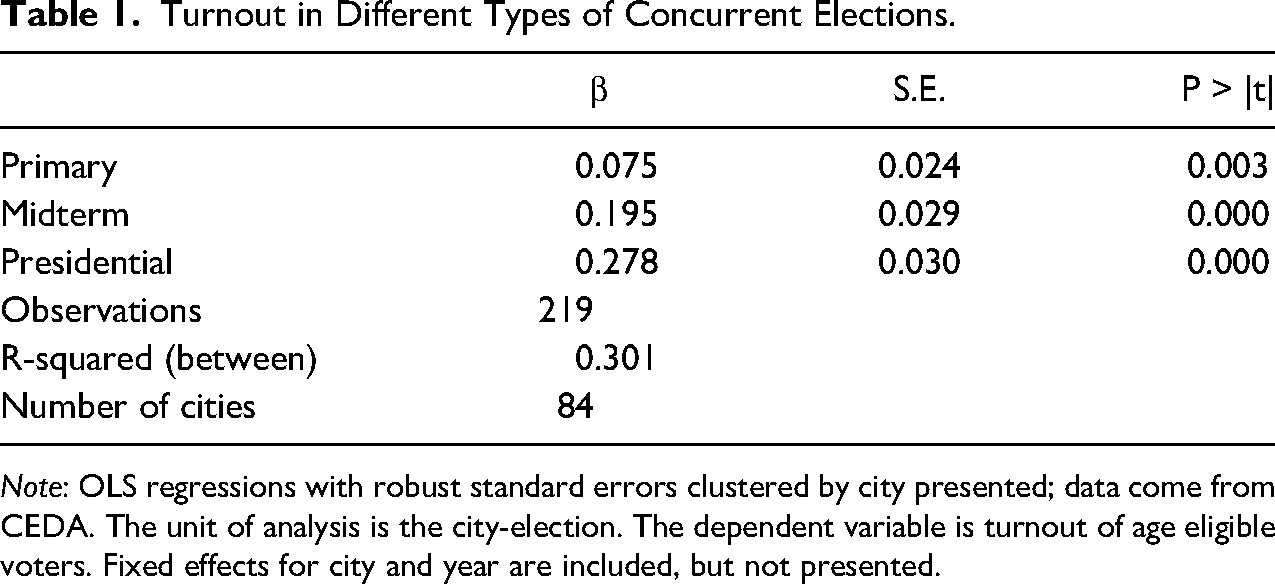
Note: OLS regressions with robust standard errors clustered by city presented; data come from CEDA. The unit of analysis is the city-election. The dependent variable is turnout of age eligible voters. Fixed effects for city and year are included, but not presented.
As expected, we see different turnout increases depending on the type of concurrent election. Elections that are held concurrently with November presidential elections see the largest increase in participation (about 28 percentage points), followed by elections that are held concurrently with midterm elections (about 20 percentage points). Elections that are held concurrently with primary elections see an increase in turnout of about 8 percentage points relative to off-cycle elections.
Composition of the Electorate
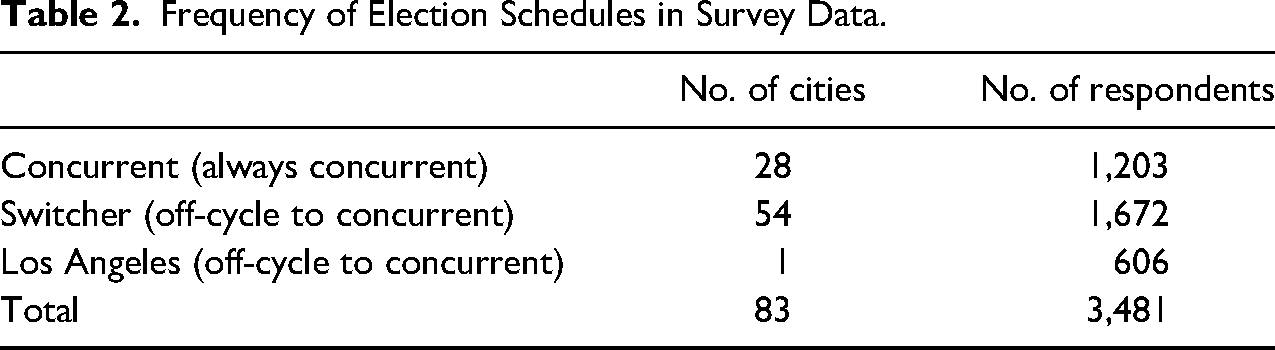
Next, we ask whether these turnout differences affect the demographic composition and policy priorities of the electorate. To answer these questions, we conducted an original survey of registered voters from Los Angeles County in November of 2020 (just after the presidential election). To ensure that we would have respondents from cities with different types of election timing, we divided the cities in LA County into three categories, namely, those that only had concurrent elections during the period of the study, those that switched from off-cycle to concurrent elections after the passage of SB 415, and the city of Los Angeles. Our survey firm, FM3, used the registered voter file to build three separate random samples comprising at least 1000 respondents from the concurrent cities, at least 1500 respondents from the switching cities, and at least 500 respondents from Los Angeles. 5 Because FM3 worked to ensure representativeness by race, age, voter turnout, and partisan affiliation as responses came in, we obtained a slightly larger sample than initially requested. In total, we obtained 3,481 completed responses from eighty-three cities. Table 2 shows how many cities and respondents in our sample fall into each category.
Frequency of Election Schedules in Survey Data.
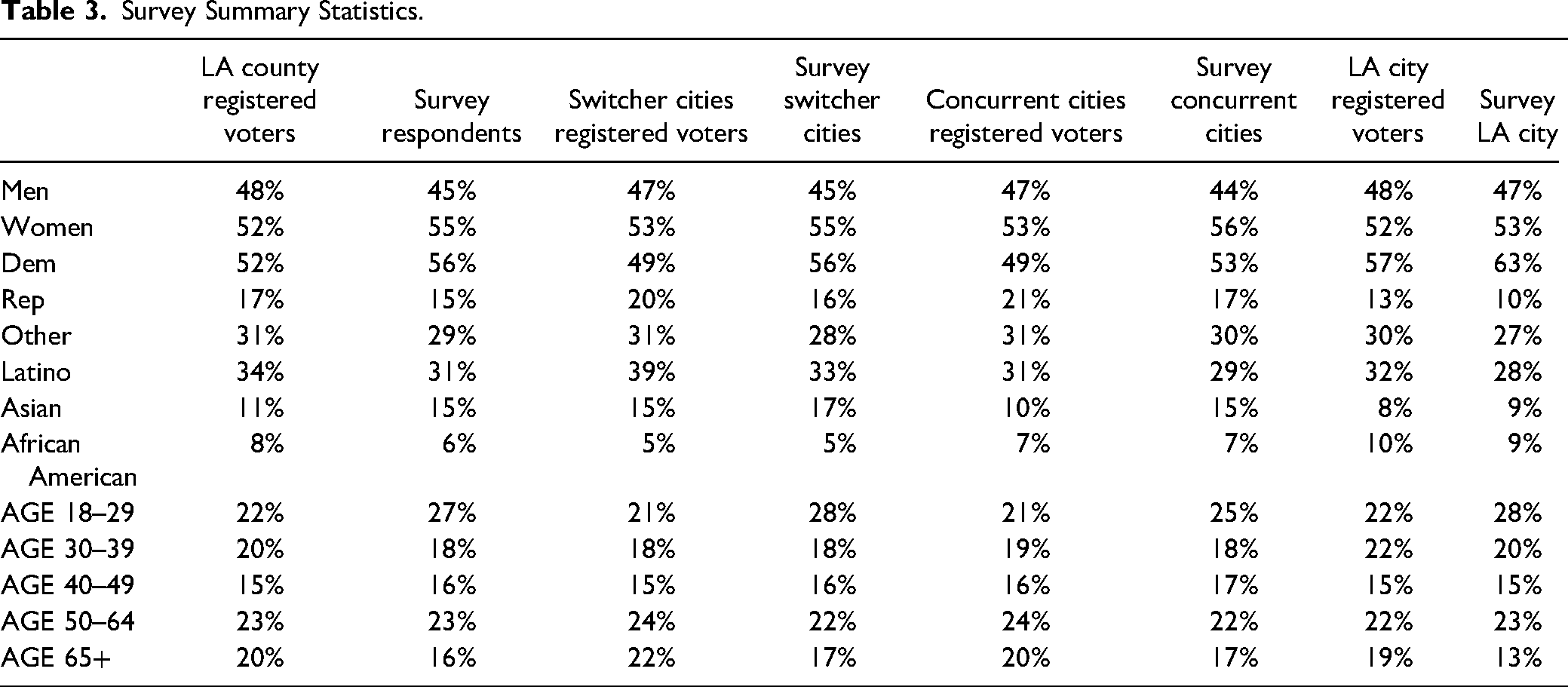
The survey was conducted via the internet, and respondents were contacted through email and text message. Respondents were encouraged to participate by being entered into a sweepstakes to win one of 10 $100 Amazon gift cards. All respondents signed an informed consent form (see online appendix for additional information). Table 3 shows that the survey sample is representative of the three sample frames we specified.
Survey Summary Statistics.
Turnout Inequalities
As explained above, we are interested in determining whether the demographic composition and policy priorities of the electorate differ depending on the timing of the election.
To capture the composition of the electorate, we analyze who turns out to vote and what they care about. Our dependent variable measures whether a voter said that she Turned Out in a local election. We asked every respondent about the
In Appendix Table A2, we present descriptive statistics of the three samples using different strategies for coding turnout. First, we re-coded those not registered as not voting. Second, we make use of a follow-up question in which we asked voters who they voted for in their local election. The measure codes those who stated that they did not recall who they voted for in their local election as zero. Our last alternative coding compared every respondent to information in the voter file to verify turnout. 8 We do not think that this is a reliable estimate of voting in municipal elections for two reasons. The voter file only includes information about whether a voter voted in any election, so we cannot know whether the voter participated in a particular local election. 9 Additionally, turnout data were missing from the voter file for many of the off-cycle elections in our dataset because when elections are held non-concurrently, it is incumbent upon the municipality to report individual turnout to the state and not all do. This resulted in many respondents being coded as nonvoters when they may have in fact participated in local elections. Nonetheless, we created an alternative measure of turnout coded one for those who turned out according to the voter file and zero for those who did not and present these data in Table A2.
We have two types of independent variables: those capturing demographic traits of respondents and those capturing the timing of elections. We use survey responses to measure the demographic characteristics of voters and nonvoters. As independent variables, we include Race, Over Age 45, Gender, Homeownership Status, Income under 75 K, College Degree, and Party ID (with independents as the base category). We use a factor variable for election timing. Elections that were held on June 5, 2018 and March 3, 2020 are coded as Primaries (30 elections); elections held on November 6, 2018 are coded as Midterms (20 elections); and elections held on November 3, 2020 are coded as Presidential (83 elections). All other election dates are coded as Off-Cycle (53 elections) and serve as the base category in our models. We include fixed effects for the three sample frames (Los Angeles, switchers, always concurrent) to allow us to isolate the effect of switching to different types of concurrent elections. These fixed effects allow us to estimate, for example, how the expected turnout differs between off-cycle and November presidential elections for the city of Los Angeles or for the set of cities that changed their election timing from off-cycle elections to primary elections by controlling for the time-invariant characteristics of cities within each sampling frame. These sample frame fixed effects produce coefficient estimates on our timing variables that are nearly identical to including fixed effects for city but are preferable because our survey is representative for the sampling frame, not individual cities. We cluster standard errors by city.
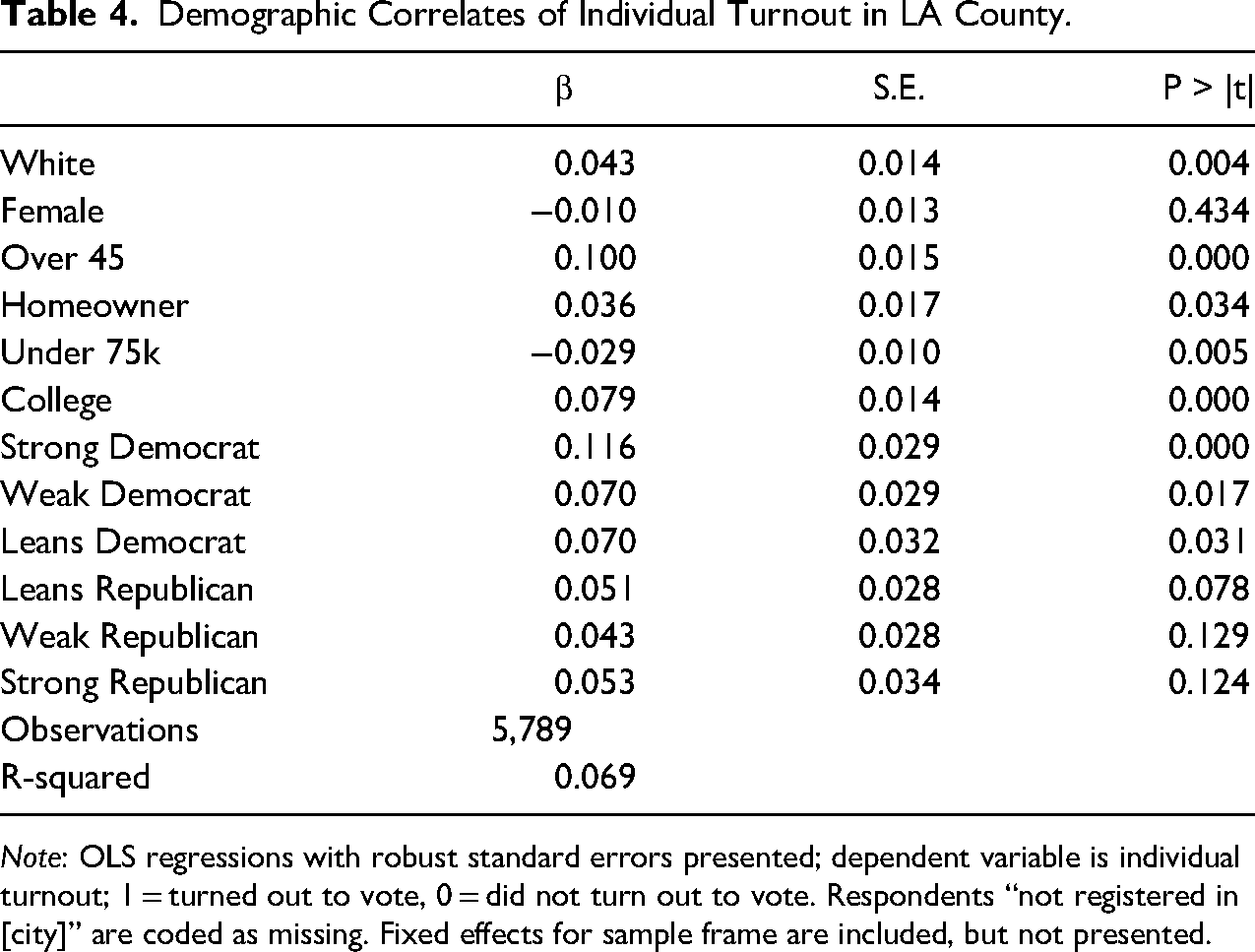
First, we regress individual-level Turnout on respondents’ demographic characteristics to reveal which groups are more likely to participate in local elections overall. We estimate the following model: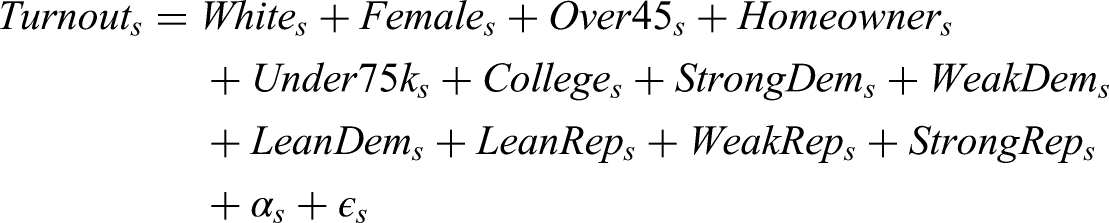
Demographic Correlates of Individual Turnout in LA County.
Note: OLS regressions with robust standard errors presented; dependent variable is individual turnout; 1 = turned out to vote, 0 = did not turn out to vote. Respondents “not registered in [city]” are coded as missing. Fixed effects for sample frame are included, but not presented.
Table 4 reveals that, similar to national level elections, on average, white, older, wealthier, and more educated respondents are more likely to turn out to vote compared to respondents of color, those who are younger, poorer, and less educated. Homeowners and stronger partisans are also more likely to participate compared to renters and weak partisans.
How do these demographic gaps change with election timing? To answer this question, we interact each demographic trait with our factor variable for election timing. We run the interactions in separate regressions and combine the relevant coefficients in the plots below. As in Table 4, our dependent variable measures individual-level Turnout in each election. We add fixed effects for the sample frame, so that our estimates compare the compositions of the electorate when election timing changes. For example, to determine how the probability of turning out for white voters changes with election timing, we estimate the following model: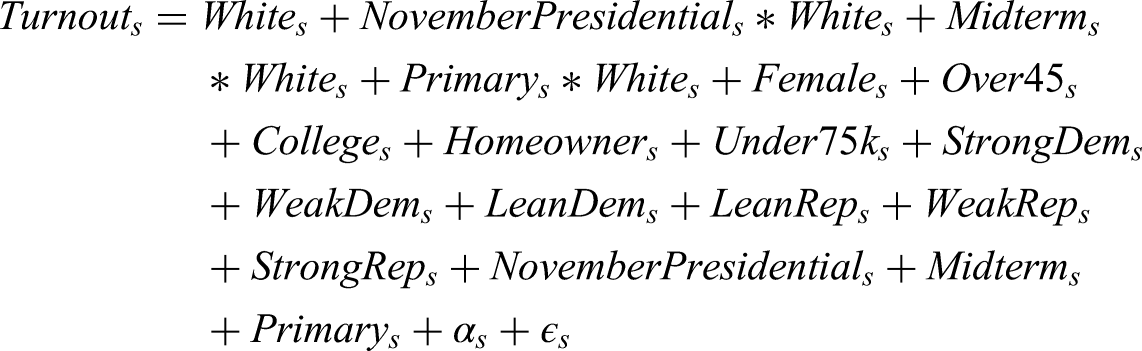
Figure 1 plots the interaction coefficients, which tell us the increase (or decrease) in white turnout (relative to turnout of people of color) in primary, midterm, and November elections compared to off-cycle elections (the underlying regressions are included in Table A3). In the first panel, we display coefficients for each demographic group in primary concurrent elections compared to off-cycle elections. In the second panel, we show the coefficients for midterm concurrent elections compared to off-cycle elections. In the third panel, we display coefficients for presidential concurrent elections compared to off-cycle elections. Coefficients are denoted with black circles along with 90% and 95% confidence intervals (in dark and light gray).
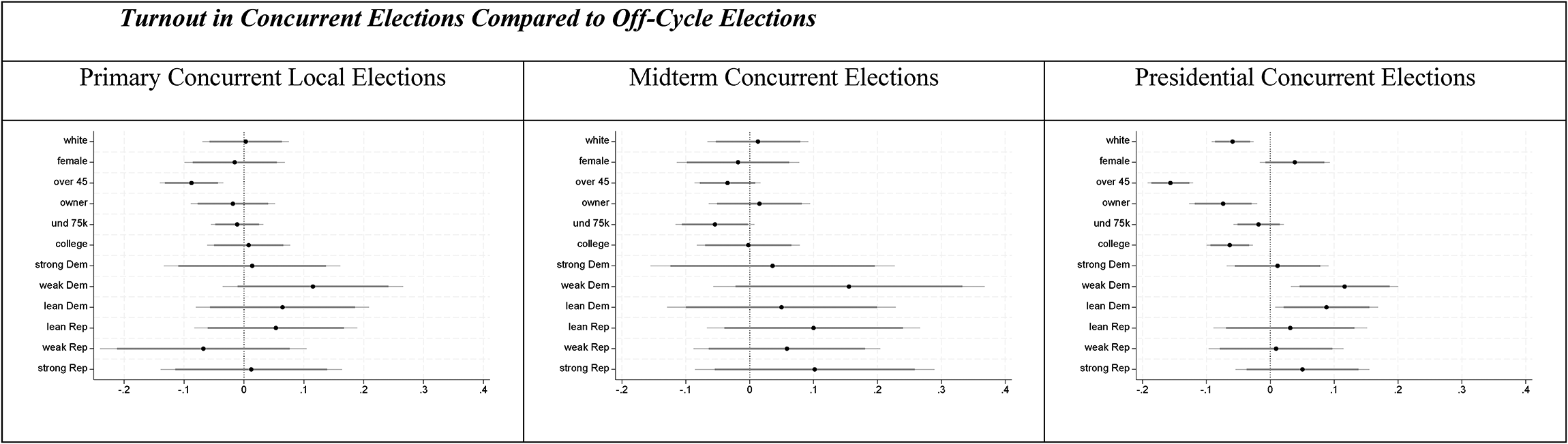
Turnout in concurrent elections compared to off-cycle elections.
Figure 1 reveals that primary and midterm concurrent elections do not significantly change the turnout rates of most groups compared to off-cycle elections. The third panel reveals that younger voters, renters, respondents without college degrees, voters of color, and weak partisans are more likely to turn out when elections are held concurrently with presidential general elections compared to off-cycle elections. In presidential elections, turnout gaps between demographic groups are substantially lessened. For example, renters have a 71% probability of turning out in off-cycle elections compared to an 88% probability in local elections that are concurrent with presidential general elections. Similarly, the probability of participating for people of color increases by 16 percentage points in elections that are concurrent with presidential general elections relative to off-cycle elections. 10
Changes in individual probabilities of turning out matter to the overall composition of the electorate. To see this, we follow the approach recommended by Grimmer et al. (2023) and aggregated voters by election timing within each of our sampling frames. More specifically, we added up all the people in each demographic group who said that they voted in each type of election (off-cycle, primary, midterm, and presidential general) and divided this aggregate figure by the total number of voters in each type of election within each sample. 11 For instance, we noted all of the respondents in our survey who said that they are white and voted in a particular election. We summed these white voters for each type of election (off-cycle, primary, midterm, and presidential general). We then divided this aggregate figure by the total number of voters in each type of election in each sampling frame. This produced an estimate of the composition of the electorate for our different demographic and issue priority groups. To continue with the example, whites comprise 37% of the electorate when elections are concurrent with presidential general elections and 39% of the off-cycle electorate in our Switcher sample. This gives us the share of the voters in each type of election from each demographic group. We present estimates along with 95% confidence intervals for our Switcher and LA City samples (because only these samples have off-cycle elections) in Table 5. Statistically significant differences are in bold.
Aggregation Analysis: Share of the Electorate Represented by Each Group.
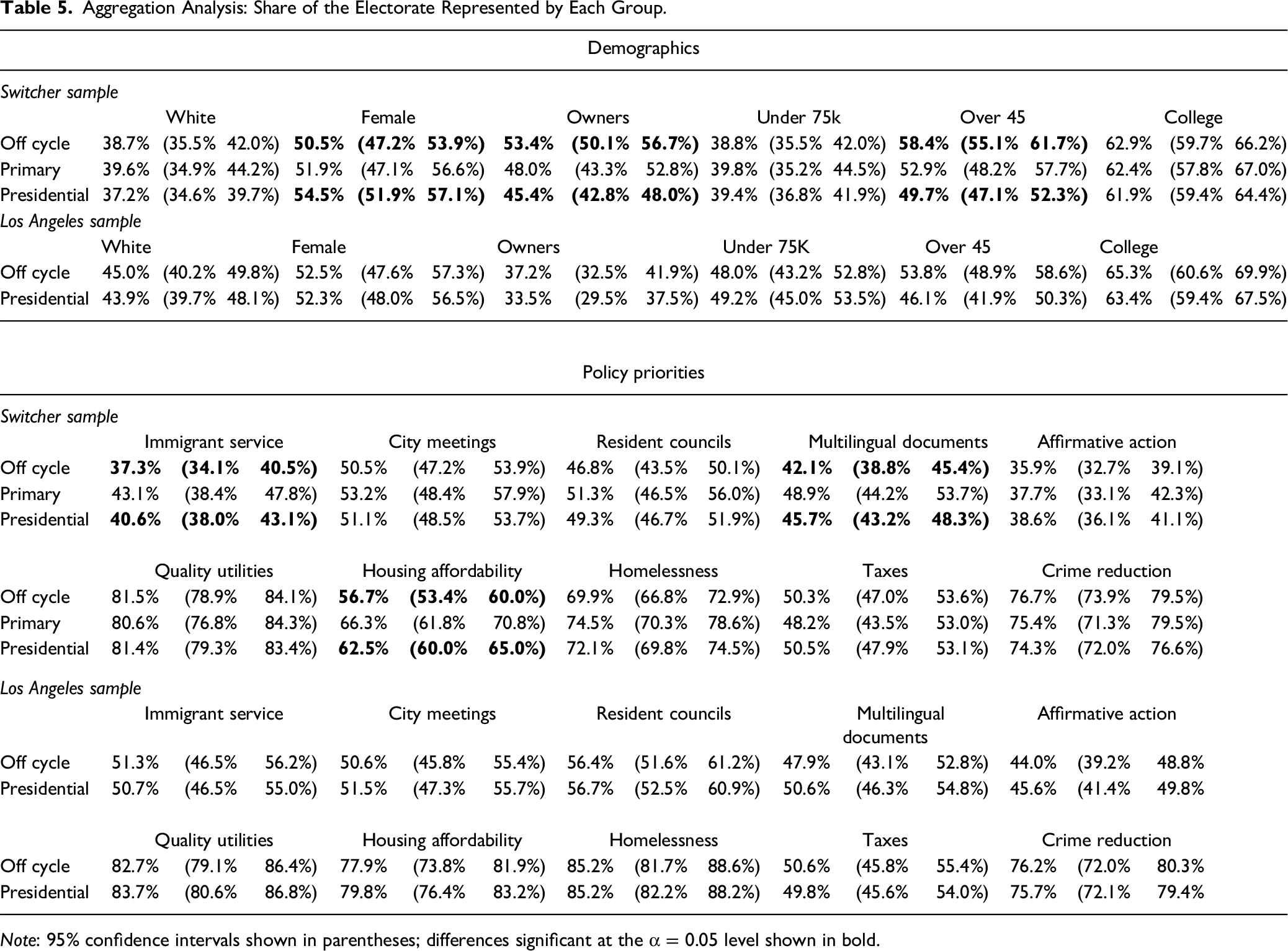
Note: 95% confidence intervals shown in parentheses; differences significant at the α = 0.05 level shown in bold.
We find that compared to presidential general elections, off-cycle electorates have higher shares of older and homeowning voters and a higher share of male voters in our Switchers sample. Additionally, the analysis from our Switcher sample indicates that switching from off-cycle to presidential concurrent elections has the greatest impact on the composition of the electorate. Homeowners make up 53% of the electorate in the off-cycle electorate, 48% in the primary electorate, and 45% in the presidential general electorate. Older voters make up 58% of the electorate in the off-cycle electorate, 53% in the primary electorate, and 50% in the presidential general electorate. Women make up 51% of the off-cycle electorate, 52% in the primary electorate, and 55% in the presidential general electorate. Because SB 415 allows cities to hold elections concurrent with any state or federal election, this means that some cities will witness more representative electorates as a result of the law than others.
Consequences for Representation and Policy Preferences
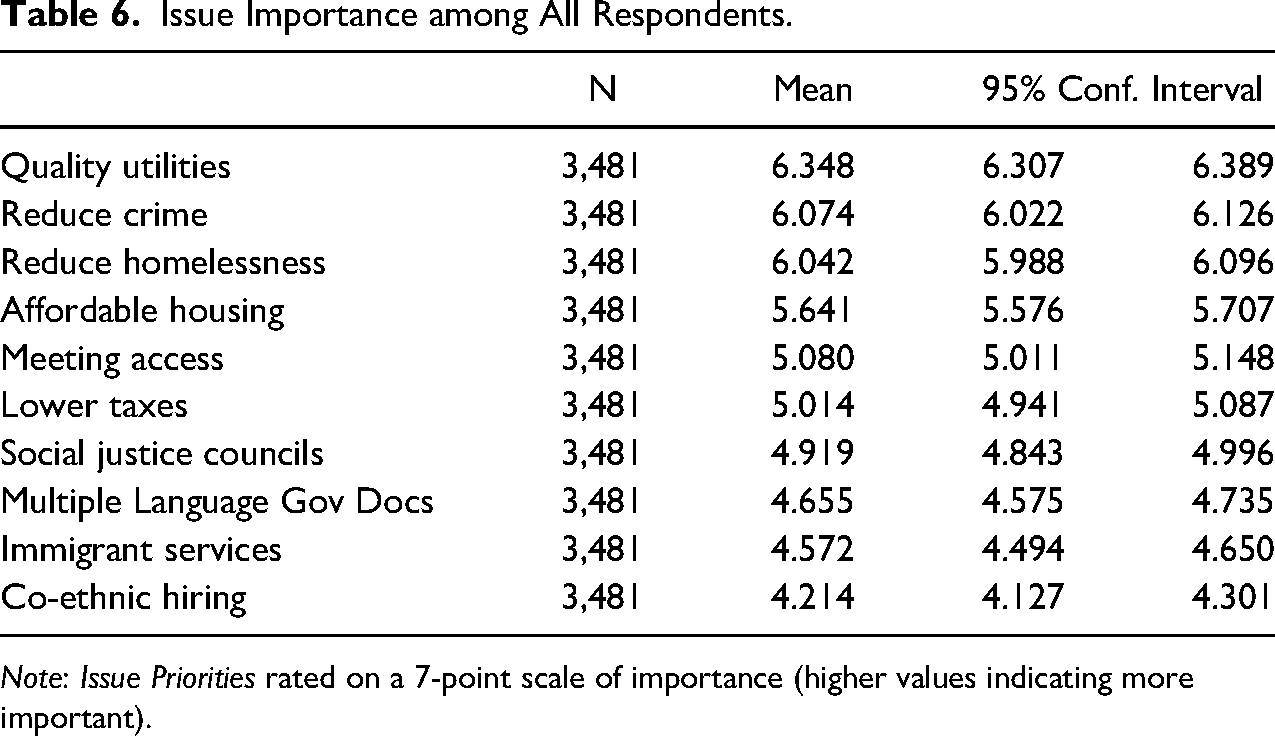
For our final set of analyses, we ask whether concurrency is likely to change political outcomes. If turnout is higher, and the composition of voters differs, the issues that voters prioritize could change as well. So, what do Los Angeles voters care about in local politics? We drew on existing research on Los Angeles by Kaufmann (2004), Sonenshein (1993) and Abrajano, Nagler and Alvarez (2005) to develop a set of ten issues that have been important in Los Angeles politics. The survey asked voters, “How important are the following local issues to you?” The issues included: establishing dedicated services for immigrants; making city council meetings and school board meetings more accessible; establishing resident-led councils to advocate for social justice and fight racial discrimination; having government documents available in multiple languages; hiring more people of my racial/ethnic group in city government; making sure the city provides quality utilities (water, sewage, trash collection); increasing housing availability and affordability; reducing homelessness; lowering taxes; and reducing crime. Voters were asked to rate these issues on a scale of 0–7 with 0 being Not important at all and 7 being Very Important. Table 6 shows how our survey respondents rated these Issue Priorities.
Issue Importance among All Respondents.
Note: Issue Priorities rated on a 7-point scale of importance (higher values indicating more important).
The most important local issues for respondents are ensuring quality utilities, followed by reducing crime, reducing homelessness, and ensuring housing accessibility and affordability. The least important issues listed are having government documents available in multiple languages, establishing dedicated services for immigrants, and hiring more city government employees of the same racial/ethnic group as the respondent.
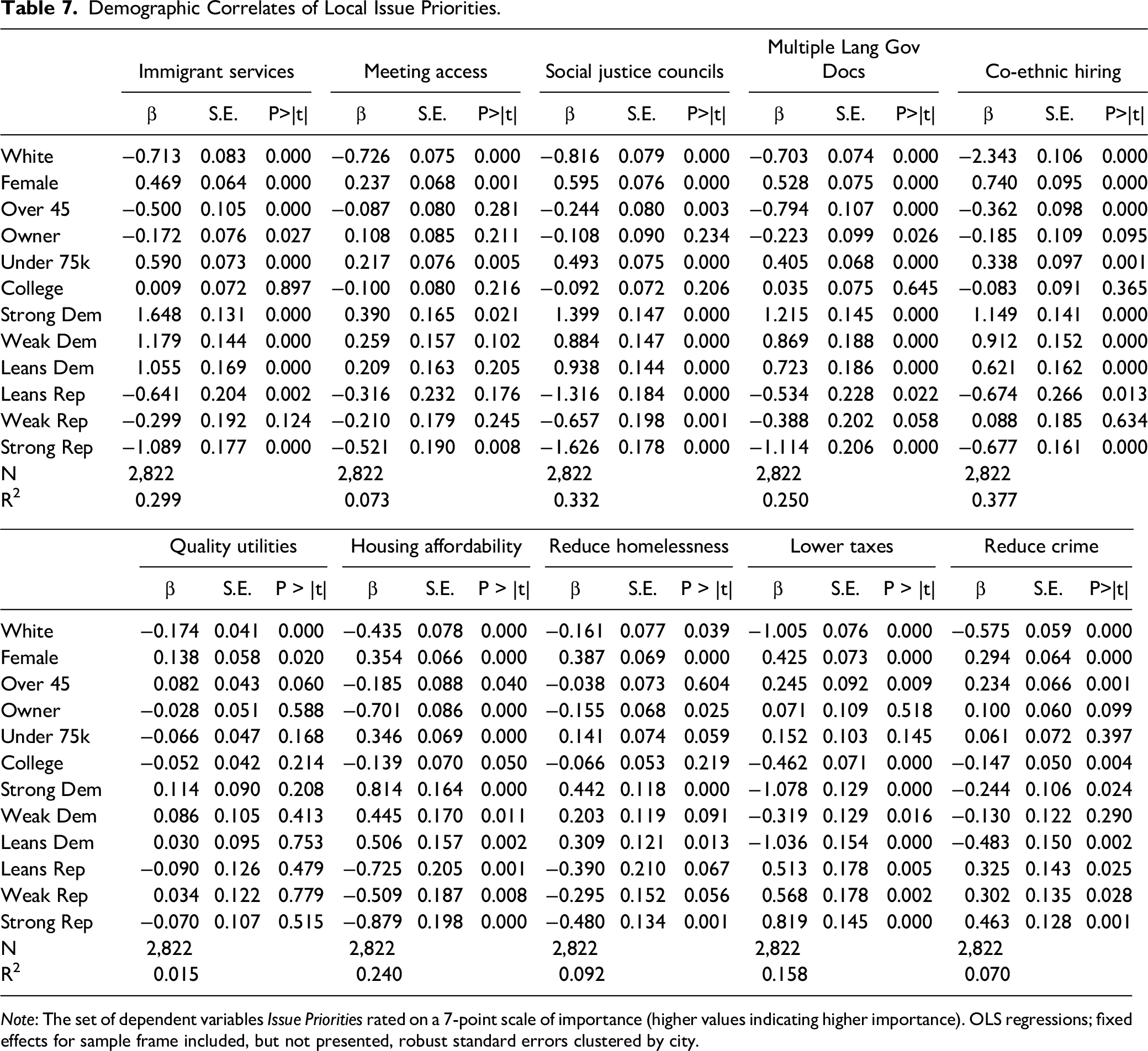
Yet, these aggregate statistics hide important variations across demographic groups. In Table 7, we use our set of Issue Priorities as dependent variables and regress each on the same set of demographic characteristics as we used in Table 4. Each column shows the demographic correlates of voter ratings of the importance of each issue area.
Demographic Correlates of Local Issue Priorities.
Note: The set of dependent variables Issue Priorities rated on a 7-point scale of importance (higher values indicating higher importance). OLS regressions; fixed effects for sample frame included, but not presented, robust standard errors clustered by city.
The table reveals that respondents of color are likely to give higher ratings to local issues across the board compared to white respondents. In additional analysis, we find that more than 50% of respondents of color rate every issue as very important (a score of 6 or 7), while a majority of white respondents only rate the top four issues this highly. A similar pattern appears for women and men (women rate all issues as more important than men). However, the gaps are larger on some issues versus others, meaning that overall prioritization of issues is different across groups. For instance, relative to whites, respondents of color are more likely to prioritize co-ethnic hiring in city government. This makes sense given patterns of the underrepresentation of racial and ethnic minorities in city government. Renters and owners diverge most sharply on the importance of housing affordability. On most issues, Democrats and Republicans take significantly different positions. However, on the highest ranked issue — the importance of providing quality utilities, there is little discernable difference across groups. Everyone wants their garbage collected.
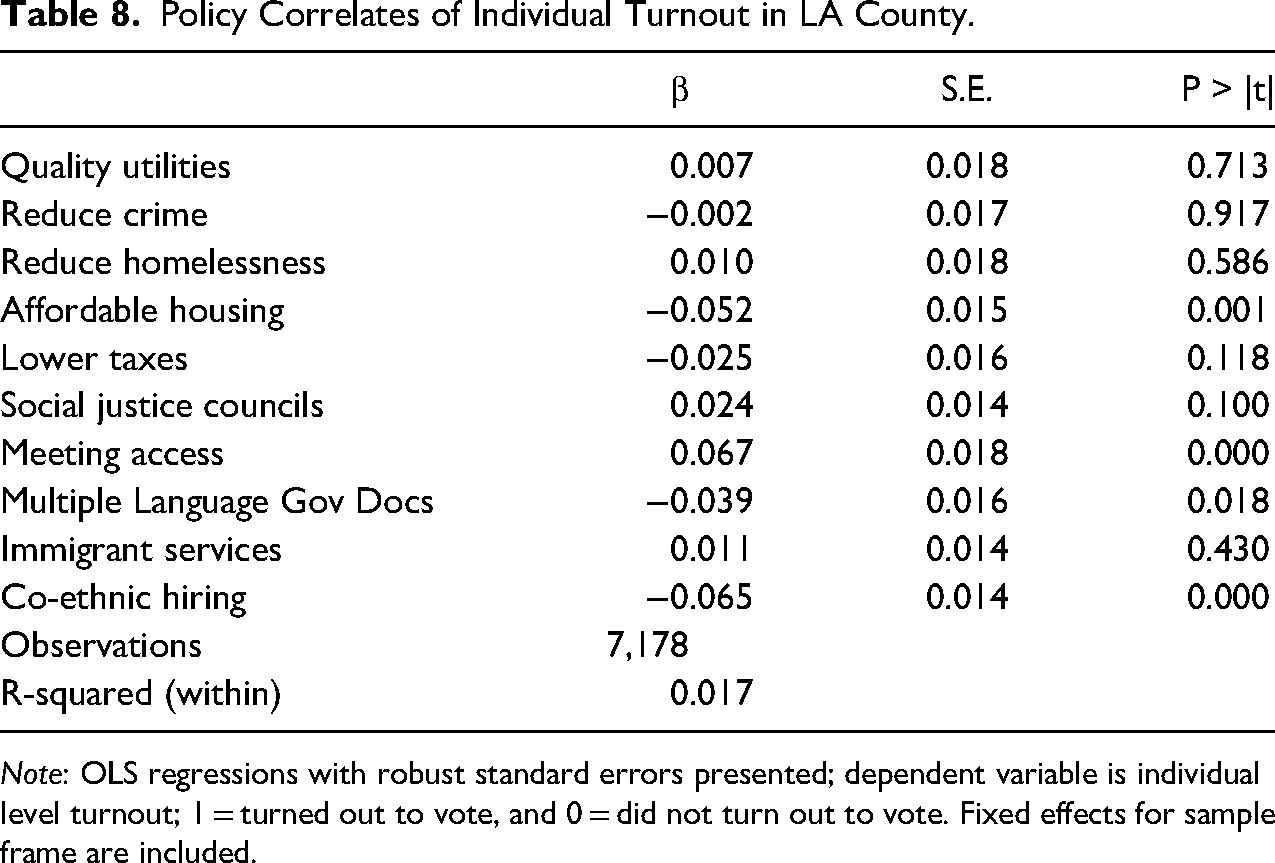
These patterns suggest that election timing could affect issue prioritization in the electorate if respondents who care more (or less) about certain issues are more (or less) likely to participate in elections held at different times. To determine the relationship between policy priorities and turnout, we began by regressing individual Turnout on our set of Issue Priorities. This analysis reveals whether there is a variation in the average turnout rates among people who prioritize various issues. To make the comparisons clear, we transformed each issue priority variable into a dichotomous variable coded one if the issue was rated 6 or 7 by the respondent and zero, otherwise. We regress turnout on these ten dichotomous issue variables. We include fixed effects for sample frame and cluster errors by city. The results of this analysis are presented in Table 8.
Policy Correlates of Individual Turnout in LA County.
Note: OLS regressions with robust standard errors presented; dependent variable is individual level turnout; 1 = turned out to vote, and 0 = did not turn out to vote. Fixed effects for sample frame are included.
Table 8 shows that residents who prioritize meeting access are more likely to turn out to vote on average across our sample of local elections. Respondents who prioritize having government documents available in multiple languages, co-ethnic hiring, and affordable housing are less likely to participate relative to respondents who do not prioritize these issues. The estimated coefficients for the remaining Issue Priorities are not statistically significant, indicating that voters prioritizing these issues are no more or less likely to vote in local elections. Summarizing the results so far, we can see that the issues that are rated as more important by voters of color, younger voters, poorer voters, women, renters, and Democrats according to Table 7 (i.e., government documents available in multiple languages, co-ethnic hiring, and affordable housing) are less likely to be represented in the local electorate according to Table 8.
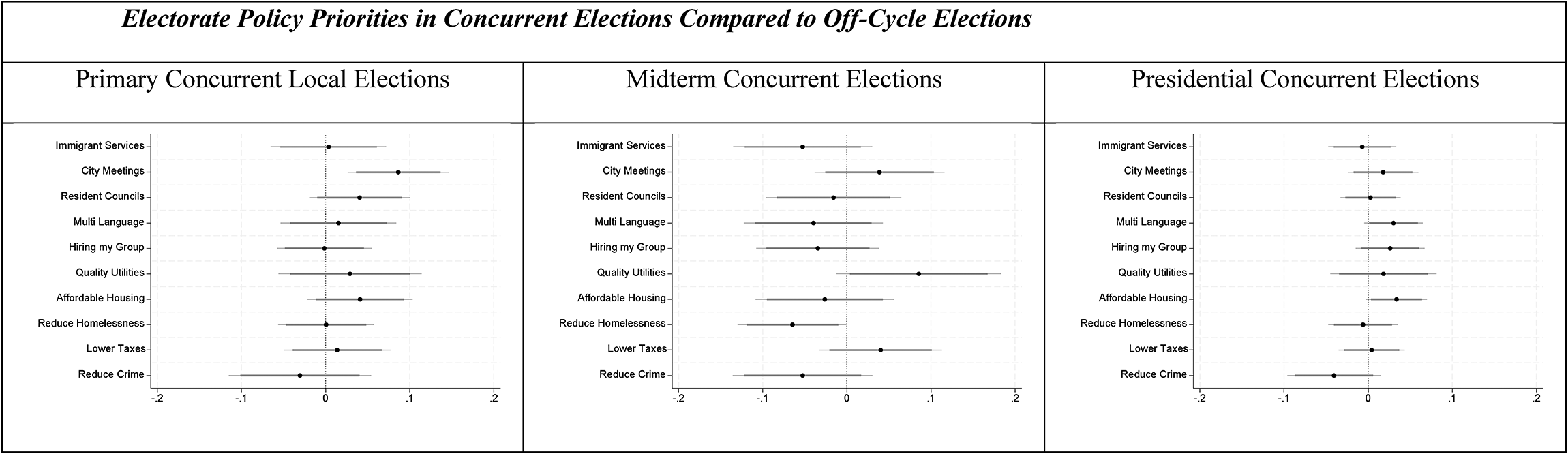
To determine whether the timing of local elections affects the relationship between policy priorities and turnout, we replicate our strategy from Figure 1, replacing the demographic characteristics with policy priorities in our interactions. In this analysis, we regress individual level turnout on our dichotomous issue prioritization variables, interacting each with our factor variable for election timing.
We include fixed effects for sample frame and cluster the errors by city. We plot the interaction coefficients from these regressions in Figure 2 (with the underlying tables included in Appendix Table A4).
Electorate policy priorities in concurrent elections compared to off-cycle elections.
In three panels, Figure 2 shows the estimated effect of issue prioritization on individual level turnout in primary elections, midterm elections, and presidential general elections compared to off-cycle local elections.
The figure reveals no dramatic changes in turnout likelihood based on issue priorities and timing of elections. In only a handful of cases are results significant at conventional levels.
However, using the same strategy of aggregation described above, we find that even these small differences in turnout probabilities can affect the composition of the electorate. In our switcher sample, the presidential general electorate is more likely to prioritize immigrant services, multilingual government document availability, and affordable housing than the off-cycle electorate (see Table 5). The shift in the prioritization of immigrant services and multilingual government documents is most likely attributable to the increased probability of participation among young voters, renters, and voters of color (see Figure 1) who are more likely to prioritize these issues relative to older voters, homeowners, and whites (see Table 7). Yet, dedicated immigrant services and providing multilingual documents were prioritized by less than a majority of voters, even in presidential general elections.
The most meaningful result here is the shift in prioritizing housing access and affordability, which makes sense given that the turnout analysis revealed that local elections concurrent with general presidential elections comprised more young voters and more renters. These demographic groups were more likely to list housing affordability as an important issue but are underrepresented in local off-cycle elections. The changes in the timing of LA County elections from off-cycle to on-cycle not only shifted the demographic composition of the electorate, but also shifted what issues the electorate cares about.
Conclusion
Does the timing of local elections affect voter turnout and political outcomes? Using election data from the California Election Data archive paired with an original survey of more than 3000 respondents in Los Angeles County, we leverage a state government forced change in local election timing. We find that concurrent elections do increase turnout, but the effect is largest when local elections coincide with presidential general elections. When cities hold local elections concurrently with state and national primaries or midterm general elections, we find smaller increases in participation. When cities change the timing of their elections to be concurrent with presidential general elections, the demographics and policy composition of the electorate change. Concurrent electorates featured a greater share of women, younger people, and renters compared to off-cycle electorates.
We also show that the policy preferences of the electorate differ somewhat when cities switch their election timing. Presidential concurrent electorates are more likely to prioritize the issues of housing affordability, making government documents available in multiple languages, and the provision of supportive services for immigrants. We attribute the increased prioritization of these issues across the electorate to the increased participation of young voters, renters, and voters of color who are more likely to prioritize these issues and who are more likely to turn out when local elections are concurrent with general presidential elections.
In conclusion, while we find that the timing of elections can substantially alter the local electorate, not all concurrent elections are created equal. SB 415 mandated that cities change their elections to coincide with statewide elections, but they were free to choose concurrency with primary or general elections and during midterm or presidential years. Only in cities that have switched from off-cycle to concurrent presidential general elections do we see significant changes in the voter turnout, demographic makeup, and policy preferences of the electorate. Understanding the ways in which variation in the timing of local elections affects participation and electorate composition is crucial for policymakers seeking to increase representation in the elections.
Supplemental Material
sj-docx-1-uar-10.1177_10780874241297100 - Supplemental material for What Date Works Best for You? Changes in Electorate Demographics and Policy Priorities in Concurrent Elections
Supplemental material, sj-docx-1-uar-10.1177_10780874241297100 for What Date Works Best for You? Changes in Electorate Demographics and Policy Priorities in Concurrent Elections by Eddie Lucero, Ricardo Robles, Jessica Trounstine and Jonathan Collins in Urban Affairs Review
Footnotes
Declaration of Conflicting Interests
The authors declared no potential conflicts of interest with respect to the research, authorship, and/or publication of this article.
Funding
The authors disclosed receipt of the following financial support for the research, authorship, and/or publication of this article: This work was supported by the Office of the President, University of California.

Supplemental Material
Supplemental material for this article is available online.
Notes
Author Biographies
References
Supplementary Material
Please find the following supplemental material available below.
For Open Access articles published under a Creative Commons License, all supplemental material carries the same license as the article it is associated with.
For non-Open Access articles published, all supplemental material carries a non-exclusive license, and permission requests for re-use of supplemental material or any part of supplemental material shall be sent directly to the copyright owner as specified in the copyright notice associated with the article.
