




Abstract
As automation challenges labour markets across Europe, research in political science is pointing towards the socially corrosive link between such technological change and political dissatisfaction. In this paper, I extend this research agenda by looking at the relation between automation risk and incumbent support in 20 European countries between 2012 and 2018. I find strong support for the notion that workers with substantial exposure to automation risk are more likely to reject governments at the ballot box. Importantly, however, these findings indicate that this anti-incumbent voting is less prevalent among theoretically at-risk workers who enjoy some level of protection, in the form of permanent contracts, co-determination rights or higher educational attainment. As such, this paper argues that technological occupation risk should be seen as feeding into broader labour market risks faced by voters.
Introduction
How does technological change influence politics? Over the past decades, automation has chipped away at the opportunities of many in the labour market (Acemoglu and Autor, 2011). Some have linked this process of occupational change to the success of the radical right in Europe and the U.S. (Gallego and Kurer, 2022; Kurer, 2020). Yet, we still know little about this source of occupational risk interacts with workers’ individual circumstances in the electoral arena.
This paper therefore advances this literature by proposing a more differentiated approach to understanding automation risk. I argue that the risks workers face are not only a function of how susceptible their job contents are to automation but also of the resources at their disposal to absorb those technological shocks. Using four waves of the ESS across twenty EU countries, I estimate a series of logistic regressions to understand how automation blends in with within-occupational (Pahontu, 2021) differences to determine workers’ support for incumbents across Europe. The findings suggest that technological risk is partly conditional on institutional and individual-level factors which empower some workers and put others in particularly precarious situations.
I begin this paper by reviewing arguments about the relation between automation risk and political behaviour. This analysis in this paper then proceeds via two steps. First, I demonstrate there is a robust link between occupational automation risk and anti-incumbent voting. In the second step, I introduce respondent-level labour market resources (Pahontu, 2021) into the equation. More specifically, I look at the intermediating role of contract-type, co-determination rights and education on the relation between occupational risk and incumbent support.
Automation, political preferences and labour market resources
Most citizens in wealthy democracies rely on work to secure an income, making the jobs we do not just important markers of social status but essential to sustain a decent standard of living. Since liabilities and other expenses tend to be more certain than jobs, for most households it does not just matter how much they earn (Downs, 1957) but also how secure that income is. In an age of ubiquitous innovation, one increasingly important source of such labour market risks is automation or technology that replaces workers.
Existing work has presented two arguments on how this increasingly salient source of labour market risk affects politics in advanced democracies. On the one hand, there is literature that proposes voters challenged by automation make redistributive claims on the state (Kurer and Häusermann, 2021; Im, 2021; Sacchi et al., 2020; Thewissen and Rueda, 2019). Workers seem to be ‘picky’ in their particular redistributive preferences. Kurer and Häusermann (2021) find that risk-exposed workers tend to support increased spending on unemployment benefits but not on pensions, while Sacchi et al. (2020) find these individuals to prefer traditional welfarist measures over newer proposals such as Universal Basic Income.
A second strand of the literature points to a surprising link between automation and far-right support, through the mechanism of status anxiety (Gidron and Hall, 2017). Rather than being primarily concerned about their future earnings, automation-exposed care about the loss of social status they will experience by losing their job to automation. Frey et al. (2018) demonstrate strong support for Trump in Midwest commuter zones that have been highly exposed to robotisation leading up to the 2016 presidential elections. Anelli et al. (2021) similarly exploit regional robot exposure rates, as well as individual-level voter data, to link automation to far-right support in Europe. Kurer (2020) tracks employment trajectories to argue the perception of economic decline leads voters to right-wing populist parties.
This debate has largely relied on occupational indicators which measure automation risk by determining the susceptibility of jobs’ task structure to automation. While this is a useful tool to tackle this complex question, that approach has blended out the basic premise that objective automation risk is not only a matter of job content but is also likely co-determined by the labour market resources workers have at their disposal to absorb occupational risk (Pahontu, 2021). We know from the literature in comparative political economy that there are several important parameters which help to make employees more resilient to labour market shocks and therefore play an important role in preference formation (Ahrens, 2023; Burgoon and Dekker, 2010; Halikiopoulou and Vlandas, 2016; Pahontu, 2021; Rehm, 2016; Rueda, 2007).
I explore the intermediating effects of three labour market resources on the link between automation risk and voting patterns. First, the type of contract workers have is important. There is ample evidence suggesting patterns of political behaviour differ between workers in temporary employment and those benefiting from permanent contracts (Burgoon and Dekker, 2010; Halikiopoulou and Vlandas, 2016; Häusermann et al., 2015; Rueda, 2007; Vlandas and Halikiopoulou, 2021). Not only would such workers, all else being equal, be more expensive to fire but they might also have greater leverage to negotiate the outcomes of innovation with their employers. I similarly expect co-determination to intermediate workers’ perception of their occupational risk. Workers with extensive information and consultation rights tend to feel more at ease with firm-level innovations (Bellmann et al., 2017; Genz et al., 2018; Haipeter, 2020) due to the increased say in decision and reduced uncertainty over the impact of innovations.
Two-By-Two of the Basic Argument.

How can we expect automation risk, and the different ways in which individuals might experience it, to materialise at the ballot box? Prior public opinion research on automation indicates that automation-exposed voters predominantly hold ego-tropic economic concerns (Dekker et al., 2017; Heinrich and Witko, 2021). Yet, these citizens often face an uphill battle in identifying parties that to blame for their exposure to automation, let alone who will support them on these issues since that most parties in rich democracies support speeding up the pace of this type of technical change (Köning and Wenzelburger, 2019).
In line with previous work by Baccini and Weymouth (2021) and Gallego et al. (2022a), who attribute technical and industrial changes to support for governing parties, I argue that this ambiguity leads voters, who fear losing their jobs to automation to reject incumbents. Within the framework of representative democracy, governing parties stand out as politically accountable for the broader economic changes confronting citizens. This is especially the case when it is hard for voter to differentiate between party positions. Whereas previous scholars suggested this ambiguity favours far right parties, it is worthwhile noting that some parties on far right such as Belgian Vlaams Belang actively support automation and advocate for technological change as a substitute for labour migration. Considering that voters are prone to making quasi-rational decisions when attributing blame (Wolfers, 2002; Achen and Bartels, 2017) it therefore makes sense that they might vote against incumbents, particularly in the context of retrospective voting.
Beyond its theoretical appeal, the focus on incumbent voting also serves several other purposes. First, this focus helps to investigate whether patterns of incumbent voting that have been picked up in majoritarian electoral systems (Baccini and Weymouth, 2021; Gallego et al., 2022a) are replicated in other settings. Methodologically, meanwhile, this approach is helpful since the incumbency has a weaker ideological association with the key hypothesised interactions. Both left- and right-wing parties have stated positions on labour market conditions and education policies which are likely to be internalised by voters. This political association with the interaction variables could therefore make it harder to understand whether voters act different because of the insulating qualities of the resources or because of the political positions of the party captured in the dependent variable. Finally, empirically this focus also helps to investigate whether patterns of incumbent voting that have been picked up in majoritarian electoral systems (Baccini and Weymouth, 2021; Gallego et al., 2022b) are replicated in other settings.
Based on the discussion, I test the following hypotheses. • H1: Voters who face high exposure to automation are more likely to vote against the incumbent. • H2: Voters who are exposed to automation are less likely to vote against the government if they have a long-term contract. • H3: Voters who are exposed to automation are less likely to vote against the government when they have firm-level co-determination. • H4: Voters who are exposed to automation are less likely to vote against the government if they have enjoyed more education.
Data and methodology
I estimate a series of logistic fixed-effects models with election, region and wave dummies using the last four waves of the European Social Survey (ESS), running from 2012 to 2018 in 20 European countries.
I use a binary dependent variable in which voters are designated as voting for or against the government based on whether or not the party they supported in the last national election was in government or opposition, at the time.
For the main independent variable I rely on the Frey and Osborne (2017) index (F&O), ranging between 0 and 1 (in which higher values denote more risk). This measures the likelihood of automation for respondents’ jobs building on the task approach in labour economics (Acemoglu and Autor, 2011). In this framework, job automatability is based on the range of tasks performed within that job, as well as the automatability of those discrete tasks. Frey and Osborne use expert judgement (in the form of Oxford University Engineering Department researchers) as well as the identification of technological bottlenecks to determine the automatability of tasks. Task automatability is then translated into overall job-level risk by using O*NET data on the tasks performed within each job category. Figures 1 and 2 plot the distribution of this measure across occupations and countries, respectively. Frey and Osborne (2017) by occupation (non-exhaustive list). Distribution of Frey and Osborne (2017) in ESS.

To test H2-4, I use specific questions within the ESS that are repeated across all observed waves. Firstly, to test the importance of contract types I use respondents’ classification of their contract as being ‘unlimited’ or ‘limited in duration’. To capture co-determination, I leverage a question that proxies this dimension by asking respondents to rank between 0 and 10: ‘I am allowed to influence policy decisions about the activities of the organisation?’ Finally, education is also measured as a continuous variable as the total years of schooling enjoyed by respondents at the time of their response. All of these variables are then individually interacted with the main occupational indicator by F&O. The baseline model also includes further controls at the individual level. Here, I follow the literature (Gingrich, 2019; Thewissen and Rueda, 2019) by controlling for some of the most important parameters in the form of age, income, education, religiosity and urban–rural.
The use of regional fixed-effects here is to account for unobserved local-level heterogeneity, principally in the form of socioeconomic conditions that could mediate support for incumbents. The use of election dummies, in turn, is based on the insight that factors related to election cycles (such as the nature of the incumbent, campaign dynamics and scandals) are likely to play a significant role in explaining incumbent support.
As automation risk is a hard concept to measure, the main F&O indicator used in this study has come under some critique (see Frey, 2021). One prevalent critique has been that its reliance on technical experts exposes the measure to hubris, meaning it potentially overestimates some risks. At the same time, the measure assumes task contents are consistent within occupational groups as well as across countries. As a result of some of these limitations, several competing indicators have been created. To check the validity of my empirical strategy and findings I conduct extensive robustness tests, including the use of two alternative IVs: the Arntz et al. (2016) and RTI (Goos et al., 2014). For further details, please consult the online appendix.
Results
Baseline results
Baseline Estimation of Incumbent Support.

Robust standard errors are in parentheses ***p < 0.01, **p < .05 and *p < 0.1.
Conversely, other coefficients that we might take to signal higher degrees of labour market security such as age, income and education all point in the other direction. Older, better-educated and better-paid voters are much less likely to vote against the incumbent. In fact, each extra year spent in education predicts around a 2% increase in the relative likelihood of voting with the incumbent. The effects of jumping from one income decile to another or a 1-year increase in age, meanwhile, are around 11% and 1.7%, respectively. Findings from the mixed-effects estimations in models 2 and 4 echo the same story while also confirming the notion that there is a significant variation from election to election as well as between regions. In line with previous work, this lends credibility to the basic notion that across Europe, automation risk is an electorally salient issue which leads voters to reject the government, plausibly through blind retrospect (Autor et al., 2016; Baccini and Weymouth, 2021; Jensen et al., 2017; Kurer, 2020).
The appendix reports further robustness tests which give further confidence in these results. These estimations suggest the results are more or less stable when we consider further confounders such as observants’ attitudes towards migration, social background or the ideology of the incumbent. Most importantly, the main findings hold up with the inclusion of occupational fixed effects and with the inclusion of an alternative IV, though it is worth noting that the inclusion of occupational FE does affect the significance of the findings (p < .05).
Individual-level labour market resources and occupational risk
How does this between-occupational effect interact with within-occupational differences in labour market resources? I proposed that the likelihood of voting against the incumbent would be smaller for workers facing occupational automation risk if they had either a. a permanent contract, b. firm-level co-determination and/or c. extensive education.
Figure 3 presents the results with regards to contract type where, for the purpose of clarity, I plot two critical groups: low automation and high automation risk workers, defined as individuals who are on or above the 0.9 or below the 0.1 F&O threshold, respectively. These results have been obtained using the same specifications as the baseline model in column 3 of Table 2 where the main regressor is interacted with the labour market resource in question. Interaction effect between occupational automation risk and contract type on incumbent support.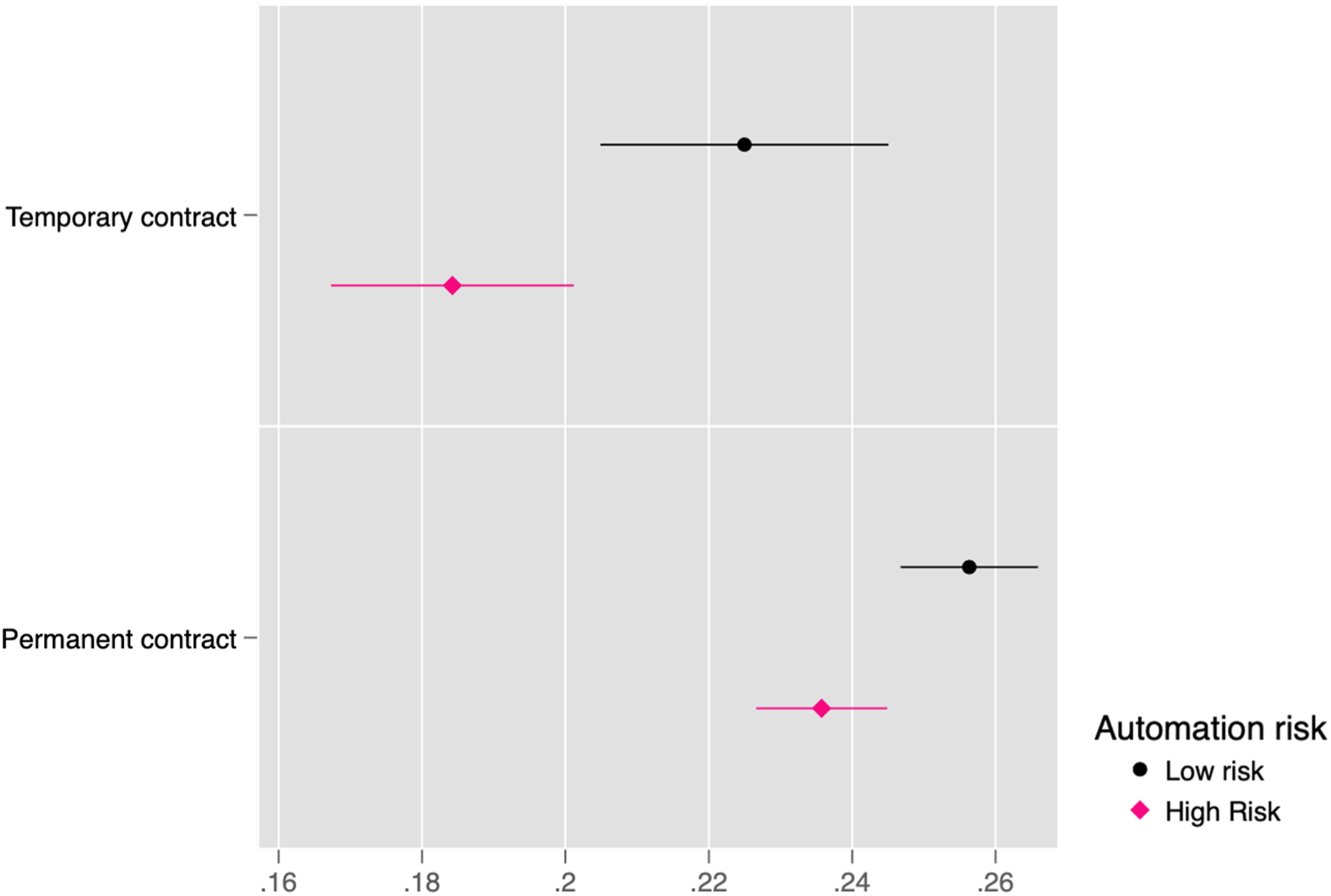
First, the main effect of contract type is strong. This tells us that support for the government is greatest (an estimated difference of some 18.7%) among workers who enjoy the comfort of a stable employment contract. The importance of contracts does not wipe out the main effect of automation risk: routine workers in precarious contracts remain more prone to vote against the government than non-routine workers holding the same type of contract. Second, poor contracts amplify the effects of automation risk on incumbent support. The gap in the probability of voting for the government between workers with and without automation risk is much more pronounced for employees on temporary contracts.
Figure 4, then, presents the results for co-determination and a similar, but weaker, picture emerges here. Firstly, the main effect of co-determination is strong. The main effect of automation risk, meanwhile, is less pronounced. This suggests that differences between levels of co-determination are more important for incumbent support, than differences in automation risk within those categories. For workers in unautomatable jobs, this means we expect a 37% fall in incumbent support for workers without meaningful co-determination compared to those with maximal influence. This effect is compounded by another 13% for those facing substantial automation risk, though this finding is not statistically significant. Interaction effect between occupational automation risk and co-determination on incumbent support.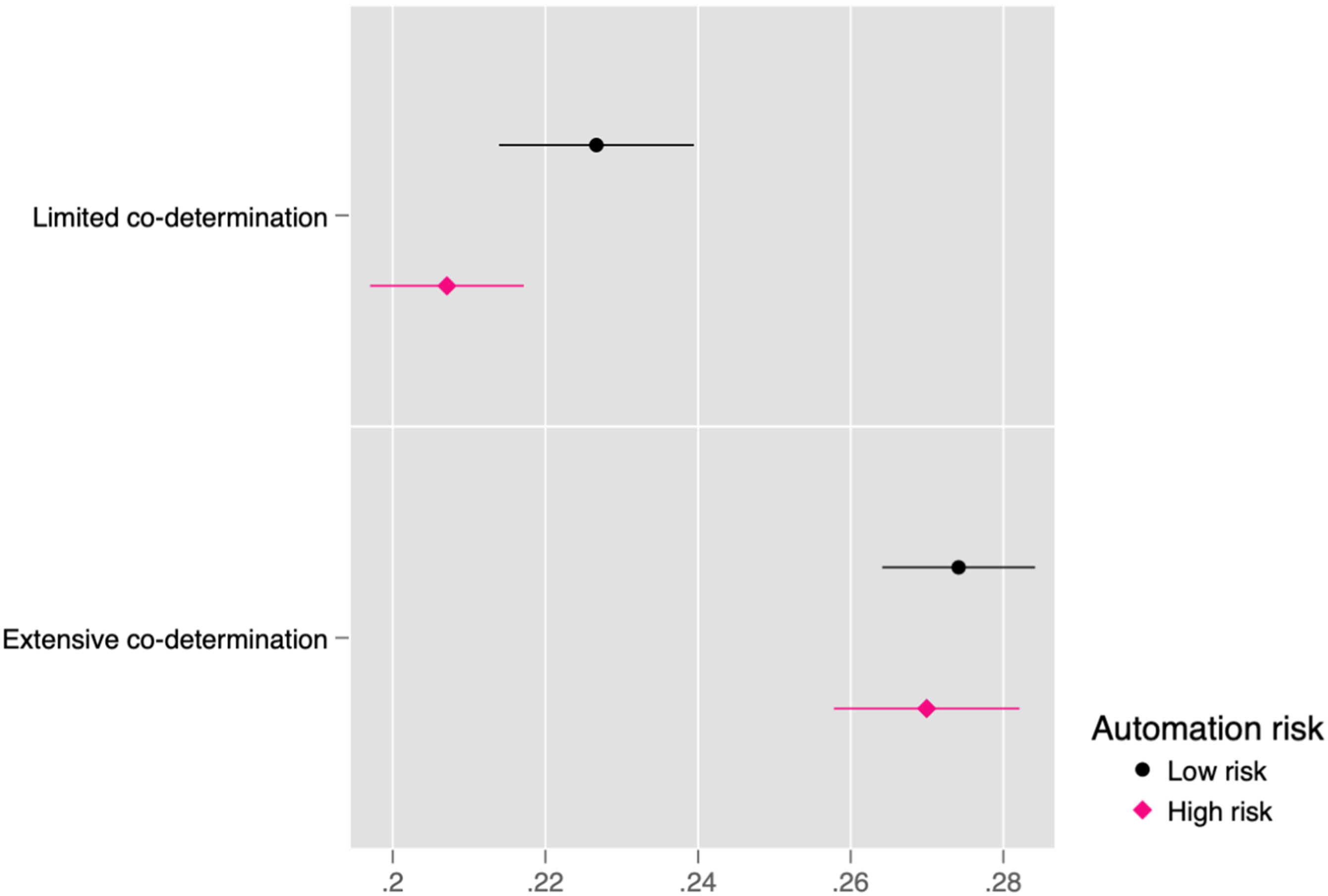
Realistically, real-world differences in firm-level co-determination, particularly within countries, are unlikely to be so binary but the magnitude of this effect means that even marginal differences are important for incumbent support. It is worth emphasising that the relative importance of co-determination here does not necessarily go against the argument presented here. For one, the main effect of automation risk remains statistically significant while can also clearly observe an interaction effect, similar to the one found for contract type. Most importantly, from an institutionalist perspective this finding makes perfect sense: Being in an automatable occupation is likely to be far less of a fazing experience when you hold significant power over firm decisions.
Finally, we turn to education in Figure 5. More than in the two previous estimations, the effects of education seem to strongly go hand in hand with those of automation risk. Workers in automatable jobs who have only completed minimal education are significantly less likely to support the government than any other group, even other employees with similar educational backgrounds. Each additional year of education, meanwhile, decreases the likelihood that workers in these at-risk jobs vote against the government by some 3.5%. This paints a stark picture that suggests education and automation risk are pieces of the same puzzle when it comes to incumbent support and political (dis)satisfaction more broadly. Interaction effect between occupational automation risk and education on incumbent support.
Figure 6 pulls together the insights from the three above-discussed sources of labour market resources. It shows predicted incumbent support among voters with high automation risk for different levels of aggregated labour market resources (i.e. high is minimal 2, medium is 1 and low is the absence of resources). The observed, and significant, decline in predicted government support as the level of resources falls, quite nicely encapsulates the idea that automation risk and broader labour market position interact when it comes to voting behaviour. Concretely, voters with favourable labour market resources are around a fifth more likely to support incumbents than peers who cannot draw on the same resources. Again, this is not necessarily a traditional labour market story about voters in ‘bad’ jobs. Automation threatens jobs on either end of the occupational ladder and is most strongly correlated with middle-skilled jobs. What these findings do pick up on is the risk among exposed voters in the labour market who cannot fall back onto key labour market resources. Put together with the previous findings, this again gives us a strong indication that workers think about automation risk in a differentiated way and can reasonably approximate their own overall risk status. Predicted margins of support for the government among voters with high automation exposure by levels of labour market resources.
Conclusions
Technological change and automation are here to stay. As we have seen in the past, this almost inevitably means significant adaption in labour markets and product markets as well as the creation of winners and losers. This paper, therefore, analysed the link between occupational automation risk, incumbent support and individuals’ capacity to adapt to technical change in Europe.
Looking at the impact of this occupational risk on voters’ support for the government in 20 European countries, a clear pattern emerged. Workers facing the danger of seeing their job automated were significantly more likely to cast votes against the incumbent. This finding was backed up by further evidence (in the appendix) demonstrating that these same workers are far less satisfied with the government and perceive their jobs as being not very secure.
Crucially, however, my results indicate that this automation does not stand on its own. That is to say, automation risk is only one part of broader labour market risks that voters might channel into anti-incumbent sentiments. This means that at-risk workers lacking permanent contracts, significant co-determination and/or a strong education to fall back on, form a constituency that is particularly likely to reject incumbents. However, when those same voters are equipped with the tools to adapt to the technological challenge, this antipathy seems to largely dissipate.
This paper, therefore, makes two contributions to the existing literature. It specifically demonstrates how anti-incumbent votes driven by automation risk are particularly dominant among those workers facing the most pressing material risks. In line with previous work done by Pahontu (2021) and Vlandas and Halikiopoulou (2021), these findings highlight the importance of considering important sources of within-group variation for understanding the effects of economic shocks and insecurity on political behaviour. Interestingly, these conclusions also line up with work on the differentiated effects of automation across institutional settings (Belloc et al., 2022; Van Overbeke, 2023).
While the three specific sources of that variation explored here obviously differ somewhat in how they affect individuals, they share some important characteristics. That is to say, they help to make the jobs and careers of workers who hold them more resilient because they confer workers with key resources to absorb and pro-actively ward off labour market risks. These findings therefore line up with earlier work on the interplay between automation risk and broader risks workers face in the labour market (Burgoon and Dekker, 2010; Pahontu, 2021). For democratic societies, this suggests the crux of the problem of keeping workers on board with technological transitions is about giving them the tools and resources to adapt to these changes.
Secondly, this paper also widens up the empirical scope of the analysis of automation’s effects on democracies by looking at more than 20 European countries. In doing so, this paper shows that anti-incumbent voting is a particular feature of this story and that this trend is widespread. While the focus on incumbents has helped to understand some of the political dynamics of technological change, this particular outcome variable also leaves some questions unanswered; more work can be done to disentangle the intermediating effect of labour market resources on directional voting patterns.
So, where does this leave us? There is a reason to be cautiously optimistic. If political dissatisfaction among workers facing occupational automation risk is primarily driven by workers who presently cannot easily adapt to technological changes, then the list of possible solutions to this problem is plentiful. A wide range of policies, from strengthening unions and social dialogue to better contracts, retraining opportunities and generous unemployment support, could go towards diminishing the risks perceived by some workers.
Supplemental Material
Supplemental Material - It’s the robots, stupid? Automation risk, labour market resources and incumbent support in Europe
Supplemental Material for It’s the robots, stupid? Automation risk, labour market resources and incumbent support in Europe by Toon Van Overbeke in Research & Politics.
Footnotes
Acknowledgements
I want to thank Bob Hancké, Saul Estrin, Dustin Voss, Peter Hall, Brian Burgoon, Andrew McNeil, Catherine Boone, David Soskice, Anke Hassel, Thomas Kurer, Tomasso Crescioli, Tom Hunter, Jonathan Hopkin, Jonas Lefevre and many others for the helpful comments on earlier versions.
Declaration of conflicting interests
The author(s) declared no potential conflicts of interest with respect to the research, authorship, and/or publication of this article.
Funding
The author(s) received no financial support for the research, authorship, and/or publication of this article.

Data Availability Statement
Data is available upon request but includes proprietary materials.
Supplemental Material
Supplemental material for this article is available online (https://dataverse.harvard.edu/dataset.xhtml?persistentId=doi:10.7910/DVN/S3LR9Q&faces-redirect=true).
References
Supplementary Material
Please find the following supplemental material available below.
For Open Access articles published under a Creative Commons License, all supplemental material carries the same license as the article it is associated with.
For non-Open Access articles published, all supplemental material carries a non-exclusive license, and permission requests for re-use of supplemental material or any part of supplemental material shall be sent directly to the copyright owner as specified in the copyright notice associated with the article.
