



Abstract
Cultural polarization divides European public opinion on moral issues, from Italy’s refusal to register children of same-sex couples to abortion protests in Poland. These divisions stem from historical church-state conflicts in various religious cultures. This polarization is particularly strong in Catholic countries but less so in Protestant ones. Using data from 19 European democracies, I show a persistent gap between Catholic and Protestant countries. On the other hand, I show a limited effect of economic prosperity. Developed countries no longer lead in moral issue divisions, with recent surveys showing no or reversed differences. Younger generations are no less principled on moral issues in the Catholic contexts, with cohort differences in polarization even growing significantly between 2008 and 2017, highlighting the enduring impact of religious traditions among younger cohorts.
Introduction
Values are an essential source of friction in European politics that has to be considered alongside the classical economic self-interest (Kriesi, 2010; Kriesi et al., 2012; Rovny and Polk, 2019). In many European countries, value divisions currently overshadow class divisions in voters’ minds and are the primary dimension of political conflict (Borbáth et al., 2023; Zollinger, 2024). This transformation of the political space highlights the shifting roles of economic issues, which involve considerations of one’s financial situation and self-interest, and non-economic issues, which are sometimes labeled “cultural” or “social” issues (Baldassarri and Gelman, 2008; Layman and Carmines, 1997).
Morality issues (such as sexual morality or end-of-life decisions), more specifically, reappeared in various European contexts. In the United Kingdom, the awareness of the term “culture wars” skyrocketed in recent years (Duffy et al., 2023). These issues, despite being long avoided by the French radical right, resurfaced with the recent presidential elections, when Éric Zemmour, a journalist and new contender in the presidential race, brought morality issues back to the spotlight (Ivaldi, 2023). In Spain, the political squabble about the new policy giving extended protection to LGBT+ minorities continues even after the adoption of the law, with People’s Party Madrid recently revoking those rights (Latona, 2023). An upheaval of conflict occurred in other countries due to the adoption of strict abortion laws in Poland (Kasztelan, 2024) or a denial of registration for children of same-sex couples in Italy (Ghiglione, 2023). On the other hand, many European societies remain calm on these issues. Despite the scholarly and journalistic interest, we are yet to explain why, in some contexts, public opinion is divided on morality issues, whereas in different contexts, people disagree on other matters, mostly economic ones.
I argue that comparative differences in public opinion polarization on morality issues are entrenched in a perpetuated legacy of a historical church-state cleavage and religious cultures. Because this conflict between secularists and religious traditionalists in early modernity (Lipset and Rokkan, 1967) occurred with much higher intensity in Catholic countries, it became imprinted in European religious cultures (Norris and Inglehart, 2011), a difference still visible in the dimensionality of party competition (Rovny and Polk, 2019). The association between religiosity and conservatism in Catholic countries contributes to this division (Knutsen, 2004; Rovny and Polk, 2019; Van der Brug et al., 2009). On the other hand, this association does not exist in Protestant countries where churches better collaborated with the state in the past, and believers do not diverge from the general population in their political beliefs (Jordan, 2014). This argument is related to a similar debate in the United States showing that the conflict between secularists and religious traditionalists transcends to partisan identification (Layman, 1999) and affective reactions (Bolce and De Maio, 1999). My argument, however, emphasizes the lasting impact of historical conflict rather than the behavioral aspects arising from the current political developments.
Using time-series cross-sectional data from 19 European countries (1990–2017), I describe differences in public opinion polarization on morality and economic issues. I used 15 questions consistently repeated in the European Values Study survey and a measurement of public opinion polarization developed by Baldassarri and Gelman (2008). For that purpose, I compute and model issue alignment (belief dispersion and constraint across many issues) and ideological identity alignment (consolidation through alignment with ideological identities) for individual countries at four points in time. I show that the comparative differences in religious cultures well describe the public opinion polarization on morality issues. Protestant countries are more divided on economic than morality issues, which differs strikingly from public opinion in Catholic countries. Looking at the temporal dimension, the disparity between the two categories remained stable in the studied time period. Additionally, I show that this effect is not diminishing among younger cohorts.
This explanation contrasts with theories that link the cultural dimension to more recent transformations in European societies, most notably postmaterialism, its postulated influence on developed societies, and the political socialization of younger cohorts in new social settings. I also control for economic factors, such as globalization (Kriesi et al., 2006) or economic development (Flanagan and Lee, 2003; Inglehart, 1971). Focusing on the change toward postmaterialistic priorities (Gethin et al., 2021; Ignazi, 1992; Steel et al., 1992), I show that economic developmental differences no longer structure public opinion polarization on morality issues as relative economic scarcity would predict. In addition to studies showing no differences across generations (O’Grady, 2022; Schäfer, 2022), I also fail to identify a pattern of generational replacement toward more polarization within cohorts expected to be happening in the less developed economies (Flanagan and Lee, 2003; Savage, 1985). With the East-West convergence, I provide an alternative viewpoint focusing on cultural differences between the predominantly Protestant North and the Catholic South. Simultaneously, these findings indicate an influence of processes in early modernity. This study, although focused on cultural contexts and not individuals, suggests that the conflict over religious beliefs and identities is an interesting new dimension in studying polarization in Europe.
The long shadow of the church-state conflict
The main political divides that emerged with the break of modernity continue to shape our daily politics (Lipset and Rokkan, 1967). Such conflicts persist in the shifts in political agendas and changing conditions, being ingrained in people’s values and identities. The church-state conflict is an instance of such a conflict. It is perpetuated in some religious cultures, and, as I argue here, well explains the patterns of polarization on morality issues in Europe. This argument implies that culture wars are not a new phenomenon but a consequence of the “old” value division between religious traditionalism and secularism. Put differently, culture wars are claimed to be a manifestation of the church-state cleavage. As indicated by multiple pieces of evidence I review in the next paragraph, this cleavage persisted to the present day even if the conflict’s core issues changed due to the changing context.
Growing evidence suggests that religious tensions shape contemporary politics and are particularly relevant to opinions on morality issues. Minkenberg (2003) demonstrates that church-state relations, involving a complex interplay of cultural factors and the positions of religious and political actors, continue to influence morality policies today. Similarly, Green-Pedersen (2007) illustrates how the emergence of euthanasia as a political issue reflects the contention between secular and religious political forces at the party level. In the context of the United States, religious traditionalists and secularists were primarily engaged in culture wars (Layman and Carmines, 1997), whereas generational conflict or value priorities played a lesser role. In Europe, the cultural divide at the party level is heightened in countries with pronounced church-state conflict (Rovny and Polk, 2019).
Church-state conflict is a unique division because it’s embedded in cultures and values rather than specific socioeconomic positions or political identities. This becomes more apparent when we compare it to other political cleavages. A fitting analogy in another persistent conflict is the division between workers and owners based on the means of production. For many decades, European politics were, and continue to be, shaped by economic class divisions (Abou-Chadi and Hix, 2021). In this case, path dependency is driven by personal socio-economic status, which remains an important determinant of voting behavior (Oesch and Rennwald, 2018). In a similar vein, the center-periphery cleavage is also concerned with status and place of residence (Lipset and Rokkan, 1967). Unlike class conflict, the new cultural conflict is not connected to specific identities or interests and is purely based on values (Kriesi, 2010). These values cut across classes and cohorts. Some may say that this conflict is connected to specific religious identities. However, other studies have shown that these identities often emerge as a function of such beliefs (Goren and Chapp, 2017) bringing the attention back to values.
Persistence of the church-state conflict in Catholic religious cultures
A conflict rooted solely in values might seem ill-equipped to endure. Circumstances and opinions change. However, such conflicts may persist as part of cultures that build their value systems around them. In some cases, like in the United States, certain denominations have made appeals to morality a central part of their doctrine. As a result, denomination membership often translates into partisan identification (Layman, 1999; Layman and Carmines, 1997). Specifically, Republicans became associated with traditional religiosity, while Democrats attracted more secular voters. The alignment of religious beliefs with partisan identities has created significant animosity, often directed toward particular denominations (Bolce and De Maio, 1999). Overall, American research suggests that culture wars are driven by (a) differences in denominational membership, which, however, (b) are often expressed indirectly (e.g., through partisanship).
On the other hand, the religious landscape in Europe is fundamentally different. European religiosity is more conventional and less diverse than in the United States, with usually only one church present in an area (Pollack and Rosta, 2017). Since a particular religious tradition is concentrated in a given region, it becomes an intrinsic part of the local culture. For this reason, European religiosity is better understood through the concept of religious culture, which encompasses not so much personal faith or religious practice, but rather social norms and religious beliefs (Norris and Inglehart, 2011). Instead of focusing on the doctrinal conservatism of various churches, attention is directed toward cultural differences. Therefore, despite the decline in church attendance, religious cultures continue to shape values even in the absence of regular religious practice.
Traditional religiosity clashed with liberal secularity much more in Catholic than in Protestant countries. For instance, in Catholic countries, there is much stronger opposition to abortion or euthanasia than in Protestant contexts (Norris and Inglehart, 2011). Additionally, in the face of secularization in areas such as education, Protestant churches historically cooperated better with the state compared to the Catholic Church, which often competed with or even contested the secular schooling system (Morgan, 2002). Catholic believers became affiliated with the traditionalist political right and, unlike Protestants, dissociated from the progressive political left. Consequently, Catholic support contributed to the rise of right-wing Christian-democratic and conservative parties (Van der Brug et al., 2009). On the other hand, in Protestant countries, religiosity plays a much smaller role in voting choices, as believers tend to resemble the rest of the population (Knutsen, 2004). Finally, the cultural dimension of party competition is far more pronounced in Catholic countries than in Protestant ones (Rovny and Polk, 2019).
The religious division is not only limited to morality attitudes or vote choice but also influences public opinion about economic issues, such as redistribution (Stegmueller, 2013). In such cases, religious identity combined with conservative political beliefs may even overshadow the economic self-interest of the less fortunate. Those who belong to Protestant denominations in Protestant countries diverge in their economic preferences from the non-believers. On the other hand, there is no such difference between Catholics and non-believers in Catholic countries. Therefore, the religiosity cleavage is more divisive for economic preferences in Protestant countries (Jordan, 2014).
Given the different development of the church-state cleavage in Catholic and Protestant contexts (Rovny and Polk, 2019), I focus on these two religious cultures in particular. The Eastern Orthodox religious culture is also distinctive; however, it is not a part of the church-state cleavage theory (Lipset and Rokkan, 1967) and is undertheorized in that regard. The scarce literature on this topic indicates the limited autonomy of orthodox churches from state influence due to the less autonomous organization, which does not build its own church law or centralized authority (Madeley, 2003). However, this doesn’t mean that secularization tendencies could not be driven outside of state authorities, for instance, by civic society. Given the specific and understudied church-state relations in Eastern Orthodox religious culture, I focus on the other two religious cultures, where the church-state cleavage is well theorized and analyzed.
This approach differs from other similar explanations. As the most prominent example, it contrasts with the “religious world” thesis (see Engeli et al., 2012), which, instead of focusing on denominational differences, examines the conflict between religious and secular forces at the party level, thereby linking morality issue conflicts specifically to Christian Democracy. Although both arguments partially overlap, they offer different predictions for certain cases. Christian-democratic parties, while more prevalent in Catholic countries, are also present in Protestant countries, such as Norway, Sweden, and Finland. Similarly, the predictions for predominantly Catholic countries lacking Christian-democratic parties, like France or Ireland, based on religious cultures also differ. While acknowledging the possible role of the Catholic Church as a purely social actor, I do not assume any specific party configuration, thereby linking predictions to different religious cultures. H1: Predominantly Catholic countries are more divided on morality issues and less on economic issues than predominantly Protestant.
New division? Postmaterialistic priorities
The postmaterialism theory is a prominent explanation of culture wars as a relatively new phenomenon. It provides a comprehensive account of the emergence of cultural conflict and points to its sources in value evolution. The theory states that the economic issues associated with “old” politics lost their central role due to growing economic prosperity. In the new configuration, the basic needs are already satisfied, and younger generations aim to fulfill more intellectual needs (Inglehart, 1971). The essential welfare policies, first on the political agenda after the Second World War, were swiftly implemented with marginal utility decreasing with each additional step. Redistribution was exhausted as a basis of differentiation in political competition, and economics became more about valence than position (Flanagan and Lee, 2003). The start of the transition towards new politics is dated in the counter-culture movement of the 1960s in Western Europe as a crucial breaking point. Globally, however, it is tightly linked to economic development, the transition from industrial to postindustrial society, and not a single movement (Inglehart, 1990).
Postmaterialist theorists located the “new” politics of cultural conflict in different places, which incited the so-called Inglehart-Flanagan debate (Steel et al., 1992). Whereas Inglehart saw the change as linear with the emerging division between materialists and postmaterialists (Inglehart, 1971, 1990; Inglehart and Welzel, 2005), Flanagan pointed to the bifurcation among postmaterialists and the emergence of a new division within the postmaterialist subpopulation (Flanagan and Lee, 2003; Inglehart and Flanagan, 1987; Savage, 1985). The later research corroborates this multipolar conceptualization of political space (Ignazi, 1992; Steel et al., 1992). With recent electoral losses of social democratic parties in many countries, there is evidence that Western European political contention has three poles. The economic right-wing parties represent “old” politics, but there are populist radical right and new left parties on the “new” politics scale (Bornschier, 2010; Gethin et al., 2021). The cultural conflict is located among postmaterialists rather than between them and their counterparts with more materialistic preferences. Therefore, with more postmaterialists, there should be more polarization on morality issues.
The core of the postmaterialism thesis argument rests on two mechanisms. The first is the effect of economic scarcity on political priorities, and the second is the effect of socialization on adopting (post)material values. The economic scarcity mechanism explains the comparative differences across countries. The theory relies on a psychological model of need hierarchy (Maslow, 1954), where more basic safety needs must be satisfied to refocus on more intellectual aims. These needs translate to values. Human development reshapes values from concerns about economic and physical security (survival values) to emphasis on self-expression and democratic values (Inglehart and Welzel, 2005). The postmaterial priorities are dependent on a certain quality of life. With more human development, there are more postmaterialists (Inglehart and Abramson, 1994), so there should also be more polarization on morality issues. H2: More developed countries are more divided on morality issues and less divided on economic issues than less developed countries.
The second mechanism focuses on how postmaterial values are embraced on the individual level. In the new context of material abundance, the younger generations adopt and internalize postmaterial values disproportionately more because they spend their formative years in the new reality (Flanagan and Lee, 2003; Inglehart, 1971, 1990; Inglehart and Welzel, 2005). This socialization dynamic creates gaps between generations, with markedly more social conservatism among older cohorts. These gaps were stable over time (de Graaf et al., 1989). The generational differences represent a structural component of the (post)materialist division. Social liberal values are tied to different cohorts due to the economic context in which they spent their formative years. Recently, scholars studying postmaterialism elaborated on another implication of this generational gap: An authoritarian reflex (Norris and Inglehart, 2019). As older cohorts face the new social liberal reality, the contrast they see may reach a natural tipping point, resulting in attitudinal backlash and right-wing populist vote. Recent polarization on morality issues is interpreted as a backlash against the silent revolution of social liberalism.
The cultural backlash theory is a subject of criticism and ongoing discussion. In one replication of cultural backlash theory, the cohort differences found in libertarian values were insignificantly small (Schäfer, 2022). Another study refuted expectations about increasing support for social conservative backlash by seeing no increase in age differences over time (O’Grady, 2022). Finally, the backlash theory assumes that early life experiences shape values. However, there is also evidence of lifetime learning influencing libertarian values (Mishler and Rose, 2007), so generations might converge. On the other hand, the alternative proposition of the students of postmaterialism (Flanagan and Lee, 2003; Savage, 1985) remains untested. The more significant bifurcation between authoritarians and libertarians may be within younger cohorts with more postmaterial priorities than across cohorts. The diverging views on morality issues may be aggravated by the perceived importance of non-economic issues among postmaterialists. H3: Within less economically developed societies, the younger cohorts are more divided on morality issues and less divided on economic issues.
Economic explanations through modernization
Modernization and change are also an explanation for the sociocultural division in economic theories. These theories predict the same change, but they suggest it is driven more by socioeconomic forces such as globalization, immigration, or rising inequality. However, none of these theories specifically targets morality issues as the postmaterialism theory, but rather a broader set of immigration and cultural attitudes. A most prominent example is the thesis about the “winners” and “losers” of globalization (Kriesi et al., 2006). The thesis represents another argument about the novelty of cultural divisions, which encompass morality policies. The restructuralization that went with opening economies and competition between nation-states and supra-national institutions split the people into two new groups: Those benefiting from the process and those who were harmed by it. This new cleavage, a particularism-liberalism divide, is growing in importance (Zollinger, 2024).
This globalization argument represents a more generalized inquiry into new cultural divisions. However, morality issues do not neatly fit into the logic of particularism-universalism and deserve to be studied independently. Unlike immigration, they do not necessarily lead to economic-distributive questions. Because they are not clearly linked to particular groups or identities (with the exception of ideological identities), they represent the described “conflict on values” (Kriesi, 2010) rather than purely identitarian conflict. The thesis about the “winners” and “losers” of globalization also partially overlaps with the postmaterialism thesis by emphasizing economic factors and, in particular, development. As such, they might be captured with similar predictors. To further differentiate between the two, I control for the role of globalization in the analysis.
Two other structural changes in developing societies that might be linked to polarization are changing electorates due to immigration and deepening income inequality. The uninterrupted influx of immigrants (and, on the other hand, emigration to more favorable contexts) in the last decades directly and indirectly induced changes in electorates and party competition (Ford and Jennings, 2020; Hooghe and Marks, 2018). Additionally, the grievances arising from increased immigration contribute to the radical right success (Ivarsflaten, 2008) and may also influence public opinion through elite communication and position-taking. Another factor that could impact the divisiveness of economic issues (and, by extension, non-economic morality issues) is income inequality. The rise of inequalities is associated with the growing polarization of the American electorate (McCarty et al., 2006), and there is evidence that both phenomena are connected across countries (Iversen and Soskice, 2015).
The dimensions of public opinion polarization
Despite the scholarly interest in public opinion polarization, it remains an elusive concept. Therefore, it is important to clarify the understanding I employ and why it comes closest to the conceptual core. An intuitive understanding encompasses two or more camps severely divided by divergent beliefs. A more thorough conceptualization includes at least four elements: Belief dispersion (extremity on individual beliefs), belief constraint (alignment of individual beliefs into comprehensive ideologies), bimodality (distribution with two distinct peaks), and consolidation (alignment with political identities). Although these elements of belief polarization have been identified (DiMaggio et al., 1996), several are seldom captured simultaneously in a single study.
I introduce two empirically measurable concepts that capture the principles of constraint, dispersion (issue alignment), and consolidation (ideological identity alignment). These are not the only approaches to public opinion polarization available. Previous research has used an approach capturing bimodality in ideological identification (Lelkes, 2016), which, however, cannot capture divergence between a few groups. Another alternative is the overlap coefficient (Levendusky and Pope, 2011), which estimates the overlap between two groups. However, as I argue below, in the European context, using just two groups would be too reductionist. Finally, many studies (some reviewed in the subsections) have used self-reported ideology on a single scale. This approach, however, often captures ideological identities rather than preferences.
No class of polarization measures can claim higher validity in all circumstances. In U.S.-focused research, the measures of alignment might be characterized as emphasizing ideological consistency over dispersion (Lelkes, 2016). However, emphasis on alignment is particularly important and robust in the heterogeneous European context. Unlike in the United States, within European societies opinions are organized along many dimensions (Van Noord et al., 2024), and their alignment is, therefore, the most demanding component of public opinion polarization. The selected measures capture well the reasonable axiomatic features of polarization: A small number of groups (defined here by their ideology) that are internally homogeneous, but with high heterogeneity across such groups (Esteban and Ray, 1994). Therefore, they are preferrable over alternatives.
Belief dispersion and constraint
The spread of beliefs, the state of opinions “being apart,” or belief dispersion, is an intrinsic element of public opinion polarization. On the other hand, it may be less clear why belief constraint is necessary. With dynamically changing agendas, the public can momentarily appear polarized when attention shifts from one set of issues to another. However, such polarization does not necessarily indicate the formation of permanent, hostile camps with opposing beliefs. Factions may come and go as agendas change. But when many disagreements align into a few dimensions of conflict, polarization becomes socially significant because it remains robust to changing agendas. With belief constraint, political positions consolidate into ideological camps that disagree on a broad range of issues. In contrast, in a highly fragmented environment with many dissociated attitudes, extremity alone may not produce problematic in-group/out-group hostility (Baldassarri and Gelman, 2008).
Another reason to emphasize constraint is epistemic. Analyzing single issues is highly sensitive to sampling strategies. The framing and specifics of each policy greatly influence the analysis. However, when studying constraint across multiple issues and understanding extremity through constraint, the inclusion or exclusion of individual policies has little impact. The Online appendix shows that such sensitivity and robustness tests have minimal influence on the estimates. This approach is similar to latent models of policy ideology across many issues (Caughey et al., 2019).
The inclusion of belief constraint implicates a different understanding of extremity. Using a previously employed and validated method (see Methods), I grasp extremity through constraint. Such an approach differs from aggregating belief extremity on many policies, which suffers from the abovementioned problems. Instead, I focus on correlations between the pairs of beliefs on the aggregate societal level. Doing so allows me to see both the constraint (as alignment into one dimension) and the extremity (as dispersion of beliefs at this dimension) simultaneously. As correlations grow, the distance between the clusters of different beliefs grows, and disagreement deepens. Therefore, perhaps unintuitively, correlations capture both association and disagreement (for mathematical proof of the argument, see Baldassarri and Gelman (2008)).
The primary aim of this study is not to describe public opinion polarization but to explain the polarization on morality issues. This framework also allows researchers to pre-select issues into domains based on theoretical expectations. Due to this motivation, I study public opinion polarization on these pre-defined groups of issues: morality issues and economic issues as a reference category. However, I also depict polarization across both dimensions for descriptive purposes. In the empirical part, I include polarization for pairs of morality and economic issues. The results largely confirm the dissociation of economic and social beliefs in European public opinion (Malka et al., 2019) and show that the theoretically justified domains were well drawn.
Consolidation principle
Another proposed element, the consolidation principle, connects polarization to social groups. When opinion polarization becomes linked with group identities, interactions between groups decrease, and mutual respect and tolerance diminish (DiMaggio et al., 1996). It represents a socially relevant extension of belief polarization, making it particularly severe. Consequently, researchers have paid special attention to consolidation.
Research on social polarization (Mason, 2015) and partisan sorting (Levendusky, 2010) focuses on precisely such alignment of opinions and political identities. Unlike the aforementioned studies, the comparative focus of this research makes using the same political parties impractical. Therefore, I use left-right ideological identities as a close substitute. Identifying with either the right or the left has been shown to be particularly connected to feelings of political animosity in Europe (Van Erkel and Turkenburg, 2022). Although some may view self-reported ideology as conflated with political beliefs, existing research reiterates that policy ideology and ideological identity are two distinct and seldom correlated phenomena (Caughey et al., 2019; Malka and Lelkes, 2010), each having separate effects on feelings of animosity (Dias and Lelkes, 2021; Mason, 2018).
Additionally, several studies show comparative differences in the issues linked to ideological identities. Respondents may emphasize different considerations when forming their ideological identity across contexts as a function of cultural and other differences. There are variations in what people associate with the political left and right across European countries (Lindqvist and Dornschneider-Elkink, 2023; Steiner, 2023). Moreover, the dimensionality of ideology differs in Eastern Europe, where economic and cultural conservatism are often negatively correlated, in contrast to Western European countries (Malka et al., 2019; Tavits and Letki, 2009). Therefore, right-wing ideological identity may be paired with entirely different attitudes across Eastern and Western countries.
The meaning of ideological identities is salient and varies across contexts. Moreover, ideological identities are empirically distinct from policy attitudes. Given this, I investigate how policy attitudes are consolidated into left or right political identities within European mass populations.
Methods
Measurement of public opinion polarization requires a repeated cross-country survey with an extensive set of policy attitudes. I seek a survey that includes both economic and social attitudes, which represent the core areas of conflict and can be unequivocally placed within their respective issue domains. The European Values Study is a repeated survey, representative of populations of many European countries, that closely meets these criteria. Since 1990, the survey has been conducted four times (1990–1993, 1998–2001, 2008–2010, 2017–2020). It includes multiple relevant questions on economic (welfare, redistribution, government interventions) and morality attitudes (homosexuality, end-of-life decisions, soft drugs, or in vitro fertilization). The analysis includes all European countries that participated in at least three of the four survey waves. The final sample includes 19 European democracies from all parts of Europe (17 EU member states, Norway, and Iceland), and 105,165 unique respondents (1460 respondents per country/year on average) whose opinions are studied within each country at least at three points in time. Selected countries of Central and Eastern Europe are all without significant Eastern Orthodox minorities (below 1 % of the population).
Preprocessing has three steps. First, I partition the data by creating subsets based on predictor values. Second, within each of these subsets, I compute issue alignment and ideological identity alignment, focusing on the associations at stake. Therefore, I take strings of answers on Likert scales for each political issue—policy attitude vectors. In the data matrix, they represent individual columns. For issue alignment, I compute correlations between all pairs of policy attitude vectors. For ideological identity alignment, I compute correlations between individual policy attitude vectors and the ideological identity scale. Both measures are described in more detail below. In the final step, I transform the correlation matrices of issue alignment or ideological identity alignment into data matrices and merge them using variables designating each country (or country and birth year) and year for which the attitude vectors were processed. The schema of this preprocessing is provided in Figure 1. When modeling age differences, I additionally subset based on a third dimension—cohorts based on birth years.
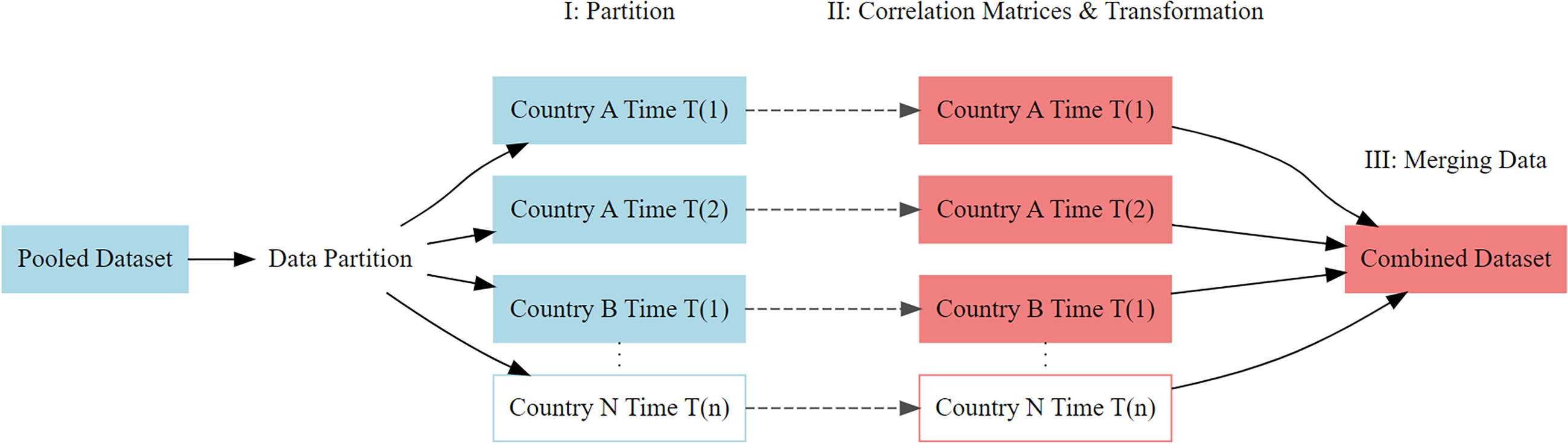
Illustration on preprocessing. Note: The preprocessing is identical for issue alignment and ideological identity alignment. In the latter case, correlations between policy attitude vectors and ideological identity are used instead of correlations between policy attitude vectors. For cohort analysis, I use birth years and time for data partition instead of country years.
Next, I model the average values of two outcome variables as a function of predictors in a multi-level model with varying intercepts (countries) and varying slopes (time). For descriptive purposes, I also model averages for individual countries to allow visual comparison of inter-country differences, which also shows the underlying data (correlations being modeled). Economic and morality issues are modeled separately in the main analysis, but all issues are pooled in the descriptive analysis. When modeling issue alignment, inter-domain differences are also interacted with the time variable. The measurement is identical to that by Baldassarri and Gelman (2008), or Munzert and Bauer (2013) with the single deviation in subsetting multiple countries and cohorts.
Outcome variables
The studied attitudes include six economic issues dealing with preference for redistribution, private or state ownership of business, the benefits of economic competition, the welfare state, and the size of government. For cultural issues, I use nine questions on morality concerning family life, sexual ethics, and end-of-life considerations. Most of the issues correspond to those previously analyzed in the United States (Baldassarri and Gelman, 2008; Kozlowski and Murphy, 2021; Layman, 1999), which enables us to compare the results from the European and American contexts. All items use a 10-point Likert scale, and 12 of 15 items are included in all the studied survey waves. I replicated the main model with unrepeated items removed in Online appendix. Full question wording is included in Online appendix. The variables are transformed so that higher values reflect more liberal positions. The employed measurement should be considered conservative in their interpretation, as observed correlations rarely reach perfect alignment or total disconnection. Therefore, even small differences in correlations could be considered meaningful.
Issue alignment
Issue alignment is measured through pairwise correlations. Using public opinion data, the vectors of attitudes toward political issues are paired on the aggregated level of society. Afterward, the researcher measures correlation coefficients for all the pairs, thus constituting observations for the follow-up regression analysis (Baldassarri and Gelman, 2008; Munzert and Bauer, 2013). This method requires caution in interpretation because, unlike most public opinion studies, observation represents one pair of political issues and not one respondent. Such an approach focuses on both constraint and extremity, as previously demonstrated (Baldassarri and Gelman, 2008). Although it cannot serve to determine individual belief systems, this approach is a good way to describe division on the societal level (Brandt and Morgan, 2022). Possible arbitrariness may come with a choice of correlation coefficient. I reproduced the analysis with several different correlation coefficients, but as in the previous studies, the results were substantively similar (Munzert and Bauer, 2013). For an overview, see Online appendix. Here, I present results using Pearson’s rho because it is most frequently used in other work, and the scale length is sufficient to measure the attitudes on a continuous scale.
Issue alignment is measured as the correlation between all pairs of issues (see Figure 2(b)). To compute issue alignment, I pair each attitude vector with all other attitude vectors, resulting in a total of 120 unique data points (correlations) for each country-year. Since the research focuses on the aggregated level of countries over time, I emphasize the average issue alignment across all issue pairs for each unit.
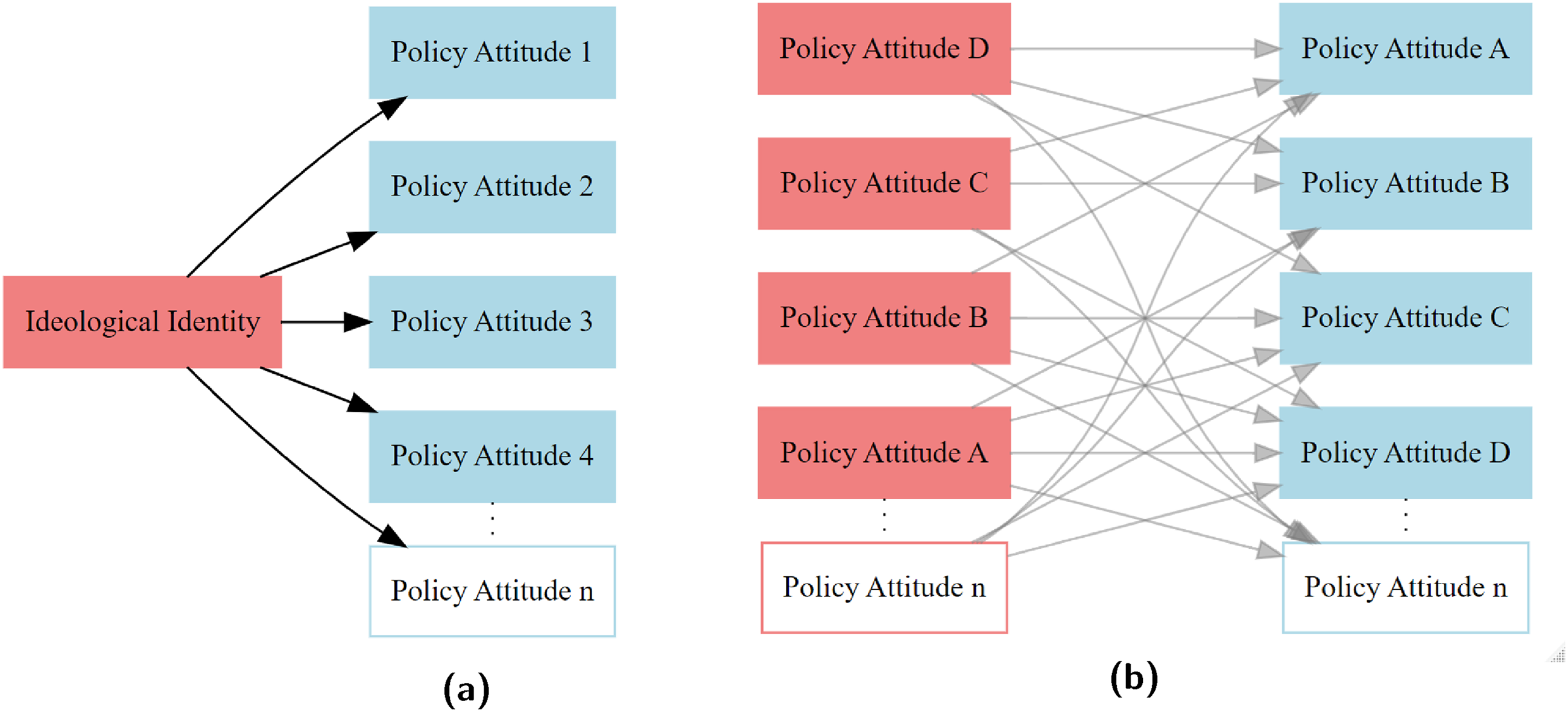
Computation of outcomes. (a) Ideological identity alignment; (b)Issue alignment. Note: These computations are part of preprocessing stage II from Figure 1. Both variables are computed on the aggregated level. Therefore, nodes such as ideological identity do not represent individual ideological identity but a vector of all ideological identities within analyzed unit.
This method is well-suited for researching comparative public opinion polarization. As demonstrated in this and previous analyses, it is robust to the selection of specific issues for analysis. Focusing on averages across a large number of issues is advantageous for research involving many countries with differing political agendas because of regression to the mean. Even when some issues are excluded from the analysis, the averages remain stable since there is a large number of issues. To assess the influence of non-random variation due to omitted cultural factors, I remove specific issues covarying differently across contexts and replicate the results for religious cultures anyway (see Online appendix).
In the analysis, beliefs are paired within and across economic and social issue domains, with pairs from different issue domains forming a specific third category (a mixed domain). I model issue alignment across issue domains to better illustrate the dimensionality of conflict. High average correlations within this domain would indicate unidimensional public opinion polarization. Even though no hypothesis is connected to mixed pairs, I include them in the descriptive analysis. The chosen data and approach address several types of biases that might emerge. One concern is the different lengths of scales for individual items, which could influence measures of association. However, I use only items with the same scale length, and these scales are reasonably extensive (10 points). Another concern is response set bias. The items used are part of two batteries, one for each issue domain. Although this may overestimate the degree of public opinion polarization compared to estimates in similar studies, there is no reason to expect that both domains are affected differently.
Ideological identity alignment
Ideological identity alignment is measured as the correlation between a vector of ideological identities and policy attitude vectors (see Figure 2(a)). Self-reported ideological identity, measured on a 10-point scale ranging from left to right, allows us to assess the extent to which public opinion polarization is ingrained in political identities. The computation of ideological identity alignment results in fewer data points (correlations) for each country-year. Specifically, there are only 15 pairs corresponding to the 15 analyzed political issues. Consequently, I pool the observations from multiple time points and focus solely on cross-sectional differences across countries (60 data points per country). Due to this limitation, the additional analyses of change concentrate exclusively on issue alignment.
It might be argued that self-reported ideology is conflated with policy attitudes. However, the connection between ideological identity and actual beliefs is very weak, which supports the use of self-reported ideology as empirically distinct from policy attitudes (Mason, 2018). Despite the emphasis on partisanship in current research on phenomena such as affective polarization (Iyengar and Westwood, 2015), ideological identity is an intriguing dimension to consider, especially in the context of multiparty systems. In complex multidimensional party competition, identification with a particular party is a complicated endeavor (Dassonneville et al., 2023), particularly since in some countries or regions (e.g., in Eastern Europe), political parties frequently change. The dynamics of pre-electoral coalitions and the turbulent transformations of party systems over the last 30 years are additional reasons to prefer an identity that is more stable over time. A question on a respondent’s ideological identity is a good candidate for such a measure since it is not linked to specific actors or contingent on political parties.
Predictors
The predictors implicated in religious culture and economic scarcity hypotheses are measured consistently with previous analyses. Based on the theory, the religious culture should range between the most Protestant and Catholic poles. Religious culture may come in degrees. For instance, countries like Germany have a mixed composition of Catholics and Protestants. As in the previous analysis (Rovny and Polk, 2019), the denominational membership statistics are based on World Christian Encyclopedia data from 2001, roughly in the middle of the analyzed period. The resulting score for religious culture is computed as the share of Catholics in the population minus the share of Protestants. The score ranges between
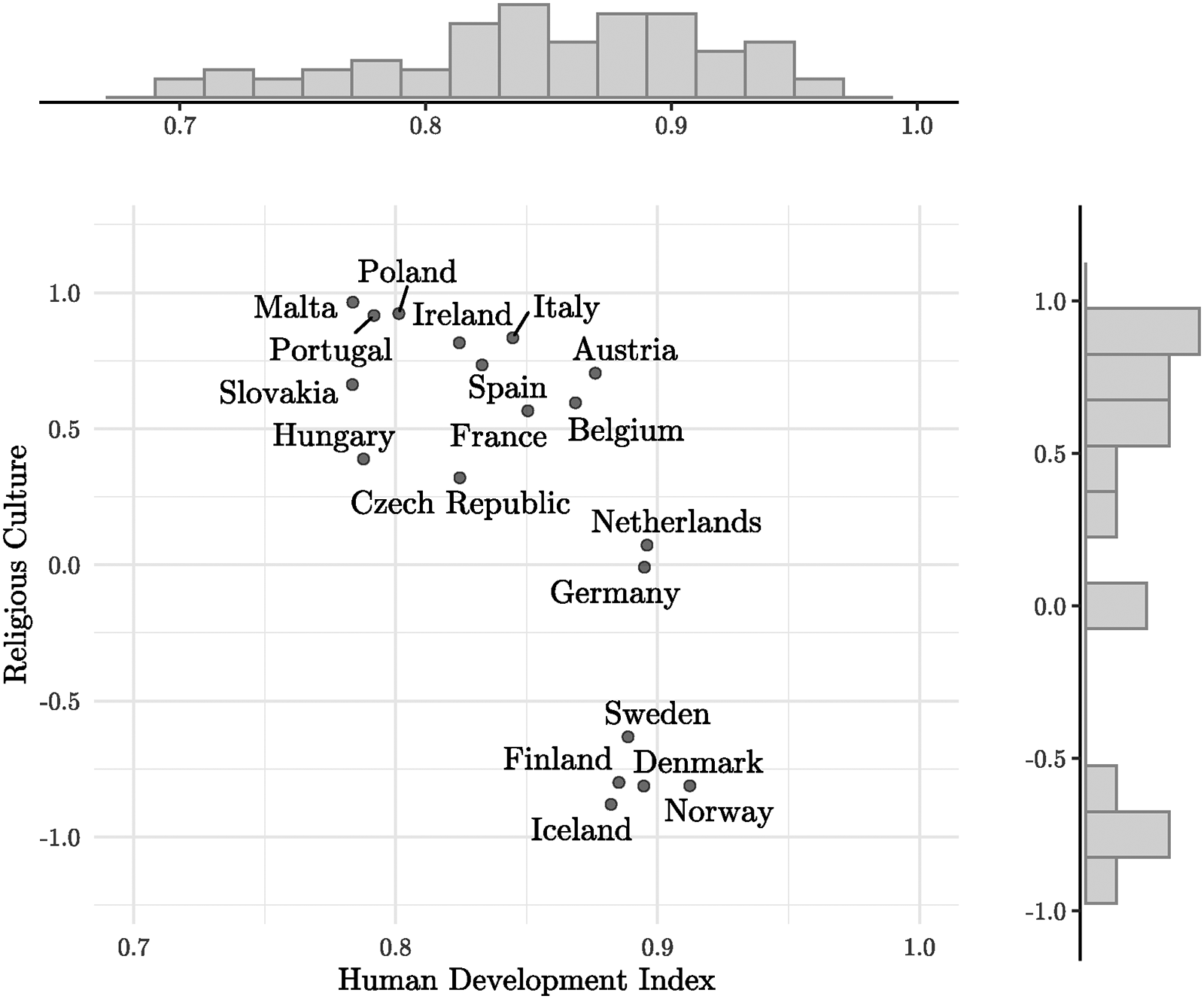
Distribution of countries on both predictors. Note: The scatter plot depicts average values for individual countries. Histograms capture distributions for pooled data across survey waves.
As the measurement of globalization, I employ the KOF Globalization Index, which incorporates a large set of variables into a single index (Gygli et al., 2019). Another advantage of this measurement is data availability for many countries in the past. The two structural control variables are measured using World Bank indicators, more specifically, the net migration measure and the GINI index. The net migration per 1000 inhabitants is measured as the number of immigrants minus the number of emigrants for each country and divided by population (in thousands). GINI index values are not available for all the countries before 2008. For that time period, I use index values from the nearest data available. The country-level variables for the 1990 wave in what would become the Czech Republic and Slovakia were determined from the earliest date after the separation of the two countries (1993). The introduction of these controls did not significantly change the result with model estimates similar to the previous model or even more extreme.
Country differences in public opinion polarization
The first section outlines the profile of public opinion polarization within a single country. I examine how European countries compare with each other and how these comparisons have evolved over time. To achieve this, I model the average correlation between attitude vectors (issue alignment) and between attitude vectors and ideological identity vector (ideological identity alignment) for each type of issue in each country at a specific point in time. The averages are modeled within the economic and morality issue domain. In the case of ideological identity alignment, correlations are pooled only at the country level, without modeling differences over time. For transparency, I also visualize the individual data points (correlations).
Issue alignment
The alignment on all pairs of issues is depicted using separate OLS models for each individual country. The time variable is ordinal (not continuous) because of the small number of data points in time, so the average issue alignment and its confidence interval is provided at each point in time. In contrast to other studies that typically use decadal intervals, the EVS survey is conducted every nine years. The average within-domain correlation estimate change in time provides information about the process of public opinion (de)polarization over time. The cross-sectional differences describe different levels of public opinion polarization on either morality or economic attitudes across countries. Furthermore, in the Online appendix, I also plot correlation for pairs from different domains informs about the dimensionality of conflict (issue alignment across domains). Consistently with the previous literature (Malka et al., 2019), the average association is about zero in all the countries. The average issue alignment for each country and year is presented in Figure 4. In this figure, issue alignment (
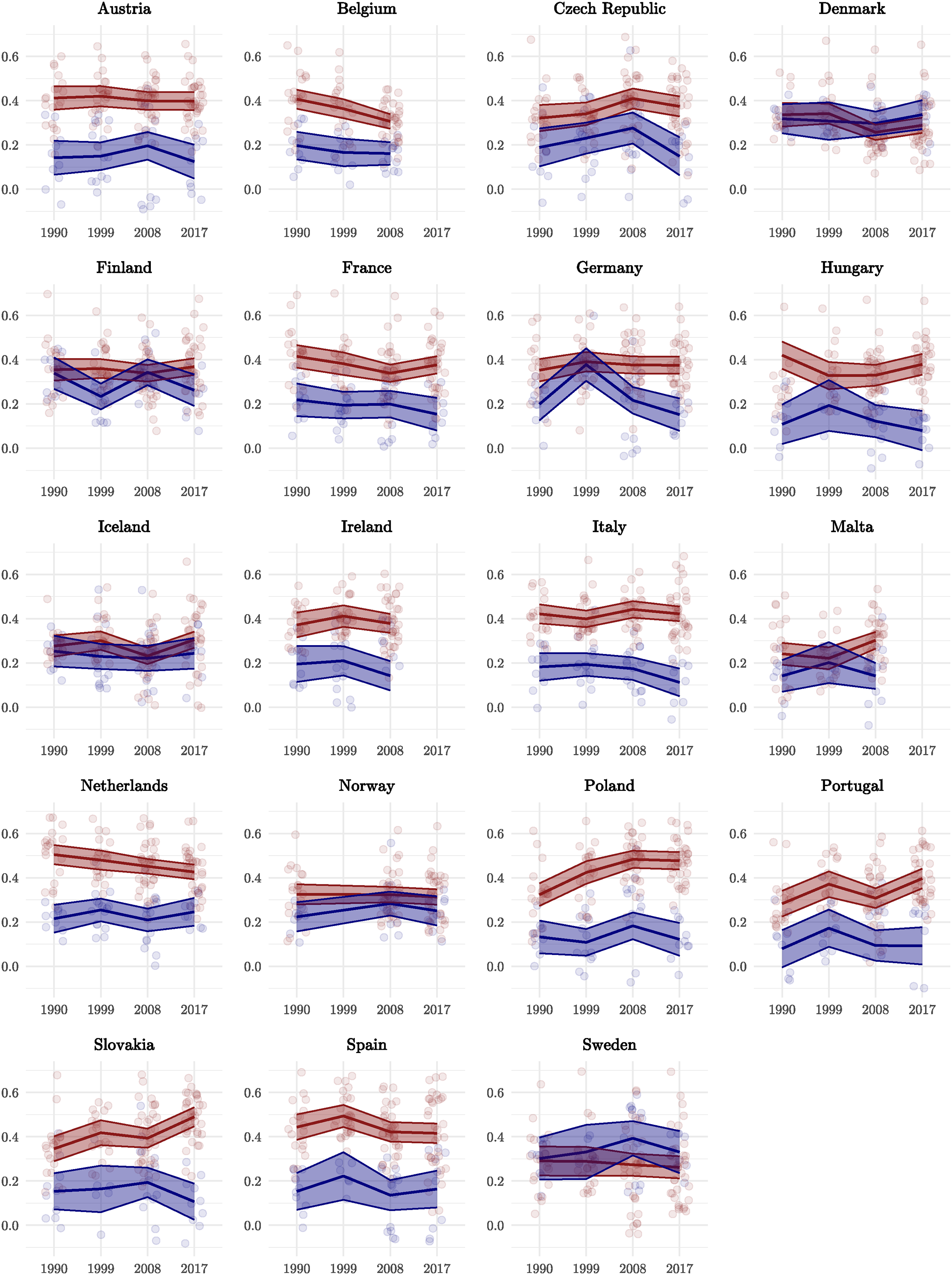
Issue alignment for individual countries. Note: Countries are organized alphabetically. The morality issues are depicted in red and economic issues in blue.
Very few societies are experiencing public opinion (de)polarization on morality issues as captured by the measure of issue alignment. The most prominent example is the convergence of Eastern Europe with its Western counterpart over time. The polarizing trend is particularly notable in post-communist Central European countries. Although polarized on morality issues to a similar extent as other European countries in 1990, the societies of the Czech Republic, Slovakia, and Poland have experienced increased public opinion polarization in recent decades. The average issue alignment on morality issues grew from 0.32 to 0.49 in Poland, from 0.32 to 0.37 in the Czech Republic (the estimate for 2008 is 0.4), and from 0.35 to 0.5 in Slovakia. The latest estimates for Poland and Slovakia are among the highest in Europe. Conversely, public opinion in Belgium and the Netherlands has disconnected on these issues. The estimate for Belgium was 0.4 in 1990, decreasing to 0.3 in 2008 (data for 2017 are not available). In the Netherlands, the alignment dropped from 0.5 in 1990 to 0.43 in 2017. Nordic societies appear different in a cross-sectional comparison. They generally exhibit lower public opinion polarization on morality issues (except Finland) and higher opinion polarization on economic issues (especially Sweden and Denmark).
Ideological identity
Second, I model the average ideological identity alignment in a manner similar to issue alignment. However, the data are aggregated at the country level over the entire 30-year period. The visual comparison yields several insights (see Figure 5). The values of ideological alignment (
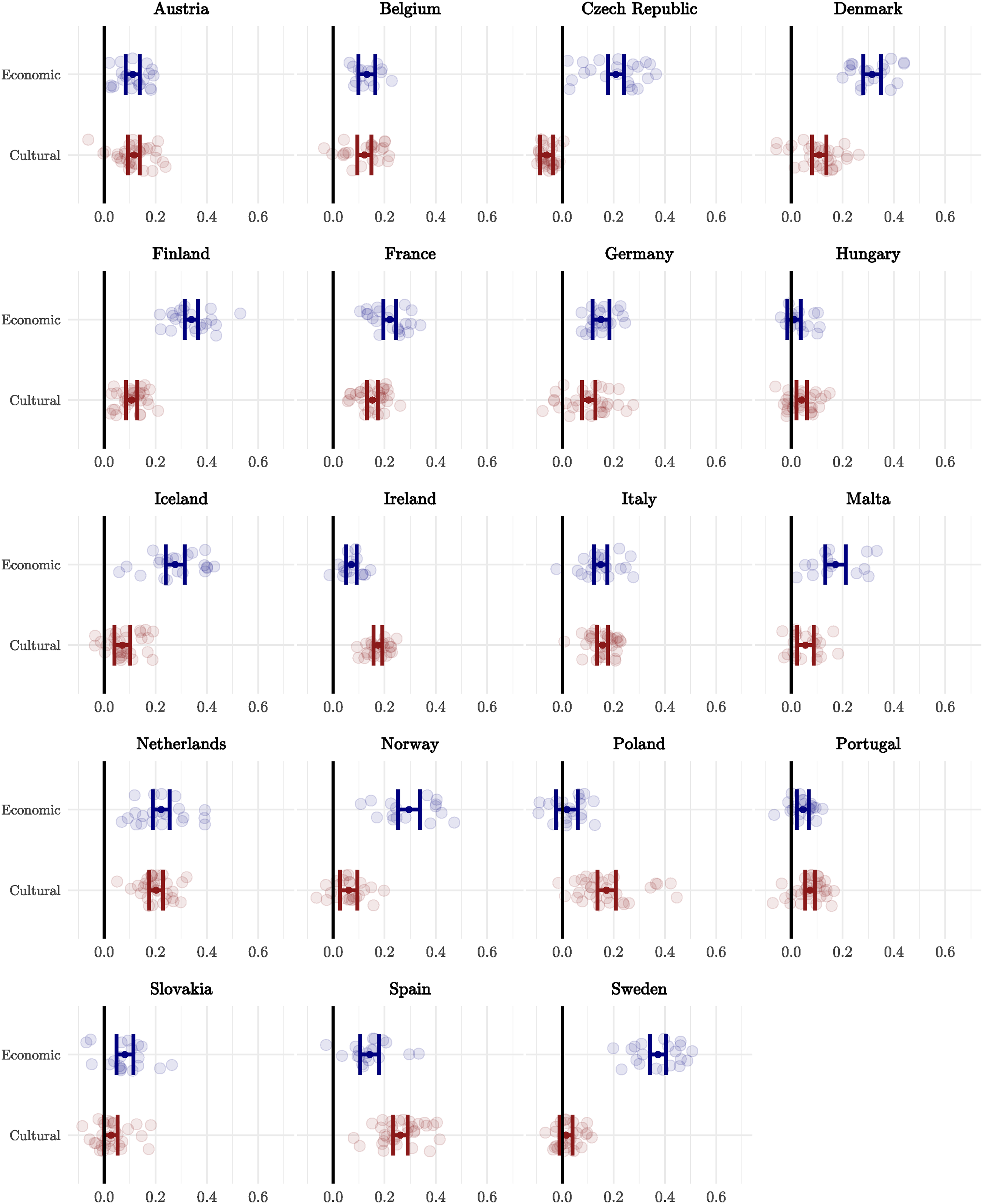
Ideological identity alignment for individual countries. Note: Countries are organized alphabetically.
First, as expected, identification with either the left or the right is more strongly connected to economic beliefs than to moral beliefs. Nonetheless, there are notable cross-country variations. For instance, in Spain (morality: 0.26, economic: 0.14), Poland (morality: 0.17, economic: 0.02), and Ireland (morality: 0.17, economic: 0.1), moral beliefs show on average a stronger association with ideological identities than economic beliefs. Conversely, in Nordic countries and the Czech Republic, the alignment of ideological identity with economic beliefs is substantially higher (e.g., Czech Republic, economic: 0.21). Notably, the Czech Republic exhibits a unique pattern with an average negative correlation between moral beliefs and ideological identity (morality: -0.6). Overall, countries in Northwestern Europe (e.g., Nordic countries) exhibit lower alignment across morality issues and between morality issues and ideological identities. Predominantly Catholic countries, on the other hand, appear to have higher alignment on morality issues. The next section provides a statistical test for this hypothesis.
Political cleavages and public opinion polarization
The previous section demonstrates that there are intriguing differences in the degree and content of public opinion polarization across European societies. However, can these differences be explained by existing theories of conflict on economic and social issues? In a time-series cross-section analysis, I first seek the average effects across countries and time periods on issue alignment. The pairwise correlations are modeled in a varying intercept (country) varying slope (time) multi-level model. I model public opinion polarization on economic issues and morality issues independently. The models are based on a sufficient number of issue pairs (N: Morality Model = 2079, Economic Model = 836) with similar levels of residual variance not explained by models. Considering the methodological approach, the error terms should be interpreted as representing variance in issue alignment within specific issue domains, rather than the usual interpretation of inferential uncertainty. All the control variables were centered and standardized.
Imprinted in religious cultures, I map and model differences across European societies to show such an effect of different cultural environment. However, this effect is not limited to believers (as I demonstrate in Online appendix) and affects also non-religious voters or atheists. The model estimates are summarized in Table 1.
Issue alignment: Multi-level regression estimates.
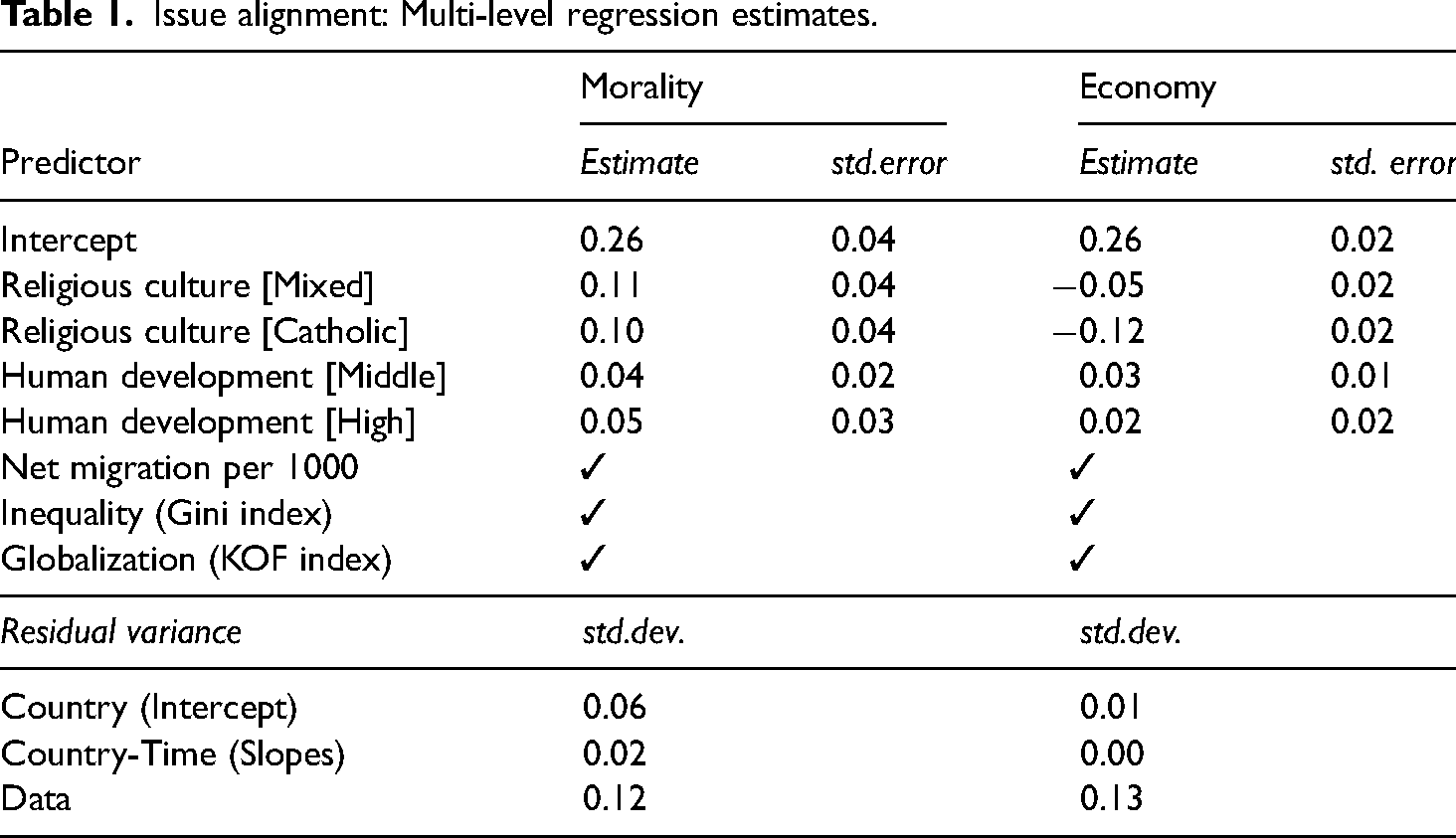
The results support religious culture hypothesis but do not support the economic scarcity hypothesis. The difference in average issue alignment between a Protestant and a Catholic country is relatively well pronounced, given the additional heterogeneity across countries. Issue alignment in Catholic countries is 0.10 (or 38 %) higher on morality issues, and 0.12 (or 46 %) lower on economic issues. Countries such as Germany (with mixed elements of Catholicism and Protestantism) or Czechia (having very low numbers of both Catholics and Protestants) resemble Catholic countries, even though the difference in issue alignment on economic issues is less pronounced. The effect of economic scarcity is comparatively modest, and the substantively significant difference across issues is limited to lower categories of human development. In the Online appendix, I also consider the possibility that the effect is simply detecting cultural differences given by selection bias in analyzed issues. I replicate the models without the items functioning differently in Protestant and Catholic countries and find no significant deviations from this analysis.
Ideological identity alignment
Ideological identity alignment is examined independently for morality issues, with 548 observations, and economic issues, with 362 observations. Given the relatively small sample sizes, it is not feasible to model temporal variations, and thus, a varying slope for the time variable is excluded from this analysis. The model incorporates the same set of control variables used in the previous model.
The comparative differences in ideological identity alignment, summarized in Table 2, reaffirm previous findings. On average, ideological identity alignment is 0.12 points higher for morality issues, nearly doubling the alignment seen in other areas, while it is 0.25 points lower for economic issues, representing a reduction to 68% of the baseline. Notably, the mixed cultures category does not exhibit substantial differences from Protestant countries concerning morality issues, a result likely influenced by the specific case of the Czech Republic. Furthermore, differences in ideological identity alignment due to economic development are not as pronounced as those based on religious cultures.
Ideological identity alignment: Multi-level regression estimates.
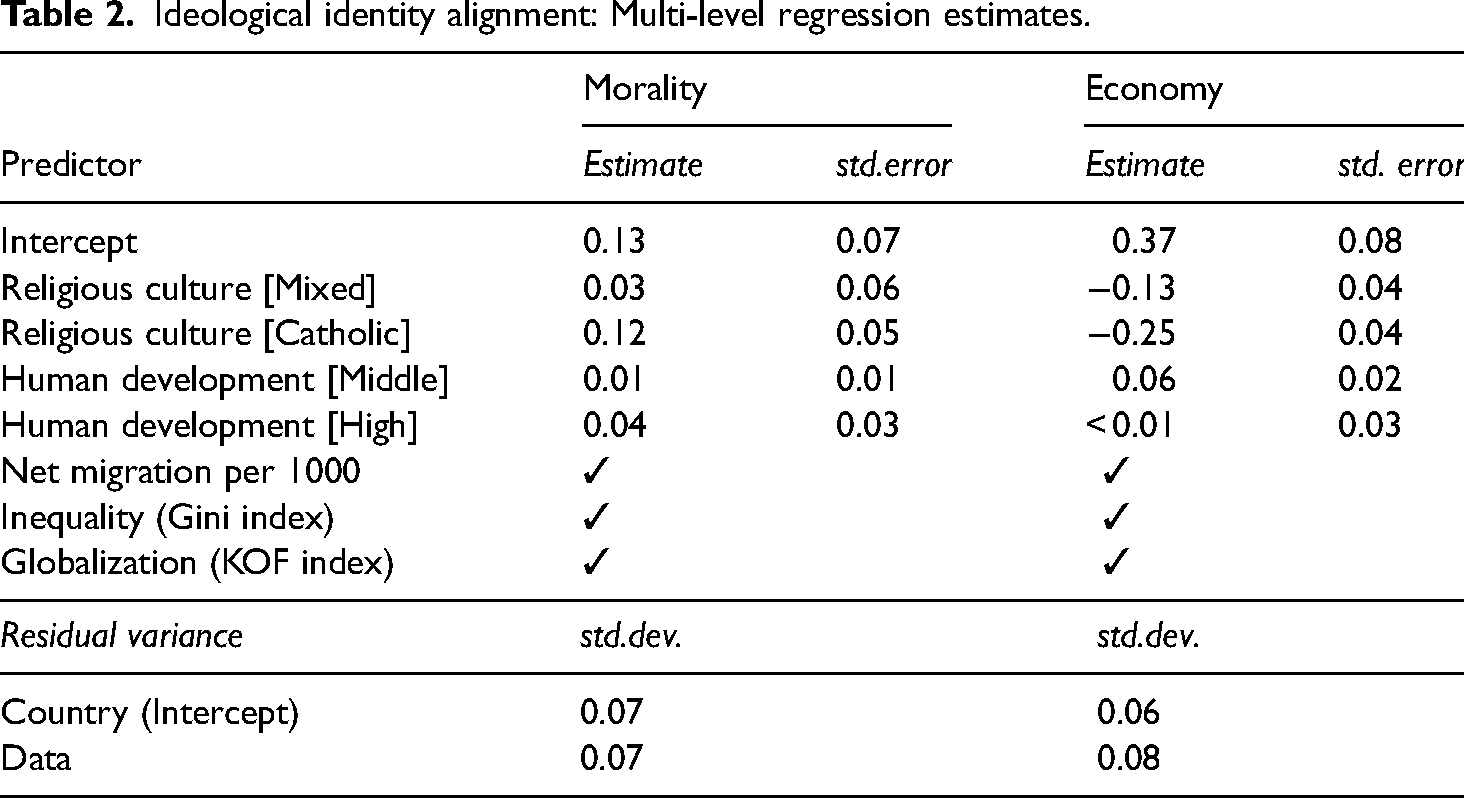
Overall, this analysis reaffirms the support for the religious cultures hypothesis while finding no evidence consistent with the economic scarcity hypothesis. In Catholic countries, mass populations exhibit more ideologically aligned moral beliefs, with greater dispersion and stronger connections to ideological identities. Conversely, public opinion polarization on economic issues is substantially lower in this context.
Change in effects on issue alignment
The descriptive analysis revealed an intriguing temporal variation. Consequently, I extend the analysis beyond average effects to examine whether the explanatory power of religious culture has diminished over time. Given that this variation is often non-linear, I employ a model that allows for the observation of trends as well as differences between survey waves. Using binning estimation, I also estimate effects specific to each survey wave to capture non-linear changes in effect size. To model the differences across cultures and over time, I use models with country fixed-effects. The results are summarized in Figure 6.
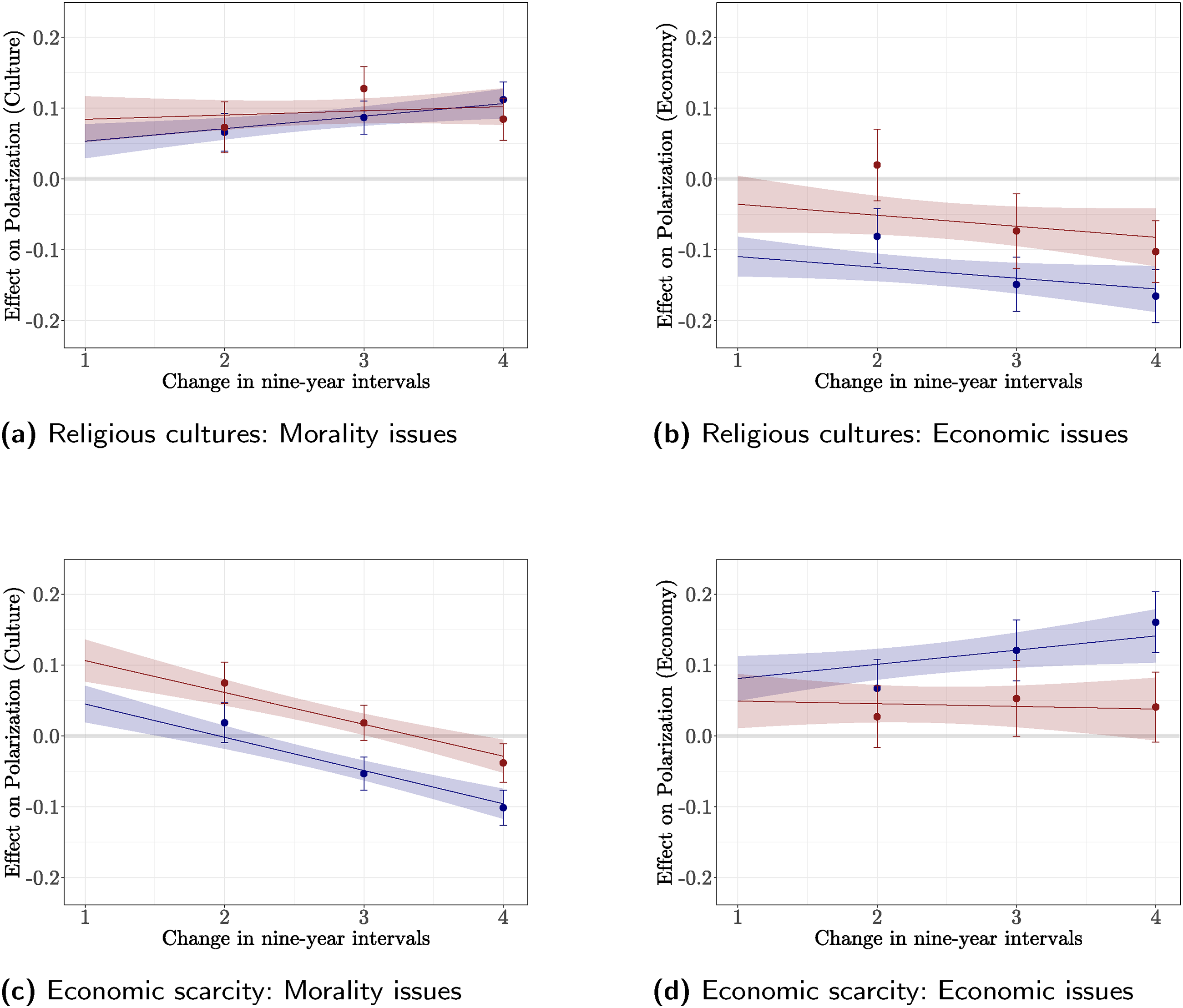
Change in effects on issue alignment over time. (a) Religious cultures: Morality issues; (b) Religious cultures: Economic issues; (c) Economic scarcity: Morality issues; (d) Economic scarcity: Economic issues. Note: Baseline is the category of Least Developed or Protestant, Moderately Developed/Mixed Cultures are in red, Most Developed/Catholic Cultures are in blue. The interactions were plotted and estimated using the interflex package. This model uses country-fixed effects instead of random effects.
The religious culture differences are relatively stable, with effect size even growing moderately over time. The analysis also indicates some non-linearity in the case of economic issues, with the biggest change between 1999 and 2008. Nevertheless, the difference between Protestant and Catholic countries remains substantial for the whole studied period. On the other hand, the effect of economic scarcity diminished over time. By 2017, the most developed countries were less aligned on morality issues than the least developed countries in Europe. At the same time, the most developed countries are more divided on the economy than the least divided countries. This difference has not been hypothesized and goes against the expectations of the postmaterialism thesis.
Age differences in issue alignment on morality issues
The previous analysis indicates a declining predictive power of economic development in explaining public opinion polarization on morality issues. While this finding appears to contrast with postmaterialism theory, it may still align with its underlying principles. Postmaterialism theory suggests that the impact of economic scarcity on the divide on morality issues may be diminishing as younger generations grow up in abundance. According to the generational difference hypothesis, the more aligned younger generations may have replaced their predecessors who were less divided on morality issues.
The age differences are important for the religious cultures hypothesis as well. The significant increase in the number of individuals who do not identify with any religion (referred to as “nones”) in recent years has often been accompanied by shifts in public opinion and voting behavior (Clements and Gries, 2017). While it can be debated whether changes in religious affiliation drive changes in opinions, or if the reverse is true, as suggested by Goren and Chapp (2017) and Brenner (2019), we should also consider the potential decline in the exceptionalism of Catholic countries due to the growing secularization among younger cohorts.
This hypothesis could be tested using cohort analysis. The study focuses on individuals who were between 23 and 82 years old in 2017, corresponding to birth years 1994 and 1935, respectively. These age limits were chosen to ensure a sufficient sample size among the oldest cohort in recent years and to align closely with the 18-year age threshold set by the European Values Study. Apart from cohort analysis, I also modeled age differences in issue alignment at several points in time. This analysis could be useful for better visualizing the distribution of issue alignment based on age (see Online appendix).
This analysis reveals (see Figure 7) a bifurcation between younger and older cohorts across all contexts, although this is limited to the last year of the survey (2017). This bifurcation, however, is not consistent with generational replacement dynamic posited by the postmaterialism thesis (H3). Instead, it appears to be a result of political dynamics between 2008 and 2017 with the main change occurring then. When examining the intercepts (the survey wave when the cohort is introduced to the sample), younger cohorts are not more divided than their older counterparts. This finding provides little evidence for generational replacement. Additionally, a similar bifurcation is observed within most developed countries. None of these trends is specific to the least developed contexts, as would be consistent with the third hypothesis. Overall, there is little evidence to support the postmaterialism thesis.
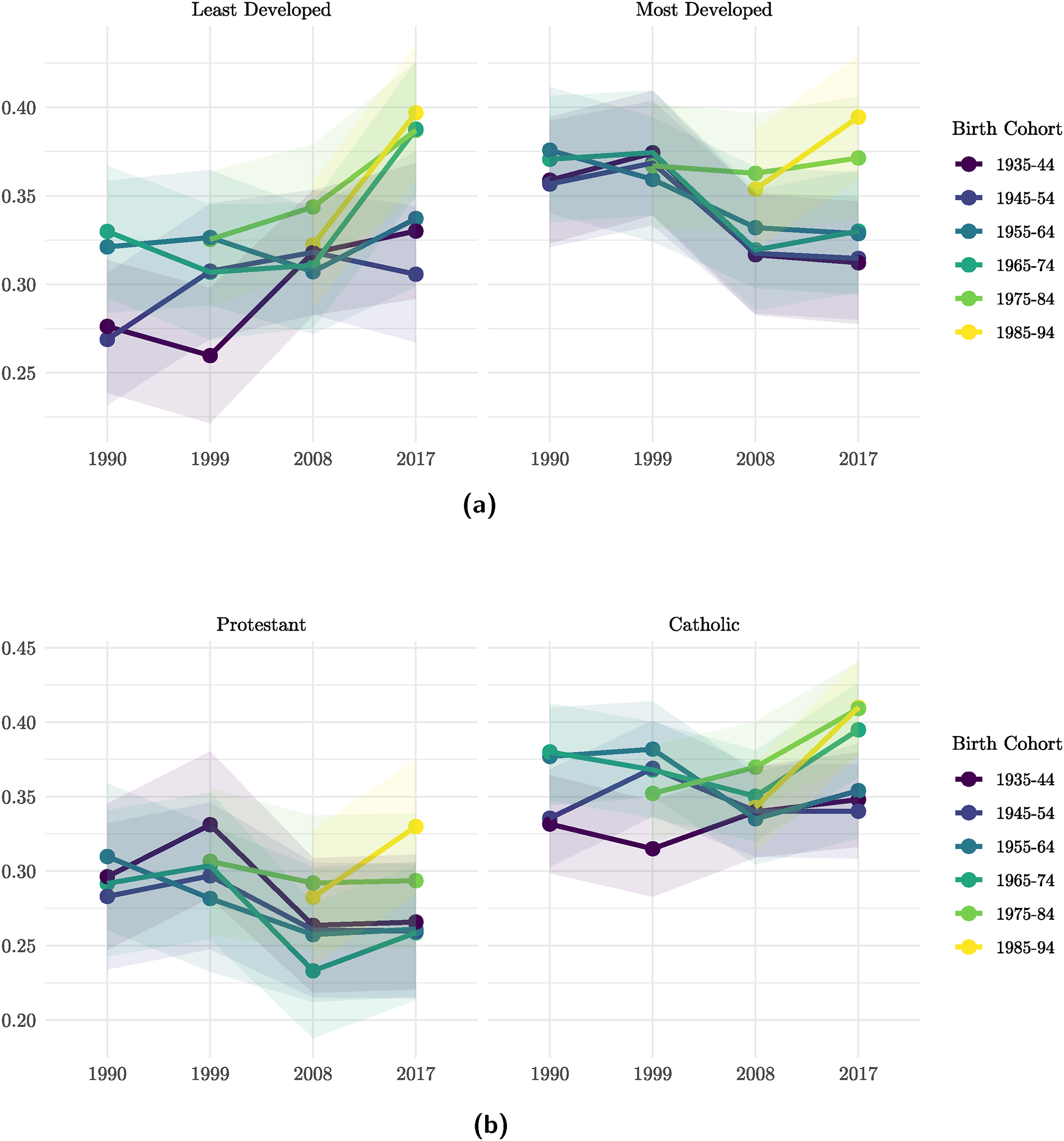
Birth cohort differences in issue alignment. (a) Economic development; (b) Religious cultures.
Discussion and conclusions
Value divisions on morality issues are essential in contemporary European politics and the European politics of the past three decades. Their importance, however, varies significantly across countries. The enduring legacy of the church-state conflict, I propose, is the main comparative difference in Europe. Due to the clustered religious landscape, culture wares were differently imprinted in countries based on their predominant religion. At the start of modernity, state-sponsored secular policies resulted in an outburst of traditionalist religiosity in Catholic countries. The division, which started with a struggle about issues such as schooling or cremation, continues in heated debates on sexual morality or end-of-life decisions (like abortion).
As I have shown, these issues divide societies with Catholic religious traditions much more than predominantly Protestant countries. This was found both in terms of issue alignment, but also in ways morality views are linked to the left-right ideological identities. Additionally, despite the increase in the number of religious “nones” in Western countries, younger generations in predominantly Catholic countries remain as principled on morality issues as their older counterparts. Unlike Catholics, Protestants largely converged with the majority of the population and do not hold distinct attitudes that would divide the society. This study demonstrates the entrenched nature of culture wars in historical processes starting as far back as the 19th century. By linking religious cultures to different modes of public opinion polarization, the thesis is well complemented by the existing literature on the role of denomination differences in party choice (Arzheimer and Carter, 2009; Marcinkiewicz and Dassonneville, 2022) and party competition (Rovny and Polk, 2019).
On the other hand, there are theories that emphasize the relative novelty of non-economic divisions, suggesting that cultural divisions stem from recent societal transformations. A prominent example is the theory of growing postmaterialism priorities (Flanagan and Lee, 2003; Ignazi, 1992; Inglehart, 1971; Inglehart and Welzel, 2005; Steel et al., 1992), which associates the emphasis on economic concerns with resource scarcity and related socialization effects. In contrast to this prediction, when focusing on moral issues, I observe a diminishing role of economic development. In the most recent waves of the survey, less economically developed countries tend to be more divided on moral issues than more developed countries. To further investigate this change, I explore an alternative to the previously refuted claim of polarization between generations (O’Grady, 2022; Schäfer, 2022), which is an expectation of increased division within younger generations. I draw on an interpretation of postmaterialism theory that claims division on social issues should be higher among younger cohorts in developing contexts, leading to eventual convergence with more developed countries through generational replacement (Flanagan and Lee, 2003). However, cohort analysis showed no evidence of generational replacement in such contexts. Instead, I found a bifurcation in alignment of beliefs on social issues between older and younger cohorts. This result is an interesting complement to the debate on age-based polarization (see O’Grady, 2022; Schäfer, 2022), highlighting a different degree of public opinion polarization within cohorts rather than between cohorts.
The argument presented in this study is crucial for students of European politics, as it elucidates the contexts in which politicians are likely to clash with the core values of the European Union and norms of democratic politics. Democratic backsliding, for instance in Hungary or Poland, is largely driven and justified by cultural wars and moral convictions that often trump allegiance to democratic norms (Krekó and Enyedi, 2018; Svolik et al., 2023). By highlighting the shift toward morality conflict in Central European countries, my argument sheds light on how such parties might have succeeded in altering yet democratically unconsolidated countries. However, as I contend in this paper, the same argument implies that Western European countries are not immune to similar backsliding grounded in conflicts over morality. This is because Southern and Western European countries share the same Catholic religious tradition, which is a common denominator in the polarization of public opinion on morality issues. Many of these societies are no less polarized on the same issues. The described troubling development hinges on a political entrepreneur or party who could capitalize on this polarization and bring morality issues back to the forefront.
I acknowledge some limitations, primarily due to the availability of data for a larger set of countries. Although the European Values Study offers many advantages, such as its comparative scope and the range of relevant attitudes, it is conducted in temporally distant waves. Consequently, the dynamics of public opinion polarization may be understated. Future research will require more granular longitudinal data to delve deeper into the micro-mechanisms of the proposed relationships, focusing on specific cultural elements. Additionally, the limited number of items related to immigration precludes an analysis of another prominent conflict area concerning migratory policies (Bornschier et al., 2021; Kriesi et al., 2012). These shortcomings were a necessary tradeoff to cover as many countries as possible. Despite these limitations, this study opens a new avenue for research in this direction, particularly since religiosity and denominations appear relevant for immigration attitudes as well (Marcinkiewicz and Dassonneville, 2022).
Supplemental Material
sj-zip-1-eup-10.1177_14651165251320882 - Supplemental material for New threat of culture wars? The religious roots of public opinion polarization on morality issues in Europe
Supplemental material, sj-zip-1-eup-10.1177_14651165251320882 for New threat of culture wars? The religious roots of public opinion polarization on morality issues in Europe by Tadeas Cely in European Union Politics
Supplemental Material
sj-pdf-2-eup-10.1177_14651165251320882 - Supplemental material for New threat of culture wars? The religious roots of public opinion polarization on morality issues in Europe
Supplemental material, sj-pdf-2-eup-10.1177_14651165251320882 for New threat of culture wars? The religious roots of public opinion polarization on morality issues in Europe by Tadeas Cely in European Union Politics
Footnotes
Acknowledgments
Many scholars provided valuable advice and reviews of this article, including Andrew Roberts, Markus Wagner, Sean Westwood, Marc Jacob, Peter Spáč, and Jochem Van Noord. Earlier versions of this paper were presented at the NORFACE Polarization & Populism Workshop, the EUI Political Behavior in CEE Countries Workshop, and seminars at the University of Vienna, Masaryk University, and the University of Montreal. The paper was also discussed at MPSA 2024. Finally, I would like to thank the editor and anonymous reviewers for their constructive feedback.
Funding
The author(s) disclosed receipt of the following financial support for the research, authorship, and/or publication of this article: This publication was written with the support of the Specific University Research Grant provided by the Ministry of Education, Youth and Sports of the Czech Republic at Masaryk University. This work was also supported by the Czech Science Foundation (GA23-07985S).

Data availability statement
All data generated or analyzed during this study are included in this published article.
Supplemental material
Supplemental material for this article is available online.
References
Supplementary Material
Please find the following supplemental material available below.
For Open Access articles published under a Creative Commons License, all supplemental material carries the same license as the article it is associated with.
For non-Open Access articles published, all supplemental material carries a non-exclusive license, and permission requests for re-use of supplemental material or any part of supplemental material shall be sent directly to the copyright owner as specified in the copyright notice associated with the article.
