




Abstract
This article uses new quantitative data to systematically test established arguments concerning the origins of party strength in 11 West European countries between 1870 and 1939. Through time-series cross-sectional analyses and using a wide range of sources, I investigate the role of the development of parliamentarism, suffrage extension, civil society, and the adoption of proportional representation. I further theorize that the development of parliamentarism and suffrage had an interactive effect because the legislative strength of a party affected its electoral strength, and vice versa. The main findings are that the development of parliamentarism most consistently helps explain party strength and that suffrage extension also was important, and I find support for an interactive effect of the two. A qualitative illustration of the Dutch development offers further support. Thus, the study provides a general explanation for the historical origins of a key component of West European parliamentary democracy, its strong parties.
Introduction
Political parties are essential for democratic politics. In contemporary West European democracies, strong, well-organized parties mark elections and legislation, they sustain politically central institutions and provide durable reference points for other organizations, voters, political activists, and politicians, as these parties engage in both competition and collaboration. Historically, parties and party elites were central agents for institutional reform and durable democratization (Capoccia and Ziblatt, 2010). In the West European case, party development thus represents a crucial political change during the three to four decades around the year 1900.
How parties and party organizations have evolved historically are thus important questions, and research on party development in different contexts is prolific. For Western Europe, an older generation of comparative political scientists focused on the general historical trends (Duverger, 1964; Panebianco, 1988; Sartori, 1976; Von Beyme, 1985). Later, scholars offered country-case studies of the historical development of party organization or aspects thereof in different settings (e.g. Cox, 1987). To this could be added the innumerable party biographies provided by historians in different countries (see also Heyer, 2022).
In this article, I combine statistical analysis on new data with a case study drawing on a wide range of historiography to assess four potentially general factors that have been proposed to drive the development of strong parties. The factors include parliamentarism, which makes parliamentary organization important for obtaining government office and maximizing the value of legislative seats; suffrage extension, which gives the parties incentives for electoral organization; the conditions for civil-society development, which facilitates electoral campaigning and mobilization; and proportional representation (PR), which increases the power and control of the party leadership over the party. I understand strong parties as centrally organized and distinct bodies whose institutional presence in both the legislature and the electorate allows them to mobilize legislators and voters to realize a program. Honing on the 1870s–1930s period, which was crucial for party development (Aidt and Jensen, 2014; Caramani, 2004: 197), I consider 11 West European countries: Austria including Austria-Hungary, Belgium, Britain, Denmark, Finland, France, Germany, Italy, the Netherlands, Norway, and Sweden.
Furthermore, I theorize that parliamentarism and suffrage extension had an interactive effect on party development. 1 As the powers of parliament expanded, a party’s strength in the legislature became more important for policy and office. This legislative strength mattered for electoral performance, which gave the party leadership an opportunity to strengthen both the legislative and electoral aspects of party strength. As leaders built party strength, modern party competition developed through a process in which leaders tightened their control over their parties against individual candidates and local electoral associations who wanted to maintain their independence against a suspicious new phenomenon (the modern party), but who often surrendered this independence if party organization gave them an advantage in the competition for votes, legislative influence, or internal party promotions.
I find that the development of parliamentarism exhibits the most consistent relationship with the development of strong parties both in the long and short run, followed by suffrage. I also find support for an interactive relationship between parliamentarism and suffrage with the development of party strength. Because the analysis relies on macro-level observational data in a setting where many factors seemingly codevelop, I also qualitatively analyze the Dutch experience for support of the theorized individual-level mechanisms and the temporal order. This shows how the leaders of those parties that would prove successful understood that the development of parliamentary powers and the subsequent electoral expansion meant that party strength would give them and their parties an advantage in competition and negotiation. The development of parliamentarism and suffrage expansion also enabled leaders to strengthen their own position within the parties as they managed the connection between and consolidation of the electoral and legislative associations. Individual parliamentarians and local electoral associations were reluctant to surrender their independence to the party, but sooner or later they often did because of the competitive gains. Those who did not embrace the new dynamics of competition in time suffered in electoral and legislative performance. Party development was well under way before PR reform, and civil-society conditions were only loosely connected, while actual civil-society development was extensively driven by the parties themselves.
The main contributions of this article are the following. First, I assess established theories of West European party development according to contemporary standards of evidence. Thereby, the paper advances the research of previous generations, who did not have access to the data and methods to go beyond qualitative illustrations only (e.g. Daalder, 1966a; LaPalombara and Weiner, 1966; Panebianco, 1988; on the virtue of revisiting older research with systematic, quantitative tests on newer data, see Geddes, 2003). It also advances research that has focused foremost on the electoral-organizational development of particular parties (e.g. Bartolini, 2000; Ziblatt, 2017) or parties in general (e.g. Caramani, 2004).
Second, I theorize an interactive effect of suffrage and parliamentarism on party strength. The support for an interactive relationship implies that the mechanisms mapped by Cox (1987) and Eggers and Spirling (2016) concerning British party development generalize to other West European countries. From a broader horizon, I indicate the historical origins of the differences in party strength between contemporary parliamentary and presidential democracies (e.g. Hazan, 2006).
Finally, the analysis invites a reconsideration of the temporal order and the timing of the development of the factors. Recent research on PR reform in Norway (Cox et al., 2018) and Germany (Schröder and Manow, 2021) suggests that the legislative threat of socialist parties has been overlooked compared to electoral considerations and that the need to consolidate the party leadership and the legislative organization gave bourgeois parties further reason to consider PR reform (this possibility is mentioned already by Kreuzer, 2010). Given this, the long-term picture presented here suggests that parliamentary development is an important background condition for historical PR reform.
Strong Parties and their Sources
The process in focus is the development of strong parties in the late 19th and early 20th centuries. By strong parties, I mean parties that have a central organization, that are institutionally present in both the national legislature and the electorate, and who can mobilize legislators and voters around the realization of a distinct program (cf. Katz and Mair, 1993; Kreuzer, 2001: 3, 24). 2 Party strength allows leaders to engage in lasting competition and collaboration with other parties in the legislative and electoral arenas, and through their relations to the state, the rest of civil society, and voters, they give an enduring structure to politics and policy. All this makes historical party-development an important research topic.
However, strong parties as conceived of above were absent throughout Western Europe some 150 years ago. Around 1850, most West European parties were loose, embryonic, and often ephemeral. Moreover, while strong parties have marked Europe since WWII (Rosenbluth and Shapiro, 2018), it was generally in the period between, c. 1870 to 1939, that parties developed their crucial strengths (Caramani, 2004; Lipset and Rokkan, 1967). Since then, the ideal of politics as conducted by independent candidates who formulate well-reasoned arguments, an ideal that was shared and practiced by many mid-19th-century liberals and conservatives who viewed parties as suspicious, is no longer workable.
This article addresses four factors that have been proposed to explain party development: parliamentarism, suffrage, the conditions for civil-society organization, and the adoption of PR. The explanations take party elites as the main actors and competitiveness as the dynamic force behind the development. Rising political competition and ideological differentiation make it increasingly important for party elites to organize to maximize policy influence by securing legislative seats or office, and by ensuring that party representatives follow the line on important issues. Increases in party strength enable leaders to engage in cooperation and competition concerning policy, and to demonstrate this ability to competitors, active members, and potential casual supporters, including voters. Competitive dynamics mean that when one party is observed to strengthen its organization, others are pushed to follow. Those who fail to strengthen organizationally before it is too late are at greater risk of becoming marginalized and outcompeted.
In the process, the party leadership strengthens its own position as managers of the links between the parties’ parliamentary and electoral associations. However, party strength has both costs and benefits for individual party representatives, that is, the candidates, parliamentarians, and managers of local electoral associations. It costs them their independence and their personal and more unprincipled relations with the voters in their constituency, which are historically important characteristics of weak and loose parties. What they gain is increased chances of reelection and office, because via strong parties, they are in a better position to win votes, affect policy, and stay in office. Stronger parties also provide more channels for career advancement (cf. Kam, 2009; Müller, 2000; Tavits, 2012).
I now consider the four factors in turn. Students of Postwar democracies argue that parliamentarism enhances party strength because votes in parliament can affect government survival. A strong party becomes essential, because voting unity is required for legislative coalitions, executive control, and the functioning of a parliamentary system (Samuels and Shugart, 2010; Sartori, 1997: 94; Sieberer, 2006). Historically, Cox (1987) and Eggers and Spirling (2016) suggest that as parliament obtained a monopoly over legislation and executive control, party leaders and deputies realized that parliamentarism increased the importance of party-loyal parliamentarians. Simultaneously, parliamentarism permitted the party leadership to enforce unity by rewarding loyal deputies with promotions. To this I add that the establishment of parliamentarism barred the original alternative route to political influence, namely courting the head of state. Legislative strength, not court strength, became primary.
Suffrage extension, likewise, has been claimed to make party strength crucial (Daalder, 1966a; Epstein, 1967: 20, 34–36; LaPalombara and Weiner, 1966), and it offered party leaders arguments for increasing their organizational control (Heyer, 2022, ch. 6). Once the electorate expanded, through legislation or through changes that made people meet census criteria, personalistic ties between candidates and voters in constituencies were insufficient to win elections. Instead, it became increasingly important for parties to make nationwide efforts to convey their positions, mobilize supporters, and gain votes (Caramani, 2004). Note that suffrage extension does not necessarily mean full suffrage, but that it still makes party strength increasingly important for electoral gains.
There is reason here to discuss how parliamentary and suffrage development might have interacted to affect party strength. As parliaments acquired monopoly over government terminations, and indirectly over important legislation, and as the suffrage extended, party strength and performance in the one arena affected strength and performance in the other. This incentivized further improvement in both arenas. The logic is that it is easier for parties to attract voters and perform well electorally if their representatives follow the party line, because it is a poor individual voting decision to vote for a party that controls its members less well than the opponent parties. In turn, good electoral performance positively affects a party’s chances to influence the executive, which is increasingly at stake as parliamentary powers develop. Thus, with the development toward democratic parliamentarism, parties must enhance their legislative strength to win elections and enhance their electoral strength to increase their performance in parliament. The two strengths go together. It will normally not suffice for a party to focus on only one of the two if it is to survive and remain of more than marginal size in the electorate and parliament.
This interaction is observed in the British case, although researchers might not have discussed it in such terms. Cox’s (1987) study supports the idea that the development of parliamentarism and suffrage interacted, and it substantiates the mechanisms and temporal order between the two institutions and party strength (cf. Eggers and Spirling, 2016; Judge, 1993). Parliamentarism developed and suffrage expanded in the mid-19th century, with the specific consequences on voting unity and campaign mobilization theorized above. But there was also an interactive element at play. Party leaders sought to build organizations, preferring to promote those individual politicians who were willing to trade their electoral and legislative independence for the increased reelection chances and legislative influence that they won from belonging to a more organized party. The expanded electorate, in turn, reacted to the development of parliamentarism when voting by considering the parties’ perceived ability to mobilize deputies to get legislation through parliament and to gain executive control. Thus, party leaders constructed distinct labels, platforms, and organizational structures, all to increase parliamentary influence via electoral support, and vice versa. Thus, parliamentarism and suffrage separately may have fostered party strength, but together, the impact was even more powerful.
A third explanation concerns civil society. It has been argued that the conditions for a vibrant civil society permitted the rise of mass parties during the second half of the 19th century. Emerging outside parliament and anchored in civil society, the so-called mass party of integration forced loosely structured parties to reorganize against the new competitors (Katz and Mair, 1993). An earlier version of the argument concerned workers’ parties, whose extra-parliamentary organizational strength Duverger (1964) claimed drove party development more generally. Katz and Mair’s (1993) formulation captures the importance of civil-society organization in general and has the virtue of not excluding any party by ideology.
Indeed, both workers’ and confessional party organizations have been suggested to have raised the standards for party strength in the late 19th century throughout Western Europe (Bartolini, 2000; Kalyvas, 1996), along with some Conservative parties (Epstein, 1967: 126–129; Panebianco, 1988). The upshot is that the conditions for the development of civil-society organizations might have been a separate important factor behind the development of strong parties (cf. Bermeo and Nord, 2000).
PR reform is a fourth explanation of party strength. In the early 20th century, most West European countries adopted some form of PR. The reasons have been found to relate to suffrage extension during the period when workers’ parties were rising. Suffrage extension boosted workers’ parties electorally (Emanuele, 2024), and workers’ parties naturally demanded universal and equal (male) suffrage, which was believed to benefit them. And while existing majoritarian electoral systems suited the Social Democrats and some other parties that were already electorally strong (Penadés, 2008), many bourgeois parties feared that they would be swept away unless the electoral rules changed. PR offered a way to contain many workers’ parties, reduce the likelihood that they would come to dominate parliament, and increase the electoral chances of many non-socialist parties (e.g. Ahmed, 2013; Boix, 1999; Boix, 2010; Kreuzer, 2010; cf. Benedetto et al., 2020, whose finding that socialist vote share levels are associated with larger district magnitudes, that is, PR, suggests that countries that had adopted PR also had electorally stronger socialist parties.
However, PR was understood to have a second effect, namely, to strengthen the party leadership against individual candidates and deputies because the larger district magnitudes put the party leadership in the position to draw up electoral lists and prioritize candidates who behaved loyally (Cox et al., 2018; Katz and Mair, 1993). This permitted leaders to centrally control party representatives both in the electorate and in the legislature, and thus to develop party strength. Indeed, the prospects of increased leadership control over more distinct parties was a motive for introducing PR in Third Republic France (Kreuzer, 2001; Williams, 1964) and Norway (Cox et al., 2018). Moreover, parties would have less need to associate or ally with each other and could focus on consolidating (which does not preclude inter-party cooperation). Overall, PR reform can be seen as a response from the relatively weak parties to the rise of the relatively strong, and its expected effect was to raise the strength of parties in general (Penadés, 2008).
In sum, the development of parliamentarism, suffrage, and civil society, and the adoption of PR are factors expected to have strengthened parties. Arguments have been provided theoretically and empirically in qualitative historical comparisons, quantitative and qualitative historical case studies, and quantitative analyses of the post-WWII period. I add a hitherto missing perspective, a general quantitative analysis of the historical period during which the development of the factors has been suggested to prompt party strength (on the usefulness of revisiting qualitatively informed arguments with quantitative tools, see Geddes, 2003). I also test the argument that parliamentarism and suffrage in interaction drove party strength.
Data, Design, and Description
To statistically test the factors, I draw on sources that provide detailed, state-of-the-art measures, the absence of which has long prohibited systematic tests. For the dependent variable, the measure of strong parties, I take the party institutionalization index from the V-Dem Institute (Coppedge, 2020a; 2020b). 3 This is an additive five-component index including the existence of central party offices, local party branches, and distinct party platforms, the degree of cohesive party voting in parliament, and the nature of the parties’ links to their constituents (clientelistic, collective, policy/programmatic or mixes thereof). 4 The data are gathered by asking country experts about the number of parties who meet a certain criterion (e.g. having a central office) or about the common organizational form among the major parties (e.g. what is the common major party link to constituents).
The set of components reflects previous qualitative measures used in historical research on party strength (e.g. Katz and Mair, 1993; Kreuzer, 2001). In a similar form, it has been used by Bizzarro (2018), which I refer to for further discussion. Central offices, voting unity, organization in the country, programmatic platforms and principles are features that make parties strong and viable. All this suggests that the index is suitable to capture the general development of strong parties at the country-year level. Yet, limitations should be noted. Two assets of parties are absent: membership and finances. To the best of my knowledge, no such data exist for the period. It is difficult to know how such information might alter interpretations. Still, it is worth recalling that the V-Dem variables and indices perform well in external and internal validity checks (Seim, 2020).
Parliamentarism is a continuous measure from 0 to 1 that captures the extent to which the fate of the government is controlled by parliament or its historical rival, the head of state. It is created with data from country historiographies that provide information on all identifiable head-of-government resignations that were followed by a new government formation attempt, as well as all parliamentary dissolutions in which the head of state was actively involved, ever since the establishment of national parliaments. Parliamentarism is estimated with a Bayesian learning model as the probability over time that the head of state is involved in a government resignation. The probability is updated in time as more events occur. The variable used here is the mean country-level probability. At a value around 1, parliament alone controls the executive. Between 0 and 1, both parliament and the head of state can trigger or prevent government terminations. The measure is particularly suitable here because it captures the theoretical reason why parliamentarism should influence party strength positively, namely that leaders have incentives to develop their parties when executive office is at stake. The focus on heads of government as opposed to the collective organization and responsibility of governments or their partisan composition assures that party characteristics are not built into the variable, which would make significant relationships between parliamentarism and parties easier to find. The appendix gives further information.
A granular measure of suffrage for parliamentary elections comes from Flora (1983). It measures the share of eligible voters over 20 years old. Importantly, the suffrage measure ignores the extent to which votes affect the composition of the executive, while the measure of parliamentarism ignores how deputies are elected. The two measures thus capture separate dimensions of political development.
I measure the conditions for civil-society development with V-Dem’s core civil society index. It consists of three items added together to capture the autonomy, diversity and popular involvement, and state attempts at repression of civil-society organizations. I use this measure because the rise of the mass party of integration relates closely to the development of different civil-society organizations, especially unions and religious communities (Ertman, 1998; Katz and Mair, 1993). It also reflects the observation that civil-society restrictions provided important disincentives for party formation (Scarrow, 2006). The measure permits an evaluation of the claim that civil-society freedoms allowed parties to form and organize outside parliament, forcing older, more loosely structured parties to become stronger both in parliament and in the electorate. 5
I code PR as a dummy variable based on the widely used data from Colomer (2004). This coding captures the essence of the theoretical argument that PR permitted leaders to bolster both the electoral and legislative strength of their parties. I return to a discussion of the role of district magnitudes in the concluding discussion.
The control variables, motivated in the next section, include measures of the socialist seat share in parliament and of parliamentary party-system fragmentation. Socialist seat share (both chambers when data exist) is based on various country sources. The identification of (main) socialist parties relies on Ahmed (2013) and Vössing (2011). Party-system fragmentation is measured as the effective number of parties in parliament (Laakso and Taagepera, 1979), based on the same country sources.
The 11 countries in the analysis are Austria, Belgium, Britain, Denmark, Finland, France, Italy, Germany, the Netherlands, Norway, and Sweden. This selection is determined by the data on parliamentarism, which cover those West European countries that had established independent parliaments by the early 1870s and that were never closed more than once and then not for more than 20 years. The choice of period, 1870–1939, set the study’s historical boundary conditions (Caramani, 2004; Lipset and Rokkan, 1967). This period covers the 70 years during which the countries generally moved toward full (manhood) suffrage, many of them established parliamentarism, saw the development of a lively civil society, and experimented with different electoral systems. The institutional and party development in this period thus set the stage for postwar party competition, which, except in France, took place within relatively fixed institutional settings. The start is marked by the formation of the newest of the states in the analysis, Germany and Italy, and the creation of an autonomous Finnish parliament and civil society (Klinge, 1996). The end is marked by the outbreak of WWII and the fact that many of the factors stabilized soon after the peace. For Austria, Germany, and Italy, the last observations are in 1932, 1933, and 1922, whereafter parties were abolished.
Table 1 displays the correlations between the continuously measured factors. All correlations are significant (the appendix gives descriptive statistics by country). Figure 1 visualizes how the continuous variables developed during the period. It indicates that many substantial changes really did occur in this period (cf. Scarrow, 2006).6,7 The early relative strength of the British, Belgian, French, and Dutch parliaments is shown, as are the poorer conditions for civil-society organization in the more authoritarian countries, Austria and Germany, in the decades before WWI.
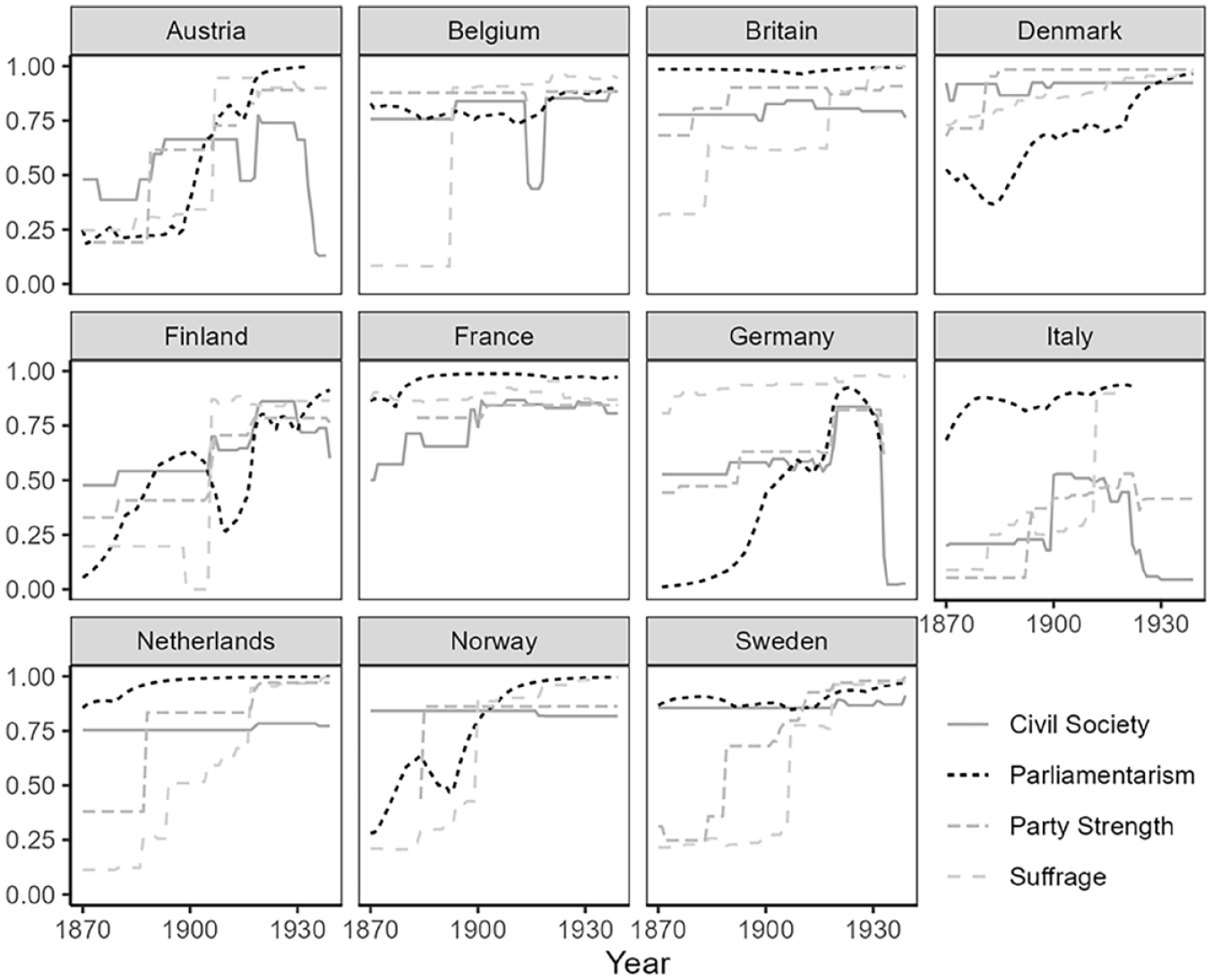
The development of party institutionalization, parliamentarism, suffrage, and civil society, 1870–1939.
Correlations, 1870–1930.
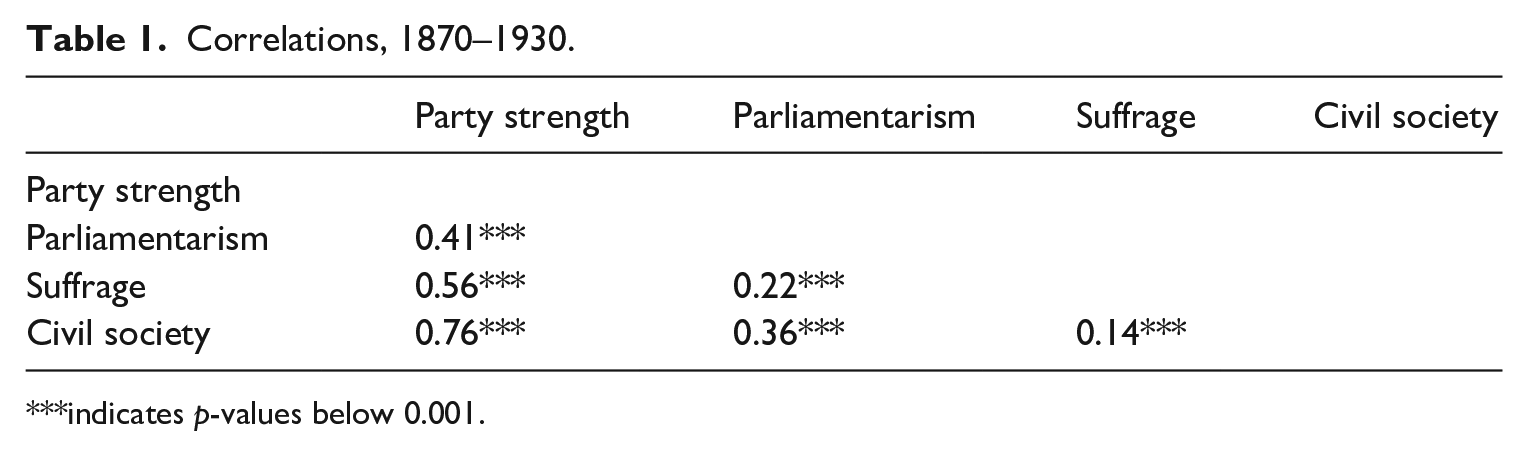
indicates p-values below 0.001.
Figure 1 suggests that the party-strength measure is valid and reliable. I offer a few examples in support of this claim. The measure reflects the gradual development of British parties to high levels of strength in terms of central offices, institutionalized electoral presence, relatively strong cohesion, and distinct platforms (Panebianco, 1988; Ziblatt, 2017). The slow evolution of party strength during the Wilhelmine Empire and the increased general strength of the Weimar parties as well as the rather subtle strengthening of French parties around the year 1900 is also captured (cf. Kreuzer, 2001; Ziblatt, 2017). The persisting weakness of Italian parties is also visible, reflecting their low cohesion, personalistic leadership, unclear platforms, and clientelistic structures (Cotta, 2016).
It is hard to infer relationships visually from Figure 1, which suggests the need for more elaborate quantitative and qualitative analyses. Nevertheless, some patterns are discernable. Parliamentarism and civil-society conditions generally start developing before political parties, suffrage, and the introduction of PR. However, while parliamentarism and civil-society conditions remain relatively stable early on, parties keep developing. This is consistent with the interaction argument above, namely that suffrage extension within the context of extensive parliamentary powers increased the importance of party strength. Denmark and Germany are the two clear exceptions to the general picture. In these two countries, suffrage levels are high and rising from the beginning and may account for early party development. Yet, in these two countries, subsequent parliamentary development may have incentivized party development in the context of an already extended suffrage. Again, this supports the interaction argument.
The interpretation that parliamentary powers generally develop first, followed by party development and civil-society organizations, is implicitly supported by in-depth analyses of West European party-organizational history (Heyer, 2022; Panebianco, 1988). These discuss how suffrage extension prompted specific parties to connect their parliamentary and electoral organizations, a process which gave an opportunity for increased leadership control and party consolidation. Importantly, expanding parliamentary powers provided the context that they seem not to note. For Denmark and Germany, suffrage extension substitutes for parliamentary development, but nevertheless, the quest to connect parliamentary and electoral organizations strengthened the party leadership. This interpretation of Figure 1 and of previous literature suggests the importance of parliamentarism and suffrage for party development, and it supports my contention that the two together had an even stronger effect on party strength.
Statistical Analyses
This section tests the different factors using time-series cross-sectional regression. All models include country- and year-fixed effects, and heteroskedasticity robust standard errors. 8 The country-fixed effects address unobservable country-specific factors, such as cultural legacies, while the year effects address common time trends. Reflecting the low number of observations, I treat p values below 0.1 as indicating significance (cf. Beckmann, 2020; Røed et al., 2024). To account for the temporal order between the variables, I lag the independent variables one year. Yet, organizational change might be slow. Reforms to build party strength in a period when models of modern parties were unknown and when many resisted the development might take time. Therefore, the use of 1-year lags should imply conservative tests of the relationships. Analyses below using other lag lengths will corroborate this reasoning.
I first assess the factors separately, before testing them against each other while controlling for potential confounders: past party strength, the size of the main workers’ party in parliament, and party-system fragmentation. A lagged dependent variable addresses the fact that party strength in 1 year will naturally depend on party strength in the previous year. The strength of socialist parties addresses Duverger’s (1964) influential argument that these parties, not the more general mass party of integration, forced non-socialist parties to organize. Note that socialist seat share should affect party strength both by the organization of socialist parties themselves and by their influence on other parties. Party-system fragmentation is included because it affected the development of parliamentarism (Davidsson, 2022), and it should almost by definition be (negatively) related to the strength of parties in general. One might worry that the inclusion of party-system fragmentation would mar estimates for PR, if the former was a result of the latter. However, a high effective number of parties preceded PR adoption throughout Europe (Colomer, 2005).
The first four models of Table 2 assess bivariate relationships between each factor and party strength. All variables are measured on a 0–1 scale, so the coefficients can be compared. The developments of civil society and suffrage show the strongest relationships with party strength. Model 5 of Table 2 offers the main model. Parliamentarism and suffrage exhibit significant, positive relationships with party strength. PR and civil society are, perhaps surprisingly, insignificant. Concerning civil-society strength, notwithstanding arguments by scholar such as Katz and Mair (1993) and Scarrow (2006), this factor might be too (conceptually and empirically) distant or general to exhibit a relationship with party strength (following Katz and Mair (1993) one might take the existence of socialist parties as a special case of civil-society strength and surmise that if socialist seat share is omitted, the coefficient size for civil society should increase in size, but this is not so (not shown)). As an alternative to the V-Dem variable, column 6 shows results using a three-component index based on Ebbinghaus (1995; cf. Marks et al., 2009). The index captures the years of introduction of freedom of expression, association, and unionization, respectively, each freedom being assigned one-third on a 0–1 scale. Results are unaltered (also when treating the variable as categorical). For PR, the insignificant finding is consistent with party historiography such as Heyer (2022), and with Figure 1, in that parties had developed substantial strength already before its adoption.
Models testing causes of party strength 1870-1939.
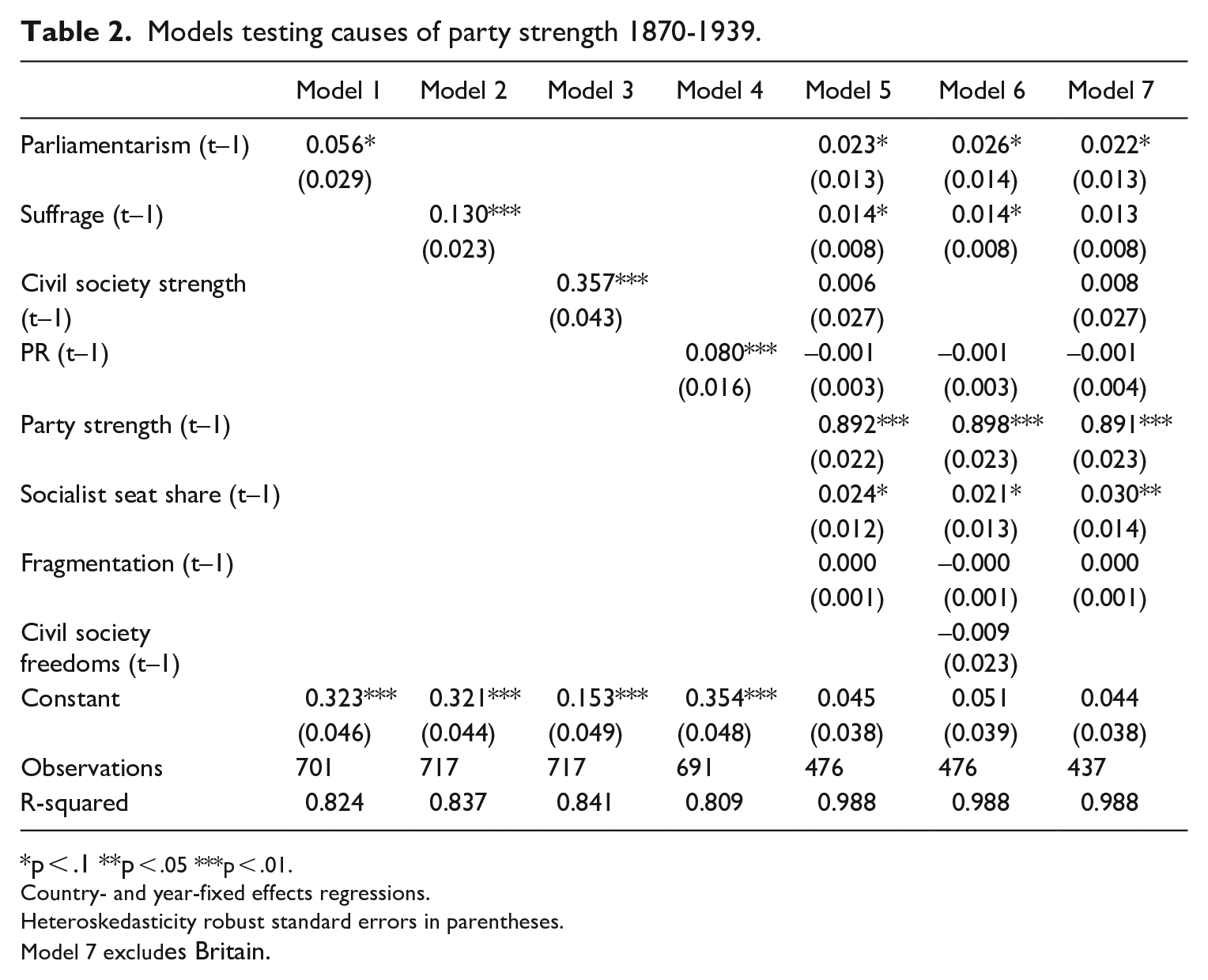
p < .1 **p < .05 ***p < .01.
Country- and year-fixed effects regressions.
Heteroskedasticity robust standard errors in parentheses.
Model 7 excludes Britain.
I reasoned above that the use of 1-year lags in Table 2 yields conservative tests because organizational reform might take more time. Models with longer lag lengths support this reasoning. Appendix Table 4 shows the main model when 2- to 5-year lags are used. At the cost of past party strength, the coefficient for parliamentarism increases from 0.04 and 0.09 over the lag lengths and that for suffrage increases from 0.02 to 0.05, with p values below 0.05 or 0.01, thus satisfying more demanding significance criteria. Civil-society conditions and PR are unaffected.
Among the control variables, past party strength shows an expected significant relationship with current party strength. The share of socialist seats is also significant, supporting Duverger’s thesis. However, Appendix Table 4 shows that the result for socialism is not robust to the choice of lag length, and the best interpretation is that Duverger’s thesis gets little to no support. 9 Party-system fragmentation, in contrast, exhibits a small but significant and expectedly negative relationship only when using lag lengths longer than 1 year.
The mechanisms linking the development of party strength to that of parliamentarism are thoroughly substantiated in case studies concerning Britain (Cox, 1987; Eggers and Spirling, 2016). Because the theory draws on those studies, model 7 omits Britain to evaluate the extent to which it drives the relationship. Parliamentarism remains significant, while suffrage is marginally insignificant with a p value of 0.11.
The coefficients of Model 5 show the relationships between the different factors and party strength, measured 1 year later. These short-run marginal effects of parliamentarism and suffrage, the two robustly significant factors from model 5 can be illustrated by two country periods, chosen because their minimum and maximum values of parliamentarism and suffrage are close to the mean minimum and mean maximum of the 11 country periods. A change in the measure of parliamentarism from 0.37 to 0.97 (Denmark in 1883 and 1939) is associated with a change in general party strength from 0.79 to 0.81 (p value of 0.067), the range of which is from 0.68 to 0.98 in the country period. A suffrage-share change from 0.31 to 1 (Britain in 1870 and 1935) is associated with an increase in party strength from 0.80 to 0.81 (p value of 0.072), whose range is between 0.68 and 0.91 in the country period. These short-term marginal effects of parliamentarism and suffrage thus represent 7% and 4% of the total change in these country periods, respectively. These effects might appear small, yet they are noteworthy given the inclusion of country- and year-fixed effects and the lagged dependent variable, which together account for differences between countries, regional trends over time, and all party development up until the previous year. 10
Moreover, the positive, significant relationship between past and current party strength indicates that a sizable part of the relationship between the factors and current party strength runs through past party strength. Therefore, the size of the long-run statistical relationships might be more interesting. These are, with p values in parentheses, 0.21 (0.065) for parliamentarism and 0.13 (0.042) for suffrage. During the 1870–1939 period, the party-strength measure ranges from 0.05 (1870s Italy, where parties were loose connections of parliamentary deputies with clientelistic relations to their constituents) to 0.99 (Sweden in 1939, where parties were consolidated electoral and legislative organizations), with a mean range of 0.4 for the 11 country periods. Thus, parliamentarism accounts for half and suffrage for one-fourth of the empirical change in party strength, and they account for one-fifth and one-tenth of the theoretically possible change.
As further robustness checks, Appendix Table 2 shows re-estimations of the main model using five other estimators that are suitable when there are more periods (years) than units (countries). These include choosing the “pairwise” option for the regressions, assuming an AR(1) autocorrelation structure, using a Driscoll–Kraay estimator, or Prais–Winsten transformations assuming either a common or a panel-specific AR(1) structure. Parliamentarism is the factor that remains consistently significant, followed by suffrage. 11
I now return to my contention that parliamentarism and suffrage had an interactive relationship with party strength. Columns 1–3 in Table 3 reproduces columns 5–7 in Table 2, adding an interaction term between parliamentarism and suffrage. That term is always positive and significant. It remains significant when using the alternative estimators (Appendix Table 3), 2 to 5-year lags (Appendix Table 5), or removing one index component (Appendix Table 7).
Models interacting parliamentarism and suffrage.
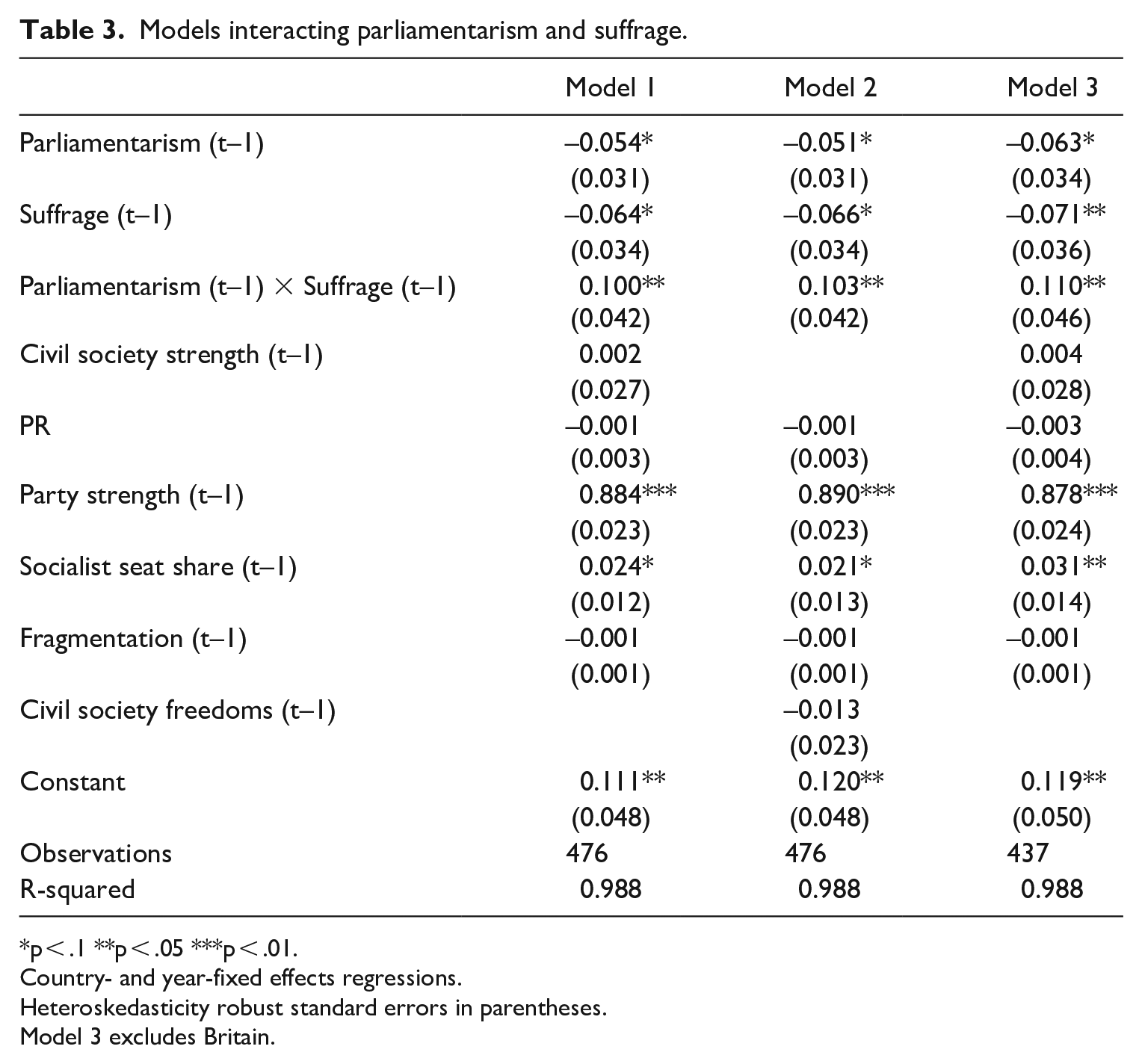
p < .1 **p < .05 ***p < .01.
Country- and year-fixed effects regressions.
Heteroskedasticity robust standard errors in parentheses.
Model 3 excludes Britain.
Figure 2 illustrates the interaction by showing the short-term marginal effect of suffrage extension on party strength for different values of parliamentarism. I prefer this depiction because Figure 1 shows that parliamentarism generally reached higher levels earlier than suffrage. At lower levels of parliamentarism, for which the sample includes relatively few observations, as indicated by the large confidence intervals, the relationship between suffrage and party strength is indistinguishable from zero. For higher levels of parliamentarism, the relationship is positive and significant. The threshold is around 0.8. Britain, France, Italy, the Netherlands, and Sweden either had crossed or did cross this threshold already in the 1870s, followed by Norway in the early 1900s, Austria, Belgium, Denmark, and Germany at the end of WWI, and Finland in the early 1930s.
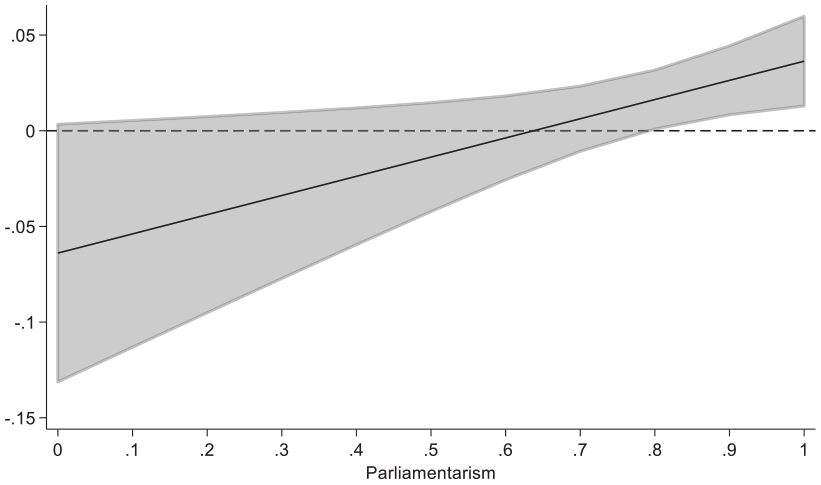
Marginal effects of suffrage at different levels of parliamentarism.
In all, parliamentarism and suffrage are the best candidates for being general drivers of West European party strength among the factors considered here. Parliamentarism and suffrage significantly interact, another finding of substantive interest. This suggests that the mechanisms between parliamentarism (and suffrage) and party strength suggested in Cox (1987) and Eggers and Spirling (2016) have general bearing. In the concluding discussion, I return both to this and to how the different factors may relate to each other in the specific historical West European period under study. First, I complement the statistical analysis with a qualitative study.
A Within-Case Illustration: The Netherlands
Macro-observational analyses in historical contexts where multiple factors develop simultaneously present challenges. Data are rare. If theorized general relationships are uncovered, they seldom satisfy criteria for causality, although they are prerequisites for causal claims. These challenges concern this study too. One good way to address them is to qualitatively investigate a case in more detail. This can elucidate the motives and actions of key actors, the time order between changes in the different factors, and whether the dimensions of the concepts that are captured by the statistical measures were part of those which actors (successfully) changed. Specifically, it here serves to track how party leaders responded to the development of parliamentarism and suffrage by trying to strengthen their parties in ways that reflect the statistical analysis, how party building required them to overcome local and individual resistance, and how early successful attempts created a dynamic that prompted reactions from other parties and leaders. If findings align with the theory of the general relationship, it increases the probability that the relationship has a causal interpretation (Seawright, 2016).
Thus, I here use historiography to probe the plausibility of my arguments at the level of parties and party leaders within a less-studied country, the Netherlands. I pay specific attention to the moves and reasoning of key actors, the order in which factors change, the reasons why parliamentarism and suffrage might have prompted actors to strengthen their parties, and the dimensions of party strength that the V-Dem index captures. Figure 1 suggests that the timing in this country of the development of the factors under investigation resembles that of Britain. This makes the Dutch case a likely setting to probe the mechanisms further, so it would be particularly worrying if a qualitative investigation failed to support the findings. It is an illustration. A full case study would require extensive analyses beyond the present scope.
Before the late 1870s, Dutch political parties were loosely organized parliamentary groups of free parliamentarians who campaigned through independent electoral associations dominated by local notables (Blom, 1999: 396; Tijn, 1971; Wielenga, 2020: 154–157). In 1878, party development took off, and there can be directly linked to the development of parliamentarism. That year, a liberal government and parliamentary majority adopted a school reform that was (rightly) understood to threaten Dutch confessional schools. The Calvinist leader, Abraham Kuyper, responded by coordinating the different religious organizations in the country and organizing an extra-parliamentary protest movement to make King William III refuse to sign the bill. The strategy was reasonable. In 1853, organized popular protests had given the king reasons to make a liberal government resign (Kossmann, 1978: 282, 326; Tijn, 1971: 186). But by 1878, parliament had increased its powers vis-à-vis the king, who no longer dared to confront a government that parliament supported. The bill became law, and the government remained in office.
The failure of his move convinced Kuyper that formal political party organization was needed. Already in 1869, he had suggested a party program to unite Protestant parliamentarians, but the then leader Groen van Prinsterer had resisted the move, fearing that it would alienate them. The developments described above prompted Kuyper to try again. In 1879, he transformed the protest movement into the Anti-Revolutionary Party (ARP). This became the first Dutch party with an electoral organization, a party program, and a central leadership to organize and command the parliamentary group (Blom, 1999: 402–410; Kennedy, 2017: 332–333; Verkade, 1965: 41–42). He summoned a founding assembly, at which the costs and benefits of party strength and individual and local independence was a dominating issue. Kuyper challenged the view of parliamentarians as independent politicians without obligations to their party, the population it represented, and the program that made it distinct. He explicitly stated that the key to electoral success lay in parliamentary organization and the commitment of candidates to the interests of ordinary voters as formulated by the central party. Individual delegates, in turn, were concerned with the interests of their local constituencies and their own parliamentary independence. Kuyper managed to find a compromise, but one which strengthened his position as central-party leader. Because Kuyper and the central board decided on strategy and led parliamentary negotiations, he could, within a few years, go beyond the formal compromise and exercise great influence over the local associations, demand approval of individual candidates, and use promotions to reward loyalty (Bratt, 2013: 113–125; Heyer, 2022: 141–145, 156–160, 205–213; Wielenga, 2020: 157). Kuyper thus consciously took independence from individual parliamentarians and instead gave them collective party strength which increased chances of reelection and legislative influence, initially against their own wishes. 12
Kuyper’s reforms made other party leaders try to follow. The Catholic parliamentary leader Schaepman, who was in contact with Kuyper, believed that political organization and cooperation between confessional groups was necessary to strengthen the religious parties both electorally and in parliament, where Catholic delegates remained undisciplined (Bakvis, 1981: 59–61; Bratt, 2013: 136; Kossmann, 1978: 307, 352). He published a Catholic program in 1883, but many parliamentarians were reluctant to embrace it and surrender their independence. Again, the costs and benefits of party strength and individual independence were at play. Importantly, Blom (1999: 410) and Verhoef (1974) explain the slow Catholic party development by the resistance of the Catholic candidates who were electorally safe in their districts in the South to the point that saw no need to surrender their electoral or legislative independence to organizational pressure. Only in the late 1890s, following a suffrage extension in 1887 and the successful creation of an electoral and parliamentary collaboration between the two confessional parties, and the fact that voters punished it in the next elections for having shown difficulties to cooperate in parliament, that the sharpening competition convinced Catholic electoral associations to accept a national program, and that party centralization was reinforced (Bakvis, 1981; 62–63; Kossmann, 1978: 356). By the turn of the century, the party was the electorally most successful one and its leadership exercised tight control over the parliamentarians, putting together coalitions with other parties, and using promotions and dismissals to influence candidates (Bakvis, 1981: 69–70; Verkade, 1965: 107). Symptomatically, candidates in North Brabant remained electorally safe and refused to join the national electoral association until the introduction of PR (Bakvis, 1981: 63).
On the left, the preacher Nieuwenhuis formed the Social Democratic Union in 1881. Its story illustrates the consequences of denying the importance of legislative and electoral strength in a time when parliamentary powers increased, and the suffrage expanded. Nieuwenhuis was elected to parliament in 1889 on a local liberal party ticket. A few years later, frustrated by his inability to exercise influence, he declared himself against parliamentary democracy and party discipline. As a reaction, some members of his party broke out and formed the Social-Democratic Workers’ Party in 1894, driven by the understanding that an independent, nationwide electoral organization with a parliamentary program was needed for political power. That party rose at the same pace at which Nieuwenhuis’s organization waned, and they were important in the competition with Catholics and the ARP to mobilize the enfranchised segments of the population after the mid-1890s (Kossmann, 1978: 345–347, 474–476; Newton, 1978: 89–91). It was thus the Social Democrats, who sought to improve their electoral and parliamentary strength, that would become the main Dutch socialist contender.
Other parties failed to react to the new competitive dynamics triggered by Kuyper. This was the case for the old Conservatives, who were quickly swallowed by the strengthening religious parties (Verhoef, 1974), and for the once-dominating Liberals. Liberal parliamentarians and electoral associations relied on their traditional dominance and wanted to maintain their independence. Even after the 1887 suffrage extension, which many Liberals were instrumental in, most of them refused to join one national party in Kuyper’s sense. The refusal came at the cost of squabbles, splits, and failures to form governments and conduct their own policy, all of which was observable to competitors (Kossmann, 1978: 360–361; Verkade, 1965: 47–49; Tijn, 1971: 195) and to voters, who punished them for their poor legislative performance (Daalder, 1966b: 217). Only gradually from the late 1890s, did Liberal groups unite around a program and centralize their electoral organization(s). By then, their competitors had already claimed most of the political space.
The Dutch illustration aligns with the theoretical arguments and the general findings concerning actors, temporal order, and the importance of the dimensions of the measured factors. The first successful move to build a modern Dutch party was directly prompted by the development of parliamentary powers, a connection that historians seem to have overlooked. The failure to make the king confront his own government showed Kuyper that influence must be won through parliamentary politics and electoral-political organization. Kuyper understood the interplay between parliamentary and electoral organization, and this gave him arguments to overcome resistance from parliamentarians and electoral associations who guarded their independence. In the processes of building a strong party, Kuyper consolidated his own position. This started before suffrage extension, which certainly provided additional impetus (for instance concerning the aforementioned Catholic organization after 1887 and the Social Democrats).
Kuyper’s moves launched a competitive dynamic, which forced other parties and candidates to face the tradeoff between party strength and independence that Kuyper had understood. In the historical context, where modern parties lacked precedence (Bratt, 2013: 125), the choice was not obvious. Some parties followed Kuyper’s lead (Catholics and Social Democrats), while others lost influence (Liberals) or perished (old Conservatives). Voters were also seen to observe the interplay between electoral and legislative performance, as illustrated by their negative reactions to the relatively incohesive first ARP-Catholic coalition and to the subsequent Liberal government. Moreover, party building took time and was an ongoing process. Kuyper and especially Schaepman needed years to overcome resistance. The Liberals were even slower. Finally, those dimensions that are measured in the V-Dem index were also pivotal in Dutch party development: a central office, cohesive voting, distinct platforms, and electoral organizations with programmatic constituent links.
Concerning the other factors, party development is connected to civil-society organization only in a loose sense. And though the conditions for civil-society development were there before parties developed, the increasingly vibrant Dutch civil society from the late 19th century and onward is a product of party development and competition between elites (Blom, 1999: 401–413; Kossmann, 1978: 567–569; Wielenga, 2020). Concerning PR, introduced with full male suffrage in 1918, historians argue that it permitted the parties to dominate politics and society even more and let leaders consolidate their organizations (Blom, 1999: 425–433; Kossmann, 1978: 425–433; Wielenga, 2020: 188–196), but it also had an offsetting effect by allowing smaller, less-organized parties to survive, which might have benefited the Liberals. Crucially, the same historiography clearly suggests that party strength was already well developed.
Discussion and Conclusion
In this concluding discussion, I elaborate on the findings. I suggest a new way of understanding the development of parliamentarism, suffrage, electoral rules, and parties in relation to each other in prewar Western Europe, and I suggest some avenues for future research.
This article suggests that the development of strong parties in Western Europe in the 1870s–1930s period owed to the development of parliamentarism and suffrage extension. If this has been stated in older scholarly work (cf. Daalder, 1966a), I offer the first systematic test with fine-grained data, considering other potential explanations, going beyond the electoral aspects of party strength, and relating these to the concerns of the party leadership and individual candidates. The analyses also corroborate an explicit theorization of parliamentarism and suffrage in interaction: that suffrage expansion took place in the context of increased parliamentary powers was important. The increasing parliamentary influence over executive composition enhanced the importance of party strength. Parliamentary control over the executive gave suffrage extension a deeper meaning, and when the one (normally suffrage) expanded in the context of the other (normally parliamentarism), the process both forced and allowed the leaders of successful parties to tighten their control over their electoral and parliamentary organizations, launching a competitive dynamic in which party leaders in order to strengthen their organizations had to overcome local or individual preferences for independence. The Dutch illustration supports this. Many political leaders understood the importance and interplay of parliamentary and electoral strength, attempted to act accordingly, and outcompeted their rivals. Fine-grained country-level data would allow further investigations of these intra- and inter-party dynamics.
I find no support for Katz and Mair’s (1993) argument concerning civil-society conditions and the mass party of integration, which included both socialist and confessional parties, who in many countries organized before and independently of socialist parties (Kalyvas, 1996; Panebianco, 1988). Because the political parties should be seen as part of civil society, the lack of support is surprising. One reason might be the broadness of the concept (cf. Seim, 2020). 13
PR exhibits no (positive) relation to party strength. This is surprising, given that contemporary observers, including party politicians, believed that this would be so. Someone may surmise that the positive relationship with the strength of existing parties is offset if PR made it easier for new, perhaps less well-organized parties to contest elections and obtain parliamentary seats. 14 But as Carstairs (1980) underlines, for a long period, the number of parties did not increase after PR was introduced.
Considering recent research, it may be that the consequences of PR depended on details such as district size and magnitude (Schröder and Manow, 2021). 15 Furthermore, Cox et al. (2018) and Schröder and Manow (2021) mention that the effect of proportional-representation reforms related to simultaneously changed nomination laws. Future country-case studies might further elucidate the relations between different electoral reforms, party systems, and the development of different aspects of party strength.
Regardless the relations one might uncover with a more fine-grained measure of proportional-representation systems on party strength, from a broader historical perspective the adoption of PR should be seen as a way in which party leaders strengthened their parties in response to the development of (democratic) parliamentarism and the emergence of new rivals (Cox et al., 2018; Schröder and Manow, 2021). Indeed, parliamentarism is a potential factor behind PR reform that has been overlooked compared to suffrage. Research suggests that the electoral challenge from socialist parties could be successfully met by electoral alliances between non-socialist parties (Emmenegger and Walter, 2019; Walter, 2021; also in the Netherlands, Verhoef, 1974). Such alliances, however, created difficulties for parliamentary organization because members of the same party would owe their seats to the electoral campaigns of different parties (Schröder and Manow, 2021). Legislative cohesion gained relevance as parliamentary powers developed. Inferior parliamentary strength could no longer be balanced by reliance on the head of state, and parliamentary composition and votes could now have immediate bearing on government survival. Thus, PR might have facilitated the connection of legislative and electoral party organizations by a strengthened central office, especially for the relatively weak parliamentary parties. To further evaluate this interpretation, studies of individual parties and leader strategies are warranted.
This articler has contributed a systematic assessment of different factors that have been proposed to explain the origins of the strong parties that have characterized Postwar West European politics. The results suggest the generalizability of the well-studied British case and of interest conflicts faced within modern parties (Kam, 2009; Tavits, 2012). They invite the conclusion that the historical transition of West European states from systems with restricted franchise and power sharing between parliament and monarch into democratic parliamentary systems helps explain party development. This corroborates research concerning the institutional causes for weaker-on-average parties in presidential states, which focuses on the post-WWII period (Hazan, 2006; Rosenbluth and Shapiro, 2018; Samuels and Shugart, 2010). They contribute further understanding of party dynamics in the historical nationalization of politics (Caramani, 2004), and they speak to the difficulties and the stakes involved in party organizational reform given new developments, a modern example of which is the increasing importance of social-media presence as an aspect of party strength. The results also have wider implications for the understanding of the relative political stability in Western Europe after WWII. Given the importance of organized parties for cohesive policy, the necessity for parties to improve their strength when competitive legislative elections are of direct consequence also for executive power might be one reason why parliamentary states have been found to be “better” (Cheibub and et al, 1996; Gerring et al., 2009).
Supplemental Material
sj-docx-1-psx-10.1177_00323217241311355 – Supplemental material for The Parliamentary Origins of Party Strength in Western Europe before the Second World War
Supplemental material, sj-docx-1-psx-10.1177_00323217241311355 for The Parliamentary Origins of Party Strength in Western Europe before the Second World War by Simon Davidsson in Political Studies
Footnotes
Acknowledgements
Previous versions were presented at the annual ECPR 2022, MPSA 2022, and SWEPSA 2022 meetings. I thank Gary W. Cox, Fleming Juul Christensen, Carl Dahlström, Annika Fredén, Agustín Goenaga, Sarai-Anne Ikenze, Marcus Kreuzer, Johannes Lindvall, Jonathan Polk, Maiken Røed, Florence So, Thomas Saalfeld, Jan Teorell, and Radoslaw Zubek for valuable comments and feedback. I also thank the two anonymous referees for their very valuable feedback.
Declaration of Conflicting Interests
The author declared no potential conflicts of interest with respect to the research, authorship, and/or publication of this article.
Funding
The author received no financial support for the research, authorship, and/or publication of this article.
