



Abstract
The Covid-19 pandemic changed contentious politics worldwide. After causing a short-lived decline in global protest activities in early 2020, it has led to the emergence of a variety of pandemic-related protests. While previous work has mostly looked at how event frequencies have changed over time, this paper focuses on changes in protest issues. It applies quantitative text analysis to protest event descriptions and makes the following contributions. First, it traces the rise and fall of pandemic-related protests globally between 2020 and mid-2022, showing that, on average, more than 15% of protest events were pandemic-related. Second, it identifies the most dominant pandemic-related protest issues—masks and vaccination, the economy, business restrictions, health care, education, mismanagement, and crime—and their salience over time. Third, the paper explores potential explanations for differences in the prevalence of pandemic-related protest issues between countries. Multivariate regression analyses suggest a global divide. Protests in developed countries and liberal democracies were more likely about government restrictions. In contrast, citizens in less developed countries took to the streets to demand better healthcare provision.
Introduction
In 2020, anti-government protests erupted from Algeria to Zimbabwe, amounting to one of the largest waves of mass mobilization in recent history (Chenoweth, 2020). The global spread of Covid-19 in early 2020 brought protests to a halt. Social movement organizations canceled street demonstrations, and governments restricted the freedom of assembly. Previous scholarly work has documented the stark decline in protest activity at the beginning of 2020 (Metternich, 2020) and the shrinking of spaces for civil society in the early stages of the Covid-19 pandemic (Bethke and Wolff, 2020).
However, the drop in protest activity was only short-lived, and protests quickly rose to pre-pandemic levels (Bloem and Salemi, 2021). The pandemic gave rise to new grievances and demands. Examples include sit-ins by healthcare workers, anti-lockdown protests, or the rise of the anti-vax movement (Gerbaudo, 2020). At the same time, economic issues “got crowded out” (Kriesi and Oana, 2023, 752). While changes in protest frequency after the outbreak of Covid-19 are well-studied, there is little systematic evidence on the changing nature of protest issues on a global scale.
Extending recent work by Kriesi and Oana (2023) and Neumayer et al. (2023), this paper examines variation in pandemic-related protest issues across time and space. Applying methods of quantitative text analysis to protest event data from the Armed Conflict Location and Event Data (ACLED) project (Raleigh et al., 2010), I trace pandemic-related protests in a global sample of countries and identify the main protest issues. The data show the rise and fall of Covid-19-related protests. Between May 2020 and July 2022, on average, 15% of all protest events were pandemic-related, with a peak of more than 50% in April 2020. By spring 2022, pandemic-related events had almost entirely disappeared.
Using topic models, I identify eight main Covid-19-related protest issues: business restrictions, the economy, education, health care, crime/imprisonment, restrictions/masks, mismanagement, and vaccinations. As the data suggest, the salience of some protest issues has changed substantially over time. Finally, the paper examines variation in issue prevalence between countries. An exploratory regression analysis suggests that developed countries and countries with high level of liberal democracy were more likely to see contention around government restrictions. In less developed countries, by contrast, contention was more often about health care. The paper contributes to a better understanding of protest dynamics during the pandemic and the pandemic’s effect on contentious politics from a global perspective.
Contentious politics and the Covid-19 pandemic
Mass protest is at the core of what McAdam et al. (2001, 5) understand as contentious politics, that is, “episodic, public, collective interaction among makers of claims and their objects (…).” The Covid-19 pandemic affected contentious politics in important ways. In its early stages in 2020, when little was known about how the virus was transmitted, mobilizing large crowds was associated with considerable risk. Consequently, many social movement organizations (SMOs), such as the climate activist group Fridays for Future, canceled rallies and moved their activities online (Lawal, 2020). In addition to activists’ health concerns, governments around the world imposed heavy restrictions on the freedom of assembly. According to Edgell et al. (2021, 5), “both democracies and autocracies have engaged in violations, but on average autocracies have done so more.” Some governments exploited the health crisis to crack down on the opposition (Grasse et al., 2020). In the short term, government restrictions in response to the pandemic have accelerated the global trend toward shrinking spaces for civic engagement (Bethke and Wolff, 2020).
Still, SMOs rapidly adapted to the changing circumstances and opportunity structures. They conquered new areas of engagement by organizing in a more decentralized fashion, designing activities that complied with social distancing regulations, and moving parts of their activities online (Sydiq, 2020; Pinckney and Rivers, 2020). The “logic of numbers,” that is, the mobilization of huge crowds, was trumped by the “logic of bearing witness” (Kowalewski, 2021, 758). As Della Porta and Lavizzari (2022) argue, the pandemic was a window of opportunity for progressive movements to advance broader health care–related issues. Nevertheless, reactionary movements also tried to capitalize on the crisis (Pleyers, 2020).
Scholars noted a drastic decline in protest activity following the global surge of the pandemic in March 2020. According to Pavlik (2020), demonstrations decreased by one-third. Metternich (2020) showed a clear drop in protest activity, particularly in Europe and Asia. Yet, this substantial decline in event frequencies was only short-lived (Bloem and Salemi, 2021), and protests quickly rose to pre-pandemic levels. Some scholars argue that the crisis strengthened solidarity and thus helped mass mobilization in other areas, as evidenced by the massive Black Lives Matter (BLM) protests in mid-2020 (Libal and Kashwan, 2020). Others find strong partisan divides and polarization in public opinion about state responses to the pandemic (Druckman et al., 2021).
While previous work has examined how protest frequency changed during the pandemic, there is limited systematic evidence on how the pandemic affected protest issues. The pandemic and state responses gave rise to various new protest issues (Pressman and Choi-Fitzpatrick, 2021). Gerbaudo (2020, 63) identifies different types of “pandemic protests” such as socially distanced protests by healthcare personnel, anti-lockdown protests, and riots. While recent research has begun to explain the occurrence of protests against government restrictions (e.g., Neumayer et al., 2023), we lack a comprehensive account of the diversity of Covid-19-related protests. One important exception is recent work by Kriesi and Oana (2023). Their study of protest data for 30 European countries shows that anti-lockdown protests dominated the protest landscape and that economic protests got crowded out. Adding to this line of inquiry, this paper looks at a global sample of countries and identifies and traces the various pandemic-related protest issues across space and time.
The rise and fall of Covid-19 protests
To track pandemic-related protests, I relied on protest event data from the Armed Conflict Location & Event Data Project (Raleigh et al., 2010, ACLED), which offers broad coverage and frequent updates. 1 Unlike other protest event data sets, ACLED does not provide systematic information on protest issues. However, the data include short event descriptions with information on who protested and why. 2 To identify pandemic-related protests, I searched all event descriptions for the words corona, pandemic, and covid. This approach is valid because ACLED had explicit rules that discouraged coders from referencing the word coronavirus if the event was not directly related to the pandemic. 3 Out of all 381,058 recorded protest events between January 2020 and July 2022, about 15% (57,042) events were classified as pandemic-related protests.
Figure 1 illustrates the rise and fall of pandemic-related protests. Covid-19-related demonstrations emerged after the World Health Organization declared a global health emergency on 30 January 2020, and the number of cases skyrocketed globally. At the same time, protests concerning other issues declined substantially as activists called off demonstrations and governments implemented lockdown measures. In April 2020, pandemic-related protests comprised more than 50% of all protest events. They reached their peak in absolute terms in May 2020, shortly after more than one million cases of Covid-19 had been recorded around the globe. Overall, protest activities quickly rose to pre-pandemic levels and peaked in June 2020 when the massive George Floyd solidarity protests erupted in the U.S. and elsewhere. Subsequently, Covid-19-related protests became a regular feature of the protest landscape. Between January 2020 and July 2022, they made up around 15% of all events recorded in ACLED, on average. In Spring 2022, the number of pandemic-related protests declined drastically, and since mid-2022, there have only been occasional demonstrations. Moving beyond event frequencies, the next section sheds light on the variation in topics related to pandemic protests. Absolute number of protest events per month. Dark gray area represents pandemic-related events, light gray area represents all other events. Own depiction based on data from Raleigh et al. (2010).
Varieties of pandemic protest issues
As scholars have pointed out, the pandemic led to the emergence of various new types of protests (Pressman and Choi-Fitzpatrick, 2021). In the Philippines, for instance, healthcare workers took to the street to demand better working conditions. 4 In Greece, protesters clashed with the police over mandatory coronavirus vaccinations. 5 Both events were pandemic-related. Still, they differed considerably concerning protesters’ demands.
To capture variation in pandemic-related protest issues, I applied topic modeling to the event descriptions in ACLED for the subset of 57,042 pandemic-related events. The pre-processing involved the following steps. First, I annotated the event descriptions using the udpipe package in R (Wijffels, 2021) and only retained adjectives and nouns. Second, I lemmatized the remaining words. Finally, I removed all punctuation and a set of frequent words. 6 The quanteda package (Benoit et al., 2018) was used for the last pre-processing steps. Appendix A has more detailed information about the methodological approach.
Following previous work that estimated protest issues from text (Keremoğlu et al., 2022), I ran a biterm topic model (Yan et al., 2013, BTM) on the corpus of event descriptions. The BTM is based on word co-occurrence and outperforms existing topic models if the input text is short (ibid.), which is the case for the protest event descriptions. I ran the model with nine substantive topics, set beta to 0.05 and alpha to 0.1. 7 More details on this procedure are given in Appendix A.
Results From BTM (15 Most Frequent Terms).

Figure 2 depicts the relative prevalence of each topic from the beginning of the pandemic onward. In early 2020, many protests centered around the economic consequences and the situation of vulnerable groups such as prisoners and refugees hosted in environments conducive to contagion. A substantial number of demonstrations also responded to the economic consequences of the pandemic. Throughout 2020, business restrictions, including factory closures, and protests in the education sector became more frequent. The widespread availability of vaccines and ensuing discussions about vaccine mandates marked a major turning point and led vaccination and government restrictions to become the most widespread pandemic-related protest issues in 2021.
8
Trends in protest topic prevalence over time for each topic (smoothed averages).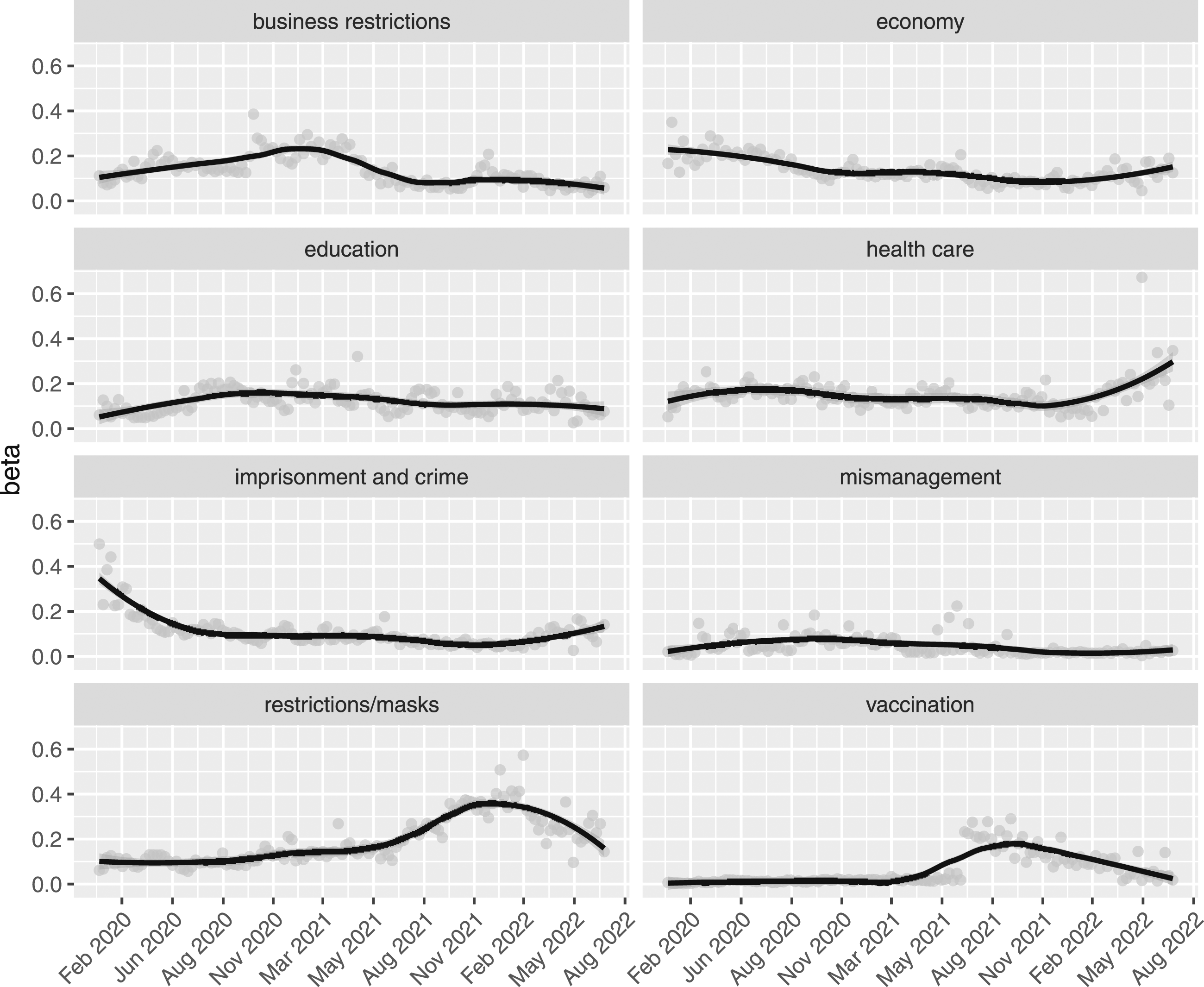
Topics also varied substantively between countries. Figure 3 shows the average topic prevalence for selected countries aggregated for the period from 2020 to July 2022. Again, a higher score for one topic does not necessarily imply more protests but rather that the events that did occur were more likely about a specific topic. In Germany, for example, protests were predominantly about government measures to curb the pandemic and business restrictions. During the pandemic, the so-called Querdenken movement emerged and frequently mobilized to defeat mask mandates and lockdown measures (Plümper et al., 2021). The United States also experienced many “anti-lockdown” protests, but education played a much more important role, with multiple demonstrations demanding better protection against Covid-19 on campuses or the reopening of schools. In Brazil, tens of thousands marched to criticize how the Bolsonaro government (mis)handled the pandemic following an alleged corruption scandal about the supply of vaccines.
9
In countries hit hard by the pandemic, such as Venezuela, Turkey, and South Africa, protests centered around the countries’ healthcare systems and the state’s economic policies. Thus, the data clearly show different topic configurations in protest mobilization around the globe. Average prevalence of protest issues across selected countries between 2020 and 2022.
Exploring variation in issue prevalence
The cross-country variation in pandemic-related protest issues shown in Figure 3 raises questions about potential explanatory factors. Therefore, the final part of the paper is dedicated to exploring such factors. While a causal analysis is beyond the scope of this paper, I attempt to identify variables that deserve further scholarly attention.
One pattern in the data is that more developed countries saw less contention about health care but more about government restrictions. Figure 4 shows the prevalence of the restrictions/masks topic by geopolitical region as defined in the Varieties of Democracy data (Coppedge et al., 2021).
10
The topic played a much more important role in Europe and North America compared to Africa, Asia, and Latin America. Figure 5 shows the negative correlation between a country’s Human Development Index (HDI) as measured by the United Nations and the average prevalence of the healthcare protest topic. Protests in highly developed countries were less likely to be about hospital work conditions. Protests about restrictions and masks by geopolitical region (2020–2022). Linear relationship between the prevalence of health care–related protest issues and human development. Unit of analysis: country-years.

To identify potential explanatory factors more systematically, I ran linear regressions with the following predictors taken from Hale et al. (2021) and Coppedge et al. (2021): the severity of the pandemic (deaths per million, log), state measures to curb the pandemic (avg. stringency index), development (UN Human Development Index), and the state of democracy (liberal democracy index). The dependent variable in the regression is the average prevalence of each topic at the country-year level (n = 244), that is, I ran separate models for each topic. I used mixed effects models with random intercepts for each country and each year to capture mean differences across time and space. In addition to the explanatory factors mentioned above, I adjusted the estimates for the overall number of protest events (log) and population size (log).
The coefficients from separate linear regression models for each protest topic are summarized in Figure 6 and regression tables are shown in the Appendix. Estimates that are statistically significant at the 0.05 level are highlighted in blue. The models reveal a few noteworthy patterns. More stringent measures, for instance, were associated with more protests about the economic consequences of the pandemic but less mobilization around education. Higher death rates correlate with more health care–related protests. Regression results. Linear mixed regression models for each topic with random intercepts for country and year. Unit of analysis: country-year (n = 244). Statistically significant terms are highlighted in blue.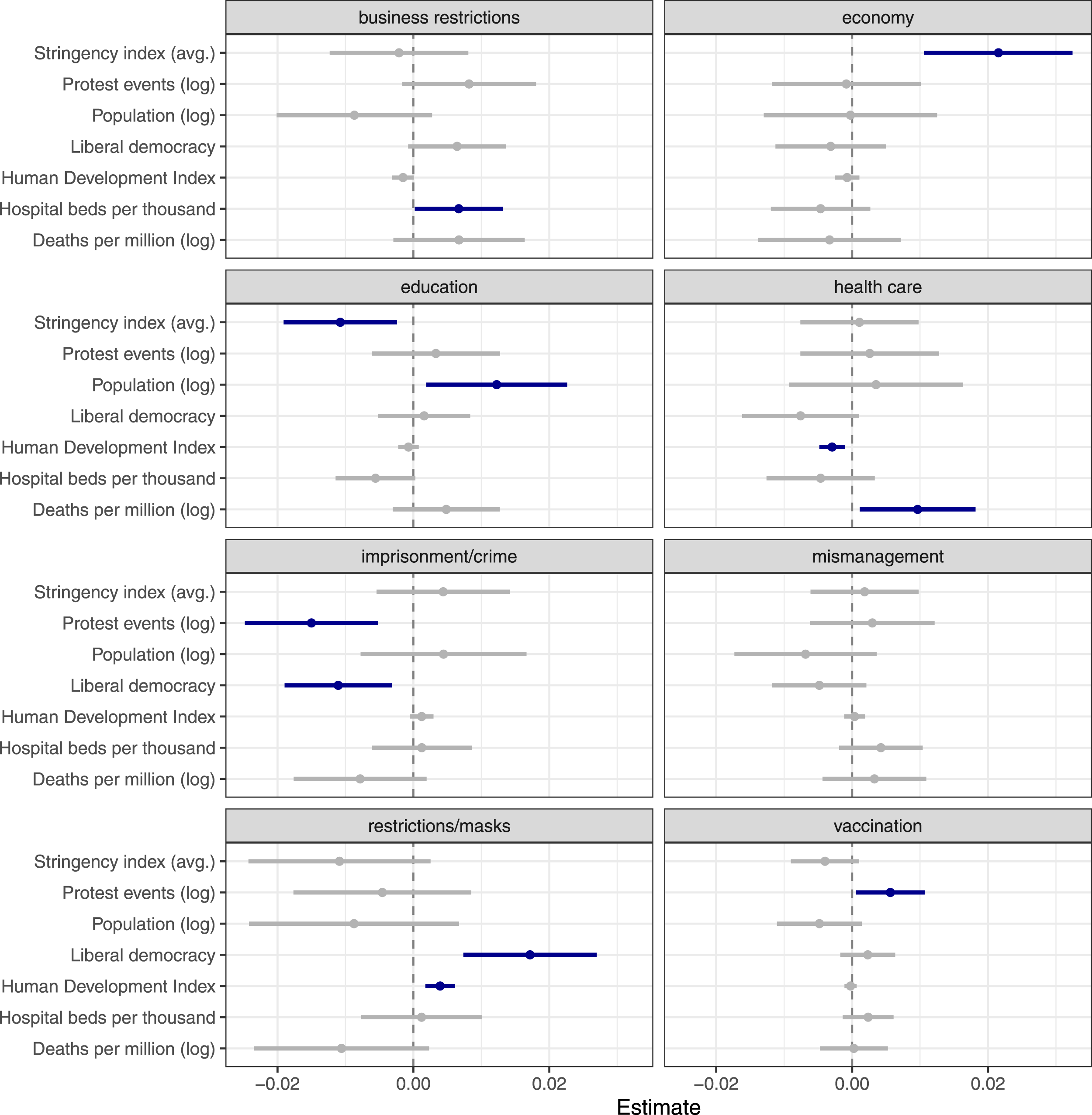
Liberal democracy was associated with less protesting about imprisonment/crime, but there was more contention about government restrictions. The positive relationship between human development and the salience of protests about restrictions and masks (see Figure 4) persisted. In countries with better healthcare provision as measured by hospital beds, contention around business restrictions was more widespread. The fact that nations with higher levels of liberal democracy saw more mass mobilization about government restrictions and vaccinations could be due to better opportunity structures—even during a pandemic. It could also be indicative of privilege in the sense that citizens had to worry less about the healthcare system. While these estimates are not causal, they suggest systematic differences in how the pandemic has shaped contentious politics in different ways around the globe.
Conclusion
The Covid-19 pandemic has left a mark on contentious politics around the globe. After a short-lived decline in protest activity, the pandemic and states’ responses gave rise to thousands of Covid-19-related protests. This paper showed the rise and fall of the pandemic as a protest issue. Using text-as-data methods, the paper shed light on variation in Covid-19-related protests and protesters’ diverse demands, including vaccines, business restrictions, masks, education, and health care.
The paper also showed substantial variation between countries. In highly developed countries and countries with high levels of liberal democracy, contention was more about government restrictions, while in less developed countries, protests were more often about the healthcare system, underlining differences in political opportunity structures. This finding aligns with recent work by Neumayer et al. (2023) showing that stronger civil liberties are associated with more protest events. Future studies could apply more advanced research designs to uncover the causal effect of particular predictors to understand why certain issues become more salient in some countries than others.
The paper showed that Covid-19-related protests have declined significantly in recent times, and there is no sign of an upcoming protest wave. At the same time, we can expect the pandemic’s effect on protest to become more subtle and indirect, for instance, if it leads to long-term economic grievances.
Supplemental Material
Supplemental Material - From masks to mismanagement: A global assessment of the rise and fall of pandemic-related protests
Supplemental Material for From masks to mismanagement: A global assessment of the rise and fall of pandemic-related protests by Sebastian Hellmeier in Research & Politics.
Footnotes
Acknowledgements
The author would like to thank members of the TD Department at WZB, Philipp M. Lutscher and Eda Keremoğlu for their feedback, and Nikolina Klatt for helpful research assistance.
Declaration of conflicting interests
The author(s) declared no potential conflicts of interest with respect to the research, authorship, and/or publication of this article.
Funding
The publication of this article was funded by the WZB Berlin Social Science Center and the Open Access Fund of the Leibniz Association.
