



Abstract
Norms about what constitutes an ideal politician are shown to negatively affect the demand for young political candidates within political parties because they favor qualities that young people have yet to acquire. We ask whether this “youth bias” continues to shape the political opportunities of those young persons who get elected. Drawing on comprehensive, original data encompassing all Czech MPs elected between 1996 and 2021, we analyze potential age-driven heterogeneities in access to valuable political resources and reelection, both of which are subject to party gatekeeping. We find that young MPs are given a privileged access to assignments that facilitate learning about the legislative business and reelection, despite being more likely to cast a dissenting vote at roll call. These results suggest that young MPs, unlike some other political outgroups, are not marginalized by their superiors despite exhibiting certain traits typically associated with political outgroups.
Keywords
Introduction
Despite comprising half of the global population, individuals under the age of 30 account for only three percent of all legislators (Inter-Parliamentary Union, 2021). Previous research has delved into the reasons for this discrepancy, examining both supply- and demand-related factors. On the supply side, young people are suggested to be less interested in pursuing political office (Grasso and Giugni, 2022; Lawless and Fox, 2015; Trachtman et al., 2023). The reasons for this are multifaceted, spanning from young people’s position in the life cycle to feelings of alienation caused by a lack of relevant policy proposals and political role models (Lawless and Fox, 2015; Stockemer and Sundström, 2023). On the demand side, existing norms within political parties about the qualities a successful politician should possess can disadvantage young political aspirants (Belschner, 2023; Rehmert, 2022; Stockemer and Sundström, 2018: 469). These norms often favor traits, resources, and competences that young individuals have yet to acquire (Belschner, 2023; Bjarnegård, 2013; Cirone et al., 2021). 1 Nevertheless, some young individuals do succeed in navigating the recruitment process and secure election, a success that is in part attributable to the growing demands for youth representation (Krook and Nugent, 2018; Stockemer and Sundström, 2022). Our knowledge of what happens to these young MPs once they enter office is limited (Winsvold et al., 2017). To bridge this knowledge gap, this article examines potential age-driven variations in access to politically meriting tasks and assignments and reelection. This is done in the context of the Czech Republic where political parties act as gatekeepers to various political resources (Bäck et al., 2019; Hájek, 2019).
Drawing on comprehensive, original data encompassing all Czech MPs elected between 1996 and 2021, the study finds no evidence to support the notion that young MPs are marginalized by their party superiors. On the contrary, young MPs seem be to be provided with opportunities to learn the ropes of the legislative profession and are groomed for long-term political careers. This is significant given that young MPs possess certain characteristics which, according to previous research, tend to negatively impact the political fortunes of MPs who belong to politically marginalized groups. It is suggested that senior party representatives might be willing to overlook these traits because being young is not a fixed group identity: everyone eventually outgrows it. These findings hold significance beyond the matter of youth representation as they shed light on heterogeneities in party gatekeeping practices toward different political outgroups.
Background and expectations
When it comes to selecting new candidates, party recruiters often base their criteria on dominant norms that define a successful politician (Bjarnegård, 2013; Norris, 1997). The political fortunes of young political aspirants are negatively affected by these norms. Stockemer and Sundström (2018: 469) argue that party selectors commonly believe that political competence is associated with age. Using a conjoint experiment, Rehmert (2022) finds evidence of a preference for older candidates among senior German party selectors. In a similar vein, Belschner (2023: 91) discovers that political parties show a preference for candidates with high political status, which is often correlated with being male and middle-aged. Furthermore, Cirone et al. (2021) find that young aspirants face disadvantages due to a seniority progression norm that shapes the career path within political parties. Although previous studies have investigated the sources of youth bias in candidate selection processes, it remains unclear whether and to what extent this bias persists and negatively impacts the political trajectories of young individuals who successfully navigate the recruitment process and get elected. This is an important question in light of the growing demands for the inclusion of young people in political decision making (Krook and Nugent, 2018; Stockemer and Sundström, 2023).
While previous studies have not specifically examined the impact of youth bias on the political opportunities and career progression of young MPs, insights from the field of women in politics can provide relevant perspectives. This research suggests that the barriers preventing women from entering politics also hinder the political careers of women MPs. Women, still relatively underrepresented in many political systems, are often perceived as an incompetent or untrustworthy outgroup, making them riskier choices for valuable positions and assignments under party control (Erikson and Josefsson, 2021; Folke and Rickne, 2016; O’Brien, 2015). This has a negative impact on their legislative output and long-term political career prospects (Folke and Rickne, 2016; O’Brien, 2015; Verge and Claveria, 2018). These practices are not necessarily driven by outright misogyny among party representatives responsible for allocating political capital. Often, they reflect rational responses to the uncertainties associated with delegating visibility-generating posts and assignments that are invariably associated with the party label (Carey, 2007). In this high-risk setting, party selectors distribute valuable political capital along lines of homophily (Rehmert, 2022). Considering these dynamics, should we expect youth bias to affect the political opportunities of young MPs? Two alternatives are plausible.
On one hand, young MPs may face similar exclusionary practices as their women colleagues (Belschner, 2023; Cirone et al., 2021; Erikson and Josefsson, 2021). If age is used by party selectors as a proxy for dependability or political competence (Belschner, 2023; Rehmert, 2022), then an average young MP might actually be farther away from the ideal of a promising politician than an average woman legislator. This could limit young MPs’ access tao political-capital-enhancing tasks and posts (Cirone et al., 2021). Restricted access to various sources of political capital can negatively impact their political performance, output, reputation in their constituencies, and their prospects for renomination or reelection. This scenario is referred to in this article as the marginalization thesis.
However, it is important to note a notable difference between young age and other group identities mentioned earlier (Stockemer and Sundström, 2023). While gender and ethnic background are enduring identities that tend to persist throughout one’s life, everyone eventually “grows out” of being young. Young MPs might therefore not be subjected to the same exclusionary practices as women MPs or MPs of color (Belschner, 2023). On the contrary, senior party officials might view young MPs as younger versions of themselves: prospective future party elites that need to be trained and groomed to reach their full potential (Cirone et al., 2021). Although this dynamic may not immediately propel young MPs into positions of power within the legislature or their party, it could provide them with privileged access to political tasks and assignments that facilitate their learning and integration into the legislative arena. If young MPs are perceived as diligent apprentices by party selectors, it could positively (or at least not negatively) impact their prospects for renomination or reelection. This scenario is referred to here as the apprenticeship thesis. This article aims to analyze which of these competing views align more consistently with the available empirical evidence.
Case selection and empirical strategy
The Czech Republic
This inquiry is carried out in the context of the Czech Republic, which is characterized by a moderately pluralistic, multiparty system where coalition governments are the rule (Mansfeldová, 2011). Similar to other proportional-representation (PR) systems, political parties have various tools at their disposal to pursue their policy objectives in a fragmented political landscape (Bäck et al., 2019; Carey, 2007). This includes control over access to the party label (Outlý and Prouza, 2013) and a range of political resources within the legislature (Bäck et al., 2019; Hájek, 2019; Marcinkiewicz and Stegmaier, 2019).
In PR systems, voters cast their votes for political parties rather than individual candidates. Therefore, in order to get elected, individual candidates need to secure a place on their party’s multicandidate ballots. While voters have the opportunity to express their individual candidate preferences, the most influential factor shaping the electoral success of Czech candidates is the ballot placement determined by their respective parties (Smrek, 2020). The fact that most voters vote for parties rather than individual candidates allows political parties considerable flexibility in composing their candidate lists. Consequently, parties have the relative freedom to promote loyal party members and sideline or exclude dissenting individuals (Outlý and Prouza, 2013; Smrek, 2023) and affect the representation of different social groups, including young people (Hájek, 2019: 556) and women (Stegmaier et al., 2014), among others.
The power of political parties extends beyond candidate selection. Czech political parties enjoy a dominant position within the legislature to make policy making possible in a fragmented multiparty context (Marcinkiewicz and Stegmaier, 2019). The allocation of influential political resources, such as senior legislative positions or seats on popular committees, is determined by political parties during the government formation process and subsequently distributed by senior party officials (Mansfeldová, 2011). As multiple parties are represented in parliament, these positions are always limited in number. Senior party officials must carefully consider which MPs will gain access to agenda-setting roles on behalf of the party (Bäck et al., 2019). This creates an environment where norms regarding the characteristics of promising committee chairs, issue spokespersons, and so on can influence the distribution of valuable political resources under party control.
Through their control over candidate selection and access to influential political resources, Czech political parties can make or break individual MPs. This significant gatekeeping role, coupled with the underrepresentation of young people in elected office, provides favorable conditions for supporting the marginalization thesis and less favorable conditions for the apprenticeship thesis.
Empirical strategy
This article utilizes an original dataset that includes all Members of Parliament (MPs) elected to the Chamber of Deputies of the Czech Republic between 1996 and 2021. 2 The dataset contains multiple indicators of legislative performance and information on renomination outcomes. The main independent variable is whether an MP can be classified as young. This variable takes on the value of “1” for those MPs who are 35 years old or younger at the start of the parliamentary term. This operationalization aligns with the existing literature on youth representation (Stockemer and Sundström, 2023).
To assess whether the data supports the marginalization or apprenticeship thesis, the study examines the distribution of various tasks, posts, and promotions that are subject to party gatekeeping. Limited access to these political benefits for young MPs will be construed as evidence in favor of the marginalization thesis, while privileged or comparable access will be interpreted as support for the apprenticeship thesis.
The analysis focuses on two categories of political resources: those that facilitate learning about the legislative process and integration into the legislative arena, and those that enhance an MP’s agenda-setting power and name recognition. The first category includes membership in (1) legislative committees, (2) standing expert groups and permanent parliamentary delegations, which are measured as count variables. A privileged access to these resources will be interpreted as evidence that party superiors intend to afford MPs opportunities to learn about the legislative business. The second category examines access to senior legislative posts such as (1) committee chairpersonship and (2) house speakership/vice-speakership, (3) senior legislative party posts like chairpersonship of the parliamentary party group, and (4) opportunities to sponsor successful bill proposals that become laws. The latter is measured as the proportion of successful bill proposals among all the proposals tabled by the MP during the term. Additionally, three binary measures of renomination fortunes are analyzed, including (1) returning to the ballot at the next election, (2) securing a safe ballot spot, and (3) securing reelection. The second measure takes on the value of “1” if the MP’s party-predetermined ballot rank at the next election does not exceed the number of mandates secured by the party in the district. 3
In addition to these outcomes, we also study two aspects of legislative activity that are individual in nature and subject to less party gatekeeping. The objective is to assess the degree to which young MPs can exercise independent agency within the legislature and effectively express their views. This includes (1) proclivity to uphold party unity at roll call, defined as the proportion of times the MP votes along the party line during the term; and (2) engagement in government oversight, defined as the number of interpellations tabled by the MP, standardized by term length. These measures aim to evaluate whether young MPs are able or willing to voice their perspectives in the policy-making process.
To study potential age-driven disparities in access to potent political resources and renomination, the analysis employs linear regression models with fixed effects for interactions between party affiliation, electoral term, and when relevant, electoral district. Therefore, we control for party-specific, time-specific, and location-specific factors such as party culture, leadership style, government status, and other contextual particularities that may impact legislative activity. Following this approach, we are able to compare the political performance and fortunes of young and older MPs who represent the same party at the same time. We use linear modelling for all the outcomes—including the non-continuous ones. This approach facilitates a straightforward interpretation of key coefficients. 4 The models include various control variables that could explain age-driven disparities, such as legislators’ sex, possession of a college degree, individual electoral appeal measured by preference-vote tallies, and a proxy for each MP’s within-party standing reflected in their party-determined ballot rank. The models also account for political seniority, measured by the number of years served as an MP and serving as a minister in the current parliamentary term. This is to ensure that the association between being young and access to political resources is not confounded by political seniority.
Descriptive statistics for the response and control variables are presented in the Online Appendix (Tables A1 and A2, pp. 7–10). These statistics reveal that young MPs constitute a small minority, approximately twelve percent, of all MPs. Young MPs are generally less educated and less politically experienced compared to their older colleagues. They are also assigned to less electable ballot spots, indicating weaker intraparty standing, and receive fewer personal votes. These differences between young and older MPs could trigger the mechanisms underlying marginalization.
Analysis
Distribution of political capital and legislative activity
Distribution of legislative tasks and posts and legislative activity.
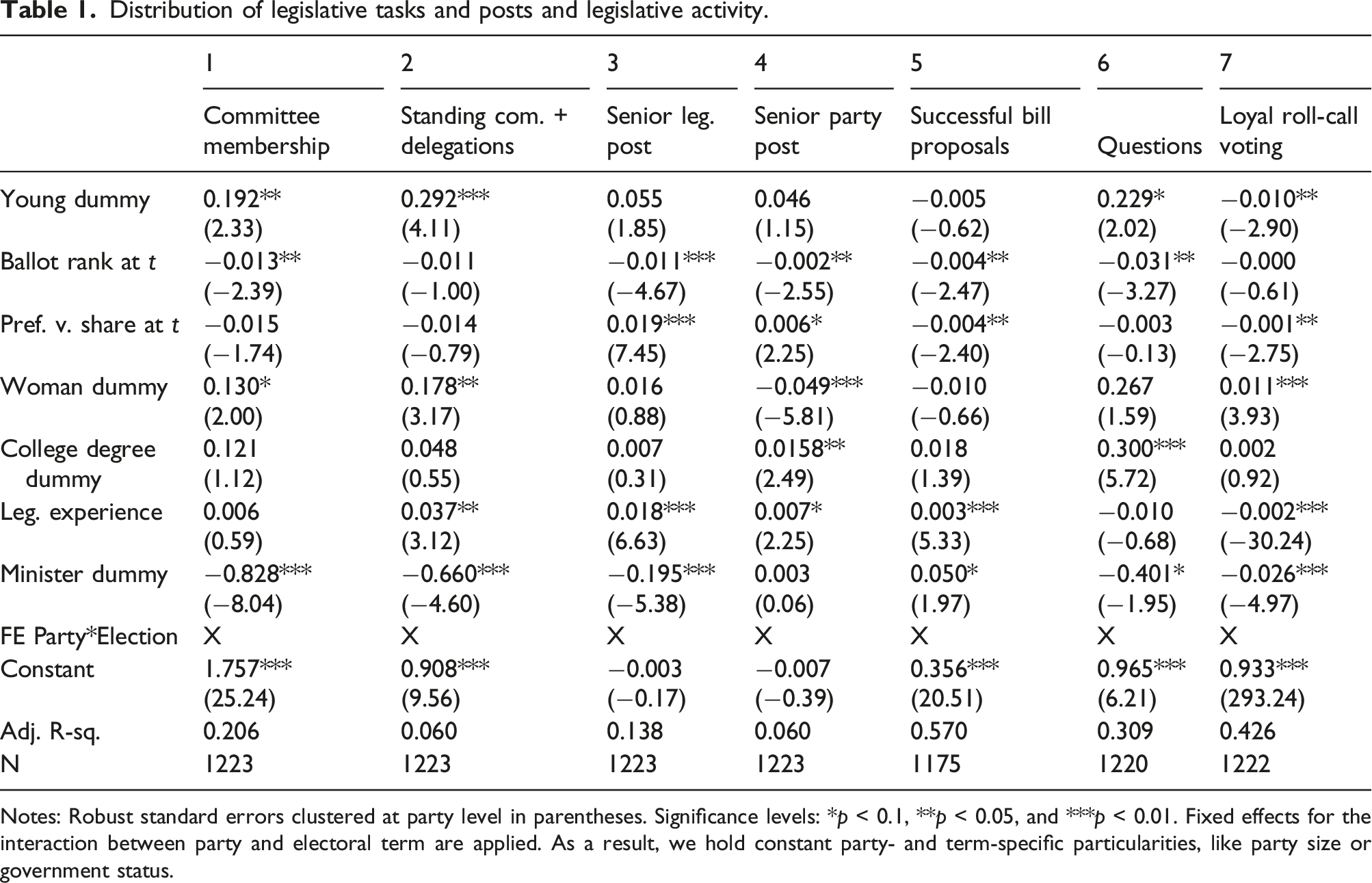
Notes: Robust standard errors clustered at party level in parentheses. Significance levels: *p < 0.1, **p < 0.05, and ***p < 0.01. Fixed effects for the interaction between party and electoral term are applied. As a result, we hold constant party- and term-specific particularities, like party size or government status.
Political career fortunes
Access to reelection.

Notes: Robust standard errors clustered at party and electoral district levels in parentheses. Significance levels: *p < 0.1, **p < 0.05, and ***p < 0.01. Fixed effects for the interaction between party and electoral term and electoral district are applied. Specifications 2 and 3 only include those MPs who return to the ballot at t+1.
Concluding discussion
While previous literature provides evidence that youth bias affects the recruitment fortunes of young political aspirants (Belschner, 2023; Rehmert, 2022; Stockemer and Sundström, 2018), little is known about the legislative activity and political fortunes of young MPs who successfully navigate the recruitment process and get elected (Cirone et al., 2021; Erikson and Josefsson, 2021; Wood and Young, 1997). This knowledge gap is significant, given the recent demands for—and minor improvements in—youth descriptive representation (Krook and Nugent, 2018; Stockemer and Sundström, 2023). This research article addresses this gap in our understanding of youth political representation by examining age-driven differences in access to valuable political resources and reelection. Two alternative scenarios were considered. One posits that young MPs would be marginalized by their party superiors due to being perceived as an insufficiently competent or untrustworthy outgroup (Belschner, 2023; Cirone et al., 2021; Winsvold et al., 2017). The other scenario suggests that young MPs might be taken on as apprentices by their senior colleagues. The veracity of these competing models was tested in the context of the Czech Republic, where political parties play multiple gatekeeping roles.
The results strongly support the latter theory. Young MPs are found to have privileged access to tasks that facilitate learning about the legislative business and are more likely than their older counterparts to secure favorable renomination outcomes and get reelected. These findings enhance our understanding of the extent of youth political underrepresentation. Despite being numerically underrepresented in elected office, young MPs are provided with opportunities to gain knowledge about the law-making process and establish long-term political careers. This is noteworthy considering that young MPs possess certain outgroup characteristics that previous research has shown to negatively impact the political fortunes of other marginalized social groups, such as women or ethnic minorities (O’Brien, 2015; Smrek, 2020; Verge and Claveria, 2018). It is suggested that young MPs are not subjected to the same othering practices as other politically marginalized groups because youth is not a fixed group identity. These results highlight the heterogeneous ways in which political parties exercise their gatekeeping functions and shape political representation of different social strata.
While this study offers valuable insights, many questions remain unanswered. Future research should investigate whether the observed results are influenced by the political fortunes of young men to the detriment of young women (Erikson and Josefsson, 2021). The Czech Republic, with its quota-free environment, is an ideal context for such investigation and holds potential to augment existing literature on this subject (Belschner, 2023; Belschner and Garcia De Paredes, 2021; Joshi and Och, 2021). Party selectors, often predominantly male, may show a bias toward mentoring and promoting young men, viewing them as younger versions of themselves, while young women may not receive the same treatment (Bjarnegård, 2013). Future studies should also scrutinize committee allocation patterns more thoroughly. It is possible that young MPs are disproportionately assigned to less prominent committees with limited visibility (Erikson and Josefsson, 2021; Winsvold et al., 2017). While not problematic for learning legislative skills, this would suggest that younger MPs have fewer opportunities to act as spokespersons for young adults (Stockemer and Sundström, 2023). Lastly, future studies should ideally examine the content of the questions and bill proposals submitted by young MPs, as well as instances when these MPs deviate from the party line during roll calls, to ascertain the extent to which young MPs can express their unique perspectives within the legislature.
Supplemental Material
Supplemental Material - Apprentices or outsiders? Age-driven heterogeneities in access to political capital and reelection
Supplemental Material for Apprentices or outsiders? Age-driven heterogeneities in access to political capital and reelection by Michal Grahn in Research & Politics.
Footnotes
Acknowledgments
I would like to express my gratitude to Pär Zetterberg for providing valuable feedback on a previous version of this manuscript. I extend my heartfelt thanks to the two anonymous reviewers and Associate Editor Diana O’Brien for their insightful comments. Any remaining errors are mine.
Declaration of conflicting interests
The author(s) declared no potential conflicts of interest with respect to the research, authorship, and/or publication of this article.
Funding
The author(s) disclosed receipt of the following financial support for the research, authorship, and/or publication of this article: This inquiry was generously funded with the help of a public grant 2019-00986_FORTE “Strategic inclusion? The promises and pitfalls of diversity initiatives in Swedish party politics” Forskningsrådet om Hälsa, Arbetsliv och Välfärd.

Supplemental Material
Supplemental material for this article is available online.
Notes
References
Supplementary Material
Please find the following supplemental material available below.
For Open Access articles published under a Creative Commons License, all supplemental material carries the same license as the article it is associated with.
For non-Open Access articles published, all supplemental material carries a non-exclusive license, and permission requests for re-use of supplemental material or any part of supplemental material shall be sent directly to the copyright owner as specified in the copyright notice associated with the article.
