



Abstract
Young people are under-represented in formal politics. While this may be a mere projection of their lack among voters and party members, the article investigates whether being young is a disadvantage in election processes, and if age effects differ by gender. Bridging the literature on gender & politics and political behavior, the article draws on an innovative sequential mixed-method design. Studying the 2019 Irish local elections, it uses 33 interviews to build hypotheses, which are subsequently tested on an original candidate-level dataset (n = 1884). The findings suggest that, when controlling for party affiliation and political status, being young can provide a net electoral advantage to male candidates. In contrast, young female candidates appear to be advantaged by their age but penalized by their gender. The article thus contributes to our understanding about the conditions right at the start of political careers and the emergence of intersectional representational inequalities.
Introduction
All over the world, young 1 men and women are under-represented in institutionalized politics (Fisher 2012): As voters, party members, and elected politicians alike. Whereas there is an abundant literature on the causes and consequences of young peoples’ political participation, as voters (Albacete 2014; Grasso 2016; Henn, Weinstein, and Forrest 2005) and party members (Bruter and Harrison 2009a, 2009b; Hooghe, Stolle, and Stouthuysen 2004; Sloam 2012), less is known about their political representation and their access to political office. Is being young a disadvantage when running for election?
While gendered patterns of political over- and under-representation have been extensively studied, research on youth representation is only emerging (Joshi 2012; Joshi and Och 2014; Sundström and Stockemer 2021; Stockemer and Sundström 2019a). Existing studies have, so far, focused on describing and explaining cross-national differences in the descriptive representation of youth (Belschner 2021; IPU 2018), emphasizing the intersection of gender- and age-based representational inequalities (Belschner and Paredes 2021; Stockemer and Sundström 2019a, 2019b). These studies confirm that youth are under-represented in politics worldwide—young women in particular—and that the degree of under-representation varies by electoral system, voting age, and party factors.
Yet the electoral dynamics explaining these patterns remain unexplored. Since, in general, few young people decide to run for election, their political under-representation may be a mere projection of this fact, thus, a supply-side issue. On the other hand, young candidates could be facing structural barriers on the demand-side of the electoral process, related to parties’ selection practices and voters’ election preferences (Norris and Lovenduski 1995). Furthermore, the effects of being young may be gendered and differ for young male and female candidates. To date, there are few studies that analyze the intersectional effects of age and gender on electoral performance (but see Segaard and Saglie 2021). This article aims to address this gap by investigating the following question: How do candidate age and gender condition candidate selection and electoral performance?
It draws on an analysis of the 2019 local elections in the Republic of Ireland (hereafter: Ireland). The Dáil Éireann, Ireland’s lower house of parliament, exhibits one of the lowest shares of young and female MPs in Western Europe: 12.6% of all Irish MPs are young men under 41 years of age; 3.3% are young women. This lack of diversity in the political system tends to be attributed to Ireland’s conservative (party) culture and the features of its electoral system (Galligan and Knight 2011; McGing 2013). Ireland employs the PR-STV system (Proportional Representation with Single Transferable Vote), which allows voters to express preferences for individual candidates within those pre-selected by the political parties. PR-STV is counted among the most personalized electoral systems (McElroy and Marsh 2010).
The article’s focus on Irish local elections is motivated by three aspects. First, the unique setup of PR-STV enables the researcher to assess and compare both party and voter behavior, that is, candidate selection and election. These two main demand-side-related effects for representational outcomes are notoriously difficult to disentangle empirically, which is why most studies on electoral behavior focus on either one of them (Doherty, Dowling, and Miller 2019; Marien, Schouteden, and Wauters 2017; McGregor et al. 2017). Second, local politics is often the first step of a political career and thus a suitable site to study the conditions for young candidates’ electoral performance (Cirone, Cox, and Fiva 2021; Buckley and Hofman 2015; Buckley et al. 2015; Fortin-Rittberger et al. 2019). Third, as illustrated above, Ireland represents a most likely case for the existence of demand-side-related barriers to young peoples’ political representation. As such, it allows us to assess the scope conditions under which one would expect to find these barriers also beyond the specific Irish case. If they are not present in Ireland, they are unlikely to occur in most other comparable settings.
The article uses an innovative sequential mixed-methods design that swaps the classical order of steps in a multi-method analysis. Instead of using quantitative data to find correlations that are then explained by qualitative data, I start by analyzing 33 explorative interviews with young party members, local councilors, and election candidates. This is done to identify relevant variables and possible mediation and interaction (moderation) effects, which are then tested quantitatively. This procedure is motivated by the fact that literature on the role of age in electoral processes is relatively scant and, if we assume that intersectional effects may differ from the simple sum of separate age and gender effects, not sufficient to formulate specific expectations regarding intersectional dynamics in electoral processes.
Specifically, the interviewees rejected the idea of a discriminatory bias against young candidates among either party elites or voters. Instead, they identified three relevant variables expected to mediate (Baron and Kenny 1986) the effects of candidate age and gender on performance in selection and election processes: party affiliation, political status, and dynastic relations. 2 These variables were then collected for an original dataset of an almost full sample of the 2019 local election candidates (n = 1884) that was used to test the hypotheses quantitatively.
In terms of selection effects, the data show that young candidates tend to run for smaller and younger parties that win fewer seats in total. Furthermore, parties prefer candidates with high political status—this correlates with being male and middle-aged. Third, parties preferably select young candidates with ties to political dynasties. In terms of election effects, a series of multivariate regressions confirm that a good proportion of young candidates’ weaker electoral performance can be attributed to these systematic differences in party affiliation and lower levels of political status. Both electoral disadvantages hit young women harder. Specifically, voters seem to prefer young men for their first preference votes. In contrast, young women appear to be “second-choice candidates,” over-proportionally profiting from lower order preference votes. At the same time, the data confirm that neither parties nor voters seem to exhibit systematic biases against young candidates because of their age, and that voters even prefer young men over middle-aged men, ceteris paribus.
The article therefore concludes that, in candidate-centered elections, young women are advantaged by their age (compared to middle-aged women) but penalized by their gender (compared to young men). Furthermore, it argues that future research should focus on investigating the intersectional age- and gender effects of supply-side factors on representation, and for instance explore why fewer young female party members decide to run for election.
Literature Review: Candidate Age and Gender in Electoral Processes
For a long time, research into “youth and politics” was almost exclusively dedicated to researching young peoples’ (lack of) political participation. Recently, however, the presence—or absence—of young adults in political bodies has become a topic on the research agenda of comparative politics. So far, most work focused on defining “youth” in political representation (Sundström and Stockemer 2021), as well as on describing and explaining which factors condition higher or lower levels of young people in parliaments (Stockemer and Sundström 2020; Joshi 2015) and governments (Stockemer and Sundström 2021). In their seminal work, Stockemer and Sundström have found that young peoples’ presence in parliament increases under PR electoral systems and with candidate requirements set at 18 years (Sundström and Stockemer 2021). On the other hand, youth quotas do not contribute to higher levels of young deputies, and countries with younger populations even have systematically lower levels of political youth representation (Belschner and Paredes 2021; Stockemer and Sundström 2020). In general, young women are particularly under-represented, even if the gender gap among the youngest generation of politicians tends to be smaller than among older generations (Joshi and Och 2014; Stockemer and Sundström 2019b).
Less research has been done concerning the specific role of age as a candidate characteristic in electoral processes: Is being young a disadvantage when running for election? Some experimental studies have attempted to isolate to what extent and how age cues lead to different evaluations of hypothetical candidates. Interestingly, Campbell and Cowley find that, while voters do evaluate younger candidates as less experienced, this had no impact on their overall preference to vote for this (hypothetical) candidate (Campbell and Cowley 2014). In the same vein, Shen and Shoda do not find a systematic bias against younger candidates. They do however discover differential intersectional effects, arguing that voters’ most preferred candidates are men around the age of 45, while participants’ intention to vote for female candidates consistently decreased with candidates’ age (Shen and Shoda 2021). These results hold across age groups—older voters are equally more inclined to vote for younger candidates than younger voters—and an observational study in Canada did not find large effects of affinity voting that could explain the absence of young people from politics in aging societies either (Sevi 2021).
So, it is still unclear if and why young candidates would perform worse in electoral contests once they decide to run. Although most observational studies on the role of candidate characteristics include age and gender as (control) variables, very few incorporate intersectional effects. To the best of my knowledge, Segaard and Saglie are the first ones to do so, in a study on electoral success in Norwegian municipal elections (Segaard and Saglie 2021). They focus on evaluating the impact of the open-list electoral system on gender-generational representation; with a specific interest in how this impact differs by municipality size. Concluding that young female candidates profit significantly more from preference voting than older women, particularly in larger municipalities, their study provides important insight about the structural determinants of gender- and age groups’ political representation. What is thus missing so far is research into how age and gender as individual candidate characteristics are interacting with each other as well as with other candidate characteristics known to impact electoral success, such as party affiliation, incumbency, and political experience. This is the gap this article seeks to address.
The Irish Case: Theory and Hypotheses
To disentangle how candidates’ age and gender impact on parties’ selection criteria and voters’ electoral choices within the context of a PR-STV electoral system, the following section first presents some general characteristics of the Irish case. I then draw on the interview evidence in combination with literature from gender & politics to formulate specific hypotheses.
Ireland employs a PR-STV electoral system on all levels of government, including local elections. PR-STV combines the virtue of a proportional representation system—making sure that every vote count and does so equally—with the expression of hierarchical preferences for individual candidates. In the run-up to elections, parties estimate how many candidates they can get elected in a specific constituency and select the according number. While voters in “classical” PR-list systems elect closed party lists and individual candidates are often not displayed on the ballots, the Irish electorate is presented with a list of the individual candidates of their respective constituency in alphabetical order. Thus, there are no to weak effects of candidates’ list positioning (Reidy and Buckley 2015). The ballot provides information about candidates’ party affiliation, their occupation, and a portrait picture. Voters can indicate their preference for candidates by placing ascending numbers next to the candidates’ names. This signals to which candidate the vote should be transferred in case the first preference candidate is not elected. 3
Considering the setup of PR-STV, one could thus expect candidate age and gender to impact electoral performance through both party-driven selection processes (the PR-part) and voters’ election of individual candidates (the STV-part). First, parties may behave as in other list-based systems and consider the individual characteristics of candidates when they decide about the composition of their electoral tickets (Hennl and Kaiser 2008). Thus, young and/or female candidates may systematically differ from the middle-aged and/or male candidates already in candidate selection (Celis and Erzeel 2017). Second, those structural differences between gender and age groups may also influence voters’ choices for individual candidates, which is reflected in the STV-part of the electoral system.
In general, previous studies of elections in PR-STV systems did not find an independent, that is, potentially discriminatory, effect of candidate gender on voter choice, but one that is mediated by party affiliation and incumbency (McElroy and Marsh 2010). The interviews point in the same direction, with young candidates indicating that they experienced their age rather as an advantage than as a disadvantage both in reference to parties and voters. “I find being young a very significant advantage during the campaign. I think that there was a real desire to support new and young candidates” (young male candidate, incumbent, Fianna Fáil).
Is it possible to measure and specifically locate this perceived youth advantage? In line with previous literature on gender representation (Kittilson 2011), the interviewees identify party affiliation as an important first condition for young candidates’ presence and opportunities to run. So, parties need to select them on their electoral ticket and—as party affiliation is the most important cue for any voter decision in real-world elections (Däubler and Rudolph 2020)—young candidates running for successful parties will, on average, collect more votes. In terms of selection, gender & politics research has consistently shown that younger and left-wing parties tend to run more female candidates (Keith and Verge 2018; Verge and Wiesehomeier 2019) and that voters of these parties are more likely to prefer female candidates (Dolan 2014, 2018). Ideologically, these parties and their voters may be more aware of gender equality and, potentially, also more positive toward young peoples’ involvement in politics. “I definitely think that political parties try to nominate more women. Some of the smaller left-wing parties have achieved this [...]. When it comes to young women specifically, obviously the abortion-referendum has motivated a lot of young women to get involved” (young male candidate, newcomer, People before Profit).
Besides ideology, one of the most important factors that influence candidate selection in Ireland is incumbency. Most, if not all, parties will first nominate sitting incumbents before they may add (newcomer) candidates as running mates to the number one candidate. Thus, larger and more established parties with more incumbents will be less likely to pick newcomer candidates. Consider these statements from one candidate running for the relatively established Labour party versus one running for the small and recently founded movement “People before Profit.” “Some parties are very conservative in picking young candidates, even if they want young candidates. Say for example Labour in the last general elections. They would have picked all of the sitting councilors and TDs, which means that there is no space for new people to come in” (young male candidate, experienced challenger, Labour). “The opportunity was there, because there was no one else running in the area” (young male candidate, newcomer, PbP).
In terms of how party characteristics impact on candidate selection, I therefore expect that: H1a—selection: smaller, younger, and left-wing parties will select higher shares of young and female candidates than larger, older, and conservative parties.
The question of how different party affiliation will impact on young candidates’ electoral success is more difficult to estimate. Based on the assumption that young candidates tend to run as first candidates for smaller, younger, and left-wing parties, whereas they tend to be second or third candidates in the larger parties, I do expect that the first receive comparatively higher shares of first preference votes than the latter. H1b—election: young candidates of smaller, younger, and left-wing parties will attract higher shares of first preference votes than young candidates in bigger, older, and conservative parties.
However, while being an only candidate of a smaller party allows candidates to collect 100% of the party vote, the disadvantage that second or third candidates of larger parties have (i.e., that they must share the party vote with their running mates) might well be outweighed by the higher total vote share that larger parties receive. I therefore do not expect any systematic differences between young candidates of different parties in terms of their eventual electoral success.
A second factor impacting on the electoral chances of young candidates that is identified in the interviews is political status. The incumbency advantage is one of the best researched electoral mechanisms and particularly pronounced in candidate-centered electoral systems (Ashworth and Bueno de Mesquita 2008). While incumbency tends to be equally beneficial for the electoral success of male and female incumbents (McElroy and Marsh 2010; Shair-Rosenfield and Hinojosa 2014), the long legacy of male dominance in politics and the connection of professional to life-cycle seniority suggest that most incumbents will be middle-aged men (Fulton 2012; McGing 2013; Murray 2008; Muthoo and Shepsle 2014). I thus expect that any negative effects of candidate age and gender will be considerably reduced when controlling for incumbency.
At the same time, even if they are not incumbents, older candidates may be more experienced than the young and have collected higher shares of “electoral capital,” that is, support networks and name recognition (Segaard and Saglie 2021). As this factor is difficult to measure, I use in this study a more nuanced conceptualization of political status. Rather than just distinguishing incumbents from non-incumbents, I employ four categories: First, newcomers, who have not run in any election before. Second, experienced challengers, who have run in elections before and/or already have had a council seat in the past. Third, co-opted incumbents, that is, incumbent candidates that have been co-opted into their seat by nomination of the party during the previous legislature. This is a common process in Ireland and applied whenever a seat becomes vacant, for example because the councilor is elected to national parliament, dies, or resigns. The fourth category of political status is running as the elected incumbent.
In terms of selection effect and due to the long legacy of male hegemony in Irish politics, I expect that middle-aged men will be over-represented among candidates with longer political experience: incumbents and experienced challengers. In contrast, both younger and female candidates have only recently started entering Irish politics in higher numbers. Parties hope to attract the increased youth vote that can be traced back to the two successful referenda on the legalization of same-sex marriage in 2015 and the decriminalization of abortion in 2018, where many young people were newly registered as voters.
4
Furthermore, Ireland employs a national 30% gender quota that is to increase to 40% by 2023. Therefore, nominating young and female newcomers and/or co-opting them into a seat when a male incumbent resigns can be an attractive way of diversifying party lists. H2a—selection: young candidates will be over-represented among co-opted incumbents and newcomer candidates, with the effect being stronger for young female candidates.
In terms of election effects, the interviews suggest that there may be something specific in how political status works to condition voter choice. Consider these statements from young candidates, emphasizing that exactly the fact they are young and newcomers may bring them sympathies. “A lot of people say on the doors that it is good to have someone young running. A new face and a young face. A lot of the incumbents who I am running against have been councilors for 10 to 20 years. But I suppose people of my own age, my peers, like to see someone who represents their own age and demographic running. And older persons like to see a new person coming up” (young male candidate, experienced challenger, Labour). “I think when you are a first-time candidate and when you are young, people are more appealed. It’s better to be young when you are a first-time candidate than to be an older first-time candidate” (young male candidate, newcomer, People before Profit).
Therefore, I suggest testing if the effect of candidates’ age and gender on electoral performance is moderated by their political status. Young female newcomer candidates—the most complementary to sitting incumbents—would then be expected to perform better than middle-aged (male) newcomer candidates. H2b—election: young newcomer candidates will perform better than middle-aged newcomers; with young female newcomers performing best.
A third aspect that is mentioned by the interviewees when asked about the conditions for the selection and election of young candidates, are relations to well-known families or political dynasties. In Ireland, but also in other countries, family relations have been a common side-entry to politics for newcomers to the political system—especially for those belonging to under-represented groups (Coakley and Gallagher 2010; Folke, Rickne, and Smith 2021). Smith and Shane observe this pattern for women politicians in the Irish national parliament, the Dáil, where women made up 18% of the dynastic members but only 7% of the non-dynastic members between 1944 and 2016 (Smith and Martin 2017). Historically, the entry of political newcomers belonging to dynasties has in Ireland often happened co-option into a relative’s seat, the so-called “widow” or “daughter” seat (O’Kelly 2000). Interestingly, Buckley finds that Irish women party candidates are almost double as likely as independent women to belong to a known political family (Buckley 2020). Folke, Rickne, and Smith argue that parties preferably select candidates from political dynasties when other signals of quality are lacking, that is, in the case of political newcomers (Folke, Rickne, and Smith 2021).
While the above cited research has focused on gender without differentiating between age groups, this reasoning seems equally relevant when theorizing about parties’ rationalities when selecting young candidates. The interviewees also frequently mention familial links as an asset in parties’ selection procedures. “Especially in the dominant parties, there is a lot of family politics. `Your father was a TD, he died, and then you are a TD, and then your brother becomes a TD. For a long time that was the one reason why there was a young person in politics” (young male party member, Social Democrats). I was asked to run because of my dad’s connections to the party. The reason my dad was a member of the party is because his mother’s second cousin was a former leader of Fine Gael in the 1940s” (young male incumbent, Fine Gael).
Therefore, I expect that young candidates selected by the political parties have a higher probability to belong to a political dynasty than their middle-aged counterparts, without specifically gendered effects. H3a—selection: young candidates are more likely to be connected to a political dynasty.
In terms of election, previous studies point to the electoral advantage that candidates belonging to a known or influential family have in candidate-centered elections (Cruz, Labonne, and Querubín 2017; Smith and Martin 2017; van Coppenolle 2017). This can distinguish the candidate from his or her competitors and foster name recognition, particularly if the family is of specific local importance. While sitting councilors and more experienced candidates will have built up their own reputation and name recognition, association with a political dynasty could be specifically beneficial for young candidates. “My father was an MP for the area. […] I am very well connected” (young male incumbent, Fianna Fáil).
Also, coming from a political dynasty may get candidates a specific publicity. Local newspapers in Ireland will often refer to these candidates with headlines like “Moran’s brother to stand against nephew in local election” (RTE news), “New Haughey hopeful says family name a mixed blessing” (Independent), or “Third generation of Power dynasty enters politics” (Independent). Folke et al. indeed find that dynastic female candidates in Irish national politics outperform non-dynastic women and that this difference is larger than among male candidates, implying that “voters appear to impute quality from the dynastic seniors to dynastic juniors more so in the case of women than for men” (Folke, Rickne, and Smith 2021, 343).
Following this reasoning, I thus expect voters to evaluate young candidates with dynastic ties better than dynastic middle-aged candidates (moderation effect), with the effect being stronger for young women. H3b—election: young candidates with dynastic relations will perform better than middle-aged candidates with dynastic relations, with the effect being stronger for young women.
Data, Coding, and Methods
This article employs a sequential mixed-methods approach drawing on both qualitative and quantitative data. The qualitative interviews were used to identify key variables and the way they are supposed to condition the impact of age and gender on selection and election as presented in the previous section. Please find a detailed description of the interview data in Supplementary Appendix B.
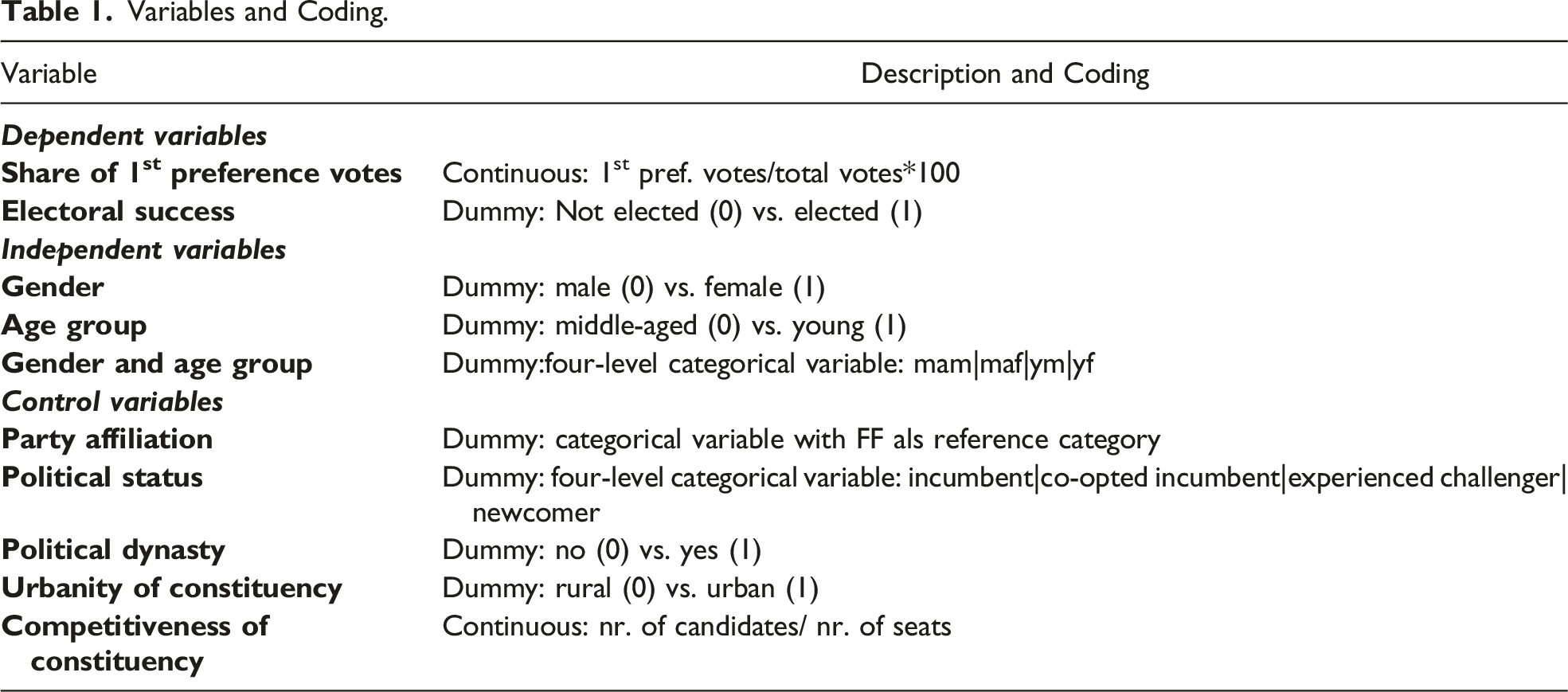
The quantitative analyses rely on an original candidate-level dataset that includes information on individual candidates’ gender, age group, political status, dynastic relations, party affiliation, constituency, share of first preference votes, and electoral success of each candidate. This information was collected, using web scraping, from the parties’ candidate pages, newspaper coverage, ElectionsIreland.org, and Donnelly (2016). The dataset contains information about 1968 candidates (out of 1974 candidates in total) in the 2019 Irish local election, running in 160 constituencies for 31 local councils. Due to missing values particularly on the age group variable, the dataset is reduced to a final n of 1884 candidates.
The analyses’ main dependent variable is electoral performance. In the Irish context, this can be measured in two ways. The first one is the proportion of 1st preference votes a candidate receives, and thus a direct measure of voters’ preferences for individual candidates. A second possibility is to use a dichotomous measure of success (elected vs. not elected). This variable takes into account the transfer votes that a candidate receives (Sinnott 2005). All analyses presented in the following sections have been conducted with both operationalizations of the dependent variable and are reported as such in the text.
I coded candidates as either middle-aged or young (with cut-off at age 40). 5 While 40 may seem a rather high cut-off age to indicate “young” candidates, this is in line with the literature on youth representation (Stockemer and Sundström 2018). It also bears to the fact that the great majority of politicians are still over 40 in Ireland and that we would see very few cases of “young” politicians when further reducing the upper age limit. Based on the two binary variables of gender and age group, I computed a four-level categorical variable combining these two, with the levels of middle-aged male, middle-aged female, young male, and young female (mam|maf|ym|yf). 6
Concerning the control variables, the dataset includes information on candidates’ party affiliation, political status, dynastic relations, and several district variables. As a relatively high number of parties ran in the elections, a short operationalization of the party variable is used, where I grouped the small parties running a very low number of candidates (Aontú, People Before Profit, Renua, Social Democrats, Workers Party) together in the category of “other.” For the political status variable, a candidate was coded as incumbent if he or she ran as incumbent in the 2019 elections and had at least won one previous election. Incumbents who have been co-opted into their seats since the last local election 2014 (i.e., who did not compete in an election before) were coded co-opted incumbents. For challengers, I researched if they were former councilors and/or had previously run for election. If yes, I coded them as experienced challengers. If no, they were coded as newcomers. The coding of dynastic relations was not as straightforward. While information on national level politicians is relatively easily available (as detailed in Folke, Rickne, and Smith (2021)), this is not the case for local politicians. So, I first coded a candidate as having dynastic relations when one or several of the sources I consulted (specifically ElectionsIreland.org and Donnelly (2016)) made a reference to familial political ties (daughter, son, husband, wife, brother, sister, cousin, etc. of…[someone in politics]). I purposefully included ties to local politicians as well. In a second step, I undertook a Google search of each candidate. Local newspapers tend to publish small candidate portraits, where familial ties are reliably mentioned. Still, there is the risk of false negatives here, with candidates having been coded as non-dynastic although they are not. Therefore, analyses relying on this operationalization of the variable should be interpreted as mirroring the effect of candidates that are widely known to belong to political dynasties.
Variables and Coding.
Results: Selecting and Electing Young Candidates
Candidates by Gender and Age Group.

Broken down to the effect of age and gender, these figures seem puzzling. Middle-aged male candidates are more successful than young male candidates, which would suggest an advantage connected to being middle-aged. However, among the female candidates, the young are more successful than the middle-aged. Within age groups, male candidates are consistently more successful than female candidates.
Selection Effects
How are candidate age and gender correlated with the attributes important for candidate selection that have been identified in the theoretical section? Figures 1, 2, and 3 display the shares of candidates in different gender and age groups by political party, political status, and connection to political dynasty, respectively. I use extended mosaic plots (package vcd in R) to visualize the observed and expected frequencies of candidates belonging to the respective categories (Friendly 1999; Meyer 2021). The benefit of extended mosaic plots is that they visualize both groups’ share of the whole sample, as well as of a dependent categorical variable—if the two categories are independent from each other, we would expect the exact same share in the sample as a whole and in the respective “dependent” category. The colored cases additionally show the results of a chi-square test indicating whether any deviances are statistically significant and in which direction. Red cases mean that the observed frequencies are significantly smaller than expected, whereas blue cases mean that they are significantly larger. Candidate age, gender, and political party. Candidates’ age, gender, and political status. Candidates’ age, gender, and dynastic relations. 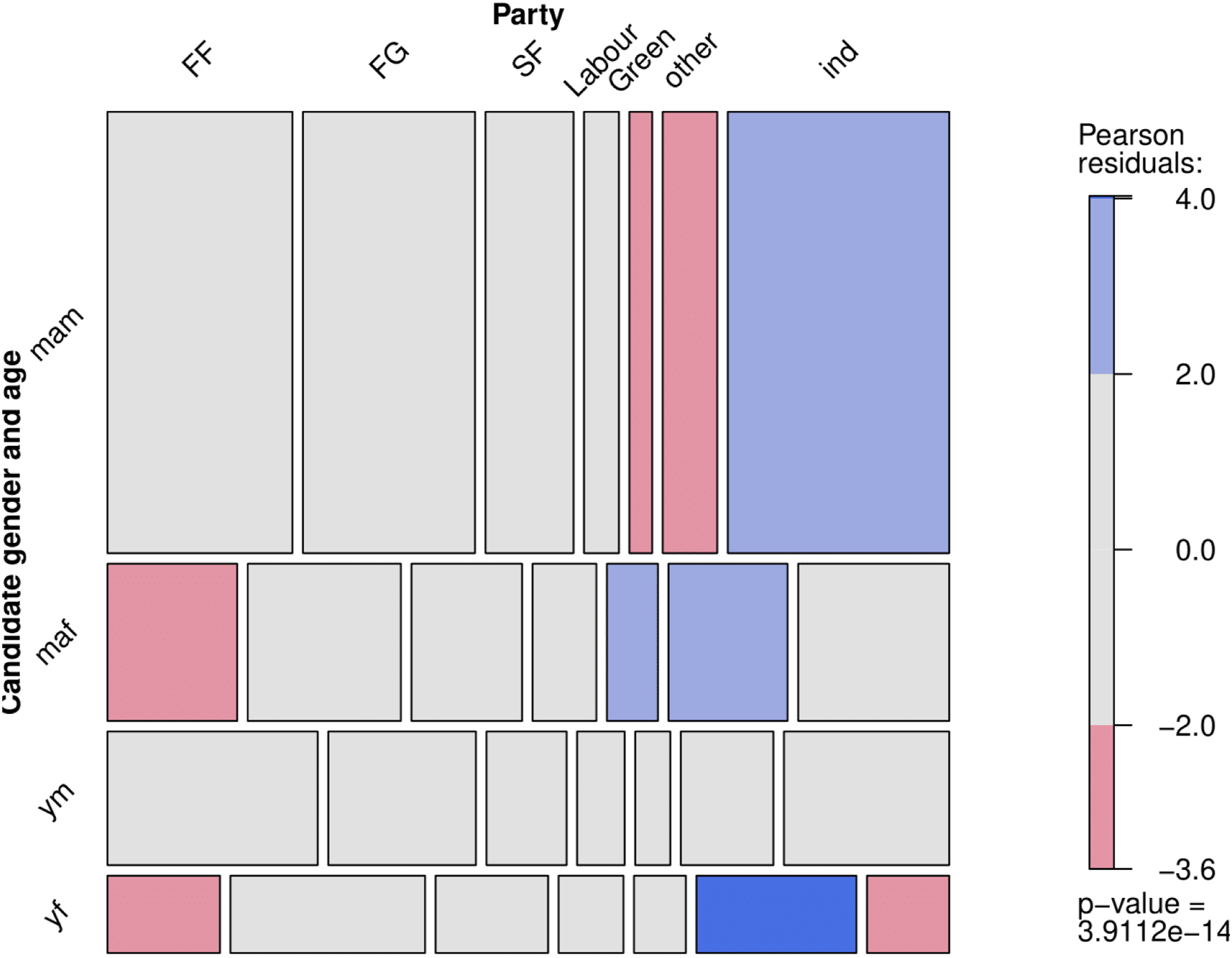
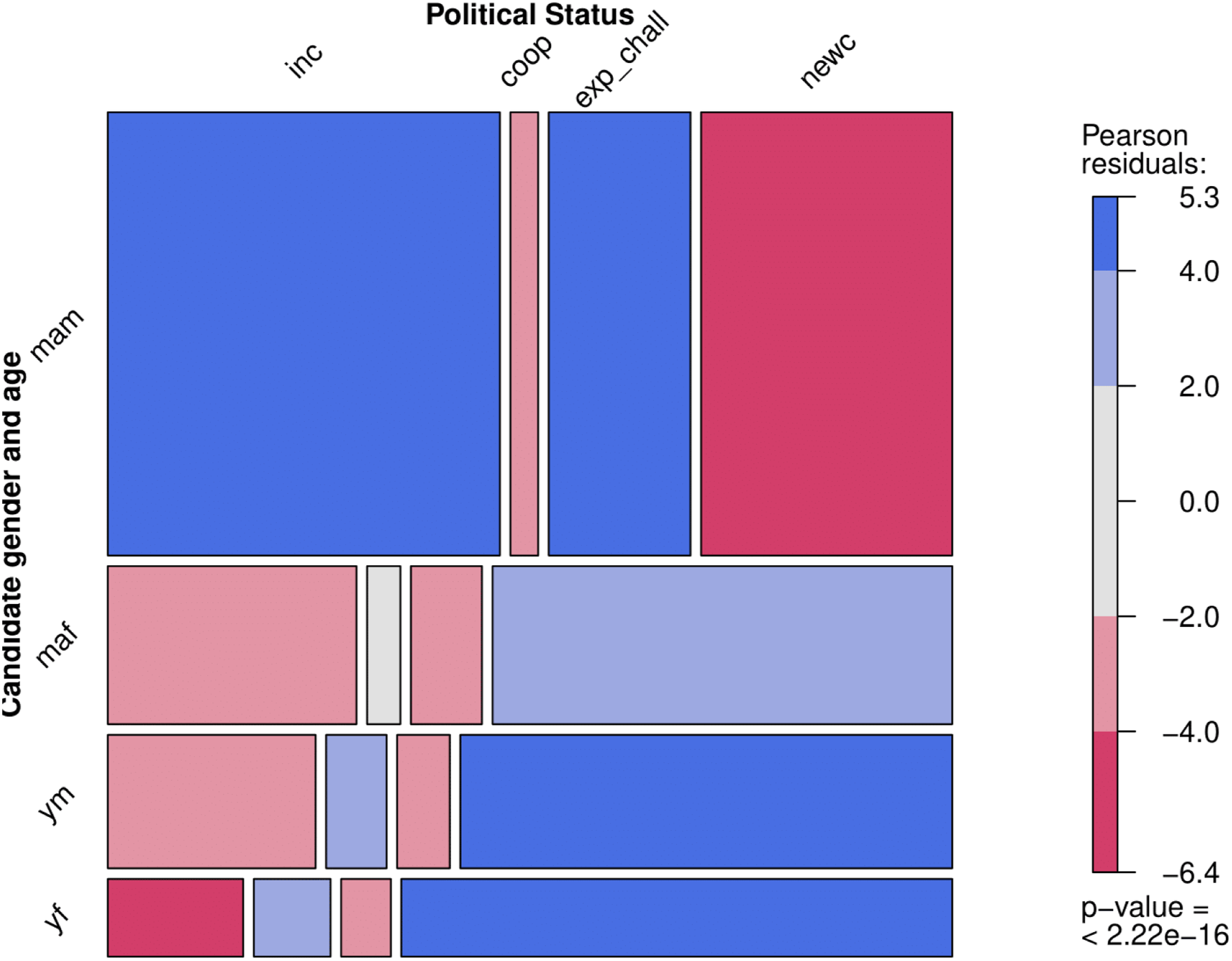
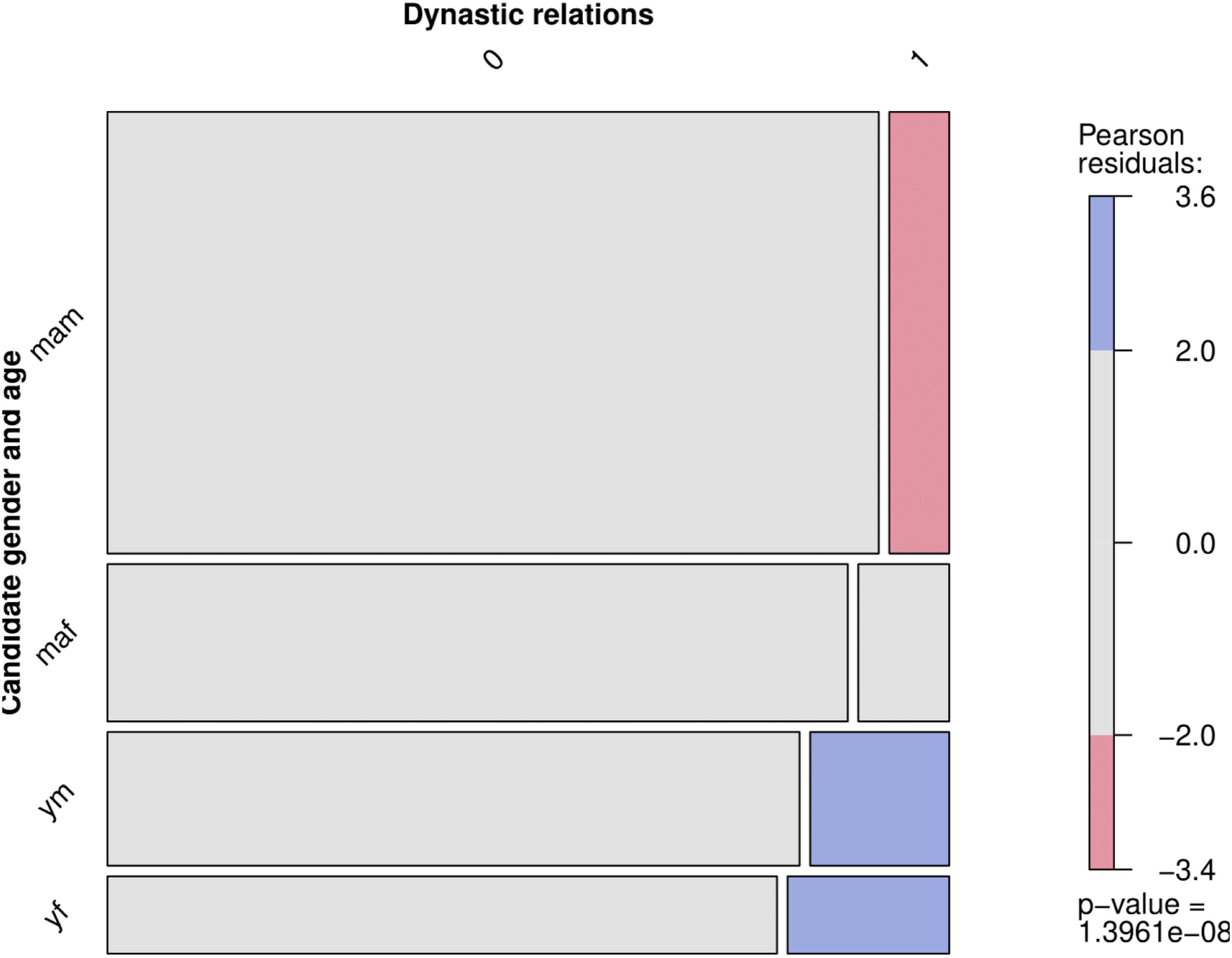
Figure 1 visualizes party differences in the share of gender and age groups among candidates. As expected, the bigger and conservative parties, Fianna Fáil (FF) and Fine Gael (FG), mostly ran middle-aged male candidates. While this may be partly driven by the fact that they have most incumbents, they also tend to run more candidates per constituency. The ideologically slightly more leftist party FF ran significantly less (young and middle-aged) female candidates than FG. Sinn Féin (SF), Labour, and the Green party all have higher shares of under-represented groups among their candidates. However, even in these smaller left-wing parties, most candidates are middle-aged and male. Only the Green party ran a significantly higher share of middle-aged female and a significantly lower share of middle-aged male candidates. Not surprisingly, most independent candidates are also middle-aged and male. This has been argued in previous research referring to the importance of party organizations in identifying, motivating, and supporting “outsider” candidates to run (Buckley 2020). The significantly higher share of young female candidates in the “other” category is mainly driven by the small, newly founded Social Democratic party. They ran for the first time in Irish local elections and young women constituted a relative majority of their candidates. H1a is thus weakly confirmed.
Figure 2 displays how the candidates are structured by political status. As can be seen, middle-aged men are over-represented among experienced challenger and incumbent candidates. Young candidates are significantly under-represented in the latter group, even when considering their lower shares among candidates in total. In contrast, they run significantly more often as co-opted incumbents or newcomer candidates, with the effect being equally sized for young men and women. Being co-opted into a seat is clearly still a side-entry to politics for under-represented groups, with almost equal shares of all gender- and age-groups in this category. The under-represented groups are all comparatively more likely to run as newcomers but the young particularly so. H2a is thus confirmed, with the qualification that there are only small differences between young male and young female candidates.
Figure 3 illustrates the shares of candidates by age and gender connected to political dynasties. Both young male and female candidates are significantly more likely to have relations to well-known families. Interestingly, middle-aged female candidates are not significantly more often connected to a political dynasty. In sum, H3a is confirmed.
Election Effects
Candidate Age, Gender, and Share of 1st Preference Votes (OLS Regression).
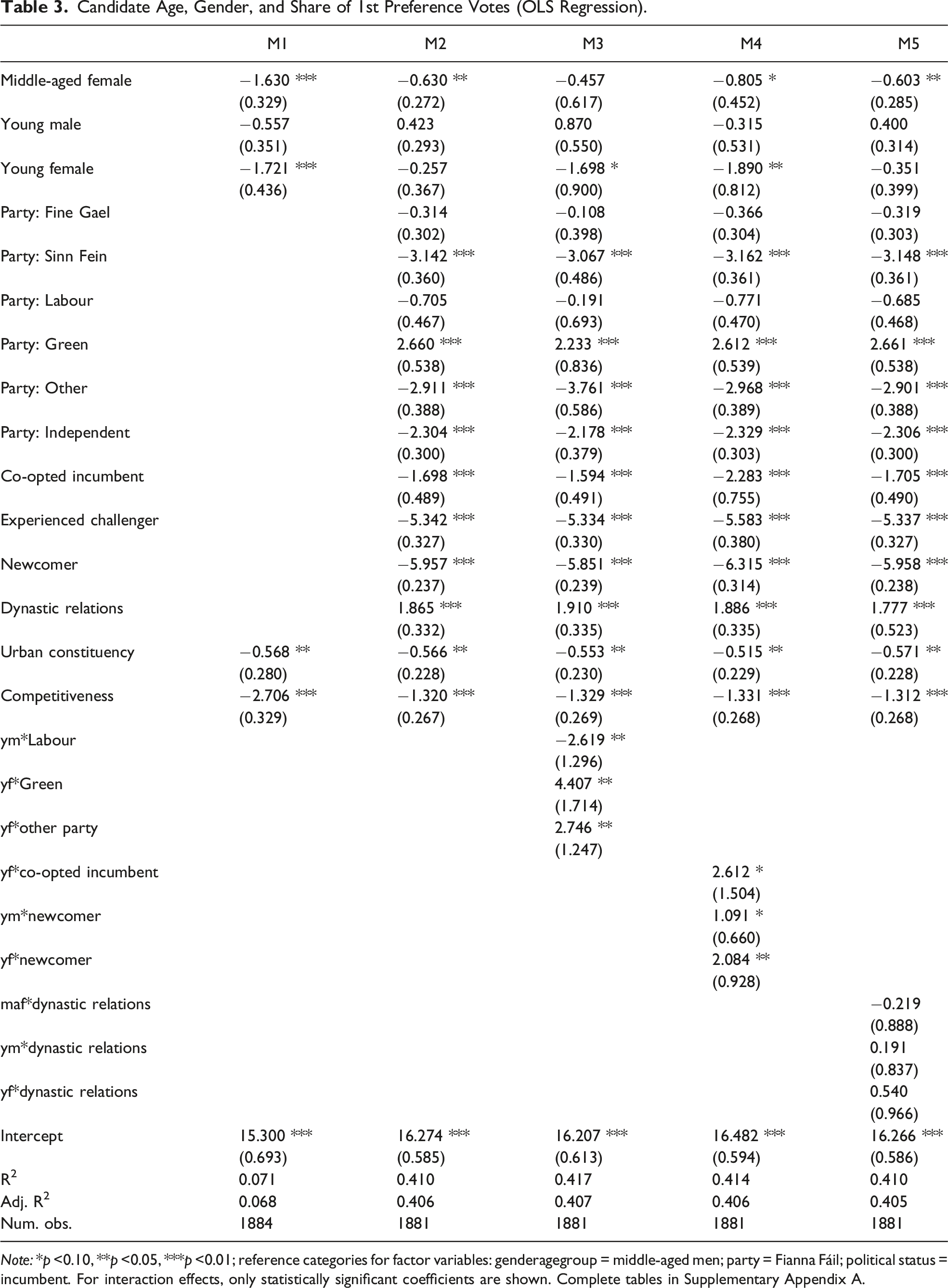
Note: *p <0.10, **p <0.05, ***p <0.01; reference categories for factor variables: genderagegroup = middle-aged men; party = Fianna Fáil; political status = incumbent. For interaction effects, only statistically significant coefficients are shown. Complete tables in Supplementary Appendix A.
Candidate Age, Gender, and Electoral Success (Logistic Regression).
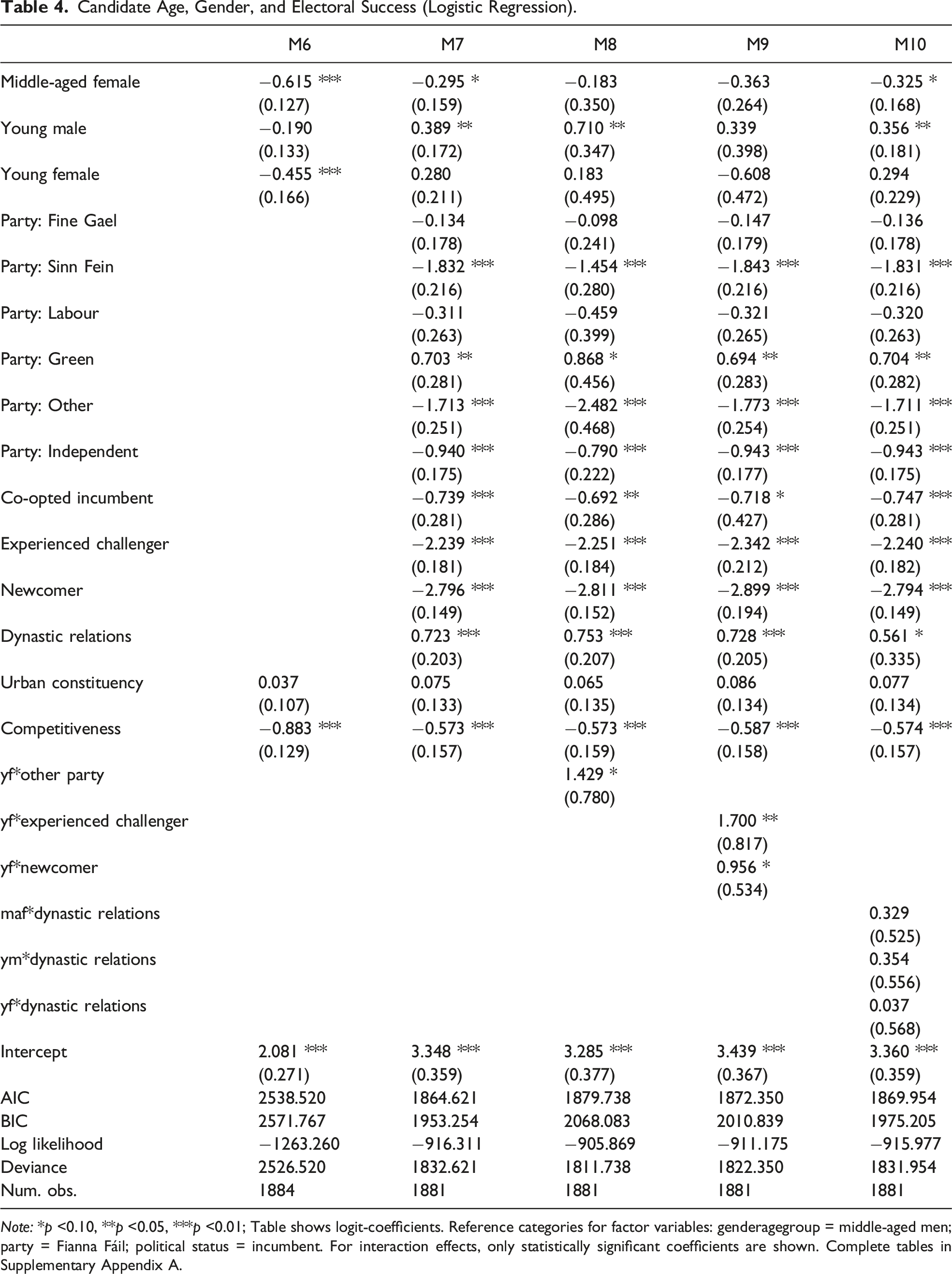
Note: *p <0.10, **p <0.05, ***p <0.01; Table shows logit-coefficients. Reference categories for factor variables: genderagegroup = middle-aged men; party = Fianna Fáil; political status = incumbent. For interaction effects, only statistically significant coefficients are shown. Complete tables in Supplementary Appendix A.
M1 and M6 show the baseline models, only including candidate age and gender and the district controls. As can be seen, all candidate groups start with an electoral disadvantage compared to middle-aged men, though not statistically significant in the case of young male candidates.
Including the controls for party affiliation, political status, and dynastic relations into M2 and M7 illustrates the high importance of these factors for the electoral performance of under-represented gender- and age-groups, with all of them reducing the net age- and gender-related electoral disadvantages in the expected direction. Whereas young candidates, and especially young women, are disadvantaged by their lower levels of political status, they profit from being selected on their dynastic relations. Belonging to a political dynasty accounts for close to 2 percentage points more 1st preference votes and is as well associated with a significantly higher probability of winning a seat.
Most interesting for this article and crucial for the test of the hypotheses are the interaction effects of candidates’ age and gender and their party affiliation, political status, and dynastic relations. M3 and M8 show the significant coefficients for interacting gender and age group with party affiliation (please find the full models with all coefficients in Supplementary Appendix A). Hypothesis 1b—that young candidates of smaller, younger, and left-wing parties will attract higher shares of first preference votes than young candidates in larger, older, and conservative parties—is only partly confirmed. Young female candidates running for the Greens or for one of the parties in the “other” category collect significantly higher shares of first preference votes. As expected, this has no, or a much weaker effect on electoral success (M8).
Second, I expected young newcomers—and especially young female newcomers—to perform better in both operationalizations of the dependent variable. Indeed, as models M4 and M9 display, young female co-opted incumbents and young female newcomers, as well as young male newcomers collect significantly more 1st preference votes. Furthermore, young female newcomers and experienced challengers seem to profit a lot from transfer votes and have significantly higher chances for electoral success. H2b is thus confirmed.
Third, H3b suggested that young candidates would specifically profit from being connected to a political dynasty. However, as M5 and M10 show, there is little evidence to support this claim. While the effect sizes are moderate and have the expected signs, they do not reach statistical significance for any of the interactions. H3b is thus not confirmed.
Based on the goodness of fit statistics, M2 and M7 perform best in explaining the share of 1st preference votes a candidate receives, and their final electoral success, respectively. Concerning the net effect of candidates’ age and gender, the coefficients reveal that middle-aged female candidates receive the lowest shares of first preference votes and have the lowest chance of winning a seat of all gender and age groups, ceteris paribus. Second, they show that young male candidates have a significantly higher chance to winning a council seat than the other gender and age groups, ceteris paribus. Thus, in sum, young women appear to be advantaged by their age (compared to middle-aged women) but penalized by their gender (compared to young men).
Discussion and Conclusion
Young people—young women in particular—are significantly under-represented in politics worldwide. This article has set out to explore whether demand-side related factors, that is, parties and voters’ behavior toward young candidates, is to blame for this phenomenon. It is among the first to employ an intersectional lens to investigate the dynamics conditioning young male and female candidates’ electoral performance in a real-world election.
Drawing on a study of the 2019 Irish local elections, it used a mixed-method design employing both qualitative and quantitative data. Evidence from 33 qualitative interviews suggested that the effects of candidates’ age and gender on parties’ selection and candidates’ eventual electoral performance is significantly mediated by party affiliation, political status, and dynastic relations.
First, in terms of selection effects, parties preferably nominated experienced candidates with high political status. While this raises initial barriers for young candidates, parties do prefer youngsters when running a newcomer in a constituency. Therefore, young candidates will, in tendency, find it easier to be selected by younger, smaller, and more left-wing parties, which, adversely, win fewer seats in total. Furthermore, the two main parties in Ireland, Fine Gael and Fianna Fáil, prefer young candidates who have ties to political dynasties. While this is beneficial for candidates’ individual electoral performance and to some extent counters their disadvantages in name recognition, it also considerably reduces the pool of young candidates. At worst, such a selection strategy may lead to a situation where young men and women without such resources are less likely to aspire a political career and are less often encouraged to run by the political parties. It may also reduce the representativeness of the young who are eventually elected.
Second, in terms of electoral performance, the analyses have shown that, once accounting for party affiliation and incumbency effects, being young can in fact provide a net electoral advantage. It does however only do so for young male candidates; specifically in terms of personalized first preference votes. In contrast, young women appear to be “second-choice candidates,” over-proportionally profiting from lower order preference votes (Quinlan and Schwarz 2020). Thus, in candidate-centered elections, young women seem to be advantaged by their age (compared to middle-aged women) but penalized by their gender (compared to young men). This evidence complements findings from experimental studies that usually report that voters are positive toward young candidates, and toward young men in particular (Shen and Shoda 2021).
The article’s findings reflect that the study of age-based inequalities in political representation profits from adopting a gender-sensitive perspective. In the case presented here, only focusing on age group would have distorted the results: Since middle-aged men fare best, and middle-aged women worst, only comparing middle-aged to young candidates would suggest that they have equal electoral chances. The article thus contributes both to the emerging literature on youth representation and to a broader field of research on inequality in elections. It corroborates existing experimental studies and complements them with observational results explaining why it is still difficult for young candidates to compete with their middle-aged counterparts.
In general, it seems that the under-representation of youth is only partly a demand-side issue. Rather than blaming parties or voters for the lack of young candidates, many interviewees point to the unattractiveness of local political office for young people. They mention the high amounts of time investment that is necessary for any political activity, the money needed to run a successful electoral campaign, and the comparatively bad salary of local councilors 8 —all issues that are of specific concern to young people in their 30s and potentially even more so for young women. This resonates with previous research on young peoples’ political involvement (Bruter and Harrison 2009b) and encourages further research into the determinants of young party members’ willingness to run for election.
While the empirical results have been generated based on the specific context of Ireland, the central findings should travel well to other personalized electoral systems, for instance Majority-Plurality systems or PR-systems with open lists.
Some of the findings presented in this article are however of a tentative nature. One limitation of the study is that the sample contained relatively few young and young female candidates. Especially the interaction effects would profit from being tested in larger samples, possibly by using time-series data, to qualify the robustness of youth advantages and gender penalties. This type of data would also be highly interesting to evaluate the selection and election effects of belonging to a political dynasty, and how this has changed over time. For example, examining whether the introduction of a gender quota led the parties to select more female candidates through the dynasty pipeline, as suggested by Folke et al. (2021).
Finally, yet importantly, future research should attempt investigating demand-side intersectional age and gender effects in national elections. That they seem to be relatively moderate in local elections might be a consequence of local elections being less competitive. While a young candidate might find it comparatively easy to be selected and elected for a career start on the local level, this may be different for young candidates attempting to start directly at the most prestigious level of politics.
Supplemental Material
sj-pdf-1-prq-10.1177_10659129211072559 – Supplemental Material for Youth Advantage Versus Gender Penalty: Selecting and Electing Young Candidates
Supplemental Material, sj-pdf-1-prq-10.1177_10659129211072559 for Youth Advantage Versus Gender Penalty: Selecting and Electing Young Candidates by Jana Belschner in Political Research Quarterly
Footnotes
Acknowledgments
I am very grateful for all comments received on previous versions of this paper. Particular thanks go to the anonymous reviewers, as well as to all who have provided comments on conferences and workshops, especially Adrian Kavanagh, Raimondas Ibenskas, and Daniel Stockemer. I also owe special thanks to the Irish party members, candidates, and politicians who made time and space to talk to me. The research was conducted with support from the Norwegian Research Council under Grant Nr. 250669/F10.
Declaration of Conflicting Interests
The author(s) declared no potential conflicts of interest with respect to the research, authorship, and/or publication of this article.
Funding
The author(s) disclosed receipt of the following financial support for the research, authorship, and/or publication of this article: This study was supported by Norges Forskningsråd; 250669/F10.

Supplemental Material
Supplemental materials and replication materials for this article are available with the manuscript on the Political Research Quarterly (PRQ) website.
Notes
References
Supplementary Material
Please find the following supplemental material available below.
For Open Access articles published under a Creative Commons License, all supplemental material carries the same license as the article it is associated with.
For non-Open Access articles published, all supplemental material carries a non-exclusive license, and permission requests for re-use of supplemental material or any part of supplemental material shall be sent directly to the copyright owner as specified in the copyright notice associated with the article.
