




Abstract
Bureaucrats are a fundamental part of the functioning of the modern state and democracies. However, there is still much disagreement about the ideal profile of bureaucrats to deliver quality and responsive policies. Bureaucrats can be meritocratically recruited or politically appointed, creating the dilemma between autonomy and accountability. This article explores this dilemma, identifying the profile of bureaucrats perceived as having the best performance in the different policymaking dimensions. The study explored the form of recruitment, the level of experience, and the bureaucrat’s gender as characteristics of interest. Using data from an original survey with high-ranking bureaucrats in Brazil, we implement conjoint analysis to identify the most valued profile. The results indicate that the bureaucrat recruited through the merit system is more valued in the dimensions of “transparency,” “evidence,” “political coordination,” and “general preference of respondents.” This result is independent of the bureaucrat’s experience, so the effect is related to the recruitment form. However, the politically appointed bureaucrat is more valued in the dimension of “effort.” Gender did not generate significant effects. The article brings experimental evidence to increase understanding of how bureaucratic autonomy and accountability connect to deliver better government performance.
Bureaucrats are a fundamental part of the delegation chain that constitutes a democracy. Citizens elect their political representatives, who form a bureaucratic body to deliver public policies to society. This article focuses on the implications of bureaucratic composition on the policymaking process, contributing to the literature that seeks to identify how different bureaucratic structures affect policy outcomes and the quality of government (Evans and Rauch, 1999; Rauch and Evans, 2000; Henderson et al., 2007; Lewis, 2007; Oliveros and Schuster, 2018; Toral, 2023). 1
Who makes the best bureaucrat? The meritocratically recruited career bureaucrat, who has greater autonomy, or a politically appointed bureaucrat 2 with a connection to the government and subjected to greater accountability? The argument is that the attitudes toward the different profiles of bureaucrats are asymmetrical, with meritocratically recruited bureaucrats better evaluated for technical policymaking functions and politically appointed bureaucrats better evaluated for political functions (or functions that require tasks outside the scope of the career bureaucrat’s attributions) (Lee and Park, 2020).
To test this argument, the research explores the effect of the profile of bureaucrats on perceived performance in different policymaking dimensions. As in Oliveros and Schuster (2018), the focus is on the bureaucrats’ behavior rather than policy outcomes. The study identified the effect of the profile of bureaucrats on the transparent administration of resources (commonly used as a proxy for corruption), the use of data and evidence in decision-making, the effort employed when performing their activities, political coordination of decisions with political actors such as pushing forward an agenda, and a general assessment of the bureaucrat. The profile is analyzed primarily by observing the form of recruitment, whether through a meritocratic system or political appointment. The study also includes the bureaucrat’s experience in public administration as a measure of accumulated knowledge (Lewis, 2007) and gender as a characteristic of diversity and social accountability (Kim, 1994).
The effect of the profile of bureaucrats on perceived performance was identified through a survey conducted with high-ranking bureaucrats in Brazil, implementing a choice-based conjoint analysis (Hainmueller et al., 2014). This article contributes to the study of bureaucrats in democratic regimes on three fronts: it explores how different profiles of bureaucrats affect policymaking; uses appropriate experimental evidence for causal inference on a topic that is difficult to identify with observational data; and analyzes policymaking in different dimensions, some unexplored in the literature, such as the use of data and evidence and political connection.
Bureaucracy: The dilemma between autonomy and accountability
The dilemma between autonomy and accountability permeates the discussion in the social sciences practically since Max Weber’s original formulation of what a modern and professionalized bureaucratic body would be (Dahlström and Lapuente, 2022; Weber, 1968).
Meritocratic recruitment is typically associated with stability in the position and offers autonomy since the career bureaucrat does not owe their position to political affiliation and cannot be dismissed only by the ruler’s will. Meritocracy allegedly generates competence, absence of particularism, long-term orientation, and motivation for public service (Horn, 1995; Nistotskaya and Cingolani, 2017; Colonnelli et al., 2020; Evans and Rauch, 1999; Dahlstrom and Lapuente, 2017; Perry and Wise, 1990).
However, the bureaucrat’s autonomy could generate a “tyranny,” in which the bureaucrat does not respond to the ruler’s preferences-who is endowed with democratic legitimacy to define policy content (Niskanen, 2017; Sandel, 2020). Thus, appointing political allies to positions in public administration is the simplest way to ensure the bureaucrats’ accountability (Bendor et al., 2001). A political appointment ensures ex-ante that the bureaucrat shares the ruler’s preferences and ex-post that they can be removed at any time if they deviate from the interests and preferences of the principal.
How the dilemma between autonomy and accountability is resolved in a society determines the profile of the bureaucrats in government and affects policy outputs and outcomes. The results of empirical research that seek to test the effect of these different profiles on public administration outcomes are divergent. A significant part of the studies shows a positive association between meritocratic recruitment and different policy outcomes such as government goals, economic development, poverty, and corruption (Evans and Rauch, 1999; Rauch and Evans, 2000; Henderson et al., 2007; Lewis, 2007).
However, most of the literature is based on observational data, where it is difficult to dissociate the many effects. For example, Lewis (2007) argues that career bureaucrats enjoy stability and, therefore, accumulate more experience in public administration. Notwithstanding, the author states that accumulated expertise is the main element behind better results, regardless of the form of recruitment. In this sense, the performance of political appointees is associated with worse outcomes because they are subjected to high turnover.
When considering the perspective of political appointees, studies based on principal-agent models emphasize the increased capacity for political control (Moe, 1989; Wood and Waterman, 1991; Bendor et al., 2001). When exploring the connection between the form of recruitment and government results, more recent studies have shown the positive effects of political appointments by increasing the bureaucrat’s accountability and responsiveness to the elected representative (Raffler, 2022; Toral, 2023). Toral (2023) argues that political appointments would generate positive effects by enhancing the bureaucrat’s accountability and effectiveness. This effect would relate to policymaking and not to rent-seeking or political services such as in Oliveros and Schuster (2018) and Oliveros (2021).
This study engages in the debate on autonomy and accountability, seeking to test the effect of the profile of bureaucrats on performance in different policymaking dimensions. Following the contribution of Oliveros and Schuster (2018), the research focuses on the bureaucrats’ attitudes and behavior and not on policy outcomes, unlike the vast majority of studies. Oliveros and Schuster (2018) analyze the effect of bureaucratic recruitment on the issues of corruption, effort, and provision of electoral services. In this study, the emphasis is limited to policymaking. The dimensions explored here are transparency in the administration of public resources (corruption), use of data and evidence, effort to complete a task, political coordination, and the general assessment of the bureaucrat.
The dimension of transparency in the administration of public resources is important for two reasons. First, transparency has become a relevant research focus. However, there is still no evidence of the connection between this dimension and the profile of bureaucrats, with studies focused almost exclusively on the politicians’ motivation to adopt transparency. Second, transparency in the administration of public resources is a proxy for corruption commonly used in surveys where it is not possible to ask questions directly about corrupt acts (Oliveros and Schuster, 2018). This research proposes the dimension of using data and evidence to encompass the recent focus-especially during the COVID-19 pandemic-on the need to work with scientific evidence in policy decision-making. The bureaucrat’s effort dimension is crucial as it measures the willingness to work in public administration. It is commonly used in studies on bureaucrats’ behavior, primarily focusing on the new public management approach (Oliveros and Schuster, 2018). The third dimension considered is political coordination. This dimension seeks to explore an aspect commonly disregarded in studies on bureaucracy, which is the role of the bureaucrat in the political coordination of policy decisions, such as moving the policy initiatives upward in the policymaking hierarchy and engaging with political actors. Finally, the general assessment of the bureaucrat is considered, which comprehends all aspects together.
Considering the literature, we propose that the evaluation of the bureaucrat’s performance is asymmetric (Lee and Park, 2020). Bureaucrats meritocratically recruited and endowed with autonomy to implement technical decisions will perform better in policymaking dimensions that require autonomy and technical expertise. The technical competence attributed from the meritocratic recruitment, the orientation to laws and procedures, and the public service ethos are consistent with the bureaucrat’s behavior oriented toward greater transparency in the administration and more significant mobilization of data and evidence in decision-making. On the other hand, politically appointed bureaucrats are subjected to an “upward embeddedness” (Toral, 2023), resulting in greater performance in the dimension of effort and political coordination. This would happen because political appointments facilitate monitoring by politicians and the application of sanctions and rewards. It also aligns priorities and incentives and increases mutual trust (Toral, 2023). Specific to my argument, loyalty to political leaders increases monitoring, and the possibility of dismissal may push bureaucrats to work hard to deliver results. In addition, political affinity or the alignment of priorities and incentives and the increased mutual trust are important assets in activities related to the political coordination of public policies. Based on these arguments, the main hypotheses in this study are:
Career bureaucrats recruited through meritocratic systems will perform better in the transparency dimension;
Career bureaucrats recruited through meritocratic systems will perform better in the use of data and evidence dimension;
Politically appointed bureaucrats will perform better in the effort dimension;
Politically appointed bureaucrats will perform better in the political coordination dimension. There are other characteristics related to the profile of bureaucrats that affect performance. First, the bureaucrat’s experience is analyzed, assuming the need to dissociate the effect of the form of recruitment from experience, as problematized by Lewis (2007). Second, considering the more recent discussion on diversity and representation in public administration (Kim, 1994), this study tested the effect of gender on the bureaucrat’s performance. In both cases, positive effects were expected since experience is a proxy for accumulated expertise, and the greater the expertise, the better the performance. Regarding gender, studies usually present positive effects of women in public administration, such as less corruption and improved policy delivery (Kim, 1994; Meier and Nicholson‐Crotty, 2006; Wängnerud, 2012; Hessel et al., 2020). Considering the most recent contributions to the debate about bureaucratic recruitment, the main advancements of this study are: first, the focus on policymaking dimensions and not on other services not directly related to the scope of activities of a bureaucrat, such as political services (Oliveros and Schuster, 2018; Oliveros, 2021). Second, the present study also includes policymaking dimensions not explored previously in the literature, such as the use of data and evidence and political coordination. Third, it defends the argument that attitudes toward different bureaucratic profiles are asymmetrical, with career bureaucrats performing better tasks related to the technical aspects of policymaking and political appointments performing better related to coordination and accountability tasks. This would be a more accurate description of the complex effects of different recruitment forms on policymaking than defending the superiority of a single profile in such different policymaking tasks. Fourth, the study focuses on the attitudes of high-level bureaucrats directly responsible for policymaking at the federal government in all different policy areas, going beyond the focus on street-level managers and narrow policy areas (Toral, 2023).
Case, data, and methods
This research presents a case study on Brazil, a multiparty presidential democracy. The Brazilian bureaucracy counts more than 100,000 employees at the federal level. The hiring process in public administration has a long tradition of meritocratic recruitment based on a public examination, and the positions filled in this system are characterized by offering stability. However, the high-ranking bureaucracy consists of positions of trust, and rulers can decide whether to recruit a career bureaucrat selected meritocratically or a politically appointed outsider, 3 selected based on party affiliation or political loyalty.
At this point, the incentives of the multiparty system and the dynamic of coalitions are relevant, promoting the proliferation of politically appointed bureaucrats selected based on patronage (Bersch et al., 2017). Thus, there are incentives for selecting career bureaucrats and politically appointed bureaucrats. According to V-Dem, the Brazilian bureaucratic recruitment system is above the world average, considering the merit-based versus political appointment criteria. In 2022, Brazil scored 0,9 in merit-based recruitment, while the world average is 0,4. For reference, America’s average is 0,35, and the Europe average is 1,22. Considering the context, the results of this study can be generalized to other developing and developed democracies where there is room for rulers to choose between different profiles of bureaucrats and systems with a structured bureaucracy and relative capacity to deliver public services.
The system of positions of trust in Brazil is a six-level hierarchical structure. Levels 1 to 3 are the lowest, and levels 4 to 6 indicate the high value and decision-making power over team composition and policy decisions. The survey carried out targeted high-ranking bureaucrats (levels 4–6) to identify the effect of the profile on the bureaucrat’s performance in the different policymaking dimensions. The participants work as secretariats and directors, answering to the ministers of state.
The survey participants are bureaucrats who observe the day-to-day policy decision-making processes. Also, these professionals are usually responsible for recruiting bureaucrats for positions of trust below them in the hierarchy. The high-ranking bureaucrats surveyed are privileged observers and part of the decision-making chain in the federal executive branch. Another critical aspect of the survey is its ability to assess the bureaucrat’s performance in different policymaking dimensions that are difficult to measure using administrative indicators.
The survey was carried out between September 2020 and January 2021 using the Qualtrics platform. Authorization from the research ethics committee was obtained prior to its start. The link to the questionnaire was sent to the email of all 6,296 bureaucrats occupying high-level positions in the federal bureaucracy, and 1,091 completed the survey, with a response rate of 17%, similar to other studies with bureaucrats in Brazil (Schuster et al., 2022). The survey has a representative sample of all ministries, increasing the potential for generalization. It also included both career bureaucrats and political appointments as respondents. The respondents’ profiles, the sample’s representativeness in relation to the population, and the results compared by respondent recruitment type can be seen in the supplementary material.
Design of the choice-based conjoint analysis.

In this type of conjoint design, it is common to force the respondent to choose, in this case, selecting one of the candidates. However, after a pre-test to assess the instrument, the option “I don’t know” was included to capture respondents’ indifference regarding the candidate’s profile. The traditional forced-choice approach is reported in the main text, excluding the indifference option. However, as a robustness test reported in the supplementary material, the respondent’s indifference was included in the analysis as an intermediate value, with the options scaled from 0 to 1. The results were identical to the forced-choice approach but with a higher response rate. A complementary test also in the supplementary material shows that this indifference is unrelated to specific attributes.
For the analyses, linear probability models were estimated by relating the dependent variables to the different values of the three attributes. Estimates for each attribute represent the average marginal component effect (AMCE) compared to baseline values with 95% confidence intervals (Hainmueller et al., 2014). The following section presents the results.
Results
The form of recruitment was the main attribute analyzed. The focus category was the career bureaucrat recruited through a meritocratic competitive system, and the comparison category was the outsider politically appointed bureaucrat. The effect of the form of recruitment is read as the probability of the career bureaucrat being selected to the position of trust suggested in the survey compared to an identical candidate who is a politically appointed outsider.
For the transparency dimension, the respondents are 40% more likely to choose career bureaucrats, when compared to political appointees, to manage public resources transparently. This result is consistent with the findings of Oliveros and Schuster (2018) in the case of the Dominican Republic. Concerning the use of evidence, the respondents are 20% more likely to choose the career bureaucrat to mobilize data and evidence in policy decision-making when compared to political appointees. These two results are consistent with hypotheses 1 and 2, indicating that career bureaucrats recruited through meritocratic systems are more valued to perform technical policymaking activities where their skills, competence, and expertise are essential. It is important to emphasize that, by design, the effect of the form of recruitment on the different policymaking dimensions is independent of the bureaucrat’s experience. This shows that the form of recruitment matters in itself and is not a function of the accumulation of expertise over time in the position (Lewis, 2007). Figures 1 and 2 show this result graphically. Bureaucrat profile and transparency. Note: points are the AMCE, and bars denote 95% confidence intervals. Bureaucrat profile and use of evidence. Note: points are the AMCE, and bars denote 95% confidence intervals.

Figure 3 and 4 show the results regarding the political dimensions of policymaking. Starting with work motivation or “effort,” the career bureaucrat is perceived as less likely to be motivated to work overtime to complete a project. In this dimension, the probability of the career bureaucrat being selected is 18% lower than the politically appointed outsider, indicating that in a dimension that requires incentives for extra work-often outside the formal attribution of position-the political appointee is perceived as more willing or motivated. This is also explained by the increased accountability towards political actors and the fact that political appointees do not have tenure in office, so the ease of motivation to work extra comes from the threat of losing the position. This result is consistent with hypothesis 3 and the argument that attitudes toward bureaucrats recruited from different formats would be asymmetrical, with those recruited on merit being more valued for the more technical functions of policymaking and politically appointed bureaucrats for the most political functions. This result is also consistent with the findings of Toral (2023), considering politically appointed street-level managers in Brazil. Bureaucrat profile and effort. Note: points are the AMCE, and bars denote 95% confidence intervals. Bureaucrat profile and political coordination. Note: points are the AMCE, and bars denote 95% confidence intervals.
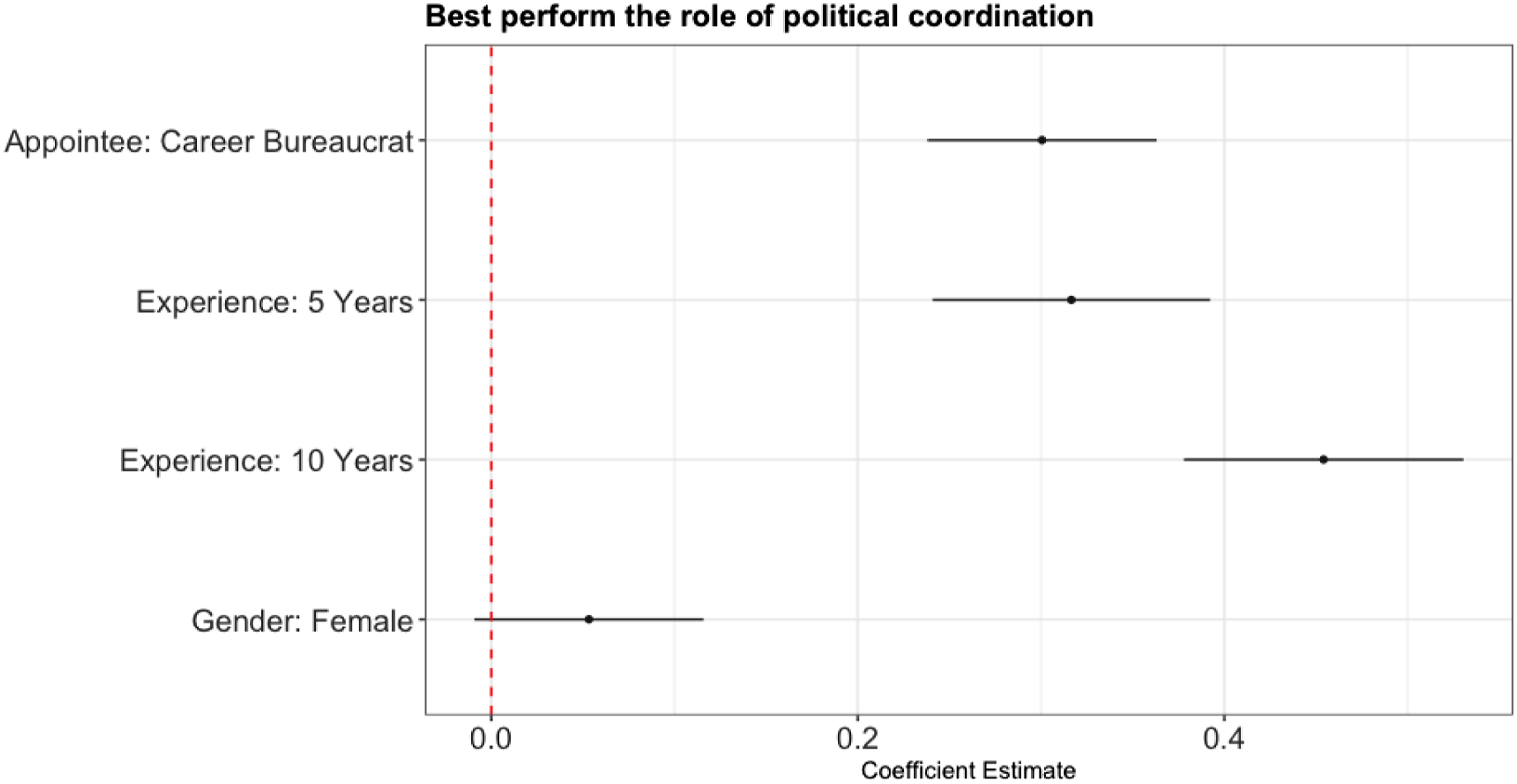
The second variable of the political dimension of policymaking referred to the bureaucrat’s performance in activities of political coordination. As is well known, the policy decision-making process involves a non-trivial connection activity in which the agenda is formed, priorities established, and the pace of progress of the proposals forwarded. In this way, establishing political connections is crucial to move forward in decision-making and policymaking processes. Hypothesis 4 expected a negative effect-career bureaucrats would be less valued regarding political coordination activities than politically appointed outsiders, who, by definition, have ties with the political actors. However, the results showed a positive effect, indicating that career bureaucrats are perceived as more likely to be chosen to perform political coordination activities. This result can be explained based on technical competence being relevant to push a decision through the line of the policy decision-making process rather than alignment or personal ties. In any case, it is a counterintuitive result that should be further explored in future research.
Figure 5 shows the results for the last item of the survey, evaluating the candidates considering all dimensions of policymaking. The results show that career bureaucrats are perceived to be best suited to perform policymaking functions, except for the effort or motivation dimension, where political appointees were perceived as best suited due to incentives such as loyalty to the ruler and the possibility of removal from office. This result is also consistent with the arguments of the new public management that is concerned with generating incentives such as performance or income to keep bureaucrats in office and minimize apathy. It is worth emphasizing the perceived superiority of career bureaucrats in dimensions essential in public administration, such as transparency—an aspect directly related to corruption-and the use of evidence—related to government interventions’ effectiveness. In short, attitudes toward bureaucrats were less asymmetrical than expected, with a clear bias toward career bureaucrats recruited through meritocratic systems.
5
Bureaucrat profile and general performance. Note: points are the AMCE, and bars denote 95% confidence intervals.
Bureaucrat’s profile and policymaking performance conjoint analysis.

Note: linear probability models. AMCE reported—standard errors in parentheses.
Regarding gender, the results were not statistically significant. This result contradicts the intuition that women would be better evaluated since a significant part of the literature suggests positive effects of women in office. The findings show a null effect, indicating no systematic difference in the evaluation of bureaucrats’ performance according to gender. At least, there is no evidence of discrimination at this level of the bureaucratic hierarchy. However, this result can be considered counterintuitive since previous research has found a significant relationship between gender and bureaucratic behavior (Toral, 2023). We argue that this result can be partly explained by the focus on level 3 positions, which are not considered high power and, therefore, do not induce gender discrimination. 6 Also, the survey included all policy areas, not focusing on areas perceived as “women’s issues” such as health or education (Escobar-Lemmon and Taylor-Robinson, 2005). However, exploring bureaucratic recruitment from a gender perspective is still a fundamental research agenda.
Conclusion
What is the effect of the profile of bureaucrats on policymaking? This research tested the argument that attitudes toward different profiles of bureaucrats would be asymmetrical. Career bureaucrats recruited through meritocratic systems would be perceived as best suited to perform technical functions. On the other hand, outsider politically appointed bureaucrats would be better evaluated for political functions.
The choice-based conjoint analysis was adopted, examining data from a survey conducted with high-ranking Brazilian federal bureaucrats. The results showed a perception that career bureaucrats are best suited to perform policymaking tasks. The effort dimension was the only dimension where this positive perception of career bureaucrats was not observed. This result points out that career bureaucrats recruited through meritocratic systems are more likely to bring better results for public administration, despite recent findings that show positive effects of patronage and political control when selecting government employees. This study contributes to the political science literature that focuses on policymaking dimensions and how the bureaucratic structure can be improved to increase the quality of democratic governments.
Some limitations of this study and the path to a future research agenda are considering the limitations of the research design implemented. Conjoint experiments provide better possibilities for causal inference. However, it is focused on hypothetical bureaucrats and self-reported perceptions. For this reason, it may reflect norms that diverge from actual behavior. Even though the question-wording was specifically designed to avoid this problem, complementing the analyses presented here with actual bureaucratic behavior would contribute immensely to the research area when accurate indicators and causal inference are considered. Another contribution would be to expand the analysis to other periods and administrative contexts. This would increase knowledge accumulation and the development of the research area on bureaucratic recruitment, considering the complexity of the relationship between different profiles and policymaking performance.
Supplemental Material
Supplemental Material - Bureaucracy and policymaking: Evidence from a choice-based conjoint analysis
Supplemental Material for Bureaucracy and policymaking: Evidence from a choice-based conjoint analysis by Mariana Batista in Research & Politics
Footnotes
Declaration of conflicting interests
The author(s) declared no potential conflicts of interest with respect to the research, authorship, and/or publication of this article.
Funding
The author(s) disclosed receipt of the following financial support for the research, authorship, and/or publication of this article: This work was supported by the Brazilian National Council for Scientific and Technological Development (grant number 420797/2022-0) and Fundação de Amparo à Ciência e Tecnologia do Estado de Pernambuco (grant number APQ-1193-7.09/22).
Ethical approval
Ethics Committee for Research with Human Subjects, Federal University of Pernambuco – Brazil, authorization number 4.381.695.

Supplemental Material
Supplemental material for this article is available online.
Notes
References
Supplementary Material
Please find the following supplemental material available below.
For Open Access articles published under a Creative Commons License, all supplemental material carries the same license as the article it is associated with.
For non-Open Access articles published, all supplemental material carries a non-exclusive license, and permission requests for re-use of supplemental material or any part of supplemental material shall be sent directly to the copyright owner as specified in the copyright notice associated with the article.
