




Abstract
The resurgence of Right-Wing Extremism (RWE) has become a cause for concern in Western countries during the 21st century. An increase in white nationalist sentiment in recent years has provided impetus to understand the contemporary drivers of far-right ideology. This study examines in-group and out-group debates on Stormfront.org, which is the largest and oldest online community dedicated to white nationalism and extreme right-wing political views. It used a dataset of approximately 1m posts collected from the open Opposing Views forum on Stormfront from the period 2001 to 2020 to create a corpus of over 195m words for thematic analysis. A Natural Language Processing (NLP) model was used to analyze the corpus, and a supervised phrase mining algorithm was used to identify key topics in the debate. The study finds that key issues being debated between in-group and out-group members of the Stormfront online community relate to perceptions of white identity, African American identity, racial issues, conservative political issues, and the history and politics of the United States. These findings highlight the issues of mutual importance to in-group and out-group members and identify opportunities for further research into the ideology of online RWE communities.
Introduction
The resurgence of nationalist politics and Right-Wing Extremism (RWE) in the West has become a significant cause for concern in the 21st century (Fahey and Simi, 2019; Ravndal, 2018). There has been a particular rise in far-right hate groups in the US (Chermak et al., 2013) and Europe (Falter and Schumann, 1988; Koehler, 2016). Following a wave of violent attacks motivated by right-wing grievances in the 2000s and 2010s, RWE has come under greater scrutiny as a potential source of emerging threats to domestic security (Stevenson, 2019). This threat has included the threat or justification of violence against minority groups, particularly vulnerable groups, and social behaviors that are inconsistent with highly conservative worldviews often promoted in far-right movements (Bjoergo, 2003; Farago et al., 2019).
Amidst debates about tensions between liberties, such as freedom of speech and political expression, and protections from hate-speech and violence, the line between political and social movements and extremists movements has become blurred in popular commentary (Adamczyk et al., 2014; Lowe, 2020). RWE has been defined variously as a fringe or extreme version of the political views espoused by far-right social movements (Carter, 2018; Perliger, 2020). It is generally associated with a broad spectrum of conservative political perspectives shared with contemporary far-right movements, such as the New Right and the Alt Right. These movements share overlapping political perspectives, including nationalist, traditionalist, anti-immigration, anti-abortion, and fundamentalist Christian views (Blee and Creasap, 2010).
An important distinction between the far-right and RWE is the willingness of extremists to support or adopt illiberal means accomplish goals that are largely incompatible with an existing societal context. The key features of this are support for nationalism, a strong or authoritarian state, racism and xenophobia, opposition to liberal democracy, appeals to populism, and anti-establishment rhetoric (Carter, 2018).
The rise of far-right social movements in contemporary societies is often depicted as reactionary. In one sense, it represents a backlash against globalization and migration. In another sense, it represents a response to widespread physical and digital content that promotes racist, authoritarian, misogynistic, and homophobic values. In both cases, the growth of far-right and RWE content has been enabled by Information and Communications Technology (ICT) in the 21st century (Gaudette et al., 2020). RWE community members, supporters, and sympathizers all have unfettered access to the kinds of ICT that deliver triggering news to them around the clock. Meanwhile, promoters of RWE materials have a previously unmatched ability to deliver content to their audiences in online communities. Members of RWE movements are often highly active on social media platforms (Froio and Ganesh, 2019; Wahlstrom and Tornberg, 2019) and adept at creating discourses and discourse communities (Hajer and Laws, 2006; Wodak, 2015).
Previous research has examined the evolution of RWE, including contemporary manifestations (Babilunga, 2013), and has charted the “ecosystem” of online right-wing communities (Baele et al., 2020b). Two studies have also explored the link between online and offline behaviors in online RWE communities, finding that there is a direct connection between real-world events and online engagement with extreme content (Baele et al., 2020a; Bliuc et al., 2019). An important focus for research about online RWE communities has been the forum site Stormfront.org, which is the largest, most viewed, and longest running right-wing site in the world. Stormfront is an online community that presents itself as a home for non-violent white nationalist social and political views (Brown, 2009; Caren et al., 2012; Thompson, 2001). Previous research on Stormfront has examined qualitative individual experiences of white nationalist rhetoric (De Koster and Houtman, 2008; Hartzell, 2020), patterns in quantitative data about positing behaviors (Scrivens, 2020), and politicized discourses used in pseudo-rational online discussions (Meddaugh and Kay, 2009).
This study focused on the content of online discussions posted on Stormfront. It takes a corpus linguistics approach to surveying the Opposing Views forum on Stormfront in order to identify key themes in the discussions that in-group members and out-group members regularly engage in. This study presents a snapshot of key words and phrases used in roughly one million posts over a period of almost 20 years. The next section explains the methodology, data, and methods used in the study. The following section presents the results of the study, focusing on a qualitative analysis of the top 100 most frequent phrases in the Opposing Views corpus. The final section concludes that a small number of themes, all of which are consistent with far-right political views, dominate debates between in-group and out-group members on Stormfront.
Research Design
This study aimed to better understand the qualitative content of themes being discussed during interactions between members of an online community in-group, comprised largely of individuals with right-wing or white nationalist views, and an out-group composed of individuals who do not identify as in-group members. It is important to note that the in-group and out-group distinctions used in the study relate to self-identified membership of the Stormfront community and its values, rather than to any offline community or identity that may be the subject of debate. This is due to the relatively anonymous nature of online posting and the impracticality of verifying the identity of individuals or the veracity of their posts.
The study used a corpus linguistics methodology and mixed quantitative and qualitative methods to identify trends in the data and then illustrate key qualitative themes. This is similar to methods used to study other violent extremist discourses (Brookes and McEnery, 2020). The methodology is corpus-driven as it applies computer-aided text analysis methods to empirical data to identify frequencies, clusters, collocates, and concordances for further examination (Crawford and Csomay, 2016). The methodology is a good fit for the corpus size and scale as it would be impractical to attempt to understand the volume of data using a corpus-based approach in the absence of previous studies having identified an existing thematic or linguistic structure in the data. It is also a good fit for the research design, which uses a content analysis approach to identify themes in textual data (Pollach, 2012).
Stormfront was identified as the most suitable source of corpus data for this study because it is the most well-known online community that espouses far-right, white nationalist, and RWE values (Bowman-Grieve, 2009). Stormfront is also unique in the RWE online ecosystem. It is the oldest online RWE community, having been in operation continuously for over 25 years and is widely recognized as the largest in the world, with the highest number of registered members, visitors, and page views (Baele et al., 2020b; Bliuc et al., 2019). Within Stormfront, there are different sections for different kinds of forums. Many are visible to anyone but require membership to post; some are open to anyone to post in. These open forums include an “Opposing Views” discussion which invites non-members to engage in civil debate with Stormfront members.
Ethical concerns related to data collection are particularly salient for politically divisive subjects, such as fringe or extremist political views. In order to minimize any potential harm, data were only collected from public forums where authors had voluntarily contributed in full knowledge that their contributions would be accessible to anyone via the internet. In addition, User IDs, which are not publicly linked to real identities, were anonymized in all data retained for the study. This is consistent with the general principle that public acts that are deliberate and intended to be observed by others do not require consent so long as individuals are not identified (Rodham and Gavin, 2006).
The Opposing Views forum was selected as a large sample of text-based discourse with the stated purpose of interaction between in-group and out-group members. Based on the structure of the website, eight variables were identified for collection via an automated web-scraping program. The records included the following data: user ID (anonymized), user join date, number of user posts, thread ID, thread name, post date, post ID, and post content. Data were collected for the period 01 September 2001 to 20 June 2020. Although Stormfront existed prior to 2001, its current servers do not store any earlier data.
A total of 1,004,628 records were collected from the Opposing Views forum. After a manual review, 5870 records were removed from the final data set due to incomplete or corrupted data. The remaining 998,758 records, containing a corpus of 196.6 million words, were retained for further analysis. For the purpose of this study, the term data set refers to all variables collected and the term corpus refers to the total words included in the post content for each record, but not the data included in the other fields.
The dataset has high validity as the corpus is large (n = 196.6 m), was collected in a consistent format over a span of almost 20 years, and was recorded objectively as text. However, it is important to note that user identities were not verified, and it is possible that some accounts claiming to be non-members may have been members using alternate accounts. This is an inherent limitation of similar studies, but it is mitigated somewhat by the relatively anonymous nature of online forums and the kind of communication they facilitate.
Thematic groups for extracted phrases.

These six themes are intended to be descriptive, rather than prescriptive, and serve to highlight the key issues being discussed in the Opposing Views forum.
Results
The results are presented in two stages. The first set of results present word frequency statistics in a visual form. This serves to demonstrate the consistency between the tokenized word frequencies and the N-grams identified through phrase mining. The second set of results presents the key phrases extracted from the data set and examines each category identified through thematic analysis of the 100 most common phrases in the Opposing Views forum corpus.
Word frequencies
The word frequency results are visualized as a word cloud in Figure 1. These individual words depict a counterintuitive picture of the key issues discussed on the forum. Despite perceptions that white nationalist content on Stormfront focuses primarily on racially motivated hate-speech and bigotry (Meddaugh and Kay, 2009), the most common words relate to whiteness and white identity. Wordcloud of token frequency.
The most immediate observation drawn from the word frequency analysis was that in-group and out-group debates in the Opposing Views forum focused heavily on white identity. The words white and people were by far the most common individual tokens in the corpus. In this visualization, all individual words are presented separately to avoid any potential misunderstanding of the specific uses of certain terms, such as nationalist or nationalism which may have distinct meaning in the context of the communication in which they were used. When combined with lemmatized word forms, some terms, for example, white, whites, and whiteness, create even more significant word frequencies.
Another significant observation was that the word people was highly significant in its own right. This suggests that the corpus skews toward words about people, with the most likely explanation being that people were discussed in reference to racial and societal issues. This is consistent with other high-frequency words in the corpus, many of which refer to racial, religious, or social groups. The assumption that the high frequency of the word people was related to politicized groups was tested in the phrase mining phase of research.
Extracted phrases
Thematic grouping of top 100 extracted phrases.

The most significant observation from the thematic grouping of key phrases was that the theme Whiteness was significantly over-represented in both frequency and proportion of cases. While 31 phrases were associated with the Whiteness theme, the frequency of those phrases was 48% of the total frequency of the top 100 phrases, and they occurred in 49% of total records in the data set.
While the remaining themes are distributed more proportionately than Whiteness, they have some unique features. The African American is the only theme that is directly proportionate across number of phrases and all frequency measures. The Political Issues and Race Issues themes have very close phrase frequencies, despite having fourteen and six phrases, respectively, and having a 25% disparity in the proportion of cases they appear in. The United States theme has the smallest frequency overall, but it appears in almost 5% of all posts despite containing only four phrases. Finally, the miscellaneous theme accounts for the largest number of phrases, but these phrases are under-represented in both the phrase and case frequencies.
Whiteness
The most frequently discussed theme in the Opposing Views forum over 20 years was Whiteness. This spanned a range of key phrases, the most common of which was the phrase white people, which was the highest frequency and TF-IDF phrase from the corpus.
Whiteness theme phrases.

The most significant group of terms referred to people either individually or collectively. Twelve of the thirty one phrases referred to people, men, women, or children in some way. Another eight referred to countries, nations, or culture in some way. The remaining 11 phrases primarily referred to nationalism, supremacy, and pride, or opposition to those things.
African Americans
African American theme phrases.

Phrases in the African American theme focused almost exclusively on people and largely on individuals. Six phrases referred directly to individuals using terms like person, man, and woman, and these accounted for 77% of the term frequency within the theme. Another three referred to people collectively, either as African American(s) or as the black community. These accounted for 18% of the term frequency. The final phrase was black race, which could also be used to refer to people collectively or could be used in another context. This phrase was underrepresented in the theme and accounted for 5% of frequencies.
Political issues
Political issue theme phrases.
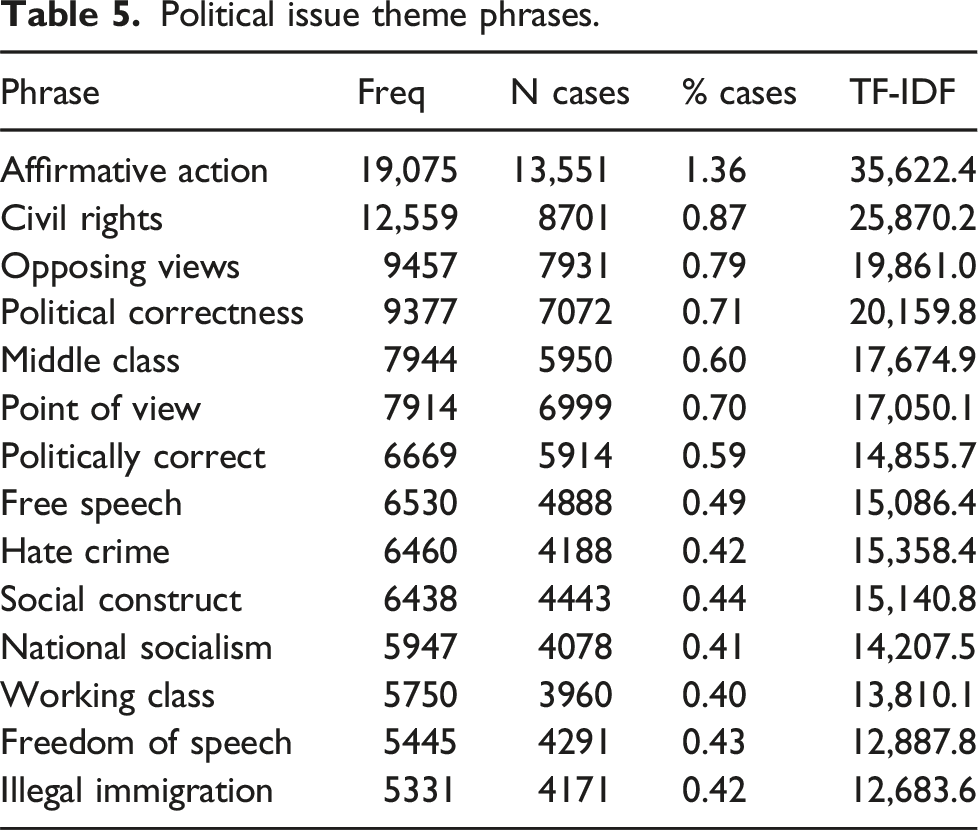
The kinds of issues discussed in the Opposing Views forum are consistent with far-right ideology and the views generally espoused in the Stormfront community. Of the 14 phrases included in the Political Issues theme, 9 relate to political perspectives, such as civil rights, political correctness, hate crime, and freedom of speech. These make up 69% of the frequency of phrases within the theme, which is consistent with their proportion. Three of the five remaining phrases relate to socialism and economic class, which together represent 10% of phrase frequency within the theme. The last two are illegal immigration, which accounts for 5% of frequencies and affirmative action, which is the single most significant phrase in the theme, accounting for 17% of frequencies for all 14 phrases.
Race issues
Race issue theme phrases.

One of the most noticeable features of the Racial Issues theme is that it is split evenly between phrases that discuss race and phrases that begin with the word anti. Frequency is also closely divided between the two groupings. The three phrases that refer to anti-racist(s) and anti-racism account for 55% of frequency within the theme. Meanwhile, the three phrases that refer to race mixing, mixed race, and race problem account for the remaining 45% of frequency. This suggests that race issues may be one of the issues that is most evenly debated between in-group and out-group participants with differing perspectives.
United States
United States theme phrases.

The four phrases included in the United States theme are split evenly between two which refer to the country geographically and two which refer to its political history. However, geographical references account for 76% of the frequency of the theme, and historical references account for only 24%. This is consistent with a tendency in conservative political perspectives to prefer nostalgic world views (Stefaniak et al., 2021). The inclusion of the phrase civil war is also politically charged within the context of far-right politics in the US.
Miscellaneous
Miscellaneous theme phrases.
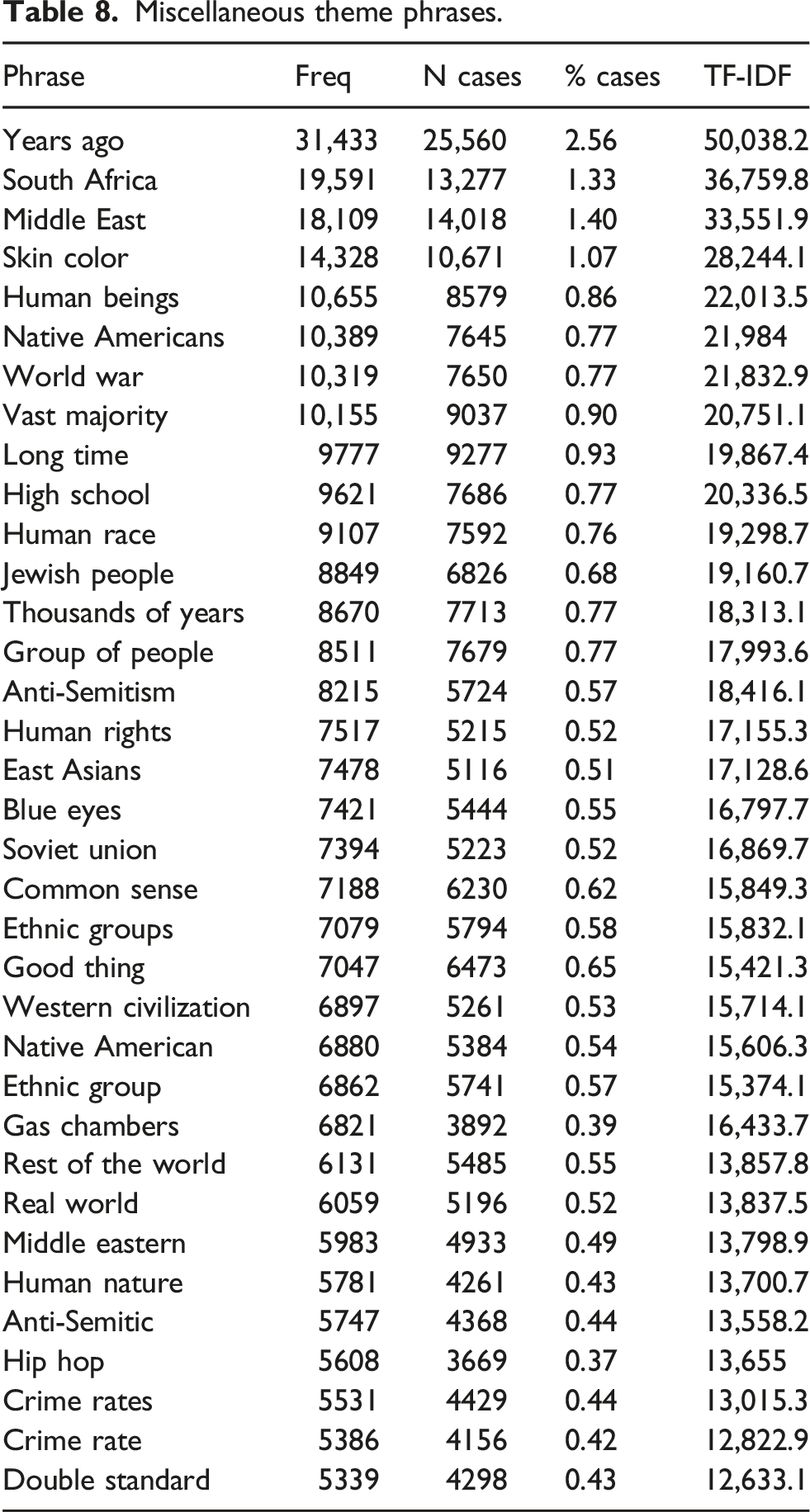
There are three important observations that can be drawn from the Miscellaneous phrases from the Opposing Views forum. The first is that references to time are common, including the most significant phrase, years ago, as well as long time and thousands of years. Interestingly, two of these three phrases hint at nostalgia in a similar way as the United States theme did. The second observation is that there are numerous references to geography in the Miscellaneous theme. These geographic references include a country, South Africa, a region, the Middle East, the former Soviet Union, and an ambiguous reference to the rest of the world. The third observation is that a number of phrases refer to groups of people in a way that is similar to the Whiteness and African American themes. These observations are aligned with other themes discussed above and are generally consistent with far-right political perspectives.
Conclusions
This study analyzed the content of public in-group and out-group discussions on Stormfront in order to identify key themes in the discourse between self-identified members and on-members of the largest online RWE community in the world. It used a corpus linguistics approach to examine the content of a dataset of approximately 1 m posts including a corpus of over 195 m words collected from the Opposing Views forum between September 2001 and June 2020. A mixed-method content analysis identified six key themes in the most frequently discussed phrases. Further examination of these themes and phrases revealed three important observations about the data.
The first observation was that the discussion between in-group and out-group members is heavily centered on white racial identity. The concept of Whiteness accounted for nearly half of all instances of top 100 phrases in the corpus, and it appears in nearly half of all cases in the entire data set. Despite presenting itself as a white nationalist forum, the Opposing Views forum discussed whiteness and threats to white culture far more than nationalism, although wherever nationalism was mentioned it was linked to whiteness.
The second observation was that the corpus is highly focused on people, either as groups or individual representatives of groups. This was evidenced in both the word frequency and phrase mining methods used. The high frequency of the individual word people was assumed to be related to politicized groups in the first stage of analysis. This was validated through the phrase mining, which showed that numerous N-grams containing references to people were linked to racial, religious, or social groups.
The third observation was that common political and miscellaneous phrases indicated a disposition toward nostalgic framing. This manifested both geographically and temporally in the data and is consistent with conservative politics generally and far-right political views specifically.
The implications of these findings are useful for researchers interested in fringe or extremist political views, in-group/out-group discourse, RWE discourses, or communication on the Stormfront site in particular. This study has provided an initial snapshot of the content of one public corpus on Stormfront. This can inform researchers interested in further studies of similar data available on Stormfront. It could also inform other forms of research into the themes and content in online RWE communities’ discourses.
Footnotes
Declaration of conflicting interests
The author(s) declared no potential conflicts of interest with respect to the research, authorship, and/or publication of this article.
Funding
The author(s) disclosed receipt of the following financial support for the research, authorship, and/or publication of this article: This work was supported by Rabdan Academy.
