




Abstract
Since the 2020 U.S. presidential election, perceptions of the validity of the outcome and broader trust in the American electoral process have reached historically low levels among Republicans. While this trend has potentially harmful consequences for democratic stability, there is little research on how beliefs that an election was fair—and trust in the electoral process more generally—can be restored. In a preregistered survey experiment (n = 2101), we find that viewing real messages from Republican politicians defending the legitimacy of the 2020 election increased faith in the election’s outcome and in the broader electoral process among Republican voters, compared to either a neutral control condition or to comparable messages from Democratic politicians. These effects are statistically mediated by shifts in voters’ perceptions of elite Republican opinion about the 2020 election, highlighting a potentially useful intervention for efforts to restore faith in elections going forward. Notably, exposure to messages from Republican politicians affirming the election’s legitimacy did not significantly decrease support for the Republican Party, suggesting that Republican politicians who endorse the 2020 election results might not face backlash from voters.
Introduction
The viability of democratic systems of government rests on the peaceful transfer of power, with losers of elections conceding defeat to winners (Levitsky and Ziblatt, 2018). When confidence in elections and respect for their outcomes is shaken, democratic systems weaken and may backslide toward autocratic or authoritarian rule (Anderson et al., 2005). In the United States, trust and confidence in elections is at an all-time low among Republican voters (Griffin and Quasem, 2021). While evidence does not support Donald Trump’s allegations of voter fraud (Eggers et al., 2021), his months-long campaign to undermine confidence in the 2020 vote count has fostered widespread distrust in the election results, vast misperceptions about the prevalence of fraud in the American electoral process, and decreased respect for democratic norms related to elections among his supporters (Clayton et al., 2021; Pennycook and Rand, 2021). Diminished trust in elections among supporters of the losing candidate is well-documented in the U.S. (Sances and Stewart, 2015), but the gap between Republicans’ and Democrats’ perceptions that the 2020 election was fair is the highest on record, and broad refusal to accept Joe Biden as the legitimate winner has persisted longer than usual (Griffin and Quasem, 2021).
What can restore confidence in the American electoral system? Here, we present results from the first experimental test of an intervention designed to increase belief in the legitimacy of the 2020 election among Republicans that we are aware of. A vast literature demonstrates that cues from elite co-partisans can shape opinions on public policy (e.g., Druckman et al., 2013) and politically relevant facts (e.g., Bisgaard and Slothuus, 2018). Here, we explore whether elite cues can also shape citizens’ faith in democratic institutions—a subjective sentiment about the reliability and trustworthiness of the country’s electoral apparatus and the individuals who direct it. Democratic norms in the U.S. have traditionally overcome partisan interests that may motivate elites to reject election losses. The 2020 election, however, revealed that these norms are fragile when some elites in the losing party withdraw compliance with them. This raises the question of whether other elites can subsequently salvage election confidence with their own endorsements.
We hypothesized that exposure to co-partisan elite cues affirming the legitimacy of the 2020 election would increase Republicans’ perceptions of the legitimacy of the election (Hypothesis 1), and their trust in the American electoral process more generally (Hypothesis 2), relative to either a neutral control condition or an out-partisan elite cue condition.
Study design
In a preregistered survey experiment,
1
a sample of 2101 Republican participants were randomly assigned to view a short video and text passage containing real statements from Republican politicians affirming the 2020 election results (see Figure 1; full video and text included in the Supplementary Information (SI)), similar content from Democratic politicians, or a neutral control condition.2,3,4 We then asked them three questions about their perceptions of the legitimacy of the 2020 election (e.g., How confident are you that votes nationwide were counted properly in the 2020 election?) and three questions about their trust in the American electoral process more generally (e.g., To what extent do you trust elections in this country?), each measured on 9-point scales, which we averaged to create composite scales for each outcome after confirming that they scaled together via factor analyses (see SI for details).
5
Excerpts from experimental stimuli. Respondents were randomly assigned to one of the below treatment conditions or a control condition. Full videos and text are included in the SI.
Results
We tested our main hypotheses using preregistered OLS regression with HC2 robust (heteroskedasticity-consistent) standard errors, which are appropriate for randomized experiments. We used the neutral control condition as the baseline and included basic demographic controls (age, gender, race, education, and income) in our models. We also computed marginal effects to test the differences between the Republican and Democrat cue conditions.
Our primary results are displayed in Figure 2. Consistent with our preregistered hypotheses, the Republican cue increased perceived legitimacy of the 2020 election relative to both the Democrat cue (b = 0.051 on a 0–1 scale, SE = 0.019, t = 2.77, p = .006) and the neutral control condition (b = 0.049, SE = 0.019, t = 2.63, p = .009). The Republican cue also increased trust in the American electoral process relative to the Democrat cue (b = 0.062, SE = 0.018, t = 3.47, p < .001) and the control (b = 0.061, SE = 0.018, t = 3.42, p < .001). Notably, we find no evidence that exposure to the Democrat cue led to backlash (i.e., decreased confidence in elections), corroborating research suggesting that backlash may be rarer than commonly supposed (Guess and Coppock, 2018). Average treatment effects of Republican elite cues on confidence in elections. Estimates shown inside the circles are OLS regression coefficients measured on a 0–1 scale; lines on either side are 95% CIs. Top panel shows estimated effects of Republican cue on both outcomes; bottom panel shows estimated effects of Democrat cue. Neutral control condition is baseline. Models include demographic controls. In the neutral control group, mean perceived 2020 legitimacy is 0.33 and trust in U.S. elections is 0.30 (see SI for full regression tables).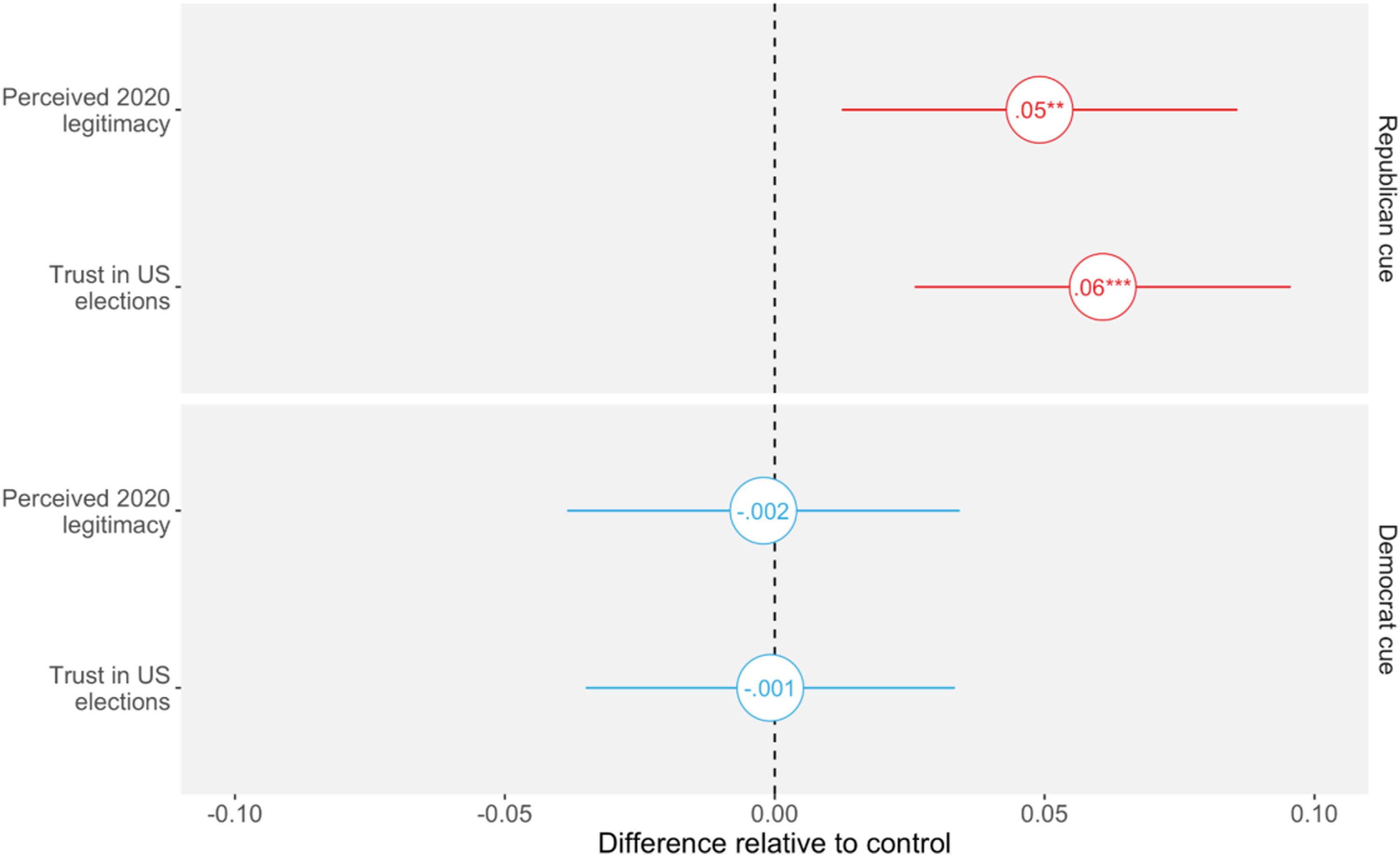
We next examine the causal mechanism behind our results. After the treatments, we asked participants to report their perceptions of the percentage of Republican politicians who believe the 2020 election was conducted fairly. Relative to the control, the Republican cue increased these perceptions (b = 12.18 on a 0–100 scale, SE = 1.40, t = 8.73, p < .001). Indeed, perceptions of elite Republican opinion about the election fully mediated the effect of the Republican cue on both outcomes. The average causal mediation effects (i.e., the indirect effects of the mediator) were even larger than the direct effects, at 0.09 [0.07, 0.11] for perceived legitimacy and 0.08 [0.06, 0.10] for trust, with both estimates highly statistically significant (p < .001; see SI for a discussion of sequential ignorability assumptions in our design and a sensitivity analysis). These results suggest that the treatment effects were likely driven by shifts in participants’ views of elite Republican opinion, with participants believing that a higher percentage of Republican elites endorse the election’s outcome as a result of the intervention.
We conducted a series of exploratory analyses to examine whether our results were moderated by pretreatment measures of Trump favorability, social identification as a Republican (Huddy et al., 2015), or strength of partisanship and found no systematic evidence of moderation effects in any case (all p’s > .18)—a noteworthy result, given fundamental differences in opinion between coalitions of Republican voters (Peters, 2021). Our results suggest that Republican elite cues could influence attitudes among diverse groups of Republicans.
Finally, we conducted an additional exploratory analysis to see whether the Republican cue impacted favorability toward the Republican Party. We found little evidence that it decreased broader party support relative to either the neutral control (b = −0.005, SE = 0.012, t = −0.40, p = .69) or the Democrat cue (b = −0.021, SE = 0.012, t = −1.75, p = .08). Note that the Republican cue versus control contrast—which we estimate to be approximately half a percentage point and statistically insignificant—is arguably the more substantively meaningful comparison here because Republicans have little sway over election-related cues from Democrats and because Democratic elites are likely to promote election-affirming messages regardless of what Republicans say about the election. We conducted a series of exploratory equivalence tests (Lakens, 2017) for p < .05 assuming unequal variances to examine the precision of these null effects. Based on these tests, we can say with 95% confidence that in our sample, the Republican cue would not decrease favorability toward the Republican Party by more than 2.6 percentage points relative to the control [−0.026, 0.012] or 3.8 percentage points relative to the Democrat cue [−0.038, 0.002]. Broadly, this provides initial evidence that the Republican Party may not lose significant support if Republican politicians publicly affirm the election’s legitimacy, although we note that even very small declines in support could influence the outcomes of close elections. Exploratory analyses of effects on other outcomes—including Trump favorability and social identification as a Republican—were similarly null.
Discussion
These results have several important implications. First, we present the first intervention we are aware of that effectively increases faith in the results of the 2020 election among Republican voters, suggesting that Republican politicians have the power to influence their supporters’ trust in elections. In the absence of such endorsements, however, our results imply that advocacy campaigns highlighting existing Republican elite endorsements of the election results could help restore election confidence. Our findings also invite future research examining whether other types of endorsements—including messages from more moderate Democrats than the ones featured in our experiments, bipartisan appeals, or endorsements from nonpolitical sources—could similarly increase faith in elections.
We also demonstrate that Republican elite cues increase confidence in elections by updating voters’ perceptions of Republican elite opinion on the issue. This is important because it suggests that skepticism about the validity of the vote count may be less rooted in deeply held, immovable beliefs about election administration than in following cues from prominent Republican leaders. Of course, this finding also raises the possibility that election integrity beliefs are fluid enough that successive exposure to real information environments—which at present are likely to include cues undermining the election’s legitimacy—could diminish the effects of election-affirming cues. This suggests that elites in politics and in the media who seek to strengthen democracy should highlight the Republican leaders who have chosen to stand up to affirm the election results, and that such cues may need to be delivered at high dosages and/or frequently over time to be effective. Additional research should explore this hypothesis.
Finally, we offer evidence that simple exposure to messages from Republican leaders affirming the election results did not lower support for the Republican Party, suggesting that Republican politicians might not face significant electoral costs if they choose to vocally affirm the 2020 election results. That said, we cannot rule out the possibility that direct attacks on Republican candidates who affirm the election’s legitimacy from other prominent elites who continue to undermine the outcome would impact public support. For example, Republican Congresswoman Liz Cheney faced significant backlash from the Republican Party after she publicly rejected Donald Trump’s claims about the election. Moreover, we do not measure outcomes that speak directly to reelection, which may motivate Republicans more than party favorability ratings (e.g., Arceneaux and Truex, 2022). The effects of election-affirming rhetoric on public support for parties and candidates are an important avenue for additional research.
Taken together, our results imply that Republican elites have the power to help restore perceptions of electoral legitimacy among their supporters. Absent such interventions, these perceptions may persist or even worsen among Americans, particularly Republicans. Continued distrust of elections risks suspicion of future electoral outcomes—a basis for leaders to reject election results, compromising the stability of the American democratic system.
Supplemental Material
Supplemental Material - Endorsements from Republican politicians can increase confidence in U.S. elections
Supplementary Material for Endorsements from Republican politicians can increase confidence in U.S. elections by Katherine Clayton and Robb Willer in Research & Politics.
Footnotes
Acknowledgments
We thank Sophia Pink, Joe Mernyk, Brendan Nyhan, and Ethan Porter for useful feedback. We also thank Chrystal Redekopp and undergraduate research assistants at the Stanford University Polarization and Social Change Lab for their helpful support of this research.
Declaration of conflicting interests
The author(s) declared no potential conflicts of interest with respect to the research, authorship, and/or publication of this article.
Funding
The author(s) disclosed receipt of the following financial support for the research, authorship, and/or publication of this article: We thank the Stanford Center on Philanthropy and Civil Society for funding this research.
Correction (June 2025):

Supplemental Material
Notes
References
Supplementary Material
Please find the following supplemental material available below.
For Open Access articles published under a Creative Commons License, all supplemental material carries the same license as the article it is associated with.
For non-Open Access articles published, all supplemental material carries a non-exclusive license, and permission requests for re-use of supplemental material or any part of supplemental material shall be sent directly to the copyright owner as specified in the copyright notice associated with the article.
