



Abstract
Conventional wisdom suggests that citizens who recognize party polarization exhibit well-sorted preferences. Curiously, however, this extant research has not grappled sufficiently with how pervasive perceptual biases might moderate the relationship between perceptions of elites and sorting. In this manuscript, I show that perceived out-group dissimilarity affects sorting, albeit in an asymmetric manner: perceived out-group dissimilarity corresponds to greater sorting for persons with right-leaning identities compared to those with left-leaning ones. I then analyze the 1992–1996 ANES Panel Study and find that these patterns mostly hold, with one caveat: sorting also shapes perceptions of out-group dissimilarity. These findings offer preliminary evidence of the existence of a feedback loop between perceptions of elites and sorting.
Keywords
Political preferences are, to some degree, learned. In particular, the political socialization literature implies that elites play a primary role in shaping citizens’ attitudes and orientations (Gilens and Murakawa, 2002). As Downs (1957: 233) notes, the average person simply cannot be an expert in many areas of politics, so “he will seek assistance from men who are experts in those fields, have the same political goals he does, and have good judgment.” This cue-taking underscores the leading explanation for sorting within the American mass public: when elites polarize, individuals receive clearer cues about the “correct” connection between their political preferences and adjust them accordingly (Levendusky, 2009: 39).
While intuitive, this logic is not without certain complications. First, the typical citizen lacks sophistication (Converse, 1964; Kahan and Braman, 2006). As a result, individuals struggle to conform to Downs’ idealized logic of cue-taking, often relying, instead, upon symbolic or group-based cues to navigate the political landscape (e.g., Bullock, 2011; Campbell et al., 1960). Second, citizens’ spatial perceptions of elites are often biased and asymmetric. Not only does the average American tend to misperceive the extent of policy polarization (Levendusky and Malhotra, 2016), but ideological placements of in-party and out-party elites and copartisans are not uniform (Ahler, 2014).
These biases constitute a thorny problem for linking perceptions of elite polarization to sorting. In this manuscript, I argue that elite-based explanations of mass sorting should consider accounting for the tendency of group memberships to filter party placements in ideological space. Returning to the idea that the perceptual screen of partisanship is pervasive (Campbell et al., 1960; Westfall et al., 2015), I find that perceived out-group dissimilarity corresponds with greater sorting than comparative differences between the parties (i.e., “perceived polarization”). This effect, however, is asymmetric among party identifiers: Republicans who perceive maximal levels of out-group dissimilarity are better sorted than comparable Democrats. I conclude with an analysis of the 1992–1996 ANES Panel Study and find that these patterns mostly hold with one caveat: Perceived dissimilarity yields greater downstream sorting among persons with right-leaning identities, yet sorting shapes such perceptions for all respondents. These findings constitute preliminary evidence for the existence of a feedback loop between perceptions of elites and sorting.
Elite cues and sorting
The accumulated wisdom regarding the development of citizens’ preferences points to a general “elite cue theory,” which suggests that mass opinion responds to elite discourse (e.g., Berinsky, 2009; Brader et al., 2012; Lenz, 2010; Zaller, 1992). While this logic underscores sorting—elites polarize, citizens recognize these ideological changes, and then sort accordingly—there is reason to suspect that individuals do not interpret elite cues uniformly. First, partisans do not interact with informational sources evenly (Stroud, 2010). Second, individuals often expend energy counter-arguing evidence that is incongruent to their political preferences (Nyhan and Reifler, 2010; Taber and Lodge, 2006). This motivated reasoning dovetails with the observation that affective biases fundamentally shape (mis)perceptions of basic ideological proximity (Ahler, 2014; Iyengar et al., 2012; Iyengar and Westwood, 2015; Levendusky and Malhotra, 2016; Westfall et al., 2015).
Consider traditional party placements in liberal-conservative space. In the 2012 ANES Time-Series survey, partisans conveyed that the out-group party was almost 15% more extreme than the in-group party. If basic ideological placements of political parties are distorted, then it follows that perceptions of elite polarization—or the Euclidean distance between ideological placements of the parties—are biased downwards in the sense that, while both parties have objectively polarized, individuals do not recognize these changes evenly. 1 In turn, this asymmetry presents an obvious challenge for the conventional sorting calculus in that it may be the case that these perceptions are differentially related to sorting.
Social identity theory provides an alternative approach to engage the linkage between perceptions of elites and sorting. If partisanship is a particular form of social identity (Huddy et al., 2015), then prototypic group members (e.g., political elites) provide the archetype to which group members should pattern their preferences. This expectation, however, cuts both ways. Social comparisons also produce contrast effects between groups (Campbell, 1967). Both Turner et al.’s (1987) and Brewer’s (1991) work, for example, implies that the categorization processes that distinguish in- from out-group membership motivate individuals to emphasize the distinctive features of out-groups in order to establish the boundaries that separate group members from opponents.
While classic versions of social identity theory emphasize that individuals desire to emulate in-group prototypes (e.g., Tajfel, 1959), more recent applications of social identity theory in political science find that out-group cues are particularly powerful (Goren et al., 2009; Nicholson, 2012). Why? Consider, first, that social comparisons literally hinge on distinctiveness, or the features that allow for contrasts between groups (Brewer, 1991). Second, Tversky’s (1977) work suggests that the illusion of out-group homogeneity—the perception that an out-group is uniformly undesirable—emphasizes the objectionable features of out-group members relative to the attractiveness of in-group characteristics. Finally, Atkinson’s (1986: 132) work posits that these differences play an important evaluative role; because “similarity and difference are not related by a perfect inverse function, the question arises as to which is the more basic process. Perhaps the best way to answer this question is to consider which is more likely to be noticed. The tentative answer would be difference since the judgment reflects distinctive over common features.”
In the context of the linkage between elite cues and sorting, one productive way of thinking about how group memberships moderate perceptions of elite cues is to consider the features of in-group similarity and out-group distinctiveness. In this case, sorting may be less a function of perceived differences between the parties than contrasts between the self and these groups—particularly given the “negativity” associated with out-groups (Abramowtiz and Webster, 2016; Iyengar et al., 2012; Mason, 2015). Accordingly, I expect that individuals who perceive significant differences between themselves and their political opposition should exhibit the most well-sorted political preferences.
Data and method
To test these relationships, I leverage the 1980–2016 American National Elections Studies (ANES) Time-Series and the 1992–1996 ANES Panel Study surveys. The outcome of interest in these analyses, sorting, follows Levendusky’s (2009) original coding. Individuals are asked to place themselves on a seven-point scale on each of the following items: aid to blacks, abortion, health insurance policy, whether government should provide jobs and a standard of living, defense spending, the extent of general government spending on social services, and liberal-conservative self-placement. Individuals who identify as a Democrat and who correctly chose “liberal” responses (values 1 to 3) receive a value of (1); in the case of pairings where the placement does not “match” one’s partisanship, the value (0) is assigned. Likewise, Republicans who selected “conservative” responses (values 4 to 7) are coded (1) for correct party-ideology matches and otherwise (0). To calculate a sorting score, I simply average together scores on all seven pairings. The resulting index ranges from 0, “not sorted on any item,” to 1, “sorted on all items.”
Perceptions of elites
The ANES surveys ask individuals to place the Democratic and Republican Parties in liberal-conservative space. Responses to these items range from 1, “extremely liberal,” to 7, “extremely conservative.” To construct the first type of group assessment, perceived party polarization, I simply subtract a respondent’s Democratic Party ideological placement from the Republican one. This operation yields a variable that ranges from -6, which conveys that a respondent perceives that the parties are fully polarized, yet completely opposite of their “correct” ideological character, to 6, which conveys that the individual correctly identifies the parties’ ideology and views them as extreme. Values of or near zero, then, represent either perceiving the parties to be moderate or perceiving the parties to be effectively indistinguishable from each other. To ease the interpretation of this variable’s relationship to sorting, I have rescaled it to range from 0 to 1; the full distribution of responses is illustrated in Panel A, Figure 1.

Perceptions of the parties in liberal-conservative space.
Next, I disaggregate this “comparative” assessment into perceptions of in-party and out-party (dis)similarity. These items reflect the perceived distance between an individual’s own liberal-conservative self-placement and the corresponding placement of the in-party, the party to which the respondent belongs, and out-party, the party with which an individual does not identify. Perceived in-party similarity is created by subtracting the liberal-conservative placement of an individual’s party from her own ideological self-placement and taking the absolute value of the resulting score. I then rescale this item so that larger values reflect greater perceived ideological similarity. Values on this variable range from 0, maximum ideological differences between the self and in-group, to 1, which conveys no differences between self and in-group liberal-conservative placements. According to Panel B in Figure 1, most respondents believe that the in-group party shares their own sense of ideological self-placement. Almost 70% of individuals fall into one of the two highest categories on this item. 2
Perceived out-party dissimilarity is constructed by subtracting the liberal-conservative placement of an individual’s out-party from their own self-placement and taking the absolute value of the resulting score. This transformation is necessary to ensure that Republican and Democrat identifiers’ scores exist within common space and yields a variable that, after rescaling, ranges from 0, or no differences between self and out-group ideological placements, to 1, or maximum differences between the self- and out-group ideological placement. Panel C in Figure 1 illustrates that the spread of values on this item is approximately normal, with fewer than 5% of all partisans perceiving maximum ideological differences between their and the out-party’s liberal-conservative placement. Although there is no difference between Republicans’ and Democrats’ perceptions of in-party similarity, those persons with right-leaning identities perceive about 12% greater out-party ideological dissimilarity on average relative to persons with left-leaning identities. As Figure 2 illustrates, these differences jump dramatically in 2012, and I return to the implications of this asymmetry below.

Perceived out-party dissimilarity by partisan group.
Controls
A number of control variables are employed. In light of the legacy of the Southern realignment, I include a dichotomous variable, Old South, for persons who reside in states that were originally included in the Confederacy. A respondent’s age is measured in years, ranging from 17 to 99. Educational attainment conveys the highest level of schooling a respondent has completed and takes the form of a seven-part ordinal scale ranging from 0, “grade school,” to 1, “graduate degree.” The degree to which persons are interested in politics is coded 0 for “not much,” 1 for “some,” and 2 for “a lot.” Because religion is deeply intertwined with political sorting (Davis, forthcoming), I account for the religiosity of respondents. Religiosity is a composite factor of church attendance, views on biblical inerrancy, and the importance of religion. Racial identification as white or black is coded 1, respectively, and 0 otherwise. To construct a measure of political knowledge, I combine party-policy placements—correctly placing Democrats to the left of Republicans on jobs, aid to blacks, and social welfare and defense spending—and knowledge of the House majority. This variable ranges from 0, answering no questions correctly, to 1, answering all questions correctly.
Results
Table 1 presents a series of models that depict the correlates of sorting. Model 1 portrays sorting as a function of perceived polarization. Here, the estimates conform with prior work: when individuals perceive that the parties are deeply divided, they exhibit greater sorting. Model 2 decomposes perceived polarization into perceptions of in- and out-group (dis)similarity. Two conclusions are warranted. First, recalling that variables have been rescaled to range from 0 to 1, the magnitude of the effect of perceived out-group dissimilarity on sorting (b = 0.43, se = 0.01) is larger than that corresponding effect of perceived in-party similarity (b = 0.22, se = 0.02). Second, the net effect of perceived polarization (Model 1) is comparatively smaller than the effect of perceived out-party dissimilarity on sorting (Model 2).
Elite cues and Partisan-Ideological Sorting.

Notes: Model includes year fixed effects, which are relegated to accompanying supplementary materials; standard errors in parentheses are clustered by year. *p<0.05, **p<0.01.
Source: 1980–2012 ANES Time-Series Surveys.
Figure 3 illustrates the contours of these findings by plotting the coefficient estimates associated with in-group similarity and out-group dissimilarity over time. Unlike the pooled coefficient estimates presented in Table 1, each point estimate is derived from fitting a model to the data from the respective year in which it was collected. Aside from the observation that in-group assessments are often a weaker correlate of sorting than out-group ones, I find that the magnitude of these effects shift over time. Focusing on the effect of perceived out-group dissimilarity (Panel B, Figure 3), the magnitude of the effect of perceiving maximum distance between the self and out-group party on sorting is almost 30% larger in 2016 relative to 1980. This observation tracks “objective” changes in elite polarization over this period of time. Although speculative, as elites have become more objectively divided in real time (e.g., McCarty et al., 2006), the informational utility of these perceived dissimilarities seems to reflect these changes. 3

The effect of perceived (dis)similarity on sorting, conditional on group membership.
While individuals who perceive stark ideological differences between themselves and the out-group party appear more likely to align their partisan and ideological preferences, it is an open question regarding whether this effect is uniform among partisans. Curiously, while a growing literature demonstrates sincere differences in the ideological foundations of the American political parties (e.g., Grossman and Hopkins, 2016), no research has explored whether these asymmetries have implications for the linkage between perceptions of elite cues and sorting. As Figure 2 hints, however, there are meaningful differences between the average levels of ideological dissimilarity that Republicans and Democrats perceive. Does this have predictive consequences?
In Figure 4, I juxtapose a series of marginal effect estimates associated with perceived polarization, perceived in-party ideological similarity, and perceived out-party dissimilarity. Each point estimate illustrates the effect of moving from minimum to maximum values on the respective assessment. At maximum values across all three variables, Republicans exhibit greater sorting than Democrats. In the case of perceived out-group dissimilarity, these differences are profound—persons with right-leaning identities exhibit almost 30% more sorting than those with left-leaning ones.

Effect of different permutations of perceptions of elites on sorting.
Untangling directionality
Implicit in the discussion of the relationship between these assessments and sorting is a causal arrow running from the former to the latter. Certainly some evidence exists that perceptions of elites (Levendusky 2009) and exposure to elite cues (Levendusky, 2010) generates sorting. Yet, teasing out whether perceptions of in- and out-group (dis)similarity cause sorting is difficult with observational data. To gain leverage on this question, I turn now to the 1992–1996 ANES Panel Study.
In general, panel data are particularly useful to explain whether a variable collected at one point explains later change at a second point in time—a modeling approach referred to as a cross-lagged design (Finkel, 1995; Granger, 1969). In this case, I model observed sorting in 1996 as a function of in-group similarity and out-group dissimilarity at 1992, in addition to sorting’s lagged 1992 value. In turn, I also analyze perceived out-group dissimilarity in 1996 as a function of such perceptions in 1992, as well as the extent to which a person was sorted at the earlier survey wave. Presenting these models side-by-side, we can assess whether perceived out-group dissimilarity causes sorting or the reverse is true. 4
Table 2 presents a series of estimates derived from these tests. In the first model, while lagged sorting is clearly predictive of later sorting, perceived out-group dissimilarity does not exert a statistically distinguishable effect on sorting. However, drawing on the partisan asymmetries present in the earlier analyses, the second model disaggregates these cues by respondents’ partisan identity. Figure 5 plots the estimates from the resulting interaction term, which reveal that individuals with right-leaning identities who perceived significant differences between the out-group and their own ideological identity at Time 1 were much more likely to possess well-sorted identities at Time 2. 5 In contrast, perceptions of out-group dissimilarity are unrelated to sorting among Democrats.
Cross-lagged panel models of sorting and out-group dissimilarity.
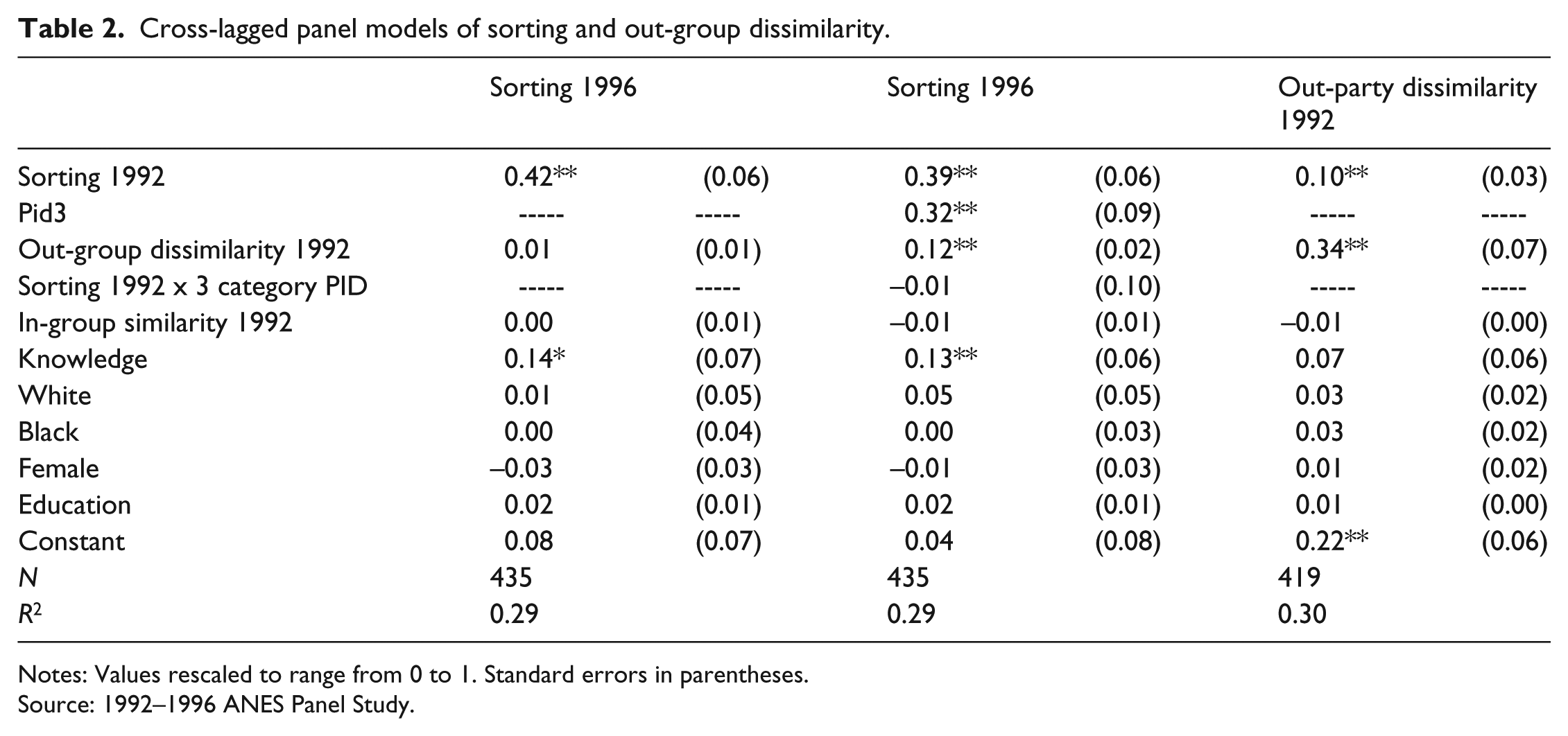
Notes: Values rescaled to range from 0 to 1. Standard errors in parentheses.
Source: 1992–1996 ANES Panel Study.

The effect of perceived out-group dissimilarity on sorting over time.
These estimates comport with the traditional linkage between cues and sorting, with the caveat that the panel data imply that this connection is asymmetric among partisans. Yet, it is also worth exploring whether sorting at Time 1 bears any relationship to perceived out-group dissimilarity at Time 2. In the third model, lagged out-party dissimilarity predicts later out-group assessments at Time 2. However, there is also evidence that sorting and perceptions of elites may be endogenous—moving from minimum to maximum values of sorting exerts about half a standard deviation change in the extent to which individuals perceive out-group dissimilarity. Although this effect is more modest than the effect of out-group dissimilarity on sorting, it nevertheless implies that sorting factors into how individuals see out-group parties. 6
Conclusion
Scholarly interest in sorting has increased dramatically over the previous decade (e.g., Levendusky, 2009; Mason, 2018). The primary explanation for these changes draws on the idea that perceived polarization conveys information that facilitates the matching of ideology to partisanship. This manuscript, however, suggests that this linkage is more nuanced.
Why are individuals more likely to conform to the political characteristics of their in-group when they perceive that their political opponents deviate from their own group’s preferences? Self-categorization theory conveys that contextual comparisons between reference groups and the individual are efficient means for processing information quickly (Atkinson, 1986). Given the desire for positive social distinction (Turner et al., 1987) and the evaluative importance of group differences (Taylor, 1981), comparisons between the self and reference groups may shape conformity among preferences beyond the recognition of between-group differences (e.g., Hogg, 1996; Turner et al., 1987).
Yet, while Baltasar Gracián’s classic admonition that “A wise man gets more use from his enemies than a fool from his friends” proves prescient, the effect of perceived out-group dissimilarity on sorting is not uniform. In fact, these assessments of elites correspond to asymmetric levels of sorting among partisans: persons with combinations of right-leaning identities exhibit greater levels of sorting than persons with left-leaning ones. This finding fits well with the growing acknowledgement that US party politics are riddled with such asymmetries. Expanding on Freeman’s (1986) early work, Grossman and Hopkins’ (2016) argue that Republicans appear to organize around thematically-central ideological principles, while Democrats reflect a loose coalition of social groups. Elsewhere, Bonica’s (2014) work on scaling the ideological preferences of political activists reveals pervasive differences between the extent to which Republican elites have become more conservative and Democrats more liberal. These differences even spill into the behavior of elected officials (Mann and Ornstein, 2012), which, according to the logic of sorting, should be noticed by ordinary partisans. Given the compositional and behavioral differences inherent in the expression of ideology, it is sensible that persons with right-leaning identities would be more sensitive and draw greater utility from perceived out-group dissimilarity.
It is important to note, however, that the inclusion of the panel data complicates this linkage. Recent work indicates that the strength of one’s political preferences can have a direct effect on the nature of assessments regarding political divisions (e.g., Westfall et al., 2015). Indeed, the results depicted in the final series of analyses suggest that sorting exerts an effect on downstream perceptions of ideological dissimilarity. As such, perceptions of elites vis-à-vis sorting may be prone to a feedback loop of sorts: individuals translate cues into actionable information, which, in turn, shapes how that information is processed.
On balance, these findings are not a cause for optimism. While some have argued that a “positive” “benefit” of polarization is that it better informs the electorate, sorting reinforces perceived divisions among citizens. Further, these findings imply that citizens may discount the ideological extremity exhibited by their own party. For example, if sorting is most responsive to perceived out-group dissimilarity, then there may be little incentive for in-group politicians to moderate their tone. Given the behavioral ramifications of sorting (Davis and Mason, 2016; Mason, 2015), the instrumental incentives that drive individual and elite behavior in spatial models of politics may be less binding in this context than other work predicts. In this way, sorting may problematize the representational link between citizens and elites by drawing attention to out-group threat rather than in-group responsiveness.
Supplemental Material
Supplementary_materials_for_cues_and_sorting_(R_and_P) – Supplemental material for Perceptions of elites and (asymmetric) sorting
Supplemental material, Supplementary_materials_for_cues_and_sorting_(R_and_P) for Perceptions of elites and (asymmetric) sorting by Nicholas T. Davis in Research & Politics
Footnotes
Acknowledgements
The author thanks Chris Hare, Jim Garand, Matt Hitt, two anonymous reviewers, and the editor for helpful comments. Any remaining errors are the author’s own.
Author’s Note
Prior portions of this manuscript were presented at the 2016 Midwest Political Science Association meeting in Chicago, IL.
Declaration of conflicting interests
The author(s) declared no potential conflicts of interest with respect to the research, authorship, and/or publication of this article.
Funding
The author(s) received no financial support for the research, authorship, and/or publication of this article.
Supplementary materials
The supplementary files are available at http://journals.sagepub.com/doi/suppl/10.1177/10.1177/2053168018777099. The replication files are available at: https://dataverse.harvard.edu/dataset.xhtml?persistentId=doi:10.7910/DVN/ZI5VFA&version=DRAFT.
Notes
Carnegie Corporation of New York Grant
This publication was made possible (in part) by a grant from Carnegie Corporation of New York. The statements made and views expressed are solely the responsibility of the author.
References
Supplementary Material
Please find the following supplemental material available below.
For Open Access articles published under a Creative Commons License, all supplemental material carries the same license as the article it is associated with.
For non-Open Access articles published, all supplemental material carries a non-exclusive license, and permission requests for re-use of supplemental material or any part of supplemental material shall be sent directly to the copyright owner as specified in the copyright notice associated with the article.
