



Abstract
The negative “Trump Effect” on international students has attracted wide media and scholarly attention. Surprisingly, the best existing evidence remains anecdotal and case-based. In this study, we fill this important gap. We employ a difference-in-differences (DID) design to estimate the Trump effect for the US vis-a-vis various control groups: top 5, top 10, top 20, and all other countries that compete with the US. We find a statistically significant and negative Trump effect that drives international students from the US to competing destinations. Relative to the top five competitors, about 12% fewer students came to the US during the first 3 years of the Trump Presidency. The average treatment effect is statistically significant across the top 5, top 10, and top 20 destination groups but not for the group of all other destinations as a whole. Pairwise DID estimates between the US and 91 individual countries further indicate that the Trump effect is primarily driven by 26 host nations. These findings contribute to our understanding of Trump effects, student flows, and migration.
Introduction
Higher education is one of the United States sectors with a vital global comparative advantage. In the 2019–2020 academic year, more than one million international students came to the US to study. They contributed $38.96 billion in education exports and created over 415,990 jobs; higher education ranked 6th among United States service exports in 2020. 1 The United States has been the most popular and largest destination for international students seeking higher education abroad. According to the UNESCO statistics, 2 during the past two decades, the United States accounts for around 20% of all student flows. The number of international students enrolled in American colleges and universities rose from 0.4 million in 2001 to more than 0.9 million in 2019.
However, after taking office in 2017, President Trump adopted anti-immigration rhetoric and various policies that many considered to have dampened the appeal of the United States to international students. 3 These policies included the Muslim Travel Ban and more stringent student and work visa restrictions. Many scholars (e.g. Hacker and Bellmore, 2020; Laws and Ammigan, 2020; Van De Walker and Slate, 2019; Todoran and Peterson, 2020) argue that there is a strong negative “Trump Effect” on international student flows into the US. Despite receiving wide attention from both media and academia, the effect has never been tested and estimated empirically, as one researcher (McKivigan, 2020) points out in a recent article. Nearly all studies employ anecdotal and case-based evidence. Rigorous systematic statistical analysis and evidence are lacking. In this study, we fill this gap.
In this study, we address the following research questions. Is there any solid statistical evidence substantiating the “Trump Effect” that deters international students from coming to the US? If the effect exists, which countries benefit as substitute destinations? We employ a difference-in-differences (DID) design to estimate the effect for the U.S. vis-a-vis various control groups: top 5, top 10, top 20, and all other host countries that compete with the U.S. for international students. We find a statistically significant and negative “Trump Effect” that drives international students to top competing destinations. To ascertain which countries substitute the US, we obtain and test the DID estimate between the US and each competing host. Among 119 other countries, 91 have sufficient data to produce pairwise DID estimates, and only 26 seem to have clearly benefited from the decline of student flows into the U.S.
Our research makes several contributions. First, the Trump effects on various outcomes have received wide attention in the news, social media, and academic research. The unexpected victory of Trump in the 2016 United States presidential election has generated an increasing number of studies exploring outcomes such as racial discrimination (Newman et al., 2021), public health (Smith, 2022), EU’s popularity (Minkus et al., 2019), the reputation of the United States abroad (Carreras et al., 2021; Haman and Školník, 2021; Bateson and Weintraub, 2022), trade protectionist sentiment and policy (Coupe and Shepotylo, 2021; Essig et al., 2021), and the financial and currency markets (Cunha and Kern, 2022; Slaski, 2021). Our research provides a useful addition to that literature by analyzing a different type of outcome.
Second, a growing body of literature on international student flows focuses on social, economic, and geographic determinants, including distance, common official language, shared religion, historical colonial ties, and relative economic development between origin and destination countries (e.g. Beine et al., 2014; Perkins and Neumayer, 2014; Tay, 2014; Abbott and Silles, 2016; Perkins and Neumayer, 2014). The impact of political shocks on international students, though widely discussed, is rarely analyzed empirically. Our research contributes to that literature by demonstrating a Trump effect and highlighting the impact of political shocks.
Third, student flows are closely related to migration because today’s students often become tomorrow’s legal migrants. For example, Dreher and Poutvaara (2011) find that international student inflows into the US significantly predict future emigration from those home countries. Since the Trump Administration increased immigration restrictions significantly, one might likely find that the negative Trump effect on student flows also applies to migration. Our research suggests a rigorous approach to estimating that effect. By demonstrating the substitution effect, our research also echoes and complements the findings in (Glennon, 2020) that restrictions on the United States H-1B immigration cause multinational firms to offshore jobs to other countries such as Canada, India, and China, without increasing the employment of natives in the United States.
Finally, as noted earlier, American colleges and universities appeal to students worldwide. Education exports constitute a significant component of the U.S. and global economies. Demonstrating how the Trump effect influences the movement of international students among various countries is of interest to a wide range of stakeholders, such as colleges and universities, students, and policymakers in different countries.
“Trump Effect” on international student flows
The “Trump Effect” is based on rhetoric and policies with negative implications for international students regarding racial profiling, migration, and visa restrictions. First, prejudiced elite speech during the Trump campaign encouraged people with racial prejudices to express and act upon those prejudices actively (Newman et al., 2021). On January 27, 2017, President Trump issued an executive order restricting the entry of people from seven Muslim majority countries—Iran, Iraq, Libya, Somalia, Sudan, Syria, and Yemen—into the United States. Following several legal challenges during the year, the Trump Administration removed Iraq and Sudan from the list but added Chad, North Korea, and Venezuela. In 2018, Chad was removed from the list. Finally, on January 31, 2020, six more countries—Eritrea, Kyrgyzstan, Myanmar, Nigeria, Sudan, and Tanzania—were added. Although the restrictions were placed on banned countries, the “Trump Ban” reportedly also caused a chilling effect on international students more generally. 4 Many students who planned to study abroad became terrified by the stressful and hostile political climate in the US and changed their plans.
Second, the Trump administration consistently tried to curtail both legal and illegal immigration. On April 18, 2017, President Trump signed the “Buy American and Hire American” Executive Order. 5 The policy sought to strengthen the enforcement of immigration laws, particularly the H-1B visa program that directly pertains to international students who intend to stay and work in the US after getting a degree. Also, in 2017, President Trump decided to end the DACA program (Deferred Action For Childhood Arrivals)—the Obama-era program allowing undocumented immigrants who arrived in the country as children to stay. 6 Meanwhile, the Trump administration significantly reduced the number of non-immigrant visas for tourists, temporary workers, and international students. 7
Third, in 2018, the Trump administration imposed new rules on international students regarding part-time on-campus jobs, course load, abilities to maintain legal status, and penalties for violations of conditions of visas. 8 For example, United States Citizenship and Immigration Services (USCIS) changed the calculation of “unlawful presence” that results in immediate deportation of students. Near the end of the Trump Presidency, more stringent restrictions were imposed on student and work visas. 9
These controversial policies, often challenged, sometimes rescinded, often re-introduced, and even escalated, created an atmosphere and environment that made the U.S. less attractive for many international students. The media reported the chilling “Trump Effect,” and researchers also explored the phenomenon. Laws and Ammigan (2020) show that since 2016, the number of international students enrolled in the US began to decrease. Hacker and Bellmore (2020) find that in the 2017–2018 academic year, international student enrollment in the US decreased by 6.6% from the 2016–2017 academic year. Van De Walker and Slate (2019) show that from fall 2016 to fall 2018, in two of the largest public Texas institutions, international graduate applicants declined by 33.34% and 18.306% from Muslim-majority countries and non-Muslim majority countries, respectively. Using data collected from four groups of international doctoral students in January 2017, Todoran and Peterson (2020) find that the “Trump Ban” affected not only students from those banned countries but also students from other countries who feel the United States climate has become stressful and hostile.
The “Trump Effect” has implications for the US as a destination and other destination countries that compete for international students. Students spend a lot of time and money preparing to study abroad. When the US becomes less appealing, these students will likely select other destinations rather than cancel going abroad due to the “sunk cost.” Meanwhile, as the victory of Trump caused global public opinions toward the US to decline dramatically (Haman and Školník, 2021; Carreras et al., 2021; Bateson and Weintraub, 2022), it led to a significant increase in the EU’s popularity in Europe (Minkus et al., 2019). As other top and popular destination countries also provide high-quality educational venues and maintain the same level of student restrictions in terms of visa policies regarding entry, re-entry, and post-graduation employment, these countries benefit as alternative destinations.
University administrators are acutely aware of this substitution effect. University of California President Janet Napolitano commented in 2018, “Where the United States retreats, there’s a vacuum, and other countries will rush to fill it.” 10 In contrast, Universities Canada, a membership organization of Canadian universities and colleges, started their news release on November 15, 2017, with the following statement, “At a time of closing borders and closing minds, students from around the world are choosing Canada.” 11 Canada was not the only one that benefited from the “Trump Effect.” Australia, New Zealand, Spain, Japan, and even China all reported an increase in international enrollment. 12
In sum, the “Trump Effect” on international student flows consists of two components: a chilling effect on those who want to but decide not to come to the US and a substitution effect of American colleges being replaced by foreign universities as new destinations. Thus, estimating the effect requires both components to be accounted for empirically, an issue we turn to in the next section.
Research design
The dependent variable is the number of students from an origin country enrolled in higher education institutions in a destination country. We collect data from the UNESCO Institute for Statistics (UIS). 13 Compared with other sources like OECD statistics, UNESCO data have the broadest spatial and temporal coverage.
Since the “Trump Effect” consists of two components, we employ a difference-in-differences (DID) design for identification and estimation (Angrist and Pischke, 2008). In our design, we compare the US against various control groups: top 5, top 10, top 20, and all other host countries that compete with the U.S. for international students, and we also compare the changes in student flows between 3 years before the Trump Presidency (2013–2015) and 3 years during the Trump Presidency (2017–2019). We exclude the election year 2016 because there is too much uncertainty for international students to anticipate who will be the next President and United States policies regarding international students. For robustness checks, we re-estimated all the models including observations from 2016. The findings reported in the supplemental appendix remain robust. We exclude the year 2020 because it coincides with the COVID-19 pandemic, thus confounding our estimation.
The equation below illustrates our DID specification

Y ijt represents student flows from home country i to host country j in year t; X ijt represents control variables in year t ɛ ijt represents the independently and identically distributed random error. US j indicates a dummy variable for the U.S. as a host country, which one may consider as a “treated” host country that experiences Trump policies at some point relative to the control group (competing destinations); β1 represents the time-invariant difference (fixed effect) between the treated (U.S.) and the control group (competing destinations) in the absence of Trump policies. Trump t indicates a time dummy that equals one after Trump takes office and his policies come into effect and zero otherwise; β2 represents the Trump Presidency period-specific effect common to both the treated and control groups. Thus, US j × Trump t is the interaction between the treated country dummy and the Trump Presidency period dummy, which equals one if a host country is the US and the value of the year is after 2016, and zero otherwise; β3 denotes the DID effect of interest, that is, the average Trump effect on student flows. According to our discussion in the previous section, β3 should be negative and statistically significant, providing a clear signal of the Trump effect. It is worth noting that a statistically insignificant β3, while not a significant sign of a strong Trump effect, could imply a weak Trump effect if the control group catches up in the growth of student inflows with the previously faster growing U.S.
We further adapt the DID specification above to suit our analysis. First, because unobserved heterogeneity is associated with various home and host countries and country pairs or dyads, we control for home and host country fixed effects or dyad fixed effects to avoid spurious findings. These fixed effects end up absorbing the time-invariant difference (fixed effect) between the treated (US) and the control group (competing destinations) that is captured by the dummy variable US j . Second, we control for possible year-specific effects common to all countries by including year dummies, which absorb the Trump Presidency period-specific effect common to all countries as reflected by Trump t .
We include various control variables according to the literature on the drivers of bilateral student flows. Almost all studies find that bilateral distance reduces student flow by raising the cost of studying abroad. Scholars also find that common official language, shared religion, and historical colonial ties promote bilateral student flows (e.g. Beine et al., 2014; Perkins and Neumayer, 2014; Tay, 2014). We control for geographical distance weighted by the populations of origin and destination countries, geographic contiguity, common official language, and historical colonial ties. Data on these variables are from the CEPII project (Mayer and Zignago, 2011).
Studies find that relative economic development between countries matters to student flows. Different wage rates and work opportunities could drive students to move from poor to rich countries (Abbott and Silles, 2016; Perkins and Neumayer, 2014). Hence, we control for the ratio of GDP per capita (in 2015 constant U.S. dollars) between the home and the host country in a dyad. We also control for home and host countries’ populations (log-transformed) as standard gravity model variables. We expect the GDP per capita ratio between home and host countries to decrease student flows and the population size to increase student flows. Data on these variables are from the World Bank’s World Development Indicators.
In terms of the estimation technique, we follow recent studies of student flows (e.g. Abbott and Silles, 2016; Beine et al., 2014) and use the Poisson pseudo maximum likelihood (PPML) estimator. As shown by Silva and Tenreyro (2006), when the dependent variable has a disproportionately large number of zero values and the error variance is heteroskedastic, PPML produces consistent statistical estimates and is superior to ordinary least squares (OLS) or negative binomial. We follow previous studies and estimate robust standard errors clustered over dyad to deal with heteroskedastic error variance and possible correlation within dyad.
Findings
Before presenting our estimation results, we provide a descriptive comparison of annual total student inflows into the top six destination countries—United States, United Kingdom, Australia, Germany, France, and Canada—between 2013 and 2019. As shown in Figure 1, before 2016, the number of international students increased rapidly in nearly all six countries except the United Kingdom. However, after 2016, the number of student flows into the U.S. stopped increasing rapidly and decreased slightly in 2018. In contrast, student flows into the other five destinations, except France, grew rapidly after 2016. Figure 1 also presents the aggregate trend lines for the top 5, top 10, top 20, and all other competing destinations. Relative to the US, the trend line is upward and rising continuously for these competitor groups. There appears to be some prima facie evidence for the “Trump Effect”: a chilling effect preventing students from coming to the US and a substitution effect of the US being replaced by other top destinations. Note: International student enrollment from 2013 to 2019. Author's calculation based on UNESCO data.
DID coefficient estimates of the “Trump effect.”

Two-tailed test: *p < 0.10, **p < 0.05, ***p < 0.01 Robust standard error and number of observations in parentheses. Control variables include home-host GDP per capita ratio, logged home and host populations, contiguity, common language, colonial ties, and logged bilateral distance.
Based on the various samples in which the host countries are the US and the other top 5, top 10, top 20, or all other destinations, the coefficient of the DID term US × Trump is negative across all four models, as expected. It is statistically different from zero in all but three of the all other destination models. 14 The size of the coefficient of the DID term is the largest in the top 10 destination models, similar between the top 5 and top 20 destination models, and the smallest in the all other destination models. Overall, the “Trump Effect” deters some international students from coming to the US for higher education and causes a substitution of the United States colleges by competitor universities as destinations for these students.
To further comprehend the size of the effect, we follow Silva and Tenreyro (2006) and interpret the coefficient of the DID term, which is a dummy variable in the PPML model, as
Pairwise DID estimates of the “Trump effect”
Our estimates so far represent average treatment effects. The results in the last section suggest that not all destinations benefit from the Trump effect, and select countries could drive the phenomenon. We take an extra step and estimate the effect for the US vis-a-vis each host country. Indeed, in their effort to attract international students, each host country might benefit from, lose out to, or be unaffected by the “Trump Effect.” We obtain pairwise DID estimates based on Model 4 in Table 1. For 119 host countries, pairwise DID coefficients are estimable for 91 countries due to data availability. We categorize these pairwise estimates into three groups: negative and statistically significant estimates that present clear evidence of the effect; statistically insignificant estimates that represent ambiguous evidence of the effect (e.g. the slowing down of the United States growth in student inflows and the catching up of the competitor’s growth make them indistinguishable); positive and statistically significant estimates that provide clear evidence of opposite Trump effect. Figure 2, Figure 3, and Figure 4 display individual DID point estimates and their 95% confidence intervals for the three groups, respectively. Since the top destinations account for most student flows, it is illuminating to examine their classification. Table 2 shows the top 22 destinations during 2013–2019, including the US as the baseline treatment group and Argentina, whose pairwise DID is not estimable due to its lack of data before 2016. Pairwise DID estimates as clear evidence of Trump effect. Pairwise DID estimates as ambiguous evidence of Trump effect. Pairwise DID estimates as clear evidence of opposite Trump effect. Top destinations during 2013–2019 and their classifications. Note: * clear Trump effect; + ambiguous Trump effect; × opposite Trump effect; e excluded from pairwise estimation due to the lack of data before 2016.


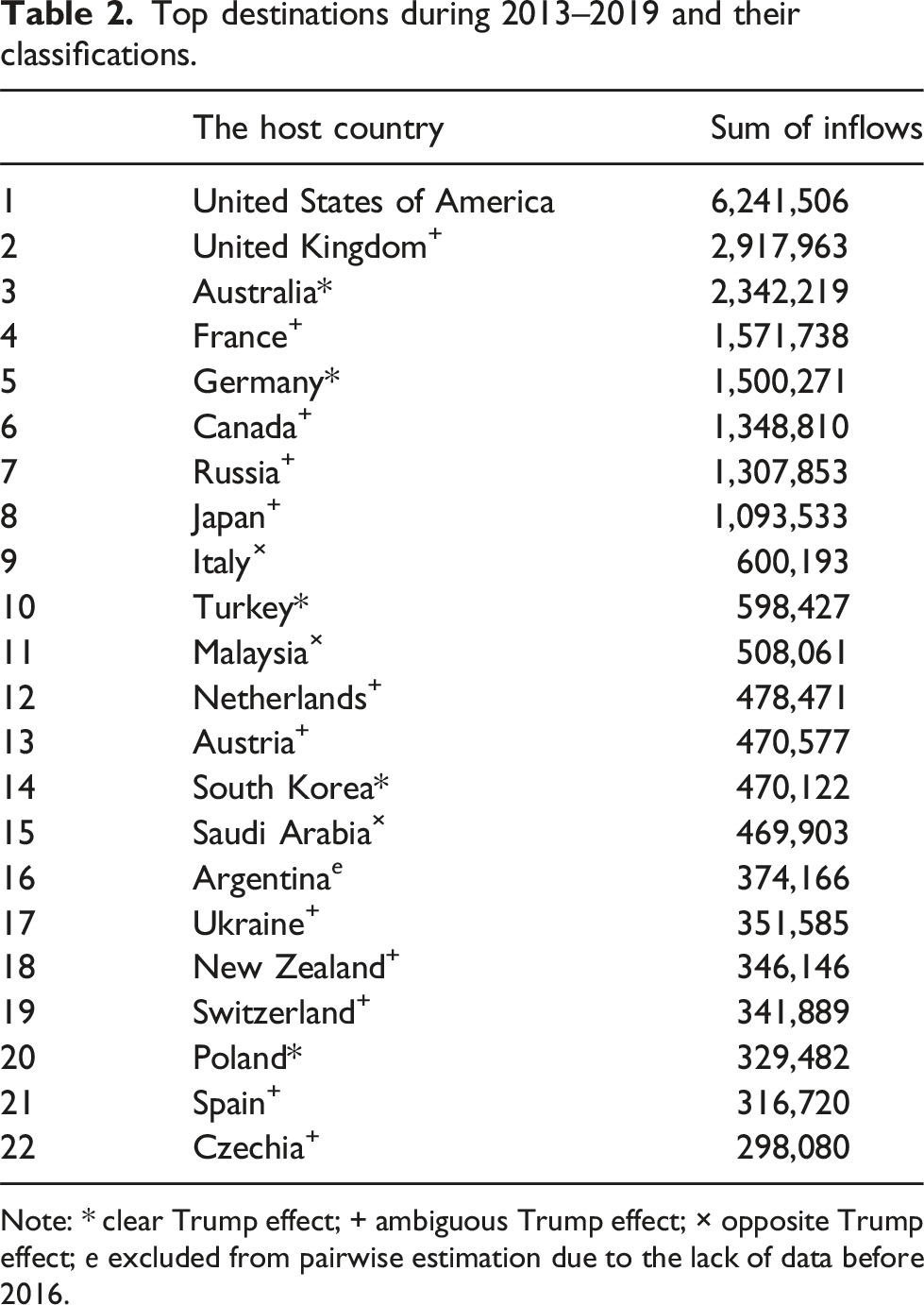
Among the 91 countries, 26 of them belong to the clear Trump effect group (significant negative DID coefficients), 51 countries belong to the ambiguous Trump effect group (insignificant DID coefficients), and 14 countries belong to the opposite Trump effect group (significant positive DID coefficients). Therefore, our findings demonstrate that the commonly suggested negative “Trump Effect” does exist, but only for a significant subset of countries.
These findings also provide other insights into the so-called “Trump Effect.” First, in Figure 2, the effect size varies dramatically. Countries that witness the most considerable percent change, such as Croatia, Moldova, Rwanda, Niger, and Grenada, have small absolute numbers of student inflows. In contrast, countries like Australia and Germany have relatively smaller estimates, but they are the strongest competitors against the US and receive large numbers of international students. Among the top 20 destinations, as shown in Table 2, Turkey, Poland, Australia, Germany, and South Korea benefit the most. They experience faster growth in student inflows during the Trump administration.
Second, Figure 3 shows that in the ambiguous Trump effect group, the 51 countries are very diverse. About half of them have insignificant and expected negative estimates. Some of these countries are good examples of the possibility that the Trump effect is most likely at work. For example, Canada’s DID estimate is −0.2395, with t statistics −1.84 and p value 0.066. Among the top United States competitors, as shown in Table 2, Spain, Japan, Russia, and the Netherlands all have the expected negative estimates. On the other hand, the other half of the countries have insignificant but positive estimates, including major destinations such as the UK. For the UK, the negative “Brexit effect” dampened its attraction to international, especially European, students. Had it not for Brexit, the UK would certainly have benefited from the Trump effect.
Finally, in Figure 4, 14 host countries exhibit patterns contrary to the expected Trump effect and experience even slower growth than the US. Except for Italy, Malaysia, and Saudi Arabia, as shown in Table 2, these countries do not appear to be major destinations for international students. Their impact on global student flows is likely to be small.
Conclusion
Since President Trump took office, policies became more restrictive for migrants and international students. The negative “Trump Effect” has attracted wide media and scholarly attention. However, the evidence to date is anecdotal and case-based. Using a difference-in-differences (DID) design, we estimated the impact of the Trump Presidency on international student flows. We demonstrated that following Trump’s election, international student flows into the U.S. declined relative to various groupings of peer countries. We also decomposed this decline and demonstrated the substitution effect among countries. The average negative treatment effect is statistically significant across the top 5, top 10, and top 20 destination groups but not for the group of all other destinations. Pairwise DID estimates between the U.S. and 91 individual host countries further indicate that the Trump effect is driven mainly by 26 nations.
As noted, our research makes several valuable contributions. We provide the first empirical test of the so-called “Trump Effect” on student flows and offer a valuable addition to the growing number of studies on the Trump effect. We show that instead of coming to the US, many international students go to competing destination countries. More importantly, our research highlights the limited scope of the Trump effect, that is, it does not apply to all host countries indiscriminately. Our research also contributes to the literature on student flows by highlighting the impact of political shocks and government policies and exposing the interconnected nature of student flows among competing destination countries. Our analysis complements the vast literature on migration to the extent that international students could be future legal migrants. One implication is that the decline of high-quality international students today could reduce high-quality legal migrants tomorrow. Finally, our research informs stakeholders in education service exports and higher education abroad about the uneven impact of political shocks and the possibility of substitution.
Our study has its limitations that call for future research. First, we do not directly test what specific policy action caused the Trump effect. In our conjecture, the Trump effect consists of both chilling and substitution effects. Many behaviors of the Trump Administration could have produced those effects, such as Trump’s anti-immigration rhetoric, the Muslim Ban, the stringent student and work visa restrictions, and the unwelcome political climate for international students during his presidency. Future research may seek to disentangle these possible causes.
Second, our research uncovers heterogeneity of the Trump effect among competing destination countries, but we do not investigate the sources of these variations. They may have resulted from the possibility that the rise of populism and the push for de-globalization unfolded unevenly among countries. Brexit in the U.K. is a good example. Future research may examine this possibility.
Finally, our study focuses on student enrollment, but the Trump effect could also apply to applications to United States institutions. Declining applications may signal decreasing attractiveness to international students. Unaffected applications may suggest the absence of the Trump effect. The survey of 294 U.S. institutions in the fall of 2017 by AACRAO (American Association of Collegiate Registrars and Admissions Officers) shows a mixed picture. Among 294 American colleges and universities, 77% were worried about application yield; 38% experienced a decline in the number of international applications, 27% experienced no change, and 35% witnessed an increase (AACRAO, 2017). The chilling effect on applications is not homogeneous, and there could be a substitution effect even among United States institutions. Future research should explore the variations among different colleges and universities.
Footnotes
Declaration of conflicting interests
The author(s) declared no potential conflicts of interest with respect to the research, authorship, and/or publication of this article.
Funding
The author(s) received no financial support for the research, authorship, and/or publication of this article.
