



Abstract
Can first-hand experience of a climate-related natural disaster make citizens more likely to vote in favour of progressive climate politics? Leveraging the rare occurrence of a large-scale disaster just two months before a federal election, we use a difference-in-differences design to study the short-term electoral effects of the devastating 2021 Germany floods on voter support for Germany’s major environmentalist party, the Green Party. Compared to other German voters, those living in areas affected by the floods were marginally (0.4–1.6 percentage points) more likely to vote for the Greens. The largest increases in Green vote share are observed in municipalities which were directly exposed to flooding. Contrary to expectation, we tend to find larger increases in Green Party support in the less severely affected areas. Despite substantial increases in turnout in affected areas, we find that the observed increase in vote share for the Greens was rather driven by a persuasion effect on voters who previously supported other parties. In the absence of evidence that the floods led to an increase in voters’ issue prioritisation of climate change, our results highlight the limited possibility for major natural disasters to induce increased localised support for Green parties.
Keywords
Increases in the frequency and intensity of devastating climate-related natural disasters have escalated the salience of climate change as a political issue across advanced democracies. 1 As evermore individuals become personally affected by climate-related disasters, the costs of policy inaction have become increasingly evident, and the question of whether personal experience of these events can engender public support for climate action has become more pertinent than ever.
An emerging body of literature identifies the effect of first-hand experience of natural disasters on climate change concern and political support for progressive environmental policies (Baccini and Leemann, 2021; Hazlett and Mildenberger, 2020; Howe et al., 2019). However, despite the existence of Green parties in over 100 countries across the world, few published studies consider the impact of a climate-related natural disaster on electoral support for an environmentalist party (McAllister and bin Oslan, 2021).
In this registered report, we leverage the rare occurrence of a large-scale natural disaster – the Germany Floods in July 2021 – which occurred just two months before the federal election on 26 September 2021. 2 Using a difference-in-differences (DID) design, we examine the short-term electoral effects of the floods on votes for Germany’s major environmentalist party, Alliance 90/The Greens. 3 In an election where the Green Party won almost 15% of the vote and made substantial electoral gains across the country, we find that voters living in areas affected by the floods were marginally (0.4–1.6 percentage points) more likely to vote Green than those in unaffected areas.
We find considerable heterogeneity in the effects of the floods between affected states and according to the severity of flooding. We see the largest increases in Green vote share in municipalities which were directly exposed to flooding. Contrary to expectation, we find evidence for differential effects whereby relatively larger increases in Green Party support are observed in the less severely affected areas. We find no consistent evidence to suggest a particular indirect effect of the disaster on those living in neighbouring municipalities to those which were flooded.
Although we find a positive correlation between flooding and voter turnout, with directly flooded municipalities experiencing an increase in turnout as high as 4 percentage points, our analyses indicate that the marginal increase in vote share for the Greens was more likely driven by a persuasion effect on voters who previously supported other parties.
The 2021 Germany floods
Following extreme rainfall between 12–15th July 2021, Germany suffered catastrophic flooding which claimed more than 180 lives, left more than 800 injured and caused around €30 billion in damages (Federal Ministry of the Interior and Finance Ministry, 2021). The floods primarily affected four states: Rhineland-Palatinate, North Rhine-Westphalia, Bavaria and Saxony, with the most intense effects felt in areas of Rhineland-Palatinate and North Rhine-Westphalia where entire towns were inundated with water, critical infrastructure was destroyed, and thousands of households were left without power and water. 4
These floods are not the first time a historic flooding disaster has affected a German federal election. The devastating 2002 Elbe floods which occurred in the month before the September federal election became an issue which dominated the last weeks of the election campaign, ultimately boosting support for the incumbent Social Democratic Party (SPD) (Bechtel and Hainmueller, 2011). Due to their timing and alarming severity, the 2021 floods also became a major election issue, providing a rare and important new setting for learning about the short-term electoral impacts of flooding disasters. In the German context where climate change has become an increasingly salient topic, the strong politicisation of the 2021 floods as a climate issue during the election campaign induced considerable speculation over how the Greens would fare, particularly in flood-affected areas (Erlanger and Eddy, 2021; Solomon, 2021).
From climate concern to Green votes?
Several studies suggest a link between personal experience of temperature extremes (Bergquist and Warshaw, 2019; Brooks et al., 2014) or other extreme weather events (Demski et al., 2017; Konisky et al., 2016; Lujala et al., 2015; Spence et al., 2011) and increased concern about the climate. 5 However, fewer studies have determined whether experience of climate change can affect pro-environmental political behaviour (Baccini and Leemann, 2021; Hazlett and Mildenberger, 2020; Hoffmann et al., 2022; McAllister and bin Oslan, 2021).
Theoretically, exposure to extreme weather events or climate-related natural disasters can help individuals to better understand the risks related to climate change, which otherwise remain abstract (Weber, 2016). Empirically, research on the transition from attitudinal to behavioural change has identified the effects of such exposure on individuals’ preparedness to take individual climate action (Demski et al., 2017; Rüttenauer, 2021; Spence et al., 2011) and hypothetical support for pro-environment politicians (Rudman et al., 2013), in both observational and experimental settings.
A consensus has emerged that voters tend to punish incumbent governments for damages caused by natural disasters, but that this effect can be offset, or indeed more than offset, when voters reward incumbent governments for effective disaster management (Gasper and Reeves, 2011; Healy and Malhotra, 2009; Masiero and Santarossa, 2020). An emerging literature now asks whether exposure to extreme weather can increase support for progressive climate politics through voter behaviour. Studies have found that voters living in close proximity to recent Californian wildfires (Hazlett and Mildenberger, 2020) and affected by flooding in Switzerland (Baccini and Leemann, 2021) are significantly more likely to show support for costly climate-related policy reforms. Hoffmann et al. (2022) find effects of temperature anomalies, heat episodes and dry spells on climate concern and Green voting in Europe, and McAllister and bin Oslan (2021) demonstrate a link between bushfires in Australia and increased support for the Greens.
Our main hypothesis concerns the direct effect of exposure to the 2021 Germany Floods on Green vote share:
We also consider three plausible heterogeneous treatment effects. The first concerns whether the effect examined in
Further to this, we examine whether any observed increase in Green vote share in affected areas is driven by a mobilisation effect on otherwise abstaining voters, or a persuasion effect on voters who have supported other parties in earlier elections. We also investigate possible mechanisms through which the Green vote could be affected by the floods by running tests to examine whether citizens in flood-affected areas demonstrate increased issue prioritisation of climate change after the floods.
Design
We use a difference-in-differences (DID) design to exploit the as-if randomly assigned nature of the flooding event, using this as a natural experiment in order to identify the causal effect of flood exposure. We conduct our main analysis at the municipality level (
The dependent variable, Green Party vote share, is measured as the percentage share of the proportional representation vote (second vote) for the Greens in a given municipality (Federal and State Statistical Offices, 2021; Federal Election Officer, 2022). To measure flood exposure, we use two complimentary measures which draw on the data visualised in Figure 1. The primary measure is based on official reporting from the Federal Office for Civil Protection and Disaster (BBK), mapping flood affectedness at the level of counties (‘Landkreise/Kreisfreie Städte’) (Federal Ministry of the Interior and Finance Ministry, 2021). Our secondary measure combines this data with satellite-based flood mapping from the Copernicus Emergency Management Service (2021), coding areas as affected where the two measures intersect. Whilst the satellite-based secondary measure allows us to identify direct exposure to flooding at the granular local level, it is less complete than the picture given by our primary measure, only covering the areas which were requested to be mapped by the German Joint Information and Situation Centre (GMLZ) (see Figure 3 in Online Appendix section ‘Description of Variables’). The combination of the two measures thus allows us to capitalise on the relative strengths of both sources. Our measure of flooding severity also draws on official reporting from the BBK: municipalities are coded as severely affected when they fall within counties which declared a flooding catastrophe. For additional information on our measurement strategy, see Online Appendix section ‘Description of Variables’. Covariate balance and parallel trends tests reported in Online Appendix section ‘Randomisation Checks’ do not reveal any major violation of the key assumptions of random assignment. Official flood mapping of the 2021 Germany floods from the Federal Office for Protection and Disaster Assistance (BKK) showing municipalities in affected counties (orange) and in counties which declared a catastrophe (red) (September 2021). Satellite-based flood mapping from the Copernicus Emergency Management Service (EMS) which is used to code the secondary measure of flood exposure is shown in blue. Boundaries of affected states are marked in black.
Our main analysis consists of a set of two-period DID models, implemented as various versions of the following two-way fixed effects regression

Results
This table shows the effects of the 2021 Germany floods on municipality-level Green Party second vote share in the 2021 federal election for the core sample of the four affected states (North Rhine-Westphalia, Rhineland-Palatinate, Bavaria and Saxony). The primary measure of flood exposure is based on official reporting from the Federal Office for Civil Protection and Disaster Assistance (BKK) which maps flood affectedness at the level of counties (‘Landkreise/Kreisfreie Städte’). The secondary measure of flood exposure combines this measure with satellite-based flood mapping from the Copernicus Emergency Management Service (2021), coding areas as affected where the two measures intersect. Base = baseline model without controls. Full = fully controlled model with all covariates. Heteroscedasticity-consistent standard errors clustered by municipality.
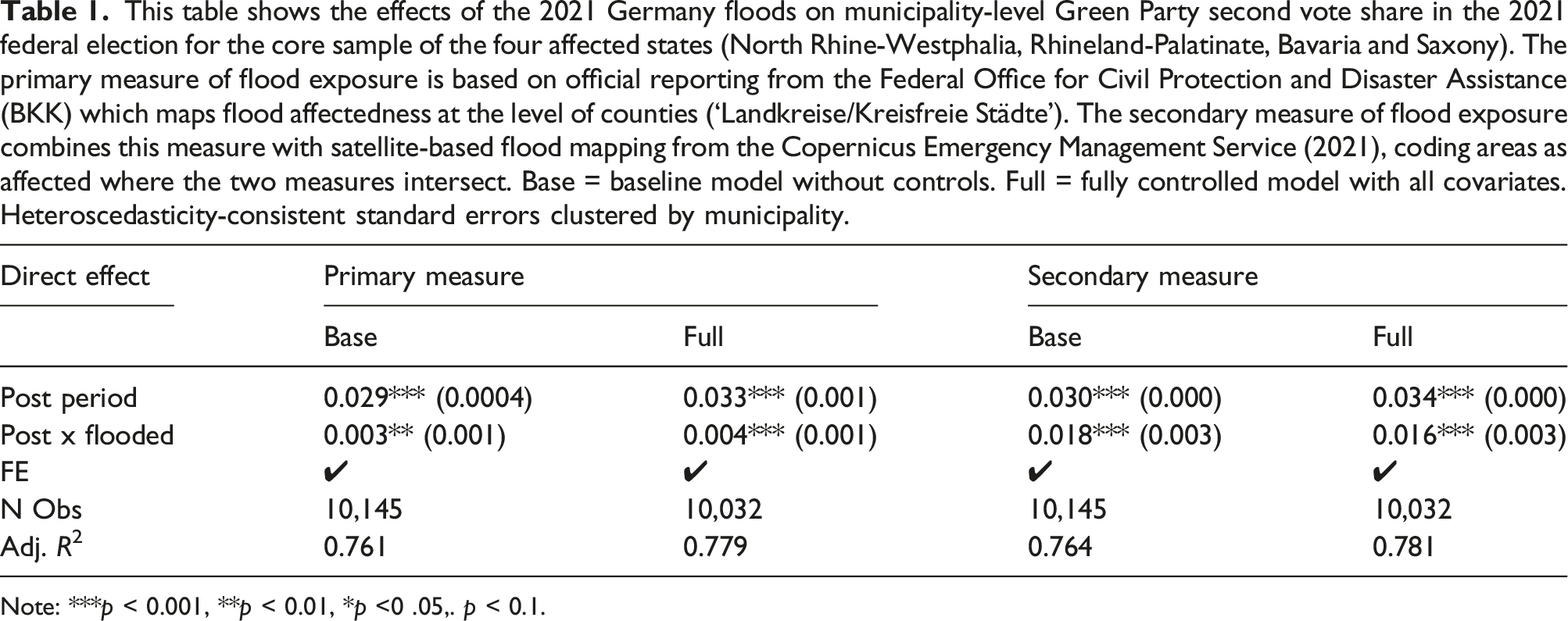
Note: ***p < 0.001, **p < 0.01, *p <0 .05,. p < 0.1.
The effect size differs according to the severity of floods. Figure 2 (and Online Appendix Table 4) display results from our differential effects model.
7
It appears that more severely affected municipalities are less likely to experience any increase in support for the Green Party when compared to the less affected municipalities. However, both are still more likely to vote for the Greens relative to municipalities which were not affected. The secondary measure again yields larger effect estimates for both sub-groups than the primary measure. When we break down the secondary measure results by percentage of flooded area in each municipality, we find the lowest effect sizes in the most highly affected areas (see Online Appendix section ‘Differential Effects by Flooded Area’). Estimated effects of flood exposure on municipality-level Green Party second vote share in the 2021 federal election, by level of severity using the core sample of four affected states (North Rhine-Westphalia, Rhineland-Palatinate, Bavaria, and Saxony). Municipalities are coded as severely affected when they fall within counties which declared a flooding catastrophe. Each dot represents a point estimate, and each bar represents the corresponding 95% confidence interval. The x-axis measures change in percentage vote share. The reference category is municipalities which have not been affected by the floods. Blue = baseline model estimate without controls. Red = full model estimate with controls. Circle = estimated effect for the less affected municipalities. Triangle = estimated effect for the severely affected municipalities.
Further examination of the results suggests that the observed differential effect by severity under the secondary measure is likely driven by one state: North Rhine-Westphalia. The less severely affected areas which appear to be driving an increase in Green vote share in this state are heavily urban areas, including the cities of Bonn, Cologne, Düsseldorf, Essen and Bochum (see Online Appendix sections ‘Results by State’ and ‘Population Density’).
We find no clear evidence to suggest that there are spatial spillover effects among neighbouring municipalities (see Online Appendix section ‘Indirect Effect’). Based on survey data from the German Longitudinal Election Survey (2019, 2022), we find limited evidence of a weak positive moderating effect of pre-existing climate change concern on the effect of flood exposure on Green vote share (see Online Appendix section ‘Perception-induced Effect Heterogeneity’).
We find a generally positive association between flood exposure and voter turnout, although the association appears to be stronger among the affected municipalities as measured by our secondary, satellite-based measure. Under this measure, there is an average 4 percentage point increase in turnout in affected municipalities. However, formal mediation analysis generates no supportive evidence for a mediating effect through turnout. Based on self-reported voting records in the previous elections and voting intentions for the current federal elections, we find evidence to suggest that the increase in Green vote share may instead be driven by a persuasion effect, with votes coming from previous supporters of both major parties: the Christian Democratic Union of Germany and the Christian Social Union in Bavaria (CDU/CSU) and SPD (see Online Appendix section ‘Mobilisation and Persuasion Mechanisms’). Although we see a general pattern of flood-affected voters punishing the nationally incumbent CDU/CSU (Online Appendix Figure 19), it is worth noting that the CDU appear to have made electoral gains in flood-affected areas of North Rhine-Westphalia (Online Appendix Figure 20).
Based on pre-election survey data collected in the period between the floods and the election (26th August–25th September 2021), we find no evidence to suggest that voters living in affected constituencies demonstrate increased issue prioritisation of climate change after experiencing the floods (see Online Appendix section ‘Climate Change Concern’). 8
Remaining tables and figures can be found in Online Appendix section ‘Further Results’ and the results of post-estimation tests to check the robustness of our main results can be found under ‘Robustness Checks’.
Discussion
Our results highlight the ability for first-hand experience of a major natural disaster to induce small localised increases in vote shares for Green parties (0.4–1.6 percentage points), with the strongest effects felt in municipalities directly exposed to flooding. Interestingly, we find larger increases in Green Party support in the less severely affected areas.
Taken together, we consider the results under our two complementary measures to reveal a small effect. We benchmark this against the total size of Green Party vote share in the 2021 elections (14.8%), as well as the effects of other drivers of party support and vote switching, including different types of shocks on smaller parties (Dinas et al., 2019) and the effects of news media (Ladd and Lenz, 2009). When considering the observed effect size, it is also important to recognise the possibility that the floods contributed towards the nationwide increase in support for the Greens, which increased from 8.9% in 2017 to 14.8% in 2021. In the context of our design, this would render localised effects of the floods less visible since the control group are, to some extent, also affected by the floods (see also Hilbig and Riaz (2022)). Indeed, the main effect we observe is small, and when we constrict our comparison to municipalities within each state, it is subject to inconsistencies both between measures and states. Although we find no consistent evidence for spatial spillover effects between municipalities directly bordering those which were flooded, we consider the possibility that, particularly within the two most-affected states, the floods may have contributed to increases in Green Party support in untreated municipalities which were sufficient to counter the effect of localised flood exposure observed in our main analysis.9
Furthermore, our findings should be considered in the context of factors which condition the likelihood of observing such effects. First, the timing and scale of the floods which occurred just two months before the 2021 federal election increase the chance of observing electoral impacts. Second, the electoral system and conditions of party competition can be seen as relatively favourable: by comparison with Green parties in other countries, the German Greens have a history as a governing coalition party (1998–2005) and are relatively attractive to voters as a credible mainstream political party within a voting system which allows for a high degree of proportionality. Third, Germany has a high level of sensitivity to climate change as a political issue which creates a favourable atmosphere for pro-environment voting (Hazlett and Mildenberger, 2020). 10 Additionally, the media heavily characterised the floods as a product of global warming (Brackel, 2021; Hölzl, 2021; Rahmstorf, 2021), further increasing the salience of the floods as an election issue beyond immediate disaster management.
Whilst we present evidence that the increase in Green vote share is driven by a persuasion rather than mobilisation mechanism, our results do not provide for a full examination of the mechanisms for our main effect. We do not find evidence that citizens living in affected constituencies demonstrate increased issue prioritisation of climate change after experiencing the floods. However, Hilbig and Riaz (2022) present evidence that the floods had positive effects on nationwide climate change salience and reported Green Party support, but that these effects were short-lived, lasting only around two weeks.
An interesting and unexpected finding is that we tend to see smaller increases in Green Party support in the more severely affected areas. Future research could investigate which of several mechanisms might be driving this phenomenon. If voters in severely impacted areas suffered economically, it could be valuable to consider whether increases in support for climate action are likely only to happen under favourable economic conditions (Hoffmann et al., 2022; Pianta and Rettl, 2022). Perhaps increases in Green vote share in severely affected areas are smaller in part because voters in these areas respond to effective flood relief by rewarding incumbent parties.
Another consideration is whether prior beliefs about climate change and political preferences might condition effect magnitude (Hazlett and Mildenberger, 2020). In this regard, our evidence for a weak positive moderating effect of pre-existing climate change concern could be further investigated. This is particularly relevant given our interpretation that the less severely affected cities in North Rhine-Westphalia (with high levels of prior Green Party support) drove observed increases in Green Party vote share in the 2021 election.
Promising avenues for future research also include linking voter preferences over policy response to voting behaviour (Bechtel and Mannino, 2022), issue prioritisation of climate change in the aftermath of a disaster, and the abilities of Green parties to capitalise on climate-related natural disasters (Valentim, 2021). As climate-related disasters increase in frequency and in intensity, our conclusions raise important questions about when and how direct (and indirect) experiences of climate-related disasters could generate support for progressive mitigation, adaptation, and disaster preparedness policies.
Supplemental Material
Supplemental Material - If not now, when? Climate disaster and the green vote following the 2021 Germany floods
Supplemental Material for If not now, when? Climate disaster and the green vote following the 2021 Germany floods by Susanna Garside and Haoyu Zhai in Research & Politics
Footnotes
Acknowledgements
We thank members of the EUI Political Behaviour Colloquium, EUI Laboratory on Comparative Politics, Climate Pipeline Project, and anonymous reviewers for their helpful comments. In particular, we thank Miriam Golden, Elias Dinas, Andrea Ichino, Silvia Pianta, Simon Hix, Dylan Potts, Rens Chazottes, Victor Ellenbroek, Julian Vierlinger, Daniel Goldstein, Makoto Fukumoto, Natalia Garbiras-Diaz, Megan Mullin, and Michael Bechtel. We also thank Sascha Riaz and Hanno Hilbig for sharing their parallel work on this topic.
Declaration of conflicting interests
The author(s) declared no potential conflicts of interest with respect to the research, authorship, and/or publication of this article.
Funding
The author(s) received no financial support for the research, authorship, and/or publication of this article.

Supplemental Material
Supplemental material for this article is available online.
Notes
References
Supplementary Material
Please find the following supplemental material available below.
For Open Access articles published under a Creative Commons License, all supplemental material carries the same license as the article it is associated with.
For non-Open Access articles published, all supplemental material carries a non-exclusive license, and permission requests for re-use of supplemental material or any part of supplemental material shall be sent directly to the copyright owner as specified in the copyright notice associated with the article.
