




Abstract
Does Green party electoral success lead to increased climate change commitment, and if so how? Drawing on a new OECD database on climate change outlays, we probe indirect influence from Green electoral success as mediated by inter-party competition, and direct mechanisms of influence from elected Green representatives. Our headline finding is that EU membership functions as a contextual catalyst for inter-party competition, with EU governing parties responding to Greens’ strong electoral performance by increasing climate change outlays to appeal to environmentally motivated voters. We also find evidence that, both across the OECD cohort and the EU sub-grouping, Green coalition presence is associated with increased climate spending over a political cycle. While direct Green influence through coalition presence is widespread, indirect influence mediated by inter-party competition is conditional on EU membership. Findings fit with literature highlighting systematic difference between EU members’ climate performance, and that of other advanced-industrialised states.
Introduction
Climate change constitutes a planetary emergency. Global average temperatures have risen by 1.2°C from their pre-industrial averages, and the ongoing scale of greenhouse gas emissions mean that urgent and significant changes are needed to limit warming to the Paris Agreement range of 1.5°C–2.0°C (IPCC, 2022). In line with this urgency, increased attention has been placed on the determinants of governments’ climate change commitment, with studies typically relying on benchmarking indicators, manifestos, or surveys to gain traction over the issue. The recently released Organisation for Economic Cooperation and Development (OECD) database on members’ climate-related spending provides a direct and internationally comparable measure of government commitment. We draw on this source to probe specifically the effect of party politics on governments’ climate change engagement.
Scholarship on climate change performance has drawn attention to a range of factors that shape government positions and outputs. Studies of party politics and climate change suggest that we should expect Green electoral success to prompt enhanced climate change commitment, driven directly by Green representatives’ advocacy work (Rihoux and Rüdig, 2006; Debus and Tosun, 2021, Kayser et al., 2022), or indirectly by mainstream parties’ competition for Green voters (Knill et al., 2010; Carter and Farstad, 2017; Carter and Little, 2020; Farstad and Aasen, 2022). Membership of the European Union has been found also to support climate change leadership (Jänicke, 2005; Liefferink et al., 2009; Tobin, 2017), with EU institutions consciously crafting a ‘Green myth’ to extend their legitimacy and embed environmentally protective norms and institutions across the community (Lenschow and Sprungk, 2010). Through this paper, we probe the relationship between Green electoral performance and national climate commitments, seeking to explore both indirect and direct mechanisms for translating electoral success into influence over spending outcomes. We find that EU membership functions as a contextual catalyst for translating Green success into enhanced commitments; within the OECD’s EU member states, inter-party competition serves to drive-up national climate spending across a political cycle in response to strong Green electoral performance. We find also that Green coalition presence is associated with increased climate spending across a political cycle, both across the whole OECD cohort and amongst the EU member state sub-grouping.
To establish these insights, we develop the paper through the following structure. In the first section below, we outline our contribution to scholarship on party politics and climate change performance. Here, we lay out the hypotheses to be tested through our empirical work. We then in the second section provide an overview of choices taken over the operationalisation of our study, giving details on data sources and analytic techniques. In the third section, we present and discuss the results of our analysis, which overall suggests that while the positive effect from Green coalition membership on climate spending across a political cycle is widespread, inter-party competition on climate change spending remains conditional on EU membership. To conclude, we recap our main line of analysis, and reflect on the implications of, and questions that follow from, our findings.
Party politics and variation in climate change engagement
In the paragraphs below, we explore scholarship that helps us to understand the drivers of variation in climate change commitment. Existing studies point toward party politics as potentially playing an important role in shaping performance, and we specifically derive expectations that Green party electoral success will lead to increased prioritisation of climate change. Additionally, existing scholarship suggests that a systematic difference is likely to be displayed amongst EU member states, given evidence of overarching climate leadership from the bloc’s regional structures. Beyond these independent variables of primary interest, we also identify supplementary factors that we subsequently control for in our models.
Rihoux and Rüdig (2006) provide a useful starting point for a review of scholarship on the relationship between Green party electoral performance and government policies and outcomes. Motivated by a concern that the Green party’s strengthened performance through the 1990s and 2000s (which had seen Greens emerge as national coalition partners in a number of countries) had largely flown below the radar of public consciousness and academic scholarship, Rihoux and Rüdig’s intervention specifically sought to outline specific research strands in this area. In their nuanced review, Rihoux and Rüdig present a cautious evaluation of the potential impact of Greens. While individual cases of Green success were reported, there was an overarching suggestion that Green impact was constrained by lower levels of governing experience, and a need to cut against the grain of established bureaucratic orthodoxy to achieve core policy aims (12–20). Rihoux and Rüdig’s contribution usefully lays out direct and indirect mechanisms through which Green party success may be linked to improved environmental policy performance. Direct impacts are generated by Greens using their presence in decision-making venues to shape outcomes, while indirect impacts function through third party actors adjusting their positions and behaviour in response to Green success.
Further studies have probed the various pathways through which Greens exercise governing influence. A range of contributions offer case study explorations of direct Green influence, providing valuable detail from across Europe (Muller-Rommel and Poguntke, 2002; Rootes, 2002; Rüdig, 2002; Spoon, 2009) and beyond (Bale and Dann, 2002). Quantitatively-oriented studies of the topic have probed the existence of systematic direct influence. Neumayer (2003) offers a partial insight into the positive role of Green representation on environmental outcomes. Focusing on OECD states from 1980 to 1999, Neumayer finds that the combined parliamentary strength of Green and left-libertarian parties impacts on air quality indicators. Whereas Neumayer does not specifically isolate a Green party effect, Debus and Tosun (2021) offer insights into this by specifically highlighting the capacity of Green parliamentarians to advance what they term the ‘Green agenda.’ Through a comparative analysis of national parliamentary debates across five European countries in the mid-2000s, Debus and Tosun (933) conclude overall ‘that it is the presence of Green parties in parliaments that determines to what degree the… green agenda is placed on the legislative agenda.’ From these insights, we derive the first hypothesis to be tested through our study: H1: A stronger Green parliamentary presence will be associated with higher government commitment to climate change.
An additional direct pathway of Green influence on environmental policy may come from contributing to coalition government. It seems intuitively likely that, when in a position to join a governing coalition, Green party representatives will use their bargaining position to lock-in strengthened commitments to climate change, and that threats of exit can be used to maintain coalition government attention on the issue. Empirical work on the link between Green coalition presence and environmental performance issue is, however, limited, and brings mixed results. Röth and Schwander (2020) explored the impact of Green presence in governing coalitions on welfare-related outcomes. Analysing OECD country experience from the 1970s to 2015, Röth and Schwander find a positive association between Green presence and the strength of ‘social investment’ policies,
1
but no systematic impact on overall social spending levels. Röth and Schwander do not include indicators of environmental policy performance in their analysis. Knill et al. (2010), focusing across OECD states from 1970 to 2000, find no evidence of an effect from the presence of a Green coalition partner on environmental policy outcomes. However, looking at sub-national government performance in Sweden, Folke (2014) presents evidence of a systematic and positive impact from Green representation in government on overall environmental performance. While the picture is mixed from this scholarship, on balance we derive a second hypothesis to be tested: H2: The presence of a Green coalition partner will be associated with higher government commitment to climate change.
Beyond studies of direct pathways of influence from Greens on policy performance, along a second axis scholarship explores indirect pathways. Spoon et al. (2014) demonstrate that inter-party competition plays an important role in boosting environmental issues up mainstream parties’ agendas. Using a comparative analysis of manifesto content, Spoon et al. show that Green electoral success is followed by the presentation of a ‘greener’ manifesto by mainstream parties at a subsequent election. The underlying intuition here is that mainstream parties are seeking to tap into the newly-demonstrated cohort of environmentally-motivated voters. Kayser et al. (2022) present evidence of inter-party competition, while also emphasising complex strategic calculation from the governing party that takes account of a range of factors in addition to Green popularity. In their studies of the UK, Ireland, and Norway respectively, Carter and Farstad (2017), Carter and Little (2020), and Farstad and Aasen (2022) further document examples of mainstream adjustments in response to Green electoral successes. From these insights, we derive the third hypothesis to be tested through our study: H3: A higher Green party vote share will be associated with higher government commitment to climate change.
H 1 -H 3 represent the core areas of interest from our paper, through which we seek to elaborate our understanding of the indirect and direct relationships between Green party performance and environmental policy outcomes.
In addition to probing H 1 -H 3 , we seek to add nuance to our model by incorporating a focus on the EU as an additional focus of analysis. The European Union has long been identified as being itself a climate change leader, and supporting climate ambition amongst its members. Since the passage of the Single European Act in 1987, the environment has been an EU policy competency. Through an initial focus on the Kyoto Protocol, the EU was described as playing protagonist to the US role of climate change villain, seeking to support and cajole members’ emissions reductions in sharp contrast to the US failure to ratify the agreement. Assessing EU performance through the 2000s, Scott and Rajamani (2012) note the ‘ambition’ displayed by the EU specifically in including the aviation industry within its emissions trading scheme. In a comparative exploration of the drivers of national climate ambition, Tobin (2017) highlights the positive influence of EU membership on climate ambition across a cohort of advanced-industrialised states. For Liefferink et al. (2009) EU membership was found to be associated with stronger environmental performance as measured across 40 issue areas including air, water, conservation, energy, and climate change, while Jänicke (2005) also highlights a positive relationship between EU membership and environmental ‘trend setting.’ In short, existing scholarship provides a firm expectation that EU membership will strengthen climate change commitment. Given these insights, we probe EU membership as a second-level point of interest in our empirical work. In our general models we test for an influence from EU membership, and we also run analyses specifically on the sub-grouping of EU member states within the OECD to test for systematic variation in climate change performance.
Turning now to the broader control variables we incorporate into our models. Explorations of the ‘environmental Kuznets curve’ represent perhaps the most prominent line of study of the determinants of governments’ green performance. Stern et al.’s (1996) work constitutes a key intervention in this field, formalising the expectation of an inverted u-shaped relationship between income and environmental degradation. Under this environmental Kuznets curve model, economic growth is predicted to initially exacerbates degradation before, as more affluent citizens begin to prioritise non-material outcomes, plateauing and then entering a down phase during which subsequent growth supports improved outcomes. Cole et al.’s (1997) empirical study of OECD countries in the early-to-mid-1990s, generated nuanced findings that presented evidence overall for the existence of a Kuznets-type relationship for local airborne pollutants that generate direct local-level harms, but not for CO2 with its less direct and more global-level harms. Empirical work on the environmental Kuznets curve has often generated corroborative findings (Dasgupta et al., 2002; Sarkodie and Strezov, 2019; Ansari, 2022), although climate leadership from lower-income states has been taken as evidence of a need for some recalibrations and some concerns expressed over the robustness of generalisations from observations across a narrow range of states and limited timeframes (Stern, 2004). On balance, though, this strand of scholarship provides a plausible expectation that, amongst high-income OECD member states in particular, economic expansion be associated with stronger government commitment to climate change. As such, we control for this factor in our empirical work.
It is in addition plausible that a government’s climate change-related spending is likely to be positively associated with the country’s vulnerability to the impact of climate change. Over the past decade, there has been a growing policy focus on identifying and addressing ‘vulnerability gaps’; situations in which infrastructure and institutional capacity falls short of increasingly likely extreme weather occurrences (Mastrandrea et al., 2010). The United Nations Environment Programme provides annual ‘national adaptation gap’ updates that aim to both catalyse governments’ domestic action and the provision by advanced-industrialised states of ‘loss and damage’ funds to support adaptation across climate-vulnerable states of the global South (UNEP, 2022), with a parallel initiative from the OECD Task Force on Climate Change Adaptation. 2 While we know that decision-makers tend to under-prepare for future crises (Pelling, 2012), it nonetheless remains plausible that a higher adaptation gap will be associated with a stronger drive to catch-up, as reflected by higher levels of current expenditure.
The final institutional features we seek to control for are the political orientation of the national government, and decentralisation. In relation to the former, debate is ongoing as to whether we should view climate change as a ‘valence’ issue over which parties compete to demonstrate commitment and competence, or a ‘partisan’ issue where political orientation determines the level of engagement (e.g. Carter and Clements, 2015). Nevertheless, given the findings from Schulze (2014), Tobin (2017), and Farstad (2018) of positive relationships between the presence of a left-wing government and climate commitment or performance, we opt to control for this factor. We incorporate decentralisation as a final control variable given the expectation that a higher level of policy and spending autonomy at the subnational level will be associated with reduced central government outlays.
Data and methodology
To operationalise climate change commitment, we draw on the newly-released OECD ‘Government Climate Finance’ database. 3 The database provides information on annual climate change-relevant spending and investment commitments, covering 29 OECD states across 2001–19. 4 The definition used by the OECD (2022: 30) captures all government expenditure and investment directed towards activities that contribute to climate change adaptation and mitigation, and includes components such as afforestation and improved forestry management, manufacture of low-carbon technologies, solar, wind, ocean, and hydro electricity generation, infrastructure for low-carbon management, and building renovation and insulation improvement. The OECD database disaggregates between sub-national and national climate relevant spending; given our study of national-level party political determinants of climate spending outcomes, we incorporate the national climate relevant spending data into our analysis. 5 The database also disaggregates between expenditure and investment. Intuitively, it is plausible that these different types of outlay may respond differently to party political factors; given the need for significant planning and consultation lead times, it may, for example, be the case that investment flows change more slowly or less intensively. In our empirical work, we run separate analyses of climate relevant spending and investment. We prioritise our exploration of climate spending when presenting and discussing our findings, in relation to which evidence of significant party-political influence is found. We discuss findings on climate investment in Annex I.
Within our models, to account for uncertainties over the role of time, we adopt two analytic strategies. First, to test for the existence of a somewhat dispersed impact from Green electoral performance on climate spending, we aggregate the outcome variable across individual ‘election cycles.’ An election cycle begins in a year that contains a national-level election, and concludes in the year preceding the next national-level election. We exclude financial data from the election year itself, given the likelihood that budgets have been set the previous year under the previous administration. Under this election cycle approach, we calculate the mean value of climate outlays across all other years of the given cycle. So, for example, in a country where there were national elections in 2001 and 2005, a first election cycle would run 2001–04 and the climate spending outcome variable would be constituted by the mean figure for 2002–04. Under this first approach, we generate a time series cross-sectional (TSCS) database, where across each political cycle the outcome variable is fixed. The second analytic approach we adopt, to test for a more immediate link between electoral performance and climate outlays, is to focus on spending in the year following an election. Again, the intuition here is that the budget for the election year itself will largely have been set in the previous cycle, and that it is in the subsequent year that responses to Green performance are likely to be seen. With this second approach, we generate a cross-sectional database that includes years in which an election occurred and associated outlays from the following year.
To explore the existence of an indirect pathway of influence from Green electoral success, we rely on Armingeon et al.'s (2022) Comparative Political Dataset (CPDS) observations of overall vote share gained by Greens in a given election. The intuition here is that the larger the pool of environmentally-motivated voters, as revealed by the Green electoral share, the greater the incentive for a governing party to strengthen its green credentials and try and attract the future support of this cohort. Given the debates over the potential role of partisan orientation in shaping climate-related inter-party competition, 6 we also incorporate CPDS information on government partisanship into our models. We specifically use the CPDS Schmidt Index score, under which a value of 5 is assigned to a cabinet with right-wing hegemony, 4 to a cabinet with right-wing dominance, 3 for a balance of power between left and right, 2 for left-wing dominance, and 1 for left-wing hegemony.
To probe direct mechanisms of Green representatives’ influence, we initially examine the existence of a systematic difference between cases where there is Green legislative representation and cases where there is no such representation. To do so, we create a dummy variable ‘Green seats (any).’ This dummy is coded 1 where there is at least one Green representative within a national legislature, and 0 otherwise. To probe the influence on spending from the scale of Green representation, we use data on the proportion of national legislative seats held by Greens (‘Green seats (share)).’ Here, no Green representation would generate a numeric value of 0, a legislature in which 5% of seats were held by Greens would generate a value of 5, and so on. Both of these measures were derived from CPDS, where we specifically aggregated together electoral performance data for all listed members of the Green party family in a given country. We toggle between these two measures of direct legislative influence when running our models and, where a change in this measure impacts on model results, we take this to limit the robustness of these findings.
In addition to direct influence that can be operationalised through presence in a national legislature, we are also interested in direct influence from Green presence in a national coalition. To operationalise this variable, we drew on Röth and Schwander’s (2020) database on Greens in national coalitions across OECD states. Specifically, where Röth and Schwander identify formal Green presence within a governing coalition we code a ‘Green coalition’ variable as 1, and 0 in other cases. Given that Röth and Schwander’s database ends in 2015, 7 we have analysed scholarship and reporting on national elections and Green party performance to populate the most recent observations.
Turning to the wider control variables, to operationalise EU membership we incorporate relevant data directly from the CPDS. 8 To control for the expected influence of economic growth on climate relevant outlays, we incorporate data from CPDS on real GDP growth. Our operationalisation here is sensitive to the outcome variable calibration. When exploring the aggregated measure of mean outlays across the election cycle, we aggregate overall growth across that cycle. When exploring the drivers of variation in the post-election year in isolation, we use the GDP growth rate data from the election year given the lag between budget planning and outlay release. To control for climate vulnerability, we incorporate the University of Notre Dame’s Global Adaptation Index score. 9 The benefit from this index is the incorporation of measures of vulnerability to climate change-related events and of existing capacity to respond to these events. A higher score represents a higher vulnerability gap, which may be associated with upward pressure on climate-relevant spending. To control for the degree of decentralisation within a given country we use Shair-Rosenfield et al.'s (2021) Regional Autonomy Index, given its incorporation of measures pertaining to policy and fiscal autonomy. 10 With the Index a higher score represents a higher degree of decentralisation.
Overall, our dataset covers 27 OECD states across 2001–19. Tests focusing on the political cycle as the unit of analysis were run on a TSCS dataset. To ensure consistency across the TSCS dataset, we removed observations that were part of an election cycle that carried over from a pre-2001 election. 11 In the case of Belgium, for example, the 2001 and 2002 observations were dropped as they represented the final years of a 1999–2002 cycle. Our analyses of the TSCS database deployed a panel-corrected standard errors (PCSE) estimator. The PCSE approach is appropriate for analysing collections in which temporally and spatially correlated errors and heteroscedasticity may be present, 12 as is the case here. To capture temporal and spatial fixed effects, we incorporated dummy variables capturing individual years and countries across the TSCS dataset. This analytic approach fits with Beck and Katz (2011: 342), and allows for a higher level of confidence in the robustness of our findings relative to the deployment of a PCSE estimator without incorporating measures to control for unobserved temporal and spatial effects. For tests focusing on the post election year climate spending outcomes we created a cross-sectional database, and deployed a Generalised Least Squares estimator. Again, to capture unobserved temporal and spatial effects and therefore strengthen confidence in results generated, we incorporated dummies for individual years and countries.
Results and discussion
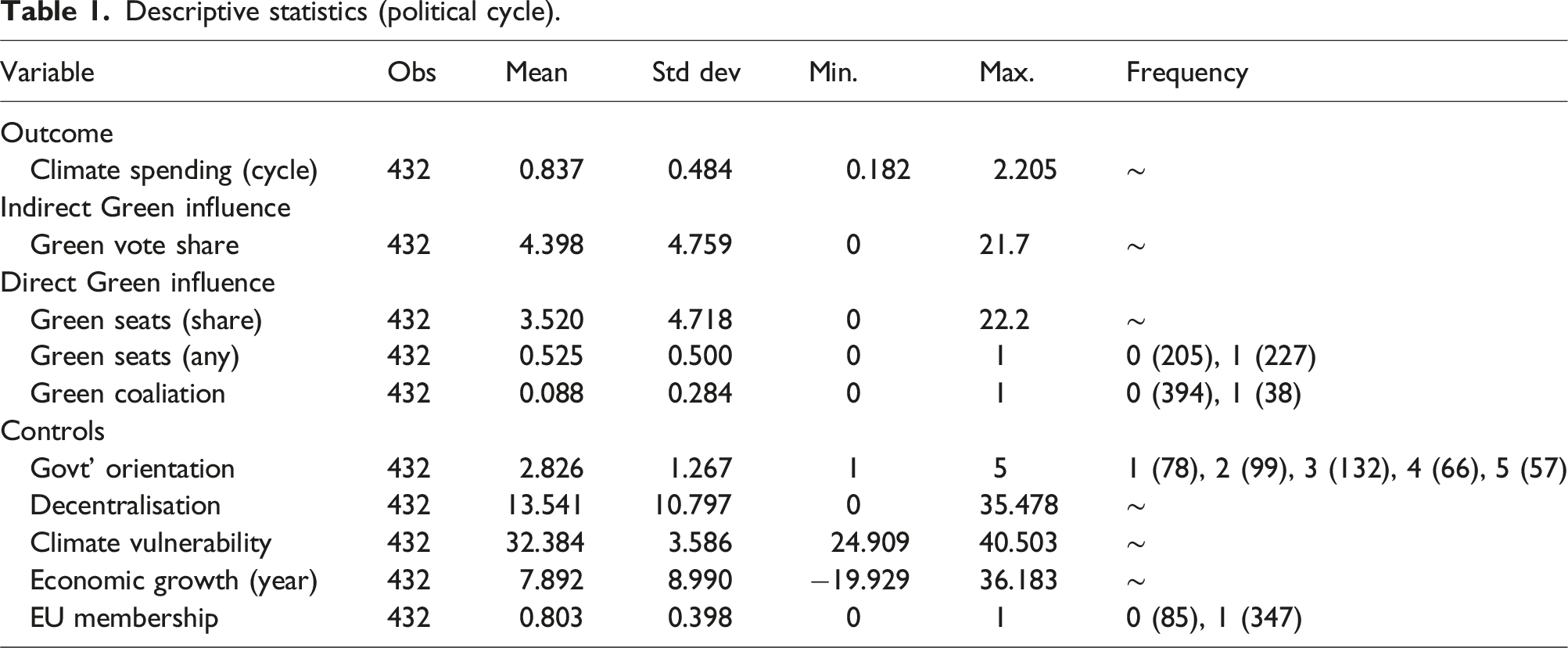
Descriptive statistics (political cycle).
Descriptive statistics (single post-election year).
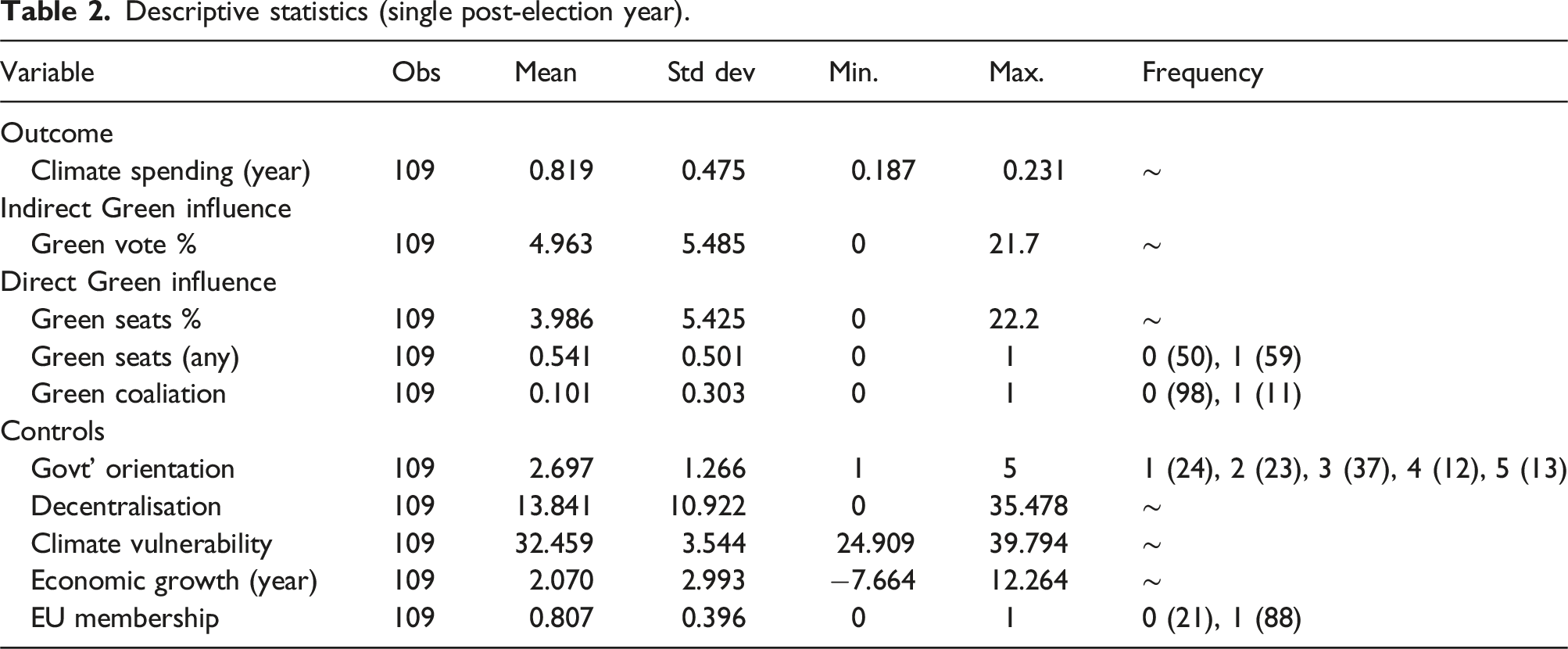
In headline terms, there is significant similarity in the climate change-relevant spending outcome variable across the two collections. Mean annual climate expenditure is, overall, around 0.8% of GDP. The minimum and maximum values for the cycle-wide and single year observations are the same across both collections, standing respectively at 0.2% (Japan, 2005–08 and Germany, 2009) and 2.2% (Hungary, 2010–13 and Luxembourg, 2018).
Turning to the independent variables of interest, across the OECD cohort there is significant variation in Green electoral performance. As explained above, we take vote share to be a proxy measure of indirect Green influence mediated through inter-party competition, and we take the presence of legislative representation and coalition presence as proxy measures of direct influence. The first point to note when summarising Green electoral dynamics is the extent of Greens’ absence from national elections. In 50 of the 109 election events recorded across the datasets, Greens gained a vote share and seat share of zero. In contrast to this baseline level, we see the strongest performance in Iceland’s 2009 election, where Greens gained a 22% share of the vote and 22% of the share of seats in parliament. In a little over half of the observations there was some Green legislative representation. There was a Green presence within a governing coalition in around 9% of observations across the political cycle-focused database (38 from 432 cases), and a similar pattern in the single year-focused database (10%, or 11 from 109 cases). Beyond these variables of primary focus, it is interesting to note that government partisanship was on average centrist but with a higher representation of right-over left-leaning executive balance, and that around 80% of the country/year observations related to EU members.
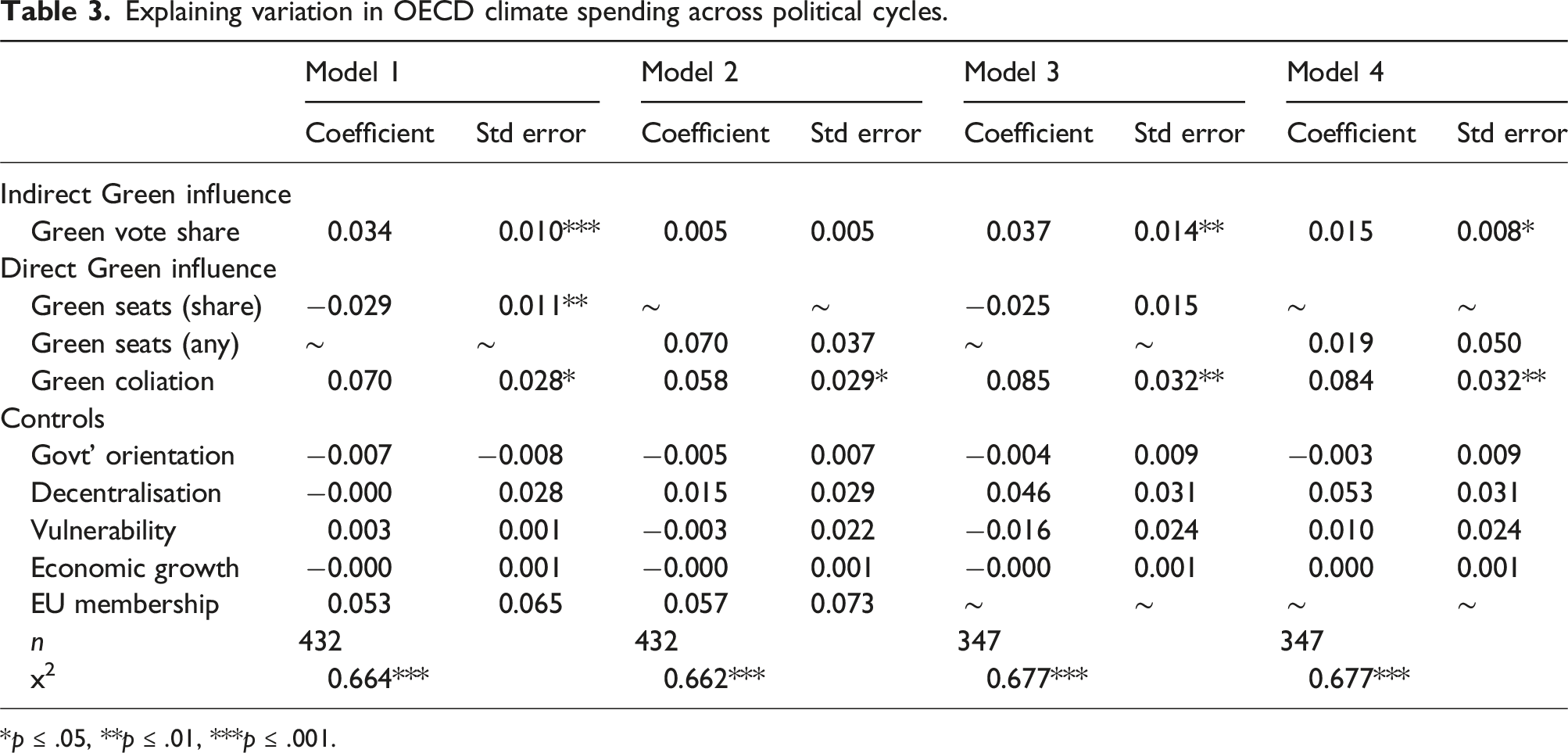
Explaining variation in OECD climate spending across political cycles.
*p ≤ .05, **p ≤ .01, ***p ≤ .001.
The results from Model 1 show, across the whole OECD cohort, significant indirect Green influence through inter-party competition effects, and significant direct influence through participation in coalition government. When we deploy the alternative specification of legislative influence in Model 2 we see that the inter-party competition effect loses its significance, which questions the robustness of the initial positive finding on this front. On the basis of Models 1 and 2, we conclude (in line with the expectation of H 2 ) that, across the OECD cohort, Green participation in coalition government is associated with higher climate relevant expenditure across the subsequent political cycle. Having a Green coalition presence boosts climate spending by between 0.07% of GDP (Model 1) and 0.06% of GDP (Model 2). In contrast, across the OECD cohort the expectations from H 1 (that we should see inter-party competition translating a higher Green vote share into increased climate spending) and H 3 (that Green legislative presence should generate increased climate spending) were confounded. Models 1 and 2 are significant (p < 0.001), and explain around 66% of observed variation in the outcome variable (χ2 = 0.664 and 0.662 respectively).
Through Models 3 and 4, we turn our attention to the sub-grouping of EU member states. Existing scholarship provided strong expectations of systematic difference in EU member states’ climate change performance, and results from Models 3 and 4 confirm this expected pattern. Across both models, we see again that Green participation in coalition government is associated with higher levels of climate expenditure. Across EU members the Green coalition effect is slightly higher, raising climate spending by around 0.08% of GDP. We also see that, amongst EU member states, larger Green vote shares are associated with higher climate spending. As such, we see that amongst EU member states inter-party competition seems to function as a pathway that drives-up climate spending. A rise of one point in Green vote share translates into an increase in climate spending of between .04% of GDP (Model 3) and 0.02% of GDP (Model 4). Overall, then, through this analysis of the EU sub-grouping, we see that H 1 and H 2 are confirmed, and H 3 continues to be confounded. Models 3 and 4 are significant (p < 0.001), and explain around 68% of observed variation in climate spending (in both cases, χ2 = 0.677). When comparing the full OECD cohort and the EU sub-group, we see that EU membership exerts a conditional effect on the impact of Green electoral performance on climate spending. Contextual factors associated with EU membership seem to facilitate inter-party competition on climate change.
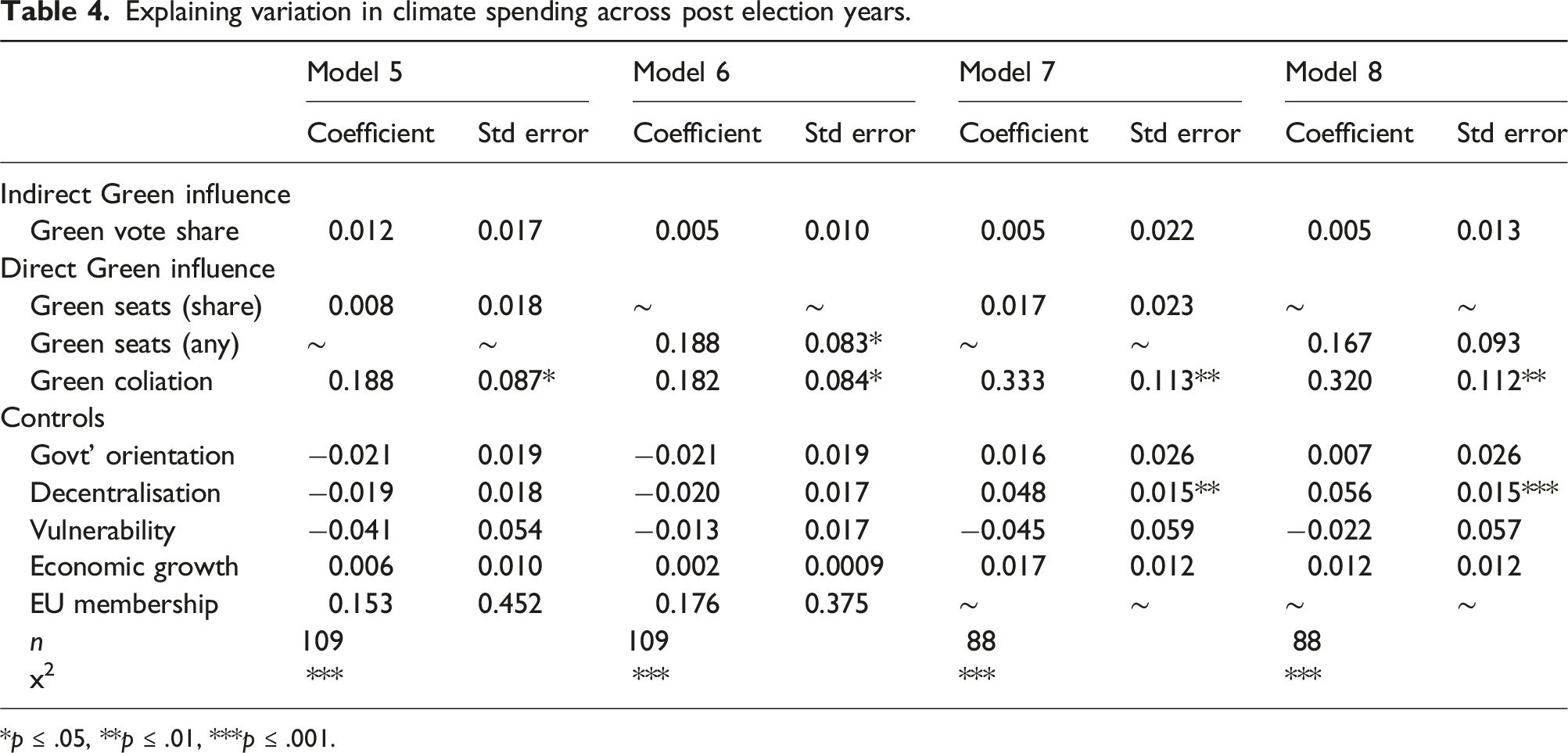
Explaining variation in climate spending across post election years.
*p ≤ .05, **p ≤ .01, ***p ≤ .001.
From across these analyses, intriguingly we see evidence of Green coalition presence having a significant negative impact on climate expenditure in the post-election year. A possible explanation for this dynamic is that Greens’ coalition partners want to signal in the short term that they remain firmly in control of the governing agenda, and so ensure that any additional climate spending becomes back-loaded toward the subsequent years of an administration. It also may be the case that Greens in coalition experience an initial transition phase of ‘learning the ropes,’ before subsequently being able to more successfully release financing for climate change-related spending. It is perhaps less surprising to see no evidence of the inter-party competition effect carrying over from spending across a political cycle in the EU to spending in a post election year in the EU; it may, for example, be the case that governments wish to strengthen their ‘green’ credentials only as an election becomes closer. We discount the finding from Model 6 of the legislative presence effect given its dependence on the use of the ‘any Green seats’ specification. The finding in Models 7 and 8 of a significant and positive effect from decentralisation on post election year climate spending is puzzling and difficult to interpret, given that a higher level of decentralisation should intuitively be associated with lower national-level spending.
Overall, then, our findings provide significant support for H 2 , which led us to expect that the presence of a Green coalition partner would be associated with stronger climate change commitment). Results also suggest that EU membership functions to ‘switch on’ the inter-party competition pathway for raising climate spending. As such, through our study we provide conditional support for H3, which led us to expect that inter-party competition would work to translate a higher Green vote share into stronger climate change commitment. The evidence also shows a sensitivity to outcome variable operationalisation, with the above outcomes holding true for climate change spending across political cycles, but not when we deployed the post election year spending measure. It takes time, it would seem, for Green coalition partners to translate their spending preferences into reality, and for EU governing parties to start competing for Green voters by ramping-up their Green credentials. 14
Conclusion
Existing scholarship highlights the importance of a range of factors in shaping governments’ climate change commitment, including party political performance and EU membership. Through this study of OECD climate spending, we engaged with and extended this body of work. We specifically structured our analysis to probe the particular pathways through which Green electoral success impacts on national climate commitment. We hypothesised the existence of direct pathways of influence, through which Green legislative presence or Green presence within a coalition may lead to increased climate commitment. We also hypothesised an indirect pathway of Green electoral success being mediated into stronger commitment via inter-party competition, through which governing parties respond to higher Green vote shares by improving their environmental credentials with a view to gaining the support of environmentally-motivated voters.
Our findings highlighted the important role played by EU membership in catalysing indirect influence from Green electoral performance on climate spending via inter-party competition. Across the EU sub-grouping, stronger Green vote share was found to be associated with higher climate spending across a political cycle, suggesting that governing parties are responding to stronger Green electoral performance by seeking to boost their own ‘green’ credentials to attract environmentally-motivated voters. We also found that, across a political cycle, Green presence as a coalition partner was associated with higher climate change spending, with this dynamic holding true both across the whole cohort of OECD members and within the EU sub-grouping.
The headline finding of a positive association between Green electoral performance and climate commitment is of intrinsic value, highlighting important links between democratic processes and sustainable transformation. The conditional role played by EU membership in catalysing the indirect Green electoral impact on climate commitments is also noteworthy. Our findings raise but do not resolve important questions: to what extent do EU institutional processes and norms condition other political parties to be more responsive to Green electoral success, and to what extent do European Green parties work to establish cross-party support for their agenda within and across EU member states? The supplementary finding that, in the year following an election, spending and investment on climate change by coalitions with a Green presence actually fell is intriguing, particularly given the emergence of a positive coalition effect on climate spending across political cycles as a whole. Further study is needed to probe the existence of ‘back-loading’ climate change commitment in Green coalitions, or a tendency towards higher capacity on the part of Greens to secure their preferences as a coalition administration progresses to its later years. The fact that our research findings confounded expectations of a positive legislative presence effect from Green representation is also noteworthy, and questions the extent to which formal inclusion in governing chambers enhances capacity to shape governing agendas.
Overall, using the OECD’s recently released database on climate change-related spending, we have through this paper shed new light on the direct and indirect pathways through which Green electoral success is translated into strengthened climate change commitment. While our empirical models are robust and establish significant relationships, the sensitivity of results to variable specification highlights the challenge of establishing causal relationships between party political factors and real-world climate change spending outcomes. Across our analyses, the limited significance of control variables on observed outcomes suggests that our understanding of contextual influences on national climate change performance remain under-developed. Given the urgency with which governments need to act to limit future global warming, it is vitally important that further study enhances our understanding of the political and socio-economic factors associated with strengthened climate change commitment.
Annex I - Explaining variation in climate change investment
Descriptive statistics for climate investment outcome variables.

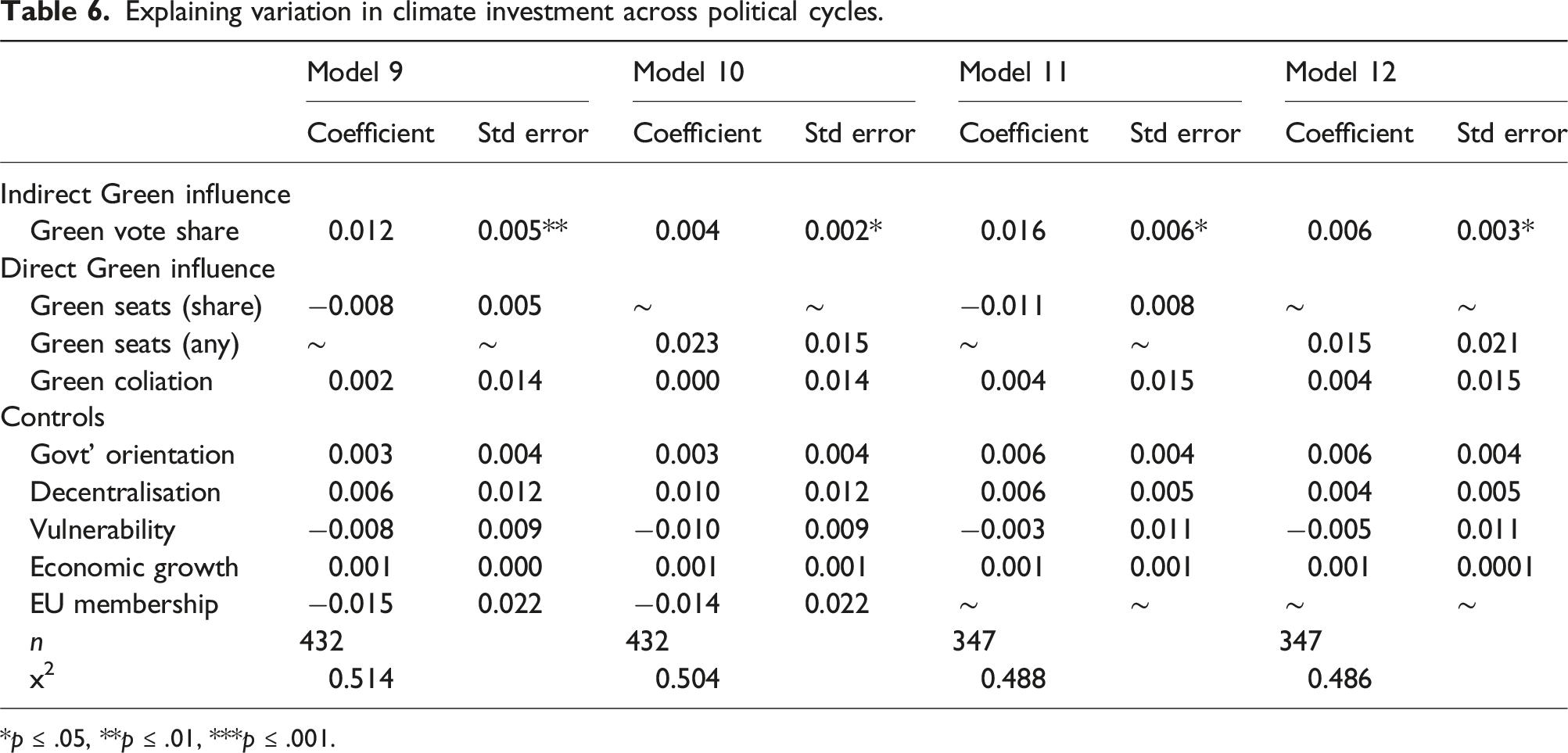
Explaining variation in climate investment across political cycles.
*p ≤ .05, **p ≤ .01, ***p ≤ .001.
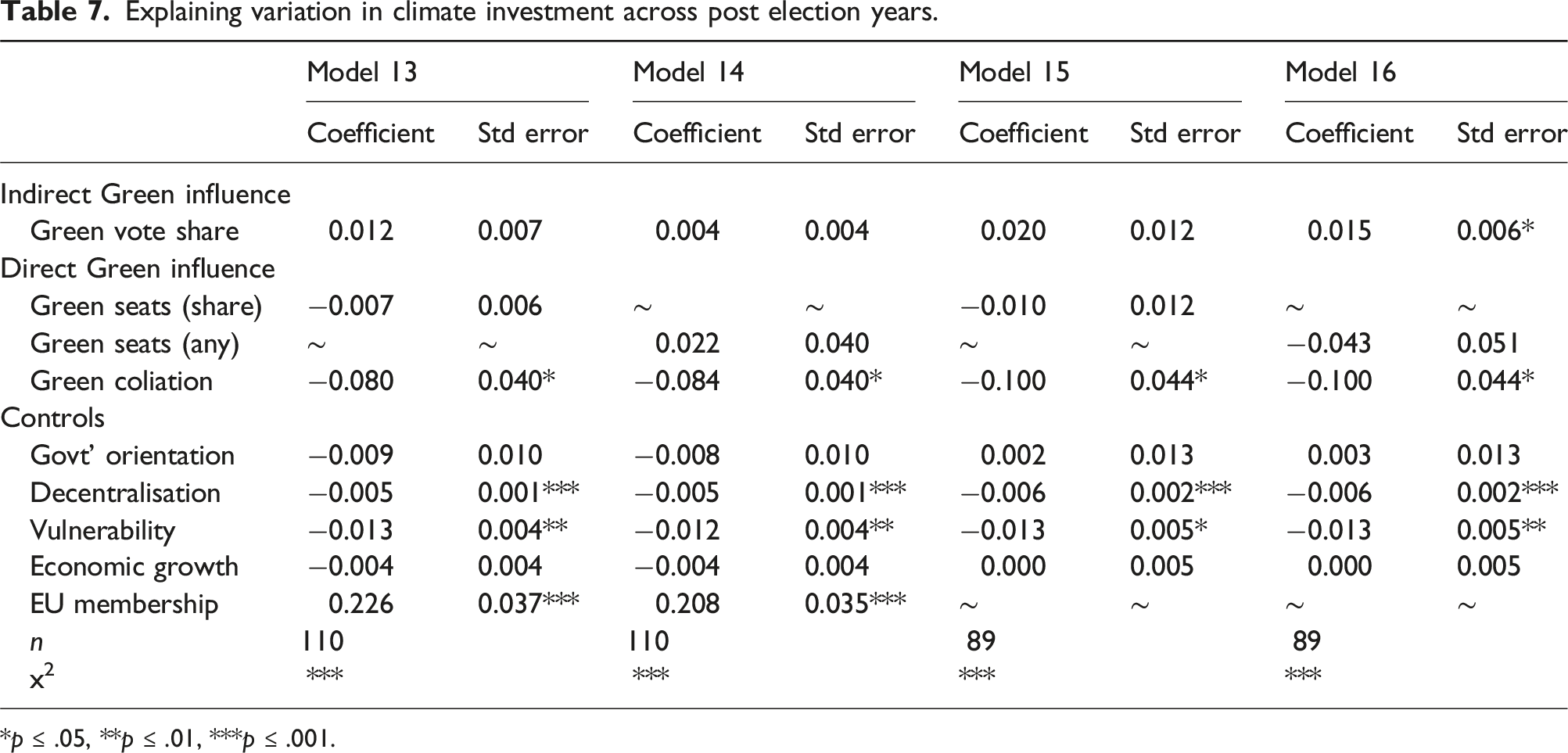
Explaining variation in climate investment across post election years.
*p ≤ .05, **p ≤ .01, ***p ≤ .001.
In headline terms, when comparing these analyses of variation in climate change-related investment with the analyses of climate change-related spending in the main body of the paper, two messages emerge. First, while EU membership is associated with increased climate investment (under the post election year measure), EU membership seems not to exert a contingent effect on the relationship between Green electoral performance and climate investment. We see both a positive relationship between Green vote share and climate investment across political cycles holding for the whole OECD cohort, and the EU member sub-group. We also see a negative relationship between Green coalition presence and post election year climate change investment. Whereas the negative coalition impact on post election year climate change spending was reversed across political cycles as a whole, this ‘correction’ does not occur in relation to investment. It seems possible that the longer lead times required to identify and design capital investments means that Green coalition partners struggle to overcome this initial budgetary squeeze on climate change investment, in contrast to their performance on climate change expenditure when the initial spending squeeze is effectively translated into a longer-term spending increase.
Footnotes
Declaration of conflicting interests
The author(s) declared the following potential conflicts of interest with respect to the research, authorship, and/or publication of this article: Liam Clegg stood - unsuccessfully - as a Green candidate in May 2023 English local elections. In line with internal guidance from our institution, we supply this declaration to provide a level of transparency that supports the integrity of research and review processes and outcomes.
Funding
The author(s) received no financial support for the research, authorship, and/or publication of this article.
