




Abstract
Can accessing a partisan media environment—irrespective of its content—change how Americans interpret and assess news? We examine this question by focusing on one of the most fraught issues in American society: racial justice. Although studies suggest that repeated exposure to right-leaning media messaging can amplify racial resentment, we leverage a pair of survey experiments to test whether merely seeing a conservative media masthead can make Whites render justice with racialized considerations. Results show that—even keeping the content of stories identical—entering a simulated right-leaning media environment significantly conditions racial attitudes. We find evidence of both anti-Black and pro-White biases that are activated when respondents consume information under the Fox News masthead. This study has important implications for understanding how partisan media priming shapes political views and the distinctive nature of racism in America.
Have outlets like Fox News and CNN become such potent ideological symbols in America that they act as political primes in and of themselves? Can the mere act of entering a media landscape associated with the political left or the right affect how people interpret and assess identical information? Repeated exposure to partisan media messaging is widely believed to shape views on a range of outcomes—from the handling of a deadly, global pandemic to the perceived legitimacy of the 2020 U.S. elections. An underlying assumption is that exposure to differential framing and facts drives these changes (cf. Broockman and Kalla 2022; Iyengar and Hahn, 2009; Ladd 2010; Lee 2010; Levendusky 2013). Research, however, not only reveals that various media venues tend to lean to the left or right politically (Gentzkow and Shapiro 2010), but also that Americans judge news as ideologically partial based on their mastheads alone (Turner 2007).
In this article, we ask whether simply accessing a partisan media environment—irrespective of its content—can change how Americans interpret and assess news. We examine this question through the lens of one of the most fraught issues in U.S. society: racial justice. Although studies suggest that repeated exposure to right-leaning media messaging can amplify racial resentment (McElwee 2015; McElwee and McDaniel 2015), we probe whether obtaining news under a conservative media masthead can make Whites render justice with racialized considerations. Building on research showing that implicit and explicit symbols can induce White Americans to exhibit more racist tendencies (cf. Ehrlinger et al., 2010; Tesler 2017), we predict that seeing a logo for Fox News—a network often accused of trafficking in racially charged content—will increase the propensity of White Americans to express racially biased judgments.
We assess the application of justice in the context of a unique category: U.S. servicemembers charged with violating U.S. military law. We use this distinctive case both because it should not be confounded by standard racialized framings that surround issues like domestic crime, policing, or welfare and because it should be arguably one of the hardest tests for detecting bias. Serving in an all-volunteer military, U.S. servicemembers willingly subject themselves to great personal risk for their country. Research reveals that among dozens of politically relevant groups, Americans judge veterans to be one of the most deserving, with the military enjoying an almost uniformly positive reputation (Kreitzer and Smith 2018). 1 Moreover, conservatives—who are generally more likely to express prejudiced attitudes (DeSante and Smith 2020)—are often the strongest defenders of the U.S. military. 2
To test whether seeing a right-leaning media logo can make White Americans apply justice based on racial considerations, we conducted a pair of experiments (in Autumn, 2020 and Spring, 2022) looking at attitudes toward accused U.S. soldiers who look nothing like the traditional “GI Joe”: non-White soldiers. We presented survey respondents with a vignette of an alleged war crime that randomly varied both the race of the accused servicemember (Black, Middle Eastern, Latino, or White) and the partisan-leaning of the news source reporting on the incident (Fox News on the right, CNN on the left, or no masthead). Results reveal that racial attitudes vary under different media mastheads, but in nuanced ways. In Study 1, respondents who learned of a Black servicemember accused of a war crime from Fox News were more punitive than those in every other condition. In Study 2, we find some evidence of a pro-White bias when learning of the incident on Fox News. To the extent that we find both anti-Black and pro-White prejudices activated by the Fox News logo, these findings speak to the plausibility that media mastheads, in and of themselves, may serve as important ideological symbols that can influence how Whites respond to information. Findings highlight the need for further research into the interplay between partisan media priming and expressions of racial prejudice.
Our paper contributes to substantial literatures on both the impacts of polarized media and the application of racial justice in America. It is well-recognized that different news outlets frame stories differently, such as the 2020 Black Lives Matter protests, with CNN emphasizing “mostly peaceful” protests (Concha 2020) and Fox News depicting events as more violent (Brunner 2020). Our results, however, reveal that even when Americans are provided the exact same story with different mastheads, they can reach different conclusions about how to apply justice in the context of race. Not only do the findings suggest that ideological cues of news sources can outweigh the content presented by those news sources (Turner 2007) and that exposure to Fox News is associated with support for harsher criminal sentencing (Ash and Poyker 2019), but they indicate potential racial ramifications of this phenomenon.
Study 1
Using an opt-in, online survey of U.S. respondents collected by the Bovitz 3 survey firm between October 29th and November 2nd, 2020, we examined how partisan media and racial frames interact to shape perceptions of a purported war criminal. 4 In the non-probability sample, designed to be comparable to other national surveys (e.g., the ANES) in its representativeness, 5 we relied on an experimental design in which respondents were instructed to read a story about “a highly decorated U.S. Army Ranger” who entered a detention center and killed an already wounded “Taliban insurgent who was responsible for the death of U.S. soldiers.”
The experiment manipulated both the partisan-leaning of the news source and the race of the soldier. Although the substantive text of the stories remained identical, respondents were randomly assigned to see either no corporate masthead (the control), the logo of Fox News, or that of CNN. The story either did not mention the name of the soldier (the control), or included a name racialized as Black, Middle Eastern, Latino, or White. Research on racial attitudes in America largely theorizes about the proclivities and nuances of racial animus harbored by Whites (e.g., DeSante 2013; Schuman et al. 1997; Sears et al. 2000), 6 so we follow conventions in the literature by restricting our analysis to 1149 White respondents. 7
Fact pattern
The subject of the news story was a U.S. servicemember accused of killing a defenseless detainee in Afghanistan. The vignette presented a realistic, high-stakes ethical scenario regarding the legal and normative implications of his actions. 8 We included certain details intended to make the accused servicemember more sympathetic, such as a long and decorated career in the military and quotes providing some rationalization of his actions. However, the vignette makes clear that the killing was executed under little pressure and without regard for the law of armed conflict. 9 The servicemember took what could only be referred to as extra-judicial actions that should reasonably be considered an unauthorized use of force.
Varying partisan news sources
We chose Fox News and CNN as the partisan news sources to randomly vary because they are prominent, widely-recognized, and established media outlets generally considered to the left and right of the political spectrum, respectively. According to recent polling (Pew 2020), Republicans and Republican-leaners trust Fox News more than any other news source (65% trust), whereas Democrats and Democratic-leaners trust CNN more than any other source (67% trust). Similarly, Fox News is the outlet that most Republican and Republican-leaners turn to for their news (60% most go-to source), whereas CNN is the source that most Democrat and Democratic-leaners turn to (53% most go-to source). Although these data suggest that partisans tend to be exposed to closed ideological echo chambers, prior research documents that a considerable number of Democrats consume conservative media, such as Fox News (Stecula and Pickup 2021), and that the ability of conservative media to shift attitudes to the right is not confined to Republicans (Goidel et al. 2021).
We also chose Fox News, in particular, because it has frequently been accused of trafficking in racial stereotypes and provoking racial bias. To take some recent examples, Tucker Carlson has lumped Black Lives Matter protestors together with “criminals…[and] antisocial thugs with…nothing better to do than hurt people and destroy things” (Owen 2020). One activist group started a petition against Fox News’s airing of a presidential debate section on “Race and Violence in Our Cities,” complaining that the network’s “framing of the debate topic was anti-Black.” Journalist and former Fox News host Eboni K. Williams has opined that “Fox has a reputation for being bigoted and racist, all for very good reason” (Moran, 2019). Popular articles—with titles like “Some of the most racist moments in Fox News history” (New York Magazines) (Miller 2017), “Fox News staff erupts over network racism: Bosses ‘Created a White Supremacist Cell’” (Daily Beast) (Cartwright et al., 2020), and “How [Fox News’s] Tucker Carlson stoked white fear to conquer cable” (New York Times, 2022) (Confessore 2022)—further document alleged racial hostility.
Varying race
Summary of experimental conditions.

Vignette
The full text of a sample news story appears below in Figure 1. Vignette (fox news, black soldier condition).
Dependent variables
After reading this story, respondents were asked two questions, which we used as our dependent variables, both of which assumed standard seven-point Likert agree/disagree scales. First, respondents were asked how strongly they agreed that “the Sergeant should be convicted for killing the insurgent”; second, they were asked whether they agreed that “the Sergeant was justified for his actions in killing the insurgent.”
Analysis
Results from Study 1.

Notes: Standard errors in parentheses.
* p < 0.05, ** p < 0.01, *** p < 0.001.
Figure 2, as an illustrative example of our findings, shows the point estimates and 95% confidence intervals for one of our DVs: agreement with whether the officer should be convicted. Given that the number of possible pair-wise comparisons that can be made between these 15 points is very large (105), the dashed line in the figure shows the mean for the control condition, which is intended to make comparisons between groups easier to interpret.
10
The plots reveal that respondents assigned to the Fox News/Black treatment responded more harshly than those in the control condition. No other combination of treatments exhibits a similar outcome. Results from Study 1.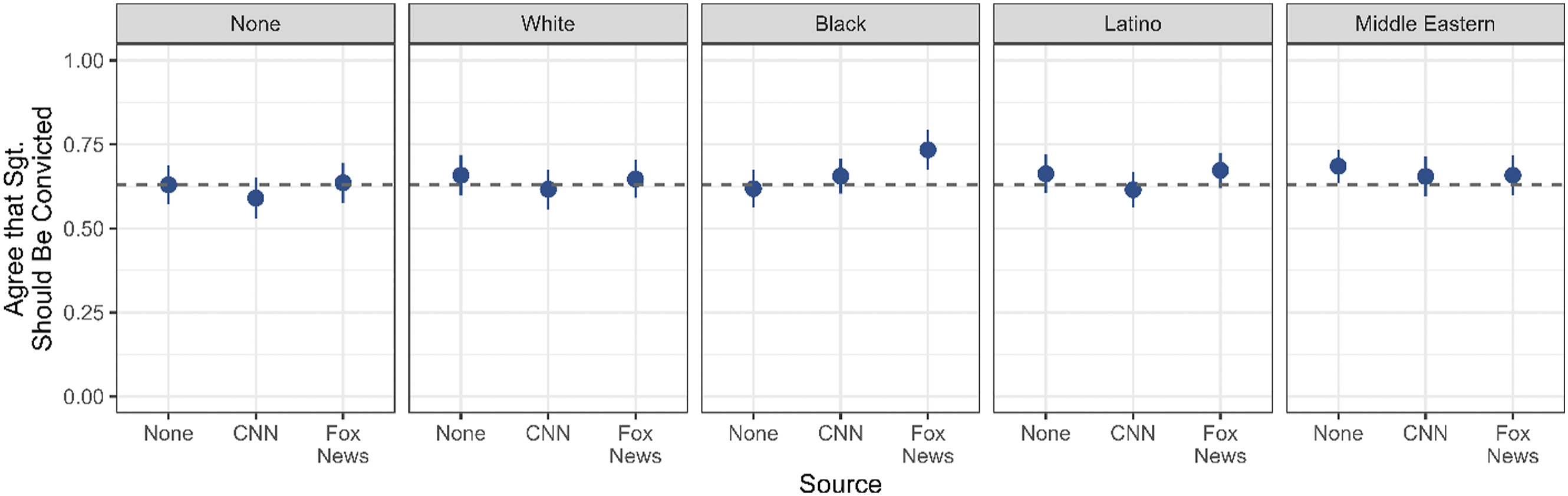
Discussion
We reason that findings from Study 1 could be rooted in two interrelated causes. One is that Fox News has a reputation for depicting Blacks according to a violent, criminal stereotype (Mills 2017), which predispose respondents to think of the Black servicemember in this way. Research has found that Fox News and others that “fly the flag” of Fox News, so to speak, have managed to be effective in their shared messaging and niche marketing, such that their reputation is well-established (Goidel et al., 2021). This finding brings to mind the concept of cognitive fluency—whereby fluent processing is “easy on the mind” and characterized by snap judgments in particular contexts (Lick and Johnson 2015). That is, when the conservative media and race primes interact, respondents may be influenced to offer more punitive responses for the Black servicemember as a matter of implicit reasoning.
A second, related issue is that different racial minorities in America have been imbued with negative stereotypes, but the shape and history of each are group specific. Latinos, for instance, are often associated with (undocumented) immigration (Farris and Silber-Muhammed 2018; Pérez, 2016), and Middle Eastern Americans (who are often conflated with Muslims) with terrorism (Lajevardi 2020). Black Americans, meanwhile, are commonly linked to violence and criminality (Oliver 2003; Young 2006). Because Black Americans are often stereotyped as violent and criminal—and Fox News has gained a reputation for amplifying these stereotypes—Whites may be predisposed to judge Blacks more punitively when seeing the Fox News masthead.
Overall, Study 1 offers evidence of a racial bias expressed by White respondents when they consume news from a conservative media outlet. That said, there may be limitations to our results. First, we collected the data for Study 1 in the weeks immediately preceding the 2020 U.S. Election and not long after the peak of Black Lives Matter protests. The salience of both partisanship and racial attitudes pertaining to Black Americans during this period might have been especially heightened. Second, given the statistical probability of committing a Type 1 error at conventional levels (5%), we might have found our experimental results by chance. To address these concerns, we replicated the first study using a larger (though far more convenient) sample.
Study 2
Study 2 replicated Study 1 with minor modifications. First, the experimental design was pre-registered at aspredicted.org (affiliated with the University of Pennsylvania’s Wharton Credibility Lab). 11 Second, respondents were sampled via Amazon’s Mechanical Turk (MTurk) crowdsourcing service 12 (a total of 2579 participants with IP addresses within the U.S. were paid $0.20 to complete the survey, which took an average of about 5 minutes). Third, we employed only one racialized name per racial category. 13 Finally, we employed an attention check. 14 In accordance with our pre-registration, we dropped from the analysis any respondent who identified as non-White or who failed the attention check. 15
Results from Study 2

Notes: Standard errors in parentheses.
* p < 0.05, ** p < 0.01, *** p < 0.001.
Figure 3 presents the results graphically, with point estimates and 95% confidence intervals for each of our conditions. This figure allows us to compare each treatment condition with the control (no masthead/no name) more directly. Here, it is clear that in comparison to the control, those in both the Latino/Fox and Black/Fox condition judged the officer as less justified than the soldier in the control condition. Still more, the White soldier in the Fox News condition is not judged more harshly than the soldier in the control condition, an advantage in comparison to the soldiers of color. Results from Study 2.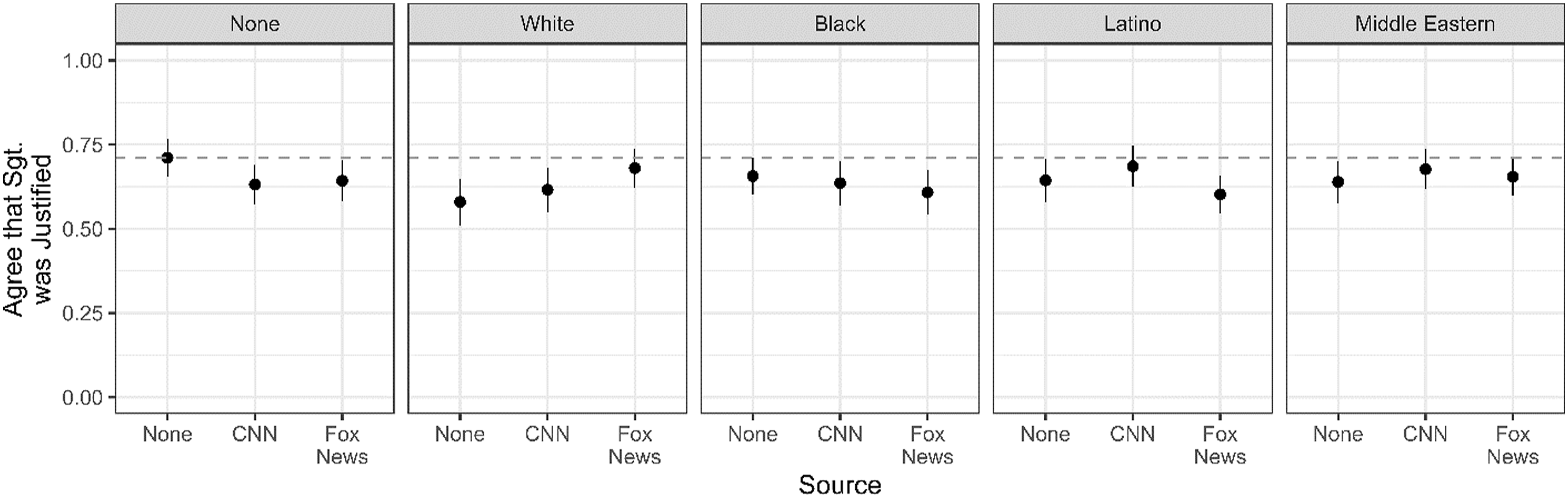
Conclusion
This article presented results from two original survey experiments parsing the relationship between exposure to partisan media branding and how Americans interpret and assess news, with a focus on racial justice. In Study 1, we found that, in the case of U.S. servicemembers accused of war crimes, the priming effect of the Fox News logo led Whites to discriminate against one group: Black Americans. In Study 2, we found some evidence of a pro-White bias when respondents were exposed to a Fox News masthead. Taken together, results indicate that partisan media may shape attitudes not just through specific content, but also by acting as an ideological or even racialized prime. Specifically, we discovered that a prominent conservative news outlet appears to influence how White Americans apply judgments across racial groups.
Going forward, scholars should assess our findings further and explain the somewhat varied results. Given research showing that consumption of Fox News predicts consumption of other right-wing media (e.g., Breitbart and Rush Limbaugh) (Stecula and Pickup 2021), future studies ought to determine whether similar effects are distilled in other types of media platforms (e.g., radio and newspaper) and/or whether a “ratchet-up” effect can be detected as news outlets move further to the right (e.g., Newsmax and OANN). Furthermore, researchers could probe whether seeing a conservative media logo depresses support for reforms against anti-Black policy brutality or anti-racist initiatives, and whether other races are seen more negatively when engaged in activities aligned with their group stereotypes (e.g., Latinos and undocumented immigration). Studies could also examine whether partisan media cues affect attitudes toward a range of non-race-related issues, from tax cuts to abortion to climate change. Conservative and liberal media present news stories differently, but we discovered that partisan media branding alone may be enough to alter citizens' attitudes.
Supplemental Material
Supplemental Material - Entering the “foxhole: Partisan media priming and the application of racial justice in America
Supplemental Material for Entering the “foxhole”: Partisan media priming and the application of racial justice in America by Andrew M. Bell, Christopher D. DeSante, Thomas Gift and Candis W. Smith in Research & Politics
Supplemental Material
Supplemental Material - Entering the “foxhole”: Partisan media priming and the application of racial justice in America
Supplemental Material for Entering the “foxhole”: Partisan media priming and the application of racial justice in America by Andrew M. Bell, Christopher D. DeSante, Thomas Gift and Candis W. Smith in Research & Politics
Footnotes
Declaration of conflicting interests
The authors declared no potential conflicts of interest with respect to the research, authorship, and/or publication of this article.
Funding
The authors received no financial support for the research, authorship, and/or publication of this article.
Correction (June 2025):

IRB approval
This study has been approved by the Indiana University Institutional Review Board, protocol #2008603055.
Supplemental Material
Supplemental material for this article is available online.
The files can be found at https://dataverse.harvard.edu/dataset.xhtml?persistentId=doi:10.7910/DVN/TIJ1WI&version=DRAFT
Notes
References
Supplementary Material
Please find the following supplemental material available below.
For Open Access articles published under a Creative Commons License, all supplemental material carries the same license as the article it is associated with.
For non-Open Access articles published, all supplemental material carries a non-exclusive license, and permission requests for re-use of supplemental material or any part of supplemental material shall be sent directly to the copyright owner as specified in the copyright notice associated with the article.
