



Abstract
Existing research on voting legislation argues that Republican lawmakers enact strict voting laws as part of a racialized, partisan electoral strategy—they believe that the laws will reduce minority turnout and benefit Republicans electorally. Yet, the empirical effects of strict voting laws on turnout are mixed, with some studies finding that restrictive legislation can actually increase minority turnout due to counter-mobilization effects. I leverage this empirical finding to study the foundations of public attitudes toward voting laws, specifically testing whether exposure to information that restrictive voting laws can boost minority turnout impacts Republicans’ or Democrats’ attitudes. My results show that Republican support for restrictive voting laws generally does not change in response to information about the consequences of the laws, but Democrats are significantly less opposed when they become aware of the laws’ potential impact on minority turnout. These results pose challenges for building majorities that will defend the franchise in the United States.
Introduction
Since the landmark 2013 US Supreme Court decision in Shelby County v. Holder that declared a key part of the Voting Rights Act unconstitutional, US states with a history of discriminatory voting practices have had considerable leeway to enact restrictive voting laws without federal oversight. As a result, voting access is polarized across states, with Republican-controlled states largely proposing and enacting legislation that makes voting harder while Democrat-controlled states focus on legislation that makes voting easier (Brennan Center for Justice 2022).
Proponents of restrictive voting laws tend to frame them as necessary to prevent fraud in elections, while opponents argue that they deny eligible citizens the right to vote (e.g., Atkeson et al. 2014; Conover and Miller 2018). 1 However, research suggests that partisan elites’ preferences for restrictive versus expansive voting laws is less a reflection of principled support for election integrity or ballot access than it is a strategic, partisan, and racialized affair. Republican lawmakers pass strict voting laws because they anticipate that the laws will reduce minority (and presumably, Democratic) turnout, and Democrats oppose strict voting laws because they believe that expanding voting access will benefit their party at the polls (Bentele and O’Brien 2013; Hicks et al. 2015; Rocha and Matsubayashi 2014).
Like their respective parties, Republican and Democratic voters are polarized in their views about voting. A recent analysis found that 85% of Democrats and Democratic-leaning independents say everything possible should be done to make voting easier, while only 29% of Republicans agree (Hartig 2021). However, we know little about whether this pattern reflects principled beliefs about voting—independent of the consequences of the laws on turnout—or if voters are making the same strategic, partisan, and/or racialized considerations that the Republican and Democratic parties are making. Why do Republican voters support restrictive voting laws while Democrats support expansive ones?
I leverage a potentially counter-intuitive empirical finding from political science research on voter turnout to answer this question. A wealth of studies have provided little empirical support for the idea that strict voting laws—most often, voter ID laws—will benefit Republicans and hurt Democrats electorally. While there is considerable variation in results across studies, the average effects of strict voter ID laws on differential rates of turnout (across racial or partisan groups) appear to be small or absent (Highton 2017). 2 Some studies even find that restrictive voter ID laws can increase minority or Democratic turnout because their passage mobilizes activists to channel additional get-out-the-vote resources to affected areas (e.g., Cantoni and Pons 2021; Valentino and Neuner 2017). To be sure, any laws that purposefully limit voting access should be viewed skeptically from a normative standpoint in democracies (Beauchamp 2021). However, the potential non-effects of suppression efforts on turnout provide a unique opportunity to examine the foundation of public attitudes toward voting laws.
I specifically use survey experiments to test whether informing voters that restrictive voting laws can boost turnout among racial minorities will decrease support for such laws among Republicans or increase support for the laws among Democrats. My results reveal marked partisan differences in how voters respond to information about the consequences of strict voting laws on turnout. Republican support for restrictive voting laws does not waver in response to information that the laws may increase minority turnout, but Democrats are significantly less opposed to strict laws when they hear about the laws’ potential consequences. Taken together, these results pose challenges for building majorities in favor of democratic norms related to voting in the United States. Republican support for laws that make voting harder appears firm and potentially built upon false allegations of voter fraud, while Democratic opposition to these laws is fragile, malleable, and may rest on unfounded assumptions about the consequences of the laws.
Background and hypotheses
Some existing research in political science examines the foundations of public opinion on voting laws. One clear pattern that emerges from these studies is the partisan nature of attitudes—Republican voters generally support strict voting laws, and Democratic voters generally oppose them (Hartig 2021). Atkeson et al. (2014) show that voters view debates over voter ID laws through the lens of partisanship, with Republicans focused on integrity and fraud and Democrats focused on participation and ballot access. These patterns reflect elite partisan discourse on voting laws (Bentele and O’Brien 2013; Conover and Miller 2018) and false allegations of fraud that intensified during the 2016 and 2020 presidential elections in the United States (e.g., Clayton et al. 2021; Eggers et al. 2021; Pennycook and Rand 2021).
Additional research shows that in addition to being partisan, public support for strict voting laws is racialized. Wilson and Brewer (2013) show that support for voter ID laws is highest among those who score high on measures of racial resentment. In an experiment, Wilson et al. (2014) find that white individuals who saw an image of a Black voter and poll worker expressed greater support for voter ID laws than those who did not see an image. Banks and Hicks (2016) document links between implicit racism and support for restrictive voting laws in white individuals that are catalyzed by feelings of fear. Racial stereotyping is likely to drive these dynamics; calls for stricter voting laws as a means to prevent fraud in elections often implicate racial minorities or non-citizens as perpetrators (e.g., Cottrell et al. 2018; Hasen 2012; Murty and Holyfield-Moss 2017).
While scholars generally agree that the dynamics of both partisanship and racial attitudes impact support for strict voting laws, there is disagreement over whether attitudes are strategic—that is, driven by beliefs about the consequences of voting laws on turnout—or principled—that is, independent of electoral outcomes and based instead on core beliefs such as electoral fraud prevention or equality in ballot access. As a starting point, some research finds that informing people about the harmful consequences of strict voting laws can lower support for the laws, pushing back on the idea that attitudes are entirely principled (Biggers 2021; Kane and Wilson 2021). However, Kane (2017) finds that alerting respondents about even a small amount of electoral fraud increased support for voter ID laws among Republicans, suggesting that Republican opinion could be rooted in principle. On the other hand, informing Democrats that voter ID laws would reduce Republican turnout boosted their support for the laws, implying that Democratic opinion could be built upon more strategic concerns. Virgin (2021) finds that core moral values including egalitarianism, moral tolerance, self-reliance, and economic individualism have an independent effect on support for various electoral reforms and attenuate the influence of partisan self-interest on attitudes toward voting laws among both Democrats and Republicans, highlighting the key role of foundational principles.
I contribute to this literature in three main ways. First, I bring together literatures on the empirical effects of strict voting laws on turnout and on public opinion about voting laws to examine the extent to which voters’ attitudes toward restrictive legislation are linked to assumptions about the consequences of the laws. To my knowledge, existing research has not tested how awareness of empirical findings on voting laws and turnout might impact public opinion about restrictive legislation.
Second, while I focus on empirical findings that are mostly related to voter ID laws, I study support for strict voting laws across a range of domains including mail voting rather than focusing solely on voter ID, as most prior work has done. As such, my research is particularly suited to understanding public opinion on voting laws in an era when forms of convenience voting (including mail voting) are increasingly common and increasingly under attack (Brennan Center for Justice 2022; Weiser et al. 2020).
Finally, I measure outcomes related to a number of different attitudinal dimensions beyond support for strict voting laws, including perceptions of whether strict voting laws will impact election integrity and feelings of anger in response to strict voting laws, as well as behavioral measures of these perceptions and attitudes. This range of outcomes sheds light on whether information about the consequences of strict voting laws is likely to mobilize voters to take action in support of, or against, new legislation.
I preregistered a series of theoretical predictions and research questions at the Open Science Framework prior to data collection. 3 First, I examine whether and how Republican support for restrictive voting laws changes when voters hear that the laws may not actually dampen turnout among minorities. Specifically, information that reveals that restrictive voting laws may (counter-intuitively) boost the minority vote could decrease support for such laws among Republicans (H1), decrease beliefs that they will make future American elections more secure (H2), and/or increase anger toward these laws (H3).
A related set of questions concerns the effects of information revealing that restrictive voting laws can boost turnout among racial minorities on Democratic support for restrictive voting laws. This information could increase Democratic support for restrictive voting laws (RQ1) and/or foster beliefs that they will make future American elections more secure (RQ2). It may also decrease feelings of anger about the laws (RQ3), which previous research suggests produces a mobilizing effect (Valentino and Neuner 2017).
Finally, I examine the effects of information indicating that restrictive voting laws can boost turnout among racial minorities on Republicans’ and Democrats’ willingness to donate to organizations supporting voting rights or election security in a fictional lottery—a behavioral measure of some of the aforementioned effects (RQ4, RQ5).
Research design
Sample
To test my hypotheses and research questions, I administered a preregistered online survey experiment among a national sample of 3175 adults in the United States provided by Lucid Marketplace from May 31 to June 1, 2021. 4 I used quotas to achieve a sample that is nationally representative of the adult population in the U.S. based on age, gender, race, ethnicity, region, party identification, and education level. Because a key focus of this study is partisanship, respondents who identify as “true independents” (i.e., lean toward neither party) were screened out prior to treatment assignment. Table B1 in the appendix provides information on the demographic breakdown of the sample overall and by treatment condition.
Prior research has demonstrated that demographic and experimental findings obtained from Lucid track well with benchmarks from national probability samples (Coppock and McClellan 2019). However, some studies have suggested that the quality of responses on Lucid has declined over time, particularly during the COVID-19 pandemic (e.g., Peyton et al. 2022; Ternovski and Orr 2022). To guard against potential respondent inattentiveness, I included an attention check question at the beginning of the survey and screened out respondents who failed to provide the correct answer prior to treatment assignment (wording provided in appendix). My resulting sample shows reasonably high attentiveness—91.4% of respondents assigned to a treatment group answered a post-treatment manipulation check question correctly. The median completion time for the survey—which included a series of modules unrelated to this study that were administered after the module on racial attitudes and voting rights—was just over 8 minutes.
Survey experiment
After consenting to participate in the survey, respondents answered a series of demographic questions and completed the attention check. They were then block-randomly assigned into one of four treatment groups: a control condition with no information, a placebo condition, a “harm minorities” condition, and a “boost minority turnout” condition. Blocks were constructed based on race (white, non-white), gender (male, female; random assignment to the male or female category for the purposes of block randomization for “other” gender category), and party ID (Democrat, Republican; partisan leaners included) for a total of eight blocks. This strategy ensures that key covariates are balanced across treatment groups. Randomization within each block occurred with probability
In the placebo condition and the two treatment conditions, respondents received information about restrictive voting laws under consideration in state legislatures around the country that was adapted from a real news article (see Beckwith 2021).
5
The first treatment condition, “harm minorities,” added information about how critics fear the laws will dampen turnout among racial minorities. The second treatment condition, “boost minority turnout,” rebuts these concerns by informing respondents that restrictive voting laws can actually increase minority turnout. The full text of each treatment condition is included below. Respondents in the null control condition read no information and proceeded directly to the outcome questions. • Placebo: State legislatures across the country are considering more than a hundred bills that would increase voter ID requirements, place limitations on voting by mail, and ban ballot drop boxes, among other changes. • Harm minorities: [placebo text + ] This flood of legislation has prompted pushback among critics who worry that stricter voting laws will decrease turnout among racial minorities. • Boost minority turnout: [placebo text + harm minorities text +] However, more than a decade of research has shown that stricter voting laws fail to decrease turnout among racial minorities. In fact, some studies show that strict voting laws may even increase minority turnout by motivating voting rights activists and spurring stronger get-out-the-vote efforts.
Given that the “boost minority turnout” condition provided information that may have been unexpected or counter-intuitive to respondents, I included a “treatment booster” that reinforced this information by asking respondents in this experimental condition about the content they read (“Based on what you just read, which of the following most accurately describes the impact of stricter voting laws on voter turnout among racial minorities?”) and corrects them if they provide the wrong answer or indicate that they are not sure (see appendix for full wording). 6
Outcome measures
I have four main dependent variables that I use to test my hypotheses and research questions (full wording provided in appendix). First, support for strict voting laws is a single question asking for respondents’ level of support for the passage of a restrictive voting law, measured on a 5-point Likert scale. 7 Second, faith in American elections is a scale that combines responses to questions on whether respondents believe a restrictive voting law will increase or decrease the likelihood that votes will be counted fairly in future elections and whether the law increases or decreases their trust and confidence in the results of future elections (both on 5-point Likert scales). Per my preregistration, the measure takes the mean of the two items after confirming that they load on the same underlying dimension (i.e., the first principal component) via factor analysis (Cronbach’s α = 0.90). Third, anger is a scale that takes the mean of two questions on respondents’ self-reported feelings of anger and outrage (4-point scales), again after confirming that they load on the same underlying dimension (Cronbach’s α = 0.91). Finally, donation behavior is a behavioral measure that examines the amount donated to organizations supporting election security and voting rights in a hypothetical lottery. Unless otherwise noted, outcomes are rescaled 0–1 for ease of interpretation.
Analysis procedure
I test my primary hypotheses and research questions using OLS regression with HC2 robust standard errors. 8 All models incorporate block fixed effects (a series of dichotomous variables for each possible value of the variables used to construct blocks) to improve efficiency. In addition to the independent (treatment group) and dependent variables (outcomes), the models include an indicator that takes the value of 1 for Republican identifiers and 0 for Democratic identifiers. This indicator is added as a covariate and interaction terms are created for each treatment variable in the model. Independent partisan leaners are included in these partisan groups. I also compute marginal effects to test the differences between the treatment groups as well as relative to the control group. My significance threshold is p < .05 (two-sided).
Results
Per my preregistration, I first use t-tests with unequal variance to test whether the null control and placebo conditions can be pooled. I test for the null hypothesis that the difference of means is zero for the support for strict voting laws outcome, the trust in future elections outcome, and the anger emotion outcome. I fail to reject the null for each of the three outcomes (p = .79 for support, p = .78 for trust, and p = .56 for anger), justifying using the pooled control/placebo group as the baseline.
I next examine the effects of exposure to information about voting laws and minority turnout on support for strict voting laws, faith in future elections, and feelings of anger toward strict voting laws. The results are presented in Figure 1, which presents OLS regression coefficients as point estimates in the white bubbles and their 95% confidence intervals indicated by the bars on either side of the bubbles. Results for Republicans are shown in red, and results for Democrats are shown in blue; results for the “boost minority turnout” condition are shown in the top panel, and results for the “harm minorities” condition are shown in the bottom panel. Analogous results with subgroup marginal effects are presented in a tabular format in Tables 1a and 1b. Main effects of exposure to information about voting laws and minority turnout. Note: *p < .05, **p < .01, ***p < .001 (two-sided). Points represent OLS regression coefficients with HC2 robust standard errors; horizontal lines are 95% confidence intervals. Models control for block fixed effects. Effects of exposure to information about voting laws and minority turnout, by party (a) statistical model results. p < .05, **p < .01, ***p < .005 (two-sided). Cell entries are OLS coefficients with robust standard errors in parentheses. Reference category for republican indicator is democrats (partisan leaners included). Models control for block fixed effects. Effects of exposure to information about voting laws and minority turnout, by party (b) subgroup marginal effects. * p < .05, ** p < .01, *** p < .005 (two-sided). Marginal effect estimates are calculated from Table 1a and show the effects of the boost turnout treatment (top) or harm minorities treatment (bottom) relative to the control among republicans and democrats separately.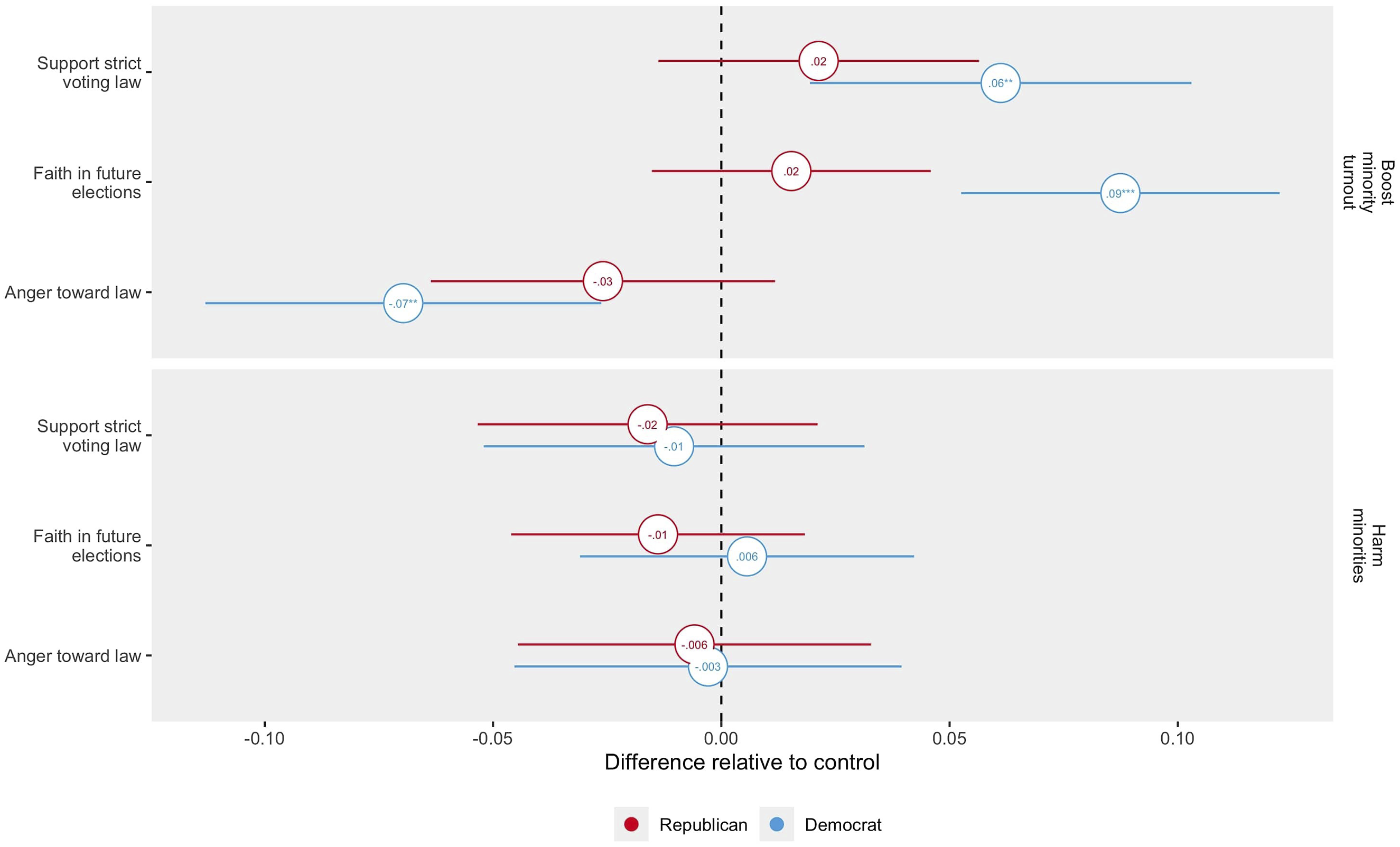


As the top panel of Figure 1 shows, information about how voting laws could boost minority turnout has differential effects on Republicans’ and Democrats’ support for restrictive voting laws, on their faith in future elections if restrictive voting laws were passed, and on their feelings of anger toward restrictive voting laws. Contrary to expectations, the “boost minority turnout” treatment did not significantly decrease support for strict voting laws among Republicans, decrease their perceptions of the integrity of future elections if strict voting laws were passed, or increase their anger toward the laws. Instead, the estimated effects are statistically insignificant, and the point estimates are oppositely signed relative to my expectations. I therefore find little evidence that Republicans are supporting strict voting laws because they believe the laws will dampen minority turnout. Instead, the results appear more consistent with the idea that Republican support for restrictive voting laws persists regardless of the electoral consequences of the laws.
Figure 1 shows an alternative pattern among Democrats that is more consistent with strategic considerations. As the blue estimates in the top panel of Figure 1 show, hearing that restrictive voting laws can boost minority turnout increases Democrats’ support for such laws (b = .06, p < .01), increases their faith in future elections if restrictive voting laws were passed (b = .09, p < .001), and decreases their anger toward restrictive voting laws (b = -.07, p < .01). These results imply that on average, Democrats are not entirely principled in their opposition to restrictive voting laws; on the contrary, many are willing to support such laws if it means that minorities—and, presumably, Democrats—will turn out in higher numbers. 9
Turning now to the effects of information that restrictive voting laws can dampen turnout among racial minorities (bottom panel of Figure 1; see also Tables 1a and 1b), I find no evidence that this treatment condition impacts any of the three main outcomes among Republicans or Democrats. These effects are not altogether unexpected—given prominent discourse among politicians and in the media about how restrictive voting laws harm minorities (e.g., Tensley 2021), being reminded of this fact may be unlikely to shift attitudes that partisans already hold. It is worth noting that consistent with prior research (e.g., Atkeson et al. 2014), baseline support, election faith, and anger (in both the “harm minorities” group and the control group) are all highly polarized along partisan lines, as indicated by the substantively large and highly statistically significant estimate on the “Republican” indicator (Table 1a).
Next, I test whether the experimental treatments impact behavior—specifically, willingness to donate to organizations supporting election security or voting rights. The results are presented in Figure 2, which shows the mean amount donated to the “Committee on Election Integrity, an organization that advocates for legislation to increase election security” by treatment group and respondent party in the top panel, and to the “Voter Protection Project, an organization that works to expand and protect opportunities to vote” in the bottom panel. The lines intersecting the bars are 95% confidence intervals. As the top left panel of Figure 2 shows, Republicans donate more to organizations advocating for legislation to increase election security when they hear that strict voting laws may boost minority turnout (differences between “boost minority turnout” and control, and “harm minorities” and control, are both significant at p < .05). By contrast, donation behavior to organizations supporting election security is not significantly different across treatment conditions for Democrats (right panel). Donation behavior to voting rights organizations is also not significantly different across treatment conditions among Republicans or Democrats (bottom panel). Lottery results by treatment group and party. Note: Dependent variable is the amount (in dollars) donated to an election security organization (top) or a voting rights organization (bottom) in a fictional lottery in which respondents are asked to allocate $100 between themselves, a voting rights organization, and an election security organization. (a) Amount donated to election security organization (b)amount donated to voting rights organization.
While the results presented in Figure 1 suggest that Republicans are at least somewhat principled in their support for strict voting laws, they are more concerned about the integrity of the vote when there is high minority turnout. One potential explanation for this finding is that Republicans have internalized rhetoric from Donald Trump and others that has blamed undocumented immigrants for electoral fraud and has singled out areas with high non-white populations as loci of fraudulent votes (Phillips 2020). This potential pattern is worthy of further investigation and would be consistent with broader research that documents the pervasive effects of elite rhetoric on perceptions of voter fraud (e.g., Clayton et al. 2021; Pennycook and Rand 2021).
Discussion and conclusion
In a survey experiment conducted on a large and diverse national sample, I examined potential foundations of public opinion about restrictive voting laws. I provided partisans with information about a counter-intuitive empirical finding that has emerged from research in political science—that restrictive voting laws can actually lead to increases in minority turnout—and measured support for strict voting laws, perceptions of the effect of such laws on election integrity, anger toward the laws, and willingness to donate to organizations promoting election integrity or ballot access.
Contrary to expectations, my results reveal that Republicans are generally firm in their support for strict voting laws: information about the effects of the laws on minority turnout does not lower support, but it does increase willingness to donate to organizations promoting election integrity. Republicans therefore seem acutely concerned about preventing election fraud regardless of the strategic consequences of voting legislation, especially when they expect high minority turnout. This troubling finding constitutes further evidence that elite messaging about fraud in elections, which is grounded in misinformation and falsely implicates minorities or non-citizens, has taken hold among Republicans (Atkeson et al. 2014; Pennycook and Rand 2021). It also implies that misperceptions about the prevalence of fraud—and resulting opinion on voting laws—may be particularly sticky.
By contrast, my survey experiments suggest that Democratic opinion on strict voting laws is at least somewhat built upon considerations about the consequences of the laws—hearing about the potential benefits of these laws on minority turnout increases support. While the Democratic Party is often heralded as the defender of democracy and racial justice, it appears that Democratic voters are not unconditionally supportive of expansive ballot access. While my research design does not fully allow me to adjudicate between whether Democrats’ opinions are built upon strategic electoral considerations (i.e., increased minority turnout benefiting the Democratic Party) or by principled support for increasing turnout among minorities (perhaps as a display of commitments to racial justice), my results do imply that Democratic opposition to restrictive voting laws could be fragile. Indeed, existing levels of opposition may be founded on assumptions about consequences on turnout that are not borne out by empirical research.
Taken together, these results paint a troubling picture of public opinion on restrictive voting laws. Neither party appears poised to unconditionally defend laws protecting the right to vote. Future research that seeks to enhance public commitments to ballot access should therefore consider what types of interventions are effective at shifting opinion on voting laws in a pro-democracy direction. Among Republicans, persuasive appeals could consider trying to reduce belief in election fraud (Bailard et al. 2022; Clayton and Willer 2023), as this may lower the relevance of principled commitments to fraud prevention. Among Democrats, interventions should instead focus on increasing commitments to ballot access and other democratic or moral principles in spite of the empirical effects of suppression efforts. Without such interventions, support for restrictive voting laws may become even more widespread, increasing barriers to political participation in the United States.
Supplemental Material
Supplemental Material - Understanding public attitudes toward restrictive voting laws in the United States
Supplemental Material for Understanding public attitudes toward restrictive voting laws in the United States by Katherine Clayton in Research & Politics.
Footnotes
Acknowledgments
I am grateful to Hakeem Jefferson, Brendan Nyhan, Paul Sniderman, Mike Tomz, and members of the Laboratory for the Study of American Values (LSAV) and the Polarization and Social Change Lab at Stanford University for helpful comments
Declaration of conflicting interests
The author(s) declared no potential conflicts of interest with respect to the research, authorship, and/or publication of this article.
Funding
The author(s) disclosed receipt of the following financial support for the research, authorship, and/or publication of this article: This work was supported by the grants provided by the Center for American Democracy at the Stanford University Institute for Research in the Social Sciences.

Supplemental Material
Supplemental material for this article is available online.
Notes
References
Supplementary Material
Please find the following supplemental material available below.
For Open Access articles published under a Creative Commons License, all supplemental material carries the same license as the article it is associated with.
For non-Open Access articles published, all supplemental material carries a non-exclusive license, and permission requests for re-use of supplemental material or any part of supplemental material shall be sent directly to the copyright owner as specified in the copyright notice associated with the article.
