



Abstract
Previous studies have shown that people oppose refugee resettlement more strongly after being exposed to frames that depict refugees as threatening. However, all people may not perceive such threats the same way. Based on contact theory, we hypothesize that the treatment effects of threatening frames on people’s opposition to refugee resettlement are conditional on their contact experience with foreign-national residents. The results of our pre-registered experiment in Japan indicate that exposure to threatening information does not change attitudes toward refugee resettlement among those living in municipalities where the number of foreign-national residents is rapidly increasing. Combined with the analyses of other subjective measures of contact with foreigners, some suggestive patterns emerge that natives with conscious and positive interactions with outgroup members may be unaffected by anti-refugee rhetoric and threatening frames.
Introduction
Existing research shows that people directly exposed to the refugee crisis become more hostile toward refugees (Hangartner et al., 2019). Numerous empirical studies have further shown that people exhibit prejudice toward outgroup members, including refugees, if they feel threatened (e.g., Branscombe and Wann 1994; Esses et al. 1998; Maio et al. 1994; Stephan et al., 2008, 2002, 2005). Although these studies emphasize the strong relationship between perceived threats and prejudice, this pattern may not hold uniformly across people because they may not perceive intergroup threats equally. Moreover, subjectively perceived threats may not lead people to form prejudices against outgroup members in an identical manner. Who, then, is more likely to perceive outgroup members as threatening? Under what conditions do perceived threats fuel their prejudice and discriminatory attitudes toward outgroup members?
One possible explanation for variations in people’s susceptibility to threats and subsequent attitudinal changes toward outgroup members is the presence or absence of actual contact experience with outgroup members. A well-known contact theory suggests that intergroup contact can alleviate prejudice toward outgroup members and reduce discriminatory behavior by weakening ingroup members’ feeling that they are being threatened (Allport 1954; Pettigrew 1998; Pettigrew and Tropp 2008). Further, it has been emphasized that several conditions, such as “equal status contact between majority and minority groups in the pursuit of common goals” (Allport 1954: 281), must be met for the contact to reduce prejudice (for a recent review, see Paluck et al. 2019). Many empirical studies testing this theory show that exposure to outgroup members alone is not sufficient to reduce prejudice and hostility toward them (e.g., Enos 2014). Rather, intergroup contact must involve positive social interactions to reduce people’s discriminatory behavior and attitudes toward outgroup members (e.g., Scacco and Warren 2018).
We fielded a survey experiment in Japan and demonstrated that people opposed refugee resettlement more strongly after being exposed to frames that depict refugees as threatening (Horiuchi and Ono, 2022). The current study extends that research. We examine whether the treatment effect is conditional on contact experiences with outgroup members and present the results of our analysis with a variety of social contact measures.
Effects conditional on social contact
Our previous study (Horiuchi and Ono, 2022) has shown that when natives are exposed to a news article that portrays refugees as a threat, they are more likely to oppose resettlement, regardless of whether the threat is directly related to their country, and of the resettlement location. A key question that remains is whether this strong reaction to threatening frames among the natives is homogeneous.
The long-examined contact theory suggests that intergroup contact could reduce prejudice toward outgroup members (Allport 1954). The validity of this theory has been confirmed by a meta-analysis involving 27 relevant experimental studies (Paluck et al. 2019). Drawing on this theory, we expect that citizens who often interact with outgroup members are less likely to fear them, compared to those who have limited contact. This leads to the following hypothesis:
The effect of a threat fram
e on opposition to refugee resettlement is smaller among respondents who have frequent contact with outgroup members than among those who have limited contact with them.
It is important to note that previous studies on people’s attitudes toward immigrants suggest that the mere presence of immigrants may not be sufficient to influence respondents’ attitudes (Ellison et al. 2011; Enos 2014; Hopkins 2010; Legewie 2013; McLaren 2003). Although there may be a correlation between the size of the immigrant population and xenophobia (Jolly and DiGiusto, 2014), we should pay close attention to the nature of the contact because involuntary contact does not necessarily reduce prejudice against outgroup members (Newman 2013). Therefore, to address this issue, we employ multiple measures of contact to test our hypothesis.
Research design
We conducted a pre-registered survey experiment from June 6 to July 3, 2017, using Qualtrics Panels, and collected 2250 valid responses. 1 Respondents were randomly divided into three groups. Those in the two treatment groups read one of two news articles that underscore the potential risk of accepting refugees (see Section B in the Supplementary Materials): one concerns potential threats in Paris (Foreign threat treatment), and the other concerns potential threats in Japan (Domestic threat treatment). Those in the control group did not read any news articles. We then asked three separate questions regarding refugee resettlement: Do you think refugees should be accepted in (developed countries/Japan/your municipality)?
In this paper, we analyze the treatment effects conditional on various measures of social contact. 2 One challenge for us is that almost all Japanese citizens have virtually no contact with refugees and thus have no experience of real threats caused by the influx of refugees. As an alternative, we use several measures of respondents’ contact experiences with non-Japanese residents in Japan. Although we acknowledge that this research design—understanding Japanese citizens’ attitudes toward refugees conditional on their contact with non-Japanese people—has some limitations, we do not consider it a fundamental flaw. This is because what matters in theory is natives’ contact with “outgroup members,” who could be refugees or immigrants. Japanese citizens are not likely to exhibit systematically different attitudes toward the non-Japanese depending on their residency status—short-term visitors, students, work-related immigrants, refugees, and so on—by correctly identifying whether outgroup members they encounter in everyday life are refugees or not. 3
We estimate the treatment effects conditional on each of the following three distinct measures: the presence of foreign-national residents in the respondent’s municipality, 4 the frequency with which the respondent sees non-Japanese in their municipality, and the number of non-Japanese friends that the respondent has. The first is an objective measure based on official government statistics, whereas the latter two are subjective measures based on respondents’ self-reports.
We are aware that there is debate about the validity of all these objective and subjective measures of “social contact.” Regarding the objective measure, we acknowledge that having more foreign-national residents in a municipality does not necessarily mean that there is more contact between Japanese and non-Japanese. For example, if foreign-national residents were concentrated in a particular housing complex, they would communicate less with Japanese residents in the same area. However, even in such communities, children of foreign-national parents usually attend schools with Japanese children. In fact, it is almost impossible for them to live in isolation in Japan. They use public transportation, operate garbage collection points in cooperation with Japanese people, go to local supermarkets that are open to all, and so on. In addition, many municipal governments offer subsidies and hold community events to promote the coexistence of Japanese and non-Japanese residents. Therefore, we believe that as the number of foreign-national residents increases, such communication in daily life will inevitably increase.
Our subjective measures are mostly based on those used in previous studies examining social contact and immigration attitudes (e.g., Clayton et al. 2021). We argue that these measures are reasonable in the context of Japan. Aside from making friends with foreigners, social contact with foreigners could take many forms, such as exchanging words with a foreigner in a supermarket or a public transportation. One of our measurements, “frequency of seeing foreigners,” is likely to include such light “contact,” which may not be mere “exposure.”
Results
We first show the differences in the treatment effects conditional on the presence of foreign-national residents. We divided the respondents into three groups and estimated the treatment effect separately for each group to allow for the possibility of non-linear effects. To create these groups, we sorted the respondents by the conditioning variable and set cut points to ensure a similar number of responses. The results of the analysis are shown in Figure 1. The treatment effects conditional on the presence of foreign-national residents. Note: The figure shows the treatment effects conditional on the percentage of the foreign-national population in the respondents’ place of residence (municipality) as of June 2017 (left panel) and the change in this percentage from December 2012 to June 2017 (right panel). The vertical bars represent 95% confidence intervals. The estimated effects that are significant at the 0.05 level are highlighted in black.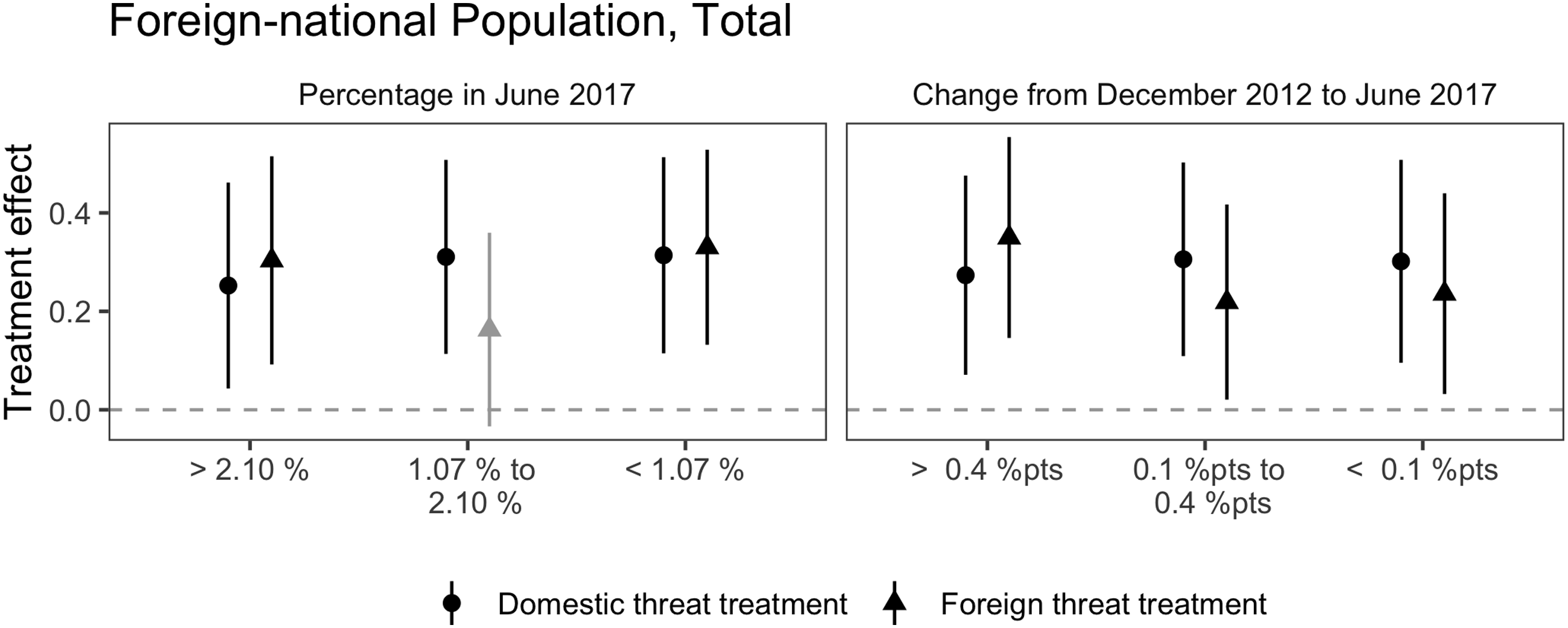
The left panel in Figure 1 shows the treatment effects conditional on the percentage of foreign-national residents in each municipality as of June 2017, the most recent data available at the time of our survey. The vertical bars indicate 95% confidence intervals, and the coefficients that are significant at the 0.05 level are highlighted in black. The results suggest that the threatening frames’ effects do not vary with the share of foreign-national residents in the respondents’ municipalities. Respondents living in municipalities with a relatively high share of foreign-national residents (over 2.10%) responded to threatening frames in a similar manner as those living in municipalities with a low share (below 1.07%). The treatment effects are mostly significant, regardless of whether the percentage of foreign-national residents in the municipality is high, middle, or low. One exception is the effect among respondents in the middle range, but we do not think that any systematic mechanism exists for this anomaly.
The right panel in Figure 1 is similarly constructed, but the conditioning variable here is based on the change in the foreign-national population ratio from December 2012 to June 2017. Some studies claim that the rapid influx of foreign-national or immigrant populations, measured by changes, causes fear among the native population. Newman (2013), for example, demonstrates that natives in areas where immigration has increased rapidly are more likely to perceive immigrants as a threat and thus tend to have stronger anti-immigrant attitudes. However, our results show that the positive effects of threatening frames are statistically significant regardless of changes in the foreign-national population; there is no statistically significant difference in the treatment effects conditional on the increase in the foreign-national population in the respondents’ municipalities.
Thus far, we have employed measurements based on the total foreign-national population to understand how changes in that population affect natives’ susceptibility to threatening frames. However, these measurements may not be appropriate because they count all individuals from various countries as “foreigners,” thereby failing to account for differences in culture, socioeconomic background, or degree of assimilation. Immigrants’ countries of origin may be important in understanding natives’ attitudes toward immigrants (Clayton et al. 2021; Hainmueller and Hopkins 2015).
In the case of Japan, analysis by country of origin is particularly important because the definition of “foreign-national” in government statistics includes Zainichi Koreans and Taiwanese, who possess special permanent residency status created after World War II. These groups are much more culturally assimilated into Japanese society than other non-Japanese groups. Thus, Japanese attitudes toward Zainichi residents may be essentially different from those toward newly arrived immigrants. This institutional and historical background provides a rationale for examining recent changes as well.
For further exploratory analysis, therefore, we focus on the top four countries of origin with the highest rates of increase in recent years.
5
Between December 2012 and June 2017, the overall percentage of foreign-national residents in Japan increased by 0.34 percentage points, of which Vietnamese were 0.15 points, (mainland) Chinese 0.05 points, Taiwanese 0.02 points, and Filipino 0.02 points.
6
The results of the analysis of the increase in the numbers of these foreign-national residents are presented in Figure 2. Most notably, respondents living in municipalities where two of the four groups—Vietnamese and Taiwanese—experienced rapid increases in numbers (the leftmost group of estimates in each panel) are consistently not susceptible to the threatening frames. The treatment effects conditional on the presence of foreign-national residents. Note: The figure shows the treatment effects conditional on the presence of foreign-national residents from the top four countries of origin: Vietnam, (mainland) China, Taiwan, and the Philippines. The vertical bars represent 95% confidence intervals. The estimated effects that are significant at the 0.05 level are highlighted in black.
These findings contribute to important debates in the extant literature. First, existing studies using data from other countries show that an influx of immigrants increases natives’ perceptions of them as a threat (e.g., Newman 2013). The case of Japan suggests that this “influx-as-threat” theory may not be universal. Second, the effect of the recent influx of immigrants in Japan is under debate: some claim that xenophobia is increasing, whereas others emphasize the welcoming attitudes of the Japanese toward immigrants (Chapman 2006; Debito, 2006; Kashiwazaki 2013; Park 2017; Shibuichi 2015). Our results may support the latter hypothesis. The mixed results further suggest that the effects of the influx of immigrants on natives’ attitudes depend on where these immigrants come from. Examining why the effects of the increase in the numbers of Vietnamese and Taiwanese differ from those of the increase in the numbers of Chinese and Filipinos is a fruitful area for future research.
We further examine the treatment effects conditional on two subjective measures of contact with non-Japanese people, or simply “foreigners” (gaikokujin). We divided the respondents into three groups again, combining several categories to balance the number of responses. The results are shown in Figure 3. The left panel employs the frequency of respondents’ daily contact with foreigners as a moderator.
7
The results show that respondents who answered that they see foreigners “sometimes,” “rarely,” or “hardly at all” were significantly influenced by threatening media frames. In contrast, those who claimed to see foreigners “often” in their municipality were not influenced by media frames. A similar pattern is observed in the right panel, which uses the reported number of foreign-national friends as a moderator. The results indicate that respondents with few or no foreign-national friends were significantly influenced by threatening media frames. However, for those who reported having some or many foreign-national friends, the media frame effects were not significant. These results are broadly consistent with our hypothesis, suggesting that the effects of threatening media frames may be moderated by contact with outgroup members. In other words, Japanese people who have close interactions with foreigners may be less affected by exposure to threatening media frames than others. The treatment effects conditional on the subjective measures of contact. Note: The figure shows the treatment effects conditional on the subjective measures of contact with “foreigners” (gaikokujin)—how often respondents see foreigners (on the left panel) and how many foreign-national friends respondents have (on the right panel). The vertical bars represent 95% confidence intervals. The estimated effects that are significant at the 0.05 level are highlighted in black.
Finally, we note that respondents were never randomly assigned to contact non-Japanese people in our survey experiment. Each of the conditional average treatment effects can be interpreted as causal because the treatments are randomly assigned independently of the condition. However, the differences in the conditional effects between different types of respondents, or the heterogeneity in treatment effects (HTE), are not causal. 8 Thus, caution must be exercised when interpreting the results presented in this section. We further tested for the HTE by running a regression model with interactions between our treatment variables and some indicator variables for respondent subgroups and presented the results in Section C of the Supplementary Materials. In most cases, the treatment effects did not differ significantly across the subgroups of respondents. Given these results, we should not overly claim that those who have more contacts with outsiders are significantly less like to be influenced by a threatening frame than those who do not. The difference in conditional treatment effects, which we show in Figures 2 and 3, should be treated as preliminary evidence that requires further data collection and analysis.
That said, it should be noted that the absence of significant HTE does not necessarily imply irrelevance of social contact in the population. New research suggests that many political science studies are substantially underpowered (Arel-Bundock et al. 2022). Lack of statistical power is a particularly significant problem when testing for the effect heterogeneity. Gelman et al. (2020) demonstrate that it is very difficult to detect statistically significant interaction effects. Specifically, they point out that to obtain a statistically discernible interaction effect comparable to the main effect, one would need a sample size four times larger than needed by the main effect. Therefore, the lack of statistically significant interactions in our study could be due to a statistical problem.
Conclusion
We examined how natives’ susceptibility to threatening news changes with experience of contact with outgroup members. Our results demonstrate that the mere presence of outgroup members in local communities may not be sufficient to change the attitudes of natives. Rather, conscious interactions with outgroup members, such as becoming friends with them, are likely to make people less susceptible to frames that portray refugees as a threat.
Whereas existing studies from other countries (e.g., Newman 2013) suggest that a rapid increase in the number of immigrants in local communities might threaten natives, we find that Japanese living in such communities are not always susceptible to threatening media frames. This indicates that an influx of outgroup members is not necessarily perceived as threatening by natives and that its effect may depend on where these outgroup members come from and how they interact with natives. Future research should identify the conditions under which an influx of outgroup members causes positive attitude changes among natives.
Further important topics for future research include investigating other factors that make natives either vulnerable or immune to threatening news frames. The ethnic and cultural diversity surrounding natives may be only one of the many conditions that weaken or strengthen the threatening framing effects. Economic conditions for accepting refugees, efforts by government and non-profit organizations to improve the quality of refugee resettlement, and integration of refugees into the community are also possible factors that can help overcome the influence of threatening information on natives’ perceptions of refugee resettlement. For instance, the reason the “influx-as-threat” theory does not necessarily hold in Japan might be because the government strictly controls the quality of immigrants it accepts, or because many local governments effectively integrate immigrants by providing them with detailed livelihood support. Research on these issues will provide more effective measures for refugee resettlement and immigration.
Footnotes
Author note
We presented earlier drafts of this paper at the inaugural annual meeting of the Japanese Society of Quantitative Political Science (Tokyo, January 8–9, 2018), the 2018 annual conference of the Midwest Political Science Association (Chicago, April 5–8, 2018), and seminars at the Research Institute of Economy, Trade, and Industry (Tokyo, June 4, 2018) and at the University of Pennsylvania (March 29, 2019).
Acknowledgements
We thank Barry Burden, Katie Clayton, Yue Hou, Akira Igarashi, Kosuke Imai, Jill Sheppard, Teppei Yamamoto, and other participants in these conferences and seminars for their helpful comments, and Sunny Drescher, Kasey Rhee, and Jen Wu for research assistance and proof-reading. Ono also acknowledges that this paper is part of the project “Research on Political Behavior and Decision Making: Searching for Evidence-based Solutions to Political Challenges in the Economy and Industry” at the Research Institute of Economy, Trade and Industry (RIETI).
Declaration of conflicting interests
The authors declared no potential conflicts of interest with respect to the research, authorship, and/or publication of this article.
Funding
The authors disclosed receipt of the following financial support for the research, authorship, and/or publication of this article: For financial support, Horiuchi thanks the Dean of the Faculty at Dartmouth College, and Ono thanks the Japan Society for the Promotion of Science (Grants-in-Aid for Scientific Research: 16H03564, 17K03523, 18H00813, 19H00584, 20H00059).
