




Abstract
A growing number of news articles and politicians’ statements treat refugees as potential terrorists. However, existing research has yet to thoroughly examine how threatening information about refugees affects natives’ attitudes toward refugee resettlement. To address this issue, we conducted a survey experiment in Japan, where the number of refugees accepted each year is extremely small, despite the rapid increase in news about refugees. Our results show that opposition to refugee resettlement is associated with its proximity. Specifically, we find two types of NIMBY (not-in-my-backyard) attitudes – within-country and between-country NIMBY-ism – toward refugee resettlement among Japanese people. Additionally, respondents become more strongly opposed to refugee resettlement when exposed to threatening frames that depict refugees as harmful, regardless of the proximity to threats and potential resettlement. These findings add nuance to the scholarly literature on threat perceptions and public attitudes in intergroup relations. First, our findings suggest that NIMBY attitudes toward refugee resettlement (shown in Ferwerda, Flynn & Horiuchi, 2017) are not a US-only phenomenon. Second, we provide empirical evidence to support the theory that subjectively perceived threats affect people’s hostility toward out-group members, even in the absence of actual threats. Finally, we contribute to the recent debate on the effects of proximity to threats. Our results support the argument that the psychological effects of terrorism on negative attitudes toward immigrants and refugees are more pronounced in homogeneous societies, irrespective of proximity to the threat.
Introduction
The number of refugees – people forced to leave their country due to civil war, violence, or persecution – is rapidly increasing. 1 According to the United Nations High Commissioner for Refugees (UNHCR), at the end of 2020, a record high of 82.4 million people had been forcibly displaced. 2 World leaders are discussing how to tackle this global refugee crisis, 3 which requires international coordination and collective effort. Nevertheless, many developed countries are reluctant to accept refugees for resettlement (Betts & Collier, 2017). Such restrictive government policies may be partly due to the general public’s opposition to refugee resettlement (Esses, Hamilton & Gaucher, 2017; Ferwerda, Flynn & Horiuchi, 2017).
Recent studies suggest that people who are directly exposed to the refugee crisis have increased hostility toward refugees (Hangartner et al., 2019) and that people who experience terrorist attacks in their own countries or neighboring countries develop negative attitudes toward refugees and immigrants (Nussio, Bove & Steele, 2019; Böhmelt, Bove & Nussio, 2020). Theoretically, these arguments are relevant to a broader socio-psychological theory about the effects of threats on intergroup relations: people exhibit prejudice toward out-group members when they feel threatened by the inflow of outsiders (Stephan & Renfro, 2002; Stephan, Renfro & Davis, 2008). These refugees-as-threat arguments could carry some conviction in a context where a series of recent terrorist incidents in Europe (e.g. Paris in 2015; Brussels, Nice, and Berlin in 2016; Manchester, London, and Barcelona in 2017) coincides with an accelerated increase in the number of refugees and asylum seekers. Despite the lack of empirical evidence that the influx of refugees and asylum seekers increases crimes and national security risks (Masterson & Yasenov, 2021), many news articles link these two trends. 4
Nevertheless, we still do not have a good understanding of what could intensify natives’ perceived threats and their resultant opposition to refugee resettlement. Among many possible factors that could reinforce their feelings of being threatened, we are particularly interested in natives’ susceptibility to threatening information. Anti-refugee politicians and conservative news media have become increasingly vocal in attributing terrorist attacks and other security threats to refugee inflows (Esses, Medianu & Lawson, 2013). Former US President Donald Trump repeatedly sent messages about refugees, explicitly associating them with terrorism. For example, he tweeted, ‘One of Paris terrorist came as Syrian refugee. Donald Trump is right again’ (15 November 2015). 5 The executive order signed by Trump shortly after taking office was intended to reduce the number of refugees, even though it was titled ‘Protecting the Nation from Foreign Terrorist Entry into the United States’ (Executive Order 13769, emphasis added).
To understand citizens’ attitudes toward refugee resettlement under such a political circumstance, Ferwerda, Flynn & Horiuchi (2017) conducted a survey experiment in the United States. They found a not-in-my-back-yard (NIMBY) syndrome among American people. Essentially, natives are less supportive of refugee resettlement in their local community than elsewhere in the nation. They also found that American people strongly react to threatening frames, 6 but not necessarily to counter-threatening frames. Our study extends their study using the case of Japan, an ethnically/racially homogeneous society with limited exposure to foreigners and refugees. Following their research design using alternative treatments and measures, we conducted a survey experiment to investigate two theories concerning public opposition to refugee resettlement: (1) NIMBY-ism and (2) the effects of perceived threats (due to threatening news) on attitudes toward out-group members (herein, refugees).
First, we focus on the outcomes of the control group respondents and show that Japanese people have a strong NIMBY attitude toward refugee resettlement: they become more opposed when the potential location of resettlement is closer to where they live, even in the absence of threatening information. This is consistent with Ferwerda, Flynn & Horiuchi’s (2017) finding in the United States. In contrast to their study, however, we identify two types of NIMBY-ism concerning refugee resettlement: within-country NIMBY-ism (stronger opposition to refugee resettlement in their own communities than in Japan as a whole) and between-country NIMBY-ism (stronger opposition to refugee resettlement in Japan than in other developed countries). Furthermore, a comparative survey conducted in the United States found that opposition to refugee resettlement is stronger in Japan than in the United States.
Second, we focus on estimating the effects of information that depicts refugees as threatening, with a variation in the proximity to threats. The results show that Japanese people become more strongly opposed to refugee resettlement when exposed to the information that depicts refugees as threatening, regardless of the proximity to threats and resettlement.
These findings add nuance to the scholarly literature on threat perceptions and public attitudes in intergroup relations. First, we suggest that NIMBY attitudes toward refugee resettlement (Ferwerda, Flynn & Horiuchi, 2017) are not a US-only phenomenon. Second, we provide empirical evidence to support the theory that subjectively perceived threats affect people’s hostility toward out-group members, even in the absence of actual threats (Stephan, Ybarra & Bachman, 1999; Stephan, Ybarra & Rios, 2009). Finally, we contribute to the recent debate on the effects of proximity to threats: our results support the argument that the psychological effects of terrorism on negative attitudes toward immigrants and refugees are more pronounced in homogeneous societies, irrespective of the proximity to the threat (Nussio, Bove & Steele, 2019).
Japan as a case
We use Japan as a case study in this research. Although Japan is the third wealthiest country globally, accepting refugees has not been a priority for its government for a long time. Specifically, Japan’s borders are almost shut to refugees. 7 In 2018, Japan granted the UN Convention status to merely 42 applicants. The ratio of this number relative to the total population in Japan is only 0.3 per million, the smallest ratio among all the Organisation for Economic Co-operation and Development (OECD) member countries (see Table A.1 in the Online appendix). 8 Additionally, the refugee concerns are neither salient nor politicized in the country. Therefore, we can examine how the influx of information about refugees (separating it from people’s prior experiences and conceptions about refugees) affects their attitudes. 9
Notably, although the number of refugees accepted for resettlement remains remarkably small in Japan (right panel of Figure 1), the number of news articles about refugees has dramatically increased in recent years (left panel of Figure 1). 10 These articles describe the issues surrounding refugees from Middle Eastern and African countries and report challenges in major host countries in Europe and the United States. Moreover, the number of newspaper articles linking refugees to terrorism is increasing (middle panel of Figure 1). We anticipate that such threatening reports by the news media significantly affect public opinion even in countries not accepting many refugees.
Anti-refugee rhetoric from politicians is also becoming more prevalent. In September 2017, Deputy Prime Minister Taro Aso said that Japan could face a wave of ‘armed’ refugees from North Korea, and Japan should contemplate shooting them.
11
Active social movements against the influx of refugees also exist in Japan. In November 2015, the extreme far-right organization Zaitokukai (Zainichi Tokken o Yurusanai Shimin no Kai, meaning Association of Citizens against the Special Privileges of Zainichi) mobilized nationwide protests against the acceptance of refugees (and, more broadly, foreigners), claiming the link between the influx of refugees and the increase in terrorist incidents.
12
The number of articles and the number of refugees, 2007–16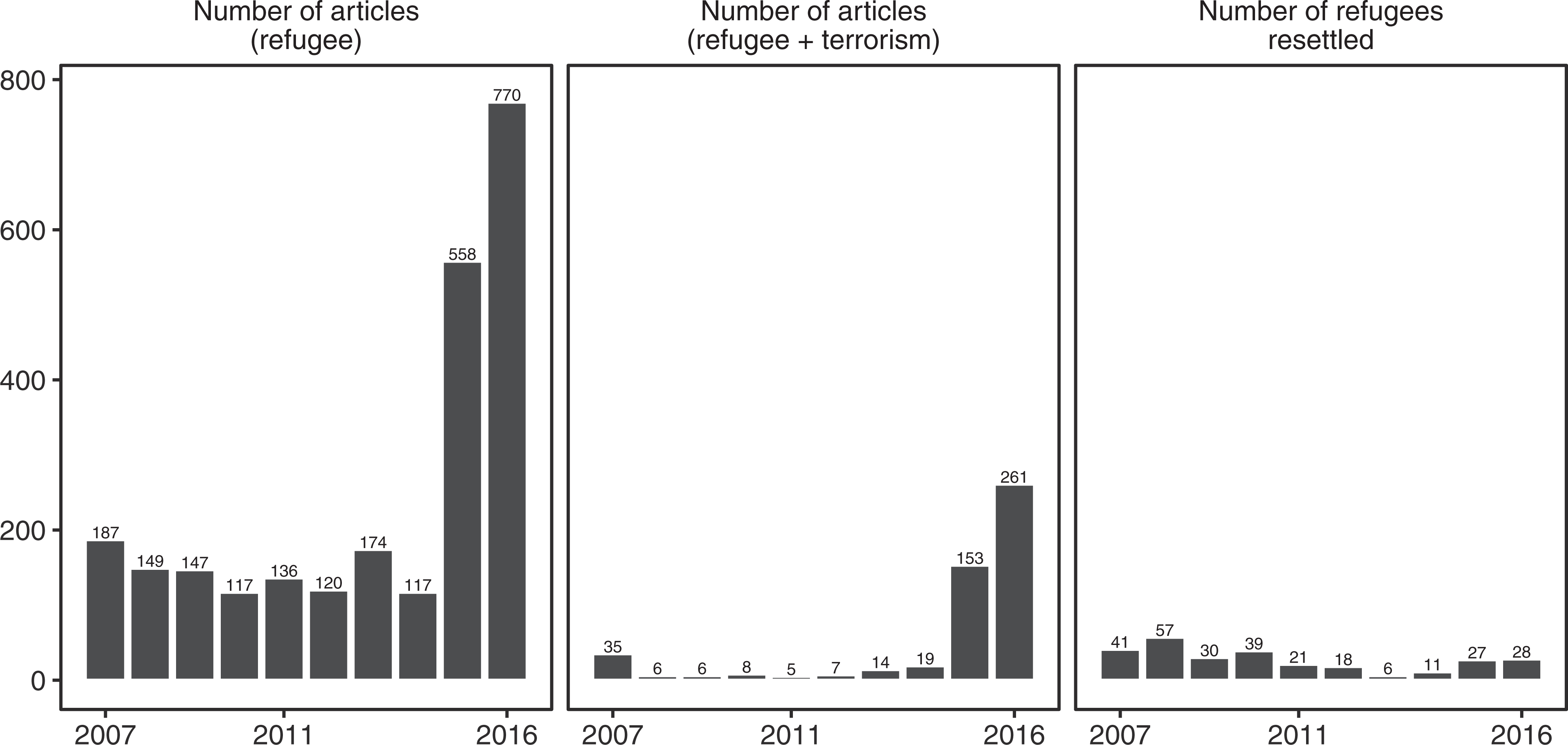
Since the refugee crisis is inherently a global collective action problem, the increasingly prevalent frames of refugees as a security risk could make many countries, including Japan, more restrictive in refugee policies. The primary objective of our study is to contribute to the theoretical literature on NIMBY-ism and on the linkage between perceived threats and prejudice among people. We also aim to examine policy concerns regarding this global problem based on our survey experiment in Japan.
Theories
This section discusses how our study will contribute to the broad theoretical literature on NIMBY-ism and intergroup relations. In particular, we focus on the linkage between perceived threats and prejudice among people to highlight some theoretical ambiguities in the context of Japan.
NIMBY-ism
In the United States, former President Donald Trump signed the controversial executive order (the so-called ‘travel ban’ or ‘Muslim ban’) in 2017 to slow and halt refugee resettlement. The Trump administration’s preconception was that refugees, mainly Muslim refugees from the Middle East, were likely terrorists in disguise. Ferwerda, Flynn & Horiuchi (2017) conducted a survey experiment in the United States soon after the executive order was signed to understand US citizens’ attitudes toward this controversial issue. Their findings suggest the presence of NIMBY syndrome among Americans. Specifically, they are less supportive of resettlement in their local community than elsewhere in the nation.
We extend their study by varying geographic resettlement locations to measure two levels of NIMBY-ism among natives. The previous study only measures within-country NIMBY-ism – whether people are less supportive of refugee resettlement in their own communities than in their country as a whole. Our study also explores between-country NIMBY-ism – whether people are less supportive of refugee resettlement in their country than in other developed countries. Specifically, our survey experiment asked participants about refugee resettlement in Japan, their communities, and developed countries in general. 13 This theoretical conceptualization of NIMBY-ism is essential to understand Japan’s passive and restrictive refugee policy, as we can gauge to what extent the public would prefer to free-ride other countries’ efforts on this issue.
Furthermore, by measuring the two levels of NIMBY-ism, with randomized variations in the geographical proximity to potential threats and refugee resettlement, we also intend to examine whether information about the influx of refugees can amplify or mutate NIMBY attitudes in public. Using respondents in the control group, Ferwerda, Flynn & Horiuchi (2017) show that Americans’ NIMBY-ism sentiment toward refugee resettlement is robust. They also show that this sentiment is prevalent among respondents regardless of their individual-level attributes, including partisanship and location-specific characteristics (such as whether they reside in refugee-dense counties). However, they do not examine how their measure of NIMBY-ism – the difference between the level of support for local resettlement and for national resettlement – would vary by information stimuli given to respondents.
In theory, the origin of NIMBY-ism is the concentrated cost and the diffused benefit associated with hosting a public facility that is perceived to be unpleasant by local residents (Dear, 1992; Hankinson, 2018). When people can benefit without incurring the cost, they are motivated to oppose the development of such a facility in their neighborhood. In the context of refugee resettlement, the perceived benefits are primarily derived from humanitarian concerns. Therefore, the benefits are diffused and not specific to locations. However, the perceived costs are expected to be geographically concentrated because they relate to the risks of accepting refugees, such as safety concerns. We expect that this mechanism operates broadly not just in the United States (Ferwerda, Flynn & Horiuchi, 2017) but also in other countries, including Japan.
With respect to the change in NIMBY-ism, however, the effects are less straightforward. There are two possible outcomes. One is that if people’s attitudes toward refugee resettlement are susceptible to location-specific information, NIMBY attitudes are likely to vary accordingly. For example, when respondents are exposed to information about the increased risk of terrorism associated with the influx of refugees in their countries, their opposition to resettlement in their countries, not in other countries, may increase. Subsequently, the difference in the level of opposition between the two conditions will expand, resulting in a stronger NIMBY sentiment.
Alternatively, people may be susceptible to threatening information regardless of the proximity to the threats in the information. In the above example, when people are exposed to information about the risk of refugee resettlement, their opposition to resettlement may increase regardless of the location. Suppose opposition to resettlement in their countries (say, Y
1) and other countries (Y
2) both increase to the same degree (and in the same direction). In that case, the baseline NIMBY attitudes will neither increase nor decrease, and the effect of threatening information on
Perceived threats on intergroup relations
Another body of literature relevant to our study concerns the impact of threats on intergroup relations. According to the social psychology literature, group membership can provide people with various psychological benefits related to identification (Tajfel & Turner, 1986). For instance, in-group members may boost their self-esteem by looking for negative aspects in the out-group members (Crocker & Luhtanen, 1990). Negativity plays an important role in shaping prejudices against out-group members. In particular, intergroup threat theory – also known as integrated threat theory – points to a close relationship between the perceived threats of intergroup members and their discriminatory attitudes toward out-group members (Stephan & Renfro, 2002; Stephan, Renfro & Davis, 2008).
Empirical research supports the intergroup threat theory: it demonstrates that perceived fear and threat from out-group members, such as immigrants, can form prejudice against out-group members (Branscombe & Wann, 1994; Maio, Esses & Bell, 1994; Esses, Jackson & Armstrong, 1998; Stephan et al., 2005). Notably, scholars endorsing intergroup threat theory argue that the subjectively perceived threat posed by out-group members increases prejudice and hostility toward them among in-group members, even if the threat is not real or perceived inaccurately (Stephan, Ybarra & Bachman, 1999; Stephan, Ybarra & Rios, 2009). 14
If the perceived threat matters regardless of its accuracy, we question how a threatening rhetoric and news about refugees affect their attitudes toward resettlement. Previous studies examining natives’ threat perceptions and attitudes toward migrants are often based on actual terrorist incidents. 15 One important exception is Avdan & Webb (2019). 16 By conducting two survey experiments in the United States, they show that people’s threat perceptions are influenced by not only their physical proximity to actual terrorist attacks but also what they call ‘personal proximity’. Specifically, they show that threat perception is greater when respondents are exposed to a hypothetical terrorist attack story in countries with similar demographics to the United States (i.e. Canada and Britain) and in predominantly white countries (i.e. Romania and Albania). They call the variation in people’s empathy for the victims of terrorist attacks the ‘empathy gap’.
Avdan & Webb’s (2019) study provides a new theoretical perspective for understanding how proximity to a threat affects public opinion. If the theory of empathy gap is generally applicable beyond the case of the United States, then we should expect the respondents in our survey experiment to react negatively to a threatening frame associated with Japan but not necessarily to that of a distant country.
The effect of threatening information could also be amplified by factors other than the physical or psychological proximity to threat. Recent studies show that the fear caused by terrorist incidents may spread across national borders (Böhmelt, Bove & Nussio, 2020) and that people in homogeneous societies are more receptive to stories that connect outsiders (e.g. immigrants) to terrorism (Nussio, Bove & Steele, 2019). In a situation where there is an increase in news linking refugee resettlement and terrorism (as discussed in the ‘Japan as a case’ section), an alternate possibility in the context of Japan is that Japanese people are susceptible to threatening information about refugee resettlement, because of the highly homogeneous nature of its society and culture, regardless of the proximity to resettlement and potential threat.
Hypotheses
To add nuance to our theoretical understanding of the roles of NIMBY-ism and perceived threats in forming opinions about refugee resettlement, we made several novel variations to our survey experiment. Before introducing our hypotheses, we briefly explain the variations in our outcome and treatment variables. 17 The details of our survey design are explained below in the ‘Research design’ section.
First, we examine whether natives’ attitudes toward refugee resettlement vary depending on the geographic locations of potential refugee resettlement. Ferwerda, Flynn & Horiuchi (2017) examine Americans’ opposition to refugee resettlement in their local community versus elsewhere in the United States. Extending their study, we investigate Japanese people’s opposition to refugee resettlement in three different locations – their local municipality, elsewhere in Japan, and (other) developed countries.
Second, we randomly assign different media frames with a variation in the proximity to potential threats – a threatening frame that discusses security concerns caused by the inflow of refugees to Japan (hereinafter, ‘Domestic threat frame’) and one which reports the security problems facing a foreign country (‘Foreign threat frame’). This variation in proximity to threats is key to understanding the two theoretical puzzles discussed in the ‘Theories’ section: whether the NIMBY attitude changes with geographically specific threatening information and whether Japanese people have a weaker sense of empathy toward people in other countries.
Describing the above discussion formally, each respondent i is randomly assigned to
The first hypothesis is about NIMBY-ism. We expect that even in the absence of a threat frame, the opposition to refugee resettlement varies by resettlement location.
Hypothesis 1 (NIMBY-ism): The opposition to refugee resettlement is stronger when a question is more relevant to respondents’ locality or country of residence.
For this analysis, we exclusively focus on the control group respondents who were not exposed to a threatening frame (
The second hypothesis is about the effect of a threatening frame. We expect that natives primed with information that refugees might pose a serious threat, as opposed to those who are not primed, are more likely to become concerned about accepting refugees for resettlement because of their intensified fear and prejudice.
Hypothesis 2 (Effect of threat frame): The opposition to refugee resettlement becomes stronger when respondents are exposed to a threatening frame.
For this analysis, we use the average level of opposition to refugee resettlement;
The third hypothesis is about the differential effects of threat frames. People may consider the ‘personal proximity’ to the potential threats (Avdan & Webb, 2019). The issues presented in the Domestic threat frame are more directly relevant to respondents’ perceived well-being than the issues in the Foreign threat frame. Hence, the effect of threat frame may be particularly large when the respondents are exposed to the Domestic threat frame than the Foreign threat frame. These possibilities lead to the following hypothesis.
Hypothesis 3a (Differential effects of threat frames): The effect of Domestic threat frame is larger than the effect of Foreign threat frame.
If Japanese people did not measure the ‘odds’ of potential threats in varying locations, we might not observe a substantive difference in the treatment effects between the two types of threat frames. To test these competing views, we use the average outcome variable, that is,
In addition, these differential effects (by the potential location of threats – domestic or foreign) may depend on the potential location of refugee resettlement. Thus, we hypothesize as follows.
Hypothesis 3b (Differential effects on NIMBY-ism): The differential effect is significant when a question is about resettlement in Japan or in each respondent’s municipality but not when it is about resettlement in other developed countries.
The underlying logic here is that the Domestic threat frame is expected to substantially affect public opposition to refugee resettlement when it comes to resettlement in respondents’ proximity. In other words, the differential effects of threat frames may magnify the NIMBY attitudes among respondents. However, if Japanese people do not consider where the negative consequences of threats could occur, the differential effects may not vary depending on the refugee resettlement location. In this case, NIMBY-ism does not change depending on the presented threat frame.
Research design
To test our hypotheses, we conducted a pre-registered survey experiment from 6 June through 3 July 2017 using Qualtrics Panels. 20 The target population was Japanese citizens who were 20 years or older. 21 We set sampling quotas based on demographic variables to obtain a sample representing the target population. 22 The total number of valid responses to our survey is 2,250. 23
In our survey, respondents first went through multiple pre-treatment questions, including questions about their attributes, opinions about society and politics, and a screener. 24 The questions about society and politics were added to create a flow of questions leading to the screener question that seemed natural and less abrupt. Then, we randomly assigned respondents to one of the following three groups: a control group and two treatment groups. The respondents in the control group did not read any news articles. In contrast, the respondents in the treatment groups read a news article that focuses on the extent to which refugees could pose risks to public safety.
There are two versions of the threatening frames based on actual news articles (see Section D in the Online appendix for details). The first treatment (Domestic threat frame) has the title ‘Disguised refugees surge into Japan: what to do with Japan’s terrorist policy’. It discusses the issues of ‘disguised refugees’ trying to take advantage of the fact that people can obtain work eligibility after submitting an application for refugee status in Japan. Similarly, the second treatment (Foreign threat frame) discusses potential concerns about terrorist attacks in relation to the influx of refugees in France. Its title is ‘Paris suicide bomber smuggled in as a Syrian refugee: negative impact of open-door policy’. The article suspects that terrorists might have entered France pretending to be Syrian refugees.
We acknowledge that these two treatments are different not only with respect to the location of potential terrorist attacks associated with the influx of refugees but also with respect to others. Methodologically, we can only estimate the ‘compound’ average treatment effects (Dunning, 2012: 300–302) of the news articles. For example, the Domestic threat frame could be interpreted as a threat to Japan’s economy rather than its security. However, our experimental design does not allow us to decompose the effects of various parts of the treatment materials. Despite such a limitation, we believe that our treatments are suitable for our study for two reasons.
First, we believe the critical part of each treatment is its title. As in the original articles, we highlighted these titles in a large and bold font. Both treatments link the influx of refugees with potential concerns of terrorism, and we expect that these titles primarily manipulate respondents’ comprehension of the treatment materials. The results of our manipulation test, which are presented in Section E of the Online appendix, confirm our expectations.
Second, using the actual articles, we ensure the ecological validity of our experimental results. Japanese newspapers and the Japanese editions of international media often carry articles such as those we use in our experiment, which link refugees and terrorism. Indeed, between 2012 and 2016, around a quarter (26.0%) of refugee-related articles that appeared in the Nihon Keizai Shimbun, one of the most widely circulated Japanese newspapers, mentioned terrorism (see Figure 1).
In our experiment, as we mentioned before, we randomly assigned respondents to one of the three conditions, including those that display either one of the articles. We then asked the following question three times with different geographical contexts (‘developed countries’, ‘Japan’, or ‘your municipality’) of refugee resettlement to measure our outcome variables: Do you think refugees should be accepted in [developed countries/Japan/your municipality]?
25
Opposition to refugee resettlement in Japan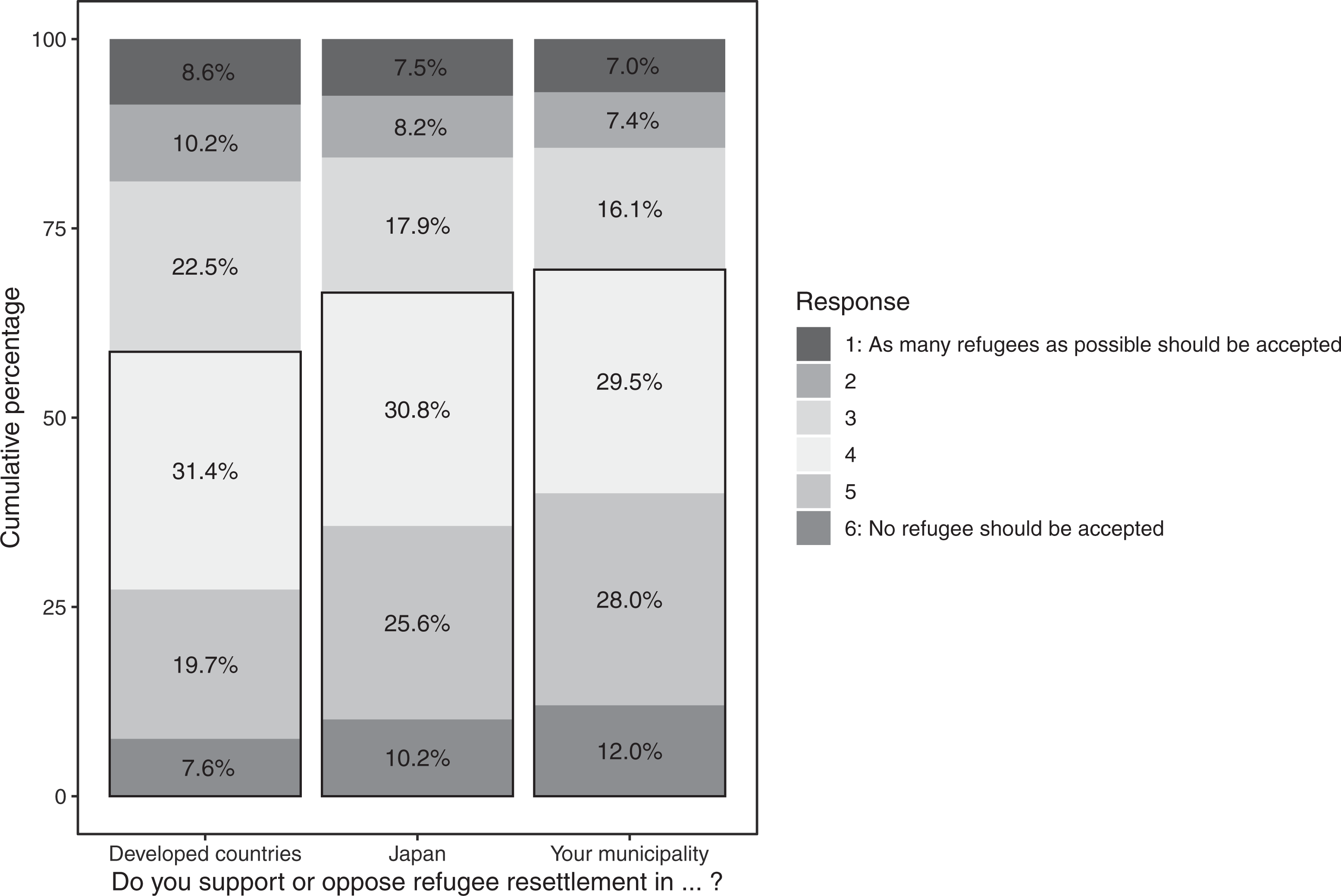
For an attention check, we asked three questions relevant to the frames given to the treatment groups at the end of the survey. For a manipulation check, we also allowed respondents to submit comments about the survey (if they had any) before concluding. As mentioned above, using the actual news articles ensures ecological validity. However, it could also raise a concern that the two articles differ in many aspects. Therefore, we confirmed that respondents were manipulated in an expected manner by examining the contents of voluntary comments that they made at the end of the survey.
Results
This section first shows the results of testing the first hypothesis on NIMBY-ism using respondents assigned to the control group. We then present the results of testing other hypotheses about the treatment effects. The results of our manipulation check, reported in Section E of the Online appendix, suggest that our treatments (news articles) successfully manipulated respondents’ perceptions as we had intended. The treatments increased perceived threats among respondents, but there is no substantial difference in the fear-inducing effects between the two treatments. The results of the attention check reported in Section I of the Online appendix suggest that respondents well understood the content of our treatments.
NIMBY-ism (Hypothesis 1)
We first assess the extent to which public opposition to refugee resettlement varies across the geographic location of potential resettlement (Hypothesis 1). Figure 2 shows the distribution of responses to each of the three outcome variables about attitudes toward refugee resettlement in the control group (i.e. respondents who were not exposed to any threat frame). As noted above, the six-point attitude scale ranges from 1 (as many refugees as possible should be accepted) to 6 (no refugee should be accepted). The percentage of participants who selected one of the three upper categories (4, 5, 6) indicating their opposition to refugee resettlement (highlighted in solid-line borders in Figure 2) is 58.7%, 66.6%, and 69.5% for ‘developed countries’, ‘Japan’, or ‘your local municipality’, respectively. Respondents are overall more opposed to refugee resettlement as the geographic location of potential resettlement becomes closer to their communities.
The percentages of participants who chose one of the lower three categories (1, 2, 3) indicating their support for refugee resettlement are higher than 30%. This number may seem high, but we argue that it is plausible to assume that participants responded to our questions based on social desirability without rationally calculating the costs and benefits of accepting refugees. Significantly, these percentages are still much lower in Japan than in the United States. In Section G of the Online appendix, we present the comparison results using an Amazon Mechanical Turk sample in the United States. We find that while more than 50% of Japanese respondents oppose refugee resettlement when asked about the resettlement in developed countries, less than 50% of American respondents oppose refugee resettlement even in their local communities. These differences indicate that Japanese people’s opposition to refugee resettlement is relatively strong.
To test the within-subject differences more appropriately, we treat the outcome variables as continuous and examine whether each pair’s difference is significantly different from zero (focusing exclusively on the respondents of the control group). The average level of opposition to refugee resettlement is 3.662 in developed countries, 3.893 in Japan, and 4.002 in municipalities. The differences in means between the question about resettlement in Japan and developed countries (
These results suggest the existence of two levels of NIMBY-ism. While Ferwerda, Flynn & Horiuchi (2017) found within-country NIMBY-ism among Americans, we find within-country and between-country NIMBY-ism among Japanese citizens. Together with our findings from comparing NIMBY attitudes between Japan and the United States, as reported above, our analysis indicates that Japanese respondents are inclined to free-ride other countries’ efforts to address the global refugee crisis. We will discuss more on the need to investigate the two levels of NIMBY-ism in the concluding section.
Treatment effect of the threat frame (Hypothesis 2)
We next test Hypothesis 2 by measuring the average responses to the three outcome variables (opposition to refugee resettlement in developed countries, Japan, and local municipality) for each respondent. Figure 3 compares these averages among respondents for the control group, the Domestic threat frame (DT) group, and the Foreign threat frame (FT) group, respectively. Figure 3 indicates the 95% confidence intervals using the vertical error bars. The estimated average treatment effects (ATEs) are within the shaded bars. The standard errors are in parentheses.
The average attitude toward refugees among respondents assigned to the control group is 3.852, which is slightly above the midpoint and leans toward opposition to refugee resettlement. Compared to these respondents, those exposed to either one of the threatening frames were more opposed to refugee resettlement, consistent with Hypothesis 2. The treatment effects are positive (i.e. more vigorous opposition against refugee resettlement) and highly significant at the 0.01 level.
The magnitude of this effect is also substantial. Given that the standard deviation of the average outcome variable among respondents in the control group is 1.293, the increases in the opposition to refugee resettlement by 0.292 and 0.267 are equivalent to 22.6% and 20.1% of the standard error in the baseline comparison group. These effects are also about 13.6% and 12.4% of the maximum increase in the outcome variable from the baseline (i.e. the average for the control group).
The results are similar when we examine the treatment effects on the individual outcome variables (resettlement in developed countries, Japan, and the local community). Table I shows the results of running three regression models. The control group is the baseline category (i.e. the constant term in our regression model). The effects of the two treatment variables on the three outcome variables are all positive and highly significant.
We further undertake three additional tests to verify the validity of our analysis. First, we use the sampling weights. To adjust and account for the remaining differences in the marginal distributions of five key demographic variables – region, age, sex, education, and income – between the population and our sample (see Section C in the Online appendix), we estimate the weights via entropy balancing (Hainmueller, 2012). Second, we test the effect heterogeneity. Using four essential
Average treatment effects (ATEs) and the difference in the ATEs The average treatment effects by outcome variables The standard errors are in parentheses. The outcome variable is opposition to refugee resettlement in developed countries, Japan, or a respondent’s municipality, ranging from 1 (‘As many refugees as possible should be accepted’) to 6 (‘No refugee should be accepted’). ** 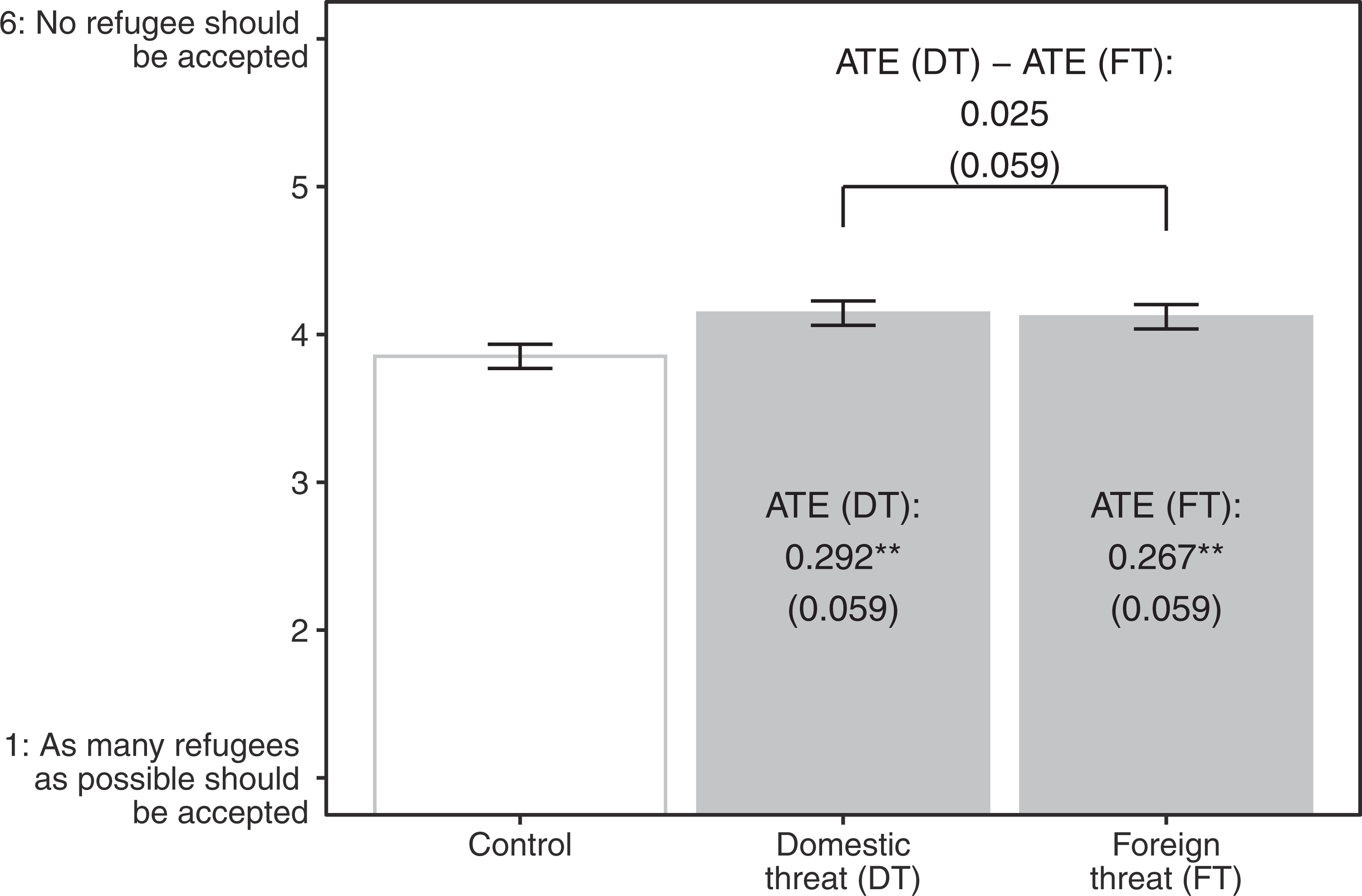
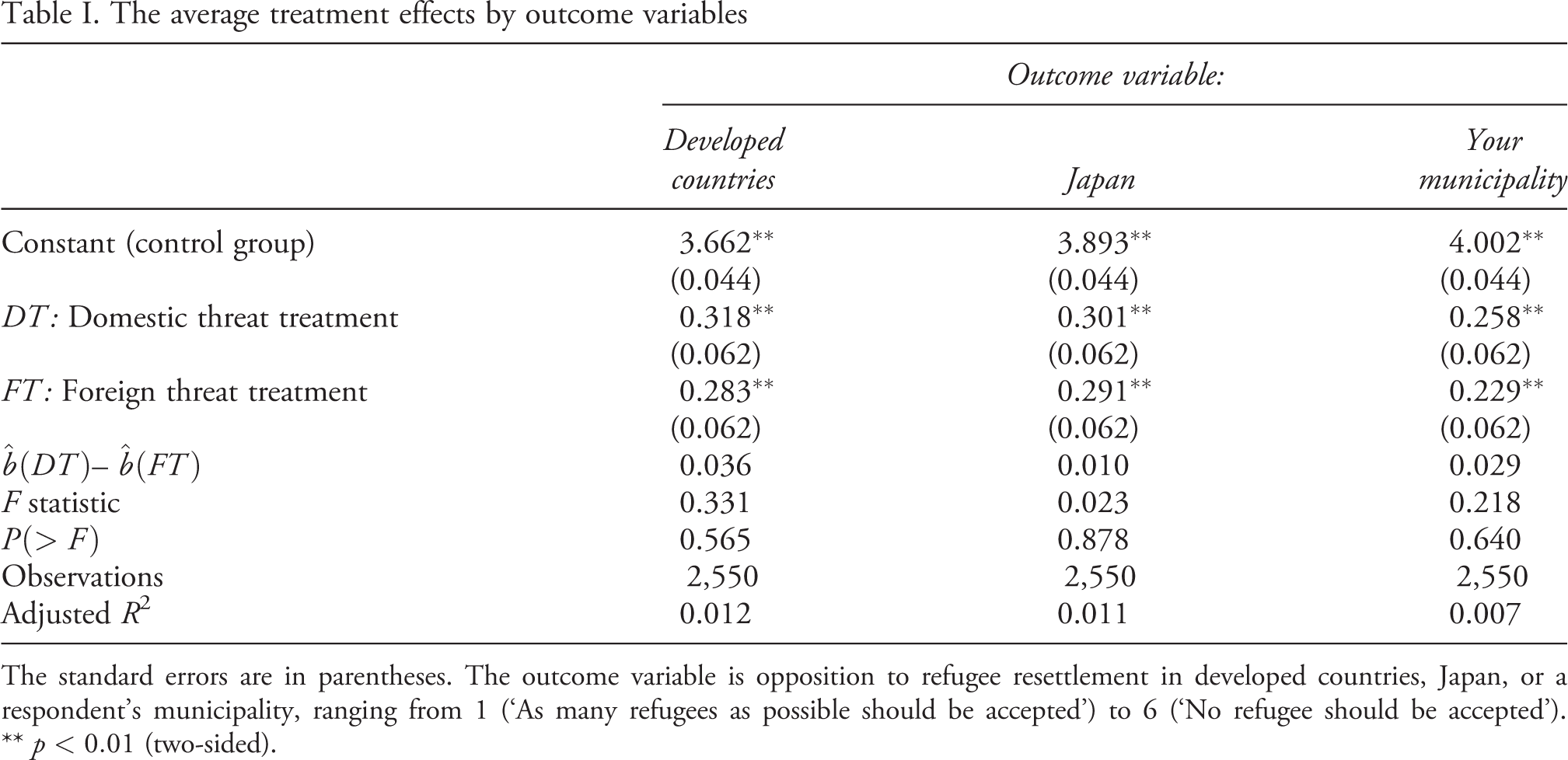
Differential effects of threat frames (Hypotheses 3)
We compare the differences in the effects of the Domestic threat frame and Foreign threat frame using the averaged outcome variable (Hypothesis 3a). As shown in Figure 3, this hypothesis is not empirically supported. Consistent with our hypothesis, respondents exposed to the domestic threat frame are more strongly opposed to refugee resettlement than those exposed to the foreign threat frame. However, the difference between the effects of the two threat frames (presented as ‘ATE (DT)
The lack of support for Hypotheses 3a and 3b may suggest that Japanese people do not distinguish between threats in Japan and abroad when exposed to threatening frames. Indeed, they have supported the government’s restrictive refugee and immigration policy to maintain demographic homogeneity. However, we do not believe that this lack of empirical support is simply because Japanese respondents think any refugee-related threat is unrealistic and thus have difficulty envisioning its impact on their everyday lives. If respondents did not take the content of the assigned news article seriously, we would not observe the significant treatment effects in both conditions (Hypothesis 2). 27
Summary of results
In summary, our hypothesis regarding the NIMBY-ism (Hypothesis 1) is strongly supported. The hypothesis on the effect of a threatening frame in general (Hypothesis 2) is also strongly supported. However, our hypotheses regarding the differential treatment effects between the Domestic threat frame and Foreign threat frame (Hypotheses 3a and 3b) are not supported. These results imply that Japanese people have strong NIMBY attitudes to refugee resettlement. Furthermore, and more importantly, they react to any threatening frame regardless of the location of the threat or refugee resettlement.
Conclusion
In many developed countries, there are exclusive attitudes toward refugees among the natives. Simultaneously, the presence of vocal anti-refugee politicians who attempt to associate refugees with terrorist attacks is also salient. Their aggressive message might strengthen the opposition to refugee resettlement among citizens, making it more difficult for the international society to cope with the refugee crisis. We conducted a randomized survey experiment in Japan to examine the effects of such threatening information about refugees on the public’s attitudes toward refugee resettlement.
We found two salient and important patterns. Our analysis of the control group, in which no threatening articles were shown to respondents, indicates that citizens commonly have strong NIMBY attitudes toward refugee resettlement. Due to humanitarian concerns, natives may support refugee resettlement in general but not necessarily in proximity. We also found that natives are more opposed to resettlement when exposed to an article that portrays refugees as a threat, regardless of whether the threat is directly relevant to their country and regardless of the geographic location of potential resettlement.
These findings add nuance to the literature on threat perceptions and public attitudes in intergroup relations (or attitudes toward refugee resettlement, in particular) in three important ways. First, Ferwerda, Flynn & Horiuchi (2017) point out the presence of NIMBY attitudes toward refugee resettlement among citizens of the United States, but our finding suggests that the NIMBY syndrome is not just specific to the United States. Second, our empirical findings support the theory that subjectively perceived threats augment hostility toward out-group members, even in the absence of actual threats (Stephan, Ybarra & Bachman, 1999; Stephan, Ybarra & Rios, 2009). Third, our study contributes to the theoretical debate on the effects of proximity to threat and supports the argument that the psychological effects of terrorism on negative attitudes toward outsiders are more significant in homogeneous societies, irrespective of proximity to incidents (Nussio, Bove & Steele, 2019).
The finding that people have NIMBY attitudes toward refugee resettlement and are highly susceptible to any threatening frame regardless of the context has substantive and practical implications beyond the scholarly debate. First, although the global refugee crisis requires coordination among developed countries, people in these countries are inclined to free-ride other countries’ efforts to address the crisis. As our research shows, NIMBY-ism is relevant within each country (within-country NIMBY-ism) and an important threat to solving the global refugee crisis (between-country NIMBY-ism). Japan’s restrictive policy has been criticized for free-riding, and the international community has urged them to accept more refugees. 28 However, Japan is unlikely to be the only country facing an incentive for free-riding. We need further comparative studies on NIMBY attitudes toward refugee resettlement.
Second, media reports portraying refugees as a threat in other countries could induce feelings of fear among natives and make them even more opposed to refugee resettlement. With increasing accessibility to various types of news and social media worldwide, including ‘fake news’ and misinformation, these results raise serious concerns about their roles in shaping public opinion on refugee issues. The duration of the media effect might be short-lived, but the repetition of similar threatening messages in the media may produce persistent effects on natives’ political and social attitudes.
In conclusion, our study shows a continued challenge for many developed countries in accepting more refugees, at least in the short term. As long as the government is responsive to public opinion, it is unlikely to observe significant changes in its highly restrictive refugee policy. Even if refugee policy becomes a political priority (due to, for example, pressure from other countries or the collapse of a neighboring country’s regime), voters’ predisposition to free-riding and their strong reaction to threatening frames could trigger their opposition to accepting more refugees. Such opposition is particularly plausible if politicians scare citizens by emphasizing potential threats to the country, thereby persuading them to support their anti-refugee policies and candidates (Jerit, 2004; Lupia & Menning, 2009; Marcus, 2000).
Do natives of other developed countries also have a similar inclination to free-ride other countries’ efforts? Are they also susceptible to threatening information, regardless of the proximity to threat and the proximity to refugee resettlement? Examining these questions is essential for future research, to the extent that international cooperation is needed to tackle this global crisis. We hope that our study paves the way for further development of theories on the causes and consequences of natives’ susceptibility to threatening information and their attitudes toward out-group members, especially refugees.
Footnotes
Replication data

Acknowledgments
We presented earlier drafts of this article at the inaugural annual meeting of the Japanese Society of Quantitative Political Science (Tokyo, 8–9 January 2018); the 2018 annual conference of the Midwest Political Science Association (Chicago, 5–8 April 2018); and seminars at the Research Institute of Economy, Trade, and Industry (Tokyo, 4 June 2018) and the University of Pennsylvania (29 March 2019). We thank Barry Burden, Katie Clayton, Yue Hou, Akira Igarashi, Kosuke Imai, Jill Sheppard, Teppei Yamamoto, and other participants in these conferences and seminars for their helpful comments. We also thank Sunny Drescher, Kasey Rhee, and Jen Wu for research assistance and proof-reading. Ono also acknowledges that this article is part of the project ‘Research on Political Behavior and Decision Making: Searching for Evidence-Based Solutions to Political Challenges in the Economy and Industry’ at the Research Institute of Economy, Trade and Industry (RIETI).
Funding
For financial support, Horiuchi thanks the Dean of the Faculty at Dartmouth College and Ono thanks the Japan Society for the Promotion of Science (Grants-in-Aid for Scientific Research: 16H03564, 17K03523, 18H00813, 19H00584, 20H00059).