




Abstract
How do major national events influence attitudes toward non-nationals? Recent research suggests that national sports team wins help foster national pride, weaken ethnic attachments, and build trust among conational out-group members. This paper asks a related question: By heightening nationalism, do these victories also affect attitudes toward foreign out-groups, specifically refugees? We examine this question using the 2019 Africa Cup football match between Kenya and Tanzania, which Kenya narrowly won, coupled with an online survey experiment conducted with a panel of 2,647 respondents recruited through Facebook. We find that winning increases national pride and preferences for resource allocation toward conationals, but it also leads to negative views of refugees’ contribution to the country’s diversity. However, we present experimental evidence that reframing national sports victories as a product of cooperation among diverse players and highlighting shared superordinate identities can offset these views and help foster positive attitudes toward refugees.
Introduction
How do major national events affect citizens’ attitudes toward foreigners? Independence day celebrations, the Olympics, and other cultural events have been shown to increase national identity and pride (e.g., Billig, 1995; Billings et al., 2013; Lau et al., 2012). While the comparative politics literature generally considers nationalism to be a beneficial resource for improving intergroup relations and fostering nation building (Anderson, 1982; Miguel, 2004; Robinson, 2016), this view stands in stark contrast to studies which demonstrate that nationalism can intensify or reinforce xenophobia (Berezin, 2006; Sniderman et al., 2004; Wimmer, 2002). The narrow focus on national identification as it pertains to intergroup relations between subnational groups overlooks potential costs associated with increased nationalism related to attitudes and behaviors toward foreigners.
This paper centers on the important, yet understudied, question of how national events, specifically sports games, engender nationalism and influence views toward migrants living in the nation’s borders. Extending the literature on nationalism and sports, we adopt a micro-level focus centered on a critical dependent variable not generally incorporated in the existing empirical work—attitudes toward refugees. Drawing on social identity theory, we theorize that if enhancing national identification shifts the referent out-group from subnational “others” to those beyond state borders, we might wonder whether events that galvanize nationalism affect attitudes toward non-nationals (Brewer, 1999; Tajfel, 1981). Using the context of an international sports competition, we examine how a national team victory influences attitudes toward refugees. In particular, we explore whether nationalism induced by these cultural events is inherently exclusive, or whether it need not co-occur with negative feelings toward refugees—a salient and often stigmatized foreign out-group.
As levels of forced displacement have reached unprecedented rates in the past decade, hosting refugees has increasingly been met with public resistance (Adida et al., 2018; Dancygier & Laitin, 2014). This trend is reflected in the growing wave of scholarship on refugee reception in the Global North. Yet the vast majority of refugees, more than 85%, are located in the Global South, which makes understanding citizens’ attitudes toward refugees in these regions both an important theoretical and policy question. We investigate our research questions in sub-Saharan Africa, which hosts 6.3 million refugees, almost a third of the world’s refugee population (UNHCR, 2019). To date, less scholarship has been devoted to understanding citizen attitudes toward refugees in African contexts. 1 Sub-Saharan Africa also presents an interesting case where many countries are generally considered to have weaker national ties and more robust ethnic affinities (e.g., Asiwaju, 1985; Englebert, 2009; Herbst, 2000; Young, 2001).
Our study takes advantage of the 2019 Africa Cup football match between East African rivals, Kenya and Tanzania. We recruited a panel of 2,647 respondents through Facebook in Kenya and Tanzania, and we measured their pre and post-game levels of identification, pride, and attitudes toward different groups. Using the outcome of the game—which Kenya narrowly won—we use a difference-in-differences design to look at the effect of a win on attitudes. In addition, experimental survey primes that manipulated either the salience of a superordinate (pan-African) identity or highlighted the diversity of the team allow us to test whether a national victory can be reframed to foster inclusion and broaden the in-group to encompass other African refugees.
Consistent with previous research, we first confirm that a national team win bolsters national identity and pride in the nation. Next, we show that the win does not affect attitudes toward refugees with respect to their contribution to the economy, disease, or crime in the country. However, we do find a negative effect of winning on citizens’ attitudes about refugees’ contribution to the diversity of the nation, and these effects last several days after the match. Our results suggest that while national team victories do not affect more practical concerns about refugees, they can heighten feelings of cultural threat. Importantly, we also find that our primes, particularly that which emphasizes a shared pan-African identity, help to ameliorate this negative sentiment and actually induce positive attitudes toward refugee diversity as well as greater willingness to allocate scarce government resources to refugees in the country.
This paper contributes to the intergroup relations literature by examining the connection between nationalism and xenophobia in sub-Saharan Africa and provides an empirical test of the common in-group identity model (Gaertner et al., 2000). Although our sample of social media users is not nationally representative, we do not believe the effect of a sports team win or survey primes are unique to our sample and may indeed generalize more broadly, due to the psychological nature of the mechanism. Similarly, this paper uses the context of a sports team victory as a “shock” to nationalism, while recognizing that sporting events are an example of a class of salient cultural events that can similarly evoke feelings of national pride and nationalism but may also induce animosity toward foreigners. 2 We therefore suggest that this paper offers broader insights into how policy makers and the media might take advantage of cultural events by reframing them to engender trust between citizens and foreigners.
Nationalism, Sports, and Intergroup Relations
Existing intergroup relations research suggests that it is possible to extend positive feelings toward previously excluded out-group members by emphasizing a higher order common in-group identity (Crisp & Hewstone, 2007; Gaertner et al., 1993). Several studies use national identification as one such superordinate identity. These studies illustrate that national identity can help mitigate animosity between ethnic and religious groups that compete over scarce resources in developing countries (Charnysh et al., 2015; Depetris-Chauvin et al., 2018; Robinson, 2016). In sub-Saharan Africa, where identification with the nation is generally thought to be weak, the strength of national identity has also been shown to have important implications for public goods provision (Miguel, 2004), inter-ethnic trust (Robinson, 2016) and social sanctioning (Jeon et al., 2017). In nascent and diverse states, a strong national identity is generally purported to be a benefit.
Nationalism, or the practice of identifying with one’s nation-state and viewing other nations and their citizens as fundamentally different (Bonikowski & DiMaggio, 2016), can also have negative consequences. Although a shared national identity can bind people within a society together—reducing the likelihood of domestic civil strife—it may provoke nationalist sentiments that lead to war with neighboring countries or exacerbate tensions with non-nationals residing in the country, sometimes referred to as “xenophobic nationalism” (Brubaker, 2009). Several studies conducted in the U.S. and Europe illustrate that nationalism can lead to anti-immigration attitudes. For example, Citrin et al. (1990) and Sniderman et al. (2004) find that national identity considerations strongly predict opposition to immigrants. Wimmer (1997) argues that xenophobia and racism emerge alongside appeals to national solidarity during times of societal crisis such as downward mobility of native citizens. 3 In international relations research, scholars link surges of nationalism to more hawkish citizens and leaders, and increased state aggression against foreign adversaries (Bertoli, 2017; Herrmann et al., 2009; Schrock-Jacobson, 2012; Van Evera, 1994; Woodwell, 2007). Notably, none of these studies were conducted in the Global South. Connecting the literatures on nationalism in the Global South—where it is generally seen as a boon for coethnic relations—and in the West—where it is linked to xenophobia—we examine whether strengthening national identification and pride leads to out-group animosity targeted toward foreigners in sub-Saharan Africa.
Using the context of a national sports team victory, we analyze the relationship between sports-induced nationalism and attitudes toward refugees in Kenya and Tanzania. Across the globe, national sporting events have been shown to be a potential mechanism through which states can foster nationalism (Billings et al., 2013). In Africa, post-independence leaders used sports, particularly football, as a nation-building tool to foster a shared national identity (Dorman, 2019; Larmer & Lecocq, 2018). Recent cross-national research on the continent reveals that national sports team victories lead to greater national identification, increased trust in members of other ethnic groups, and lowered intrastate ethnic conflict (Depetris-Chauvin et al., 2018). Yet, sports-fueled nationalism can also lead to a more hawkish citizenry and more aggressive foreign policy (Bertoli, 2017).
This paper adds to the growing number of studies using sports to explore dynamics of intergroup relations. Some researchers vary “contact” with out-group members through sports activities to measure the effect of sports-related cooperation on attitudes and behaviors (Lowe, 2021; Mousa, 2020). Other studies consider how sports team “fandom” generates cross-cutting, potentially unifying identities (Dawes & Rubenson, 2020) and how celebrity players of diverse backgrounds can help reduce prejudice (Alrababa’h et al., 2019). Identification with a sports team has also been linked to particularly negative sentiments toward fans of the rival team (Cikara & Fiske, 2013). Similar to our questions of interest, Kim and Lopez de Leon (2019) experimentally study the effects of group identity on market discrimination during the 2014 Brazil World Cup, and find that foreigners are charged higher prices than nationals. Depetris-Chauvin et al. (2018) find that football team wins in sub-Saharan Africa foster trust between non-coethnics and even reduce civil conflict. Hence, growing evidence suggests that sports events have a significant impact on intergroup relations.
In the same vein, we ask whether strengthening identification along a particular dimension (national identity) automatically stimulates exclusionary attitudes toward out-group members who do not share that identity trait (Berinsky et al., 2018; Brewer, 2007). We theorize that if national sports team victories increase nationalism, they may also increase negative sentiments toward refugees when their foreign-ness is made salient in an environment of heightened national pride. Due to unprecedented levels of global migration and forced displacement, nation builders today must pay particular attention to how cultural events and other instances of “banal nationalism” (Billig, 1995) structure and influence nationals’ attitudes toward foreigners living within the country’s borders. Different from enduring nation-building schemes, such as civic education (Anderson, 1982; Ansell & Lindvall, 2013), sports are part of a class of more ephemeral, punctuated, and salient cultural events that similarly help define the shared history and experience of a nation. Sports are also an example of cultural events that can have political implications. While understanding how sports become political is worth studying in its own right, since they often serve as national past-times and gain wide viewership, the findings from studies like this likely extend beyond the specific context of a sports team victory to other nationalism-bolstering events, such as Independence Day celebrations.
This study focuses specifically on refugees for several reasons. First, refugees are a growing proportion of the population, particularly in the Global South (UNHCR, 2019). Second, continental sports tournaments offer an opportunity to highlight a shared identity between citizens and these outsiders that could help to overcome out-group animosity. The empirical design presented in this paper offers a harder test of whether boosting nationalism influences attitudes toward foreigners, because in the context of a sports victory, where refugees are not particularly salient, the causal link is somewhat distant. Nevertheless, we believe it is an important test in order to evaluate whether in-group love in the form of strengthened national ties necessitates out-group animosity and if this antipathy is directed toward foreign stigmatized out-groups, particularly refugees.
Thus, our paper builds upon a growing literature studying factors that shape negative attitudes toward refugees and interventions that try to mitigate this animosity. We find that in boosting nationalism, a major national cultural event such as a sports win can prompt exclusionary attitudes toward refugees. Yet given these effects, we are equally interested in whether reframing that event can shift these attitudes toward a more positive view of refugees. We therefore incorporate within-survey experimental primes that do not explicitly make references to migration or refugees, but simply highlight the diversity of the team and a more inclusive pan-African identity. This part of the study relates to recent studies that seek to shift host populations’ attitudes toward greater acceptance of and empathy for refugees using light-touch interventions. 4 These types of interventions include having individuals complete a perspective-taking exercise imagining themselves as refugees (Adida et al., 2018) or consider their own families’ histories of migration (Williamson et al., 2020) in the U.S.; or listen to personal narratives of refugees in Kenya (Audette et al., 2020). Similar to these light-touch interventions, our primes have positive effects.
Case Selection of Kenya and Tanzania
We focus on Kenya and Tanzania, two neighboring rivals, because they are also often compared in the literature due to their similar geography and colonial histories (Miguel, 2004). Nevertheless, post-colonial nation-building policies in Tanzania have led to a difference in the salience of ethnic divisions and national identification. In Tanzania, ethnicity is less politically salient and nationalism is high despite lower levels of economic development (Boone & Nyeme, 2015; Robinson, 2014). 5 Neighboring Kenya, by comparison, is a more ethnically divisive country, in which resource allocation, voting, and political violence are mediated through politically-salient ethnic identities (Ajulu, 2002; Boone, 2011; Kanyinga, 2009; Kasara, 2014). Whereas ethnicity delineates partisanship in Kenya, the relationship between ethnicity and political support is more fluid in Tanzania. Afrobarometer data suggest that, on average, Kenyan citizens are more likely to identify with their ethnic group rather than their national identity. Kenyans are also much more likely to feel that their ethnic group is treated unfairly by the government. These national-level differences have consequences for interethnic trust and participation in public goods provision (Jeon et al., 2017; Miguel, 2004). This project sets aside baseline level differences to look at whether a major national sports event serves as a stimulus for differential change in national identification and pride between these two countries, focusing on citizens’ attitudes toward refugees.
Sub-Saharan African countries collectively host 18 million refugees, which is more than 26% of the world’s total refugee population. Together, Kenya and Tanzania have some of the largest and oldest refugee settlements in the world. Dadaab (est. 1991) and Kakuma (est. 1992) in eastern and northwestern Kenya each host approximately 200,000 refugees from Somalia and South Sudan, respectively. Nyarugusu (est. 1996) in northwestern Tanzania recently hosted approximately 150,000 refugees from Burundi and Democratic Republic of the Congo. Refugees in both countries remain in large camps where movement is restricted, which segregates refugees from interacting with citizens.
Host citizens in both countries generally hold negative stigmatized views of refugees. For example, in Kenya, security concerns surrounding refugees are pervasive, with many associating them with terrorism and conflict (Audette et al., 2020; Aukot, 2003; Whitaker, 2020). Likewise, Tanzania has enacted increasingly repressive policies such as forced repatriation and even state-sanctioned torture citing security fears.6,7 Tanzanians living near the camps have also expressed growing economic resentment at the humanitarian aid delivered to the camps and fears of cholera transmission (Chaulia, 2003; da Costa, 2018; Kweka, 2007; Landau, 2004; Zhou, 2019). A 2018 nationally representative survey conducted in both countries by the International Rescue Committee and Twaweza found that the majority of Kenyans and Tanzanians believe their countries have taken an outsized share of hosting responsibility, and are supportive of closing the camps and sending refugees back to their origin countries. 8 Understanding how national sports events affect nationalism and subsequently influence attitudes toward and willingness to aid refugees, a visible and often stigmatized out-group, can offer important policy lessons in light of the growing displacement crisis which disproportionately affects countries in the Global South.
Importance of the June 27th Africa Cup Match
Across the continent, football is an often watched and much loved pastime. In a documentary about the sport, Archbishop Desmond Tutu is quoted saying that in Africa, football has a “following larger than any one religion. . . Not every African is a Muslim but almost every African is a supporter of one or another team” (Buhler, 2012). The Africa Cup of Nations is a biennial international men’s football championship, for which players of both domestic and foreign clubs return to represent their nation. In the 2019 tournament, a historic number of 24 teams participated. Qualifying for the 2019 Africa Cup of Nations tournament was momentous for both Kenya and Tanzania. Tanzania had not qualified for this tournament since 1980, and Kenya had not appeared since 2004. Tanzanian President John Magufuli demonstrated his pride in the team by rewarding the players with land after they beat Uganda to qualify. 9 The timing was also changed this year such that the tournament did not conflict with the Premier League whose season ended in May. This schedule change meant that Premier League players, such as Mohamed Salah (Egypt) and Sadio Mane (Senegal), were able to represent their nations and the tournaments did not compete for viewers. As further evidence that football is an important pastime, 58% of our survey respondents in Kenya and Tanzania report being “very” or “extremely interested” in football (less than 2% were “not at all interested”), and 66% said they watched the match between Kenya and Tanzania on June 27th.
The June 27th match between Kenya and Tanzania did not disappoint expectant viewers. Though Kenya was slightly favored to win over Tanzania, 10 Tanzania scored first and forced Kenya to come from behind twice before Kenyan forward Michael Olunga scored the winning goal with only 10 minutes remaining, for a final score of 3 to 2. 11 The win for Kenya meant that they would go on to play Senegal for second place in the group. If Tanzania had won instead, it would have meant that Kenya and Tanzania would vie for third and fourth place in the group. Given the intensity and uncertainty throughout the game, we might expect that this narrow win would serve to heighten nationalism more than a landslide victory. It could also be the case that if Tanzania performed better than fans expected, despite the result of the match, it could still have strengthened nationalism in Tanzania.
Another important contextual point about the national football teams is that, unlike in the U.S. and Europe, players in Kenya and Tanzania do not serve as iconic symbols of immigration. For instance, Mohamed Salah who plays for Liverpool, UK is viewed as a symbol of immigration given his Egyptian heritage (Alrababa’h et al., 2019). Similarly, France’s World Cup victory in 2018 was heralded as “a victory for immigrants everywhere” based on the number of players with immigrant roots from Africa. 12 By contrast, most players on the Kenya and Tanzania national teams likely do not hold dual citizenship, come from immigrant families, nor are perceived by fans as “foreign.” 13 Rather, many Kenyan and Tanzanian players play on club teams abroad but come home to represent their nation in the Africa Cup games.
Research Design
Africa Cup Tournament
This project takes advantage of the 2019 Africa Cup of Nations to study how national sports team victories affect national identity, pride, and attitudes toward refugees. The tournament was hosted by Egypt and held from June 21 to July 19. Tanzania, Kenya, Senegal, and Algeria were in Group C. On June 23rd, Tanzania lost to Senegal and Kenya lost to Algeria, both 2 to 0. Kenya and Tanzania played each other on June 27th. Then on July 1st, Kenya lost to Senegal and Tanzania lost to Algeria, both 3 to 0. In fact, Senegal and Algeria proceeded through the knockout stage to play each other in the final, with Algeria winning the Africa Cup. For more information on their tournament group, see Section S2 in Supplemental Information (SI). We conducted an online panel survey experiment around the June 27th match to assess how greater feelings of nationalism, by way of a national sports victory, affect attitudes toward foreigners, particularly refugees. 14
Figure 1 shows the timeline for our panel survey, starting on June 12th and concluding on July 12th. During our data collection window, both Kenya and Tanzania played other matches against Senegal and Algeria on June 23rd and July 1st. Fortuitously for this study, they both lost their respective matches by the same number of points. Without knowing ahead of time how these matches would play out, we planned two study “windows” for analyses: the 28 day “full window” and a 6 day “clean window.” The clean window, baseline in Period B and endline in Period C, occurs after the June 23 match and before the July 1 match in order to most cleanly measure our outcomes without any differential treatments from wins or losses in the other two group matches. The majority of our respondents, N = 1,444 were surveyed during this clean window. The analysis presented below uses data from the full window, since we are interested in whether effects can persist for a longer time frame, but results do not substantively change when we restrict the analysis to data from the clean window (see SI Section S7.1).
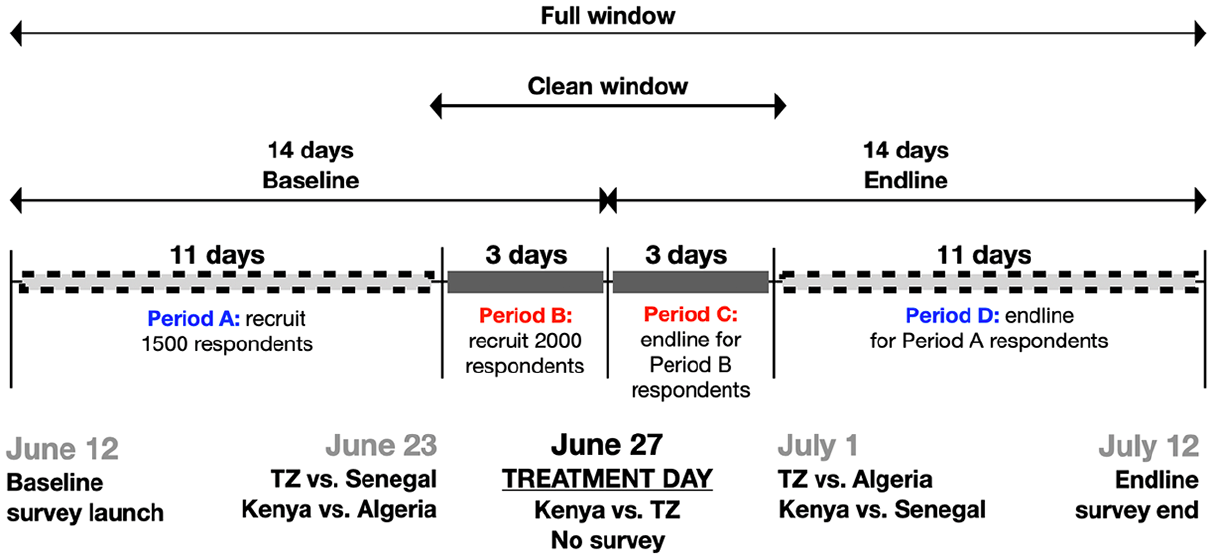
Study timeline.
Recruitment and Sample
We recruited online survey respondents using Facebook advertisements. 15 Facebook users in Kenya and Tanzania, 18 years or older, saw ads offering airtime for their participation in an academic survey. 16 We targeted ads to the entire country but, given previous experience with Facebook ads, anticipated that most of our respondents would come from urban centers (Rosenzweig et al., 2020). Indeed, 73% of our sample report living in mostly urban areas (Supplemental Figure S1 in the SI displays the geographic distribution of our sample).
Comparing our sample to recent nationally representative Afrobarometer surveys in each country, we find that our sample is younger, more educated, wealthier, and slightly more urban than the overall adult population in Kenya and Tanzania (see SI Supplemental Section S1.3). While some research suggests that urban citizens tend to be more nationally oriented than their rural counterparts (Robinson, 2014), Bhandari and Mueller (2019) find in Niger that overall levels of nationalism do not differ between urban and rural citizens. In our sample, urban respondents identify slightly more with the nation than their rural counterparts, but as a whole our respondents identify slightly less with the nation than those in Afrobarometer. This difference may be due to the different survey modes—Afrobarometer is conducted in person—and greater social desirability to appear nationally oriented in front of an enumerator in the Afrobarometer survey.
In the baseline survey, we collected respondents’ mobile phone numbers and emails. We screened their eligibility for the endline based on consent, citizenship status, having a valid phone number for payment, and taking at least 9 minutes to complete the baseline survey. Using an SMS platform, we sent respondents their first participation token after the baseline and a randomly generated date within the respective endline windows (A to D period, B to C period in Figure 1) for their endline survey. On that date, we sent them a link to their endline survey with instructions that they had 24 hours to complete this survey. Upon completion, we sent respondents their second participation token.
Supplemental Section S1 in the SI summarizes the demographic covariates of our respondents by country, and shows the balance across countries and across survey treatments. Although covariates are generally imbalanced between Kenyan and Tanzanian respondents, we use covariate adjustment in our analyses, and we rely on the parallel trends assumption in difference-in-differences estimation. Under this assumption, it is not necessary that baseline levels of outcomes are the same for the two countries, rather we assume that their shifts from baseline would have been similar during the period of time we study in the absence of a match. Given the short time period between the pre- and post-survey rounds, we believe this assumption is reasonable in this setting.
Also important for our research design, specifically the test of whether priming a superordinate pan-African identity affects attitudes toward refugees, is the assumption that citizens are aware that refugees in their country are from neighboring countries. Our survey confirmed respondents are generally knowledgable about refugees in their country. 17
Out of 3,810 eligible baseline survey respondents, our endline attrition rate was 31%, giving us a total of 2,647 respondents. As a robustness check, we reran the main analyses weighting by the inverse propensity of completing the endline survey, thereby upweighting respondents who resemble those who attrited based on demographic covariates. Supplemental Section S7.2 in the SI shows that results do not substantively change.
Survey Experimental Treatments
The main treatment is the outcome of the June 27th match in which Kenya won against Tanzania, 3–2. Given that we could not ensure the match would be salient for our respondents, we also randomly assigned respondents to receive primes in the endline survey that included information about the match outcome. 18 The Match Info prime shown at the top of Figure 2 included two photos from the match between Kenya and Tanzania and a sentence with information about the outcome.
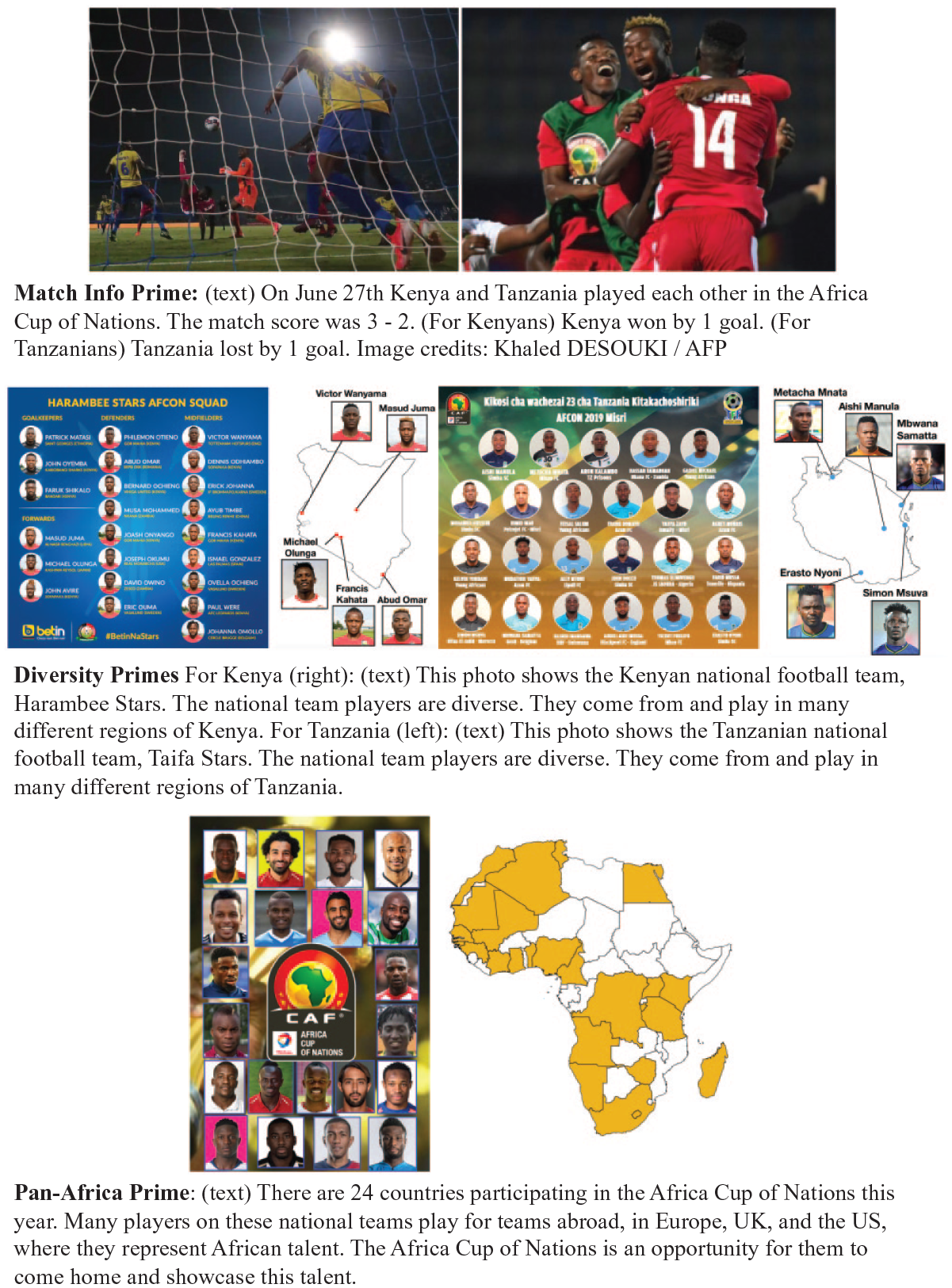
This figure shows the three survey primes: match info, diversity, and Pan-Africa.
We expected this information to simply enhance the effect of the outcome of the game, since 93% of our respondents knew that Kenya won this match without any additional information, which verifies that this match was a prominent cultural event. By providing this information, we hoped to also address a possible alternative explanation that winning the match simply increases the salience of national identity. For instance, for the losing team and nation, there would likely be less media coverage after the game. This treatment makes the match salient for respondents who receive this information in both countries.
Two additional survey experimental treatments build on Match Info by additionally providing information that makes salient two different aspects of the match (shown in Figure 2). The Diversity Prime frames the match in a way intended to promote inclusion, specifically of other conationals, by highlighting the regional and ethnic diversity of the national teams. By including players’ photos and names, as well as spotlighting the regions where they come from, we aimed to bring attention to the fact that these national teams involve cooperation among diverse players. 19 If this prime also inspires a more supportive view of the benefits to diversity, more generally, we might expect that this would enhance attitudes toward refugees, who contribute to a nation’s diversity.
The Pan-Africa Prime highlights the fact that the Cup includes 24 country-teams in Africa, where players in leagues around the world return to represent their home country in the Africa Cup. Also shown in Figure 2, it included a photo of the captains across the participating teams and a map of Africa with the participating countries highlighted. Following the Common In-Group Identity Model, this prime tests whether highlighting an superordinate identity can ameliorate out-group animosity toward non-nationals by making salient a shared, African identity. We might expect that this prime would induce a more inclusive pan-Africa pride and promote more positive attitudes toward refugees “by increasing the attractiveness of former outgroup members, once they are included within a superordinate category” (Crisp & Hewstone, 2007, p. 180).
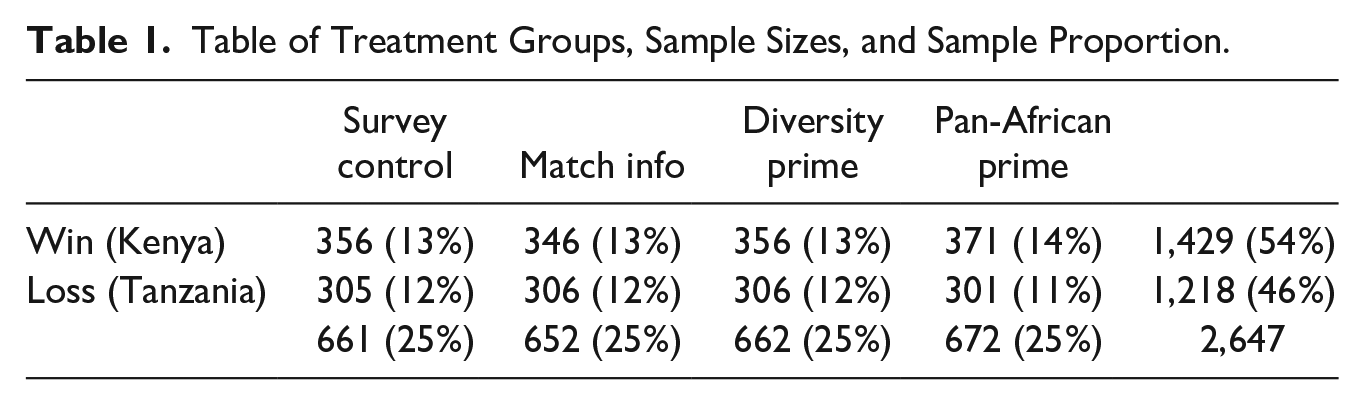
Together, these primes test whether reframing the match and highlighting benefits to diversity or a shared superordinate identity can move respondents toward a more inclusive form of nationalism in the context of the match. Thus, these primes target the cultural or symbolic side of intergroup relations—rather than economic or other practical concerns like crime or disease, which would have been strange to cue in the context of a sporting event. 20 Hence, we explore how policy makers and the media might choose to publicize national sports team victories or other cultural events to promote inclusion over animosity. Table 1 shows our factorial design with the number of respondents corresponding to each treatment group.
Table of Treatment Groups, Sample Sizes, and Sample Proportion.
Hypotheses
We examine three hypotheses. First, given existing studies that suggest national sports team wins increase nationalism, we hypothesized that winning the match and priming Kenyans with the result of the match, would increase national identification and pride among the winners. 21 Second, we predicted that winning would result in negative attitudes toward refugees, but we were agnostic as to whether these negative attitudes would manifest in cultural, economic, or security concerns, which is why we included all of these as separate measures. Finally, we hypothesized that when also receiving the Diversity and Pan-Africa Prime, which reframe the match win in inclusive terms and highlight a superordinate identity, respectively, the winning respondents would in turn feel more positive toward refugees.
Estimation Strategy
We use a difference-in-differences OLS estimator, with covariate adjustment, for the attitudinal questions asked in the baseline and endline. Our two main outcomes of interest include nationalism and attitudes toward refugees, and we measure both using a set of questions described in the following section and listed in SI Supplemental Section S3. For covariate adjustment, we control for gender, age, education level, urban/rural, how long the respondent has lived outside of their home country, whether they personally know a refugee, employment status, household wealth based on an index of seven items, whether they voted in the last national election, whether they consider themselves close to a political party, religion, religiosity, survey language, and survey period (A/D or B/C). We calculate cluster robust standard errors at the respondent level (Bertrand et al., 2004).
For each outcome, we run three models. The first is the main model with only the match Win as treatment, marginalizing over the survey experimental treatments:

The second model is the interaction between Win and AnyPrime, an indicator if the respondent received any of the three survey treatments:

The third model is the interaction between Win with each of the survey treatments:

Where
Results
The following sections evaluate these two sets of hypotheses. SI Supplemental Section S8 addresses concerns of multiple hypothesis testing, illustrating that the majority of the following results hold after adjusting for the false discovery rate. Regression tables for all analyses are shown in SI Supplemental Section S9.
National Pride and Identification
Following other scholars, we operationalize “nationalism” with respect to two dimensions: attachment to one’s national identity and feelings of national pride. We use attitudinal questions to measure these outcomes as well as African pride. The pride questions asked, “How much do you agree or disagree with the following statement: ‘It makes me proud to be called a Kenyan (Tanzanian)/African’?” Our measure of national versus ethnic attachment is the traditional question used in the Afrobarometer survey, which asks respondents to report whether they feel more a member of their national or ethnic group.
The top plot of Figure 3 shows outcomes pre- and post-match for all Tanzanian (blue) and Kenyan (red) respondents, marginalizing over the survey primes. 22 To interpret this plot, we can compare changes across the two countries since both sets of respondents randomly received primes, but we cannot compare before and after levels within countries since in endline, the treated groups’ effects are now moderated through the primes. As expected, Tanzanians are higher than Kenyans on all of these measures. The positive effect of the win on national pride is due to the fact that national pride increased among Kenyans but decreased among Tanzanians after the match. While national attachment compared to ethnic identification decreased among respondents in both countries after the match, it did more so among Tanzanians.
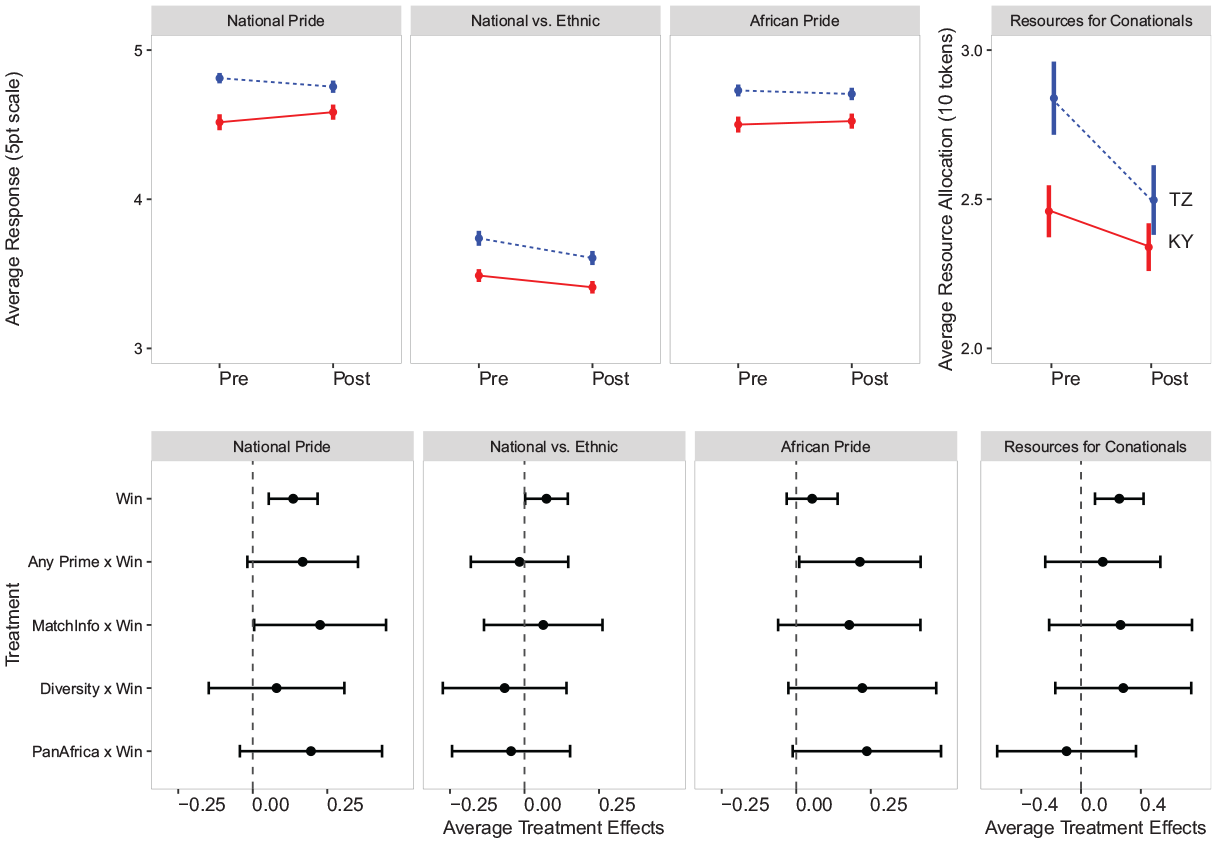
The top plot shows pre- and post-match means for Tanzania (blue) and Kenya (red) on national pride, national versus ethnic attachment, African pride, and amount of government resources (out of 10 tokens) that should be distributed to conational children. The bottom plot shows DiD effect sizes for each of these outcomes. All point estimates include 95% CIs.
The bottom plot of Figure 3 shows the difference-in-differences effect that winning has on these identity and pride outcomes, where we find a positive effect on national pride and identification. Winning increases national pride by 0.14 on a five point scale (95% CI = [0.054, 0.22]). A substantive point of reference for this effect size is the pre-match Kenya-Tanzania difference in national pride, which was −0.3. Hence, Kenya winning the match closes almost half of the initial gap in national pride between the two countries. Despite the brief duration of the game, these effects last for more than a week (see SI Supplemental Section S6.1).
There is also a positive interaction effect of winning and receiving the MatchInfo prime by 0.23 (95% CI = [0.0047, 0.45]). This is in line with previous research and our hypothesized expectations. In SI Supplemental Section S4.2, we discuss potential theorized mechanisms. There is some initial evidence that cognitive nationalism (Robinson, 2016), when individuals categorize themselves as members of a homogeneous group based on shared attributes, may be driving these results. Winning also increases national (over ethnic) identification by 0.074 on a five point scale (95% CI = [0.0021, 0.15], about 30% of the pre-match difference of -0.25). There is no effect of winning on pride in being African, but a marginally significant effect of 0.21 (95% CI = [0.0099, 0.42], pre-match difference of -0.23) on a five point scale if the respondent received any of the primes, which all reemphasized the Africa Cup of Nations. 23
In addition to these questions about feelings of pride and identity attachment, we also examine whether such sentiments extend to respondents’ preferences for how the government should allocate scarce resources across various groups. Specifically, we asked respondents to divide limited budget resources (10 total shares) across six types of children in need living in their country, including conational coethnic children, any conational children, and refugee children. 24 While preferences for allocating budget resources to conational children decreased among respondents in both countries after the match, the change is larger for Tanzanians. 25 We observe a positive effect of winning on allocating spending to conationals by 0.26 of a token (95% CI = [0.093, 0.42], pre-match difference of -0.38).
With respect to heterogeneous treatment effects, in SI Supplemental Section S5, we find that the effect of the win and the primes on national and African pride are stronger among men. 26 Aside from gender, we also importantly observe that the results are similar across individuals regardless of their baseline levels of interest in football. There are also no differential effects of the win or primes among urban versus rural, wealthier versus poorer, or more versus less formally educated respondents. This lack of heterogeneity suggests that our results likely extend to more diverse samples (Coppock et al., 2018). Nevertheless, we do find some suggestive differences between respondents with higher and lower baseline levels of national identification; we observe that the effect of the win on national and African pride is slightly larger (more positive) for those with low baseline levels of nationalism. Additionally, the effect of the pan-Africa prime on national and African pride is also larger among low baseline nationals (see SI Supplemental Sections S5.6 and S5.7).
Attitudes Toward Refugees
Having confirmed that winning increases national pride, identification with the nation, and a preference for the government to allocate resources to conationals, this section turns to our main question—how does winning the match affect attitudes toward refugees? To assess these sentiments, we asked respondents to say whether they agree or disagree with a series of positively and negatively framed statements: “Refugees positively contribute to diversity,” “Refugees increase local crime,” “Refugees bring disease,” and “Refugees help improve the local economy.” We recoded these outcomes such that higher values correspond to more positive views of refugees.
The top plot of Figure 4 shows average responses pre- and post-match on refugee attitude questions for Tanzanian (blue) and Kenyan (red) respondents. Overall, Kenyan respondents have more positive attitudes toward refugees, across all measures, compared to Tanzanian respondents, reflecting the mounting pressure from the Tanzanian government and citizenry for refugees to repatriate (Schwartz, 2019; Zhou, 2019). 27 Perceptions of refugees with respect to diversity were more positive after the match in both countries, but more so in Tanzania. There is little change for crime, negative for disease, and a positive change for refugees’ contribution to the economy in both countries.
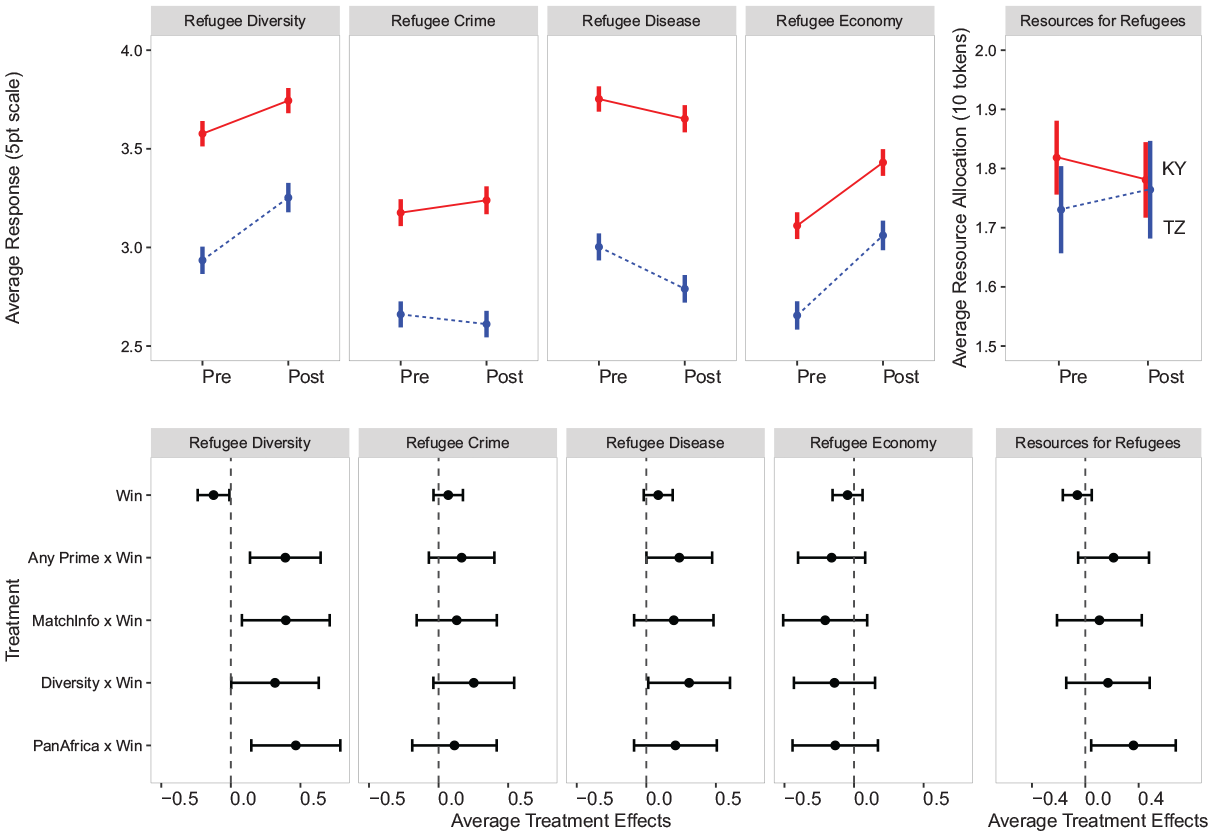
The top plot shows pre- and post-match means for Tanzania (blue) and Kenya (red) on refugee attitudes, amount of government resources (out of 10 tokens) that should be distributed to refugee children. The bottom plot shows DiD effect sizes for each of these outcomes. All point estimates include
As shown in the bottom plot of Figure 4, we find suggestive evidence that winning, which we have seen increases nationalism, contributes to negative attitudes toward refugees, but only for our diversity measure. With respect to contributing positive diversity to the country, winning has an effect of -0.12 on a five point scale (95% CI = [-0.24, -0.011], pre-match difference of 0.64). An effect of the win on this cultural or symbolic concern but no change in more practical or tangible attitudes related to perceptions of refugees contributions to crime, disease, and the economy could be due to several factors. 28
Much of the literature addressing attitudes toward non-nationals focuses on practical threats. Foreigners are said to be seen as economic threats to jobs or a strain on public resources (Ceritoglu et al., 2017; Hainmueller & Hiscox, 2007; Scheve & Slaughter, 2001). Other tangible concerns over the inclusion of foreigners tend to relate to personal safety, including fear of crime and disease (Adida et al., 2018; Lohrmann, 2000; Whitaker, 2003). A second strand of this literature examines the symbolic or “cultural” threat that foreigners are said to pose (Schmuck & Matthes, 2017; Shechory-Bitton & Soen, 2016). For example, Sniderman et al. (2004) suggest that the prominence of immigrant group differences, such as skin color, manner of dress, and language, increases the salience of concerns over national identity on the part of host citizens. To date, much of this existing literature on cultural threat stems from Western democracies.
As described earlier, refugees in these two countries are often viewed as security threats and a drain on economic resources (Audette et al., 2020; Chaulia, 2003; da Costa, 2018; Rutinwa & Kamanga, 2003). It is therefore unsurprising that neither the match nor the survey primes is able to shift these entrenched attitudes about refugees bringing crime or disease or negatively affecting the economy, and we observe no change for these outcomes. Rather, we observe that winning influences what might be considered the perceived cultural or symbolic threat of refugees, contribution to the diversity of the nation. This may be because attitudes with respect to diversity are more malleable, or because sports games are cultural events and thus cultural and symbolic attitudes may be salient, even with respect to refugees not directly involved in the game.
Although we do not have direct evidence of how respondents interpreted the “diversity” question, it is clear they conceived of it differently from the crime, disease, and economic measures (otherwise the results would look similar to these questions). We also observe that respondents were thinking about refugees’ culture, language, and religious diversity, more generally, when taking the survey. In the endline, we asked respondents if they were interested in writing a message in support of refugees to be posted anonymously on social media; 68% of Kenyan respondents and 46% of Tanzanian respondents indicated they wanted to write a message. Messages were coded based on whether the content discussed cultural, economic, security, humanitarian, or other appeals. 29 A quarter of the messages were coded as cultural. 30 Examples include: “Refugees bring cultural diversity to our country and should therefore be treated right as they are humans,” 31 “I love to tell them to feel free and be part of the society. Language and culture differences should not make them to feel alone in the country they are in,” 32 and “Let us make them proud of their humanity, dignity, culture and norms as being as well as our African relatives.” 33 We recognize that these messages come from a subset of individuals interested in writing a positive message about refugees, nevertheless, they provide descriptive evidence that some respondents thought about refugees in terms of their cultural contributions.
Moreover, we find that the effect of winning the game persists for several days after the match. Figure 5 illustrates that the negative effect of winning on perceptions of refugee diversity lasts for about 3 days after the game. Though it may seem surprising that winning the match has an effect on attitudes toward refugees, given that this group is unlikely to be particularly salient in the context of a national sports team victory, our finding speaks to previous evidence that irrelevant events can influence political attitudes (Busby et al., 2017). Our proposed mechanism—that increasing the salience and strength of national identity and pride influences attitudes toward non-nationals—suggests that these attitudes can be affected even indirectly in the context of a national team victory.
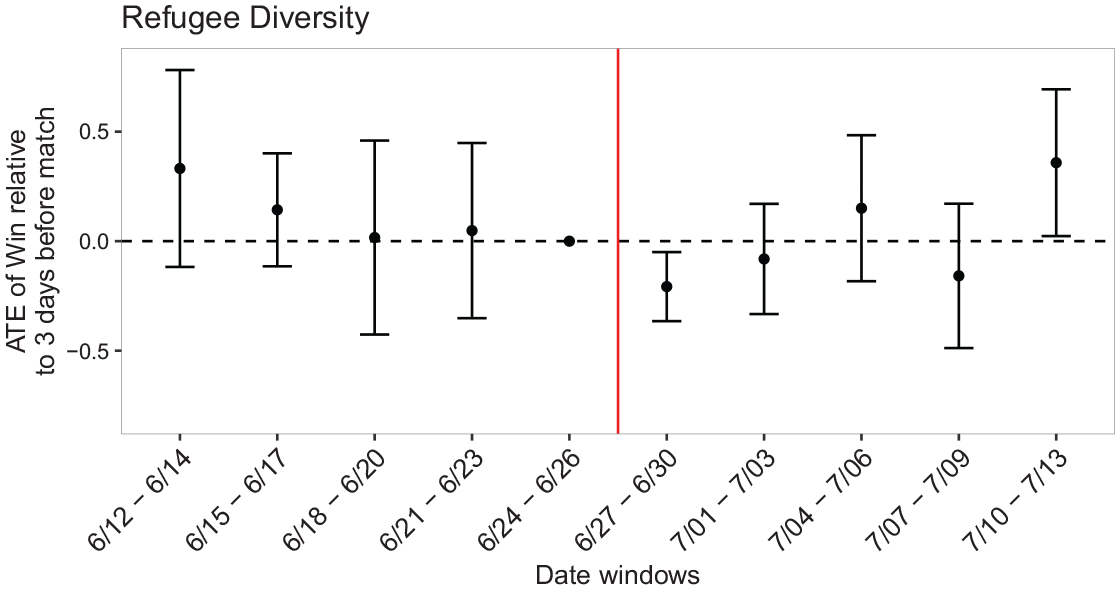
This figure plots the effect of winning on the refugee diversity outcome for 10 dummies indicating 3-day blocks from 15 days before to 15 days after the match day on June 27. The coefficient for the period between 3 to 1 days before the match is normalized to zero. In the regression, we include the usual controls. All point estimates include
Interestingly, with respect to perceptions of refugee diversity, when the win is reframed toward a more inclusive nationalism, by either focusing on the diversity of the team or highlighting a pan-African identity, refugees come to be seen as positive contributors to the nation’s diversity. 34 From Figure 4, the diversity prime increases positive attitudes by 0.32 (95% CI = [0.0028, 0.63]) and the pan-Africa prime by 0.47 (95% CI = [0.15, 0.79]). These effect sizes more than offset the negative effects of winning. 35 Here, we also note that among Tanzanian respondents who chose to write a positive message about refugees, 34% of those who received a survey prime wrote a cultural message, compared to 24% who were assigned to the control condition (difference in means p-value = .04). 36 This provides additional evidence that the primes made respondents think more about diversity and cultural concepts.
We again analyze respondents’ preferences for government resource allocation, this time as it relates to allocating funds for refugee children living in the country. Winning has no effect on redistributive preferences toward refugees. However, in line with our preregistered hypothesis that the Pan-African Prime decreases negative (superior) attitudes against refugees, we see that emphasizing a shared African identity between natives and refugees improves preferences for financially supporting these foreigners living in the country by 0.36 of a token (95% CI = [0.044, 0.68], pre-match difference of 0.088).
Did winning change Kenyans’ sentiment toward other groups aside from refugees? In SI Supplemental Section S4.3, we do not find strong evidence of anti-rival sentiments after the win. In other words, Kenyans did not feel greater animosity toward Tanzanians after the game. We also do not observe anti-Kenyan sentiment from Tanzanian respondents. It does not seem to be the case, as one might expect, that general xenophobia ensues after a team victory and moment of high nationalism. In a related study, Kim and Lopez de Leon (2019) find that while foreigners were charged higher prices for goods during the 2014 Brazil World Cup, there is no evidence of greater discrimination against foreigners wearing the jerseys of Brazil’s rival team.
Lastly, as a robustness check, we show in SI Supplemental Section S7.3 that our results are attributable to Kenya winning and not by simply playing a match. We use the prior games played on June 23rd that Tanzania and Kenya lost to Senegal and Algeria, respectively, as a placebo test. Here, we must compare across respondents, those who responded to the baseline survey pre-June 23 versus those who responded to the baseline survey post-June 23 (removing those who responded on June 23). We code Kenya as having won even though both countries lost this first game, and we find no effect of playing an Africa Cup match (as opposed to winning) on our outcomes of interest.
Discussion
As migration continues to change the composition of nations, policy makers must find tools to encourage a more inclusive kind of nationalism among the citizenry. This means taking into account the economic, political, but also social forces that shape the salience of national identities (Shayo, 2020). This paper has presented evidence that cultural events have political and social consequences, but also that these events pose opportunities for policy makers to define and reframe the conversation, directing citizens to more inclusive and positive feelings toward out-groups.
While nationalism has been shown to be beneficial for igniting positive attitudes toward compatriots, this paper demonstrates how sports victories that boost nationalism can also detrimentally affect attitudes toward non-nationals residing in the country. We showed that among a sample of social media users, a national football team win did not affect concerns about refugees in terms of their negative impacts on the economy, crime, and public health—common stereotypes associated with this stigmatized group. However, we observed a negative effect on attitudes that refugees positively contribute to the nation’s melting pot with respect to diversity. Yet encouragingly, our results suggest that reframing the victory to remind individuals about the positive diversity of their country and highlighting a superordinate identity shared among citizens and refugees can not only counteract negative attitudes, but can convert them into positive ones. These reframing treatments are relatively light-touch interventions that media and refugee-advocacy organizations could implement during such periods of heightened nationalism.
This study relied on a sample of social media users in two East African countries around a continental football tournament, but we have no reason to believe that the psychological mechanisms observed here would not similarly be found in other contexts. Making an African identity salient was feasible and appropriate in this case because the vast majority of refugees in Kenya and Tanzania come from nearby African countries. In contexts where refugees originate in countries that seem more “foreign” to locals, emphasizing other shared attributes (Berinsky et al., 2018) or shared histories (Williamson et al., 2020) may be necessary. In such situations, cross-cutting identities may be useful avenues to engender affinity. In the realm of sports, others have suggested that teams or clubs can be a useful cross-cutting tie to highlight and playing sports with out-group members can improve certain behaviors and attitudes toward them (Alrababa’h et al., 2019; Dawes & Rubenson, 2020; Lowe, 2021; Mousa, 2020).
Nation building is punctuated and often influenced by particular historical moments. Outside of wars, occasions for countries to create a common culture and a unified nation, and to execute these on the international stage are infrequent. It is beyond the scope of this paper to test how sports-induced nationalism and national pride compares to other kinds of nationalism-increasing activities. We can imagine, however, that given sports games are salient events of short duration, similar results may be found in other cultural events that have important, yet ephemeral, effects on national pride. For example, Independence Day parades and other national holidays similarly present opportunities for the country to commemorate a shared history through domestic demonstrations of nationalism. An interesting question is how these particular events compare to longer-term influences on national pride, such as civics education in schools. Do these events have fleeting consequences or do they accumulate over time amounting to a more enduring impact? Future work might also investigate similar questions about the political consequences of cultural events to understand what shifts economic and cultural attitudes toward refugees, and how animosities along these dimensions may be overcome.
Supplemental Material
sj-pdf-1-cps-10.1177_0010414021997498 – Supplemental material for Team and Nation: Sports, Nationalism, and Attitudes Toward Refugees
Supplemental material, sj-pdf-1-cps-10.1177_0010414021997498 for Team and Nation: Sports, Nationalism, and Attitudes Toward Refugees by Leah R. Rosenzweig and Yang-Yang Zhou in Comparative Political Studies
Footnotes
Acknowledgements
We thank Vincent De Paul, Maureen Mboka, Anthony Mwambanga, Isabella Preite, Scarion Rupia, Alex Meyer, and Benjamin Fifield for excellent research assistance. We are grateful to Michael Becher, Alex Coppock, Rafaela Dancygier, Francis Fukuyama, Randy Illum, Sarah LaRocca, Evan Lieberman, Matt Lowe, Lisa Akinyi May, Salma Mousa, Lisa Mueller, Ken Opalo, Daniel Posner, Daniel Rubenson, Michael Smith, Lily Tsai, Maya Tudor, Ashutosh Varshney, Carlos Velasco, Andreas Wimmer; members of the Paluck Lab, MIT GOV/LAB, IAST; participants from APSA 2020 and the Intergroup Relations Workshop; and our editors and anonymous reviewers for providing helpful comments. We thank MIT GOV/LAB and the Princeton Bobst Center for research funding. Rosenzweig acknowledges funding from the French Agence Nationale de la Recherche (under the Investissement d’Avenir programme, ANR-17-EURE-0010). Zhou acknowledges funding support from the National Science Foundation (SES–1148900).
Authors’ Note
All replication material, including R code and data, are available via Harvard University’s Dataverse: DOI: https://doi.org/10.7910/DVN/XCSB9W10.7910/DVN/XCSB9W (Zhou & Rosenzweig, 2021). Please find our Pre-analysis Plan available on OSF:  . This project is approved under Princeton IRB #11821 and MIT COUHES #E-1392. All errors and omissions are ours.
Declaration of Conflicting Interests
The authors declared no potential conflicts of interest with respect to the research, authorship, and/or publication of this article.
Funding
The authors received no financial support for the research, authorship, and/or publication of this article.
Supplemental Material
Supplemental material for this article is available online.
Notes
Author Biographies
References
Supplementary Material
Please find the following supplemental material available below.
For Open Access articles published under a Creative Commons License, all supplemental material carries the same license as the article it is associated with.
For non-Open Access articles published, all supplemental material carries a non-exclusive license, and permission requests for re-use of supplemental material or any part of supplemental material shall be sent directly to the copyright owner as specified in the copyright notice associated with the article.
