




Abstract
Political knowledge is the cornerstone of a functional representative democracy, but belief in conspiracy theories disrupts that connection and may be dangerous with consequences for democracy. Pundits and politicians have speculated about the cause and effect of misinformation and conspiracy theories, but no work has examined what causes beliefs in conspiracy theories or misinformation among Latinos specifically. In a unique survey of Texas Latinos prior to the 2020 election, we find belief in conspiracy theories is most related to support for Donald Trump and greater reliance on Spanish-language media and social media. The results highlight how conspiratorial thinking manifests in specific ethnic groups and the need to counter those beliefs in Spanish-language media.
Introduction
Political knowledge is the cornerstone of a functional representative democracy, but misinformation (Kuklinski et al., 2000) and belief in conspiracy theories (Uscinski 2018) disrupt that connection and may be “dangerous” with consequences for democracy. Conspiratorial thinking from individuals explains political or historical events through references to “the machinations of powerful people” (Aaronovitch 2010; Byford 2011; Coady 2019; Dentith and Orr 2018; Jerit and Zhao 2020; Keeley 1999; Sunstein and Adarian, 2009). In effect, conspiracy theories revolve around secret plots by “powerful” and “malevolent” groups seeking money or power at the expense of the public and are deceptive or corrupt (Goertzel 1994). For example, those on the right and left of the ideological scale who do not trust government are susceptible to conspiracy theories about health issues (Uscinski 2020). Believing in unfounded conspiracy theories as real endangers a free exchange of ideas, creates “disorientation” (Rosenblum and Russel 2019), and artificially increases political divides (Uscinski 2018).
In particular, the Latino community has been susceptible to misinformation and conspiracy theories on political and health issues—mistaken beliefs that COVID-19 vaccines do not work, Democrats illegally harvested ballots, a Biden Administration would put America under the control of “Jews and Blacks,” and Joe Biden is not a “real Catholic” were “rampant and consequential” in the 2020 election (Allen 2021; Mazzei and Medina 2020; Rodriguez and Caputo 2020). Despite concern in the media and among political partisans, not much is known about the extent misinformation may have influenced Latino voters (Sanz 2020). Pundits and politicians have speculated about the cause and effect of misinformation (Romero 2020) and conspiracy theories (Uscinski and Parent 2014), and some work examines specific racial groups' beliefs in conspiracy theories (Goertzel 1994; Simmons and Parsons 2005), but no work has examined what causes beliefs in conspiracy theories or misinformation among Latinos specifically.
Why focus on Latinos? Latinos in Texas account for more than half of the population growth of the state since 2010. Latinos make up 30% of registered voters, and projections indicate they will become the most significant and fastest-growing ethnic group in the state. Young Latinos are also a big part of Texas' future—210000 young Latino voters will turn voting age between 2018 and 2028 (Carolan 2020).Understanding how misinformation impacts Latino communities is important to explaining Latino political behavior, especially if media use and weak partisanship precipitate beliefs in conspiracy theories (Allen 2021; Mazzei and Medina 2020) and since Latinos are targets of misinformation in elections (Sanz 2020).
This paper uses a unique survey of Texas Latinos before the 2020 election to examine some of the correlates of beliefs in conspiracy theories. On three specific misinformation beliefs, we find supporters of Donald Trump were more likely to endorse or express a belief in conspiracy theories but not necessarily Latino Republicans. Despite expectations, lower trust in media did not lead to more beliefs in conspiracy theories, only more trust in social media was associated with believing in conspiracy theories. Reflecting that Latinos were targeted with misinformation in the 2020 election, we find that social media use, when interacted with age, leads to more beliefs in such theories, and accessing information on Spanish-language outlets increases conspiracy theory beliefs. The results suggest Latinos are unique in the patterns and pathways that generate belief in conspiracy theories and the importance of media checks on such information.
Hypotheses
To explore factors that predict belief in conspiracy thinking among Latinos, we pose three hypotheses.
Latino Republicans and self-identified supporters of President Trump are more likely to believe conspiracy theories. Exposure to selected political messages resonant with individuals' beliefs shapes the depth of belief in conspiracy theories (Oliver and Wood 2014). This is especially true when a believed conspiracy matches individuals' ideological preferences, contingent on levels of political knowledge (Miller et al. 2016), which allows people to preserve and protect their beliefs (Lewandowsky et al. 2013). In some cases, Latinos may be more prone to conspiracy theories because many have weak partisan ties but strong ideological policy beliefs (Alvarez and Bedolla 2003). Conservatives are more likely to be exposed to misinformation because “a majority of the stories tend to come from conservative-leaning groups” (Covington 2020; Uscinski et al. 2016) and conservatives are generally more prone to conspiracy theories than liberals (Galliford and Furnham 2017; Miller et al. 2016). In addition, support for and attention to Donald Trump's 2020 candidacy are strongly linked to beliefs in conspiracy theories since the former President was a significant spreader of misinformation (Choi 2021; Mazzei and Medina 2020; Uscinski 2020). Trump supporters relied on the President for information, including medical advice (Robertson, 2021). This is consistent with findings that Republicans are more likely to believe in conspiracy theories because Republican elites have been claiming the media are bias and potentially corrupt (Uscinski et al. 2016). Why? Some scholars report a link between conspiracy beliefs and right-wing authoritarianism (Bruder et al., 2013; Grzesiak-Feldman and Irzycka 2009) that fits well with Trump’s rhetoric. Believing in conspiracy theories provides cognitive closure for uncertain situations (i.e., the COVID-19 pandemic and the election) when people feel distressed (Grzesiak-Feldman and Monika, 2013; Marchlewska et al. 2018; van Prooijen et al., 2013) by shielding beliefs from uncertainty (Douglas et al. 2017).
Latinos who have less trust in the mainstream media will be more likely to believe conspiracy theories. Those respondents who generally perceive news to be “made up” or have low trust in the information they get from the news should be more likely to hold conspiratorial beliefs. Individuals with low trust in government or elected officials are more likely to believe in conspiracy theories (Miller et al. 2016; Oliver and Wood 2014). Specifically, lower trust in the media is shown to be associated with stronger conspiratorial predispositions (Uscinski et al. 2016), especially since conspiracy theories provide a sense of safety against untrustworthy actors (Bost and Prunier 2013). Individuals who feel less powerful or left out of societal gains are more likely to believe in conspiracies (Abalakina-Paap et al. 1999; Uscinski 2020). Specifically, Trump’s victory in 2016 made Latinos worried about the well-being of friends and family, leading to a decline in political trust and political efficacy (McCann and Jones-Correa 2021). Latinos often display lower levels of political efficacy in a system that leaves them behind and feels “rigged” against them (Bruder et al., 2013; Michelson 2003; Pantoja and Segura 2003), making Latinos more susceptible to conspiracy thinking (Brotherton et al. 2013; Imhoff and Bruder 2014; Uscinski and Parent 2014). Latinos may also be more likely to believe in conspiracies when experiencing discrimination, as shown by Simmons and Parsons (2005) for African Americans.
Latinos who use social media as their main source of news will be more likely to believe conspiracy theories, but older respondents will be more likely to believe conspiracy theories. Attention to social media is also a key driver of beliefs in misinformation (Uscinski 2020) in part because social media makes spreads it easily (Yee 2020) and because it increases party loyalty over truth (Bavel et al. 2018), shaping political polarization through selective partisanship and content mechanisms (Van Bavel et al. 2021). The rapid flow of information on the Internet allows for immediate refutation (or shaming) of conspiracy thinking (Clarke 2007). Still, in many cases, the damage of spreading the initial information is already done. Reports from the 2020 election on WhatsApp, Telegram, and Facebook pushed racial divisions between Blacks and Latinos, threats of socialist policies from a prospective “comunista” Biden administration, and that Biden was not a “real Catholic,” misleading many and increasing unconscious bias (Ghaffary 2020). Individuals who rely more on social media for their news will be more likely to retain conspiratorial beliefs. In particular, older Latinos should be more likely to believe conspiracy theories if exposed to social media, consistent with other findings (Edelson et al., 2017). Older minority respondents have been found to be more likely to believe conspiracy theories because they experienced more discrimination than younger respondents and may be triggered by certain racial content to conspiracy beliefs (Uscinski and Parent 2014), much like occurred in 2020.
Data and Empirical Design
To examine the factors that predict beliefs in conspiracy theories in the Latino community, we use a national survey of Latino registered voters implemented from September 17–24, 2020 with an oversample of Latinos in Texas (n=401 MO +/− 4.89). The multi-mode survey was administered in English or Spanish (see appendix for full description).
All respondents were confirmed to be registered to vote and identified as Hispanic or Latina/o based on their surname; specifically, 70% of respondents traced back their ancestry to Mexico, while 30% traced back their ancestry to a country in Latin America other than Mexico. In terms of coverage, around two-thirds of respondents (64%) resided in Bexar, Harris, Dallas, Hidalgo, El Paso, Tarrant, Nueces, and Travis counties, the counties with the highest proportion of registered voters in Texas. These data also provide evidence that survey participation among Latinos in Texas is not truncated by low levels of political trust, as suggested by some (e.g., Kennedy 2021; Matthews 2020). The results, however, have to be interpreted within these limitations.
We use three key dependent variables capturing beliefs in conspiracy theories, each taken from popular contemporary misinformation tropes consistent with definitions of conspiracy theories (Uscinski et al. 2016). The first question asks about Joe Biden, BLM, and Antifa, the second about the “deep state” and Trump, and the third one about COVID-19 (see appendix for wording). For each question, beliefs in these unfounded conspiracies were higher than average (Uscinski 2020). Forty-one percent of respondents agreed it was definitely or probably true that Joe Biden was under the influence of Black Lives Matter and Antifa. Thirty-five percent believed the deep state was out to ruin the Trump presidency, and 39% believed that powerful people intentionally planned COVID-19.
We follow Miller et al. (2016) and Oliver and Wood (2014) to create a scale using these three questions to develop an overall additive index of beliefs in conspiracy theories, coded to range from−6 to 6, with higher numbers representing a greater endorsement of false conspiracies. 1
Summary Statistics.

Presidential choice and party
If a respondent indicated they were a Republican or leaned Republican, we coded it as “1.” Presidential voice choice (between Donald Trump and Democrat Joe Biden) was scored as “1″ if the respondents expressed support for the Republican ticket (certain to support or leaning support were grouped).
Income
Income affects believe in conspiracy theories so we include this as a control variable (Freeman and Bentall 2017; Uscinski and Parent 2014). This is coded on a 1–7 scale in income gradients from under $20,000 to over $150,000.
Education
Higher educated individuals show less susceptibility to belief in conspiracy theories (Oliver and Wood 2014; Uscinski 2020), so we included a variable to capture education levels. An ordinal scale that runs from grade school (grades 1–8) to post-graduate degree.
Age
We include age as a continuous variable to examine how age affects beliefs in conspiracy theories.
Trust
Trust in others and institutions is negatively related to belief in conspiracy theories (Oliver and Wood 2014). We include a battery of questions to capture how much trust respondents have in family and friends, national and local news outlets, social media, and political leaders and public officials on a four-point scale (a lot, some, not too much, not at all). Low trust in the media explains higher belief in conspiracies (Klepper et al. 2020).
Media attention and social media
We include a variable to control for media attention: “In the last couple of weeks, have you seen any stories about politics or the election that were made-up?” this was coded on an ordinal scale to four (none, one, a few, many) as well as how confidence in recognizing made up stories respondents are, coded on an ordinal scale of how much “confidence” the respondent had (very, somewhat, only a little, not at all). Craft, Ashley and Maksl (2017) show that being knowledgeable about the news media predicts a lower probability of conspiracy theory endorsement. In addition, we include an indicator variable that measures if a respondent uses social media as the most common way to get their news (Southwell et al. 2018; Uscinski et al. 2018; Uscinski et al. 2016).
Spanish language
We include variables to control for any potential effects of taking the survey in Spanish and a variable controlling for accessing information on Spanish-language outlets since they may not have the fact-checking infrastructure, especially at the local level. As the Latino population in Texas increases, so does reliance on Spanish-language communication (Valenzuela and Michelson 2016), which may increase conspirational beliefs and impact Latinos' political attitudes (Lee and Pérez 2014; Pérez and Tavits 2017).
Ancestry and race
Finally, we include an indicator variable to control for any differences between Latino ancestry, given that political preferences between Latino subgroups may vary (de la Garza 2004) and an indicator variable controlling for racial and ethnic self-identification. We also include a variable for foreign-born registered voters to control for any targeting effects (Rodriguez and Caputo 2020; Romero 2020).
Findings
Linear regression predicting beliefs in conspiracy theories.
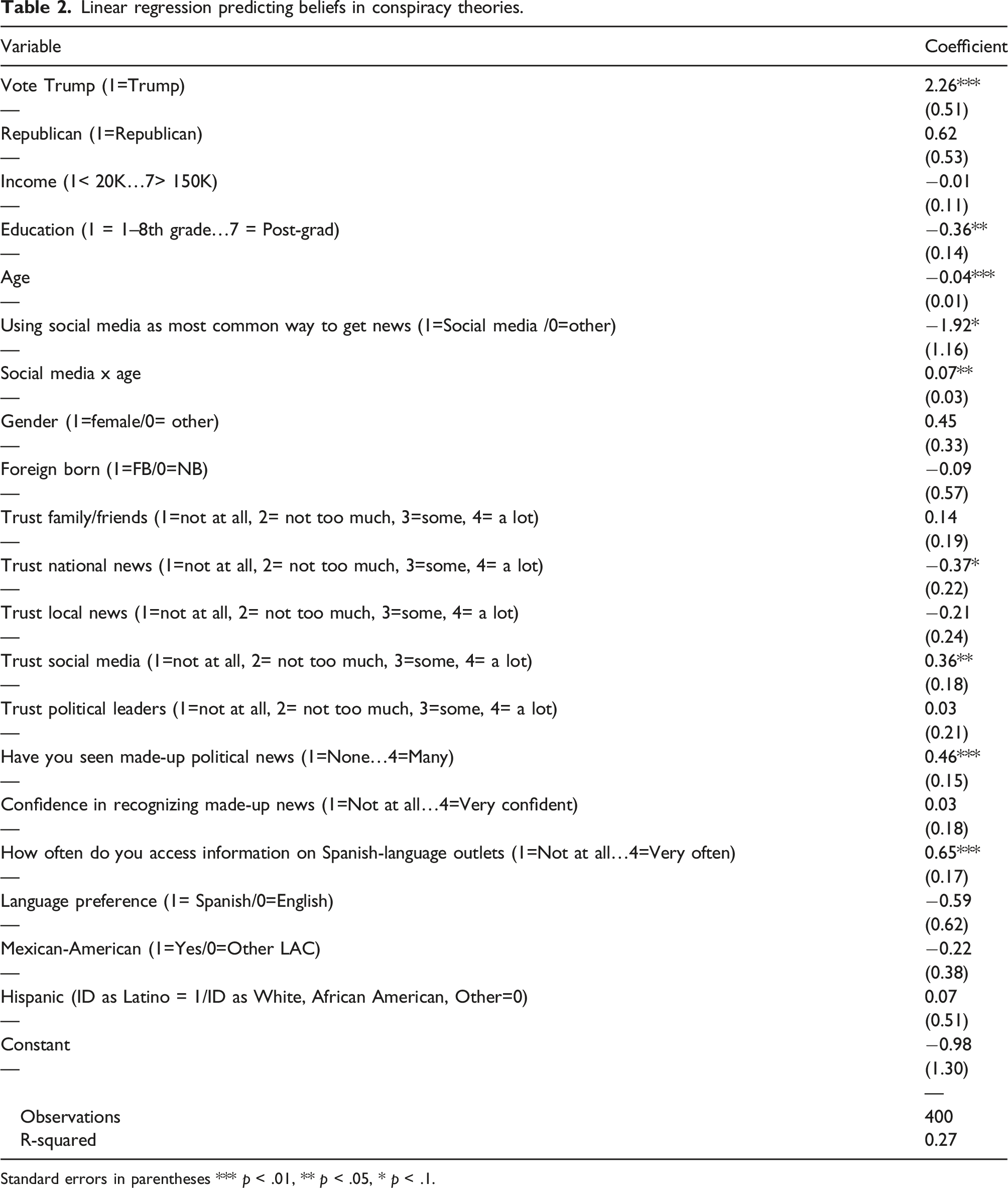
Standard errors in parentheses *** p < .01, ** p < .05, * p < .1.
Other predictors that have been associated with the endorsement of conspiracy theories (like income and partisanship) proved to be not significant for Latinos in Texas. For instance, income and partisanship had no statistically significant impact. Education, on the other hand, is associated with a decrease in beliefs in conspiracy theories, consistent with past findings. Despite expectations, lower trust in media would lead to more beliefs in conspiracy theories, none of the measures of media trust were statistically significant for Latinos.
Using social media as the main source of news has a negative effect, however not at traditional levels of statistical significance. This effect was the opposite predicted, but the explanatory statistical power is low. However, as predicted, social media use has a positive effect when interacted with age, meaning older Latinos exposed to social media are more susceptible to conspiracy theories than younger Latinos (see Figure 1). Although older Latinos are infrequent users of social media, the findings suggest that Latinos are affected by the information environment in different ways than broader findings suggest. Predictive Margins of endorsement of conspiracy theories by social media and age.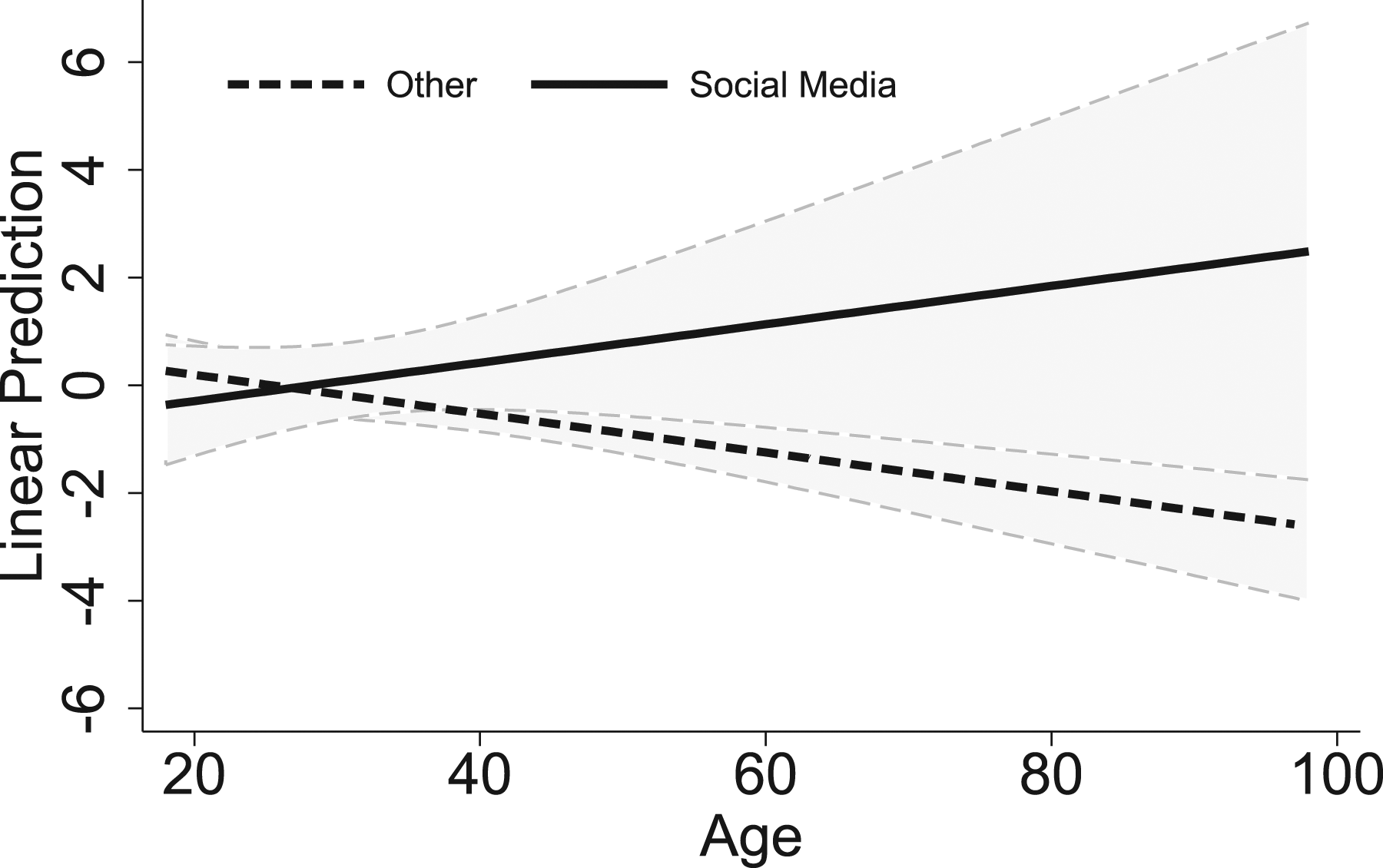
In addition, those who make greater use of information on Spanish-language outlets tend to be more likely to believe in conspiracy theories, as shown in Table 2; however, given data availability, it is not possible yet to indicate the type of outlets that Latinos are accessing. The main Spanish-language networks joined FactCHAT by the International Fact-checking Network at Poynter in September 2020 to counter misinformation (Villafañe 2020). However, it is still too early to know its effects and how fact-checking percolated to local affiliates, as Owen (2020) suggests, because of rapid changes in how information is transmitted online.
Conclusion
Although some work has examined belief in conspiracy theories among racial or ethnic groups (Goertzel 1994), this article is one of the first to examine the effect among a group and in a setting that might have electoral consequences. This work is a beachhead for future research on social media, Latinos, and misinformation. For Latinos, we find the biggest driver of belief in conspiracies is support for President Trump, unsurprising because of the frequency and impact of the former President’s unfounded claims about several issues. However, if conspiratorial beliefs are a Trump phenomenon, it may be that the phenomenon is fleeting, likely to fade as the politics gravitate to new elected leaders. In fact, the findings reveal that not every Latino Republican believes in these false concepts, primarily Latino Trump supporters.
Attention to Spanish language media is also a major driver of beliefs in conspiracy theories among Latinos. Misinformation through Spanish language media (especially social media) may also play a role in beliefs about conspiracy theories (Sanz 2020). Examining the content of Spanish language advertisements and social media—as well as conservative Spanish-language social media, which fills in the gap in Spanish-language news—would also allow us to assess how news (and possible misinformation) is spread. A Nieman Lab report suggests that there is little to no response to misinformation from Spanish-language media outlets, allowing conspiracy theories to flourish (Owen 2020). Examining this trend is important as Latinos grow in importance as a political power.
Ultimately, belief in conspiracy theories among Latinos is limited to support of Trump, heavy use of (and trust in) social media, especially among older Latinos (who infrequently use social media anyway), and high use of Spanish language media. These findings provide perspective to claims about Latino persuadability and political attitudes toward elites.
Supplemental Material
sj-pdf-1-rap-10.1177_20531680221083535 - Supplemental material for Conspiratorial thinking in the Latino community on the 2020 election
Supplemental material, sj-pdf-1-rap-10.1177_20531680221083535 for Conspiratorial thinking in the Latino community on the 2020 election by Jeronimo Cortina and Brandon Rottinghaus in Research & Politics
Footnotes
Declaration of conflicting interests
The author(s) declared no potential conflicts of interest with respect to the research, authorship and/or publication of this article.
Funding
The authors disclosed receipt of the following financial support for the research, authorship, and/or publication of this article: This article was supported by the Center for Mexican American and Latino/a Studies at the University of Houston in partnership with Univision News.
Correction (April 2025):

Supplemental material
Notes
References
Supplementary Material
Please find the following supplemental material available below.
For Open Access articles published under a Creative Commons License, all supplemental material carries the same license as the article it is associated with.
For non-Open Access articles published, all supplemental material carries a non-exclusive license, and permission requests for re-use of supplemental material or any part of supplemental material shall be sent directly to the copyright owner as specified in the copyright notice associated with the article.
