




Abstract
Mail voting became unusually controversial in the 2020 presidential election. Many observers, including former President Trump, believed that more accessible vote by mail would encourage higher turnout at the expense of Republicans. While the literature has tested some of these claims, it has not offered a more comprehensive causal assessment of vote-by-mail policy, nor has any study looked at these questions in the context of the extraordinary 2020 election. We examine the effect of mail ballot access policies both before and during the 2020 pandemic election with county-level data and a variety of methodological approaches. Our results suggest that making it easier to vote by mail—especially mailing every voter a ballot—generally does increase turnout, both before and during the 2020 election. By contrast, the same policies do not have robust partisan effects, and in many models, they tilt the results in a more Republican direction. While some of our findings are sensitive to model specification, the positive turnout effect of mailing every voter a ballot is robust to many alternative approaches. The confirmation of the existing understanding of universally mailed ballots suggests the basic dynamics of the reform are immune to a wide range of disruptive forces.
Keywords
Expanding access to voting by mail (VBM) is one of the most common reforms designed to increase turnout by making voting easier. These reforms vary from relaxing restrictions on absentee voting to mailing every voter a ballot. Research has generally shown that they modestly increase turnout without much change in the demographic or political composition of the electorate, though the literature has only recently explored more sophisticated causal analysis of the topic.
Understanding the consequences of voting by mail took on a new urgency in the 2020 election cycle. Expanded voting by mail became the most common solution to coronavirus-related challenges to election administration. Complicating matters, former President Trump explicitly politicized the practice, claiming it was vulnerable to fraud. These unprecedented developments may have altered both the magnitude of the turnout effects and their partisan neutrality as found in existing research. States are making decisions about whether to make their 2020 mail ballot policies permanent without knowing their consequences.
In this paper, we use a large data set of county elections over several decades to examine the effect of mail voting access reforms, both in the past and in the context of the 2020 election. We break new ground by looking at the causal effects of all major mail access reforms (including at least one that had rarely been attempted before) and by looking at each of them in the context of the 2020 election. Consistent with results prior to 2020, our results suggest that mailing every voter a ballot has a substantial and robust positive effect on turnout. Other reform effects on turnout are smaller and more dependent on modeling decisions. Any relationship between these reforms and more Democratic outcomes appears to be a function of strongly Democratic pre-reform trends in the counties and states that adopted them. After adjusting for these trends, reform effects are small and sometimes favor the Republican party. The results broaden our understanding of mail ballot access while also demonstrating that many of these effects are remarkably immune to significant disruptive forces.
Background
The coronavirus pandemic presented two major challenges for successful administration of the 2020 election. First was a risk of viral transmission at in-person voting sites, especially for the often retired volunteers staffing them throughout the day. Second, this risk then made it difficult to find volunteers to staff as many in-person locations as in previous elections.
The rapid expansion of voting by mail was a common way to address both problems simultaneously. States took a range of steps to facilitate access to mail voting: (1) relaxing limits on voting by mail that had required an excuse or had limited the practice to a small subset of citizens (“no excuse” absentee voting), (2) mailing all active registered voters a vote by mail application to make it easier to sign up, and (3) mailing all active registered voters a ballot, giving them a simple way to vote by mail if they chose to take advantage of it (McGhee, et al., 2020). These policy shifts on mail voting took place against a backdrop of broader change, including widespread adoption of automatic voter registration (AVR) and a host of other adjustments to election administration to cope with the pandemic.
The very idea of voting by mail also became politicized. Former President Trump began criticizing vote-by-mail early in the pandemic, claiming that it would lead to “massive electoral fraud” and would ensure that “you’d never have a Republican elected in this country again” (Levine 2020; Rizzo 2020). True to these partisan dynamics, Democrats were far more likely than Republicans to vote by mail (Patterson and Caldeira, 1985; Pew Research Center, 2020), and since the election, some states with Republican legislatures like Georgia, Iowa, and Pennsylvania have moved to limit mail voting, while states with Democratic legislatures like California have sought to make expansive mail voting permanent (Brewster and Huey-Burns, 2021; Koseff 2021).
Research on the turnout effects of all-mail voting generally suggests a positive effect of two to three percentage points (Barber and Holbein 2020; Gerber, et al., 2013; Thompson et al., 2020). No-excuse absentee voting has received less attention, and much of the work that exists has suggested no effect from the reform (Fitzgerald 2005; Gronke, et al., 2007; Yoder, et al., 2021; but see Leighley and Nagler 2014). As far as we know, there have been no studies of the effect of sending all voters a vote-by-mail application, which until 2020 was a rare occurrence.
There has been even less work on the partisan effects of these reforms. Some studies have looked at the effects of mail balloting on the composition of the voting population, but generally without either a well-identified causal model (Berinsky, et al., 2001; Magleby 1987; Patterson and Caldeira 1985) or without any attempt to look at partisan outcomes directly (Gerber, et al., 2013). Burden, et al. (2017) found that early voting broadly considered had the effect of lowering Democratic vote share, but they did not include separate causal estimates of access to vote by mail in particular. The sudden politicization of mail voting in 2020 has generated studies that measure the effect of all-mail voting on partisan voting results with well-specified models; both concluded that the effects had been minimal (Barber and Holbein 2020; Thompson, et al., 2020). There has also been at least one study that looked at the partisan effects of no-excuse voting and found them to be small, though in the context of a high-propensity senior voter population (Yoder, et al., 2021).
Motivation and methods
We make three important contributions to this literature. First and foremost, we broaden our understanding of reforms like expanding access to mail ballots or mailing every voter a ballot by examining them in the context of the 2020 pandemic election. The conclusions from existing studies have drawn on a sometimes limited number of jurisdictions (in the case of all-mail elections) that have adopted the reforms at their own leisure. By contrast, the states adopting these reforms in 2020 did so under significant duress, resulting in a much broader range of states adopting them than one might usually expect. The pandemic itself might also complicate the effects, since it was an election unlike any in American history. The robustness of mail voting and its viability for future emergencies rests on the conclusions.
Furthermore, the politicization of mail voting may have fundamentally altered its role in shaping partisan outcomes. Former President Trump expected significant fraud that would benefit Democrats in mail-heavy states. There is no need to believe this narrative to expect the partisan effects of mail ballot policy to have different dynamics in 2020. Democrats became substantially more likely to vote by mail in the 2020 election (Patterson and Caldeira, 1985; Pew Research Center, 2020); if partisanship affected choice of voting method but not fear of viral transmission, Republicans might both refuse to vote by mail and refuse to vote in person, even as Democrats took advantage of mail voting where it was available. The result might be more Democratic voters where mail voting was easier to do.
Second, we examine a wider range of mail access reforms with a generalizable causal design. We test all the reforms that significantly expand access to mail voting: removing the need for an excuse to vote by mail, mailing every voter an application to vote by mail, and mailing every voter a ballot that they can return in the mail. 1 The effect of no-excuse mail voting on partisan outcomes has not been explored with data from a broad cross-section of the United States, while to our knowledge the effect of mailing voters vote-by-mail applications has not been studied at all.
Unlike many other studies of mail voting, we control for other major reforms that can often be adopted in the same election cycle as mail voting. Early in-person voting—where voters can vote a new ballot at a physical location rather than mailing in or dropping off a ballot they had already received—makes the act of voting itself easier, while election day registration—which allows eligible residents to both register and vote on election day and sometimes earlier—increases access to both registration and voting. We also control for permanent voting by mail, where voters add their name to a list once and receive a ballot in the mail in all future elections. Accounting for these reforms will help offer more accurate estimates of vote-by-mail effects prior to 2020. However, there were no states or counties that implemented any of these reforms for the first time in 2020, so they cannot be confounds for the effects of mail balloting in the pandemic election.
The last reform we account for is AVR. Automatic voter registration encompasses a range of reforms that all encourage registration more firmly during government transactions like renewing a driver’s license when citizens provide the information necessary to be registered. These reforms show signs of greatly increasing registration very quickly (McGhee and Romero 2020). Registrants newly registered under AVR may be low-propensity voters who would be unlikely to vote at first. That means AVR might have a negative near-term effect on turnout among registered voters, as the registered population expands disproportionately among voters initially less likely to vote. 2 Since many of the states that relaxed their approach to VBM in 2020 also adopted AVR, it is especially important to account for this reform in our mail ballot estimates. 3
Our data consist of a time series cross-section of county results for presidential elections from 1992 through 2020, from David Leip’s Atlas of U.S. Presidential Elections. For partisan effects, our outcome variable is the Democratic share of the two-party presidential vote. For turnout, we follow Gerber, et al. (2013) and Southwell and Burchett (2000) and use registered voters as our denominator. This deviates from some other studies that have relied on citizen voting‐age population (CVAP) or even all adults as the reference population. Variation across jurisdictions in the frequency and quality of voter file maintenance introduces noise into the analysis, but available county-level population measures from the Census Bureau have both sampling error and unknown bias from averaging population counts across multiple years.
We also use registered voters as the denominator because we expect the effects of mail ballot reforms to be felt mostly through turnout among registered voters rather than by stimulating new registrations. Registering to vote and signing up for mail voting can be done in one administrative transaction, so states mailing all active registrants either a ballot or an application for voting by mail would significantly reduce costs only for those already registered. The exception is no-excuse VBM, which might lower the bar for voting itself enough to encourage some to register in the first place, but which will still likely have most of its effects through existing registrants. Since our goal is to identify whether these reforms have an effect, we do not seek to identify the exact mechanism so much as avoid a false negative. 4 Nonetheless, we confirm our findings with an analysis of eligible turnout and note any differences in the results.
Note that our focus on turnout among registered voters differs from Berinsky and Adam’s (2005) similar distinction between “stimulating” and “retaining” voters. Retention, in Berinsky’s framework, ensures that voters turn out more consistently from one election to the next, while stimulation encourages participation from voters who are registered but rarely vote. The two are observationally equivalent in our analysis: the VBM reforms we examine could both stimulate and retain existing registrants without bringing in any new registrants at all. Thus, we do not have the data necessary to pull apart Berinsky’s distinction, and we are not able to reveal the equity of the reforms in this sense.
Our core modeling approach is two-way fixed-effects regression, which accounts for unmeasured fixed differences across units and uniform change over time through fixed effects for counties and elections. This model can be written as

In this model,
The event study design is one way to relax these constraints and explore more of the nuance of change over time. Event study models turn the single

The
Event study analysis
Figure 1 contains the coefficients from our event study models of turnout under mail ballot reforms.
5
Each plot shows how turnout in counties that adopted the reform differed from others in the three periods leading up to and three periods after the reform (the vote-by-mail application reform is new enough that we do not have three periods post-treatment, so we only report one). There is some evidence of pre-treatment trends, especially a slight upward turnout trend in universal mail counties and a slight declining trend in mail application counties. For mail-ballot applications and universal mailed ballots, the treatment effect is immediate and (in the latter case) actually increases some over time. No-excuse mail voting shows no effect in the period immediately following adoption of the reform, but then a sudden increase in the third election cycle post-treatment. Event study models of voting reforms: turnout.
In contrast to these modest trends for turnout, both no-excuse vote-by-mail and universal mailed ballots have been adopted in counties already trending Democratic well before the reform (Figure 2). This pre-treatment trend is particularly strong for universal mailed ballots, ranging from 7.3% more Republican three periods before to 6.8% more Democratic three periods after. The third reform—mailing an application—shows no clear sign of pre-treatment trends and has a slightly higher post-treatment Democratic vote. Event study models of voting reforms: presidential vote.
Two-way fixed effect analysis
This analysis suggests controlling for county-specific time trends will be important for our two-way fixed-effects models, especially in the case of partisan presidential outcomes. Switching to a fixed-effects model of this kind will also allow us to specify separate effects for the 2020 election, which is a key outcome of interest. Our full model is the following modification of equation (2)

In addition to the model in equation (3), we also run a model that interacts the universal vote-by-mail treatment with the share of votes cast as VBM in the last election before the reform. The main effect in this interactive model serves as an estimate of the “treatment-on-the-treated” effect, by extrapolating to what the effect might be in counties with no VBM voters at all prior to the reform (Gerber, et al., 2013). This resembles the Menger and Stein (2020) approach of using the actual vote-by-mail ballots in the treated election as a gradient measure of the reform’s effect, but our approach here is more focused on how the opportunity for an effect conditions the outcome. We report the main effect both with and without this interaction. 6
The results for turnout (Figure 3) largely confirm the findings from the event study. Prior to 2020 (see top panel), universal mail ballots produced an increase of almost four percentage points in turnout, while no-excuse voting-by-mail and mailing every voter an application produced weaker increases of between one and one and a half percentage points. Our treatment-on-the-treated estimate of universal mail ballots on precinct voters suggests a substantial effect of almost 10 points, consistent with the results from some previous work (Gerber, et al., 2013). Estimates of vote-by-mail policy effects: total turnout.
The results for 2020 are in the bottom panel of Figure 3, and they suggest that the effects that election year were generally the same. Universal mail ballots increased turnout an average of 5.6 percentage points in 2020—a modest increase over early elections—and the effect on precinct voters was also slightly higher (2.1, p = 0.235). The exception is no-excuse mail voting, which suddenly flips from a small positive effect (0.4%) to a robust negative one (−3%).
The estimates for both no-excuse mail voting and universal applications are sensitive to including county-specific trends in the model. Without those trends, no-excuse mail voting has a modest effect before 2020 and no effect in 2020, and mail applications have a strong positive effect before 2020 and no effect in the pandemic election itself. It is also worth noting that the pre-2020 estimate for mail applications is based on a single county in Nebraska and so should be viewed skeptically. Thus, it is probably safest to say that universal mailed ballots had a strong positive effect on turnout that was robust to the highly unusual aspects of 2020, while the other reforms had smaller effects more sensitive to modeling decisions. 7
The results are very different when the partisan presidential vote is the outcome (Figure 4). Here, the effects are generally small and indistinguishable from zero before 2020—including our estimate of the treatment effect for precinct voters. In fact, if anything, they favor Republicans, precisely the opposite of the claims made by former President Trump and others. The effects are even more Republican in 2020, in the very election when many on the Republican side became most concerned about the partisan effects and when Democrats were more likely to use vote-by-mail options. Because counties adopting these reforms have generally trended Democratic, the pro-Republican results in Figure 4 are measured against that pro-Democratic trend. Thus, the counties adopting these reforms may still have had more Democratic results than before the reform.
8
Estimates of vote-by-mail policy effects: presidential vote.
Alternative models of 2020 vote-by-mail effects: turnout.
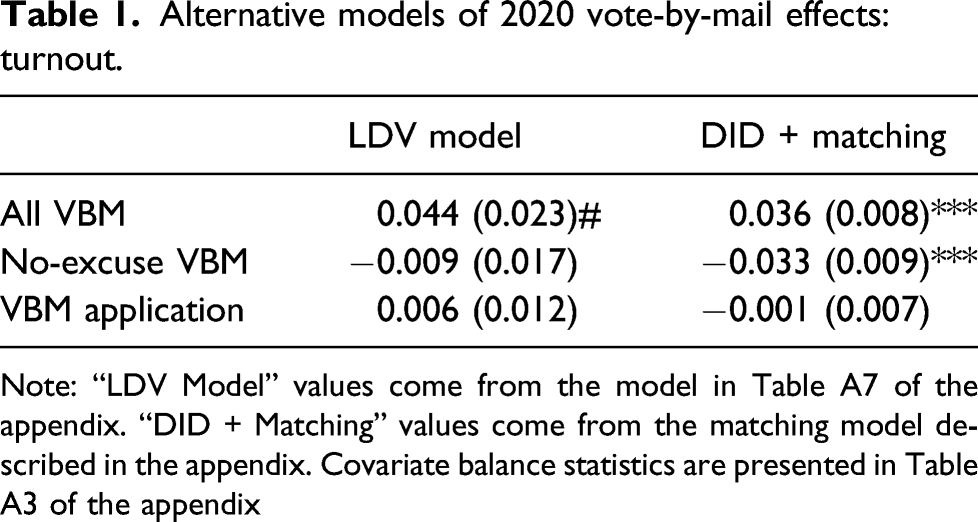
Note: “LDV Model” values come from the model in Table A7 of the appendix. “DID + Matching” values come from the matching model described in the appendix. Covariate balance statistics are presented in Table A3 of the appendix. “DID + Matching” values come from the matching model described in the appendix. Covariate balance statistics are presented in Table A3 of the appendix.
Alternative models of 2020 vote-by-mail effects: presidential vote.

For turnout, these additional models largely confirm the earlier analysis. Universal VBM had the only clear positive effect, increasing turnout by about four percentage points in 2020. The other two reforms had far smaller effects: no-excuse vote-by-mail may have decreased turnout, and the effect of sending applications had different signs in each approach. For the partisan outcomes, these models eliminate the pro-Republican result from the earlier models, suggesting that finding is sensitive to the linear trend assumption. With these methods, universal VBM appeared to have very small effects with varying signs, no-excuse VBM had a very small pro-Democratic effect, and mailing applications had no LDV effect and only an extremely small pro-Democratic effect in the matching analysis.
We also explored using the eligible population as a denominator in our turnout models. County estimates of are not easily available for most years prior to 2009, so we imputed them from a combination of Center for Disease Control and Prevention estimates of the voting-age population (VAP) and estimates of CVAP from the 1990 and 2000 censuses. 10 With a larger denominator, the effect sizes were generally smaller but otherwise comparable. For the matching estimates, the negative effects became null. The effect sizes for 2020 in the two-way fixed-effects models were much larger than for previous years, but this change was highly sensitive to the modeling decisions. It disappeared when the county-specific linear trends were removed, and it was not replicated in either the lagged dependent variable model or the difference-in-difference with matching.
Discussion
Overall, the turnout effects of these reforms are small and often model dependent, while the partisan effects are generally weak and sometimes even favor Republicans. Mailing every voter a ballot is the one exception here: either because it makes voting easier or because it alerts voters to the upcoming election, mailing every voter a ballot does have a fairly large positive effect on voting. These findings for universal VBM and no-excuse VBM are broadly consistent with findings from before the pandemic. Policy decisions should be considered with these broader conclusions in mind.
In assessing the effects of these reforms during presidential elections, we likely understate their turnout effects for lower-engagement contests. Presidential elections draw in the largest number of voters, so those who are uncertain about participating in such contests are likely to be the hardest to reach, the least familiar with the voting process, and the least likely to think of themselves as voters.
We believe these findings provide a far more rigorous test of the effects of these reforms than was possible before the coronavirus pandemic. The pandemic motivated changes in election laws across a far wider range of states than had previously made the effort. The changes were made even as mail voting became vastly more politicized than at any time in its history. And the pandemic itself inserted a deeply disruptive force into the normal administration of elections, even for states that did not change their laws. Yet in the midst of all these dynamics, we find that these laws behaved much as they had prior to the 2020 election. Our analysis also broadens the range of mail access policies that are subject to rigorous causal analysis. This helps cement our understanding of the effect of these laws both in 2020 and in elections to come.
Moving forward, it will also be important to understand the equity of these policies: whether they address longstanding disparities that limit participation among young people and people of color. We have not considered that question here but it remains an essential one for future research.
Footnotes
Declaration of conflicting interests
The author(s) declared no potential conflicts of interest with respect to the research, authorship, and/or publication of this article.
Funding
The author(s) received no financial support for the research, authorship, and/or publication of this article.
Author Notes
The authors would like to thank William Blake, Barry Burden, Andrew Hall, Michael James Ritter, Charles Stewart, Daniel Thompson, and Chris Warshaw for helpful comments on earlier drafts. Current version compiled 7 January 2022.
