




Abstract
Even though they both held the same office, Donald Trump and Joe Biden could not have presented themselves more differently. Biden presented himself as the restorer of tradition after Trump was the disruptor. In this research note, we examine seven sets of speeches that hold constant either the timing or the setting to see if their rhetoric contrasted as much as the way they presented themselves. We find that the words and emotions that they invoked were not nearly as systematically distinct from each other as we expected. We argue that this result demonstrates that the power of the presidency as an institution is sufficiently constraining that even the most unorthodox candidate’s rhetoric mirrors that of a traditionalist. When we do uncover some distinctions between them, those that exist are, for the most part, consistent with our expectations.
Even though they both held the same office, Donald Trump and Joe Biden could not have presented themselves more differently. Biden intended to restore all that Trump had disrupted. In this research note, we examine seven sets of speeches that hold constant either the timing or the setting to see if their rhetoric contrasted as much as the way they presented themselves. We find that the words and emotions that they invoked were not nearly as systematically distinct from each other as we expected. We argue that this result demonstrates that the power of the presidency as an institution is sufficiently constraining that even the most unorthodox candidate’s rhetoric mirrors that of a traditionalist. The distinctions between them that we do find are, for the most part, consistent with our expectations.
They couldn’t be more different. One made (and lost) fortunes, starred in a hit television show, and had never run for political office before his 2016 presidential run. The other was a product of middle-class America, served more than 35 years in the Senate, and ran for president two times before finally winning in 2020. The latter was of the political establishment while the former promised to “drain the swamp.” When the former argued that “there were good people on both sides” of a nighttime racist march in Charlottesville, Virginia, the latter was sufficiently enraged that he made one more run for the White House. Indeed, Donald Trump and Joe Biden could not be more different in politics, background, experience, and style. In this paper, we examine systematically if their rhetoric was as different as the ways in which they presented themselves.
Trump developed a unique communication style characterized by frenetic use of “technology, the Internet, and social media to take control of his voice and message via Twitter” (Lockhart, 2018, p. 1), which captured journalistic and public attention (McGregor & Lawrence, 2018). Biden portrayed himself as the antidote to Trump’s disruptive nature, but despite distinctly different presentation styles, the office to which they aspired and inhabited was the same. On the campaign trail, because all candidates do the necessary town halls, debates, and convention addresses, they elicit similar rhetorical styles. After being elected, the Oval Office, the Rose Garden, the press briefing room, the State of the Union address, and the other norms of the office offer each president a similar audience and venue for communication. Historian Arthur Schlesinger (1965) noted that big presidential speeches are rarely original, they are ritualistic and devoid of surprises. The rhetorical choices of phrasing, framing, and style are tied to the context in which any speech is delivered and the audience to whom it is given (Zarefsky, 2004). The substance of the rhetoric is ripe for change, but the style of presentation and underlying emotion are shaped by the norms of presidential speech-making that Schlesinger bemoans.
In this research note, we consider the nuance of Trump’s presumed “novel” style of presentation by comparing him to his successor, Biden, along a series of common presidential communication tools to examine if their rhetorical styles mirrored their differences on Twitter (Lockhart, 2018; Ross & Caldwell, 2020; Watt et al., 2017). We use LIWC (Linguistic Inquiry and Word Count) language software to assess potential systematic differences across rhetorical dimensions that prior research associates with presidents and executive leadership – clout, authenticity, power, and positive/negative sentiment (Pennebaker et al. 2001). We find relatively few differences; yet when they do occur, they are usually consistent with our expectations. We suggest that the norms of the institution and the contextual factors of presidential speechmaking constrain language such that the even the most unorthodox candidate’s rhetoric can often mirror that of a traditionalist.
I. The Influence of Personality and Context on Presidential Rhetoric
In February 2017, as President Trump was about to give his first joint address, pundits debated whether the president’s desire for generating “must-see TV” would clash with the traditions associated with the speech. In a surprising turn, the president’s tone reflected a conventional president. 1 Journalists described him as calm, controlled, and even presidential. Many struggled to reconcile his image as a Twitter-driven candidate to a normal president. None of this speculation existed four years later for the same speech Biden was about to give, and no one was surprised when he presented himself as a conventional president.
Trump’s behavior on the dais in the House of Representatives highlights a central tension of presidential politics between personality and the aura of the institution. Presidents have many opportunities to convey their agenda, but inherent in each opportunity are norms for engagement that reflect the power of the institution (Russell & Eissler, 2022). Scholars of presidential communication highlight the traditional paradigm of presidential communication, in which presidents make deliberate choices about the tone of their messages to affect change (Stuckey and Atczack 1998; Zagacki, 2007). With the rise of the Internet and the 24-hour news cycle, presidents are subject to constant attention and pressure to “be presidential” (Scacco & Coe, 2021). Yet individual differences may not necessarily appear in all types of communication (Slatcher et al., 2007).
While President Trump used Twitter to differ in form, substance, and frequency from past leaders, presidents still build their “brand” or personality with traditional rhetorical tools that provide fodder for the news. We look at presidential rhetoric beyond President Trump’s tweets to explore just how different the “disruptor” was from the “restorer.” The content may very well vary just as previous presidents of different parties, but in this research note we isolate the extent to which Trump and Biden’s tone differed in multiple, parallel speeches. While we think the Office of the President is strong, we still hypothesize that the rhetorical tones that Trump and Biden used were different and that the differences are consistent with how both men portrayed themselves across different venues and at different times. We expect these differences to vary with the constraints imposed by the setting of these speeches. The degree to which these differences exist suggests how the individual can still be distinct within the highly institutional Office of the President.
II. Rhetorical Tests and Results
Trump was considered a disruptor who bucked presentation norms, and Biden was portrayed as restoring the presidency to the previous political order. We test how these suppositions affected their rhetorical presentations across a series of parallel speeches using LIWC (Linguistic Inquiry and Word Count), a common tool that categorizes common words into 68 categories to measure personality through language (Pennebaker et al. 2001; Jordan et al., 2019). 2 The LIWC output shows the number of words in a category as a percentage of the total number of words in the sample text. Our unit of analysis is the quasi-statement, which is defined as the text between periods, semicolons, and other punctuation marks that indicates a complete thought.
Linguistic Categories, Examples, and Summaries.
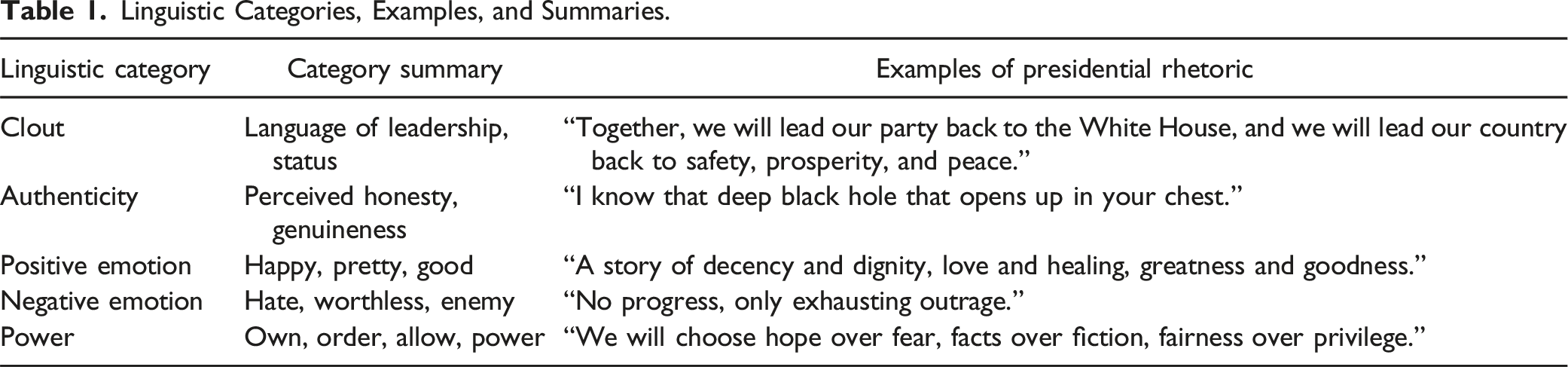
President’s Trump rhetoric, particularly that on Twitter, has often been characterized by high levels of negative sentiment and negatively valanced emotions (Enli, 2017). As such, we expect President Trump to express higher levels of clout, power, and negativity. Because of how Biden portrays himself, as at home in the institution, we expect him to have higher levels of authenticity and positive emotion. If the Office of the President does constrain rhetoric, we expect the biggest differences between Trump and Biden to be in the least formal settings where the office’s presence is least felt.
We conduct two levels of analysis. The first keeps time constant, by selecting five public appearances from the 2020 campaign where both candidates were in a similar context allowing a direct comparison in how they presented themselves to the public. First, the standard campaign stump speech from early in the nominating process illustrate policy priorities, as well as efforts to energize fellow partisans. Second, nomination acceptance speeches at the conventions are the first opportunity to speak to the general electorate, allowing them to show off their message and style to a new audience. Third, the first presidential debate puts the two candidates in direct and extemporaneous rhetorical combat. Fourth, the “dueling” town halls held in leu of the second presidential debate provided them an opportunity to show their individuality in real-time as they spoke to voters in separate though similar venues. And, finally, we examine their final appeals to the voters at separate campaign events in the week prior to the general election.
Comparison of Campaign Rhetoric Between Trump and Biden in 2020.
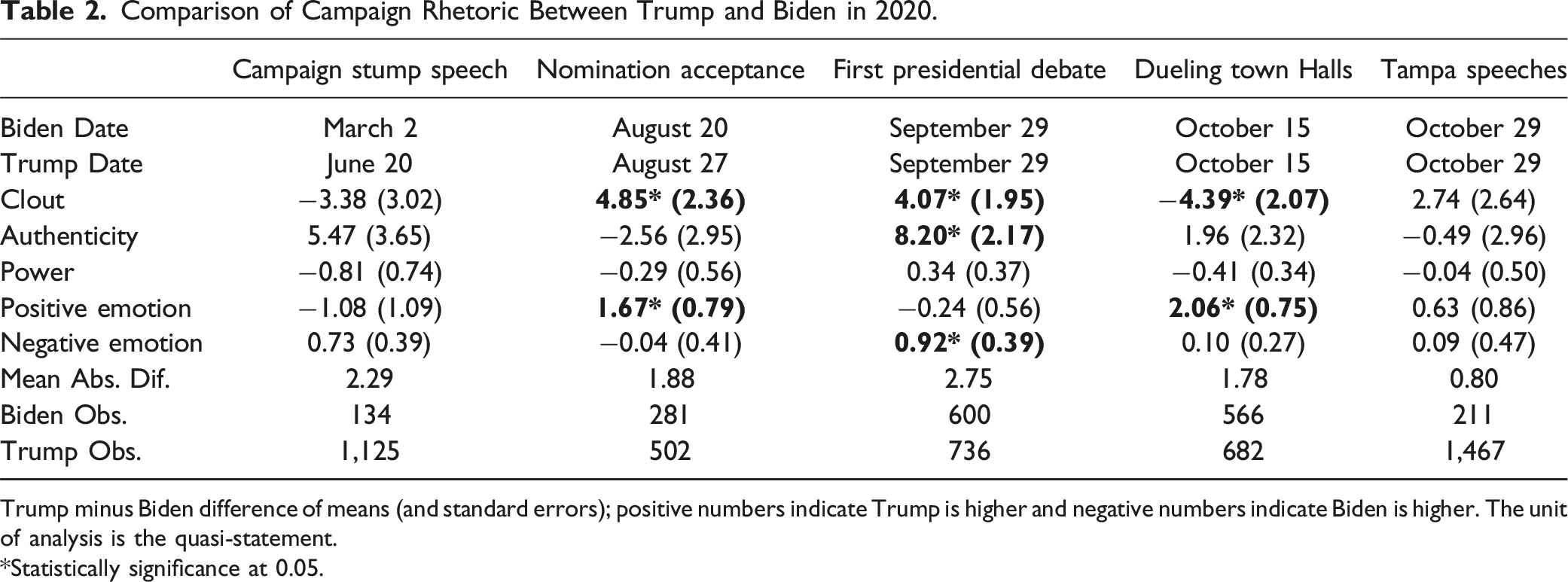
Trump minus Biden difference of means (and standard errors); positive numbers indicate Trump is higher and negative numbers indicate Biden is higher. The unit of analysis is the quasi-statement.
*Statistically significance at 0.05.
As we expected, Trump showed more clout in the nomination acceptance address and the presidential debate. Counter to our prediction, though, Biden showed more clout during the town halls. During the campaign season, authenticity is only notably higher by Trump in the presidential debate. The candidates do not differ in their power rhetoric. Counter to our hypotheses, Trump is more positive twice (the nomination acceptance speech and the town hall) and Biden is more negative once (the debate). Contrary to our expectations, their rhetorical styles were most distinct in the first presidential debate. Rather than the constraining their rhetoric, perhaps the side-by-side nature of the debate forced rhetorical distinctiveness. In the other settings the opponent was only figuratively in the room, whereas during the debate their opponent was literally in the room. Their differences were smallest in the closing argument speeches, which we also consider a highly constrained setting, especially in comparison to the stump speeches earlier in the campaign.
While counter to our predictions, we see some rationale behind the mixed set of results. Trump, as the sitting president, was seeking approval from the American public for another term, which requires a more positive message than the candidate who is trying to defeat the incumbent. These results suggest that the individuals were not only constrained by the presidential setting, but also by the roles they were playing in the campaign.
Comparison of the Rhetoric of Presidential Tools Between Trump (in 2017) and Biden (in 2021).
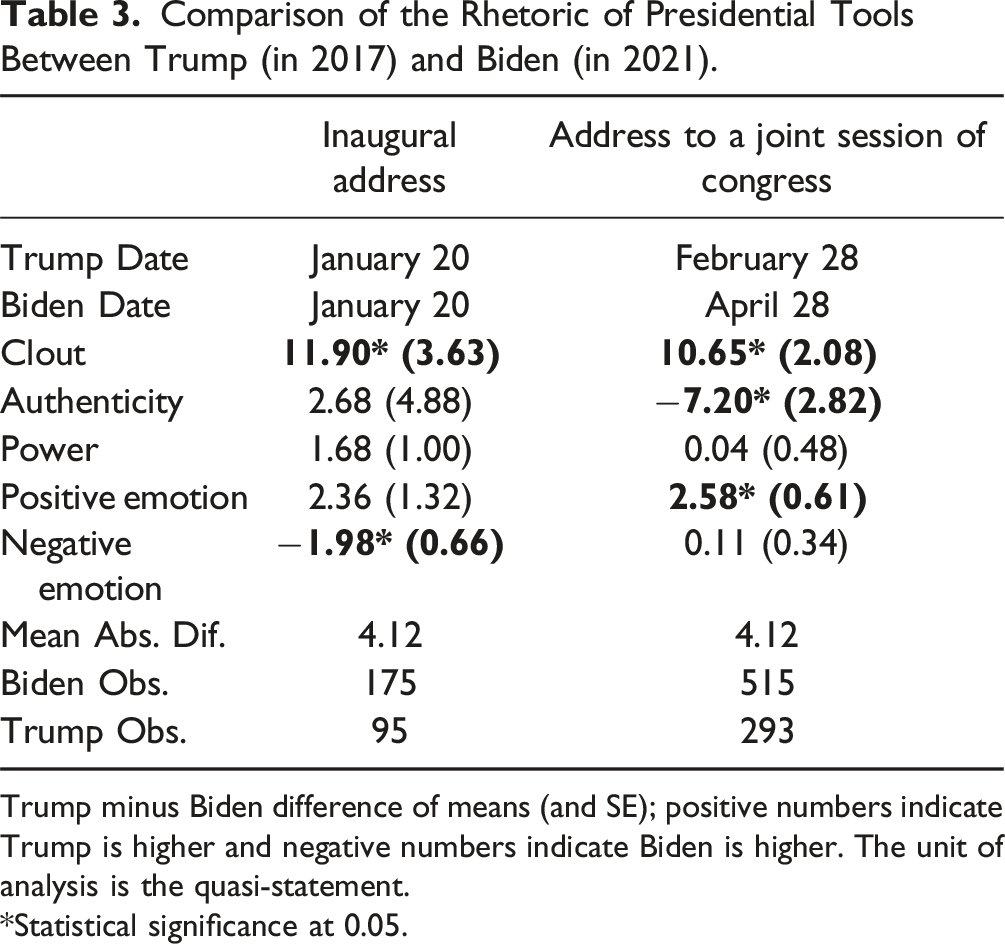
Trump minus Biden difference of means (and SE); positive numbers indicate Trump is higher and negative numbers indicate Biden is higher. The unit of analysis is the quasi-statement.
*Statistical significance at 0.05.
Trump used significantly more clout language than Biden in both speeches, which is consistent with our hypothesis. Biden showed more authenticity in the joint session, which again is consistent with our hypothesis. We get statistically significant results in the opposite direction than we expected for positive and negative emotion. We think this result is driven by the time in which the speeches were given. Biden delivered his inaugural address at a time when the Covid-19 vaccine was only starting to be distributed and in the shadow of the very recent insurrection at the Capitol. Biden’s negative rhetoric for Biden matched the political mood.
The differences in how they presented themselves suggest that the rhetorical styles of Trump and Biden are vastly divergent. Yet our results demonstrate a great deal of similarity, suggesting that the “climate of expectations” that presidents face from the public and the institution can moderate those differences across some rhetorical dimensions (Barber, 2019). Furthermore, the context in which they are speaking and the role that they are playing can drive their rhetorical patterns as much as much as their personalities; and, under some situations, perhaps more.
III. Conclusion
The presidency of Donald J. Trump has offered scholars a wealth of opportunities to ask whether the presidency was changed by this seemingly unusual individual (Eshbaugh-Soha & Montgomery, 2021; Mercieca, 2020; Rowland, 2021; Stuckey, 2021), and we find that the rhetorical differences between Trump and Biden in scripted speeches are minimal compared to the perceived differences in how they behave. The notable differences they showed on Twitter and cable news (Clarke & Grieve, 2019; Meeks, 2017; Parks, 2020; Stelter, 2020) are not as clearly evident in the more traditional settings. It could be that we have examined the wrong dimensions and/or the wrong speeches, but we picked what we thought were the most relevant dimensions and where we might find the greatest differences. Further analysis may show differences that we did not discover in this paper. To test that point a bit further, we also looked at the differences between Trump and Biden on their rhetoric that invokes the past, present, and future. The results suggest results consistent with what we find here across multiple speeches on multiple dimensions. 3 If we cannot detect systematic differences in even the easiest dimensions of the easiest cases, we suspect the harder dimensions and the harder cases would only show even smaller differences.
Our systematic examination of the rhetoric of Trump and Biden reveals that the Office of the President and its trappings constrain rhetoric such that uncovering differences is difficult. Furthermore, we find that their roles as incumbent and challenger had a bigger effect than how the public perceives them. Finally, the side-by-side nature of the presidential debate forced divergence rather than causing convergence. These sets of results suggest that systematic differences in rhetoric do have some underlying causes, but perhaps not the most obvious given the divergence between how they present themselves. Our findings lay the foundation for future research that asks what underlies these differences in presidential rhetoric and what determines the different rhetorical strategies that executives take to win elections. Additionally, to study the norms of presidential rhetoric, the focus should extend beyond speeches to include the response and reception that speech.
Supplemental Material
Supplemental Material - Research Note: “Comparing Traditional Presidential Rhetoric: Trump Versus Biden”
Supplemental Material for Research Note: “Comparing Traditional Presidential Rhetoric: Trump Versus Biden” by Rebecca Eissler, Annelise Russell, and Sean Theriault in American Politics Research.
Footnotes
Declaration of Conflicting Interests
The author(s) declared no potential conflicts of interest with respect to the research, authorship, and/or publication of this article.
Funding
The author(s) received no financial support for the research, authorship, and/or publication of this article.

Supplemental Material
Supplemental material for this article is available online.
Notes
References
Supplementary Material
Please find the following supplemental material available below.
For Open Access articles published under a Creative Commons License, all supplemental material carries the same license as the article it is associated with.
For non-Open Access articles published, all supplemental material carries a non-exclusive license, and permission requests for re-use of supplemental material or any part of supplemental material shall be sent directly to the copyright owner as specified in the copyright notice associated with the article.
