



Abstract
Chile is undergoing perhaps the most dramatic reformation of any contemporary democracy and will adopt a wholly new constitution in the coming two years. Against this backdrop, in this Research Note we investigate which democratic features Chileans prefer. To so do, we field a conjoint experiment with a large quota sample of Chileans. Results reveal that Chileans have several distinct preferences over democratic features that are currently subject to change. We also find that these preferences are largely indistinguishable within demographic subgroups. We conclude with a discussion of the implications of our findings in light of Chile’s ongoing processes of democratic reform and lessons for other democracies.
Introduction
In late 2019, Chileans took to the streets to protest an increase in fares for the Santiago Metro. The protests, which came to be known as El Estallido Social (The Social Outbreak), spread through the country as their focus expanded to include broad reforms to Chilean institutions, the resignation of the president, and a new constitution. In response, Chile’s National Congress scheduled a national referendum on constitutional reform. On 25 October 2020, voters overwhelmingly opted for a wholly new constitution to be drafted by a Constitutional Convention, which was itself elected by popular vote in May 2021. Ratification of the constitution drawn by this Convention will take place through an additional referendum to be held in 2022.
This begs the question of what type of democracy Chileans prefer. A citizen consultation held by the Chilean Association of Municipalities in December 2019 and January 2020 shed some light on Chileans’ democratic and social preferences. For example, over 86% of respondents expressed a preference for mandatory voting. However, the consultation did not touch on many fundamental democratic features, such as the electoral system and presidentialism, or substantive features like same-sex marriage.
In this Research Note, we provide a timely investigation of Chileans’ democratic preferences as their country begins the process of redrafting its constitution. We use a conjoint experiment fielded with a large quota sample of Chileans. In a series of tasks, respondents are asked to choose which of two hypothetical countries they would prefer to live in, with the democratic features of each country randomly varying from task to task.
This approach has three desirable properties. First, it allows us to estimate the causal relationship between various democratic features and Chileans’ preferences. Second, unlike those from direct survey questions, our inferences are protected from social desirability bias, as conjoint experiments are unobtrusive. Third, as people are likely to evaluate a country’s democratic features holistically, our approach improves upon traditional surveys that ask respondents about particular aspects of democracy in isolation.
Results reveal that Chileans have several distinct preferences over democratic features that are currently subject to change, such as presidential power, the electoral system, compulsory voting, and gay marriage—and that these preferences tend to be indistinguishable within demographic subgroups. We conclude with a discussion of the implications of our findings for Chile, and we discuss their relevance for other democracies that may be considering or undergoing similar reforms.
The conjoint experiment
We hired Netquest, an international market research firm, to recruit a nationally representative sample of Chileans to our conjoint experiment. Participants recruited by Netquest were sent to our online platform, which was programmed in Qualtrics. Fieldwork ran from 7 to 14 December 2020. We also asked participants in the experiment a series of questions meant to gauge demographic information. A total of 1635 respondents completed the survey and successfully answered an attention check. 1 Survey takers were compensated by Netquest with points that can be redeemed for gifts. Ethics approval was obtained before any data were collected. 2
Netquest employs quotas for region of residence, age, and sex, which are sourced from the 2017 Chilean national census, as well as a measure of socioeconomic status sourced from the Chilean Association of Market and Public Opinion Researchers. In Section 1 of the Supplementary Materials, we compare the distribution of the demographic variables in our sample to those of population-level variables for which comparable data are available. While representativeness is strong for age and sex, the mean level of education in our sample exceeds that of the Chilean population. All analyses presented below include weights to adjust for discrepancies between the sample and population on these three variables. The weights are calculated with raking, or iterative proportional fitting. We provide unweighted results in Section 2 of the Supplementary Materials.
After reading a consent screen, respondents were entered into the conjoint experiment. In each of five decision tasks, they were asked to choose which of two countries they would prefer to live in. The countries could take on various levels over seven attributes, which we chose based on current and recent debates in Chile and reforms that are likely to be considered by the Constitutional Convention.
First, we include an attribute pertaining to compulsory voting because it was only recently (in 2012) abrogated, and there have been repeated efforts to reinstate it. We ask respondents to choose between the current voluntary system, an unenforced compulsory system, or the exact system that was used before 2012. In addition, we include attributes on the electoral and party systems because Chile very recently (in 2017) began using a proportional system that significantly reduced barriers to small party entry. We ask respondents to choose between a theoretically proportional seat allocation and a mechanism that, like the system in use before 2017, disproportionately rewards parties that win the most votes. Relatedly, we ask respondents to choose between a multiparty and two-party system. 3
We also include an attribute on the legality of same-sex marriage, which is likely to be discussed by the Convention. Indeed, a 2018 ruling by the Chilean Supreme Court established marriage as a fundamental right, and a 2018 ruling by the Inter-American Court of Human Rights required Chile (and other signatories to the American Convention on Human Rights) to legalize same-sex marriage. We do not include a level about civil unions, which are already (since 2015) recognized in Chile.
Next, we include two attributes on the powers of the presidency. Under the current constitution, the Chilean presidency is one of the most powerful in Latin America (e.g., Negretto 2013). While a series of amendments to the constitution have weakened the president’s power since its original drafting under the dictatorship of Augusto Pinochet, the Constitutional Convention may further enfeeble the executive. We asked respondents to choose between a symbolic presidency and one with the ability to shape law and policy and a presidency with and without decree powers. These attribute levels reflect calls for parliamentarism, or, less dramatically, the weakening of the president’s legislative powers, made by some candidates for the Convention.
Finally, we include an attribute on universal suffrage, with levels that include true universal voting rights, suffrage limits for dissidents, and suffrage limits for the politically uninformed. While we do not expect the Convention to limit ballot access, we felt it important to gauge Chileans’ political tolerance given the febrility of the protests that gave rise to the Convention and the ensuing public debate. The attributes and their potential levels are shown in Table 1.
Attributes and levels in the conjoint experiment.

UTM: Unidad Tributaria Mensual.
Translated from original Spanish. UTM is an administrative financial unit in Chile. The punishment for failing to vote under Chile’s 1988–2011 compulsory voting law was three UTM. At the time of the experiment in December 2020, three UTM was equal to just over US$200.
Following the design of Hainmueller et al. (2014), the levels a country could take on the attributes were randomized in each decision task. 4 An example of a potential decision task shown to a respondent is shown in Section 3 of the Supplementary Materials. As attribute levels were randomized, we obtain unbiased estimates of marginal means (MMs) and average marginal component effects (AMCEs) with linear regression of a respondent’s choice of country in a given task on binary indicators capturing the attribute levels displayed in that task. As noted, we use raking weights for age, sex, and education when estimating the MMs and AMCEs. These are calculated with the survey package in R. Standard errors are clustered by respondent.
MMs give the probability that respondents chose a country with a particular attribute level, and AMCEs give differences in marginal means across attribute levels. 5 While AMCEs are commonly used to report the results of conjoint experiments, when comparing preferences among subgroups of respondents, we focus on marginal means. As Leeper et al. (2020) demonstrate, inferences made from comparisons of AMCEs are sensitive to the chosen baseline level, and, because subgroups’ mean levels of affinity for a baseline are likely to be dissimilar, such comparisons can thus be misleading.
Results
The points plotted in Figure 1 represent MMs (left plot) and AMCEs (right plot). Results show that respondents prefer voluntary voting to non-penalized or penalized compulsory voting, a proportional rather than majoritarian electoral system, multipartism over two-party competition, the legal protection of same-sex marriage, and universal suffrage rather than the disenfranchisement of dissidents or the uninformed. Respondents do not distinguish between presidents with symbolic power and legislative power. However, if a president is able to influence policy, respondents prefer that legislation requires congressional approval rather than a mere executive decree.

Overall results from the conjoint experiment.
The starkest effects involve same-sex marriage, universal suffrage, and compulsory voting. Respondents chose a country with legalized gay marriage with a probability of about 0.56, while a country in which same-sex marriage is outlawed was chosen with a probability of about 0.44. The difference in these two marginal means—the AMCE—is statistically different from zero at the 5% level, two-sided, as shown in the right-hand panel of the figure. Turning to universal suffrage, respondents chose a country in which all adults have the right to vote with a probability of 0.60. This is significantly (5% level, two-sided) greater than their probability of choosing a country where dissidents or uninformed people are disenfranchised (about 0.41 and 0.48, respectively). With regard to compulsory voting, respondents have a substantial preference for a voluntary system over unsanctioned compulsory voting or, even more so, compulsory voting with a fine for abstention (differences that are significant at the 5% level, two-sided).
In Sections 4 and 5 of the Supplementary Materials, we probe the identifying assumptions of stability and no carryover effects and no profile order effects required for unbiased estimation with conjoint experiments (Hainmueller et al., 2014: 8–9). Results suggest that these assumptions are met.
We also explore whether Chilean’s democratic preferences vary according to age, sex, level of education, and income. 6 In Figures 2–5 we display marginal means estimated among various demographic subgroups. We include 84% confidence intervals, overlap in which can be used to approximately test the null hypothesis of equivalent point estimates at the 5% significance level, two-sided.
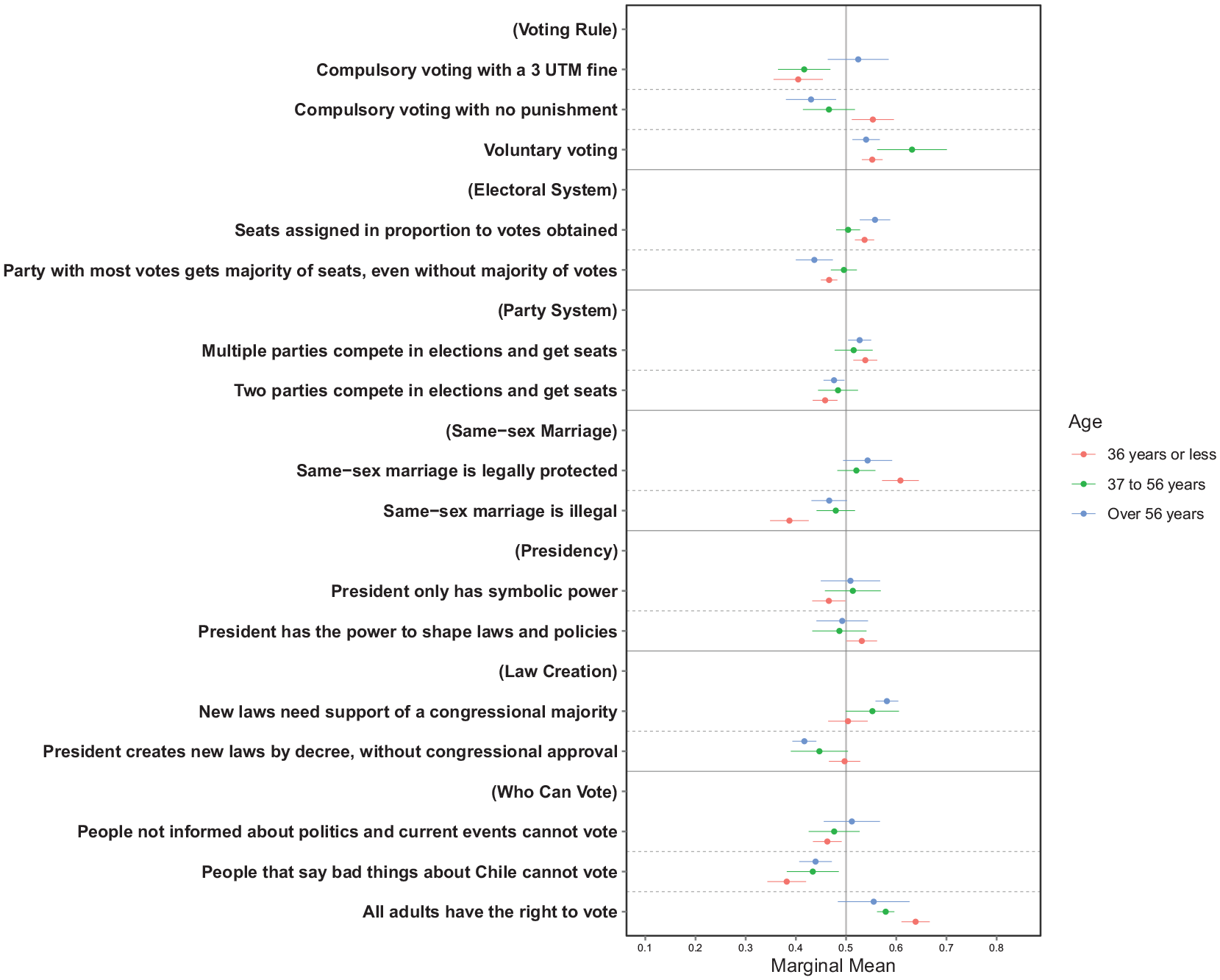
Results from the conjoint experiment by age.
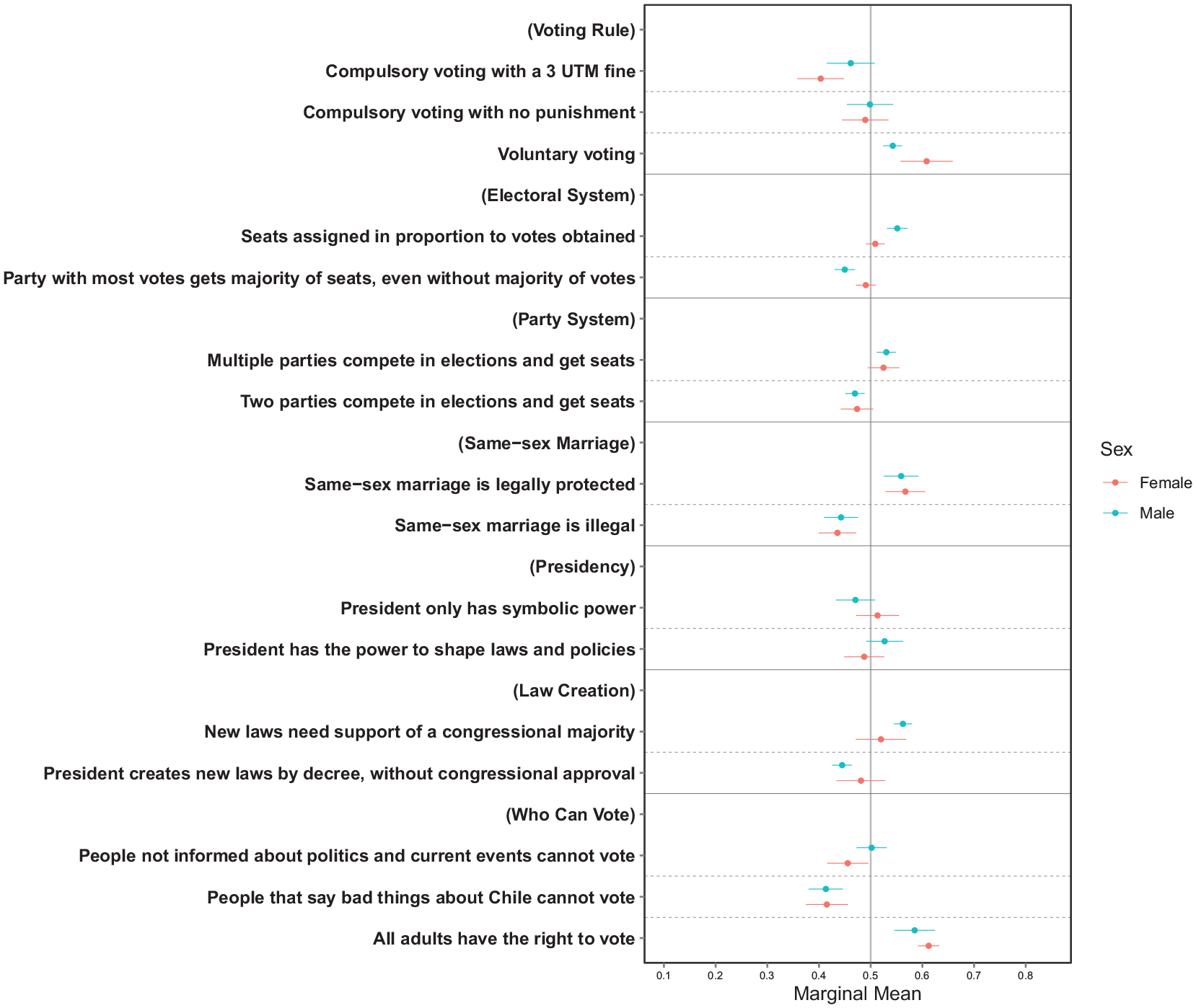
Results from the conjoint experiment by sex.

Results from the conjoint experiment by education.
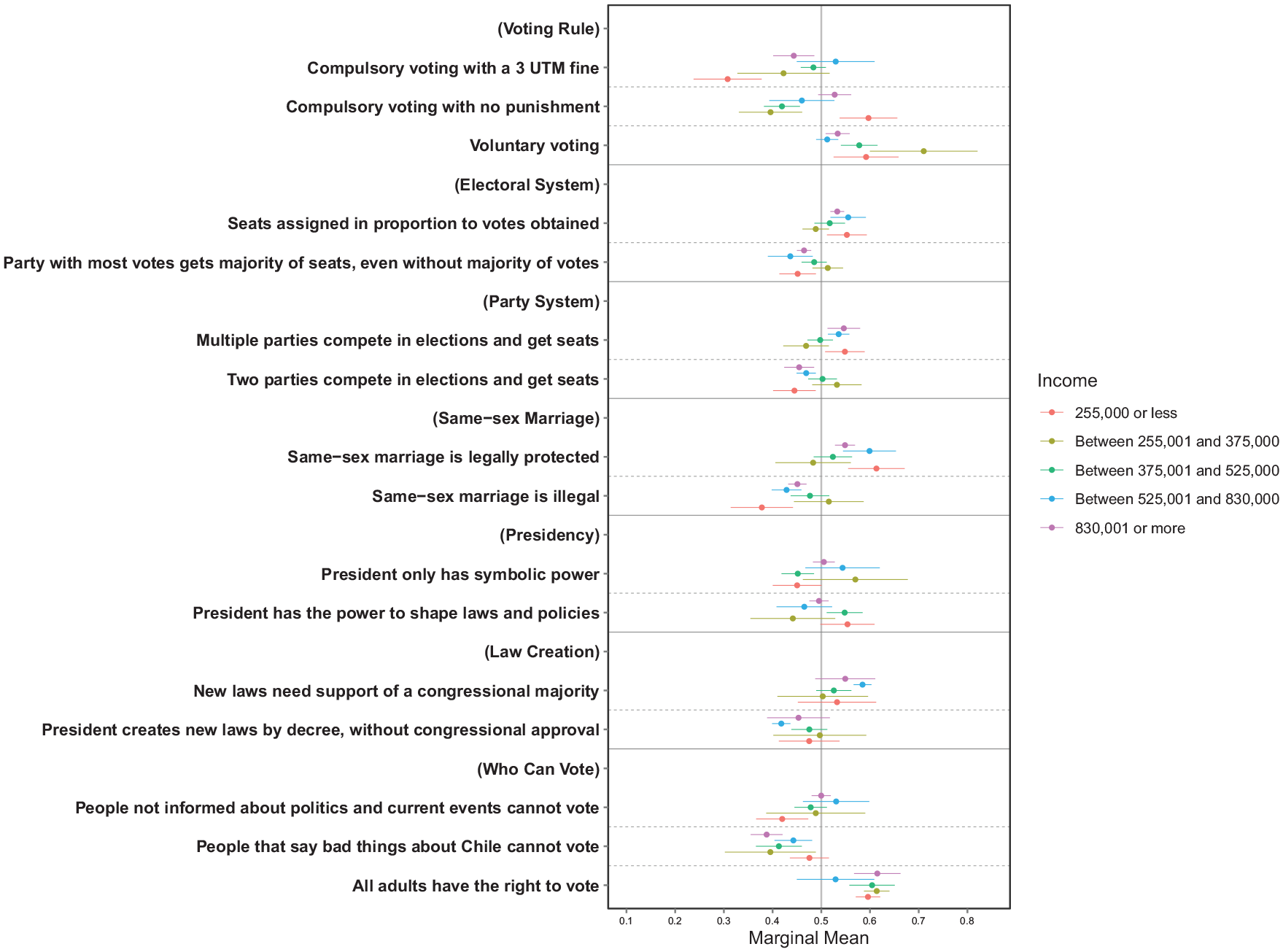
Results from the conjoint experiment by income.
Subgroup differences in marginal means within attributes are rare. For example, those with a primary school education are more skeptical about enforced compulsory voting than others, and the youngest individuals are more likely to prefer protections for same-sex marriage than older cohorts. In nearly all other cases, pairwise differences within attributes are neither substantively nor statistically (as evidenced by the frequent overlap in the 84% confidence intervals) significant.
Conclusion and implications
Our findings provide a holistic picture of Chileans’ democratic preferences as their country begins the process of rewriting its constitution and reorienting its democracy. Several interesting patterns emerge.
First, Chileans are more likely to express a preference for a country with voluntary voting than one with unenforced or penalized compulsory voting. This is an important finding, as there is a strong push for the constitutional reinstatement of mandatory voting, the abolition of which in 2012 (at the same time automatic voter registration was adopted) likely caused a sharp drop in turnout (e.g., Barnes and Rangel, 2014; Brieba and Bunker, 2019). Second, Chileans are more likely to express a preference for a country with proportional representation and multiparty competition than one with disproportional electoral rules and two-party competition. This suggests that they approve of Chile’s recently adopted proportional electoral system, which came into use in 2017 and eased barriers to small party entry.
Third, Chileans are more likely to express a preference for a country with the legal protection of gay marriage than one without legalized gay marriage. While civil unions between same-sex partners have been recognized in Chile since 2015, gay marriage remains illegal. An equal marriage law was proposed by former president Michelle Bachelet in 2017, but legislation is still pending. This is despite the above-mentioned rulings of the Chilean Supreme Court and the Inter-American Court of Human Rights that established marriage as a fundamental right and compelled Chile to legalize same-sex marriage.
Fourth, Chileans are more likely to express a preference for a country with a constrained president than one with an executive with unilateral lawmaking power. However, Chileans do not distinguish between a symbolic presidency and one in which the president has legislative powers.
Fifth, Chileans are more likely to express a preference for a country with universal suffrage than one with limits on voting rights for dissidents or the politically uninformed. Despite the fractious political debate surrounding the protests and new constitution, there is no evidence that Chileans prefer that their country limits the electoral participation of groups they may disagree with or see as unfit to contribute to the political process.
Sixth, there is little evidence that democratic preferences are conditional on age, sex, level of education, or income. This suggests that a constitution that enshrines the democratic features Chileans gravitate toward would not open up or amplify fault lines between demographic subgroups; such a constitution would be more likely to promote unity than further strife.
What can be inferred from these Chile-specific results to other democracies? First, with regard to voting rules, Chileans appear content with recently adopted institutions. While the extant voluntary voting and proportional electoral system are both less than a decade old, they are preferred to the alternatives proposed in the conjoint experiment. Other countries considering electoral reforms—current regional examples include Brazil and Colombia—may be encouraged by this finding. Second, our findings evidence a pattern whereby Chileans are “institutionally conservative” but “socially progressive.” That is, while Chileans express a preference for their current, if recent, institutional arrangements, they also have a strong affinity for the universal application of the rights that accompany democratic citizenship—including in areas such as same-sex marriage, where such universality is not yet realized. Chileans do not have a knee-jerk anti-status quo bias, but, as El Estallido Social made clear, they are willing to demand changes in areas they feel need reform. Other countries that have undergone recent institutional reforms might take heed of the Chilean experience: citizens may accept and even embrace reforms, but these are not sufficient to prevent further demands for change.
Supplemental Material
sj-pdf-1-rap-10.1177_20531680211031045 – Supplemental material for What type of democracy do Chileans want?
Supplemental material, sj-pdf-1-rap-10.1177_20531680211031045 for What type of democracy do Chileans want? by Shane P. Singh and Neil S. Williams in Research & Politics
Footnotes
Correction (June 2025):

Declaration of conflicting interests
The authors declared no potential conflicts of interest with respect to the research, authorship, and/or publication of this article.
Funding
The authors received no financial support for the research, authorship, and/or publication of this article.
Supplementary materials
Notes
Carnegie Corporation of New York Grant
This publication was made possible (in part) by a grant from the Carnegie Corporation of New York. The statements made and views expressed are solely the responsibility of the author.
References
Supplementary Material
Please find the following supplemental material available below.
For Open Access articles published under a Creative Commons License, all supplemental material carries the same license as the article it is associated with.
For non-Open Access articles published, all supplemental material carries a non-exclusive license, and permission requests for re-use of supplemental material or any part of supplemental material shall be sent directly to the copyright owner as specified in the copyright notice associated with the article.
