




Abstract
When submitted to popular ratification, new constitutions tend to be approved. Chilean voters, however, rejected the proposal put forward by the country’s Constitutional Council in 2023. This article examines the reasons for this outcome. Leveraging an original conjoint experiment exploring voter preferences across four policy areas, we demonstrate that most voters disfavored a proposed clause protecting unborn life, which would have likely restricted access to abortion. Despite general support for other provisions in the draft, opposition to the abortion clause proved pivotal. Our analysis underscores the risks of partisan constitutional proposals dependent on the median voter for approval and highlights the importance of abortion as a mobilizing issue in contemporary democracies. The study also suggests that right-wing drafters miscalculated voter support, even as moderate members attempted to amend the controversial clause, showcasing the limitations of compromise-inducing rules when one ideological bloc controls the drafting process.
The rejection of a new constitution in a referendum is a rare event: only 6.1% of constitutions submitted for popular ratification between 1789 and 2016 were rejected (Elkins and Hudson 2019: 155). However, several conditions can increase the likelihood of a new constitution being rejected within a democracy. Constitution writing requires crafting a multidimensional policy package, often demanding concessions from opposing factions. A special convention elected to draft a constitution may complicate this task because it does not enjoy the compromise-inducing trait of repeated interactions common to legislatures. Political actors can impose supermajority thresholds for decision-making ex-ante to induce ideological blocs to reach mutually acceptable compromises. However, incentives for moderation diminish when elections to the constitution-making body result in one ideological bloc winning enough seats to control decisions. Moreover, when voter approval of the final draft is required, a volatile electorate may complicate drafters’ calculations and increase their chances of misreading voters’ preferences. This dynamic, we argue, characterized Chile’s 2023 constitution-making efforts and helps explain the outcome of voters rejecting the constitutional proposal.
In this article, we present the results of a conjoint survey experiment conducted before the 2023 plebiscite, designed to explore Chileans’ views on four crucial issues included in the Constitutional Council’s proposal: abortion, pensions, immigration, and property taxes. While voters supported the proposal’s text on the latter three issues, the clause protecting the life of the unborn, which could have rendered the current law allowing abortion in limited cases unconstitutional, triggered significant opposition. We argue that this clause, put forward by some right-wing councilors and unpopular among centrists and left-leaning voters, was key to the proposal’s failure. Our article contributes to the comparative literature on constitution-making and representation in two ways. First, we highlight the challenges of crafting a multidimensional constitutional package, especially with a volatile electorate. While voter rejection of a new constitution may seem historically uncommon, Chile’s process unfolded in an environment of high electoral volatility and significant disconnection between the electorate and political parties, conditions common in many democracies. Second, we demonstrate the importance of abortion as a voting issue, as recently seen in the U.S.
Chile’s constitutional choice
In November 2019, amid a severe social crisis and violent confrontations, the Chilean government and most opposition parties agreed to start a process to replace the constitution originally established under Pinochet’s military government. In a 2020 plebiscite, 78% supported this move via an elected convention. The 155-member convention, elected in 2021, was dominated by leftist delegates, with rightists falling short of the one-third threshold required to block the left-wing majority. The convention proposed a progressive constitution, aiming to establish Chile as a plurinational state, introduce ethnicity-based judicial systems, expand the state’s role in pensions and health care, and establish unrestricted access to abortion, among other provisions. In September 2022, under newly introduced mandatory voting rules, 62% of voters rejected the draft. Two main non-mutually exclusive explanations for this failure were the low approval levels of President Gabriel Boric, who campaigned for ratification, and voter opposition to some of the constitutional provisions (Alemán and Navia, 2023; González-Ocantos and Meléndez, 2024; Keefer and Negretto, 2024).
Continued public support for replacing the authoritarian-era constitution led legislators to agree to a second attempt. To avert a repeat failure, the new process departed from the previous one by relying on experts, increasing barriers to entry for independents, and involving political parties more directly (Heiss and Suárez-Cao, 2024). A 24-member Expert Commission, equally appointed by the Chamber of Deputies and the Senate, was tasked with crafting an initial draft requiring three-fifths approval. This draft would then be reviewed by a 51-member Constitutional Council, elected across 16 districts, also operating under a three-fifths decision rule. To prevent radical amendments, Congress established 12 unreformable principles, including presidentialism, bicameralism, a unitary nation-state, and key rights (over property and life). Additionally, a 14-member Technical Committee was established to ensure adherence to these principles. In short, the architects of this process implemented an institutional structure that they expected would foster consensus, increasing the likelihood of voter approval.
The election of the Constitutional Council in May 2023 unraveled the meticulously designed process. Whereas the Expert Commission comprised an equal mix of center-left and center-right representatives, the Constitutional Council’s election gave rightist parties a veto-proof supermajority. The rightist Republican Party secured 45% of the seats, and other center-right parties received 22%.
The Expert Committee’s draft represented a compromise between its left and right-leaning members. It incorporated substantive reforms while steering clear of the four contentious issues that would dominate public debate during the campaign for the constitutional plebiscite: abortion, individual pension accounts, undocumented immigrants, and property taxes.
In the Constitutional Council, the rightist majority appeared less willing to compromise. On abortion, the status quo was based on a 2017 law upheld by subsequent jurisprudence interpreting an existing constitutional clause protecting “the life of the one to be born” (la vida del que está por nacer). Specifically, the Constitutional Tribunal had concluded that this clause was compatible with a 2017 law permitting abortion in three scenarios: risk to the mother’s life, non-viability of the fetus, and rape (Maira et al. 2019). 1 Republican Party members in the Council introduced a new clause subtly changing the wording to protect “the life of who is to be born” (de quien está por nacer). This proposal contrasted sharply with the attempt to enshrine abortion rights in the previous process. While proponents claimed this provision would leave current legislation unaffected, most Chileans viewed it as a subterfuge designed to force a reevaluation of the abortion law by the Constitutional Tribunal. 2 Polls indicated widespread opposition to this revision, perceived as a rollback in abortion access. 3
The Constitutional Council also included a clause mandating that compulsory monthly pension contributions be deposited into inheritable individual savings accounts, aligning with current private pension law (not in the constitution). This measure contrasted with the first Convention’s proposal for a pay-as-you-go public pension system with a common pool and without individual inheritable accounts. The dominant majority also included an article authorizing the prompt expulsion of undocumented immigrants, addressing public concerns over rising crime rates. A national poll in October 2023 revealed that around 70% of Chileans believed immigrants increased levels of criminality. 4 A fourth provision aimed at rallying support for the new charter introduced a broad property tax exemption. These proposals addressed issues salient in public debates, generated opposing reactions among voters, divided rightist and leftist councilors, and were linked to clearly distinguishable alternatives. As such, they are ideal for exploring how individuals confront complex multidimensional ballot propositions.
Conjoint experiment
Conjoint designs facilitate understanding how individuals make multidimensional choices. Our study investigates support for different constitutional profiles, which involve trade-offs between different features. This approach allows us to quantify the causal effect of specific clauses on support for a hypothetical constitutional proposal. We employed a choice conjoint design, wherein respondents were presented with pairs of constitutional profiles and asked to choose one profile from each pair.
The survey was conducted online a few days before the constitutional plebiscite of December 17, 2023. It was designed to be representative of urban areas covering 89% of the population. A total of 1094 respondents evaluated the constitutional profiles. Each profile is a constitutional package that combined positions on four attributes (i.e., policy topics): abortion, pensions, immigration, and property taxes. Each attribute could take two values (levels), which are policy options on each topic. One option reflected the proposal the Constitutional Council put into the new text. The other represented distinct alternatives favored by the main political forces that opposed the draft.
Constitutional proposals conjoint.

Findings
The discussion focuses on the Average Marginal Component Effect (AMCE). Towards the end, we also discuss the Average Component Preference (Ganter 2023). The AMCE quantifies the effect of a specific attribute level while controlling for the potential effects of other attributes (Hainmueller et al. 2014). Because attribute levels are fully randomized, we can estimate the causal impact of, for instance, implementing versus restricting abortion rights on how respondents evaluate constitutional profiles in the context of additional information on pension, immigration policies, and property taxes. The AMCE captures the average shift in the likelihood that a constitutional profile will win respondents’ support when it incorporates a specific attribute level over the baseline (Hainmueller et al. 2014).
Figure 1 shows the AMCEs. The blue dots represent the point predictions, and the horizontal lines indicate the 95% confidence intervals. Positive AMCEs, positioned to the right of the red reference line, indicate that the corresponding attribute level increases the probability of selecting a constitutional profile. Conversely, negative AMCEs indicate a reduction in this probability. Average marginal component effect.
Chileans were not indifferent to the four policy areas under consideration. First, there was a marked disinclination towards constitutional profiles that imposed restrictions on abortion rights. Changing the attribute from affirming the right to abortion to emphasizing the protection of unborn life resulted in an 8.2 percentage point decrease in support for the profile. This result highlights the likely significance of abortion rights among Chilean voters.
Regarding pensions, Chileans were much more likely to support constitutional profiles favoring individual inheritable retirement accounts over those advocating pooled contributions. Altering the attribute from a common pool system to individual inheritable accounts led to a significant increase in support, amounting to 15.4 percentage points. This finding indicates a pronounced preference among Chileans for individualized control over retirement savings over the common pool scheme advocated by left-wing forces.
The impact of the other two policy areas—immigration and property taxes—on the support of constitutional profiles was less pronounced but still noteworthy. Changing the immigration policy attribute from delegating to congress the power to legislate on the expulsion of undocumented immigrants to instituting a constitutional mandate for automatic expulsion increased support for constitutional profiles by 3.2 percentage points. Similarly, shifting from congressional control over property tax decisions to a constitutional clause granting tax exemptions increased support by 4.2 percentage points.
To further investigate these effects, we estimate conditional AMCEs across a series of pre-treatment respondent characteristics. We begin by examining whether constitutional preferences differ by ideology. The previous constitutional proposal rejected in the 2022 plebiscite was drafted by a Convention dominated by left-leaning members. That rejection, largely due to opposition from right-leaning and many centrist voters, underscored the political divisions shaping constitutional preferences. Conversely, the second constitution-writing process was led by right-wing parties, with centrist voters again playing a decisive role. Among survey respondents, 28% identified as left-of-center, 28.6% as right-of-center, and 43.7% as centrists. Figure 2 shows the conditional AMCEs based on ideological self-placement. Conditional AMCEs across respondent ideological self-identification.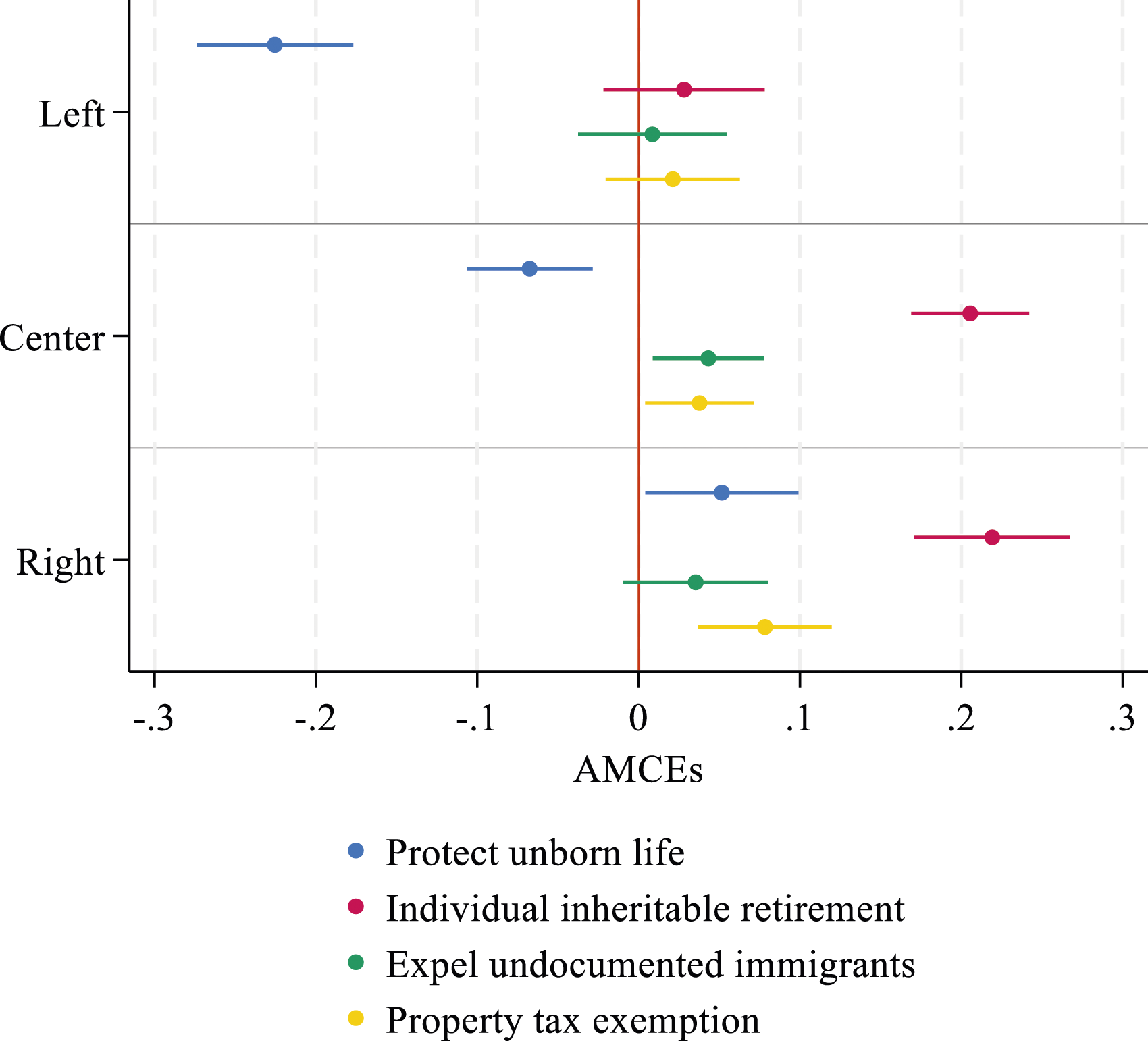
Results show that both centrists and left-leaning respondents were significantly more likely to support constitutional profiles that enshrined abortion rights than profiles that sought to protect unborn life. For left-leaning individuals, switching from a provision supporting abortion rights to one protecting unborn life led to a substantial 22.5 percentage points drop in support for the profile. Among centrists, this switch led to a more moderate decrease in support of 6.8 percentage points. The opposite is true for right-leaning respondents, whose support for constitutional profiles increased by 5.2 percentage points. Interestingly, the effect was smaller for right-leaning than left-leaning respondents.
Interestingly, changes in the other attributes do not seem to have significantly affected leftists’ support for constitutional profiles, despite opposition to the Council’s proposal on these issues by leftist politicians. For centrists and right-leaning respondents, switching from a common pool pensions scheme to individual inheritable accounts greatly increases support for constitutional profiles (by 20.6 and 21.9 percentage points, respectively). For these respondents, instituting the property tax exemption also increases support, although the effect is less substantive among centrists (3.8 percentage points) than right-leaning respondents (7.8 percentage points). Lastly, constitutionalizing the immediate expulsion of undocumented immigrants has a much more modest effect, and surprisingly, it is significant only among centrists (increasing support by about 4.3 percentage points).
Next, we explore respondents’ attitudes based on their vote in the previous constitutional plebiscite. Sizable support from those who, in the previous process, had voted to reject, voted blank, or abstained was crucial for passage. As expected, Figure 3 shows that the preferences of individuals who supported the 2022 constitutional proposal closely aligned with those of leftists shown in the previous figure. Restricting abortion significantly reduced support among this group, while changes to pensions, immigration, and property taxes had no statistically significant effects. Conditional AMCEs across respondent vote in the first plebiscite in 2022.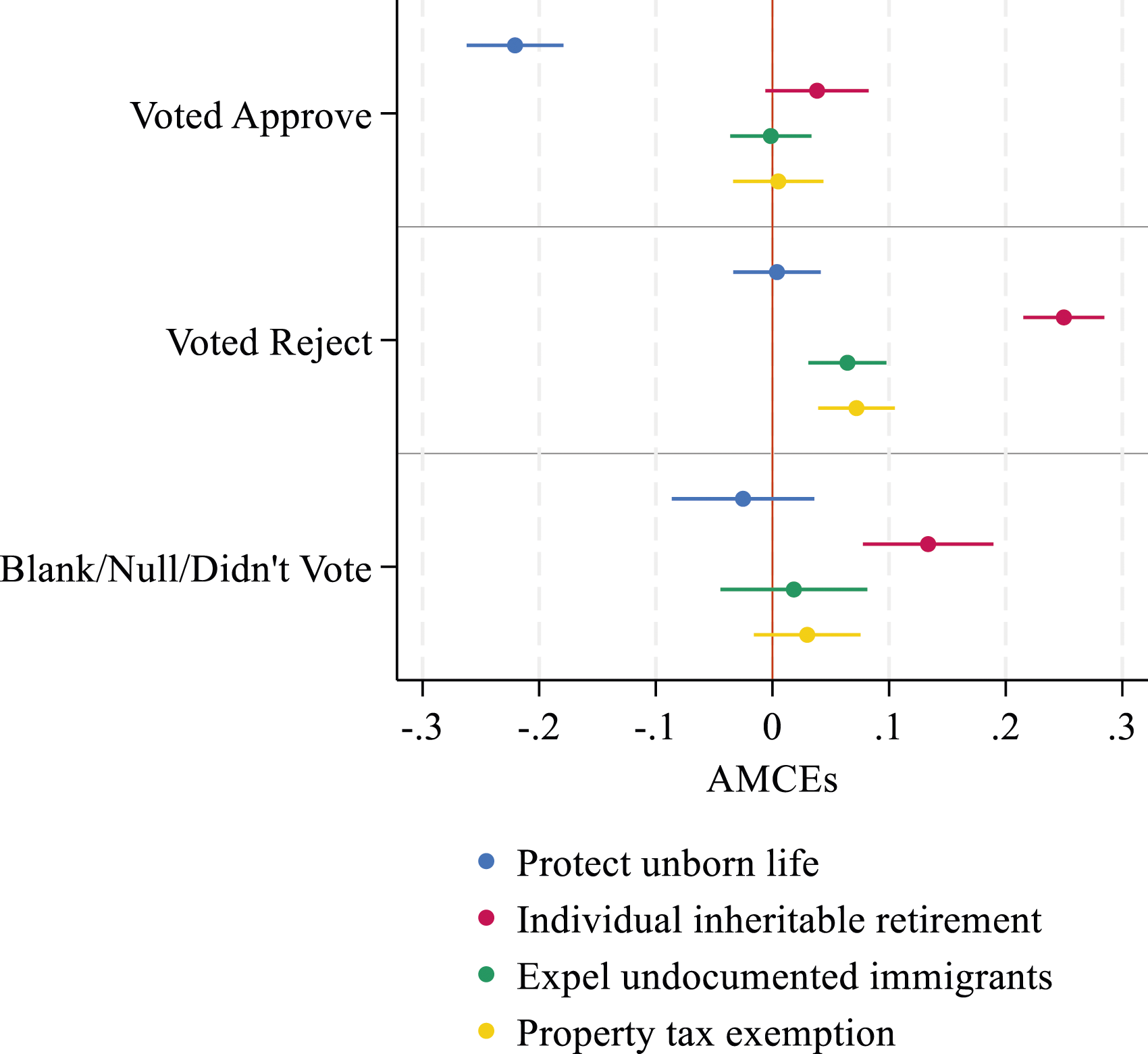
Conversely, among participants who voted against the first proposal, submitted blank or null votes, or abstained, the attribute on abortion rights had no statistically significant impact. This may be due to the heterogeneity of voters who rejected the previous draft, which included centrists and right-leaning individuals with opposing views on abortion. Also, there was support for profiles establishing individual inheritable retirement accounts. Those who rejected the previous proposal also preferred profiles mandating the automatic expulsion of undocumented immigrants and granting a tax exemption for homeowners over those deferring these policy decisions to congress.
Notably, nearly half of those who rejected the previous draft reported no confidence in the Constitutional Council. Moreover, most respondents did not identify with any party, and over a quarter expressed apathy toward the constitutional process. Detachment and skepticism were particularly pronounced among those who had submitted blank or null ballots or abstained from voting in the 2022 plebiscite. With the introduction of mandatory voting, these individuals were compelled to participate in both plebiscites but had a pronounced distrust in the Council, lacked party loyalty, and expressed little interest in the process.
Further examination of AMCEs for these subgroups shows that individuals with no trust in the Constitutional Council, who did not identify with any party, and who had no interest in the constitutional process were significantly less likely to support profiles protecting the life of the unborn compared to those establishing abortion rights. This suggests that by politicizing abortion, the right failed to engage a crucial constituency positively with the new draft. Similarly, these respondents were much more likely to support profiles with individual inheritable retirement accounts over a common pool scheme and moderately more likely to back a property tax exemption over leaving the decision to Congress. However, the choice between automatic expulsion of undocumented immigrants and deferring immigration policy to Congress did not significantly affect their preferences.
Lastly, conjoint experiments are not only useful to estimate the causal effects of attributes on a profile’s selection probability, but also to uncover respondents’ preferences. In a recent article, Ganter (2023) advances an estimand, the average component preference (ACP), to measure respondents’ multidimensional preferences. The ACP allows us to answer preference-related questions, such as whether Chileans prefer abortion rights over restrictions that protect unborn life. While estimated ACPs and AMCEs may be very similar, substantive interpretation differs in meaningful ways (Ganter 2023). After estimating ACPs, we found they are almost identical to the estimated AMCEs. Thus, we can interpret the results presented in Figure 1 as revealing Chilean’s preferences between alternative attribute levels, that is, not only as indicative of the effect of a specific attribute level on the probability that constitutional profiles will be selected.
Discussion: The constitutional council’s gamble
On December 17, 2023, Chileans rejected a constitutional proposal for the second time in slightly over a year, with 56% opposing the Council’s draft. Post-referendum polls highlighted the abortion restriction as a critical factor. 5 While the regulation of abortion has been important in public policy debates, it had not been identified as a critical issue in previous national elections in Chile. However, there are surprising parallels with the 2022 midterm elections in the U.S., where views on abortion were shown to be central in explaining electoral outcomes (Kann et al., 2024; Mutz and Mansfield, 2024). Among persuadable voters, the importance of abortion had a significant effect in shifting support toward the incumbent party, something not observed in the previous election before the Supreme Court decision overturning the landmark Roe v. Wade ruling (Kann et al., 2024). One salient difference in the case of Chile, however, is that abortion did not become a central issue due to a decision by an exogenous institutional actor but was the conscious decision of the political bloc controlling the Council.
As our conjoint experiment showed, a majority of Chileans disliked the clause protecting unborn life, including centrist voters, whose support was crucial. So, why did the right-leaning members of the Constitutional Council put that restriction in the new text? Furthermore, why didn’t the other popular provisions in the draft sway public opinion in its favor?
Several Republican Council members—and some on the traditional right—deemed the clause safeguarding unborn life essential, aligning with past legislative efforts to repeal the 2017 abortion law. As the process neared its conclusion, opinions within the right bloc were split. One faction dogmatically adhered to this clause, while a pragmatic faction favored aligning its language with the existing constitutional provision, thereby safeguarding the 2017 abortion law. At this time, opinion polls were already showing the unpopularity of abortion restriction, and some members of the pragmatic group were concerned about the potential costs of committing to this clause.
The pragmatic group sought to change the controversial clause when the Council’s proposal returned to the more moderate and conciliatory Expert Committee. There, a majority of the rightist bloc introduced an amendment to replace the Council’s text with one replicating the constitutional status quo. However, the amendment did not achieve the necessary supermajority to pass, splitting the rightist bloc in the Expert Committee in half between supporters and abstainers. Presumably foreseeing the electoral implications of leaving the more extreme clause in place, the left voted to reject it.
While there were different opinions within the right about leaving in place the more extreme abortion clause, neither faction appeared to have considered it decisive for the draft’s fate. Many thought the overwhelming rejection of the previous constitutional proposal by the leftist-dominated Convention and the widespread support the right had received in the Council election meant that Chileans were now inclined to accept a constitution tilted to the right. Also relevant was the view that the constitutional proposal was a multidimensional package including other popular proposals, such as the pension clause, the expulsion of undocumented immigrants, and the property tax exemption. They were not entirely off the mark, as the conjoint experiment showed. Why, then, weren’t these items able to sway voters, offsetting the negative impact of abortion restrictions?
Our poll shows that the majority that rejected the Council’s proposal comprised almost all the voters identified as leftists, a clear majority of centrists, and a non-trivial minority of those positioned right-of-center. 6 For this group, the populist proposal seeking the prompt expulsion of undocumented immigrants did not significantly increase support for constitutional profiles. Additionally, the clause seeking to establish a property tax exemption did not sway those identified as left-of-center and had only a marginal effect on increasing support among centrists.
Only the inheritability of individual pension funds substantially increased support for the proposal. Nevertheless, the effect of this clause on support for constitutional profiles among leftists and centrists had the same weight as their opposition to the abortion clause (about 13 percentage points in the conjoint experiment). 7 A crucial difference, however, was that individual inheritable accounts were also the default policy if the Council’s proposal was rejected. The Council sought to constitutionalize such policy and correctly estimated its popularity: voters overwhelmingly preferred this retirement provision over the alternative common pool scheme advocated by left-wingers. However, voters would get the same policy (albeit less formally secured) if they rejected the Council’s proposal, and they could avoid the abortion clause they disliked.
Whereas some rightist councilors likely overestimated the effect of inheritable pensions, immigration, and property tax provisions in countering voters’ opposition to the clause on abortion, others may have underestimated the negative impact of their dogmatic position on abortion. By including the protection of unborn life, they alienated voters who might have otherwise supported the draft’s provisions, contributing to its rejection. Chile’s case underscores the uncertainty of replacing a constitution that requires support from a volatile electorate and highlights abortion’s importance as a decisive issue in modern democracies. It also reveals the inherent risks of sectarian constitutional proposals, especially in a context of significant disconnection between the electorate and political parties.
Supplemental Material
Supplemental Material - Gambling on the constitution: Abortion rights and the 2023 constitution-making process in Chile
Supplemental Material for Gambling on the constitution: Abortion rights and the 2023 constitution-making process in Chile by Eduardo Alemán, Patricio Navia, Gabriel Negretto, and Ezequiel González-Ocantos in Research & Politics.
Footnotes
Declaration of conflicting interests
The author(s) declared no potential conflicts of interest with respect to the research, authorship, and/or publication of this article.
Funding
The author(s) disclosed receipt of the following financial support for the research, authorship, and/or publication of this article: This work was funded by the Fondo Nacional de Desarrollo Científico y Tecnológico (1231627) and Agencia Nacional de Investigación y Desarrrollo, Millenium Science Initiative (NCS2021-063).
Carnegie Corporation of New York Grant
This publication was made possible (in part) by a grant from the Carnegie Corporation of New York. The statements made and views expressed are solely the responsibility of the author.

Supplemental Material
Notes
References
Supplementary Material
Please find the following supplemental material available below.
For Open Access articles published under a Creative Commons License, all supplemental material carries the same license as the article it is associated with.
For non-Open Access articles published, all supplemental material carries a non-exclusive license, and permission requests for re-use of supplemental material or any part of supplemental material shall be sent directly to the copyright owner as specified in the copyright notice associated with the article.
