




Abstract
The urgency of climate change has prompted political theorists to consider how democracy might be reconfigured to cope with the future challenges that our current social and economic practices will generate. There have been in recent years numerous promising proposals for how political systems might be reformed so as to make them more forward-looking. This article offers an assessment of a number of such proposals that touch on elections. The main contribution of the article is to bring together suggestions put forward by political theorists and evidence from empirical social science that is of relevance to these suggestions.
Many of the decisions that democratic publics make today will have repercussions for years to come. This is particularly the case with policies that shape fossil fuel use, agriculture and forestry practices, and the urgency of climate change has brought the future impacts of contemporary decisions into clearer focus. There are a number of reasons for seeking to establish policy guardrails so that current citizens do not do things that could potentially undermine the viability of future communities and polities: cross-generational egalitarian concerns, respect for the rights of future generations, the desirability of non-domination, the state’s duty of precaution in the face of uncertainty and the interests of today’s citizens in protecting their progeny (e.g. Barry, 1978; Caney, 2009, 2018; de-Shalit, 1995; Gosseries and Meyer, 2009; Hiskes, 2009; Karnein, 2022; McKinnon, 2009, 2022; Rawls, 1972; Shue, 2014; Vanderheiden, 2008; Weale, 2022). Arguments put forward by scholars working in this area are often framed as recommendations for reforms to democratic institutions. Yet such proposals tend not to be systematically evaluated in the light of empirical evidence. The aim of this article is to draw on empirical social science evidence to assess the viability of a range of proposals for electoral reforms intended to protect future citizens.
The analysis is based on the normative assumption that institutional reform, undertaken fairly and inclusively, is a constitutive part of the democratic process. As the needs of societies evolve, their political institutions must change to match those needs. In this sense, reforms to collective decision-making institutions are coordination actions that fine-tune democratic mechanisms so as to enable them to address contemporaneous social challenges. I also make the empirical assumption, following Jon Elster (1979: 86), that the citizens of democracies are ‘neither angels (i.e. fully rational) nor animals (i.e. essentially myopic); they are imperfectly rational creatures able to deal strategically with their own myopia’. In as much as the societal challenges I will be discussing are inter-temporal, they can be understood in terms of Elster’s (1979, 2000) concept of pre-commitment or collective self-binding, a point to which I return in the concluding section of the article.
Liberal democracy is a system where majoritarian policy-making operates within constitutional (or quasi-constitutional) constraints. There are certain commitments that democratic societies deem non-negotiable, such as observing civil liberties and political rights, upholding democratic decision-making and adhering to other widely valued social norms. These normative commitments are typically shielded from the cut and thrust of majoritarian decision-making by judicial means. Within constitutional confines, citizens then decide on policy via the mechanisms of (representative) democracy, which typically follow majoritarian or pluritarian principles (Dworkin, 1977; Rawls, 1972). Proposals designed to entrench the rights of future generations generally serve functions different from those designed to encourage future-regarding decision-making in majoritarian legislatures. The first type of institution sets boundaries on decision-making (‘constraining’ devices in González-Ricoy’s and Rey, 2019 terminology), and the large literature on the rights of future generations is most relevant to institutions of this type, which include the constitutional entrenchment of the rights of future citizens and/or principles and procedures designed to protect those rights (e.g. Beckman, 2008; Boston and Stuart, 2015; Eckersely, 2004; Ekeli, 2009; González-Ricoy, 2016; Hiskes, 2009: 126–133; Thompson, 2010; Tremmel, 2019 [2018]). The second type of institution seeks to ensure that the policy process selects from among different potential means of achieving the objectives of current citizens while also safeguarding – or refraining from harming – the interests of future citizens. If the overarching goal of safeguarding the interests of future citizens is constitutionalised or otherwise protected through judicial means, 1 the practical task of refraining from endangering those interests is the proper concern of legislative decision-making. Electoral and parliamentary institutions are the two institutional clusters that can be tailored to realising policies that safeguard future interests. This article focuses on electoral institutions, for reasons I explain below.
The need to curb carbon emissions with the aim of protecting the natural worlds, societies, economies and political structures available for future citizens is a policy domain that is both emblematic and illustrative. In its latest synthesis report, the Intergovernmental Panel on Climate Change (IPCC) notes that although there has been recent progress on commitments to address climate change, the world is not on track to achieve the goal agreed at the 2015 Paris Conference to limit temperature rises to 1.5° (IPCC, 2023). This is mainly because collectively, countries’ commitments (‘Nationally Determined Contributions’ (NDCs)) are insufficient to meet this challenge, and many countries are not achieving the targets set out in their NDCs. Even if countries implement all of their NDCs, the IPCC still estimates that global warming will reach at least 2.8°, well above the 2.0° generally considered to be the upper sustainable limit (IPCC, 2023: 11). However, the existing gap between NDCs and actual emission reduction to date suggests a likely increase of 3.2° (IPCC, 2023: 11). The reforms considered in this article are mainly relevant to countries with democratic political institutions, and only relevant to those that hold elections (so not high emitters such as China or Saudi Arabia). However, developed democracies are also lagging behind the actions they need to take to meet their emissions reduction pledges. The 2022 annual report by the organisation Climate Action Tracker, which monitors the extent to which countries around the world are honouring their commitments to reduce emissions, found that as of mid-2023, not a single country in the world was on course to reduce emissions sufficiently to meet the 2015 Paris Agreement goal of keeping warming below 1.5° (https://climateactiontracker.org/countries/). Even the UK, once hailed as a climate leader for being the first major country to commit to net zero, has in recent years fallen behind the action required, as detailed in the latest report of the Climate Change Committee, the official independent body that monitors progress on achieving the UK’s targets (Climate Change Committee, 2023). Given its substantive relevance, the climate change example will guide the current discussion, although the general logic presented here is applicable to a wide range of inter-temporal policy domains.
Many reforms designed to increase democratic foresight involve adding new structures onto institutional edifices. 2 Given the practical obstacles to radical democratic redesign, and the urgency of the future challenges we face, it seems more prudent to focus on proposals that entail incremental adjustments to current practices. Working within liberal democracy as we know it rules out some of the more utopian suggestions, but it has the practical benefit of inviting consideration of institutional designs that have been trialled in some form and on which there is thus empirical evidence.
Safeguarding Future Citizens by Means of Democratic Institutions
The oft-noted myopia of democratic decision-making or ‘presentist’ bias (Boston, 2021; Caney, 2016, 2019b, 2022; Jacobs and Matthews, 2012; Karnein, 2022; Smith, 2021; Thompson, 2005, 2010) is in part a function of the fact that parties and representatives are elected for terms of several years only; this means that votes in year t can only reliably influence policies until t + 4 or t + 5. 3 Parties therefore have little incentive to make promises pertaining to policy-making in the period after this, as they cannot credibly commit to implementing such policies (MacKenzie, 2016a). Moreover, when they do commit to future policies, voters often discount those policy offers due to uncertainty surrounding future events, the likely consequences of policies and the probability that elected officials will deliver the results they promise (Fairbrother et al., 2021; Jacobs, 2011, 2016; Jacobs and Matthews, 2012, 2017). For this reason, parties tend to focus on what they can achieve in the next electoral cycle.
If the need to curb climate change requires the reduction of greenhouse gas emissions to net zero by 2030, 2040, 2050 or some other specified date, and a commitment to do this is given constitutional or equivalent standing through the entrenchment of the rights of future citizens, all subsequent policy proposals can then be classified into those that fall within the acceptable range – in that they are in keeping with this commitment – and those that fall outside the acceptable range. In order to ensure that only policies in the acceptable range are enacted, a preliminary requirement is to put in place a mechanism for assessing policy proposals in order to ascertain which category they fall into. 4 Following his, there need to be institutional mechanisms capable of filtering out proposals not in the acceptable range.
Filtering devices can operate at one of three levels. The judiciary could be empowered to review all policy proposals and rule unconstitutional proposals that fall outside the acceptable range, or even to ban political parties espousing such policies on the grounds that they threaten the basis of the future democratic order. The use of judicial review as a principal filtering device is disadvantageous, however, as it is counter-majoritarian. In fragile democracies, unpopular judicial decisions might even spark civil disorder and extra-constitutional moves to replace the system. Less heavy-handed devices are therefore preferable, with judicial review being available as a fall-back option.
A second level at which out-of-range policies might be filtered is the elected representative assembly, which might be reformed to include internal mechanisms designed to ensure that only acceptable bills are considered. Yet as with judicial review, such mechanisms might be counter-majoritarian if they filtered out policy proposals that were popular with the electorate.
The third level at which reforms could be targeted is the electoral process. If reforms were introduced to discourage parties from including out-of-range proposals in their manifestoes, and/or to encourage voters to opt for parties whose proposals were most likely to protect future citizens, this would achieve the desired result while at the same time reflecting majoritarian consensus. It is in this sense that reforms to the electoral process, broadly construed, are most likely to have the greatest democratic legitimacy and to be most widely accepted, and it is for this reason that they are the primary focus of this article.
An additional advantage of focusing on the electoral process is that voters have been found in a wide variety of contexts to act ‘sociotropically’; in other words, they vote with the interest of society as a whole in mind rather than their own personal interest (e.g. Kiewiet and Lewis-Beck, 2011; Rogers and Tyszler, 2018; Wang, 2017). Citizens have also been found to be other-oriented in their preferences for protecting future generations from climate-related disasters (Fairbrother et al., 2021; Graham et al., 2017). This suggests that it is not citizen short-sightedness that is the biggest obstacle to bringing about future-protecting change, but instead the short-sightedness of elected leaders on shortish fixed-term contracts (cf. Smith, 2021). For this reason, citizen choice in elections is arguably the immediately viable institutional vehicle with the greatest potential to bring about future-regarding policy. If voters’ other-regarding orientations can be harnessed to the needs of future citizens, this will put pressure on parties and representatives to develop more future-focused policies.
Proposals for Reforming Electoral Institutions
Though democratic institutions build ‘presentism’ into political decision-making, there is variation in the extent to which this result is observed; as Jacobs (2011: 17) notes, ‘a systematic inquiry into the politics of inter-temporal policy choice needs to treat the political relevance of the long term as a variable rather than a constant’ (italics in the original). This variation prompts consideration of how electoral institutions might be reformed with a view to maximising foresight. In this section, I provide a critical assessment of a range of proposals that have been put forward, drawing on empirical studies that shed light on their likely impact. Where possible I rely on meta-studies and literature reviews to take account of as wide a range of empirical analyses as possible and to avoid cherry-picking evidence. Where meta-studies and literature reviews are not available, I draw on comparative studies that analyse a variety of socio-political contexts. Though the evidence is not in all cases definitive, this itself is informative as it casts doubt on previous claims that have been made about the probable benefits of particular reforms, and it serves to identify gaps in the empirical literature that could usefully be filled by future social science research.
Reforms to legislative and electoral institutions can have two main targets: the composition of the decision-making body and the revealed preferences of members of that body. Compositional strategies aim to shape who is permitted to decide and/or who decides in practice. Preference-shaping strategies seek to induce decision-makers to favour policy packages likely to be within the range that safeguards future citizens. 5 These considerations suggest the four-fold typology set out in Table 1.
A Typology of Future-Safeguarding Reforms to Majoritarian Institutions.
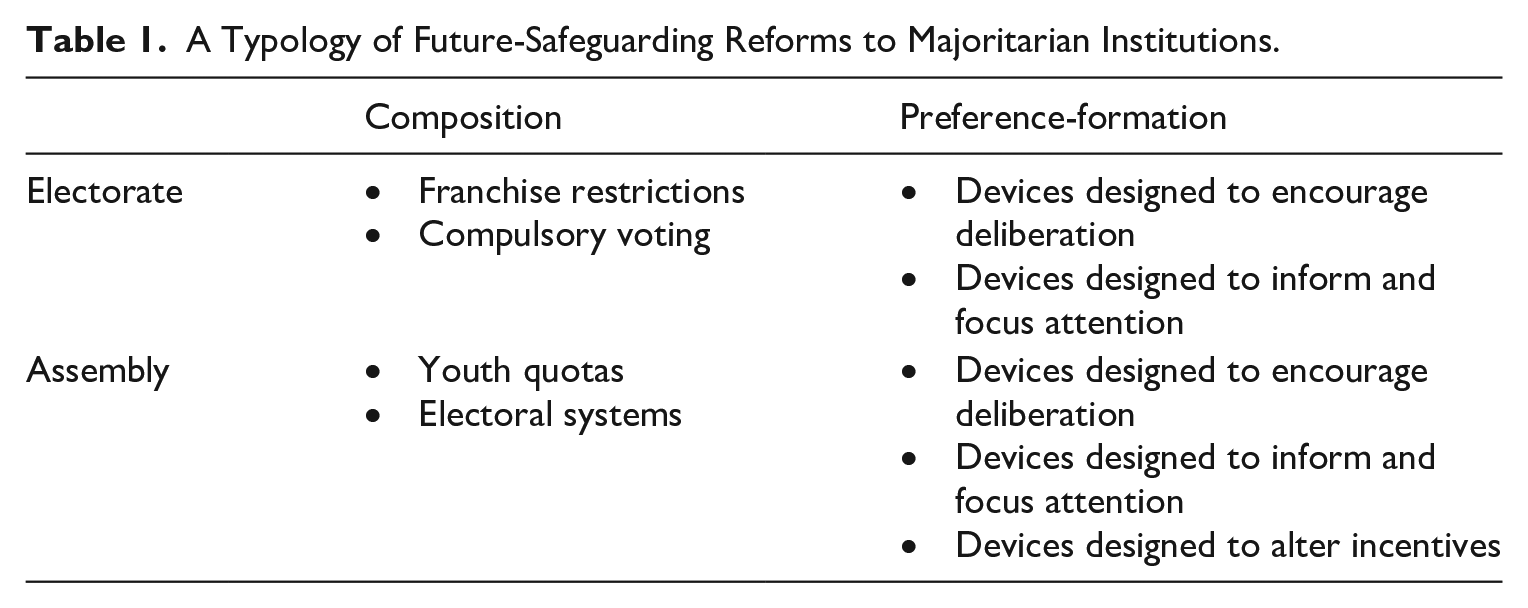
The present article is concerned mainly with the top row of this table, but the discussion will also stray to the bottom row. This is because some proposals that have been put forward operate simultaneously on both legislative and electoral levels; for example, changing vote-to-seat conversion formulae is known to have both mechanical effects on the composition of the resulting assembly and psychological effects on voters (Duverger, 1954).
My focus will be on elections to parliaments and other assemblies, as these are virtually universal in the contemporary world, but some of the proposals I discuss could also have relevance for executive elections. I will not consider proposals to reshape the number or powers of legislative chambers; though such reforms may be worthy of assessment in their own right as a means of promoting future-regarding legislation (e.g. MacKenzie, 2016b, 2021; Stein, 1998; Tonn and Hogan, 2006; Vatn, 2020), they are a separate topic.
I also limit my analysis to proposals that fall within the bounds of contemporary electoral norms, as set out in international legal instruments to which virtually all democratic states are signatories, including the Universal Declaration on Human Rights (1948) and the International Covenant on Civil and Political Rights (1966) which commit signatories to hold elections under universal and equal suffrage by secret ballot and with free expression. Not only would violating these norms be undesirable in democratic terms, but such violation would also be problematic from a prudential point of view in that it would open the way to proposals targeted at any and all democratic principles that have for generations been considered inviolable, with potentially destabilising consequences for really existing democracies. This constraint rules out a number of proposals that have been considered in the literature, such as weighted franchises (including granting proxy votes for children) or the disenfranchisement of certain categories of adult citizen (e.g. Gosseries, 2022; Van Parijs, 1998).
Compositional Proposals
Relevant ‘compositional’ institutions are those that count voters and/or votes in such a way as to deliver electoral outcomes likely to be commensurate with safeguarding the interests of future citizens. These include proposals to remodel the age structure of the electorate on the one hand and to alter vote aggregation on the other.
Remodelling the Electorate
Proposals designed to reshape the composition of the electorate include altering age thresholds and encouraging or requiring eligible voters of different ages to take part in elections. Lowering the voting age to 16 is a reform that has gained pace in recent years in many European countries, largely for reasons other than fostering institutional foresight (Birch et al., 2015), though it would have this effect if younger voters were more likely to opt for forward-looking parties. Alternative proposals that would achieve similar ends include the Brazilian practice of making voting compulsory until the age of 70, whereafter it is voluntary; and first-time compulsory voting, under which electors are obliged to take part in the first election for which they are eligible, but not thereafter (Birch and Lodge, 2015). In contexts where turnout is higher among older age groups – which is the case in most developed democracies – making electoral participation mandatory for all eligible citizens would also go a considerable way towards reducing age biases in the electorate that tend to lead to policies catering disproportionately to the needs of the elderly (Birch et al., 2013; Van Parijs, 1998). ‘Age-engineering’ of the electorate may be more acceptable from a normative point of view than seeking to boost or reduce the role of other demographic categories, as appeals can be made to lifetime egalitarianism (Gosseries, 2022); this argument is especially compelling when it comes to proposals that focus on the point of entry into the electorate, which each elector reaches exactly once. Finally, the use of youth quotas in the election of MPs, along the lines of commonly used gender quotas, has been proposed as a means of increasing the number of elected representatives from younger age groups and thereby promoting more climate-friendly policies (Bidadanure, 2016). In short, a variety of proposals have been put forward to reshape the electorate in order to increase the electoral weight of younger electors, who tend in most contemporary contexts to be under-represented.
Although there may be good democratic justifications for most of these schemes, they rest on empirical assumptions that are not justified in many contexts, as the available evidence does not lend clear support to the supposition that empowering young people electorally would promote more future-regarding policies. There are several reasons for this. First, the difference in timeframes between young and old is small in relation to many inter-temporal policy challenges, such as climate change (González-Ricoy and Rey, 2019: 7). Second, there is evidence that the young tend to prioritise the present over the future; a review of empirical studies of temporal discounting found that on average, younger people discount the future at a higher rate than older people. This may be due to the greater impulsiveness of the young (Sparrow and Spaniol, 2016), or because young people are often poorer than older people, and deprivation shortens time horizons. A recent comparative study finds that in multivariate analysis, youth is associated with climate change concerns in the US, Canada, Australia and the UK; whereas in Africa, Latin America, Asia/Pacific and Eastern Europe, older people were found to be more concerned about this problem, and in Western Europe there was no association between age and concern once other factors were taken into consideration (Lewis et al., 2019). Likewise, a literature review by Ejelöv and Nilsson (2020) identified three studies that found younger age to be associated with favourable dispositions towards pro-climate policies, three studies that found older age to be linked to preferences of this sort and one study that found no link between age and climate policy preferences. Though it may be that in the early years of the twentieth century, climate change has risen up the issue attention cycle of educated youth in certain affluent Western democracies (Knappe and Renn, 2022), this does not necessarily mean that young people in all societies at all historical junctures can be relied on to have preferences that take account of the needs of future citizens.
Proportional Representation
A theoretically more promising compositional strategy is to introduce (or retain) proportional electoral systems. In theory, this would have four impacts on future-relevant policy: first, green parties – which tend to be small and to have geographically dispersed support bases – may be more likely to win seats under proportional representation (PR) systems (Smith, 2003). Second, multiparty politics often leads to a less polarised more consensual style of politics, and this might be expected to generate policies more likely to safeguard the interests of future citizens (Boston, 2016). Third, the power-sharing coalitions that tend to result from elections held under PR may make commitments more credible, as they are backed by a wider range of political actors (Jacobs, 2016). Finally, PR insulates parties against changes in seat share, as these are lower, on average, than is the case in all-or-nothing single-member district systems.
The empirical literature on electoral system effects indicates that countries with more proportional electoral rules do indeed have more pro-environmental outcomes, as confirmed in literature reviews by Harrison (2010) and Fiorino (2011), suggesting that proportionality fosters future-regarding policy-making. The empirical evidence also supports the role of the four causal channels posited in the theoretical literature. Andersen (2019) finds that the greater parliamentary representation of green parties in smaller European states with PR is linked to their success in introducing carbon taxes, as green parties can serve as catalysts in the political system; this, combined with the more consensual policy styles of such systems, makes easier to overcome barriers to taxing carbon (cf. Folke, 2014). Studies by Fredriksson and Millimet (2004) and Lachapelle and Paterson (2013) both support the contention that the broader support base of governments elected under proportional rules facilitates the introduction of carbon taxes. Finnegan (2022) shows how PR boosts the electoral safety of representatives, making it easier for them to implement policies that entail short-term costs for voters.
The introduction or retention of PR electoral rules is therefore a promising compositional strategy, whereas efforts to remodel the electorate are unlikely to be successful in most contexts in safeguarding the interests of future generations.
Preference-Shaping Proposals
Unlike proposals intended to affect the composition of electorates and assemblies, ‘preference-shaping’ proposals are designed to engender shifts in how parties and candidates understand and formulate the policy offers they present to voters, and how voters go about selecting parties (or candidates) when they make their voting decisions. The basic intuition behind such proposals is that neither voters nor politicians are inherently and invariably short-sighted; the extent to which they are able and willing to take account of the needs of future others varies in systematic ways (Ascher, 2009: chap. 2; Fairbrother et al., 2021; Hiskes, 2009; Jacobs, 2011; Loewenstein and Elster, 1992; MacKenzie, 2021: 98). If institutions can be designed to harness the potential willingness of people to take account of the longer-term impacts of their decisions, this will address the problem of democratic myopia. A range of different strategies have been proposed to achieve this end.
Deliberative Institutions
One option is to align deliberative institutions with electoral processes. Discussion that occurs during an election campaign has elements and can be seen as ‘part of a deliberative system’ (Chambers, 2012: 65), but for the full benefits of the deliberative model of democracy to be achieved, more structured institutions need to be put in place. For example, funding could be made available for voluntary-sector organisations to hold citizen assemblies or deliberative mini-publics on different issues – including issues relevant to future citizens – during the electoral campaign (Steiner, 2012: 135–136). Deliberative theory has been identified by scholars as a tool that can, if embedded in democratic structures, generate policies likely to protect the interests of future citizens (Boston, 2016; Dryzek, 2000: chap. 6, 2010; Ekeli, 2009; Jacobs, 2016; MacKenzie, 2021; Niemeyer and Jennstäl, 2016; Smith, 2003, 2021). This is because, among its supposed benefits, deliberation is held to have the potential to generate more other-regarding attitudes conducive to taking account of the needs of future citizens.
Yet there are reasons for believing that this assumption may not be always entirely well-founded. Deliberation involves three cognitive stages: (a) focusing attention on the topic under consideration and mustering or collecting information about that topic; (b) taking and articulating a position on the topic and (c) considering the perspectives of others through dialogue and debate. 6 Much of the focus in the literature on deliberative democracy is the purported impact on other-regarding attitudes of having to defend a position and consider the positions of others. However, it may well be that the main benefit of deliberative activities lies in the fact that participants are obliged to focus their attention on a topic and muster or collect salient information, therefore bringing to the fore of their minds considerations that might have been less prominent in the absence of the deliberative activity.
This conjecture is supported by a range of evidence from empirical work on the effects of deliberation. Reviews of the relevant literature have demonstrated that there is very mixed support for the predicted effects of deliberation (Mutz, 2008; Steiner, 2012; Thompson, 2008). Psychological research sheds light on why this might be the case; the views formed via intuitive ‘fast’ thinking are then justified via analytic ‘slow’ thinking, as our rational minds develop reasoned arguments to support the positions that our intuitive minds have already decided on (Haidt, 2012). This evidence suggests that rather than espousing more other-regarding positions, deliberators may instead try to find respectable justifications for their self-regarding views.
Several empirical studies that have looked explicitly at the impact of deliberation on the promotion of future-regarding attitudes and behaviours have also shown mixed results. A study by Fishkin et al. (2014) found that European citizens who engaged in a deliberative forum on climate change were more in favour of action on climate change at the end of the event than before. Yet Dietz et al’s. (2009) study found no effect of deliberation on willingness to pay for carbon dioxide emissions mitigation. MacKenzie and Caluwaerts (2021) found that deliberation shifted views in favour of one pro-climate policy but not another. Kulha et al. (2021) show that deliberation has a weak and marginally significant positive effect on general willingness to make sacrifices for future generations, but when it comes to more specific policy proposals, such as flood defences, there is no significant effect. The same study shows that there is a deliberation effect on future-regarding perspectives only among participants who were encouraged to put themselves in the shoes of future citizens, but not among those who took part in conventional deliberation (Kulha et al., 2021), and the results are also found in studies by Hara et al. (2019) and Nakagawa et al. (2019).
These findings are mixed, but a number of them suggest that it is the epistemic aspects of the deliberation – information-gathering and attention-focusing – that make citizens more future-regarding, not the position-defending or dialogic aspects. It follows that if the epistemic benefits of deliberation could be achieved in other ways, this might be sufficient. In other words, attention-focusing and information-gathering may well be as efficacious in promoting future-regarding preferences as discussion and debate. Given that the present is generally more salient in people’s minds than hypothetical futures (Jacobs, 2016), raising the salience of the future by providing a clearer picture of likely future outcomes, and linking political options to those outcomes, could engender future-oriented decision-making by voters.
The question, then, is how to design deliberative institutions so as to maximise their potential to enable future-regarding thinking. There is ample empirical evidence that many voters tend to be myopic and prefer short-term over long-term benefits (e.g. Healy and Malhotra, 2009; Hui et al., 2022). However, there is also reason to believe that when people have information about the long-term benefits of investing in protection from future harms, they are often willing to accept such investment, as found in a literature review of attitudes towards climate policy by Drews and Van den Berg (2016), as well as more recent studies (e.g. Bechtel and Mannino, 2023; Jacobs, 2016).
This conclusion is backed up by evidence from empirical analyses that show how informing people about the future effects of climate change has three consequences: (a) it focuses their attention on future effects, (b) it frames topics in terms of the future and (c) it reduces uncertainty about future effects. 7
Attention-focusing: There is considerable support for the supposition that visualising the future makes people assign more weight to it (Ascher, 2009: 158), as does focusing attention on likely future outcomes (Ascher, 2009: chap 10; Caney, 2016: 146–147; Jacobs, 2011). In addition to the above-cited deliberation studies by Nakagawa et al. (2019) and Hara et al. (2019), a recent article by Shahen et al. (2021) found that personal exercises which prompt individuals to put themselves in the shoes of future citizens cause them to make more future-regarding decisions. Another study by Graham et al. (2017) that asked citizens explicitly to balance benefits to their generation against benefits to future generations found that most people are willing to forego benefits themselves in order to benefit future citizens. Likewise, research about the impact of reading climate change science fiction has demonstrated that focusing on fictionalised future worlds orients readers towards the future (Schneider-Mayerson et al., 2023).
Framing: Research has also shown that when the discursive framing of policy emphasises future effects, people are more likely to evaluate policies in those terms (Hurlstone et al., 2014). In a study of state pension design, Jacobs (2011) finds that when future-oriented policies are framed in terms of short-term investment in order to achieve greater rewards in the long term, actors are more likely to accept them. Most relevant in the current context is a review of climate change literature by Van der Linden et al. (2015: 761) which concludes that people value the intrinsic long-term benefits of climate policy and that framing policy options in these terms can help make future-oriented options more attractive (cf. Bolderdijk et al., 2013).
Uncertainty: Voter uncertainty about the future impact of policies is a major impediment to voters selecting electoral options that will safeguard their own future and the future of their offspring. 8 Uncertainty takes several forms, including voter ignorance of existing information, ‘contingent’ uncertainty that results from the lack in the public sphere of information that could in theory be obtained, and unavoidable ‘essential’ uncertainty that is a function of inherently unknowable or stochastic aspects of future outcomes. Although ‘essential’ uncertainty of the third type cannot be reduced, ignorance and the absence of obtainable information are susceptible to at least partial remediation through institutional means. Jacobs and Matthews (2012) demonstrate that citizen discounting of future policy effects is driven largely by uncertainty as to these effects, rather than by pure time preference. It follows that if uncertainty can be reduced via the provision of trusted information, people will discount less. Another study by Morton et al. (2011) found that the effects of uncertainty can be mitigated by positive framing of a future where climate-change-related loss is prevented.
In sum, the epistemic effects of focusing attention, future-oriented framing and uncertainty mitigation may well be the aspects of deliberation and other communicative activities that shape consideration of outcomes that will affect future citizens.
In addition to the roll-out of deliberative fora, there are several other potential institutional reforms that could induce or oblige political parties to frame issues so as to include the future, to focus attention on long-term outcomes, and to reduce uncertainty by specifying the future impacts of the policies they develop. I start with two proposals designed to increase voter information before turning to three proposals that target the preferences of candidates.
Party Statements of Future-Oriented Policy or Policy Assessment
Parties could be required to state in their manifestoes how they would protect the interests of future citizens, or to put forward ‘manifestoes for the future’ (Caney, 2016, 2019b) or ‘posterity impact statements’ (cf. Boston, 2016; John and MacAskill, 2021; Thompson, 2005, 2016). A variation on this is a system whereby future impact assessments of party manifestoes could be undertaken by a body tasked with ascertaining the impact of government policies on future generations. Alternatively, there could be a requirement that any bill under consideration by the legislature be accompanied by a statement of how the proposed law would affect future citizens (Jones et al., 2018).
Independent agencies whose job it is to monitor and report on future trends also serve to reduce uncertainty by making it easier to forecast future events and to identify the likelihood of various possible outcomes. Finland’s Parliamentary Committee for the Future already serves this function, working effectively as a ‘think tank’ within the national legislature and sharing its expertise internationally (Koskimaa and Raunio, 2020). Independent monitoring and reporting capabilities such as those recommended by Ascher (2009), Caney (2016) and Thompson (2016) could play similar roles.
It was noted above that policy-vetting of some sort is necessary in any society that commits constitutionally to safeguarding future citizens, as this makes it possible to filter ‘in-range’ policies from ‘out-of-range’ policies. One version of vetting would be informational only: the extent to which policies were consistent with the polity’s commitment to future citizens could be identified and publicised, with formal judicial review reserved for a later stage in the policy process. This would oblige parties to justify their policies in relation to future generations and could potentially filter out certain proposals they might otherwise have adopted.
Voter Information and Attention-Focusing
A second proposal that also focuses on information is the extended use of voter information tools to inform the electorate of policy positions. Research on the effectiveness of different messaging strategies to convince people of the need for climate action (or other types of environmental change) has generally found that simply informing people of the dangers of environmental degradation is insufficient on its own consistently to alter attitudes or behaviour (Druckman and McGrath, 2019; Dunwoody, 2007; Heberlein, 2012; Moser, 2010; Patchen, 2010; Van der Linden et al., 2015). 9 However, the strategies I have in mind here involve informing people not about inter-temporal risks per se, but rather informing them about party positions on issues at a point in the electoral cycle when they are likely to be seeking such information. Devices that might accomplish these tasks include vote advice applications (VAAs) through which voters are educated about party positions directly or other means by which independent bodies communicate party positions on different issues to the electorate during the electoral campaign. 10 Electoral commissions and state broadcasters could potentially also offer comparative summaries of party positions.
Voter information tools can be expected to work in three ways to enable more future-regarding vote choices. First, they focus attention on policies relevant to the future, such as environmental policy, thereby making them as salient as policies on other issues. Second, they have epistemic benefits in that they educate voters about the policy positions of parties. Third, they enable voters better to select parties that align with their own preferences.
There is evidence from numerous studies, including two reviews of the literature, that the use of VAAs has at least some effect on vote intention (Alvarez et al., 2014; Garzia and Marschall, 2019; Kamoen et al., 2015; Kleinnijenhuis et al., 2019; Krouwel et al., 2014; Ladner et al., 2012; Munzert and Ramirez-Ruiz, 2021; Walgrave et al., 2008), and that the causal mechanism through which this operates is increased voter knowledge of party positions (Garzia and Marschall, 2019; Kamoen et al., 2015; Munzert and Ramirez-Ruiz, 2021; Schultze, 2014; Walgrave et al., 2008). Several studies have also found increases in green party voting among users of VAAs (Ladner et al., 2012; Walgrave et al., 2008), which is consistent with the supposition that VAAs make voters more future-regarding. Voter information tools are thus a promising avenue for increasing citizen knowledge of future-relevant policy options, encouraging them to think about party policy offers, and promoting policy-based voting.
There are also several reforms that might be targeted at the preferences of candidates and elected officials: campaign finance reform, extended terms of office, term limits and PR (considered here a second time but for other reasons).
Campaign Finance Reform
The role of vested economic interests in shaping party policy could be drastically curtailed by banning private electoral finance and instead funding election campaigns from the public purse and party membership fees. There are many other democratic reasons to undertake reforms of this nature (Birch, 2022), but a co-benefit would be removal of the disproportionate influence of legacy economic interests on policy-making (Stein, 1998) and the circumvention of special interests that often seek to block future-regarding policies (Jacobs, 2011). The current distribution of economic resources in society reflects economic and policy decisions that have been made in the past; allowing those who have in years gone by amassed more wealth to convert that wealth into political influence by means of campaign donations entrenches past policy decisions in the present and the future, therefore representing a temporal drag on the democratic process. Banning private donations would go a considerable way towards removing this drag.
Extended Terms of Office
The electoral cycle could be reconfigured so as to encourage more long-term thinking on the part of individual representatives by insulating them from electoral backlash against decisions that are unpopular in the short term but necessary to prevent harm to future citizens. Longer terms of office (potentially alongside staggered elections) would give representatives an incentive to consider the impact of policies over a more extended period. One could envisage the extension of representative terms to 9 or 10 years in order to ensure that they are in office long enough to witness the medium-term impacts of many of the policies they adopt. It does appear that legislators elected for longer terms work harder (Dal Bó and Rossi, 2011; Titiunik, 2016). However, term extensions can be expected to have only marginal impacts on the propensity of elected officials to make future-regarding policy, as extensions of realistic magnitudes are short in relation to the timespan over which policy effects are likely to be experienced (MacKenzie, 2016a: 32).
Term Limits
Term limits might also reduce myopia on the part of individual representatives if one assumes that voters are motivated by myopic considerations (Jacobs, 2016). There is some evidence that term limits can lead to more pro-social behaviour by elected representatives (Erler, 2007; Johnson and Crain, 2004; Motolinia, 2021; Smart and Sturm, 2013), though other analysis finds no such effect (Fouirnaies and Hall, 2022). However, as Ascher (2009: 239–240) notes, the supposed benefit of term limits might well be undermined by the revolving doors problem – the private-sector opportunities that former elected officials may have following their terms, which may shape the decisions they make while in office (McCrain, 2018). Moreover, it appears that final-term legislators work less hard than those facing re-election (Fouirnaies and Hall, 2022; Frech et al., 2021).
Proportional Representation (Again)
Finally, electoral systems could be reformed in the direction of greater proportionality, but for reasons different from those discussed above. The more ‘permissive’ electoral systems that facilitate the election of small political parties have a second feature that could make them encourage longer-term policy offers: they strengthen parties as institutions. This is not necessarily true of all PR systems; the single-transferable vote – as practised in Ireland, Malta and the Australian Senate – is an institutional device that is very much focused on individual candidates, although it tends to deliver relatively proportional outcomes. However, most countries in the world with PR electoral systems make use of lists, where voters opt for parties (though they may also select candidates, as in open list systems). List PR shifts the focus of electoral campaigns from candidates to parties, and in stable democracies, parties typically have longer time horizons than individual politicians (Stein, 1998). A politician may look forward to a political career extending one, two or potentially three decades into the future, whereas a party has indefinite prospects. In as much as the interests of parties as organisations are at the heart of politics, political actors have an incentive to take account of the political long game. Adopting party list systems may therefore be conducive to encouraging longer-term thinking by politicians when they draw up their policy programmes.
Assessing the Proposals
The foregoing discussion suggests that some of the proposals suggested as means of reducing democratic myopia are more attractive than others. Yet in order to formulate concrete recommendations for institutional design, it is desirable to adopt a somewhat more systematic approach to evaluating suggested reforms. Simon Caney (2022) offers a useful set of criteria for assessing such proposals: effectiveness, political legitimacy, distributive justice and liberty, and attainability (cf. González-Ricoy and Rey, 2019). I will follow Caney’s schema, but address his evaluative criteria in a slightly different order from that set out in his article.
If proposals are likely to be lacking in political legitimacy, consideration of their other properties is superfluous. In recent years, there have been several future-regarding institutions that appear to have failed the empirical legitimacy test and have been abolished in consequence, including bodies designed to represent future generations in Israel and Hungary (González-Ricoy and Rey, 2019; Jones et al., 2018; Smith, 2020). In the vast majority of democratic contexts, illegitimate institutions would also most likely include proposals requiring judicial review of all policy proposals suggested by parties, or outlawing parties that propose policy options outside the range deemed conducive to achieving an agreed future aim. The other proposals considered above would probably be considered broadly legitimate both empirically and normatively in most contexts, as they are all consistent with internationally recognised electoral norms. 11
Distributive justice is a criterion on which it is difficult to assess electoral institutions without taking account of the concrete circumstances in which they are operating. A number of scholars have recognised that policies that consider the needs of current citizens in relation to those of future citizens have distributive implications for both groups (e.g. Barry, 1978; Caney, 2016; Jacobs, 2011). Yet the substantive impact of electoral institutions on welfare outcomes depends very much on the configuration of political parties in different historical and political contexts, making it virtually impossible to make generalisations about the likely distributional effects of the proposals considered here. At most, it is possible to say that proposals designed to reduce the age bias commonly found in states with voluntary voting would lead to the fairer distribution of benefits across age groups in the present and the not-too-distant future, and that may well be a good reason to advocate such proposals, regardless of their impact on the distribution of benefits among the citizens of later periods.
The two principal criteria that I will employ to assess the proposals discussed are those of effectiveness and attainability. The empirical literature cited in the previous section indicates that proposals designed to remodel the electorate are unlikely to achieve the aim of producing more future-regarding electorates, as young people cannot reliably be counted on to favour policies that will safeguard the interests of future citizens. PR, by contrast, is a compositional device that has a number of properties that might well generate representative assemblies that would take account of future citizens. PR can therefore be considered to be a relatively efficacious institution.
Of the various means proposed for shaping preferences, the provision of information and the formal requirement for policy justification appears to be as promising as citizen-based deliberative institutions, bearing in mind that deliberative institutions often play informational roles as well. Requiring parties to state publicly at election time how they would protect future citizens would raise the salience of this aspect of policy proposals and would pressure parties to filter out proposals that they would find difficult to defend in this context. Widening the use of voter information tools in order to maximise the chances that citizens will be aware of future-regarding policy commitments is also likely to be efficacious.
Restructuring the incentives of parties may, in addition, be a promising way forward, though more empirical research needs to be done on how such proposals would affect future-regarding policy development. Campaign finance reform is promising in that it would remove a range of incentives for parties to craft policies that cater to accumulations of wealth in the past rather than to future groups. Term limits and term extensions may conceivably have a role to play in extending the time horizons of policy-makers, though their benefits are less clear.
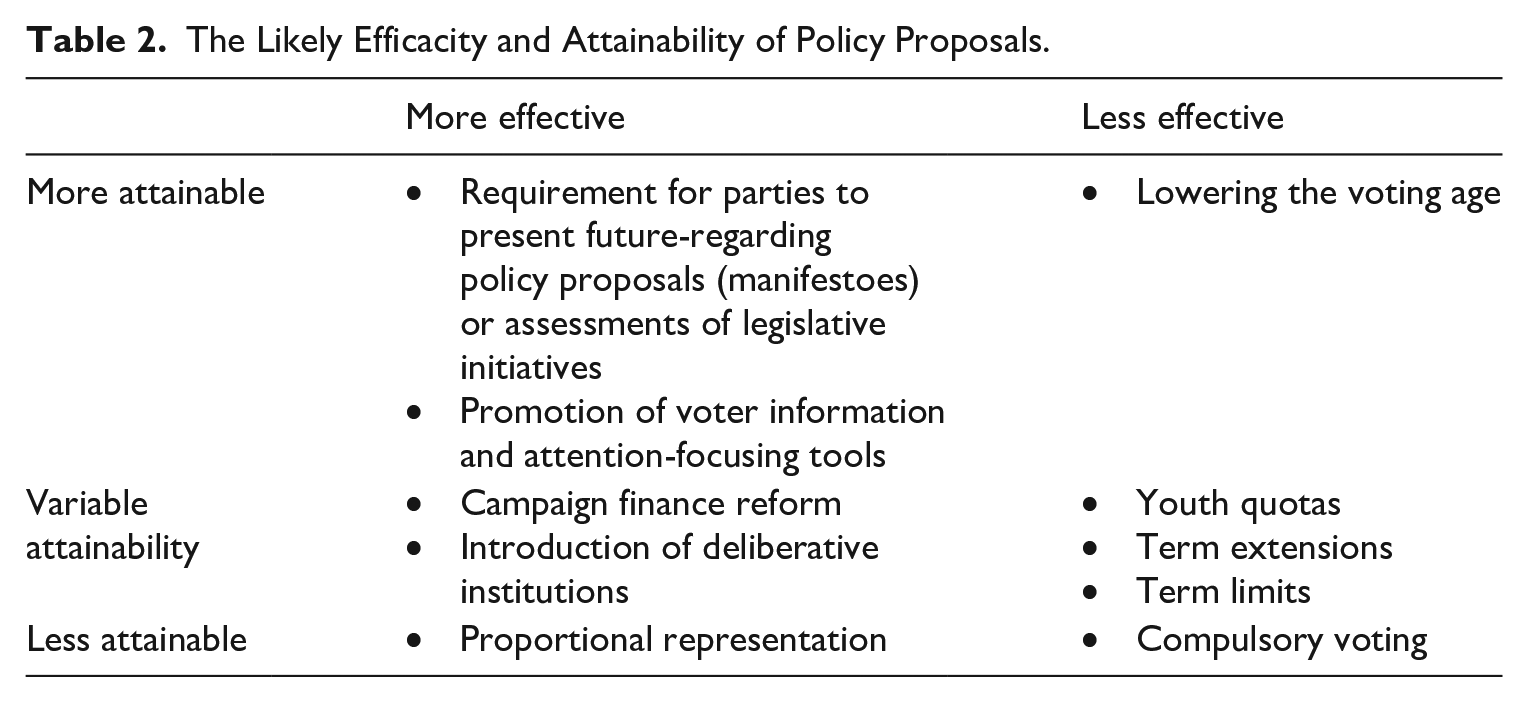
These proposals vary in the extent to which they are attainable in really existing democracies. Attainability also varies across states and time. That said, some types of reform are very challenging in most contexts. Generally speaking, electoral systems are difficult to alter, save in times of radical political reform (Rahat, 2011). Compulsory voting is also an institutional device that attracts opposition in many cultures, despite the fact that it is practised by approximately a quarter of all democracies. Thus, most countries that have not already adopted PR and/or compulsory voting are unlikely to do so.
At the other end of the attainability spectrum, widening the use of voter information tools and requiring parties to address the needs of future generations in manifestoes would be relatively easy to introduce in many situations, as they represent incremental changes to existing institutions. Indeed, Boston (2021) notes that transparency requirements and the provision of information are attractive due to their viability and the modest alterations they would entail to existing systems.
Campaign finance reform, term limits and term extensions are reform proposals that may well have other benefits, and when there is a groundswell of support for such proposals, it could be viable to achieve them. Under other circumstances, such reforms might be seen to threaten the interests of the political elite to such an extent that they would have no realistic chance of being adopted.
Table 2 sets out the proposals discussed according to the dual criteria of likely efficacity and likely attainability. Manifesto requirements and voter information/attention-focusing tools appear to be the most promising of all the proposals, followed by campaign finance reform and deliberative institutions. What works and what is possible will vary considerably by context, but this analysis suggests that empirical political scientists could usefully devote more attention to the ability of voter information and attention-focusing tools and future-oriented manifesto commitments to extend voters’ time horizons and induce them to pay greater heed to the interests of future citizens when they make their vote choices.
The Likely Efficacity and Attainability of Policy Proposals.
The foregoing discussion indicates that there are mechanisms that have a realistic chance of being adopted in many contexts and that would go some way towards making democratic decision-making more future-regarding. Kates (2015) is sceptical of claims such as this on the grounds that democratic institutions that have generated the problem of presentism are for this very reason unlikely to be ones in which future-regarding reform proposals would be adopted. However, the evidence I have presented suggests that this concern is wide of the mark, as the obstacle to future-regarding decision-making lies not so much in citizens who are inherently presentist, but rather in existing democratic institutions that work to restrict the time horizons of policy-making. Epistemic devices that encourage voters and parties to engage with the future consequences of policy proposals often have the ability to (re-)extend those time horizons. Moreover, democratic institutional arrangements are not all of a piece; they are made up of a complex range of structures with varying components, many of which are susceptible to reforms that have been found to have future beneficial effects.
Conclusion
Climate change is pushing us into a world with which short-sighted democratic institutions are not well suited to coping. Yet democracy is typically theorised in the present tense, and this creates inter-temporal problems when policies and laws made today impinge on the citizenries of tomorrow. This article has sought to think through electoral institutions in terms of the impact of policy-making on future citizens. 12 There is a widespread assumption in the political theory literature that insulating politicians from popular (voter) pressure will help enable them to make more future-regarding decisions (Boston, 2021; Boston and Stuart, 2015; Finnegan, 2022; González-Ricoy and Rey, 2019), but the review of empirical literature presented here suggests that this may well not be the case, and that the obstacle to democratic foresight is more likely to be politicians seeking short-term electoral advantage and campaign funding. Voters, by contrast, do demonstrate the ability to take the long term into account in their daily lives: they buy insurance, they save for the future and they often make major sacrifices for the well-being of their children and grandchildren. Likewise, the literature on political knowledge and deliberation indicates that information can extend citizen time horizons and induce them to take account of the then needs of future generations. It is for this reason that the greatest potential may well lie in reconfiguring democratic institutions such that they induce citizens to take account of future policy effects when they vote; this will then put pressure on parties and representatives to craft policies that take account of future-regarding citizen preferences.
I have therefore argued that the most promising reforms are those that extend the time horizons of voters through attention-shifting devices that harness their demonstrated propensity to vote for the social good. The main focus has been on incremental and deliverable reforms to existing institutions; time is running out for us to address climate change, and proposals that require major constitutional revamps are unlikely to be feasible soon enough. I have shown that there are a range of more modest steps that can be taken in most existing political systems to focus public attention on the needs of future citizens and encourage voters to act on this basis when they go to vote.
Detailed consideration of how these changes could and should be enacted in ways that are fair and inclusive is beyond the scope of this article, but if we follow Elster (1979, 2000) in viewing democratic constitutions and other institutions as devices as means of collective pre-commitment, the reforms I have outlined can be understood as solutions that democratic publics might debate and adopt so as to enable them to overcome inter-temporal collective action problems. This approach is more attractive from a democratic point of view than seeing reforms of this type as ‘nudges’ that might be paternalistically imposed on citizens by elites (Thaler and Sunstein, 2008). If my argument is correct, and citizens are more promising levers of future-protecting rules than political elites, it would make sense for reforms to be introduced via mechanisms in which citizens are placed centre stage, such as constitutional assemblies or standing citizen bodies whose task it is to consider democratic institutions. There is an inherent conflict of interest built into the common practice of allowing elected assemblies to decide on the rules governing elections. No electoral law, future-regarding or otherwise, can be made in a truly fair and impartial manner when it is made by those who are subject to it. In this sense, the citizen assemblies, random chambers, deliberative polls and democratic mini-publics that have been much discussed in recent democratic theory would seem to be suitable vehicles for bringing about reforms such as those discussed in this article (e.g. Abizadeh, 2021; Fishkin, 1991, 2018; Landemore, 2020; Smith, 2021). That said, there may not be in many real-world cases sufficient time to wait for reforms to our means of bringing about reforms, and ordinary legislative practices will undoubtedly be most expedient if enlightened leaders are prepared to back future-regarding institutional change.
Much of the argument put forward here has been speculative in nature, as the empirical evidence to test some of my conjectures is lacking. I am hopeful that in future years social scientists will offer evidence on some of these questions, and that this will form the basis for the public consideration of institutional reforms that will foster greater political foresight.
Footnotes
Acknowledgements
The author is grateful for comments on this article by the participants in REDEM Workshop on Equality and Electoral Democracy, Sciences Po, Paris, 28–29 November 2022; the People, Politics, and the Planet in Crisis workshop, John Moores University Liverpool, 6 April 2023; and the Institute for Future Studies seminar, Stockholm 24 May 2023. The author would also like in particular to thank Ludvig Beckman, Malcolm Fairbrother, Anabelle Lever, Attila Mráz, Anne Philipps and Albert Weale.
Declaration of conflicting interests
The author(s) declared no potential conflicts of interest with respect to the research, authorship, and/or publication of this article.
Funding
The author(s) received no financial support for the research, authorship, and/or publication of this article.
