




Abstract
Mediation is widely used to settle armed conflict and interstate crises. However, the debate over the most appropriate and effective mediation strategy is still ongoing. In particular, manipulative mediation is controversial, with some research indicating that heavy-handed mediation may buy short-term peace at the expense of an instable long-term situation. This paper re-evaluates these claims. We discuss how existing theoretical arguments either do not imply long-term instability or implicitly make unrealistic assumptions to explain possible long-term problems of manipulative strategies. We re-examine published empirical evidence for problematic long-term effects of manipulative mediation in interstate crises. We demonstrate statistically that this evidence actually implies a different conclusion and instead supports our theoretical argument: manipulative mediation is associated with substantively greater stability compared to unmediated cases, although this effect weakens and becomes statistically insignificant after several years. Interestingly, non-manipulative mediation appears to be uncorrelated with post-crisis stability, based on our analysis.
Introduction
Mediation is often regarded as a successful tool for conflict resolution (Clayton, 2013; Greig, 2001; Svensson, 2007). The literature suggests that mediation reduces violence and increases the probability of reaching a settlement (cf. Beardsley et al., 2006; Wilkenfeld et al., 2003). However, the debate on the most appropriate and effective mediation strategy is ongoing and stirring controversy over the impact of manipulative mediation.
When mediators apply manipulative (also called directive) strategies, they use their leverage and power to actively change the attitudes and behaviours of the conflict parties. Their pressure and incentives alter the parties’ cost-benefit perceptions and thereby the content and outcomes of the bargaining process. Less intrusive, non-manipulative strategies include facilitation and formulative (or procedural) mediation. The formulative mediator does not control the outcome of negotiations but manages formal aspects of the process whereas facilitative mediators take on a rather passive role – mainly focused on encouraging communication between the adversaries and channelling information (Bercovitch et al., 1991).
Most authors agree that manipulative mediation produces positive short-term effects, but the long-term effects remain disputed. In the short term, manipulation contributes to resolving international crises as well as reaching agreements in intrastate conflicts (Beardsley et al., 2006; Bercovitch and Gartner, 2006; Quinn et al., 2013; Sisk, 2009; Svensson, 2007). Evidence for long-term effects of manipulative mediation varies widely and ranges from appeasing effects of specific forms of leverage (Reid, 2017) and a contribution to durable settlements – considering that manipulation is often applied in the hardest cases, to no significant effect on tension reduction (Quinn et al., 2013), or even destabilizing effects on long-term peace (Gurses et al., 2008; Werner and Yuen, 2005). The latter scepticism regarding manipulation is not limited to small-circle academic discussions, but resonates with the policy community (e.g. Clayton and Baumann, 2017; United Nations Institute for Training and Research (UNITAR), 2010).
Beardsley (2011) aims to reconcile the findings on short- and long-term effects and argues that manipulative mediation entails a ‘mediation dilemma’: An ‘increased use of third-party leverage will lead to ever-stronger short-term outcomes [. . .] and ever-weaker long-term stability’ (Beardsley, 2011: 115). In contrast, ‘without leverage, third parties will be less able to move things forward in the short run, but when they do, the peace will be relatively more likely to endure’ (7). According to his analysis, manipulation appears to be more successful in preventing crisis recurrence within the first year after the crisis, compared to non-manipulative mediation. However, Beardsley concludes that ‘the risk of failure at ten years after a crisis ends is nearly four times (297 percent) greater than the risk without mediation’ (126). Facilitative and formulative strategies do not seem to bring about such adverse long-term effects and appear to provide a smaller appeasing effect, without associated downsides (125–127). Therefore, ‘the choice of a manipulative strategy appears to be a classic risk-reward trade-off’ (126).
So should we be concerned about long-term instability following manipulative mediation? Should mediators even let conflict parties ‘fight it out’ (as suggested by Luttwak, 1999), if facilitative or formulative approaches fail? We argue that it is necessary to look at the cumulative effect of manipulation to address these questions because the risk of failure at a particular point in time is dependent on survival up to this point. Time-varying hazard ratios, as found by Beardsley (2011) for the effect of manipulation on crisis recurrence, do not necessarily indicate adverse long-term consequences (cf. Ruhe, 2018). We demonstrate that, when we apply the latest lessons from methodological research (cf. Jin and Boehmke, 2017; Ruhe, 2018), the empirical evidence provides no indication of lower long-term stability following manipulative mediation. In fact, manipulation is associated with more stable peace. Moreover, non-manipulative strategies appear to be uncorrelated with stability, therefore disputing previous conclusions.
Re-evaluating the long-term effects of manipulation
Critical assessments of the long-term effects of manipulation are mainly based on one or both of the following two theoretical arguments. First, manipulation might generate artificial bargaining solutions that falter as soon as mediators become less involved because they do not match the parties’ actual preferences (cf. Beardsley, 2008, 2011; Gurses et al., 2008; Werner and Yuen, 2005). Second, pressuring conflict parties into such artificial agreements might prevent that actors learn from fighting and develop converging views of an appropriate bargaining solution (Beardsley, 2011; see Luttwak, 1999 for an extreme position).
The first argument does not logically imply that manipulatively mediated conflicts will be worse off in the long run. If conflict parties were able to reach a self-enforcing agreement on their own, we would not expect that mediators jeopardize this agreement by forcing the parties into concessions that impair the agreement’s quality. Instead, if a mediator required pressure to generate an artificial stability in a conflict and this fragile peace were to break down once the mediator became less involved, then it is unlikely that we would see an unmediated or facilitated outcome of the same crisis that would additionally prove stable in the end. The notion that continued pressure is necessary to sustain an agreement implies that there are characteristics which make it difficult for the conflict parties to reach a self-enforcing agreement on their own and render the situation prone to escalate again (cf. Gartner, 2014). Importantly, however, without an additional theoretical argument about how the manipulative mediator worsens the situation or prevents a pacifying process, these same destabilizing characteristics would also threaten a non-mediated or facilitated post-conflict situation. Hence, without the interim stability generated by third-party leverage, we would expect such unstable situations to re-escalate even earlier.
Beardsley’s (2011: 125–126) evidence for a ‘mediation dilemma’ is based on his findings of a time-varying effect of manipulative mediation on the risk of crisis recurrence. Initially, manipulation decreases the risk of a new crisis, but appears to substantially increase this risk after some years. However, recent methodological work has pointed out that such time-varying hazard ratios are ambiguous and do not imply that the overall effect of a variable reverses over time.
Figure 1 describes, with a stylized example, why an artificial bargain imposed by the mediator may not imply long-term problems, while generating the effects observed by Beardsley. It shows hypothetical cases with their counterfactual failure times with and without short-lived mediator leverage. We assume that most cases survive longer due to mediator pressure, but fail once mediator influence vanishes (Panel A). Panel B graphs the probability of a new conflict among cases that have not yet failed (akin to the hazard rates reported by Beardsley). Clearly, the probability of failure is higher among unmediated cases in the first period. In the second period, only the strongest unmediated case survives while the fragile cases who were artificially stabilized fail. The probability of failure among surviving cases is therefore higher in the mediated group. However, this does not imply that mediated cases are worse off. They are more stable for a longer time, but converge to the same long-term probability of peace after the mediator disengages (Panel C; cf. Ruhe, 2018).
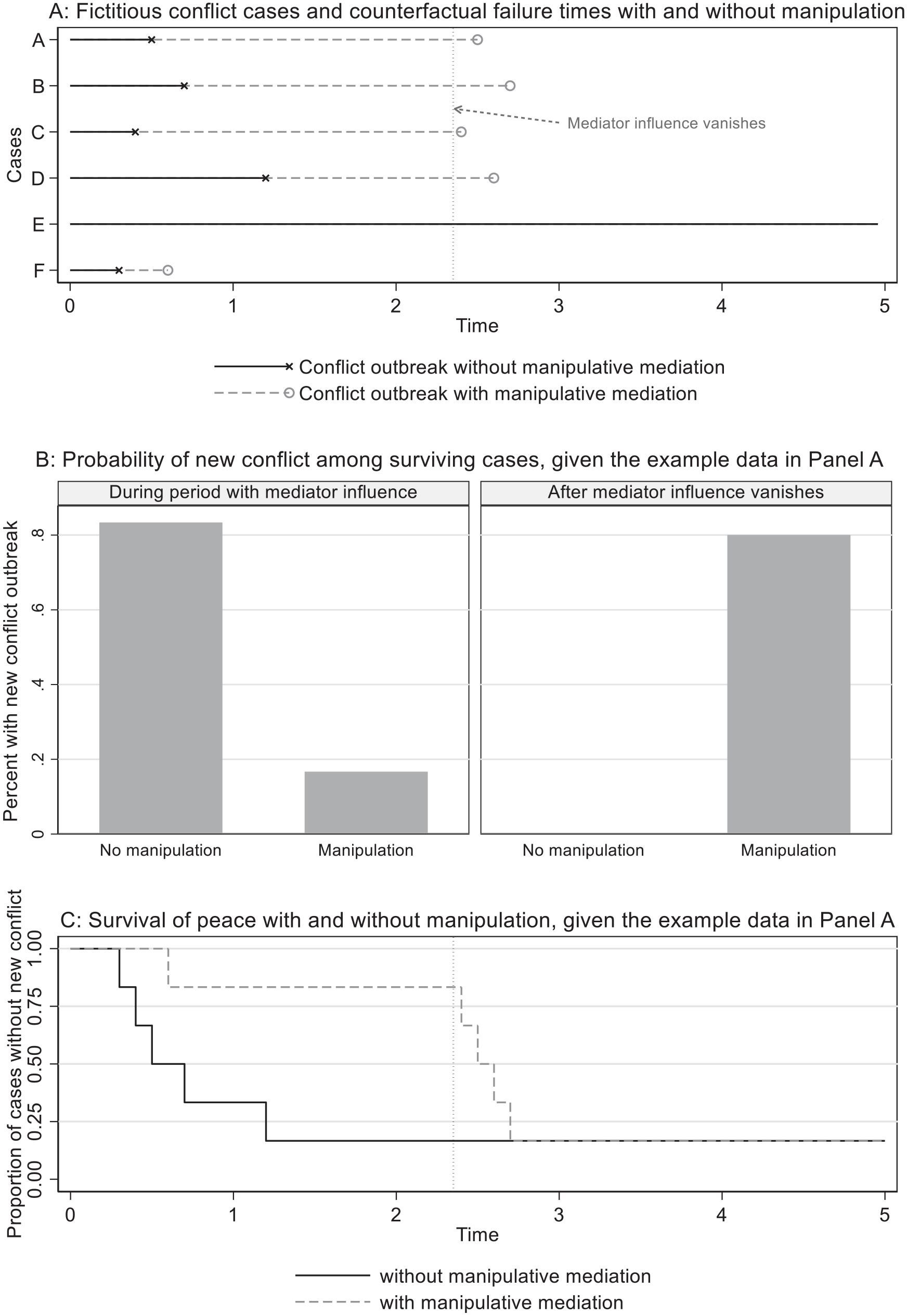
Stylized example of fictitious conflict cases with and without manipulative mediation.
Hence, an artificial bargain does not imply lower long-term stability, unless, of course, we have reason to believe that manipulative mediation suppresses a pacifying process or deteriorates the situation in some other way. The second explanation evokes such negative effects. It suggests that an early, mediated agreement due to external pressure prevents parties from developing a shared understanding of their relative strength or resolve through fighting, which makes an agreement more likely to be revoked by the parties in the future (Beardsley, 2011; Werner and Yuen, 2005; see also Luttwak, 1999).
Although this argument would explain lower long-term stability, the explanation rests on the questionable assumption that capabilities and characteristics of conflict parties remain the same after conflicts end. Accordingly, the shared perception of relative strength achieved at the end of the conflict would remain relevant for future stability. In many situations, however, this is not an empirically reasonable assumption. Often, time will invalidate intelligence about opponents acquired on the battlefield, as capabilities or resolve change. If this is the case, this advantage of ‘fighting it out’ should disappear, just as a mediator’s influence might fade.
Empirical analysis
If this reasoning is correct, we should not observe higher long-term instability following manipulative mediation. To re-evaluate the empirical evidence, we use Beardsley’s (2011) original data and modelling approach, but we interpret the effect of mediation using survival functions. As highlighted by Figure 1, examining the probability that peace survives up to a certain point is an alternative, which allows for an unambiguous interpretation (Ruhe, 2018). Moreover, we correct a further methodological issue, which has been ignored by most published political science analyses with time-varying hazard ratios and which often substantively biases results: the fact that the data needs to be split at failure times to account for time-varying covariates (Jin and Boehmke, 2017).
The empirical analysis draws on a Cox Proportional Hazards model and examines the duration of post-interstate crisis 1 peace in the International Crisis Behavior (ICB) data (Beardsley, 2011: 193–195; Brecher and Wilkenfeld, 2000). It compares whether crisis dyads with mediation (distinguishing between manipulative and non-manipulative strategies) are less likely to experience a new crisis than unmediated crisis dyads. To account for a time-varying effect of mediation, it models non-proportional hazards through an interaction with analysis time. The unit of analysis is the crisis dyad and each dyad is observed until a new crisis occurs or until 10 years after the last crisis. After a renewed crisis has ended, a dyad enters the analysis again; that is, dyads can fail repeatedly. To account for repeated failures, the analysis stratifies by the number of previous failures (Beardsley, 2011: 208–215).
As cases with and without manipulative mediation may differ substantively, the model accounts for several control variables. These mainly describe the previous crisis, coding its level of violence, its duration and whether it ended in a victory. Moreover, characteristics of the dyad are included, such as the number of previous crises in the preceding 10 years, whether it consists of democratic states and their territorial contiguity.
To provide unconditional estimates of the time-varying effect of mediation, we use the model estimates to compute the survival curves for each mediation style and for unmediated cases (cf. Ruhe, 2018). These estimates are calculated using the approach introduced by Ruhe (2016). Statistical uncertainty for the survival estimates are provided by the bootstrap procedure from Ruhe (2019).
To ensure the robustness of our findings, we follow Beardsley’s (2011) original robustness checks and assess if accounting for self-selection into mediation alters our statistical results. Research shows that mediation depends on the general conflict context as well as short-term conflict dynamics (Greig, 2001; Ruhe, 2015). Therefore, the supplementary information provides estimation results for discrete time duration models with a selection equation predicting mediation incidence, which we estimate using bivariate probit models.
Results
We first examine the data descriptively. Figure 2 provides the non-parametric Kaplan-Meier survival estimates for cases with manipulation, with non-manipulative mediation and un-mediated cases. The analysis suggests that the group with manipulation is more stable. After the first 3 years (1095 days), 90% of the cases which experienced manipulative mediation remain at peace. In contrast, at that point, merely 74% of both the non-manipulative and the unmediated cases have remained stable. In this early post-crisis period, the rate at which new crises occur is roughly the same in both non-manipulatively mediated and unmediated cases. Over time, the difference between these cases and the manipulation sample decreases somewhat, but manipulatively mediated cases remain more stable. These results present a first, descriptive indication that our theoretical reasoning points in the right direction.

Proportion of stable dyads that have not (yet) experienced a new crisis: Kaplan-Meier survival estimates for cases with manipulative, non-manipulative and without mediation. Data: Beardsley (2011).
Next, we replicate Beardsley’s (2011: 210) original model (Table 1, Model 1). However, a closer examination of the data reveals that it suffers from two flaws: first, the data has not been split at failure times to account for the time-varying covariates, which means that for some dyads we lack data at failure times of other dyads. Second, all variables are interacted with analysis time, even variables which do not display non-proportional hazards. As a result, the entire model fails conventional tests of the proportional hazards assumption (Box-Steffensmeier and Jones, 2004: 136 footnote 8).
Cox Proportional Hazard model estimates. Model 1 is an exact replication of Beardsley (2011: 210, Table 5.1); Model 2 keeps the model specification, but implements the necessary data structure for time-varying covariates (see Jin and Boehmke, 2017); Model 3 restricts time interactions to variables with non-proportional hazards.

Cluster robust SE in parentheses, *p < 0.1, **p < 0.05, ***p < 0.01.
In a first step, we correct the data structure as advised by Jin and Boehmke (2017). We then estimate the original model specification with all variables interacted with analysis time (Model 2). Subsequently, we examine all covariates in the model and find that only two display non-proportional hazards, the variables for manipulative mediation and for the number of previous crises. Model 3 presents our final model estimate, which replicates Beardsley’s (2011) original model, but which fixes the described methodological issues.
The results strongly underscore our findings from the non-parametric analysis: manipulative mediation appears to correlate with substantively more stable outcomes and post-crisis peace. In contrast, non-manipulative mediation appears to have no systematic association with stability. Manipulative mediation retains its strong initial appeasing effect reported in Beardsley’s (2011) original analysis (Model 1), although the magnitude of this immediate impact is somewhat smaller in the improved Model 3. Moreover, the time-varying effect retains approximately the same magnitude in all models. This supports Beardsley’s prediction of a time-varying hazard ratio. However, without proper visualization of the survival estimates, we are unable to assess if manipulative mediation cases are more likely to have experienced a renewed crisis after a 10-year follow-up.
Figure 3 and 4 allow us to assess if manipulative mediation creates an actual mediation dilemma: they describe the predicted proportion of dyads that remain stable and have not yet experienced a renewed crisis. In other words, the proportion of cases in which peace survived; that is, the survival function. Since the model stratifies by the number of previous crises and the different baseline hazards may alter the findings, we estimate separate results for each stratum.
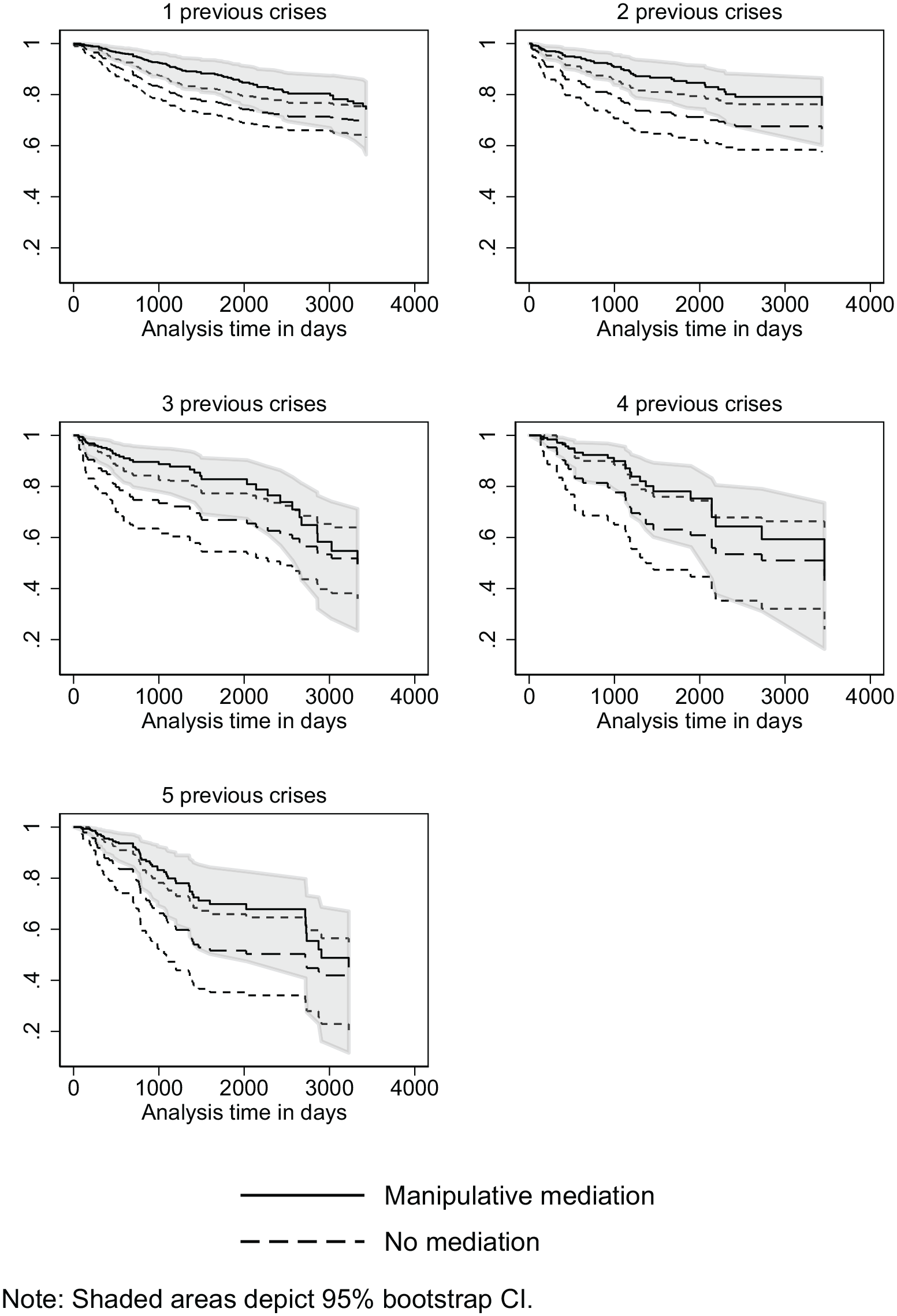
Proportion of stable dyads that have not (yet) experienced a new crisis: model-based survival estimates for cases with manipulative and without mediation (based on Model 3, Table 1, all other variables held at the sample mean).

Proportion of stable dyads that have not (yet) experienced a new crisis: model-based survival estimates for cases with manipulative and non-manipulative mediation (based on Model 3, Table 1, all other variables held at the sample mean).
A mediation dilemma or a trade-off between short- and long-term stability would imply that the survival functions cross at some point during the study period. Figures 3 and 4 highlight that this is clearly not the case. Manipulative mediation does not appear to be associated with a dilemma, neither compared to unmediated cases nor compared to non-manipulative mediation. As Beardsley (2011) suggests, cases which experienced manipulative mediation are substantively more stable in the immediate years after the crisis ended, compared to unmediated cases (see Figure 3). This difference decreases somewhat over time and confidence intervals begin to overlap in later years. Hence, the effect of manipulation seems to decrease with time and towards the end of the analysis period we cannot assess if manipulative cases are still statistically significantly more stable than non-mediated cases. However, the point estimates remain higher throughout the entire period and, although cases with manipulation fail at a higher rate after some years, the share of cases that remains at peace after 10 years is not lower with manipulation than without mediation.
Hence, manipulated cases are not worse off at the end of the study period than unmediated cases. Comparing manipulation with other forms of mediation reveals a similar pattern, though there is more overlap between the confidence intervals early on (see Figure 4). For high-risk dyads, which have experienced multiple crises in previous years, we observe a statistically somewhat less clear difference compared to unmediated cases as well as other forms of mediation. This may be due to the smaller number of cases in these strata, or because mediators are less able to employ manipulative strategies successfully.
To ensure the robustness of our findings, we follow Beardsley’s (2011) original robustness checks. The supplementary information reports results for bivariate probit models, which model as an outcome equation the risk of a new crisis as a discrete time duration model and account for self-selection into mediation using a selection equation predicting mediation incidence. The substantive results remain the same across model specifications and our survival function estimates from the discrete time duration resemble the estimates from our core model.
Conclusion
This article reconsiders the impact of different mediation styles and re-evaluates whether manipulative mediation is associated with long-term instability, as suggested by prominent research (Beardsley, 2011; Gurses et al., 2008; Werner and Yuen, 2005). We question previous theoretical arguments of possible adverse effects of manipulation and probe the validity of the two main underlying explanations. Examining the probability that post-interstate crisis dyads remain stable over 10 years, we find no evidence for a mediation dilemma associated with manipulative mediation. Instead, cases with manipulative mediation have a lower risk of a renewed crisis outbreak during the first years after the settlement. This effect decreases over time, but at no point during the studied period is the share of cases remaining at peace lower for manipulation than for unmediated crises or non-manipulative mediation. Interestingly, our results indicate no effect of non-manipulative strategies on post-interstate-crisis stability.
A clear understanding of the implications of manipulation is important beyond academic discussion. If manipulative strategies were linked with negative long-term consequences, as Beardsley’s (2011) findings might indicate, it would be essential that practitioners use manipulation with great caution. However, our findings do not support his conclusion. The manual for United Nations mediators points out that ‘(l)everage can be useful in mediation, but only if exercised in a way that advances the process rather than being counter-productive’ (UNITAR, 2010: 40). We concur and do not suggest that leverage should be used indiscriminately, given that manipulation might not work equally well for every type of mediator and conflict (Lee and Greig, 2019). Rather, our study underlines that the way leverage has been used in interstate crises in the past does not seem ‘counter-productive’ overall. Moreover, our results indicate that post-conflict contexts in which no mediation occurred and conflict parties could ‘fight it out’ without mediator interference are substantively less stable, compared to cases in which mediators employed leverage.
Given the immense policy relevance, future research should probe and refine our findings. As we only find a significant effect for manipulative mediation, exploring the causal mechanisms that link this strategy with stability would be highly relevant. One avenue may be to disaggregate manipulative mediation. Policy advice is often less reluctant to recommend the use of incentives than the use of threats (Council of the European Union, 2009; Fisas Armengol, 2013; UNITAR, 2010). Therefore, an important question for future research would be if and how ‘sticks’ and ‘carrots’ affect negotiations and post-crisis stability differently. As our analysis focuses on peace duration, the findings of course cannot rule out possible other trade-offs with manipulation. Future research should examine how the severity of renewed crises or the chances for future mediation vary with mediation strategy. Furthermore, while this article has focused on the long-term consequences of manipulation for the conflict parties, impacts on the mediators’ side – for example, on their chances to become involved in future negotiations of the same dyad or between other conflict parties – might also be considered. Finally, our empirical evidence covers interstate crisis dyads; more research should investigate whether our insights apply to intrastate conflicts.
Supplemental Material
sj-pdf-1-rap-10.1177_20531680211018368 – Supplemental material for Sticks and carrots for peace: The effect of manipulative mediation strategies on post-conflict stability
Supplemental material, sj-pdf-1-rap-10.1177_20531680211018368 for Sticks and carrots for peace: The effect of manipulative mediation strategies on post-conflict stability by Constantin Ruhe and Iris Volg in Research & Politics
Footnotes
Acknowledgements
We are grateful for detailed comments and suggestions from three anonymous reviewers and the editor. We wish to thank Kyle Beardsley for his helpful feedback and for providing his excellently documented replication material. Furthermore, we wish to thank the participants at the 2019 International Studies Association Annual Conference and at the University of Mannheim for their comments.
Correction (June 2025):
Declaration of conflicting interests
The authors declared no potential conflicts of interest with respect to the research, authorship and/or publication of this article.
Funding
The authors received no financial support for the research, authorship and/or publication of this article.
Supplementary materials
The supplementary files are available at http://journals.sagepub.com/doi/suppl/10.1177/20531680211018368.The replication files are available at:  .
.
Notes
Carnegie Corporation of New York Grant
This publication was made possible (in part) by a grant from the Carnegie Corporation of New York. The statements made and views expressed are solely the responsibility of the author.
References
Supplementary Material
Please find the following supplemental material available below.
For Open Access articles published under a Creative Commons License, all supplemental material carries the same license as the article it is associated with.
For non-Open Access articles published, all supplemental material carries a non-exclusive license, and permission requests for re-use of supplemental material or any part of supplemental material shall be sent directly to the copyright owner as specified in the copyright notice associated with the article.
