




Abstract
Previous work has suggested that civil wars can increase the risk of militarized interstate conflict. This research note examines the severity of different suggested linkages between civil war and international conflict using data from 1946 to 2001. The results show that instances of direct intervention and interstate coercion are associated with more severe interstate disputes, comparable in magnitude to the severity of territorial disputes. By contrast, disputes that entail pursuit of rebels across international borders, efforts to deter externalization and spillover events tend to have lower severity. The results underscore the important potential role of internal war for interstate conflicts as well as what types of conflict linkages seem to go together with more severe disputes.
Introduction
Much progress has been made since Sambanis (2002) lamented the lack of studies that link internal wars and episodes of interstate conflict. 1 In particular, the findings surrounding the role of civil wars in producing contentious interactions between states are noteworthy. Taken together, this vein of research provides robust evidence that not only do internal wars make interstate conflict more likely because of the issues of contention they produce (Gleditsch et al., 2008; Salehyan, 2008), but also that disputes born out of civil wars are apt to escalate (Schultz 2010). What this current vein of research does not do, however, is differentiate between the different mechanisms that have been proposed to link civil war to contentious interstate interactions.
Take, for instance, the Uganda–Tanzania war that erupted in 1978. The roots of this war were planted by the 1971 military coup that ousted Ugandan leader Milton Obote. As Idi Amin took power in Uganda, Obote joined the several thousand refugees who fled to Tanzania as Amin began to wipe out the opposition in the country. Ugandan exiles based in Tanzania launched a series of attacks against Amin over the next few years, which further strained the relationship between the two countries. The situation escalated in 1978 when Ugandan troops mutinied in response to a suspicious incident that injured a popular general. Amin responded by targeting the mutineers, who retreated across the border into Tanzania. Amin ordered his troops to follow and, amidst claims by Amin that Tanzania was arming and supporting rebel forces, eventually declared war against Tanzania.
These events demonstrate some of the progress that has been made in the literature. The theoretical logic found in much of the work, which involves the creation of issues of contention via refugee flows, spillover and other mechanisms, are clearly evident in this case. Given these linkages between civil war and militarized interstate conflict, which of these mechanisms might be associated with severe episodes of interstate conflict? This research note takes up this question by differentiating between proposed types of linkages as they relate to dispute severity. One might expect direct intervention on behalf of a rebel organization, for example, to prompt an aggressive response due to the threat that such an action imposes on the territorial integrity of the host country. This is contrary to other proposed linkages, such as an attempt by a third-party state to deter spillover, as the threat to the host country is minimal. Understanding which linkages are associated with dangerous interstate interactions has important implications for the management of civil wars, as well as work that attempts to identify the correlates of severe episodes of interstate conflict.
Below, the research design and results from the empirical analysis are presented. The results suggest that interstate coercion and direct intervention are associated with more severe interstate disputes, comparable in their magnitude to the severity of territorial disputes. By contrast, disputes that arise because of efforts to deter externalization or spillover and the pursuit of rebels across international borders tend to have lower severity. These findings, which are discussed in greater detail below, underscore the important role that civil conflict plays in influencing the evolution of interstate conflict. The results also provide important insight into which specific linkages are associated with severe interstate conflicts.
Empirical analysis
In exploring the relationship between civil war and the severity of international conflict, I examine the severity of interstate disputes linked to civil wars across all disputes over the period 1946–2001 in the Militarized Interstate Dispute dataset (Ghosn et al., 2004). The data covers a total of 1521 interstate disputes. I also consider the geographic location of each dispute based on the MID location dataset (Braithwaite, 2010), which allows for taking into account spatial dependences among disputes.
Dependent variables
The severity of interstate conflict is operationalized in two ways. First, a measure of the severity of interstate conflict is constructed using the method found in Diehl and Goertz’s seminal work (2000). 2 Although space constraints prevent describing this measure in great detail, a brief discussion is warranted. The construction of the measure is predicated on the notion that the actions taken by both sides are important (in terms of hostility level). In addition, both those disputes in which battle deaths were observed and those disputes that were reciprocated are coded as being more severe relative to those lacking these characteristics. The variable ranges from 4.5–200, with 200 representing the most severe dispute (escalation to war).
In addition to the conflict severity measure, I also test the relationship among the suggested linkages between civil war and interstate conflict and the onset of interstate war. This variable is taken from the replication data for Senese and Vasquez (2008), and is coded as a 1 if war occurred within five years. Otherwise, it is coded as a 0.
Independent variables
The independent variables of interest were taken from the replication data for Gleditsch et al. (2008), which provides a typology of linkages between civil war and interstate conflict. In each case, the variable is a dummy variable that is coded as a 1 if the type of dispute under consideration was present; otherwise, it is coded as a 0. In addition, I also include a dummy variable that is coded as a 1 if the dispute was over territory; otherwise, it is coded as a 0. The information for territorial disputes was taken from the replication data for Senese and Vasquez (2008), and is included as a baseline for comparison.
In total, there are five different potential linkages that will be tested in relation to the severity of militarized interstate disputes. The first, direct intervetion, are cases in which a third-party state fought alongside rebel troops or targeted the national government in a clear attempt to further rebel goals. There are 55 cases of direct intervention in the post-1946 period, which constitutes 3.6% of disputes.
The next three direct linkages are all considered to be externalization, as they are all related to a government embroiled in civil war initiating interstate conflict against a proximate state (or, arise out of the fear of such). These include the pursuit of rebels across international borders, attempts by a third-party state to deter externalization, and attempts by a government to coerce a third-party into ending support for rebels. The pursuit of rebels is the most common of the three, accounting for 3.2% of all disputes (N=49). This is followed by attempts at interstate coercion and disputes that arise out of a third-party seeking to deter externalization from taking place. The latter is rare, constituting only 0.3% of total disputes (N=6). The former is more common, however, as interstate coercion accounts for 2.3% of disputes (N=35).
The final potential linkage that is tested in this research note is spillover. Spillover refers to damage to the territory controlled by a third-party state as a direct result of civil war, as well as other consequences such as refugee flows. Disputes born out of spillover tend to occur when a third-party mobilizes troops in order to prevent the spillover of violence. Spillover was linked to interstate conflict 39 times in the data, constituting 2.6% of all militarized interstate disputes during the post-1946 period.
Control variables
A set of control variables are also introduced into each equation in order to account for important findings found in the interstate conflict literature. First, I include a dummy variable that is coded as a 1 if the original pair of states involved in the conflict were both democratic (Marshall et al., 2011). 3 Second, I control for the ratio of capabilities between states using version 4.0 of the National Material Capabilities dataset (Singer et al., 1972). 4 Lastly, as a proxy for previous interactions, a count variable for the number of years since the original pair of states involved in the dispute last became entangled in a conflict is included.
Findings
Dispute severity
Table 1 contains the estimates produced by the spatial regression models. 5 The models indicate that three of the five types of interstate disputes born out of internal wars are associated with dispute severity. Direct intervention and interstate coercion are associated with more severe episodes of interstate conflict, whereas efforts to deter externalization are negatively associated with severity. In addition, the substantive importance of both direct intervention and interstate coercion is greater relative to territorial disputes (see Models 6 and 7). 6
Types of disputes related to internal wars and interstate conflict severity, 1946–2001.

Note: year dummies included, but not reported. *p < 0.1; **p < 0.05; ***p < 0.01.
War onset
Table 2 contains the estimates produced by the logistic regression models. In the case of interstate war, four out of the five types of disputes related to internal wars are associated with onset. Direct intervention is positively associated with onset, whereas the pursuit of rebels across international borders, efforts to deter externalization and conflict spillover are negatively associated with war onset. In using territory as a baseline for comparison, direct intervention is associated with a higher probability of war onset (see Figure 1). Though, as with dispute severity, the confidence intervals do overlap indicating that there is no statistically significant difference between territory and direct intervention in terms of the probability of war onset.
Types of disputes related to internal wars and interstate war onset, 1946–2001.

Note: robust SE; clustered on dyad. *p < 0.1; **p < 0.05; ***p <0.01.
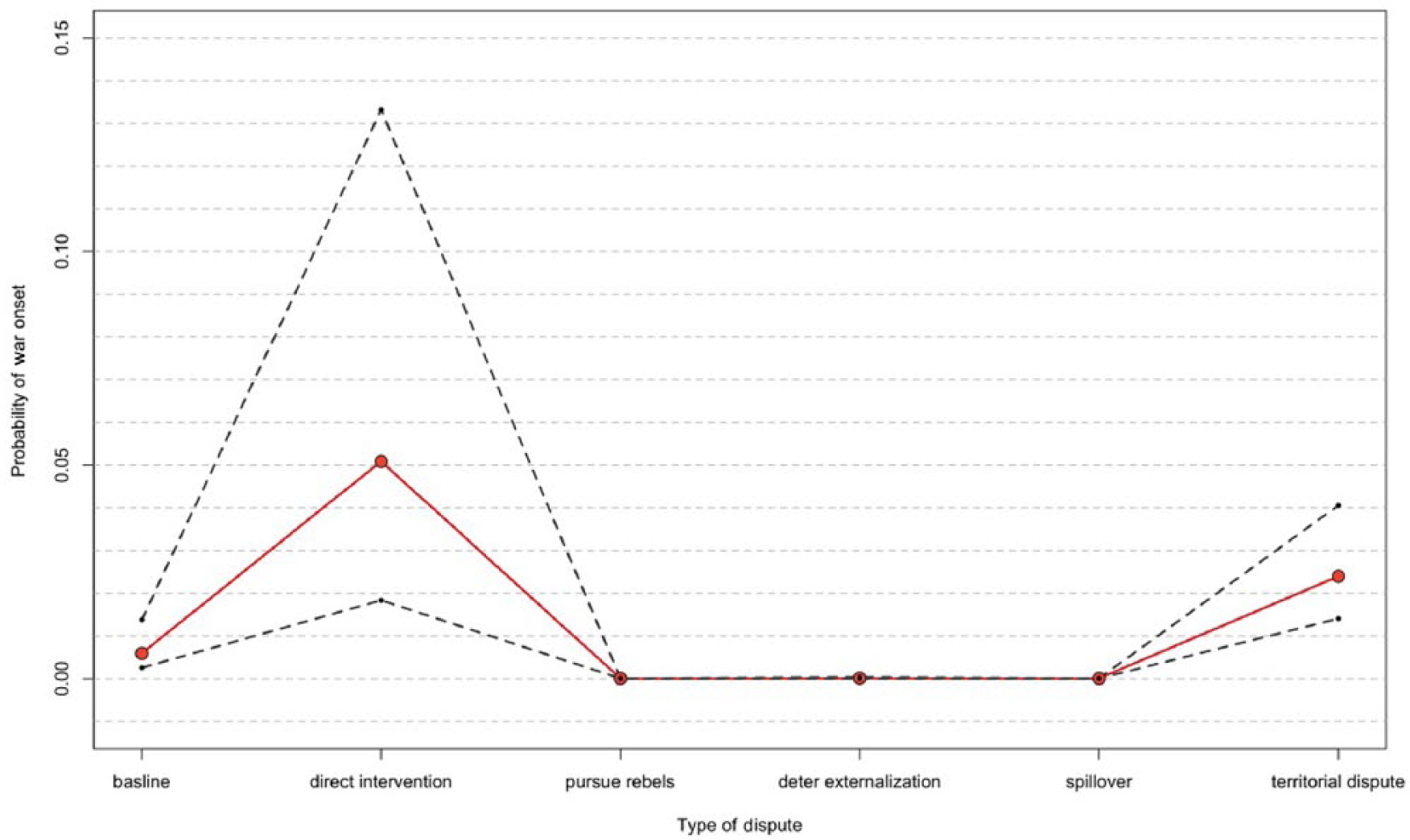
Predicted probabilities for war onset, 1946–2001.
Implications
The implications of this research note are two-fold. First, the empirical models represent the first attempt to empirically test the various types of disputes related to civil war as they pertain to the severity of interstate conflict. Doing so produces findings that further highlight the important relationship between interstate conflict and internal wars. In particular, only some types of disputes related to civil wars are associated with the escalation of interstate conflict. Other forms, especially those that are aimed at preventing the conflict from impacting a third-party state or are unintentional, are negatively associated with conflict severity. Implicit in these findings is the necessity for scholars of interstate conflict to account for internal violence when seeking to explain variation in the ways in which disputes between states evolve.
Second, the analysis here reveals that that some forms of interstate disputes born out of internal wars are as dangerous as territorial conflict. These findings demonstrate that not only does civil war make interstate conflict more likely, but these disputes are also apt to escalate. They appear to be especially dangerous when other states have a vested interest in the conflict (or one of the parties involved) and attempts to directly influence the outcome or way in which the conflict evolves. Instances in which a third-party state reacts in an attempt to minimize the spillover of conflict, on the other hand, are less likely to produce severe episodes of interstate conflict. From a conflict management perspective, this implies a strong need on behalf of the international community to take action in order to prevent third-party states from becoming directly involved in internal wars. 7 In addition, emphasizing the containment of civil wars in order to prevent externalization (and potential diffusion of conflict) appears to be a relatively safe strategy to limit the potential costs of proximate war that are often imposed on third-party states.
Footnotes
Appendix 1
Declaration of conflicting interest
The author declares that there is no conflict of interest.
Funding
This research received no specific grant from any funding agency in the public, commercial, or not-for-profit sectors.

Territory is chosen because of the robust evidence that they are the most apt to escalate. In the current sample, 428 of the 1521 disputes are coded as being related to territory, constituting 28.1\% of all militarized interstate disputes.