




Abstract
Under what conditions does conspiratorial rhetoric about election rigging change attitudes? We investigated this question using a survey experiment the day before and the morning of the 2016 US presidential election. We hypothesized that exposure to conspiratorial rhetoric about election interference would significantly heighten negative emotions (anxiety, anger) and undermine support for democratic institutions. Specifically, we expected that Democrats who read conspiratorial information about interference by the Russians in US elections, and that Republicans who read conspiratorial information about interference by the Democratic Party in US elections would express less support for key democratic norms. Our evidence largely supported our hypotheses. Americans exposed to a story claiming the election would be tampered with expressed less confidence in democratic institutions, and these effects were moderated by prior partisan beliefs about the actors most likely responsible for election meddling.
The presidential election of 2016 was remarkable in many ways. The first female major party presidential candidate was widely expected to win, and a political neophyte/reality television star not only beat out several establishment Republicans to win his party’s nomination, but he also won the presidency. Another unusual aspect was the extent to which the electoral process and democratic norms were questioned by media elites and by the candidates themselves. 1 Vote rigging conspiracy theories were rampant and the public was receptive – for instance, a national survey conducted 1 month before the election found that 73% of Republicans thought the election could be stolen from Donald Trump (Sherman and Shepard, 2016). In this article, we investigate the consequences of conspiratorial rhetoric about an election on people’s emotions and their support for democratic norms.
An election always produces winners and losers, and a key component of a stable government is that losers accept the outcome. Peaceful transitions of power are generally assumed in the United States in contrast to countries such as Peru and Venezuela, where contentious elections historically yielded losers or supporters unwilling to concede defeat. Anderson and Mendes (2006) found that the longevity of a country’s democracy helps explain whether losers accept the outcome. Protest is more likely in newer democracies, and so the longevity of the United States promotes its legitimacy. But are democratic norms in the United States sturdy? In particular, could candidates and media reports of election rigging shake the country’s democratic foundations?
In this context of a foreign government acting to destabilize US elections and a major party candidate, now president, casting doubt on electoral processes, we ask, what are the consequences of conspiratorial rhetoric regarding elections on political attitudes and support for democratic norms? We report on an original experiment, conducted on the eve and morning of the extraordinary 2016 US presidential election. What is the effect of vote rigging allegations, and how does partisanship affect what allegations people believe and how they react? In our experiment, participants read either that the election was secure, or that it was vulnerable to vote rigging. We found that vote rigging allegations affected people’s emotions and whether people had faith in the democratic process.
While there has been significant attention on what drives conspiratorial thinking and whether people accept conspiratorial messages, we know less about the consequences of these messages for how people feel, and whether conspiracy theories about elections change support for democratic norms (see Douglas et al. (2019) for a review of the causes and consequences of conspiracy theories). 2 We expected that exposure to allegations of vote rigging would have consequences for political attitudes in both people’s emotional reactions and their support for democratic norms.
Partisan Effects
Emotional and cognitive responses to election rigging allegations may be conditioned by partisanship, and our study was designed to test for this possibility. First, we had clear expectations that the cognitive reactions in our study (perceptions of fraud likelihood and support for democratic norms) would be conditioned by partisanship, with Democratic participants more likely to accept the election rigging story that victimizes Hillary Clinton, and Republican participants more likely to accept the election rigging story that victimizes Donald Trump. Partisans are more likely to endorse conspiracies that make the other party the villain, undermining the hard work and virtuous intent of well-meaning citizens. Miller et al. (2015) found that partisan-motivated reasoning drives support for conspiracies that portray the out-party in a negative light. Uscinski et al. (2016) found that both partisanship and conspiratorial predispositions shape whether people perceive conspiracies. In terms of partisanship, people are less likely to think conspiratorially when their co-partisans are the villains.
We had less clear expectations regarding emotional reactions. It could be that any alleged attack on the electoral system triggers widespread alarm, and then cognitive reactions take on partisan contours. In reaction to threatening immigration news, Albertson and Gadarian (2015) found people felt anxious regardless of partisanship, but only Republicans and Independents changed their attitudes. On the other hand, people might only feel alarm (be it anxiety, anger, or another negative emotion) when their side is threatened.
Emotional Reactions
First, we anticipated that conspiratorial election news would trigger emotional reactions. Emotions are internal states that represent an “evaluative, valanced reaction to events, agents, or objects” (Nabi, 1999: 295). They influence a range of political outcomes such as news consumption, trust, policy support, and voting (Brader, 2006; Conover et al., 1986; Huddy et al., 2005; Marcus and MacKuen, 1993). Elections themselves are emotional events (Kitchens et al., 2010) and we expected that political conspiracy theories would be particularly unsettling. Butler et al. (1995) found that watching a conspiratorial film (e.g., JFK) led to heightened anger. We envisaged conspiratorial stories about an election would heighten negative emotional reactions.
We expected conspiratorial news to heighten anxiety, which occurs when people appraise a situation as unpleasant, highly threatening and uncertain (Lerner and Keltner, 2000), and when a situation seems out of control (Smith and Ellsworth, 1985). An anxious reaction is how we detect threat and danger (Eysenck, 1992). For instance, election interference might make citizens wonder about their government’s legitimacy, or question how the election might be decided. While election interference would cause uncertainty, we also anticipated that conspiratorial news would heighten anger, which is distinct from anxiety. Anger is more likely when a threat or harm is characterized by certainty (Brader et al., 2011). In the rigged election stories that participants read, the interference was clearly attributed to different actors. While anger and anxiety have distinct origins in relation to control, and different behavioral consequences (Valentino et al., 2011), we anticipated both emotional reactions to allegations of vote rigging because they contain elements of both uncertainty (what does this mean for US democracy?) and blame (bad actors rigging an election).
We also tested for effects on sadness, disgust, and enthusiasm. Sadness is related to the inability to achieve goals and the loss of valued things and people. Disgust is a reaction to something noxious (Brader et al., 2011). While discrete models of emotion allow researchers to parse out mechanisms underlying attitude or behavior change, a single event can generate multiple emotional reactions. We expected that claims of electoral vulnerability would affect emotions broadly.
Fraud Likelihood and Democratic Norms
Thinking a system is somehow rigged affects political attitudes, though people are more likely to accept the claim when rigging disadvantages their own candidate. For example, Edelson et al. (2017) noted that losing partisans are consistently more likely to think there was election fraud than the winning team. Their research shows that conspiratorial predispositions (especially before the election) and partisanship (especially after the election) predict belief in election fraud. We expected attitudinal reactions in our study would be moderated by partisanship.
Vote rigging allegations are more than mere partisan cheerleading. Research shows that conspiratorial messaging can have negative democratic effects. Exposure to political conspiracy theories can decrease political activity (Jolley and Douglas, 2014) and trust in government (Einstein and Glick, 2015). Tomz and Weeks (2020) found that foreign meddling in an election reduces Americans’ confidence in elections and faith in democracy when the meddling advantaged the other party. Our study adds to this work by including more specific aspects of attitudes toward democracy. Vote rigging allegations strike at the foundations of democratic norms. Should peaceful transitions of power follow from a rigged election? We expected vote rigging conspiracy theories to make people less confident in elections, less likely to accept the results, and less likely to say that the loser should concede.
Data and methods
We tested our hypotheses with a survey experiment of 1,000 US voting-age adults recruited via Mechanical Turk (both the data and do-file are available in the Online Appendix). The study was administered the day before and on the morning of the 2016 presidential election. The sample was 50% female and diverse in age (M = 36.54, SD = 12.74) but not in race or ethnicity (76% Caucasian, 7% Black, 6% Hispanic, and 8% Asian American). A majority had completed a college degree (63%), with 25% attending college but not completing a degree and 12% receiving a high school diploma or less. Mechanical Turk samples tend to be more liberal and educated than the general population, and this sample was no exception (Clifford et al., 2015). Among the 975 participants who answered the partisanship question, 290 identified as Republican (70 leaners) and 567 identified as Democrats (129 leaners), and we tested our hypotheses among these partisan subgroups. Forty-one percent indicated that they had already voted when they took the survey, perhaps due to the prevalence of early voting, the nature of the sample, and social desirability.
Procedure
All participants began by reading a one-paragraph excerpt from a hypothetical news story about election interference. We randomized whether an expert believed the election would be vulnerable to interference in favor of Donald Trump or Hillary Clinton. 3 In these vote rigging conditions, subjects were informed the US voting system was vulnerable to attack, making it likely the 2016 US presidential election would be rigged. 4 In a third “Elections secure” control condition, participants read that the election was secure and would be free and fair (see Table 1).
Content comparisons for vignettes used in vote rigging experiment.

Our outcome measures asked about concern over fraud, emotions, and attitudes toward the election. 5 Fraud likelihood was measured on a 4-point scale, ranging from very unlikely to very likely. Emotions were measured on an 11-point scale, with the end points labeled “not at all” (0) and “very strongly,” (10).
We asked subjects three questions to gauge their attitudes toward the election, including, 1) “How confident are you that, across the country, the votes will be accurately cast and counted in this year’s election?”; 2) “If your preferred presidential candidate ends up losing, will you accept the election as legitimate?”; and 3) “How important is it to you that the losing candidate publicly acknowledges the winner?” Respondents answered each of these questions on the 4-point scale.
Results
Manipulation Check and Fraud Likelihood
To check the effectiveness of our treatments, we asked, “Does the article imply that the US voting system is vulnerable to fraud or secure?” Respondents then selected their answer from a 4-point scale ranging from “It strongly implies that the US voting system is vulnerable to fraud” to “It strongly implies that the US voting system is secure.” As expected, subjects who received information that the Democrats or the Russians were conspiring to rig the election were, on average, more likely to report the article implied the US voting system was vulnerable (p < .05, see Table 2). These effects held, regardless of partisanship and actor.
Effect of vote rigging allegations on perceptions of fraud.
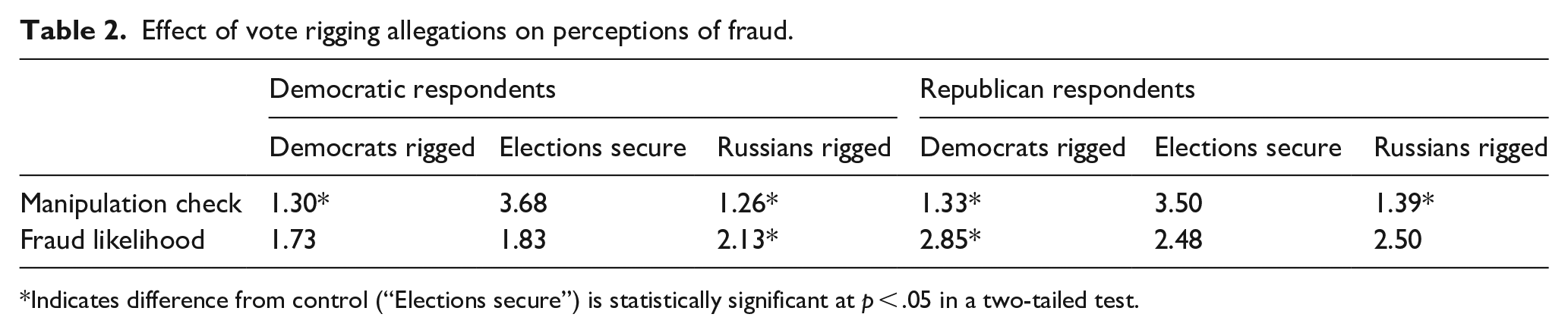
Indicates difference from control (“Elections secure”) is statistically significant at p < .05 in a two-tailed test.
Next, we looked at the extent to which respondents believed significant fraud was likely to occur in the 2016 presidential election. If the “vote rigging” conspiracy theory stimuli were working, subjects in the conspiracy theory conditions should express more concern about fraud than those in the “Elections secure” condition. As expected, the vote rigging treatments caused higher levels of concern about the likelihood of fraud, but the effect was conditioned by partisanship. In other words, Democratic (but not Republican) respondents in the “Russians rigged” condition and Republican (but not Democratic) respondents in the “Democrats rigged” condition were, on average, more likely to believe that significant fraud was likely to occur.
When Democratic respondents received information that the US voting system was secure, their mean response on the fraud likelihood scale was 1.83. This increased to 2.13 when they were exposed to information that the Russians intended to rig the election (p < .05). In contrast, Democratic respondents who read that the Democratic Party would rig the election did not differ from Democrats in the “Elections secure” condition. (p = .32). Similarly, when Republican respondents read that Democrats intended to rig the election, they were more likely to think that there would be fraud compared to the secure condition (MDemocrats Rigged = 2.85 vs. MElections Secure = 2.48, p < .05). Similar to Democratic respondents, Republican respondents who read that Russians would rig the election were no different from the “Elections secure” condition (p = .87). The fraud likelihood effects offered evidence that partisanship moderates the effects of conspiratorial news. People understood that both conspiracy theory articles said fraud was possible, however, the information only affected their perceptions of fraud likelihood when it hurt their party’s candidate.
Emotional Reactions
Next, we analyzed how exposure to vote rigging conspiracy theories affected emotions. Here we had competing hypotheses: conspiratorial news might heighten emotions conditional on partisanship, or partisans might only experience heightened emotions where stories suggested their partisan interests were threatened. We also had expectations that vote rigging articles would heighten anxiety and anger, but we included sadness, disgust, enthusiasm and hope with less clear expectations.
The results presented in Table 3 indicate that people who read about electoral vulnerability experienced higher levels of negative emotions regardless of the partisan contours of the story. Our findings suggested allegations of election rigging make voters feel more emotional, irrespective of their party and of who is accused of carrying out the alleged rigging.
Emotional effects of vote rigging allegations.

Indicates difference from “Elections secure” is statistically significant at p < .05 in a two-tailed test. All emotions were measured on a 0–10 scale, with endpoints labeled “Not at all” and “Very strongly.” Sample includes 290 Republicans (70 leaners) and 567 Democrats (129 leaners).
As hypothesized, exposure to information about expected vote rigging led to heightened feelings of anxiety and anger. When Democratic respondents received information that the US election was secure, their mean response for anxiety was 3.57, increasing to 4.34 in the “Democrats rigged” condition and 5.31 in the “Russians rigged” condition. When Democratic respondents received information about vote rigging, they also felt angrier than Democrats in the secure condition (MDemocrats_Rigged = 4.44 vs. MElections_Secure = 2.20 vs. MRussians_Rigged = 4.95, p < .05).
Similarly, Republicans in the “Democrats rigged” condition reported more anxiety than those in the secure condition (MDemocrats Rigged = 5.52 vs. MElections Secure = 4.64, p < .05). Republicans in the “Russians rigged” condition, however, were no more likely than those in the secure condition to report feeling anxious (p = .60), though the difference between the two treatment conditions was not itself significant (p = .14). Comparisons on other emotion measures, however, revealed the conditional finding for the anxiety measure among Republicans was an outlier. Republicans exposed to either article about vote rigging reported more anger compared to those in the secure condition (MDemocrats Rigged = 6.00 vs. MElections Secure = 3.51 vs. MRussians Rigged = 5.28, p < .05).
Respondents in a vote rigging condition were also more likely than those in the “Elections secure” condition to feel other negative emotions. Democrats and Republicans reacted with increased sadness and disgust. Both partisan groups also reported feeling less enthusiastic and less hopeful after reading either account of conspiratorial news (all comparisons significant at p < .05).
Conspiratorial news stories about vote rigging increased negative emotions and decreased positive emotions, regardless of partisanship. While these widespread effects showed this news was upsetting, the effect on multiple emotions made this study unlike most studies of emotions, which tend to focus on one or two emotions. While the focus on discrete emotions allows for careful hypothesis testing, it perhaps also leads researchers to miss the array of emotional events in politics. Vote rigging conspiracy theories have strong emotional effects.
Democratic Norms
Next, we looked at three variables testing support for elections and democratic norms: electoral confidence, willingness to accept the results, and perceptions about how important it is for the loser to concede. If the “vote rigging” stimuli were working, subjects in the conspiracy theory conditions should express lower electoral confidence, be less willing to accept the results of the election, and be less inclined to concede when the conspiracy theory threatens their desired political goals. In other words, we expected the effect of being in a vote rigging condition to negatively affect attitudes toward the election, with effects moderated by partisanship.
The results largely supported our hypotheses (see Figure 1). Democrats felt less confident about the results in the “Russians rigged” condition (MRussians Rigged = 2.95 vs. MElections Secure = 3.19, p < .05; all ps based on two-tailed t-tests) but were unaffected when Democrats were at fault. Conversely, Republicans expressed lower levels of electoral confidence in the “Democrats rigged” condition (MDemocrats Rigged = 2.36 vs. MElections Secure = 3.73, p < .05) and were unaffected by allegations of Russian vote rigging.
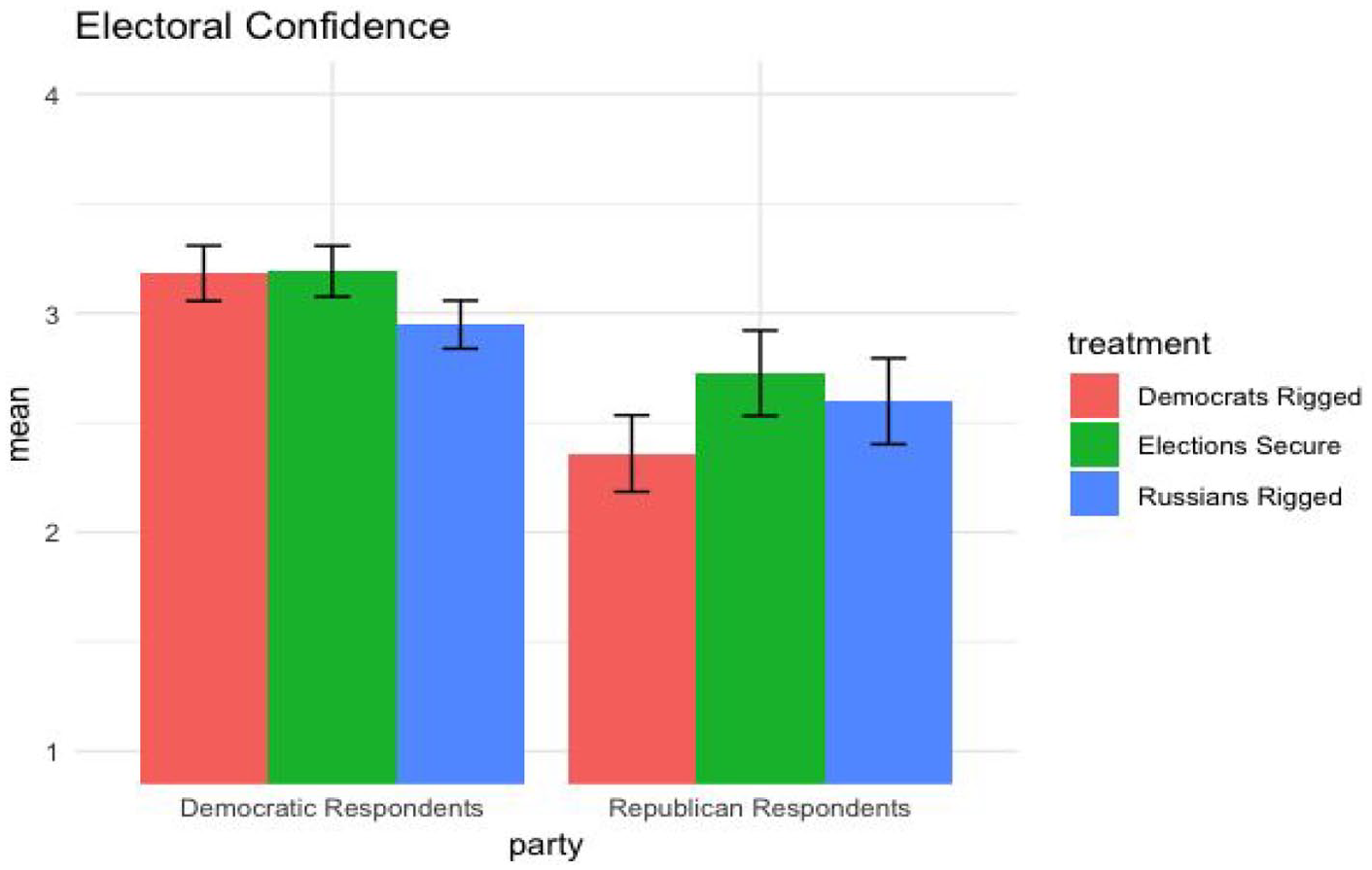
Effect of vote rigging allegations on electoral confidence.
As shown in Figure 2, Democrats were also less likely to say that they would accept the results when Russians were at fault (MRussians Rigged = 2.91 vs. MElections Secure = 3.17, p < .05) but not when Democrats were. Republicans in the “Democrats rigged” condition were also less likely than those in the “Elections secure” condition to say they would accept the results (MDemocrats Rigged = 2.53 vs. MElections Secure = 2.93, p < .05). Interestingly, the “Russians rigged” condition was also able to exert a significant effect on the willingness of Republicans to accept the results: those in the “Russians rigged” condition were less likely than those in the “Elections secure” condition to say they would accept the outcome as legitimate (MRussians Rigged = 2.54 vs. MElections Secure = 2.93, p < .05). Republicans’ symmetrical effects on accepting the results could be due to the fact that both Russians and Democrats are outside groups. However, this response was not consistent with Republicans’ reactions to the “Russians rigged” story, in terms of fraud likelihood or the other election attitude measures.
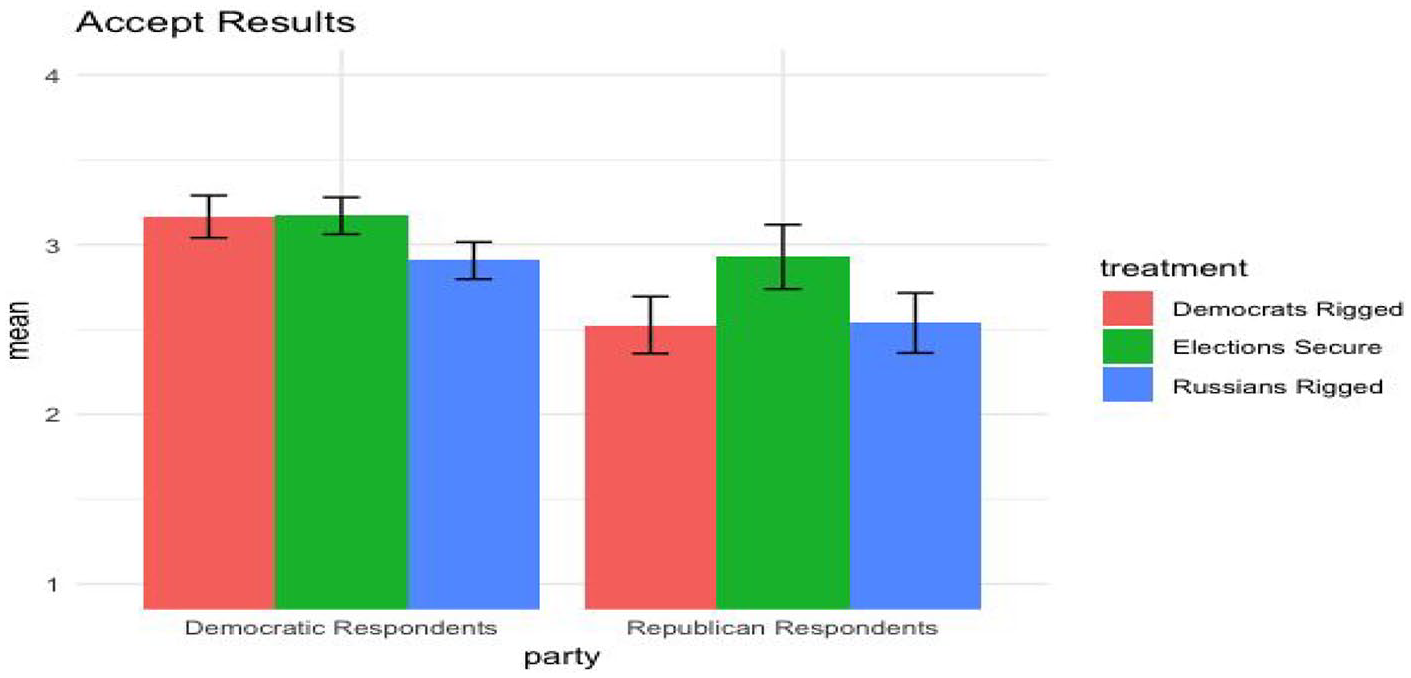
Effect of vote rigging allegations on willingness to accept the results.
Among Democrats, there were no significant differences on conceding the election when either Democrats or Russians were accused of rigging the selection (see Figure 3). The hypothesized difference between Democrats in the “Russians rigged” and “Elections secure” conditions was not significant (p = .83). Our hypothesis was supported among Republicans however, with Republicans less likely to believe that it was important for their candidate to concede in the “Democrats rigged” compared to the “Elections secure” condition (MDemocrats Rigged = 2.41 vs. MElections Secure = 2.74, p < .05).
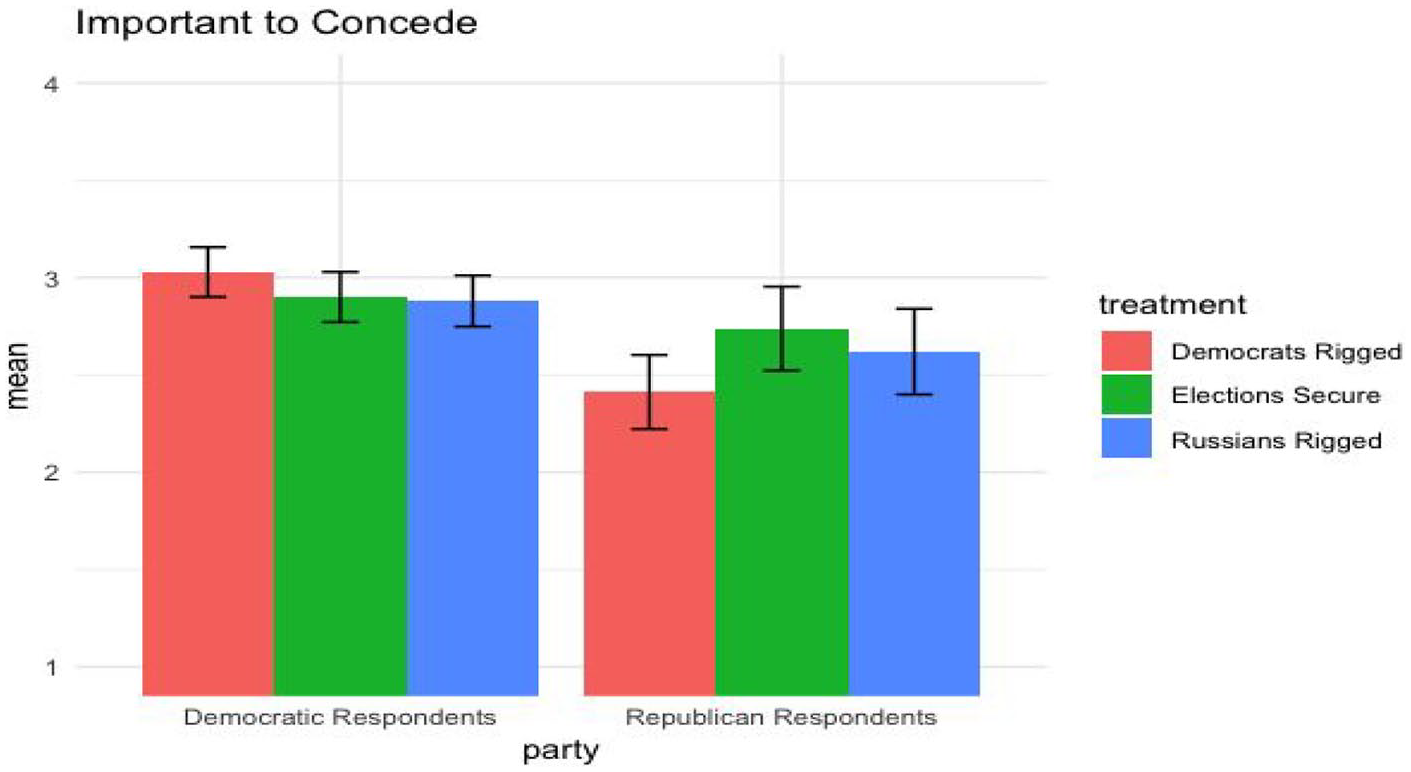
Effect of vote rigging allegations on the belief that electoral losers should concede.
Overall, this study showed strong support for our hypotheses. With some minor exceptions, partisans showed decreased support for important democratic norms when they read that their own party may be undermined through nefarious actions.
Conclusion
In the wake of the 2016 election and Trump’s norm-challenging presidency, literature emerged on the democratic decline in America. One title How Democracies Die became a bestseller (Levitsky and Ziblatt, 2018). Lieberman et al. (2017) place America’s institutional decline and party polarization in comparative perspective. Muirhead and Rosenblum (2019) argue that the “new conspiracism” that Trump engages in (such as calling an election rigged) “operates at the level of citizens’ attitudes and emotions, insisting that the defining elements of political order are not supported” (33–34). Our study has provided an empirical test of this idea. We relied on a clipping from a newspaper and not on a politician’s words. Trump’s own allegations of vote rigging might cause stronger partisan effects, conditioning emotional effects as well. In contrast, a politician’s allegation could be attributed to self-interest, and an “expert” source may be deemed more credible.
This study also adds to a growing literature on the partisan nature of conspiratorial thinking (Miller et al., 2015; Uscinski et al., 2016). Enders and Smallpage (2018) found that partisans (both Democrats and Republicans) are more likely to believe conspiracy theories that favor their political party (or vilify the other). However, they also found Republicans, and not Democrats, engage in partisan-motivated reasoning in relation to information (both bolstering and discrediting) about the conspiracy theories, and attribute the asymmetry to differences in elite behavior. Our study did not ask respondents about their baseline belief that their party and the other party could be hurt by vote tampering, but it is reasonable to expect each thinks their party is more likely to be victimized. However, the present study also showed largely symmetrical effects in relation to the likelihood of election rigging beliefs and support for democratic norms. Perhaps Enders and Smallpage’s (2018) research, which relied on existing conspiracy theories, had mismatched stimuli (e.g., with Republican conspiracy theories that are more powerful than the most popular Democratic conspiracy theories) relative to the news stories we used. Perhaps the day before and day of the election had people on edge, in a way that made both groups of partisans receptive to conspiratorial rhetoric.
This article provides support for the notion Americans are vulnerable to allegations of election rigging, though these largely dovetail with partisan expectations of specific kinds of election meddling. These findings provide little comfort that future elections will be immune to these forces. As conspiratorial rhetoric around elections continues, with a new emphasis on voting by mail, might the American public be open to a delayed election, or might the current administration take a firmer hand in election administration? This study has shown conspiratorial rhetoric around elections leaves Americans unsettled in their emotional reactions and, depending on whether their party is helped or hurt, less committed to the idea that political candidates must accept election outcomes.
Supplemental Material
research_and_politics_submission – Supplemental material for Conspiracy theories, election rigging, and support for democratic norms
Supplemental material, research_and_politics_submission for Conspiracy theories, election rigging, and support for democratic norms by Bethany Albertson and Kimberly Guiler in Research & Politics
Footnotes
Declaration of conflicting interests
The author(s) declared no potential conflicts of interest with respect to the research, authorship, and/or publication of this article.
Funding
The author(s) received no financial support for the research, authorship, and/or publication of this article.

Supplemental materials
Notes
Carnegie Corporation of New York Grant
The open access article processing charge (APC) for this article was waived due to a grant awarded to Research & Politics from Carnegie Corporation of New York under its ‘Bridging the Gap’ initiative.
References
Supplementary Material
Please find the following supplemental material available below.
For Open Access articles published under a Creative Commons License, all supplemental material carries the same license as the article it is associated with.
For non-Open Access articles published, all supplemental material carries a non-exclusive license, and permission requests for re-use of supplemental material or any part of supplemental material shall be sent directly to the copyright owner as specified in the copyright notice associated with the article.
