




Abstract
Was the COVID-19 pandemic orchestrated by a secret elite, or does the government simply filter certain truths? While both statements reflect conspiracy thinking, they refer to different rationalities. This study contributes to the debate on the definitions of conspiracy mentality, suspicion and theories by examining their relationships with trust. Analysing a nationally representative survey data from Spain, the study shows that lower levels of trust predict greater levels of belief in conspiracy theories and suspicion, while conspiracy mentality remains stable regardless of trust levels. The research concludes that different forms of conspiracy thinking have distinct social significance and do not relate to trust in the same way.
Introduction
Conspiracy beliefs challenge democratic governance by undermining trust in institutions, experts and political processes (Douglas et al., 2019; Warren, 2024). As misinformation spreads, understanding how conspiracy thinking interacts with trust becomes increasingly critical. While studies have established that lower levels of trust correlate with stronger levels of conspiracy beliefs (Milošević Đorđević et al., 2021), less attention has been given to how different types of conspiracy thinking – mentality, suspicion and theory beliefs – relate to social and institutional trust. This study addresses this gap by examining how trust relates to conspiracy mentality, suspicion and theories. It illustrates that the distinctions between types of conspiracy thinking have real-world relevance.
Given the ongoing debates about how to define conspiracy thinking, categorising its different forms is of critical importance for understanding their significance. Indeed, Koper (2024) stressed that conspiracy theorising is not just an epistemological issue but a broader political and cultural practice. To start with, conspiracy theories are ‘explanations of events in terms of the significant causal agency of a relatively small group of persons – the conspirators – acting in secret’ (Keeley, 1999: 116). Examples include beliefs that the moon landing was faked or that vaccines are part of a control scheme. Conspiracy mentality is a broader worldview: an inclination to believe that significant events are orchestrated by malevolent individuals (Imhoff et al., 2022a). Unlike conspiracy theories, which are context-dependent, conspiracy mentality is a system of thought that predisposes individuals to interpret all events through a conspiratorial perspective. An example of this is the belief in a deep state secretly controlling all political affairs. Conspiracy suspicion is the belief ‘that the real truth is explosive and shocking, and that a campaign of disinformation has successfully tricked many people into believing a carefully constructed lie instead’ (Wood, 2017: 510). It involves a general mistrust and a sense that something is being concealed from the public. For example, one might suspect that all studies sponsored by pharmaceutical companies are manipulative and designed to sell products.
Wood (2017) proposes a three-tiered structure to model conspiracy thinking. At the top level is conspiracy mentality, a worldview that conspiracies are dominant. The middle level, conspiracy suspicion, involves a belief that something is dubious without forming a theory. While it might overlap with conspiracy mentality, it is more topic-specific. The bottom level, conspiracy theory belief, pertains to theories about particular events. This study empirically assesses whether trust influences each of these types differently by analysing survey data from Spain. Focusing on a single country allows for an in-depth examination to emphasise the different implications of the types of conspiracy thinking. Below, the article first explores the relationship between conspiracy thinking and social and political trust. Subsequently, it details the data and methods before presenting the results and discussing their implications.
Interplay Between Trust and Types of Conspiracy Thinking
Trust plays a crucial role in shaping people’s susceptibility to conspiracy theories. Social trust is ‘the default expectation of another person’s trustworthiness in the absence of information about that person’ (Yamagishi, 2011: 114). It refers to the belief in the trustworthiness of strangers and the expectation that others will act cooperatively. Institutional trust pertains to how people perceive the actions and decisions of those in power, such as government officials and public agencies (Herreros, 2023). Higher levels of trust are associated with a greater acceptance of official explanations and a reduced likelihood of believing in conspiracy theories (Abalakina-Paap et al., 1999). Nefes et al. (2023) demonstrate that people’s tendencies to believe in conspiracy theories are negatively correlated with trust in health authorities, science and pharmaceutical companies in Spain. Likewise, others discuss how the far-right’s distrust of the Spanish government paved the way for COVID-19-related conspiracy theories (Romero-Reche, 2023).
Trust may influence different forms of conspiracy thinking in distinct ways. Conspiracy mentality, as a stable worldview, is likely less affected by trust and more rooted in enduring psychological or ideological orientations. For instance, a person who believes in the existence of a ‘deep state’ – a supposed clandestine network controlling national affairs (Nefes, 2025) – may see it as natural, common and necessary for protecting national interests. Consequently, such beliefs may not be linked to institutional or interpersonal trust. In contrast, conspiracy theory beliefs are more situational, involving claims about particular events being secretly manipulated by powerful actors. They often emerge in response to uncertainty and may be more strongly influenced by a lack of trust. Conspiracy suspicion, meanwhile, reflects generalised scepticism without commitment to a specific theory and is more likely to increase in low-trust environments. This study therefore hypothesises that trust has differential effects across the three forms of conspiracy thinking, with stronger associations expected for conspiracy theory belief and suspicion than for mentality. Supporting this, a recent 26-country study found conspiracy mentality to be only weakly and inconsistently related to institutional or interpersonal trust (Imhoff et al., 2022b). The following hypotheses were tested:
Hypothesis 1: Lower levels of interpersonal trust are associated with higher levels of belief in conspiracy theories.
Hypothesis 2: Lower levels of interpersonal trust are associated with higher levels of conspiracy suspicion.
Hypothesis 3: Lower levels of interpersonal trust are not significantly associated with conspiracy mentality.
Hypothesis 4: Lower levels of institutional trust are associated with higher levels of belief in conspiracy theories.
Hypothesis 5: Lower levels of institutional trust are associated with higher levels of conspiracy suspicion.
Hypothesis 6: Lower levels of institutional trust are not significantly associated with conspiracy mentality.
Data and Methods
We analyse data from the Spanish subset of the 10th round of the European Social Survey (ESS), a biennial cross-national survey measuring attitudes, beliefs and behaviour patterns. The nationally representative sample includes 2283 individuals aged 15 and older residing in Spain, collected between January and May 2022.
Dependent Variables
Conspiracy theory about COVID-19: ‘Please, tell me how much do you agree or disagree with the following statement: Coronavirus is the result of deliberate and concealed efforts of some government or organization’.
Conspiracy mentality: ‘How much do you agree or disagree with the following statement: A small secret group of people is responsible for making all major decisions in world politics’.
Conspiracy suspicion about sciences: ‘How much do you agree or disagree with the following statement: Groups of scientists manipulate, fabricate or suppress evidence in order to deceive the public’.
The study uses a Likert-type scale ranging from 1 to 5 to quantify these variables pertaining to attitudes towards conspiracy thinking, with 1 indicating complete disagreement and 5 indicating complete agreement.
Independent Variables
Social trust is measured through a survey item gauging perception of interpersonal trust, ranging from 0 (indicating high caution) to 10 (indicating high trust): ‘generally speaking, would you say that most people can be trusted, or that you cannot be too careful in dealing with people’. The range of this variable goes from 0 (‘You cannot be too careful’) to 10 (‘Most people can be trusted’). This survey question has been found to be correlated to trust measured through experimental behaviour (Bjørnskov, 2021). In addition, the analysis incorporates variables assessing trust in politicians and trust in government management of the COVID-19 pandemic. Trust in politicians is measured through the following survey question:
please tell me on a score of 0-10 how much you personally trust each of the institutions I read out. 0 means you do not trust an institution at all, and 10 means you have complete trust. How much do you trust politicians?
Trust is government management of the COVID-19 pandemic, in turn, is measured using the following:
please tell me to what extent you trust the national government in Spain to deal with the impact of the coronavirus pandemic. Please answer on a score of 0-10 where 0 means you do not trust the government at all and 10 means you have complete trust.
Another relevant independent variable that is is ideology. In ESS, it is measured as self-placement in a scale from 0 (far-left) to 10 (far-right).
Control Variables
Controlling variables associated with the COVID-19 crisis are about the impact of the pandemic in the individual’s employment situation – whether the individual was fired, experienced a reduction of working hours or was included in a furlough scheme (ERE – Expediente de Regulación de Empleo – in Spain) – and on whether the individual has suffered from COVID-19. In addition, the study controlled for the following demographic variables: years of education, age, sex and habitat. Table 1 provides a comprehensive overview of dependent and independent variables.
Summary Statistics.

Results
Given that the dependent variables – belief in COVID-19 conspiracy theories, conspiracy mentality and conspiracy suspicion – are measured on a Likert-type scale (1–5), an Ordered Logit Model is the most appropriate statistical approach for nonlinear effects. It accounts for the ordered nature of the responses, recognising that while the categories follow a hierarchy, the distances between them may not be uniform. Ordered Logit allows for the estimation of the probability of selecting each category, offering a more precise understanding of how trust influences conspiracy thinking. Furthermore, the model assumes that the degree of association of explanatory variables is consistent across response categories, which aligns with the theoretical expectations.
Figure 1 shows the result of three ordered logit regressions, with three dependent variables. Model 1’s dependent variable is the conspiracy theory about COVID-19. Model 2’s dependent variable is the conspiracy mentality, and model 3’s dependent variable is the conspiracy suspicions about sciences. The findings show that social trust is negatively associated with the belief in conspiracy types in Models 1 and 3; while political trust is negatively associated with belief in conspiracy theories in Model 1. Figure 2 shows the probability of selecting each of the five categories of the dependent variables about the COVID-19 conspiracy theories and conspiracy suspicion about scientists for the different values of social trust and political trust. The probability of choosing ‘strongly disagree’ or ‘disagree’ with conspiracy theories increases for higher values of social and political trust, while it is the opposite with the categories ‘agree’ and ‘strongly agree’: as social and political trust increases, the probability of choosing those categories of the dependent variables decreases.
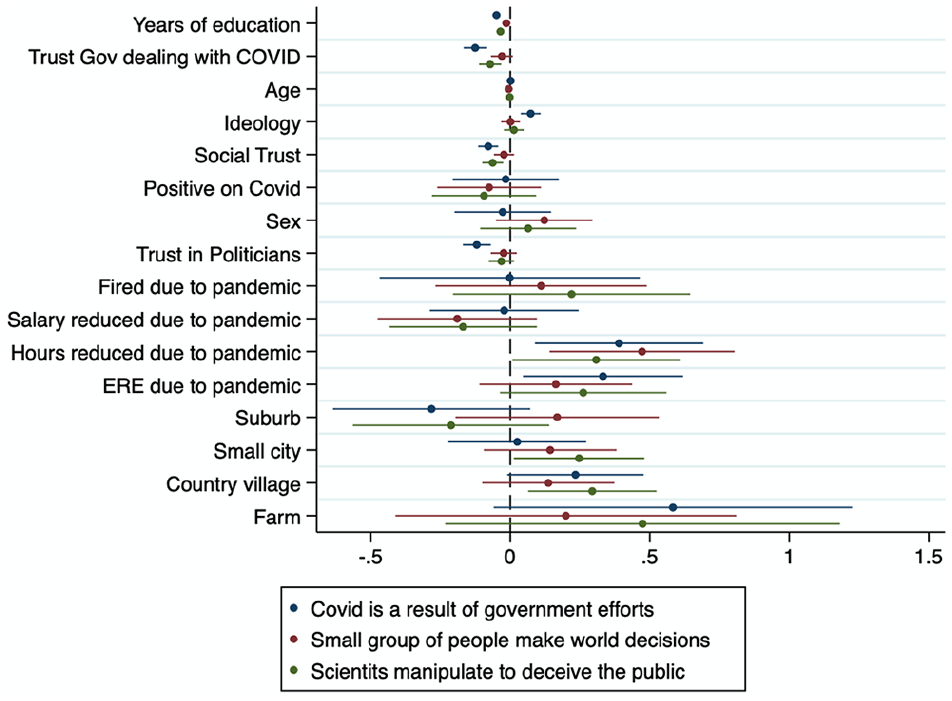
Determinants of Beliefs in Conspiracy Theories.
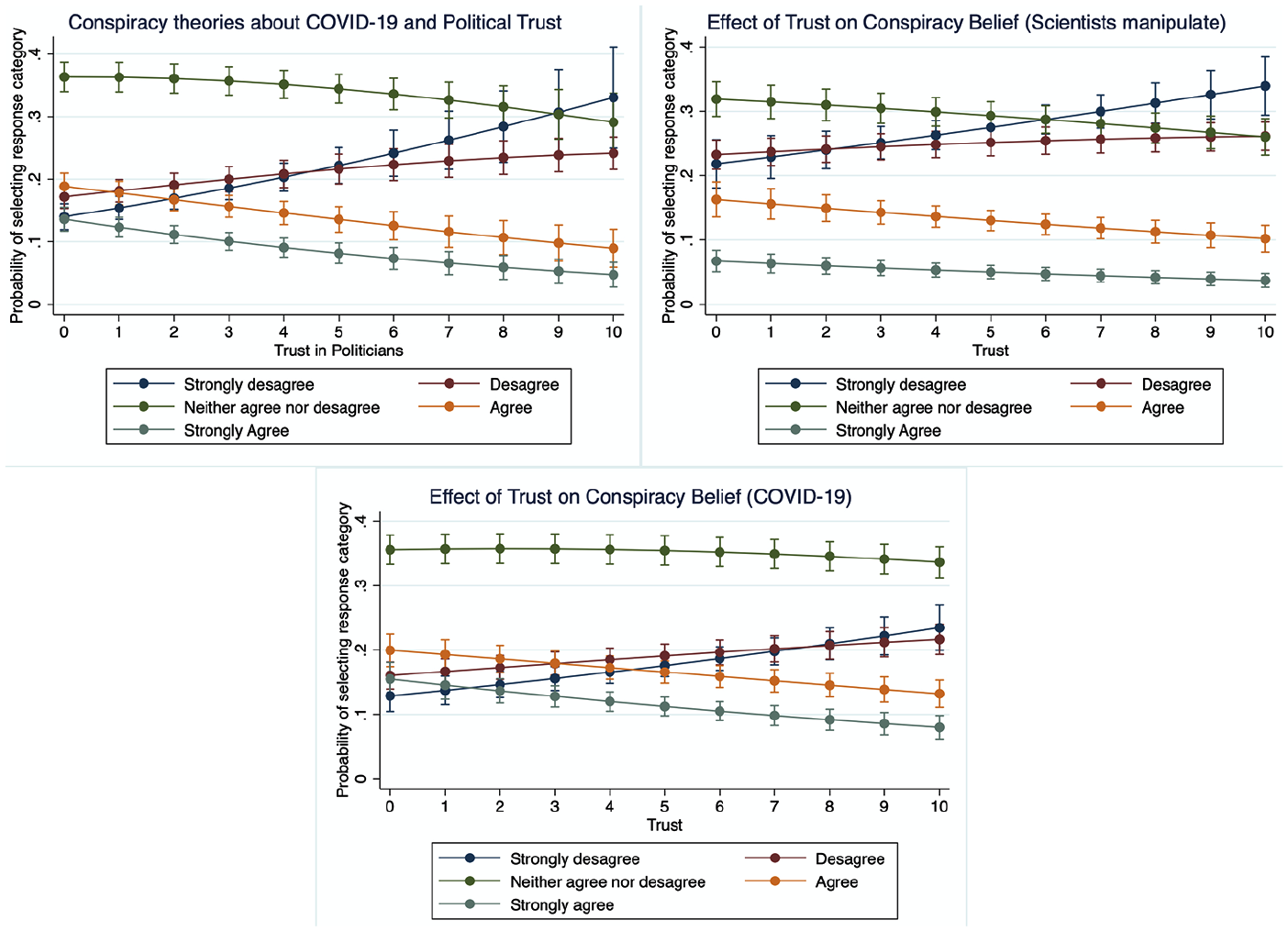
The Relationship Between Trust and Conspiracy Thinking.
While both social trust and political trust mitigate conspiracy beliefs, they are not identically associated to them. The decline in belief appears steeper for COVID-19 conspiracy theories than for conspiracy suspicion about scientists, suggesting that while social trust reduces conspiracy endorsement, suspicions about scientific institutions may persist even among those with moderate trust levels. This highlights the differentiated impact of trust on different types of conspiracy thinking.
Control Variables and Contextual Factors
As shown in Figure 1, years of education show a negative association with conspiracy beliefs, indicating that individuals with higher education levels are less likely to endorse conspiracy theories than those with lower education levels. Political ideology is also a significant predictor, with right-leaning individuals being more inclined to believe that COVID-19 resulted from deliberate government efforts compared to left-leaning individuals. Those who place themselves above 4 on the ideological scale are significantly more likely to endorse conspiracy theories than those positioned below 5. Residential environment is another factor: individuals residing in small cities, country villages and farms exhibit higher tendencies to believe in COVID-related conspiracies and scientific suspicions compared to those in big cities.
Regarding economic and employment factors, individuals who experienced reductions in working hours or were placed on furlough schemes (ERE) during the pandemic demonstrated a higher likelihood of subscribing to COVID-19 conspiracy theories. However, testing positive for COVID-19 did not significantly influence conspiracy beliefs. The results suggest that economic uncertainty and employment disruptions may fuel conspiracy endorsement, particularly regarding government and institutional trust.
Robustness Checks
To ensure the robustness, alternative model specifications were estimated to assess the sensitivity of the results; they are shown in the online Appendix A. While the primary analysis relies on ordered logit regression, an additional model has been employed to verify that the choice of statistical method does not unduly influence the conclusions. An ordered probit model was estimated as an alternative to the ordered logit, providing a different assumption about the distribution of the error term. The consistency of the results across these models suggests that the findings are not driven by the choice of function. This alternative model specification confirms that the observed relationships between trust and conspiracy beliefs are robust to different methodological approaches. Second, given that ordered logit assumes proportional odds (i.e. that predictor effects are constant across response categories), we also estimated a generalised ordered logit model. This model relaxes the proportional odds assumption where necessary, allowing the effects of independent variables to vary across levels of conspiracy belief. The results indicate that the proportional odds assumption holds for most variables, reinforcing the validity of the ordered logit estimates.
We also estimated models with other institutional trust indicators, specifically trust in parliament and trust in the legal system, to ensure that the findings are not dependent on the specific measure of trust used. In addition, to capture a broader dimension of social trust, we included an alternative interpersonal trust measure: ‘Do you think that most people would try to take advantage of you if they got the chance, or would they try to be fair?’ The results, shown in the online Appendix, remain consistent across these specifications, reinforcing the robustness of the conclusions.
Conclusion
The findings support Hypotheses 1 and 4, showing that lower levels of interpersonal and institutional trust are associated with stronger belief in conspiracy theories. Hypotheses 2 and 5 are also supported, as lower trust levels correspond to heightened conspiracy suspicion. However, Hypotheses 3 and 6 are supported in a different way: the results reveal no statistically significant association between trust – whether interpersonal or institutional – and conspiracy mentality. This outcome reinforces the idea that conspiracy mentality functions as a stable, dispositional orientation, rather than a belief shaped by contextual cues such as fluctuations in trust. Indeed, a three-way panel study empirically illustrates that conspiracy mentality is distinct from beliefs in specific conspiracy theories (Strömbäck et al., 2024).
The research demonstrates that the relationship between social and institutional trust on conspiracy theories are not identical. While higher levels of social trust are related to reduced belief in both COVID-19 conspiracy theories and conspiracy suspicion about scientists, political trust is more relevant in lower levels of the COVID-19 conspiracy beliefs. The results also reveal that higher levels of education are associated with a reduced likelihood of endorsing conspiracy theories and mentality. In addition, the study finds a significant relationship between belief in the COVID-19-related conspiracy theory and economic insecurity, particularly among individuals included in furlough schemes (ERE). This relationship does not extend to conspiracy suspicion about scientists, suggesting that economic distress primarily fuels governmental distrust rather than scientific scepticism. Consequently, this research highlights the complexity of conspiracy thinking, showing that its social significance varies by type. In so doing, it provides both conceptual and empirical insights with implications for countering conspiracy thinking.
While this study provides insight into the differentiated relationship between trust and conspiracy thinking, its findings are shaped by the Spanish context. In other words, Spain’s political culture, trust levels and experience with pandemic-related misinformation may limit the extent to which these results can be generalised. As such, future comparative research is essential to determine whether the distinctions observed here between conspiracy mentality, suspicion and theory beliefs – and their links to trust – hold across other contexts.
Supplemental Material
sj-docx-1-psw-10.1177_14789299251361780 – Supplemental material for Trust and Conspiratorial Thinking: Distinguishing Between Conspiracy Mentality, Suspicion and Theory Beliefs
Supplemental material, sj-docx-1-psw-10.1177_14789299251361780 for Trust and Conspiratorial Thinking: Distinguishing Between Conspiracy Mentality, Suspicion and Theory Beliefs by Türkay Salim Nefes and Francisco Herreros in Political Studies Review
Footnotes
Declaration of conflicting interests
The author(s) declared no potential conflicts of interest with respect to the research, authorship and/or publication of this article.
Funding
The author(s) disclosed receipt of the following financial support for the research, authorship and/or publication of this article: Dr Türkay Salim Nefes wishes to express his gratitude to the Ramon y Cajal research grant (RYC2018-023919-I) for its instrumental role in facilitating the realisation of this study.

Supplemental material
Additional supplementary information may be found with the online version of this article.
Author Biographies
References
Supplementary Material
Please find the following supplemental material available below.
For Open Access articles published under a Creative Commons License, all supplemental material carries the same license as the article it is associated with.
For non-Open Access articles published, all supplemental material carries a non-exclusive license, and permission requests for re-use of supplemental material or any part of supplemental material shall be sent directly to the copyright owner as specified in the copyright notice associated with the article.
