




Abstract
This article draws upon the literature on comparative political institutions in order to re-examine the logic of Twitter usage during campaign periods, now that social media has become a standard tool that is used across the political spectrum. We test how electoral institutions and individual characteristics shaped Twitter activity during the 2019 European elections cycle and compare the nature of this usage with the previous 2014 campaign. Our findings allow for an evaluation of social media campaigning against the backdrop of its dynamic evolution, while also confirming its normalisation in the European elections’ revival of the Spitzenkandidat process. Rather than seeking to differentiate themselves from party-internal and external competitors or highlighting their own qualities, our findings suggest that Members of the European Parliament used Twitter in 2019 to emphasise the lead candidate that they have in common.
Introduction
Since its founding in 2006, Twitter’s focus on a simple and public micro-blogging interface, along with its interactive capabilities, has given it a clear edge in political communications. Within the European Parliament (EP), as in other legislatures, Twitter has been a useful signalling medium during the legislative season (Daniel et al., 2019; Scherpereel et al., 2018) and a central campaigning tool during elections (Larsson, 2015; Obholzer and Daniel, 2016). As Twitter’s influence on global politics continues to wax, it is worth considering how politicians’ use of it has evolved over time, as well as the extent to which the platform reflects politicians’ more traditional ‘offline’ behaviours during election campaigns.
In this article, we focus on the use of Twitter by the outgoing Members of the European Parliament (MEPs) who sought re-election in May 2019. We first collect original data to replicate Obholzer and Daniel’s (2016) study on the 2014 EP campaign, which we consider to be a useful framework for viewing the individual incentive to build an online ‘electoral connection’ with voters (i.e., Mayhew, 1974). Given the diverse set of national electoral system features present within the singular EP that incentivize some members to curry a personal vote whereas others rely more heavily on their national political parties (e.g., Carey and Shugart, 1995), we then compare the frequency of individual MEP tweets with those aimed specifically at boosting the MEP’s party lead candidate.
This theoretical distinction allows for us to differentiate between those behaviours that we consider to be ‘individual-centred’ and ‘party-centred’. The former refers to activity that sets an MEP apart from competitors, both within and beyond party lists. We take this to be all tweets, as MEPs expend effort to build a personal profile. Yet, they may also specifically emphasise their party affiliation, with items such as a party manifesto, and which reflects party-centred campaigning. In this way, party-centred campaigning is complementary to and not exclusive to individual-centred campaigning. Our findings show that social media continued to play a key role in the 2019 European elections in a way that was broadly comparable to older forms of electioneering. However, the relatively costless nature of social media allows for some politicians to simultaneously campaign as both individuals and as ‘party animals’ in ways that analog campaigning might not.
Uses of Twitter during the EP campaign
Platforms such as Twitter can be used by political campaigns in a variety of important ways. They heighten the possibility of individual-centred campaigning by broadcasting positions, creating and sharing content, and enhancing voter turnout beyond political party gatekeeping (Golbeck et al., 2010; Kruikemeier, 2014; Kruikemeier et al., 2013). They also provide a tentative online ‘electoral connection’ with voters that leads to more organic forms of two-way interactions (Kessel and Castelein, 2016; Lassen and Brown, 2011). And, specific to the EP context, Twitter can be used to augment the salience of European Union (EU) issues in an election routinely seen as ‘second order’ to national contests (Hix and Marsh, 2011; Reif and Schmitt, 1980; van der Eijk et al., 1996).
During the 2014 EP elections, 341 of the 751 outgoing MEPs (45.41%) were active on Twitter during the campaign (Obholzer and Daniel, 2016). In the May 2019 elections, 595 of 751 MEPs (79.22%) used Twitter during the campaign period – nearly double the percentage active from just five years before. How might this growth in usage affect MEPs’ social media campaign strategies? We consider this in the following section, which re-visits and replicates Obholzer and Daniel’s (2016) research on the 2014 campaign, as a means of identifying individual-centred incentives to launch a personal campaign online, before focusing new attention on the complementary use of Twitter to promote more party-centred campaigns via the Spitzenkandidat system.
Individual-centred campaigning on Twitter in 2019
Obholzer and Daniel (2016)’s study of Twitter usage by re-election-seeking MEPs in 2014 identified ways in which tweets can become part of an individual-centred campaign to build an online electoral connection with voters. To do so, their article tested five propositions against the aggregate volume of tweets emitted by all 245 re-election-seeking MEPs who took to Twitter during the two-month lead-up to the 2014 elections. Expectations included: hypothesis 1 (H1) that MEPs representing larger numbers of citizens would tweet more, as the platform allowed for an efficient way to compete for seats in a legislature in which citizens from various countries are dramatically over-/under-represented; hypothesis 2 (H2) that MEPs from countries with larger average district magnitudes would tweet more if they competed on preferential list systems and would tweet less if they competed on non-preferential/closed lists – accounting for the candidate/party trade-off to campaign styles established in the comparative political institutions literature (i.e., Carey and Shugart, 1995); hypothesis 3 (H3) that MEPs from ‘safe seats’ would tweet more, as they typically occupy party leadership positions and are thus more likely to broadcast their positions; hypothesis 4 (H4) that MEPs from more dominant and better-resourced national political parties would be more active; and hypothesis 5 (H5) that MEPs with party supporters more adept at social media and internet usage would tweet more.
Using different waves of analysis meant to demonstrate the ramping-up of the campaign between March and May – and then contrasting this usage with pre- and post-election baselines – the article found robust evidence for H1 and H2 during the campaign season. MEPs did make a rational use of Twitter’s broadcasting abilities – particularly when they represented large numbers of constituents and that their tweet volume coincided with the incentives to seek a personal vote outlined by Carey and Shugart (1995). Thus, they tweeted more as average district magnitude increased under preferential voting systems, while the opposite held true under non-preferential, closed-list systems. Other hypotheses proved more mixed, however, with leading MEPs actually tweeting less often (H3) – perhaps as marginal candidates made use of the platform to raise their profiles and save their seats. Party resources and dominance (H4) had no effect on MEP behaviour and voter backgrounds mattered only tangentially – and even then, only outside of campaign time (H5).
As a general finding, the article by Obholzer and Daniel (2016) suggested that MEPs used Twitter campaigning constructively, when it benefitted their re-election campaigns as individuals. This finding, however, was taken at only one time point – using what was then a relatively untested platform. Therefore, we begin by replicating the study for 2019. To do so, we collect all MEP Twitter handles from the EP’s Twitter list of MEPs, MEPs’ profiles on the EP website, and online research. We then used the Chorus TCD package (Brooker et al., 2016) to collect our dependent variables, which are counts of Tweets during specific time periods. The number of tweets indicated on a MEP’s Twitter profile on 26 February 2019, that is, three months prior to the election, serves as a baseline for pre-electoral cycle behaviour. We then compare the number of tweets made during the early campaign period (T-2 Months, 28 March–26 April 2019), the mid-campaign (T-1 Month, 27 April–26 May 2019), the final week (T-1 Week, 17–26 May 2019) and the immediate post-election period (T+1 Month, 27 May–25 June 2019). Given the widespread adoption of Twitter handles, we only include those MEPs who both sought re-election and who were active on Twitter during the period, which – in keeping with the 2014 election – we define as having tweeted at least once during the studied period. This number ranges from 314 MEPs in the first few months to 351 in the final week, once MEPs from the United Kingdom joined the election.
In line with the 2014 study, we collect explanatory variables linked to each original hypothesis: the number of Citizens Represented by each MEP (in 10,000s), the presence of a Preferential Vote system in the country that allows individuals the right to choose or re-order their selections, the country’s Average District Magnitude 1 and its interaction with preferential voting, MEP List Safety 2 , national Seat Share and Party in Government 3 status to proxy for party dominance and resources, and Member State Social Network usage to proxy for more internet-driven societies 4 . Control variables also replicate the original paper by Obholzer and Daniel (2016), with ideological extremeness (general left–right, green–alternative–libertarian/traditional–authoritarian–nationalist and positions on European integration, all taken from Polk et al., 2017), MEP demographic data on EP seniority, internal leadership positions, age, and gender, and European party group (EPG) fixed effects. Table 1 displays the regression results and Figure 1 plots the key effects from 2019 in comparison with the original 2014 results.
Mixed effects linear regression: number of tweets.

Note: *p < 0.1; **p < 0.05; ***p < 0.01.

Comparison of key findings between 2014 and 2019 Twitter usage.
Broadly speaking, the 2019 results replicate those from the 2014 elections. MEPs representing larger constituencies were significantly more likely to tweet – both before, during, and after the campaign. This validates H1. As in 2014, the seat safety variable performed in the opposite direction from initial expectations, with safe MEPs significantly less likely to make use of Twitter at one month prior to the vote. Once again, this may indicate the need for ‘at-risk’ MEPs to use social media as a means of raising their own profiles 5 . Also similar to the 2014 study, MEPs from more social media-prone countries were more active on Twitter, prior to the campaign. The variables related to party resources (H4) remain insignificant, as was also the case in 2014.
Most differently from the previous cycle, the interaction effect between preference voting and district magnitude no longer holds for the 2019 data. While the interaction term and its constituent district magnitude variable appear significant in places (albeit with some opposite signs from the 2014 election), the effect disappears entirely in the week just prior to the election, when we might expect it to be strongest. This null finding contradicts the 2014 analysis and suggests that the incentive to seek a ‘personal vote’ in candidate-(as opposed to party-)centred electoral systems may no longer work in the same way that was found previously, with MEPs making use of the platform mostly as a general broadcasting tool (as in H1) or in the most dire needs to heighten attention (H3) 6 . Additionally, the general uptake in Twitter usage discussed above may mean the 2014 set of MEPs on Twitter might have included those self-selected politicians with the most strategic desires to use the (then relatively new) platform. Thus, when the vast majority of MEPs made use of the platform in 2019, this might have been for a wider variety of reasons, such as to share and comment on general news, that were less inherently strategic and which may not be election-related. While the results for individual-level motivations to make use of Twitter are broadly consistent, though also somewhat evolved from the 2014 race, what other ways might the use of social media be different in 2019, at the broader party level?
Lead candidate @-mentions: party-centred campaigning in action?
While we have thus far interpreted tweets as individual candidates’ campaigning, we can also identify to what extent MEPs put emphasis on their affiliation with European parties. Analysing whether MEPs mention their party’s lead candidate(s) in their tweets provides additional insight into a measure of party-centred as opposed to candidate-centred campaigning (albeit with reference to the European, rather than the national party).
Created for the 2014 elections, the lead candidate system (widely referred to in the German, Spitzenkandidat) was meant to help voters translate their ballots into identifiable connections with leadership – as the EPG with the most seats would be rewarded with their preferred candidate as the President of the Commission. While some scholars have taken a rosy view of this process (e.g., Synnott, 2018), others have pointed to the lopsided coverage that 2014 lead candidates received in their home countries as a re-nationalization of the elections, instead of the de-nationalization that it was perhaps intended to be (e.g., Braun and Schwarzbözl, 2019; Gattermann and Vasilopoulou, 2015; Popa et al., 2019).
Even as the process was ultimately disregarded by the European Council during their 2019 post-election summit, in favour of compromise candidate Ursula von der Leyen that had not been named by any of the party groups, the Spitzenkandidaten remained fixtures of the social media debate prior to the elections. They also likely enhanced both voter knowledge about the process and general turnout levels, if previous trends from 2014 held true (cf., Popa et al., 2019; Schmitt et al., 2015). And perhaps most importantly for our research, they provided outgoing MEPs with an easy shorthand to signal support for their European party (cf., Braun and Schwarzbözl, 2019: 429). As such, it is worth contemplating whether MEPs made use of them as a means of party-centred campaigning.
We therefore refocus our exploration of Twitter usage to include a new dependent variable, which is a binary variable for whether a MEP referenced his/her EPG’s lead candidate(s) during specific time periods of the 2019 campaign 7 . In this way, we are easily able to make use of the @-mentions feature on Twitter, while also navigating the complex challenge that many studies of Twitter content face when working across multiple languages. Our choice of the ‘own lead candidate’ variable also permits us to assume that mentions of the Spitzenkandidat in question will be positive ones, as opposed to rival attacks. We choose to retain the same independent variables as in the first section, which we view to be an important comparison with the individual-versus-party-centred determinants of tweeting.
Table 2 presents our mixed effects logistic regression results, using the same time periods from the initial analysis. In addition to MEPs from party groups without a lead candidate, we drop all MEPs that do not tweet in the respective time period. Hence, the number of MEPs included in the sample is lower 8 . In other words, then, our models answer the question: if a MEP tweets during the time period in question, what are the odds that they mention their lead candidate(s) at least once? Whereas we interpreted the number of tweets above as an indicator of the extent to which a MEP seeks to cultivate a personal vote, here we investigate an indicator of a more party-focused campaign. How party-centred or candidate-centred are different electoral systems? How do individual-level variables affect the odds of MEPs emphasising their affiliation with specific lead candidates to head up the European Commission? Table 2 speaks to these dynamics.
Mixed effects logistic regression: mention of own lead candidate(s).

Note: *p < 0.1; **p < 0.05; ***p < 0.01.
Of particular interest is the effect of the interacted ballot structure and district magnitude variables on the odds of mentioning one’s lead candidate(s). Prima facie, mentioning the Spitzenkandidat is a campaign tactic that fits neatly with party-centred campaigning. Rather than seeking to differentiate themselves from party-internal and external competitors or highlighting their own qualities, MEPs emphasise the lead candidate that they have in common. Yet, Figure 2 demonstrates that, counterintuitively, mentioning one’s own lead candidate(s) corresponds closely to the incentive to seek a personal vote (Carey and Shugart, 1995) discussed above.
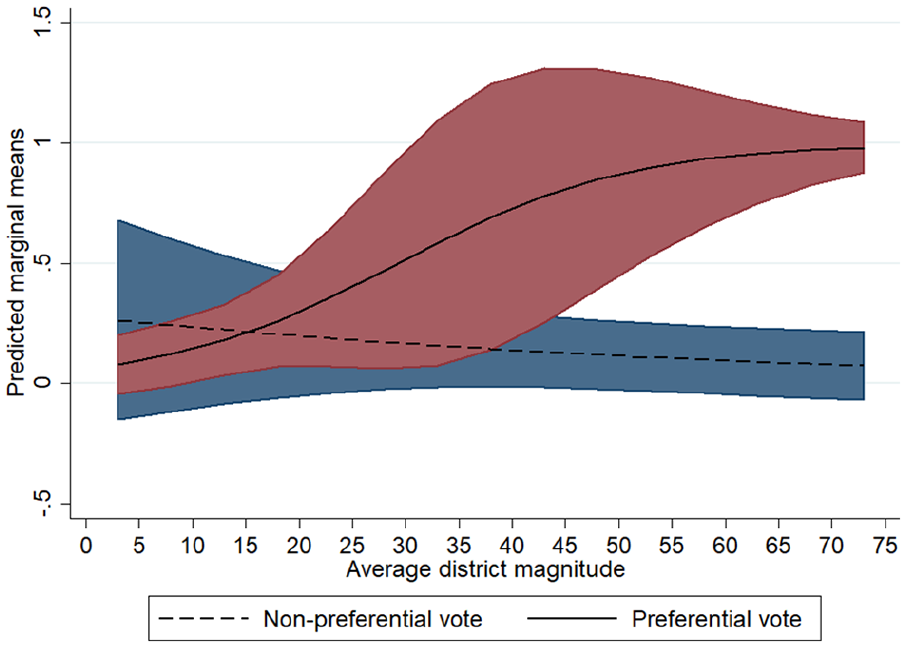
The conditional effect of electoral systems on likelihood of mentioning one’s lead candidate.
In preferential voting systems, where candidates also compete with other candidates from their own national parties, they are more likely to mention the lead candidate, as average district magnitude – and hence the internal competition – increases. In closed-list systems, by contrast, MEPs are less likely to mention the lead candidate, as the average district magnitude and, hence, the importance of the party list increases. In sum, this suggests that MEPs may use mentions of their party lead candidate(s) in order to differentiate themselves from their competitors, rather than as a party-focused campaign device. This finding connects interestingly with the non-result for individual campaigns in the first section.
We also note a strong national orientation to lead candidate mentions, whereby MEPs from countries that had a lead candidate from their own delegation were much more likely to mention them. These descriptive findings are viewed in Figures 3 and 4, with average MEP mentions broken down, across each Member State, for the two main party groups. We view this as perhaps an indicator that the lead candidates have not fully penetrated electoral politics, but that they come with the potential to make European election campaigns more competitive and ‘first-order’ by directing national campaign activity towards EU-level issues.
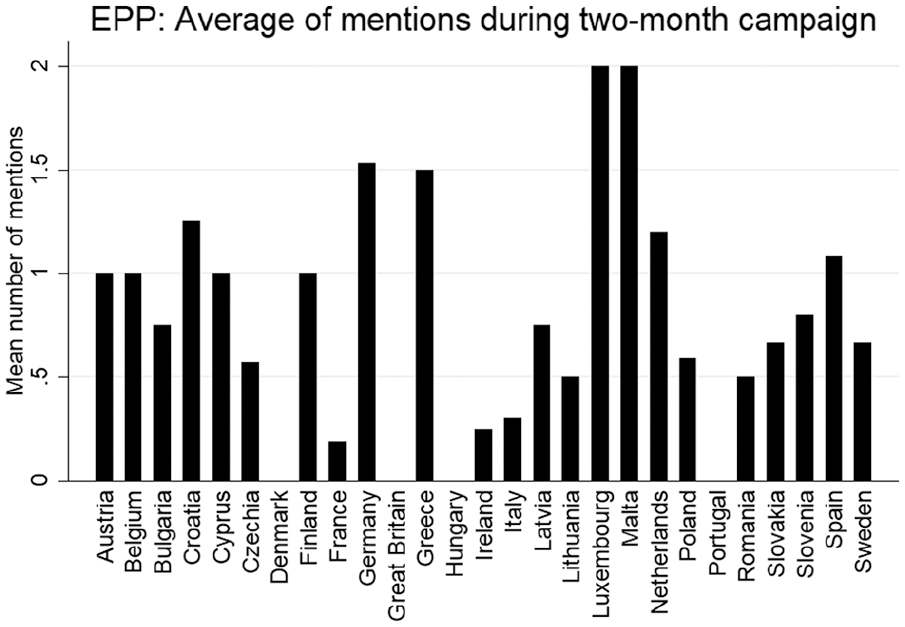
European People’s Party: average of mentions during two-month campaign.
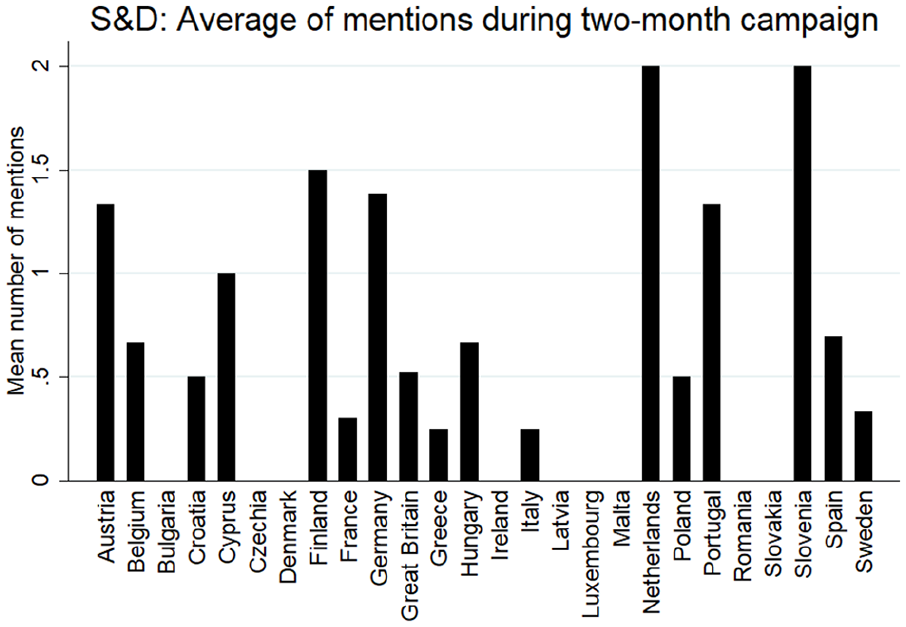
Progressive Alliance of Socialists and Democrats: average of mentions during two-month campaign.
It may also be that, under certain circumstances, mentions of the Spitzenkandidaten on social media have also become akin to the ‘coattail’ effect found in other multi-level systems, such as the United States (e.g., Campbell and Sumners, 1990; Ferejohn and Calvert, 1984). Either of these explanations would be good news for those hoping for a revival of the Spitzenkandidat process. If von der Leyen’s commitment, from her first address to the European Parliament (available at: https://ec.europa.eu/commission/presscorner/detail/en/speech_19_4230), to transnational lists means that we will see them again in 2024, then we can learn how their electoral appeal extends beyond their home country.
Conclusion
In sum, Twitter usage by MEPs continues to increase in its importance and centrality to the European elections. Whilst a number of the structural trends observed by Obholzer and Daniel (2016) from the 2014 race appear to have been replicated during the 2019 campaign, the more nuanced and conditional findings of the original study have perhaps become less significant, with a vast majority of MEPs now tweeting at a relatively constant rate. On the other hand, MEP mentions of 2019 own-lead candidates appears clearly linked with classic electoral system factors, such as the candidate-centred and party-centred indicators of preferential voting and district magnitude.
Our results suggest that general Twitter activity may be more than just about individual-centred campaigning, for example, through the broad uptake of Twitter for uses other than electioneering. Future studies should therefore focus more closely on the election-related aspects of politicians’ Twitter activity, as we did in our measure for party-centred campaigning. If mentioning a lead candidate is taken as a measure of using Twitter for campaign-related tweets, then this explains why we might be seeing the ‘party animals’ also being the most likely to seek a personal vote.
Supplemental Material
Appendix – Supplemental material for Reaching out to the voter? Campaigning on Twitter during the 2019 European elections
Supplemental material, Appendix for Reaching out to the voter? Campaigning on Twitter during the 2019 European elections by William T. Daniel and Lukas Obholzer in Research & Politics
Footnotes
Acknowledgements
We thank the anonymous reviewers and all participants at the 25–26 November 2019 #EP2019@UDE conference in Duisburg for their comments. Our special thanks go to the two associate editors Ariadna Ripoll Servent and Nils Ringe for their excellent work, as well as to Michael Kaeding and Stefan Haußner, who initiated and compiled this special issue for the 2019 European elections.
Declaration of conflicting interests
The author(s) declared no potential conflicts of interest with respect to the research, authorship, and/or publication of this article.
Funding
The author(s) received no financial support for the research, authorship, and/or publication of this article.

Supplemental materials
Notes
Carnegie Corporation of New York Grant
This publication was made possible (in part) by a grant from the Carnegie Corporation of New York. The statements made and views expressed are solely the responsibility of the author.
References
Supplementary Material
Please find the following supplemental material available below.
For Open Access articles published under a Creative Commons License, all supplemental material carries the same license as the article it is associated with.
For non-Open Access articles published, all supplemental material carries a non-exclusive license, and permission requests for re-use of supplemental material or any part of supplemental material shall be sent directly to the copyright owner as specified in the copyright notice associated with the article.
