




Abstract
With the introduction of the so-called Spitzenkandidaten procedure, by which European party families nominate lead candidates for the post of President of the European Commission for European elections, the European Parliament (EP) sought to raise voter awareness and engagement by personalizing the campaigns. This article studies candidate recognition with respect to Spitzenkandidaten, which is an important prerequisite in the study of personalization effects on voter behaviour. We use novel survey data collected in 10 European countries in the 2019 EP election campaign (n = 17,027). The article focuses on the role of voters’ news exposure in various media and argues that news exposure is crucial for candidate recognition, but its effect is contingent upon the domestic campaign context. The article is the first to show that the campaign context matters to the extent that news exposure is particularly relevant in those domestic contexts in which Spitzenkandidaten were not previously present. In other campaign contexts additional news exposure adds little to the effect of news exposure on candidate recognition. The results have important implications for understanding EP election campaigns.
Keywords
Introduction
The 2019 European Parliament (EP) election campaigns continued with the so-called Spitzenkandidaten procedure, which was first employed in 2014. By introducing Spitzenkandidaten, that is, lead candidates, of European party families competing for the post as President of the European Commission (EC), the EP had sought to raise the awareness and interest of European citizens to participate in the elections and ultimately to enhance the legitimacy of the EP and the EC. 1 The latter objective had already been challenged by scholars after the previous elections (e.g., Christiansen, 2016; Hobolt, 2014). Like in 2014, the outcome of the Spitzenkandidaten procedure was not yet foreseeable during the campaigns because the Council’s position was unclear. After the 2019 EP elections it was ultimately disregarded with the provisional abandonment of the procedure. Yet, the question of the procedure’s voter mobilization potential remains. Research on the personalization of European Union (EU) politics demonstrated that only few voters across Europe had been aware of the candidates in the run-up to the 2014 elections (e.g., Gattermann et al., 2016; Schmitt et al., 2015), although the EP evaluated the procedure as a success. 2
Candidate recognition can conceptually be understood as “cognitive personalization” (Gschwend and Zittel, 2015: 341) and is a pre-condition for any other personalization effects at the behavioural level, such as turnout or vote choice. In other words, scholars first require an understanding about the extent to which European voters are aware of the Spitzenkandidaten, before one can assess potential personalization effects on voter behaviour. That is why this article examines recognition of the pan-European Spitzenkandidaten in the run-up to the 2019 EP elections. It focuses on the role of voters’ news exposure in various media and argues that the positive effect of news exposure on candidate recognition is conditional upon the campaign context, particularly, the extent to which voters are familiar with any of the Spitzenkandidaten through domestic politics.
The article’s contribution to the extant literature is threefold. First, substantially, the article focuses on awareness of the pan-European Spitzenkandidaten as a dependent variable. With few exceptions (e.g., Gattermann et al., 2016, Popa et al., 2019), research has thus far primarily considered it an explanatory factor for political behaviour and attitudes (e.g., Hobolt, 2014; Popa et al., 2016; Schmitt et al., 2015), although there is a great need to understand the dynamics of this initial step. Second, theoretically, it considers that news exposure effects on cognitive personalization are context-dependent, which has important implications for understanding EU election campaigns. Third, empirically, it relies on novel and rich survey data that have been collected in 10 EU countries in April 2019 (Goldberg et al., 2019), which is before the final phase of the election campaigns had begun. It thus provides a conservative test of our hypotheses as the results could be even more pronounced closer to Election Day.
Hypotheses
It is well-established in the extant literature that media exposure, ceteris paribus, is conducive to knowledge gains, although this effect varies by type of medium (e.g., Barabas and Jerit, 2009; Chaffee and Frank, 1996; Fraile, 2011). Voters also tend to learn from the media about party leaders or candidates in election campaigns (e.g., Bos et al., 2011; Wei and Lo, 2008). However, much of the existing research focussed on single country contexts and we know little about the extent to which the importance of news exposure for learning about election candidates varies across different campaign contexts. Additionally, previous research concentrated on national politics as opposed to international or EU politics. Any news exposure effects on candidate recognition or evaluation are therefore limited to those candidates who are likely to be already somewhat prominent in national politics. However, foreign politicians and particularly EU politicians are likely to be less well-known compared to national politicians. Media may thus play a crucial role for voter awareness of pan-European Spitzenkandidaten.
Media reporting about EU affairs has become more comprehensive over time (e.g., Boomgaarden et al., 2010), especially during EP elections (Boomgaarden and de Vreese, 2016). The Spitzenkandidaten were also generally visible in traditional media (Schulze, 2016) and on social media (Nulty et al., 2016) during the 2014 EP election campaigns. Furthermore, research has found that exposure to specific news content can affect EU citizens’ awareness of political events (Marquart et al., 2019), political responsibilities (Hobolt and Tilley, 2014) and individual politicians (Gattermann and de Vreese, 2017). Thus, we expect that the more exposed voters are to political news, the more likely that they will come across information that enables them to recognize individual politicians. This is particularly important in the context of EU news because individual Spitzenkandidaten may have pursued their political career in other European countries or predominantly at the EU level, which is de facto rather removed from most proximate domestic political contexts.
Despite the overtime growth in EU news reporting, cross-national differences in attention paid to EU actors and particularly Spitzenkandidaten persist during EP election campaigns (e.g., Schuck et al., 2011; Schulze, 2016). Likewise, the degree of media personalization, that is, attention paid to individual politicians at the expense of parties or institutions, also varies across Europe (e.g., Kriesi, 2012), especially with respect to EU politicians (Gattermann, 2018). Thus, some European voters are more likely to learn about individual candidates than others. Although we are unable to account for potentially varying degrees of attention paid to individual Spitzenkandidaten in the plethora of media sources available to voters across Europe, we assume that some Spitzenkandidaten are more prominent in certain countries than others. They have either made their previous career in domestic politics or have been elected in previous EP elections. Consequently, voters are likely to be more aware of those Spitzenkandidaten who share the same nationality. For those voters, the effect of news exposure on candidate recognition should be comparatively small. This is because familiarity with these Spitzenkandidaten likely also generates awareness of the procedure itself, which by this means provides an access point to information about other Spitzenkandidaten competing in the elections. Experimental research shows that prior knowledge predicts further information seeking (e.g., Lecheler and de Vreese, 2017) and is positively associated with learning beyond specific information provided (Valentino et al., 2004). We may thus assume that the information context matters to a similar degree for explaining variation in Spitzenkandidaten recognition. Moreover, newspaper coverage of Spitzenkandidaten on the whole is more comprehensive in countries from which Spitzenkandidaten originate from at a given EP election (Gattermann, 2020). Conversely, news exposure effects are supposedly larger in those countries where no national candidate was among the pan-European Spitzen-kandidaten. Voters in these countries are likely to be more dependent on information about the – from their perspective – foreign Spitzenkandidaten to be able to recognize them.
Data and method
We rely on panel survey data consisting of several pre-election waves collected in 10 EU countries against the backdrop of the 2019 EP elections (Goldberg et al., 2019). The survey was administered by Kantar using computer-assisted web interviewing and implementing light quotas on age, education, gender and region. The country sample includes those that represent home countries for one or more Spitzenkandiaten, namely the Czech Republic, Denmark, Germany, and the Netherlands. There was no Spitzenkandidat from the remaining countries of our sample (France, Greece, Hungary, Poland, Spain and Sweden). We draw our dependent variable, candidate recognition, from the wave that was fielded between 5 and 24 April 2019 (n = 17,027, Online Appendix A). Importantly, campaigning was not yet at the height during this period. The first pan-European debate between five of the Spitzenkandiaten only took place in Maastricht on 29 April. Yet, all Spitzenkandidaten had been nominated by mid-March. From then onwards they were also visible in traditional, online and social media across several European countries (Gattermann, 2020). Further-more, Kleinnijenhuis and van Atteveldt (2016) demonstrated that EU news had already been prominent for several months prior to the 2014 EP elections, which is why our time period can be considered part of the campaigns.
The main survey question of interest read “There are a number of politicians running for President of the European Commission. Have you heard of the following candidates?”. A total of seven candidates were listed in random order (Table 1), which represents a selection of prominent and less prominent ones. Only their names were provided, but not their party affiliation or nationality. Respondents were asked to indicate “yes” or “no” for each candidate, which we recoded into 1 and 0, respectively (mean (M) = 0.18, standard deviation (SD) = 0.39).
Overview of Spitzenkandidaten considered.

Online Appendix B provides information about in which waves the independent variables were gathered alongside descriptive statistics. Our central independent variable is the average news exposure per respondent, which represents the mean of six news exposure items (television, national newspapers, regional newspapers, online media, social media and radio). Respondents were asked “In the past weeks, how much news would you say you followed on the following platforms?”; the scale ranged from 1 “much less than normally” to 7 “much more than normally.” We consider five additional variables that are likely to be positively associated with candidate recognition (see Gattermann et al., 2016; Popa et al., 2019): political knowledge comprising the sum of correct responses to five multiple-choice questions (Online Table A6); internal political efficacy representing the mean of responses to a maximum of three questions in each sample (7-point scales, Online Table A7); political interest in EU politics (7-point scale, ranging from no to high interest); turnout intention in the 2019 EP elections (7-point scale, higher values indicate higher certainty to participate); and general EU integration attitude (7-point scale, higher values indicate more support). Multicollinearity is not present. Controls at the respondent level comprise gender (female), age and education following the International Standard Classification of Education (higher values indicate higher education levels).
These independent variables do not vary within respondents. However, we stacked the data (n = 119,189) and aligned candidate recognition with four additional control variables: (a) the propensity to vote (PTV) for the respective domestic party that is aligned with the European party family of each candidate (11-point scales, Online Appendix B), which is likely to be positively associated with candidate recognition (Gattermann and de Vreese, 2017); (b) a dummy indicating that several domestic parties are affiliated with a Spitzenkandidat’s party group (0 refers to one party or none); (c) the candidate itself; and (d) a dummy that considers whether a candidate had the same nationality as the respondents (own candidate), which is likely to relate to higher levels of candidate recognition. We rely on multilevel logistic regression with respondents nested in countries and compute the models once with and twice without PTVs. The latter have missing values for those candidates for which no major domestic party was competing in the 2019 EP elections and a few additional missing values in four countries (Online Appendix B, n = 94,948). 3
Findings and discussion
To begin with a descriptive overview, Figure 1 provides the percentages of candidate recognition per Spitzen-kandidat in each country. Vestager (92.5%), Timmermans (76.1%), and Zahradil (52.6%) have the highest recognition levels of all candidates in their home countries. This corresponds to previous research that found higher levels of awareness among voters which share their nationality with a specific Spitzenkandidat (Hobolt, 2014). Only 37.4% of German respondents recognized Weber. He was better known in Hungary (63.8%) and the most prominent candidate in Greece (30.0%). Timmermans was most often recognized of all candidates in Poland (64.3%), Spain (24.5%), Sweden (20.1%) and France (13.9%). The former Belgian Prime Minister Verhofstadt was most often recognized in the Netherlands (53.3%), potentially because he speaks Dutch as a Fleming, Hungary (33.6%) and Poland (29.8%). The two Green candidates, Eickhout and Keller, were not very prominent – not even at home. Eickhout was recognized by 12.2% of Polish respondents compared to 8.7% of Dutch respondents. Likewise, recognition levels for Keller were higher among Polish (15.3%) and Greek (13.1%) voters compared to German voters (12.3%).
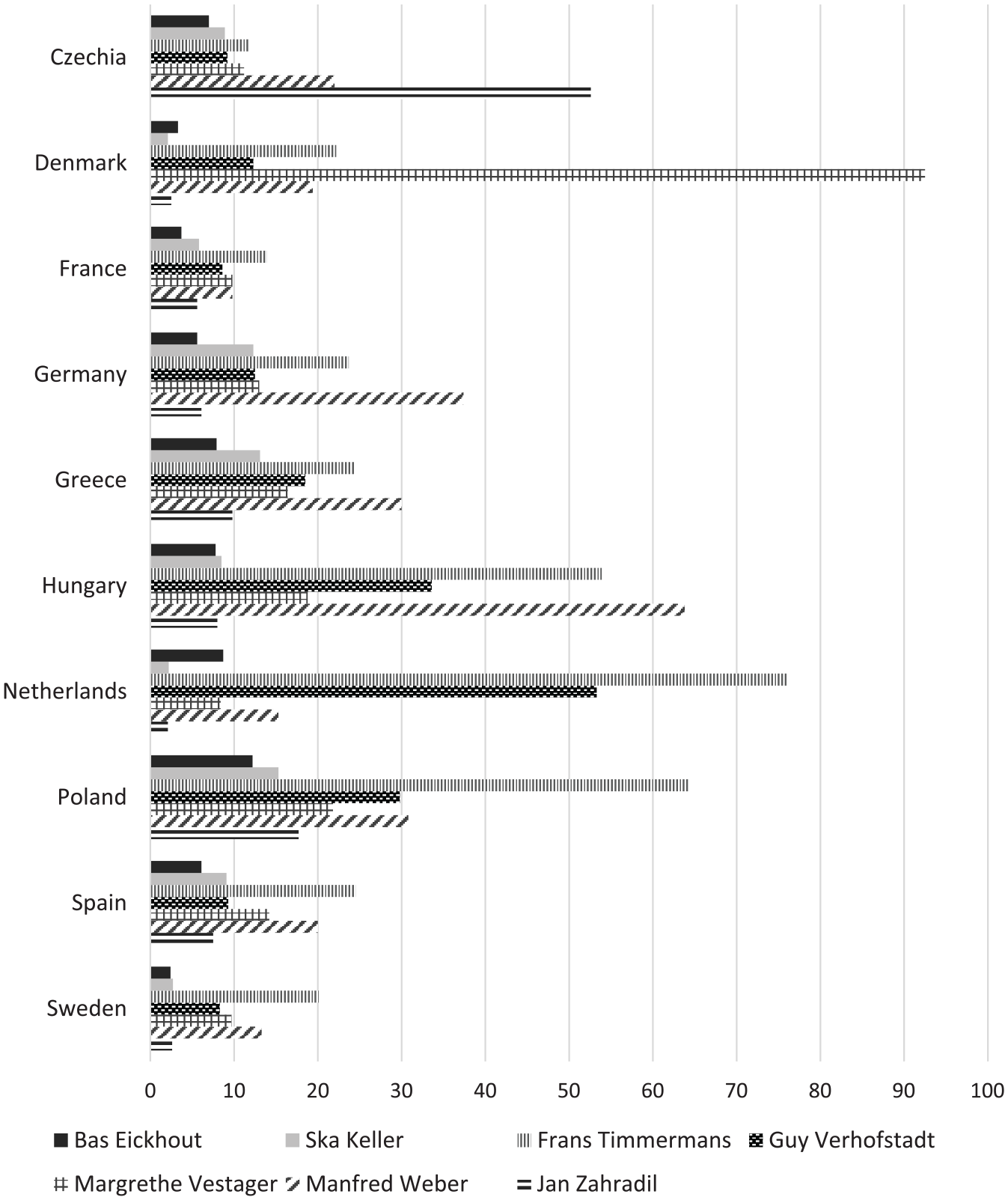
Candidate recognition levels per candidate in each country (%).
As can already be seen from Figure 1, there are generally significant differences in the mean number of Spitzen-kandidaten recognized across countries (Online Table A10, Online Appendix C). 4 Hungarian (M = 1.94, SD = 1.71) and Polish (M = 1.92, SD = 1.74) voters recognized the highest number of candidates on average, while these figures are lowest for French (M = 0.57, SD = 1.27) and Swedish (M = 0.59, SD = 1.14) voters. However, no Spitzenkandidat originated from any of these countries. For the remaining countries, the mean number of recognized candidates were significantly higher among Dutch (M = 1.66, SD = 1.29) and Danish (M = 1.54, SD = 1.11) voters, compared to Czech (M = 1.23, SD = 1.46), Greek (M = 1.20, SD = 1.61) and German (M = 1.11, SD = 1.57) voters and relative to Spanish voters (M = 0.91, SD = 1.54). 5 Thus, having a national candidate running for President of the EC does not automatically translate into higher recognition levels of Spitzenkandidaten.
To investigate the explanatory factors, we turn to Table 2, which includes three multi-level regression models. Model 1 contains PTVs; Models 2 and 3 omit them. Model 3 additionally includes the effect of average news exposure at the country level, which is depicted graphically in Figure 2. 6
Multilevel logistic regressions, predicting candidate recognition.

Note: all models show coefficients in first column and standard errors in second column, *p < 0.10, **p < 0.05, ***p < 0.01.

Fitted values for average news exposure, by country.
The results in Table 2 lend support to H1, which stipulated that news exposure has a positive effect on candidate recognition. The effect holds when either controlling for PTVs (b = 0.198, Model 1) or omitting them (b = 0.210, Model 2). Likewise, higher levels of political knowledge, internal political efficacy, political interest in EU politics, and turnout intention as well as more support for EU integration have a statistically significant and positive association with candidate recognition in all models. Female respondents are less likely to recognize any of the Spitzenkandidaten, while older and higher educated voters are more likely to recognize them. The PTV for the respective domestic party of a Spitzenkandidat also increases the likelihood to recognize him or her (b = 0.023, Model 1), which corroborates extant research on domestic candidates in EU elections (Gattermann and de Vreese, 2017). The likelihood for candidate recognition increases if several domestic parties are associated with the European party of a Spitzenkandidat compared to no party or just one party. This suggests that information received by domestic parties is crucial for awareness of Spitzenkandidaten (see also Popa et al., 2019); and, the more parties which provide this information, the better for candidate recognition. Timmermans is generally more often recognized than Weber, followed by the remaining candidates. Lastly, if the candidate has the same nationality as voters, the latter are significantly more likely to recognize him or her, when controlling for PTVs (b = 2.518, Model 1) or not (b = 2.419, Model 2).
H2 stipulated that the positive effect of news exposure on candidate recognition is conditional upon the domestic campaign context. It is statistically significant at the country level (b = -2.105, Model 3). As Figure 2 shows, news exposure adds comparatively little to recognition levels in the Czech Republic, Denmark and – to a lesser extent – in the Netherlands. Since some Spitzenkandidaten originated from these countries, the results suggest that the national candidates had been so prominent already that additional news exposure only has small effects on candidate recognition. The reverse is the case for France, Spain and Sweden, which did not provide their own Spitzenkandidaten. Here, news exposure has a considerable positive effect. Put differently, news exposure during EP election campaigns appears to be crucial in those countries which do not have a direct link to the Spitzenkandidaten.
However, the findings are not as clear cut for the remaining countries. The positive effect of news exposure on candidate recognition increases to a similar degree with additional news exposure in Germany, Greece, Hungary and Poland, albeit at different levels of candidate recognition. In Germany, this suggests that neither Weber nor Keller could be considered prominent candidates that drew attention to the Spitzenkandidaten procedure. Here, compared to other countries with national candidates, additional news exposure made a considerable difference. Conversely, the results for Greece, Hungary and Poland suggest that some foreign Spitzenkandidaten were already so well-known that additional news exposure made less difference compared to voters in France, Spain or Sweden. Greek voters may well have been alert to the procedure and therewith individual Spitzenkandidaten because their then Prime Minister, Alexis Tsipras, had been a prominent Spitzenkandidat for the 2014 EP elections (see Hobolt, 2014). Hungarian voters may have heard of Verhofstadt before as he had publicly clashed with their Prime Minister Viktor Orbán. Likewise, Weber’s European People’s Party suspended the membership of its Hungarian member Fidesz in March 2019. And, Polish voters may have particularly heard of Timmermans beforehand, who as Vice-President of the EC had triggered Article 7 in December 2017 in response to Poland’s judiciary reforms that had been considered in breach with the rule of law. This may partially explain the comparatively small effect of news exposure on candidate recognition in these countries. Given the variation in the results, we extend our argument underlying H2 beyond the nationality of Spitzenkandidaten: the positive effect of news exposure on candidate recognition is conditional upon the extent to which voters are familiar with any of the Spitzenkandidaten through domestic politics, such as through a previous political career or through other political developments.
Conclusion
This article sought to shed light on the role news exposure plays for candidate recognition against the background of the Spitzenkandidaten procedure employed in EP elections. It relied on novel survey data collected in 10 countries during the 2019 EP election campaign. We argued that news exposure is crucial for candidate recognition, but its effect is contingent upon the campaign context. Our study is the first to show that the campaign context matters to the extent that news exposure is particularly relevant in those contexts in which Spitzenkandidaten were not previously present. In other campaign contexts, additional news exposure adds little to the effect of news exposure on candidate recognition. We acknowledge that this relationship may potentially change over the course of the campaigns. Moreover, our survey is cross-sectional and thus any causal relationships could also be reverse. Although we specifically asked respondents about their news exposure in the preceding weeks, those who were aware of Spitzenkandidaten may have been actively seeking information through additional news exposure.
Cognitive personalization is a necessary pre-condition for understanding any additional personalization effects that are possibly associated with the Spitzenkandidaten (see Gschwend and Zittel, 2015: 341). It also means, however, that candidate recognition is not a sufficient assessment criterion for the success of the Spitzenkandidaten procedure. Rather, candidate recognition needs to have consequences for electoral behaviour, including turnout and vote choice. Furthermore, election outcomes must be consequential at the political level, as was the case with the election of former Spitzenkandidat Jean-Claude Juncker as EC President in 2014; if not, the procedure will likely backfire and undermine the legitimacy of European institutions.
The Spitzenkandidaten procedure played an important role in 2014 and 2019 (see also Daniel and Obholzer, this issue), but the political context and consequences differed in both EP elections. Likewise, empirical studies of candidate recognition relied on different operationalizations and considerations in the research design (e.g., Gattermann et al., 2016; Hobolt, 2014; Schmitt et al., 2015), which impedes a direct comparison of recognition levels for both EP elections. However, we underline that the procedure is conditional upon the individual Spitzenkandidaten themselves and it makes a difference for candidate recognition whether candidates have a political affiliation with the domestic political context or not, such as through a previous domestic political career or through other relevant political developments that have added to the prominence of a foreign Spitzenkandidat within a particular country. It thus remains questionable whether the EP’s aim to raise voter awareness with the Spitzenkandidaten procedure was indeed successful. Finally, we acknowledge that mere self-reported news exposure measures are limited (e.g., de Vreese and Neijens, 2016) and additionally measure increase rather than actual amount. We recommend that future research links specific news content about the candidates to media exposure (e.g., see Gattermann and de Vreese, 2017).
Supplemental Material
Appendix – Supplemental material for Awareness of Spitzenkandidaten in the 2019 European elections: The effects of news exposure in domestic campaign contexts
Supplemental material, Appendix for Awareness of Spitzenkandidaten in the 2019 European elections: The effects of news exposure in domestic campaign contexts by Katjana Gattermann and Claes de Vreese in Research & Politics
Footnotes
Acknowledgements
We thank the anonymous reviewers and all participants at the #EP2019@UDE conference in Duisburg as well as Alvaro Oleart, Wouter van der Brug and participants at the VICES Annual Workshop “The European Union under stress: Looking beyond the 2019 EP elections” for their helpful comments. Our special thanks go to the two associate editors Ariadna Ripoll Servent and Nils Ringe for their excellent work, as well as to Michael Kaeding and Stefan Haußner, who initiated and compiled this special issue for the 2019 European elections.
Declaration of conflicting interests
The authors declared no potential conflicts of interest with respect to the research, authorship, and/or publication of this article.
Funding
The authors disclosed receipt of the following financial support for the research, authorship, and/or publication of this article: The data collection was funded by a grant by the European Research Council, grant number 647316 (Principal investigator: Claes H. de Vreese). Katjana Gattermann acknowledges funding from the Nederlandse Organisatie voor Wetenschappelijk Onderzoek (NWO Veni Grant, project no. 451-15-003).
Supplemental material
The supplementary files are available at http://journals.sagepub.com/doi/suppl/10.1177/2053168020915332. The replication files are available at 
Notes
Carnegie Corporation of New York Grant
This publication was made possible (in part) by a grant from the Carnegie Corporation of New York. The statements made and views expressed are solely the responsibility of the author.
References
Supplementary Material
Please find the following supplemental material available below.
For Open Access articles published under a Creative Commons License, all supplemental material carries the same license as the article it is associated with.
For non-Open Access articles published, all supplemental material carries a non-exclusive license, and permission requests for re-use of supplemental material or any part of supplemental material shall be sent directly to the copyright owner as specified in the copyright notice associated with the article.
